Bethlehem to be hemmed in on four sides, the latest for the Wall & a settler road in the southwest: The Israeli forces Commander for the Central Region of the occupied West Bank, Major General Yair Naveh, has decided to confiscate 152 dunams of southern Bethlehem. The stated aims of the confiscation are “military purposes” and “the security wall. ” Director of the Committee to Defend against Land Confiscation in the southern West Bank, Khalid Al Azzeh, says that this portion of the Wall will run alongside a new settler road linking Israeli settlements surrounding Bethlehem.
Army closes a Wall Gate cutting Far'on village farmers from their land: The Israeli army closed on Tuesday the gate number 708 of the Annexation Wall, which is located between the village of Far'on, near the West Bank of Tulkarem, and its orchards. This gate was installed to allow the farmers of the village to reach to their orchards that became isolted behind the Wall, closing it will bar the residents from reaching their lands, the main source of livelihood of the villagers.
For Gaza's students, classes by 'remote control': Shaima Naji, a 21-year old from Gaza, has never attended classes at Bethlehem University where she is enrolled to study occupational therapy. Naji registered at the university four years ago, but security forces forbade her entry into the West Bank. Occupational therapy, commonly called OT, has become a vital aspect of rehabilitative treatment in the Gaza Strip since the intifada began, but Naji may only receive professional training in Bethlehem...
Walls turn into fact of life in West Bank city of Hebron: A Palestinian child in Hebron has drawn her West Bank home town. Apart from rows of houses and olive trees, the picture shows an area circled by barbed wire, and is complete with checkpoint and watchtower. The large drawing now hangs in a Medecins Sans Frontieres (MSF) consulting room, where the international non-governmental organisation counsels Palestinians on "the violence of the intifada and the (Israeli) occupation" of the area.
PM unaware of gov't-issued tenders for W. Bank apartments: Security sources said yesterday that the construction plans for Ma'aleh Adumim and Beitar Ilit had already been approved last year, under the government of Prime Minister Ariel Sharon and Defense Minister Shaul Mofaz. The sources said the tenders for Ma'aleh Adumim are part of a larger plan to build 4,000 apartments in the town.
Hamas on the brink of deal to lead new coalition in move to end funding crisis: But Hamas officials say even in a new joint government with its main political rival, Fatah, the movement will not give explicit recognition to Israel - one of the conditions set by the international community for funding to resume.
Report: “86, including 16 children killed, 270 taken prisoners in August” : Sixteen Palestinian children were killed by Israeli shells and bullets, the youngest casualty was a three-day old child, Shahad Saleh Al Eid. The report stated that the Israeli attacks are in direct violations to the international law while Israel continues to violate the fundamental rights of the Palestinian people by using excessive force against civilians and children.
Tony Blair 'not welcome' in Ramallah: In a statement distributed in Ramallah, they said that Blair, who is expected to visit the region later this week, was "completely unwelcome in our country because he was coming to wash the hands that are dripping Lebanese blood with Palestinian water."
EU monitors may opt to leave Gaza crossing, Israel: European monitors could be withdrawn from the border between Gaza and Egypt later this year amid concerns about Israeli restrictions on performing their duties, European officials said on Tuesday. "We cannot continue like this," a European official said.
PM: Shalit must be freed before PA prisoners: "I said in the past, before the abduction, that in my talks with Abu Mazen [Palestinian Authority Chairman Mahmoud Abbas], I would want to release Palestinian prisoners to convey to everyone that whoever opposes terror and accepts the Road Map should be supported," Olmert said. "But now we are not interested in doing so under the pressure of Shalit's abduction."
Palestinian lawmaker holds Israel responsible for economic crisis in territories: In a news conference in Ramallah, Mustafa al-Barghouti of the National Initiative party accused Israel for having withheld the Palestinians' tax revenues for more than six months. "Israel keeps holding not less than 600 millions U.S. dollars from tax revenues that form about 70 percent of the Palestinian local income," al-Barghouti denounced.
Penury and boredom weigh on West Bank refugees: While much media attention has been on Israel's war against Hizbollah in recent weeks, the situation in the Israeli-occupied West Bank has been slipping from bad to worse and beyond.
Heading for 3rd Intifada?: As Hamas is standing its ground, Israel is acting in an effort to bring about the paralysis of the PA through various administrative and military means. Against the backdrop of the ideological, constitutional, and political struggle between Fatah and Hamas, this policy is indeed leading to a growing collapse in the PA's ability to govern. This outcome contradicts the Israeli interest. A Palestinian Authority that is allowed to provide for the population's basic needs and possibly even put an end to the firing on Israeli territory is a fundamental Israeli need.
'We know what we want' : An interview with the Palestinian prime minister, Ismail Haniyeh, about his hopes for a national unity government .

Tuesday, September 5, 2006


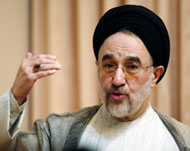
U.S., Iran share interests in Iraq, Khatami says

NEW YORK — Former Iranian president Mohammad Khatami said Monday that U.S. forces should remain in Iraq until that country's fragile government can assume greater control.
In an interview here during his first trip to the United States since leaving office a year ago, Khatami said, "We can't leave this newly formed government at the mercy of terrorists and insurgents."
Khatami is a moderate Islamic cleric who was president from 1997 to 2005. By law, he could not seek a third consecutive term. He was succeeded by Mahmoud Ahmadinejad, a hard-line fundamentalist.
Despite the change in the leadership, Khatami said that Iran is not the enemy of the United States and that the two countries share strategic interests in Iraq and Afghanistan.
Mrs. Duwaik lashes out at Abbas for not exerting enough efforts in her husbands' case

Occupied Jerusalem - The wife of Dr. Aziz Duwaik, the Israeli kidnapped PLC speaker, Tuesday addressed severe criticism to PA chief Mahmoud Abbas for not exerting enough efforts to rally international support seeking the release of her husband and other kidnapped PA ministers and lawmakers from Israeli occupation jails.
She told the PIC correspondent in occupied Jerusalem that she did not sense any tangible efforts on the part of Abbas and other PA leadership membership in the case of the kidnapped ministers and MPs.
She said that such a stand was "surprising" on the part of Abbas and raised a lot of questions, adding that he could have called on Arab and international parliaments to hold a session to discuss the Israeli arrests and the Hebrew state's attempts to disband the democratically-elected PLC and finally to demand expulsion of Israel from the international parliamentary union over such practices.
"The current passive position is not acceptable", the wife of Duwaik emphasized, and drew the attention to the fact that Arab and Muslim reactions to what had happened did not cope with the seriousness of the incident.
She said that her husband's health condition was stable but still worrying, and pointed out that he was isolated from the outside world.
She charged that her husband's arrest was political in nature and reflected the Israeli arrogance, noting that a parliament speaker enjoys immunity that bars his detention.
Mrs. Duwaik further described her husband's trial as "illegitimate" and a theatrical play that displayed the oppressive image of the Israeli occupation.
She said that the trial aimed at forcing them (kidnapped ministers and legislators) and the Palestinian people to recognize the Israeli occupation and to give up constants, which, she stressed, would never happen.
She finally praised the Palestinian masses for their sympathy with the kidnapped PLC speaker, deputies and ministers.
Robert Fisk on His Interview with Former Iranian President Khatami, Why "The IDF Could Not Protect the People of Israel" and More
Democracy Now! With Amy Goodman
In a wide-ranging interview, Robert Fisk - the veteran Middle East correspondent for the London Independent - discusses Hezbollah and Israel, Hezbollah and his interview this weekend with former Iranian president President Mohammed Khatami.
In a wide-ranging interview, Robert Fisk - the veteran Middle East correspondent for the London Independent - discusses Hezbollah and Israel, Hezbollah and his interview this weekend with former Iranian president President Mohammed Khatami.
خاتمي: واشنطن ليست عدونا وأؤيد بقاءها لحين استقرار العراق
قال الرئيس الإيراني السابق محمد خاتمي إن على القوات الأميركية البقاء في العراق إلى أن تتمكن الحكومة العراقية من السيطرة على الأمور في البلاد.
وقال خاتمي لصحيفة يو إس أي توداي إنه لا يمكن ترك هذه الحكومة التي شكلت حديثا تحت رحمة من سماهم إرهابيين ومتمردين، مضيفا أن إيران ليست عدوة الولايات المتحدة وأن البلدين لهما مصالح إستراتيجية مشتركة في العراق وأفغانستان.
وقال خاتمي -الذي يقوم بزيارة خاصة إلى الولايات المتحدة لإلقاء سلسلة من الخطابات- إنه خلال سنوات توليه الرئاسة ما بين 1997 و2005، لم تزود إيران العراقيين الشيعة بالأسلحة ويشك في أن ذلك يحدث في حكم الرئيس الإيراني الحالي محمود أحمدي نجاد.
---
Spoken as a true ally of the US.
Europeans See U.S. as Threat to Global Stability
"30 per cent of respondents believe the U.S. is the greatest threat to global stability.
Iran is second on the list with 23 per cent, followed by China with 15 per cent, Iraq with 14 per cent, North Korea with eight per cent, and Russia with two per cent.
In Spain, 44 per cent of respondents place the U.S. as the main perceived threat. 36 per cent of respondents in Britain—and 28 per cent of respondents in France—feel the same way."
Iran is second on the list with 23 per cent, followed by China with 15 per cent, Iraq with 14 per cent, North Korea with eight per cent, and Russia with two per cent.
In Spain, 44 per cent of respondents place the U.S. as the main perceived threat. 36 per cent of respondents in Britain—and 28 per cent of respondents in France—feel the same way."
T-shirt Campaign

The story of Raed Jarrar, who was barred from a flight for wearing this shirt,
can be found here: http://raedinthemiddle.blogspot.com/

From The Critical Voice
Affinity Group of Artists Against War

Sept. 5th, 2006

The "We WIll Not Be Silent" campaign is reaching all
over the world, illustrating without a doubt, the
campaign's deep resonance amongst the many who feel
strongly about speaking out.  Since the breaking of
this story, less than 48 hours ago, 'The Critical
Voice' has received over 1000 requests for t-shirts in
all languages.

People want shirts to board flights all over the
world.

A soldier requested an Arabic t-shirt to wear under
his uniform.

Another soldier had hand-drawn a stencil version to
make his own Arabic t-shirt before receiving ours.

A mother, and member of GoldStar families, who lost
her only son in Iraq on 5.30.04 wants a shirt.

A couple getting married wants shirts for the entire
wedding party to wear at their ceremony.

A man wants a shirt to wear when he runs the New York
City marathon.

A man in Israel wants 100 shirts to send to the
occupied territories.

A Methodist minister wants an Arabic t-shirt to wear,
with his white collar showing, and will bring many to
the other clergy.

The shirts are being sent as far as Slovenia, Korea,
the United Arab Emirates, South Africa, Spain,
Britain, Germany, Canada . .  .as well as of course
all over the United States.  We could not have
anticipated the extraordinary level of response, and
are moved by the genuine, personal testimonies that
strike at the heart of the statement's deep and
profound meaning.

We have been overwhelmed with the excitement and
inspiration the campaign is generating.  Please go to
the following link for our website.

Thank you,
The Critical Voice


Iraq loses its voice of reason

By Sami Moubayed
Asia Times
"Sistani and Muqtada stand on different ground when it comes to Iran and the status of the Shi'ite community in Iraq.
Muqtada is greatly opposed to creating an autonomous Shi'ite district in southern Iraq, something that has been lobbied for by Abd al-Aziz al-Hakim of the Supreme Council for Islamic Revolution in Iraq. Hakim is a creation of Iran and an ally of Sistani. His family is also the historical contender to Shi'ite leadership in Iraq against the family of Muqtada.
The young Muqtada believes in a united and Arabist Iraq. He pays little more than lip service to the mullahs of Tehran, arguing that they should not interfere in domestic politics. Both men have an ultimate goal of creating an Iran-style theocracy in Iraq. Sistani wants it influenced and controlled by Iran, while Muqtada wants it to be independent from Tehran. This brings the two men further apart when added to how they view the US occupation of Iraq. While both may be equally opposed to it, each deals with this occupation in a very different manner.
Some speculated that Sistani's journey to London at such a time was deliberate: a green light to the Americans to launch a full assault on Muqtada. If the Americans won, then Sistani would have rid himself of a noisy challenger in Shi'ite politics. If they lost (which was impossible) then he would get rid of the Americans.
What happened was a different story. During Sistani's absence, more fighting broke out. On his return, when Muqtada and his men were stranded in combat, Sistani stepped in at the last moment to end the crisis. He secured another ceasefire, a pardon for Muqtada, and his continuation in the political life of Iraq.
Sistani was sending Muqtada a message: "I saved you in a minute, and if I wish, I can also destroy you in a minute. Do not get too strong or overambitious. I am No 1 in the Shi'ite community of Iraq.""
---
Sistani faked a heart condition in April 2004 and took refuge in London (of all possible places). Informed sources at the time reported that Sistani's aids met with representatives of the US army in Najjaf. Sistani wanted the US forces to get rid of Muqtada and his Mahdi Army, even if it meant destroying Najjaf. Sistani made the excuse of "heart condition" to be in the safety of London, while US troops went about their killing and destruction in Najjaf. Sistani and his representatives did not want to be in town while this was going on, so all of them left Najjaf. Just when Muqtada himself was about to be killed or arrested, Sistani returned as the savior saint. After the destruction of 40% of Najjaf and the killing of several hundreds of the Mahdi Army, Sistani appeared to have saved Muqtada's life, but at the price of ending all armed resistance and the Mahdi army surrendering its arms. This is the real role Sistani has been playing in Iraq: opposing any armed resistance to the occupation, and instead providing tacit support of this occupation.
Will Robert Fisk tell us the whole story?

Time For a Champion of Truth to Speak Up
By JONATHAN COOK
"But possibly in an attempt at even-handedness, Fisk has also muddied the picture in relation to the actions of Hizbullah and thereby contributed towards the very mythical narratives he seeks to undermine.
Hizbullah and its leader, Hassan Nasrallah, deserve the fairest hearing we can give them, especially as their voices are systematically excluded from a Western press that identifies with Israel.
The implications of these comments are serious, and deserve to be set out clearly and transparently by a reporter who consistently makes them. And yet Fisk has not produced any evidence, let alone reasoned argument, to suggest that Syria, through Hizbullah, planned a war that would offer Israel the chance to destroy Lebanon. I am not saying Fisk is wrong, but I would like to know the basis for his grave claims.
What makes his comments all the more strange is that Fisk seems to be at least aware that, quite unrelated to the capture of the two Israeli soldiers, Israel had planned its assault on Lebanon for some time:
Most noticeable is that, in constantly castigating Hizbullah for “starting” the war, Fisk entirely ignores the background to the confrontation: that Israeli war planes and spy drones were almost daily violating Lebanese air space and sovereignty, as well, of course, as the issues of Lebanese prisoners in Israeli jails, Israel’s refusal to hand over the maps of the minefields it laid during its two-decade occupation, and its continuing refusal to negotiate over the land corridor known as the Shebaa Farms.
A separate factor may help to explain how Fisk’s judgment may have been clouded. He often mentions in passing his close relations with the family of the late Lebanese prime minister Rafik Hariri, who was killed by a car bomb more than a year ago that was widely blamed on Syria. Hariri, a millionaire Sunni businessman, was responsible for much of the private investment in Lebanon that led to its reconstruction and which Israel has now destroyed."
Better Not Meet Me at the Casbah
Hatred of Americans and Brits Soars across Middle East
By PATRICK COCKBURN
"The real reason of the increasing violence in the Middle East is the return to imperial control and foreign occupation half a century after the European colonial empires were broken up. This is the fuel for Islamic militancy. This is why fanatical but isolated Islamic groups can suddenly win broader support. Governments allied to the US and Britain have no legitimacy. The very attempts by America and Britain to crush Islamic militancy across the Middle East are making sure that it will become stronger."
By PATRICK COCKBURN
"The real reason of the increasing violence in the Middle East is the return to imperial control and foreign occupation half a century after the European colonial empires were broken up. This is the fuel for Islamic militancy. This is why fanatical but isolated Islamic groups can suddenly win broader support. Governments allied to the US and Britain have no legitimacy. The very attempts by America and Britain to crush Islamic militancy across the Middle East are making sure that it will become stronger."
Monday, September 4, 2006
"You don't see, you don't feel, and you don't look"
An Israeli Combat Soldier Breaks the Silence
By Daniel Sturm
09/04/06 -- The midday news showed Israeli tanks shelling the Gaza Strip. In a Jerusalem coffee shop, 23-year-old former combat soldier, Yehuda Saul, told me he had made it his personal mission to speak out against the Israeli army when its actions were immoral. The Canadian American-Israeli veteran said that his "arch-conservative family" had slated him for a career in the Israeli Defense Forces (IDF). But during his third year of service the young platoon sergeant witnessed a scene of looting and killing at a combat mission in Hebron that had troubled him so much that he decided to leave the army. In June 2004 Saul founded "Breaking the Silence" (Shovrim Shtrika in Hebrew), an organization whose 350 members are all former Israeli combat soldiers who can share similar experiences. "Breaking the Silence" is currently preparing a world speaking tour and photo exhibition, offering a critical look at the Israel military's occupation of Palestine.
Daniel Sturm: You criticize Israel's army, yet you served as a soldier in the defense forces yourself. Isn't this hypocritical?
Yehuda Shaul: I think that I and every member of "Breaking the Silence" deserve the attention of the public. From the first diaper that my mom changed, it was obvious that I was going to be an officer. It's not as if I woke up one day, when I was 18, and said, "Hey, let's go and have fun in the Occupied Territories." In a way, we are all ex-soldiers. When I was in the Occupied Territories, you could have said that I was an American soldier. After all, I owned an M-16 that wasn't produced in Israel. I shot grenades that weren't produced with Israeli money, but by American money. Everyone, and especially Americans, have a responsibility to know what's going on in the world. And since I am from here, I am talking about here.
Daniel Sturm: When did you first realize that "occupation corrupts," as you say?
Yehuda Shaul: I grew up in a very right-winged family in Jerusalem. I went to high school in a settlement near Ramallah. When I was 18, there was no question of whether or not I would join the IDF. The only question was how high I would climb. Would I be in an elite commander unit, or just a regular infantry combat soldier? That was the mind-set I joined the army with. But what I took part in and witnessed in the Occupied Territories opened my eyes.
Daniel Sturm: Could you explain?
Yehuda Shaul: In Hebron settlers put a poster on the wall that called for soldiers to refuse to evacuate the settlements [as had been agreed upon in the treaty]. The poster said something like, "Soldier, commander, you must distinguish between good and evil, between enemy and beloved." In the Israeli army we learned that one must deport the enemies, meaning the Palestinians, but never those who were beloved, meaning the settlers. When I joined I had a black and white vision of right and wrong. Later I learned that everything is gray.
Daniel Sturm: What happened in Hebron?
Yehuda Shaul: Hebron is the second largest city in the Palestinian West Bank, with 150,000 Palestinians. Around 600 Jewish settlers live in the heart of the city, and 450 combat soldiers guard them. Under the Oslo agreement of 1997 Hebron was divided into two parts, with 120,000 Palestinians left under Palestinian authority and 30,000 Palestinians left under Israeli authority. At the beginning of the Intifada, from 2000 until mid-2002, the Palestinians began shooting at night, from the mountains down to the settlements. My company officer told us that if they shoot, we have to shoot back. We had three well-positioned posts in Palestinian neighborhoods. We posted snipers and grenade guns. My post was at a former Palestinian school in Hebron. Our mission was to target Palestinian houses. I remember being shocked when I heard this. "You mean we should shoot into the neighborhoods, where people live?" I thought about the safety rules I had learned during training. In order to shoot live grenades, no one should be within a distance of one mile on each side of the target. And now I was supposed to shoot into a neighborhood where people lived. The grenade gun is not an accurate weapon. One grenade kills everyone within the radius of eight meters, and injures everyone within the radius of 16 meters. At night, after the Palestinians shot, we received the order to pull the trigger. On the first day, during the four to five seconds before the grenades hit, you prayed that you didn't hurt anyone innocent. On the second day you are less tense, and on the third day even less. And after a week, it's a game.
Daniel Sturm: Was this when you became critical of the army's mission?
Yehuda Shaul: Not really. I first began to fully understand the corruption after I was discharged. When you are a combat soldier in the Occupied Territories, you can't see Palestinians as equal human beings. Because then you couldn't hop through a roof in the middle of the night, wake up a family, force the women into one corner and the men into another, and tear apart the place. At least when you stand at a checkpoint you see the shape of human beings: One head, two hands, and two legs. But when I was shooting live grenades into neighborhoods where people lived every night - why, that was a computer game!
Daniel Sturm: Weren't your actions justified, considering the violence the Palestinians were using?
Yehuda Shaul: You can't ignore that the Palestinians were using violence. But what is our moral and legal boundary, as a society or a nation? Can we really condone shooting grenades into neighborhoods, as a way of getting back? When we realized we were unable to prevent the Palestinians from shooting back at us, we started a strategy called "making our presence felt." We conducted silent patrols. We walked through streets, shooting onto houses, and shoot off grenades in parks.
Daniel Sturm: At what point did you begin to sympathize with the victims of this war?
Yehuda Shaul: The terminology of "victim" doesn't apply when you're in the field. When in combat you don't see, you don't feel, and you don't look. The name "Breaking the Silence" therefore refers to two levels of silence. The first is the personal level, where we realize what is really going on around us. The second level refers to the silence of society. As I was sitting in Hebron, firing grenades, my parents were just across the street in Jerusalem, hearing on the radio the sentence that every Israeli knows by heart: "IDF forces returned fire to the sources of fire." Of course, there were no sources of fire! We shot without ever finding any specific sources. But this is how Israeli society and human beings around the world receive information.
Daniel Sturm: How have people responded to your criticism?
Yehuda Shaul: Very ambivalent. Some people understand me, some don't. In the beginning, the IDF military police investigators broke into our exhibition, confiscated some items and brought us into interrogation. The idea was to frighten us and to declare us as an extreme case of "rotten apples." For me, it's no longer a question. I can't see myself acting any other way.
Daniel Sturm: Does the military occupation make any sense at all?
Yehuda Shaul: We all want to think that we are immune, that we can perform an "enlightened" and civilized occupation of Palestine. We want to believe that we are the most moral army in the world. But the truth is, every time you have a case in the press about Israeli soldiers shooting Palestinians, the example is treated as if, "that's a rotten apple." If you were to send every Israeli soldier who has abused a Palestinian during his service to jail, every soldier who has served in the Occupied Territories would have to stand in line. Because you can't serve there without acting like an occupier.
"Breaking the Silence," contact information Email: yehuda@shovrimshtika.org - Internet: http://www.shovrimshtika.org
Israel blockade on Lebanon prevents oil spill clean-up:
by Salim Yassine
Mon Sep 4, 12:49 PM ET
The Israeli blockade on Lebanon is preventing the widescale intervention needed to clean a massive oil slick caused by the Jewish state's bombardment of a power station, Greenpeace has said.
"You have to be able to overfly Lebanese waters to pinpoint surface slicks and fuel oil deposits deeper down, as well as intervention by skimmers (cleaning boats) -- and that is not possible while the blockade continues," Greenpeace Lebanon's spokesman Omar al-Naim told AFP Monday.
"The use of pumps is also necessary, which means being able to operate freely on the surface of the sea, which is impossible because of the blockade," Naim said.
"The more time that passes, the more the slicks are dispersed by the wind and the currents," he added.