Progress from autocracy to democracy has been complicated by tensions, divisions and violence at every turn
Ian Black, Middle East editor
guardian.co.uk, Thursday 14 June 2012
"........Now, just two days before the runoff round of an already polarised presidential election, an extraordinary twist has created profound new uncertainties. The most dramatic interpretation is that it spells a decisive victory for the forces of counter-revolution. "It is like The Empire Strikes Back in the Star Wars saga," commented the popular blogger Zeinobia. Others denounced it furiously as a judicial coup.
It is not surprising that the constitutional court decided that Ahmed Shafiq, Mubarak's last prime minister, is eligible for the race, having ruled against a "political isolation" law that would have prevented him seeking office as a member of the old regime.
The judges, appointed under Mubarak, are widely seen as representative of the "deep state" that has survived the convulsions of the Egyptian chapter of the Arab spring to manoeuvre, manipulate – and retain power – behind the scenes.
Shafiq's battle against Mohamed Morsi, the candidate of the Muslim Brotherhood's Freedom and Justice party, has been dubbed a "nightmare scenario" by Egyptian commentators who see it as a throwback to the bad old days when the military-backed presidency was ranged against the world's oldest Islamist movement, with little else in the way of independent political forces between them.
But the court's second ruling is far more volatile in its implications. The dissolution of the entire parliament – not just byelections for the third of MPs deemed to have been improperly elected – means that the Islamists who dominate it, from the Brotherhood and the hardline Salafi Nur party, will feel disenfranchised and cry foul.
Given that parliament has performed terribly, their prospects for re-election will clearly be damaged....
What happens next is anyone's guess, though it would be surprising if there were not protests – the reflex action of frustrated revolutionaries who see the hopes of Tahrir Square fading fast – and a harsh response by the army and police. What is certain is that Egypt's transition just got a lot messier."

Thursday, June 14, 2012


Al-Jazeera Video: Syria accused of organised attacks
"Syrian forces and armed gangs loyal to President Bashar al Assad are systematically killing civilians in attacks that could amount to crimes against humanity. That's according to a report by human rights group, Amnesty International. Its researchers working inside Syria found repeated examples of brutality. You may find some of the images in Dominic Kane's report distressing."


The Unresolved Question of Egypt's Economy
By Ramzy Baroud
Palestine Chronicle
".....It is expected that Egypt’s intense public discussions in the current phase will be fixed on foundational issues such as the formation of a constitutional assembly and a redefinition of the rule of SCAF. But Egypt’s economy is deeply flawed. An IMF-style free market economy is of no use to millions of Egyptians when they lack proper education and the most basic rights and opportunities. For an Egyptian day laborer to have a better life in a country with a huge and growing income gap between rich and poor, something fundamental needs to take place.
Referencing ‘social justice’ while negotiating IMF loans suggests a precarious start for any truly fundamental economic reforms. While Hamdeen Sabahy is no longer in the race to challenge the free market wisdom of his contenders, the debate must not end here."
Palestine Chronicle
".....It is expected that Egypt’s intense public discussions in the current phase will be fixed on foundational issues such as the formation of a constitutional assembly and a redefinition of the rule of SCAF. But Egypt’s economy is deeply flawed. An IMF-style free market economy is of no use to millions of Egyptians when they lack proper education and the most basic rights and opportunities. For an Egyptian day laborer to have a better life in a country with a huge and growing income gap between rich and poor, something fundamental needs to take place.
Referencing ‘social justice’ while negotiating IMF loans suggests a precarious start for any truly fundamental economic reforms. While Hamdeen Sabahy is no longer in the race to challenge the free market wisdom of his contenders, the debate must not end here."
In Egypt, new president could be responsible for civilian deaths

A Great Cartoon by Carlos Latuff
Joseph Mayton
Bikya Masr
14 June 2012
"CAIRO: There are currently over 30 charges brought against presidential candidate Ahmed Shafiq. Among the charges are his role in the infamous Battle of the Camel during the 18 days of the uprising that toppled the regime of Hosni Mubarak, of which Shafiq was prime minister at the time.
In many ways, that’s pretty difficult to digest. A candidate who knowingly participated in the killing of Egyptian civilians. If he is allowed to run – a court ruling on Thursday could end his hopes and give a much needed jumpstart to the revolution – and if he somehow is victorious, it will be a sad day for Egypt......
But there is hope and it is the hope of numbers. I can think of no other time in the past year and half when the call to take Tahrir is more just. The Azl law must be implemented. Those responsible for the killing of civilians must be held accountable, namely Cairo security chief during the waning days of the Mubarak era Ismail al-Shaer, and the calls for an end to sexual violence.
While an election may be taking place, what we are witnessing is the beginning of a new movement, maybe not a revolution, but one that sees the uprising and the ousting of Mubarak as a right to freedom. A right to justice.
Egyptians, from all walks of life, have no desire to see an accomplice to murder sitting in the presidential palace. They will have justice. Egypt will be free of the old regime who tormented and destroyed the country for decades. It is only a matter of time."

Oman: Assault on Freedom of Speech

Arrests Follow Public Prosecutor’s Threat to Stop ‘Incitement’
Human Rights Watch
June 13, 2012
"(Beirut) – Omani authorities should halt a sweeping crackdown on political activists and protesters arrested solely for exercising their rights to freedom of speech and assembly. Arrests since the end of May include 22 peaceful protesters and nine online activists and writers amid rising discontent in the Persian Gulf sultanate over its perceived failure to carry out promised reforms.
Most of the arrests followed a statement by Muscat’s public prosecutor on June 4, 2012, threatening to take “all appropriate legal measures” against activists who have made “inciting calls … under the pretext of freedom of expression.”
“Omani activists are speaking out about broken promises for government reform,” said Joe Stork, deputy Middle East director at Human Rights Watch. “Instead of listening, Omani authorities are arresting and prosecuting them to silence them.”....."
Syria: Fresh evidence of armed forces’ ongoing crimes against humanity

Amnesty International
13 June 2012
"The shocking escalation in unlawful killings, torture, arbitrary detention and the wanton destruction of homes in Syria demonstrates just how urgent the need for decisive international action to stem the tide of increasingly widespread attacks on civilians by government forces and militias which act with utter impunity, Amnesty International said in a new report today.
The 70-page report Deadly Reprisals,, provides fresh evidence of widespread as well as systematic violations, including crimes against humanity and war crimes, being perpetrated as part of state policy to exact revenge against communities suspected of supporting the opposition and to intimidate people into submission.
“This disturbing new evidence of an organized pattern of grave abuses highlights the pressing need for decisive international action to stem the tide of increasingly widespread attacks against the civilian population, including crimes against humanity and war crimes, committed by government forces and militias with utter impunity,” said Donatella Rovera, Amnesty International’s Senior Crisis Adviser, who recently spent several weeks investigating human rights violations in northern Syria.
"For more than a year the UN Security Council has dithered, while a human rights crisis unfolded in Syria. It must now break the impasse and take concrete action to end to these violations and to hold to account those responsible.”
Although not granted official permission by the Syrian authorities to enter the country, Amnesty International was able to investigate the situation on the ground in northern Syria, and has concluded that Syrian government forces and militias are responsible for grave human rights violations and serious violations of international humanitarian law amounting to crimes against humanity and war crimes.
Amnesty International visited 23 towns and villages in the Aleppo and Idlib governorates, including areas where Syrian government forces launched large scale attacks including during negotiations over the implementation of the UN-Arab League-sponsored six-point ceasefire agreement in March/April.
In every town and village visited grieving families described to Amnesty International how their relatives – young and old and including children - were dragged away and shot dead by soldiers - who in some cases then set the victims’ bodies on fire.
Soldiers and shabiha militias burned down homes and properties and fired indiscriminately into residential areas, killing and injuring civilian bystanders. Those who were arrested, including the sick and elderly, were routinely tortured, sometimes to death. Many have been subjected to enforced disappearance; their fate remains unknown.
“Everywhere I went, I met distraught residents who asked why the world is standing by and doing nothing,” said Donatella Rovera.
“Such inaction by the international community ultimately encourages further abuses. As the situation continues to deteriorate and the civilian death toll rises daily, the international community must act to stop the spiraling violence”.
The government crackdown has been targeting towns and villages seen as opposition strongholds, whether the site of clashes with Free Syria Army (FSA) forces or where the opposition remains peaceful.
In Aleppo, Syria’s largest city, on several occasions in the last week of May, Amnesty International watched uniformed security forces and plain clothes shabiha militia members firing live rounds against peaceful demonstrators, killing and injuring protesters and passers-by, including children......."
"وطن يتفتّح في الحرّيّة": اختتام أكبر تظاهرة ثقافية دعما للثورة السورية

عــ48ــرب
"اختممت في العاصمة القطرية الدوحة، الجمعة، التظاهرة الثقافية والفنية الضخمة "وطن يتفتّح في الحرية"، والتي أقيمت دعما للشعب السوري وثورته، وحضرها حشد كبير من الفنانين والأدباء والشعراء والمثقفين السوريين والعرب.
ونظمت التظاهرة التي امتدت لثمانية أيام متواصلة (01-08/06/2012)، هيئة "مثقفون من أجل سورية"، والتي يترأسها المفكر العربي عزمي بشارة، وتضم من بين أعضائها القاص زكريا تامر، والشاعر أحمد فؤاد نجم، ورسّام الكاريكاتير علي فرزات، والروائي إلياس خوري، والشاعر عبد العزيز المقالح، والشاعر أمجد ناصر، والإعلامي علي الظفيري، والموسيقي نصير شمة، والروائي طالب الرفاعي، وغيرهم.
عزمي بشارة: الحرية هي الهم الذي قامت من أجله الثورة، واستجابة الفنانين السوريين فاقت التوقعات
وقد اعتبر عزمي بشارة في تصريحات صحفية على هامش افتتاح الفعاليات، أن "الحرية هي الهم الذي قامت من أجله الثورة"، لافتا إلى استجابة المبدعين والمثقفين السوريين التي جاءت بحسبه فوق التوقع، إضافة إلى مشاركة رمزية من المثقفين والمبدعين العرب."
وأضاف: "إن ملامح نجاح التظاهرة التي جاءت بمبادرة من مثقفين عرب، كانت قد بدأت قبل انطلاق الفعاليات، وأنها جاءت ردا على أقاويل حاولت النيل من الثورة بنعتها بالظلامية والإرهابية"، منوها بالدور الذي لعبته وزارة الثقافة والفنون والتراث القطرية.
وأشار بشارة إلى أن التظاهرة تهدف إلى لفت أنظار العالم للمجازر التي يرتكبها النظام السوري في حق شعبه بدم بارد، وهو ما دعا النخب من الفنانين والكتاب إلى الدعوة لهذه التظاهرة التي تمتد لثمانية أيام تناقش ما يحدث على الساحة السورية من خلال الأعمال الفنية التي تعكس روح ثورة الشعب الأعزل، ولفت إلى أن الحضور المكثف في التظاهرة دليل مهم على حجم التفاعل الثقافي مع الثورة وفعالياتها ودعمها.
حفل الختام
وكان مختتم التظاهرة احتفالية غنائية شارك فيها فنانون من سوريا والعراق وتونس والمغرب، حيث كانت أولى فقرات الحفل إعادة عرض " إيقاعات من الثورة"، وهي مقتطفات من الشعر العربي الممزوج بالموسيقى، قامت بأدائه حلا عمران، بمصاحبة الملحن والمغني الفلسطيني منعم عدوان.
وشمل الحفل كذلك فقرات من الغناء المنفرد، شارك فيها الفنان المغربي رشيد غلام، مستعيدا قصيدة الشاعر السوري نزار قباني "موال دمشقي".
.....
أحمد فؤاد نجم: سأذهب إلى سوريا والثوار في السلطة
وخصصت ضمن فعاليات التظاهرة، أمسية جمعت بين شعرية الشاعر المصري أحمد فؤاد نجم، والموسيقي العراقي نصير شمة.
وقد عبر نجم في أكثر من مرة خلال مشاركته في التظاهرة، عن إيمانه بأن الشعب السوري سينتصر لأنه ليس هناك شعب يهزم برأيه، قائلاً إنه سيذهب إلى سوريا والثوار في السلطة
.....
....."
Wednesday, June 13, 2012
Egypt decree grants arrest powers to military

New decree allows army to arrest civilians for a number of crimes, raising concerns it replaces lapsed emergency law.
Al-Jazeera
"Egypt's justice ministry has issued a decree allowing military police and intelligence officers to arrest civilians suspected of crimes, restoring some of the powers of the decades-old emergency law which expired just two weeks ago.
The decree applies to a range of offences, including those deemed "harmful to the government," destruction of property, "obstructing traffic," and "resisting orders."
Several of those provisions would allow the military to detain peaceful protesters. Rallies in Tahrir Square routinely disrupt traffic, for example.
The controversial order was drafted earlier this month, but was not announced until Wednesday.
It will remain in effect at least until a new constitution is drafted, according to the ministry......"
Back to Square One in Egypt?
How to Defeat (or Revive) a Revolution
AN EXCELLENT PIECE
by ESAM AL-AMIN
CounterPunch
"On Thursday June 14, the High Constitutional Court in Egypt will rule on two pending motions that may radically change the future course of Egypt and determine the fate of its remarkable – but unfinished- revolution. The two motions are the constitutionality of the political ban on the former regime senior officials, such as Gen. Ahmad Shafiq, the undeclared military’s candidate for president, and the constitutionality of last winter’s parliamentary elections. Each decision might drastically alter the power structure in the country, and possibly propel another revolution whose fate remains unclear.
But how did we get to this point of complete uncertainty?
History will show that the unity displayed by the Egyptian people during the eighteen revolutionary days in early 2011 was decisive in convincing the Egyptian military to dump Mubarak and side with the people......
It was also abundantly clear that, by the second week of the massive demonstrations across the country, the U.S. government encouraged the Egyptian military leaders to take matters into their hands after reaching the conclusion that the best way to keep Egypt in the U.S. orbit was to abandon Mubarak. Ever since that fateful day, the plan by the counter-revolutionary forces -internally and externally- has been to break up the unity of the revolutionary groups and gradually restore the old regime minus its most corrupt public faces.
The Supreme Council of the Armed Forces (SCAF), which took the reign of power from Mubarak, recognized early on that the most powerful organized group within the revolutionary forces was the Muslim Brotherhood (MB). As a cautious social and religious movement, the MB is more reformist in nature than revolutionary. For decades, its objective has been to gradually reform the society towards an Islamically-oriented system of government based on its interpretation of Shari’a or Islamic law.
Realizing that it has a huge organizational advantage over other political parties especially the nascent revolutionary youth movements, the MB quickly broke ranks from these groups and reached a tacit understanding with SCAF to push for parliamentary elections ahead of rewriting the constitution or cleansing the state institutions from the loyal remnants of the old regime or the fulool.......
According to a well-informed Egyptian political analyst, when SCAF allowed for free and fair parliamentary elections last winter, its plan was to allow the groups associated with political Islam to get elected, since their popularity was indisputable. But more importantly SCAF never intended to transfer any meaningful executive or governmental power to the FJP or their allies so as to demonstrate to the electorate their impotence once in Parliament. In due course as the revolutionary spirit starts to wane and the support to the Islamic groups weakens, the plan was to invalidate last winter’s parliamentary elections and call for new ones in order to restore some of the power back to the fulool and other secular forces, thus substantially reducing the support and power of the Islamic groups.....
In short, there are four possible scenarios with regard to the outcome of the HCC rulings this week. Each one would most likely benefit a distinct and different political faction. They are.....
It is evident that SCAF has for over a year outfoxed all revolutionary groups, Islamic or secular. Depending on what scenario prevails on Thursday, it is equally clear that SCAF will have to either force their candidate on the Egyptians using all the tools of the “democratic process”, or take the country back to square one through a clever judicial ruse.
No matter what the military decides, the youth this time are determined not to put their trust in either the military or the political class but on their capacity to stay the revolutionary course until all their objectives are achieved. Hundreds of their pioneers, led by dozens of women including Asmaa Mahfouz and Nawwara Nagm, among the first to call for the January 25 demonstration that sparked the revolution, have been on hunger strike and continuous sit-in for over a week in the middle of Tahrir Square.
But now they are determined not to leave until their revolution is revived, the fulool are defeated, and the military return to their barracks."
AN EXCELLENT PIECE
by ESAM AL-AMIN
CounterPunch
"On Thursday June 14, the High Constitutional Court in Egypt will rule on two pending motions that may radically change the future course of Egypt and determine the fate of its remarkable – but unfinished- revolution. The two motions are the constitutionality of the political ban on the former regime senior officials, such as Gen. Ahmad Shafiq, the undeclared military’s candidate for president, and the constitutionality of last winter’s parliamentary elections. Each decision might drastically alter the power structure in the country, and possibly propel another revolution whose fate remains unclear.
But how did we get to this point of complete uncertainty?
History will show that the unity displayed by the Egyptian people during the eighteen revolutionary days in early 2011 was decisive in convincing the Egyptian military to dump Mubarak and side with the people......
It was also abundantly clear that, by the second week of the massive demonstrations across the country, the U.S. government encouraged the Egyptian military leaders to take matters into their hands after reaching the conclusion that the best way to keep Egypt in the U.S. orbit was to abandon Mubarak. Ever since that fateful day, the plan by the counter-revolutionary forces -internally and externally- has been to break up the unity of the revolutionary groups and gradually restore the old regime minus its most corrupt public faces.
The Supreme Council of the Armed Forces (SCAF), which took the reign of power from Mubarak, recognized early on that the most powerful organized group within the revolutionary forces was the Muslim Brotherhood (MB). As a cautious social and religious movement, the MB is more reformist in nature than revolutionary. For decades, its objective has been to gradually reform the society towards an Islamically-oriented system of government based on its interpretation of Shari’a or Islamic law.
Realizing that it has a huge organizational advantage over other political parties especially the nascent revolutionary youth movements, the MB quickly broke ranks from these groups and reached a tacit understanding with SCAF to push for parliamentary elections ahead of rewriting the constitution or cleansing the state institutions from the loyal remnants of the old regime or the fulool.......
According to a well-informed Egyptian political analyst, when SCAF allowed for free and fair parliamentary elections last winter, its plan was to allow the groups associated with political Islam to get elected, since their popularity was indisputable. But more importantly SCAF never intended to transfer any meaningful executive or governmental power to the FJP or their allies so as to demonstrate to the electorate their impotence once in Parliament. In due course as the revolutionary spirit starts to wane and the support to the Islamic groups weakens, the plan was to invalidate last winter’s parliamentary elections and call for new ones in order to restore some of the power back to the fulool and other secular forces, thus substantially reducing the support and power of the Islamic groups.....
In short, there are four possible scenarios with regard to the outcome of the HCC rulings this week. Each one would most likely benefit a distinct and different political faction. They are.....
It is evident that SCAF has for over a year outfoxed all revolutionary groups, Islamic or secular. Depending on what scenario prevails on Thursday, it is equally clear that SCAF will have to either force their candidate on the Egyptians using all the tools of the “democratic process”, or take the country back to square one through a clever judicial ruse.
No matter what the military decides, the youth this time are determined not to put their trust in either the military or the political class but on their capacity to stay the revolutionary course until all their objectives are achieved. Hundreds of their pioneers, led by dozens of women including Asmaa Mahfouz and Nawwara Nagm, among the first to call for the January 25 demonstration that sparked the revolution, have been on hunger strike and continuous sit-in for over a week in the middle of Tahrir Square.
But now they are determined not to leave until their revolution is revived, the fulool are defeated, and the military return to their barracks."
Is Syria in a Civil War? Journalist Patrick Seale Debates Activist Rafif Jouejati on a Just Response
Democracy Now!
"Has a full-blown civil war broken out in Syria? Hervé Ladsous, the UN under-secretary general for peacekeeping operations, became the first senior UN official to make the assertion on Tuesday amid worsening violence across the country. The U.S. meanwhile is accusing Russia of arming the Syrian military while Saudi Arabia and Qatar are sending anti-tank missiles to the Syrian opposition through Turkey with the Obama administration’s backing. We host a debate between Syrian opposition activist Rafif Jouejati and longtime Middle East journalist Patrick Seale...."
"Has a full-blown civil war broken out in Syria? Hervé Ladsous, the UN under-secretary general for peacekeeping operations, became the first senior UN official to make the assertion on Tuesday amid worsening violence across the country. The U.S. meanwhile is accusing Russia of arming the Syrian military while Saudi Arabia and Qatar are sending anti-tank missiles to the Syrian opposition through Turkey with the Obama administration’s backing. We host a debate between Syrian opposition activist Rafif Jouejati and longtime Middle East journalist Patrick Seale...."
Al-Jazeera Video: Violence intensifies inside Syria
"Russia accuses the US of arming rebel fighters in Syria.
Syria, meanwhile, has rejected any labelling of the ongoing conflict as a civil war - calling it "inconsistent with reality".
Al Jazeera's Rula Amin has more on the worsening conditions inside Syria."
Al-Jazeera Video: UN official calls Syria conflict 'civil war'
"Herve Ladsous, the head of the United Nations' peacekeeping operations, has said that the situation in Syria now amounts to a full-scale civil war.
Meanwhile, the United States says Russia is sending attack helicopters to the country.
Al Jazeera's Kristen Saloomey reports."

Tunisian court sentences Ben Ali to 20 years for inciting violence

Ousted dictator, already sentenced to decades in jail for other crimes, is unlikely to be extradited from Saudi Arabia
guardian.co.uk, Wednesday 13 June 2012
"A Tunisian military court has sentenced the ousted dictator Zine al-Abidine Ben Ali to 20 years in jail in his absence for inciting violence during a police attempt to smuggle his nephew out of the country during last year's revolt.
Ben Ali, who fled to Saudi Arabia as protests engulfed Tunisia on 14 January 2011, has already been sentenced to decades in jail – also in his absence – on charges ranging from corruption to torture and faces more charges.
Last month, a Tunisian military prosecutor demanded that the death penalty be imposed on the former strongman for his role in the deaths of protesters in the towns where the Arab spring began last year.
There is, however, little indication that Riyadh would be willing to extradite Ben Ali.
No senior officials have so far been convicted for the deaths of more than 300 people in last year's uprising, angering the families of the dead and raising pressure on the Tunisian government to ensure that justice is done.
Tunisia's government has faced persistent criticism over its failure to persuade Saudi Arabia to hand over Ben Ali and his wife, Leila Trabelsi, a former hairdresser whose lavish lifestyle and clique of wealthy relatives came to be seen by many Tunisians as a symbol of the corrupt era....."
Egypt activist Asmaa Mahfouz acquitted of battery, assault charges

Bikya Masr
"CAIRO: An Egyptian court acquitted prominent activist Asmaa Mahfouz on Tuesday morning from battery and assault charges.
Mahfouz, whose video message “I am taking part in January 25 protest” helped galvanize youth, received an earlier sentence of one-year in prison and 2,000 Egyptian pounds ($330), appealed and won.
The man who accused her of hitting him with a stick over the head worked as a director in the Youth and Sports Ministry during the old regime.
He claimed Mahfouz hit him with a stick on his head after he testified against another activist in court.
Mahfouz denied all accusations, saying she never saw the man before in her life.
Mahfouz announced to her followers, some 309,823 Twitter followers, saying “acquitted,” three times. She reported that while she was waiting for the verdict, her movement was confined by police.
She wrote on her account that while she wanted to go and wash her face, two policemen asked her where she was going and ordered her to sit still as “her movement was restricted.”
Mahfouz has been on a hunger strike the past week, camping outside the Egyptian parliament in opposition to the non-application of the political isolation law, that should prevent loyalists to the old regime from participating in public life, most notably presidential finalist Ahmed Shafiq, who was imprisoned dictator Hosni Mubarak’s last prime minister.
Mahfouz’s happiness was short-lived, as she soon wrote on her Twitter account “the revolution is still going, and still there are detainees in military prisons and still activists are on hunger strikes.”"
On the front lines of Syria's guerrilla war

(21 photos)
Exclusive account of Sham Falcons, a rebel group waging war against the Assad government from their mountain hideouts.
Tracey Shelton
Al-Jazeera
"Idlib Province, Syria - Dawn broke over the northern mountains of Jabal al-Zawia late last month to find a group of anti-government fighters hiding along a ridge line, waiting for their remote-controlled bomb to destroy an army convoy on the road below.
The roughly 100 guerrillas were members of a larger group known as the Sham Falcons. Like many of the hundreds of ad hoc rebel groups that have sprung up across Syria, they are loosely trained but closely knit, and armed only with Kalashnikov rifles, PKT machine guns and a few rocket-propelled grenades.
Like other armed fighting groups, they were drawn from local towns and villages that carried fierce resistance to the Damascus government of President Bashar al-Assad and claimed to have suffered from its brutality. Like so many Syrians, they decided to fight back......
"We are using very simple weapons against the highly sophisticated weapons of the regime," said Fatalah, a former Syrian army lieutenant who defected at the beginning of the uprising.
Before the revolution many, like Fatalah, worked as police officers or soldiers for the government. Others were students, farmers or taxi drivers. United by the government's alleged atrocities, Fatalah said they now fight like brothers.
In pockets of resistance across Syria, groups such as these carry out missions against an army equipped with tanks and helicopters. They fight back with homemade bombs, limited weapons and meagre medical supplies. Many of these operations are carried out on foot or on motorbikes, with the occasional pick-up truck concealed beneath trees a safe distance away......."
Current Al-Jazeera (Arabic) Online Poll

Are you in favor of a no-confidence vote against the Maliki government in Iraq?
With over 3,000 responding, 94% said yes.
أساس الخلل

A BRIEF COMMENT
By Azmi Bishara
"يمكن تلخيص الخلل الأساسي في المرحلة الانتقالية في الثورة العربية بأن القوى السياسية المناصرة للثورة، أو المشاركة فيها، انتقلت الى التنافس الحزبي قبل التأكد من تغيير النظام، وقبل وضع أسس ومبادئ النظام الجديد والاتفاق عليها. هذا ما جعل النظام القديم في بعض الحالات ليس أحد الأطراف المتنافسة فحسب، بل منافسا يسيطر على أجهزة الدولة.
سوف يكون بالإمكان إصلاح هذا الخلل،وسوف يحتاج ذلك الى جهد ووقت، وربما تضحية، ولكن نرجو أن يتعلم الثوار العرب الدرس في دول أخرى. نعم للانتخابات، ولكن ليس قبل التأكد انها تجري على أساس مبادئ النظام الجديد، وليس تنافسيا بين النظام القديم الذي يحتفظ بجهاز الدولة من جهة، والجديد الذي لم يتبلور بعد، ويعتمد على قوى هي ذاتها متنافسة خارج جهاز الدولة (اي ما زالت متنافسة على الشارع وليس على الدولة، من جهة أخرى.
أكرر مرة أخرى سيكون إصلاح ذلك ممكنا، ولا عودة الى الوراء. ولكن التشخيص ضروري لتفادي أخطاء فادحة أخرى.
"
Tuesday, June 12, 2012
Al-Jazeera Video: Syria interview with UN peacekeeper spokesman
"Kieran Dwyer, a spokesman for the UN peacekeeping office, discusses his office's assertion that Syria has entered into a civil war."
The mother of the world: The birth of Egypt's democracy
This election is not a 'referendum' on the revolution, but a step in the only direction possible: forward.
A VERY GOOD COMMENT
Hamid Dabashi
Al-Jazeera
"........So it all depends how you read these numbers - with or without trust in the revolutionary will of a people. In another utterly brilliant reading, offered by Hani Shukrallah, we read:
"Minerva's owl flies at dusk... and this for the first time in our history, we can with a fair degree of confidence say that while a quarter of us want the Brotherhood and another quarter want restoration, nearly half of us want the revolution realised; not at all a bad place from which to start putting that revolutionary house in order."
This is the way a caring revolutionary, committed to the future of his homeland, reads the very same numbers. Even more importantly and poignantly, Hani Shukrallah wisely and accurately reverses the conventional and clichéd fear of the army and the Muslim Brotherhood:
"The electoral triumph of the Mubarak regime on one hand and that of its no-less-authoritarian historical antagonist, the Brotherhood, on the other, heralds not their ascent but their decline. It is not a new dawn of the Muslim Brotherhood that we are witnessing, nor is it a revival of the semi-secular police state à la Mubarak, Gaddafi et al, but rather the twilight of both."....
Flashback
These insights are accurate and trustworthy, even if we limit ourselves to events here and now in Egypt. But there are other historical comparisons we can make. If you want to have a simple sense of what exactly has happened in the Arab and Muslim world that we celebrate as the "Arab Spring", just compare the Iranian Revolution of 1979 with the Egyptian Revolution of 2011 - in a span of just a little more than three decades.
Look at the candidates and compare the scene with thirty years ago, when the Iranian revolution happened. The combination of Abdel Moneim Aboul Fotouh and Mohamed Morsi would be the functional equivalents of Ayatollah Khomeini, while Ahmed Shafiq and his fellow army officers would be the late Shah's army officers that Ayatollah Khomeini had swiftly gathered and sent to the roof of his residence to be summarily executed. Hamdeen Sabahi would be the sum of all the Iranian leftist revolutionaries who Khomeini ordered executed by the stroke of one pen, their supporters and sympathisers violently purged from universities, clubbed to death or silence in newspapers by the thugs at the employment of the clerical leadership, or else forced into exile out of their homeland.
Now: which one is a superior and more hopeful revolution?.
The Egyptian revolution is everything that the Iranian revolution was not: calm, composed, gentle, civil, human, hopeful, principled. All the legitimate fear that all Egyptians now have for the future of their revolution is fuel for visionary progress. It is good that a former army officer, a Muslim Brotherhood member, and a socialist are running, debating, charging, and trying to appease their electorate. This is sublime democracy, with minimum bloodshed, with people, the Egyptians themselves, at the driving seat - with Tahrir Square supremely at their disposal.
Which one is a superior historic moment for us as a people - Arabs, Iranians, Muslims, from one end of Africa to another end of Asia: The moment when the former officials of the Pahlavi regime are summoned on the roof of Ayatollah Khomeini's residence and swiftly executed, or when the former officials of the Mubarak regime are given a democratic chance to go to their people and tell them their vision of their future?....."
A VERY GOOD COMMENT
Hamid Dabashi
Al-Jazeera
"........So it all depends how you read these numbers - with or without trust in the revolutionary will of a people. In another utterly brilliant reading, offered by Hani Shukrallah, we read:
"Minerva's owl flies at dusk... and this for the first time in our history, we can with a fair degree of confidence say that while a quarter of us want the Brotherhood and another quarter want restoration, nearly half of us want the revolution realised; not at all a bad place from which to start putting that revolutionary house in order."
This is the way a caring revolutionary, committed to the future of his homeland, reads the very same numbers. Even more importantly and poignantly, Hani Shukrallah wisely and accurately reverses the conventional and clichéd fear of the army and the Muslim Brotherhood:
"The electoral triumph of the Mubarak regime on one hand and that of its no-less-authoritarian historical antagonist, the Brotherhood, on the other, heralds not their ascent but their decline. It is not a new dawn of the Muslim Brotherhood that we are witnessing, nor is it a revival of the semi-secular police state à la Mubarak, Gaddafi et al, but rather the twilight of both."....
Flashback
These insights are accurate and trustworthy, even if we limit ourselves to events here and now in Egypt. But there are other historical comparisons we can make. If you want to have a simple sense of what exactly has happened in the Arab and Muslim world that we celebrate as the "Arab Spring", just compare the Iranian Revolution of 1979 with the Egyptian Revolution of 2011 - in a span of just a little more than three decades.
Look at the candidates and compare the scene with thirty years ago, when the Iranian revolution happened. The combination of Abdel Moneim Aboul Fotouh and Mohamed Morsi would be the functional equivalents of Ayatollah Khomeini, while Ahmed Shafiq and his fellow army officers would be the late Shah's army officers that Ayatollah Khomeini had swiftly gathered and sent to the roof of his residence to be summarily executed. Hamdeen Sabahi would be the sum of all the Iranian leftist revolutionaries who Khomeini ordered executed by the stroke of one pen, their supporters and sympathisers violently purged from universities, clubbed to death or silence in newspapers by the thugs at the employment of the clerical leadership, or else forced into exile out of their homeland.
Now: which one is a superior and more hopeful revolution?.
The Egyptian revolution is everything that the Iranian revolution was not: calm, composed, gentle, civil, human, hopeful, principled. All the legitimate fear that all Egyptians now have for the future of their revolution is fuel for visionary progress. It is good that a former army officer, a Muslim Brotherhood member, and a socialist are running, debating, charging, and trying to appease their electorate. This is sublime democracy, with minimum bloodshed, with people, the Egyptians themselves, at the driving seat - with Tahrir Square supremely at their disposal.
Which one is a superior historic moment for us as a people - Arabs, Iranians, Muslims, from one end of Africa to another end of Asia: The moment when the former officials of the Pahlavi regime are summoned on the roof of Ayatollah Khomeini's residence and swiftly executed, or when the former officials of the Mubarak regime are given a democratic chance to go to their people and tell them their vision of their future?....."
The Syrian opposition is fighting the enemy within the mind of every citizen

As the Syrian National Council unveils its new leader, it is engaged in a battle of ideas against the regime's dominant Ba'athist ideology
A GOOD COMMENT
Nadim Shehadi
guardian.co.uk, Tuesday 12 June 2012
".....What makes these plans more difficult is that the opposition is at the same time fighting a battle of ideas against the regime's dominant Ba'athist ideology. These ideas are deeply ingrained in the minds of Syrians, including those of the opposition, and benefit from a headstart of 48 years where Ba'ath party ideology was hammered in through the media, the educational system and other government institutions.
In addition, a complex web of informants, modelled on eastern European security services, created a lack of trust and a kind of thought police where citizens were expected to report on each other. Even Syrian expats and exiles, living as far away as Texas or Paris, never felt free of these ideas or far from the atmosphere of suspicion........
The opposition to the Syrian regime in fact represents every idea that was suppressed in Syria since the 1958 declaration of the United Arab Republic and unity with Egypt, and especially since the advent of the Ba'ath party in 1958. The Arab Socialist Ba'ath party incorporates elements of Arab nationalism calling for pan-Arab unity combined with anti-imperialism and socialism. The authoritarian or even totalitarian nature of the regime evolved from a slogan that no voice can emerge above the noise of the battle against Israel and imperialism. This was consolidated through several wars and battles, both internal and external.
The ideas represented by the opposition include various facets of the antithesis of Ba'ath party teachings. Where the dominant ideology was unity, the opposition has diversity; where it has secularism you have the Muslim Brotherhood and other religious parties; where it had Arab nationalism you have Kurds and ethnic groups; where there was a one-party state you now have a multiplicity of parties. What was a strong centralised state under the Ba'ath is now a debate about various forms of administrative and political decentralisation........
Whenever an element of this ideology comes up in a meeting of the opposition, it is like hitting a brick wall. Syrians were brought up for generations with the idea that any attempts at dissent were part of a conspiracy to fragment the nation and weaken its resolve in the battlefield amounting to treason and collaboration with the enemy. While these may sound like empty rhetoric, Syrians, some of whom are discovering the practice of politics for the first time, experience these mental obstacles and realise the difficulties of surmounting them.
What the SNC hopes to achieve in the near future amounts to co-ordinating different ideas and battling a mentality that is deeply programmed in the minds of people. It is in fact a process that will take at least two generations and will last long after the regime is gone; the enemy is within the mind of each and every Syrian."
The Silence is Deafening
By Maysaloon
"Yesterday there was an enormous gun battle that lasted most of the afternoon and throughout the night in Damascus. Any explanations? Any questions by the esteemed parliament that the president of this banana republic appointed? Has the parliament demanded an end to the Syrian army's activities in Homs, Deraa, and the countless villages where it's passed through like a Tatar horde? No, nothing. They stand there in their "Sunday best" - or should that be Friday? - and clap when asked to clap for the man who has treated this entire country and its people like a joke. When all the voices are silent in a great country like Syria, and the man in the suit gives you that patronising half-smile because he knows that he's got it sorted, what can you feel but utter contempt?
Yet that's nothing besides the renewed vigour of those fifth columnists who did well out of the dictatorship; those young and educated, suited and booted, who have now rallied as a representation of an illusive "internal" opposition which - shock and horror - wants to negotiate with the dictator, and wants him to stay, "just long enough to hand things over", you understand? Pardon my ignorance, but I had thought that the real Syrian internal opposition was the one getting shot at and pounded with artillery on the streets of Syrian cities and towns.
I've read history, in fact I'm currently reading Philip Khoury's history of Syria during the mandate years, and I've never come across anything as barbaric as what this regime is doing to the country today. I grew up with that heady mix of nationalism and intense pride at kicking out the French. Yet the Great Revolt of 1925 is like a picnic compared to what's happening in the Syrian Revolution of 2011."
"Yesterday there was an enormous gun battle that lasted most of the afternoon and throughout the night in Damascus. Any explanations? Any questions by the esteemed parliament that the president of this banana republic appointed? Has the parliament demanded an end to the Syrian army's activities in Homs, Deraa, and the countless villages where it's passed through like a Tatar horde? No, nothing. They stand there in their "Sunday best" - or should that be Friday? - and clap when asked to clap for the man who has treated this entire country and its people like a joke. When all the voices are silent in a great country like Syria, and the man in the suit gives you that patronising half-smile because he knows that he's got it sorted, what can you feel but utter contempt?
Yet that's nothing besides the renewed vigour of those fifth columnists who did well out of the dictatorship; those young and educated, suited and booted, who have now rallied as a representation of an illusive "internal" opposition which - shock and horror - wants to negotiate with the dictator, and wants him to stay, "just long enough to hand things over", you understand? Pardon my ignorance, but I had thought that the real Syrian internal opposition was the one getting shot at and pounded with artillery on the streets of Syrian cities and towns.
I've read history, in fact I'm currently reading Philip Khoury's history of Syria during the mandate years, and I've never come across anything as barbaric as what this regime is doing to the country today. I grew up with that heady mix of nationalism and intense pride at kicking out the French. Yet the Great Revolt of 1925 is like a picnic compared to what's happening in the Syrian Revolution of 2011."

Al-Jazeera Video: Activist Hadi al-Abdallah speaks about the situation in Homs
"Activist Hadi al-Abdallah in Homs speaks to Al Jazeera on the situation in the province.
He says: "We met so many people in schools and homes who said they know they will die. But the question is how will they die"."
Al-Jazeera Video: George Graham from Save the Children
"George Graham from Save the Children talks about UN reports that children are being used as human shields in Syria."
Al-Jazeera Video: Migrant workers mistreated in Qatar
"Qatar, a tiny Gulf monarchy, might be known worldwide for its stunning wealth, ambitious Middle Eastern diplomacy and unprecedented winning bid to host a World Cup, but beneath the country's lightspeed rise to prominence lies a class of unprotected, often forgotten migrant construction workers whose lives can amount to forced labour.
The workers, most of whom have immigrated to Qatar from South Asia, say many are lured by irresponsible companies who make false promises of big salaries and good conditions before withholding paychecks and taking away passports once the workers arrive.
Qatari law requires that wages be paid on time and housing meet minimum standards of comfort, but most companies are never forced to comply, according to a new Human Rights Watch report. Qatar does not have a minimum wage, has not signed key international human rights agreements and prohibits unions, the report said.
Al Jazeera's Charles Stratford reports from Doha."
Al-Jazeera Video: Palestinian prisoner remains on hunger strike
"A Palestinian prisoner who has been on hunger strike for 89 days has denied claims by the Israel Prison Services that he had ended his protest.
"(Mahmoud) Sarsak ended his hunger strike," IPS spokeswoman Sivan Weizman said, saying he had taken the decision to end his fast after consulting his lawyer and the prison administration.
But Sarsak's family in Gaza, as well as the Palestinian Prisoners' Club in Ramallah, denied that he had ended his strike.
And his lawyer, Mohammed Jabarin, said he had no comment on the Israeli claim.
Al Jazeera's Nadim Baba reports from Gaza."
Syrian forces killing and sexually abusing children, says UN

Report into children and armed conflict says children have been tortured and used as human shields by forces loyal to Assad
Haroon Siddique and agencies
guardian.co.uk, Tuesday 12 June 2012
"Syrian government forces and militia loyal to the Assad regime are killing and sexually abusing children and using them as human shields, the UN says, amid fears that the conflict is intensifying.
Kofi Annan said he was "gravely concerned" about the escalation of fighting in Syria, citing the shelling of opposition areas in central Homs province and reports of mortar, helicopter and tank attacks in the town of Haffa and its surrounding villages in Latakia province on the Mediterranean coast. The US state department spokeswoman Victoria Nuland voiced fears about reports that the regime "may be organising another massacre" in Latakia, where UN monitors have been impeded.
The UN secretary general Ban Ki-moon's annual report on children and armed conflict during 2011 included Syrian government forces and the allied shabiha for the first time on a list of 52 governments and armed groups that recruit, kill or sexually attack children in armed conflicts.
"In almost all recorded cases, children were among the victims of military operations by government forces, including the Syrian armed forces, the intelligence forces and the shabiha militia, in their ongoing conflict with the opposition, including the Free Syrian Army," the report says.
The report quotes a witness to an attack on the village of Ayn l'Arouz in Idlib province on 9 March 2012 in which several dozen boys and girls between the ages of eight and 13 were forcibly taken from their homes and "used by soldiers and militia members as human shields, placing them in front of the windows of buses carrying military personnel into the raid on the village". The UN said it had collected dozens of witness accounts from children as young as 14 who were tortured in detention, as well as from former members of the Syrian military who were forced to witness or carry out acts of torture, the report says......."
Syria: Stop Grave Abuses of Children

Secretary General’s Report Should Prompt Security Council Sanctions
June 11, 2012
"(New York) – The United Nations Security Council should impose an arms embargo and other targeted sanctions, including asset freezes and travel bans, on the Syrian leadership in response to widespread killings and other grave violations against children. A report from the secretary-general to the Security Council on June 11, 2012, on children and armed conflict highlights violations against children by Syrian Armed Forces, intelligence forces, and pro-government militias. The violations, in a climate of total impunity, include targeted killings, torture of children in detention, the use of children as human shields, and attacks on schools and their use for military operations.
The report also cites credible allegations that armed opposition groups, including the Free Syrian Army (FSA), are recruiting children as soldiers. Human Rights Watch called on the leaders of Syrian opposition groups, including the FSA, to immediately stop any recruitment or use of child soldiers, to discipline all those responsible, including commanders, and to cooperate fully with any investigation into the use of child soldiers........"
Egypt: Investigate attacks on women protesters

"The Egyptian authorities must immediately launch an investigation into reports of sexual harassment and assaults against women protesters during a demonstration in Cairo, Amnesty International said today.
A group of activists calling for an end to sexual harassment of women protesters were reportedly groped and punched by a mob of men as they marched across Tahrir Square on Friday.
The assault comes amid increasing reports of sexual harassment against women protesters in Egypt.
“These women stood up to demand an end to sexual harassment. What they got was intimidation and sexual assault,” said Amnesty International’s Deputy Director for the Middle East and North Africa, Hassiba Hadj Sahraoui.
“In last year's protests, Tahrir Square was a place where women stood on an equal footing with men to demand their freedom. Now it has become a place where women are singled out for sexual harassment.
“These attacks need to be investigated immediately and those found responsible held to account. An investigation would serve as a deterrent against sexual harassment and will help protect women protesters who are exercising their right to peacefully express their views.”......"
Ilan Pappé: the boycott will work
By Ilan Pappe

Ilan Pappe (Photo: Paula Geraghty)
Even before one begins to define more specifically what such outside pressure entails, it is essential not to confuse the means (pressure) with the objective (finding a formula for joint living). In other words, it is important to emphasize that pressure is meant to trigger meaningful negotiations, not take their place. So while I still believe that change from within is key to bringing about a lasting solution to the question of the refugees, the predicament of the Palestinian minority in Israel, and the future of Jerusalem, other steps must first be taken for this to be achieved.
What kind a pressure is necessary? South Africa has provided the most illuminating and inspiring historical example for those leading this debate, while, on the ground, activists and NGOs under occupation have sought nonviolent means both to resist the occupation and to expand the forms of resistance beyond suicide bombing and the %ring of Qassam missiles from Gaza. These two impulses produced the BDS campaign against Israel. It is not a coordinated campaign operated by some secret cabal. It began as a call from within the civil society under occupation, endorsed by other Palestinian groups, and translated into individual and collective actions worldwide.
Monday, June 11, 2012
UN observers confirm Syria aerial attacks
Monitors and joint envoy Annan cite increasing use of helicopter gunships, mortars and tanks against opposition areas
Al-Jazeera
"United Nations monitors have said Syrian helicopters fired on rebel strongholds north of Homs and that many women and children are trapped in the city.
The observers called on Monday for "immediate and unfettered access" to the conflict zones, while in Haffeh, a mainly Sunni town near the Mediterranean coast, the US State Department said it feared a "potential massacre".
It was the first time the UN has verified repeated allegations by activists that Assad's forces have fired from helicopters in the military crackdown on rebels.
"UN observers reported heavy fighting in Rastan and Talbiseh, north of [Homs], with artillery and mortar shelling, as well as firing from helicopters, machine guns and smaller arms," UN spokeswoman Sausan Ghosheh said in a statement......"
Al-Jazeera
"United Nations monitors have said Syrian helicopters fired on rebel strongholds north of Homs and that many women and children are trapped in the city.
The observers called on Monday for "immediate and unfettered access" to the conflict zones, while in Haffeh, a mainly Sunni town near the Mediterranean coast, the US State Department said it feared a "potential massacre".
It was the first time the UN has verified repeated allegations by activists that Assad's forces have fired from helicopters in the military crackdown on rebels.
"UN observers reported heavy fighting in Rastan and Talbiseh, north of [Homs], with artillery and mortar shelling, as well as firing from helicopters, machine guns and smaller arms," UN spokeswoman Sausan Ghosheh said in a statement......"
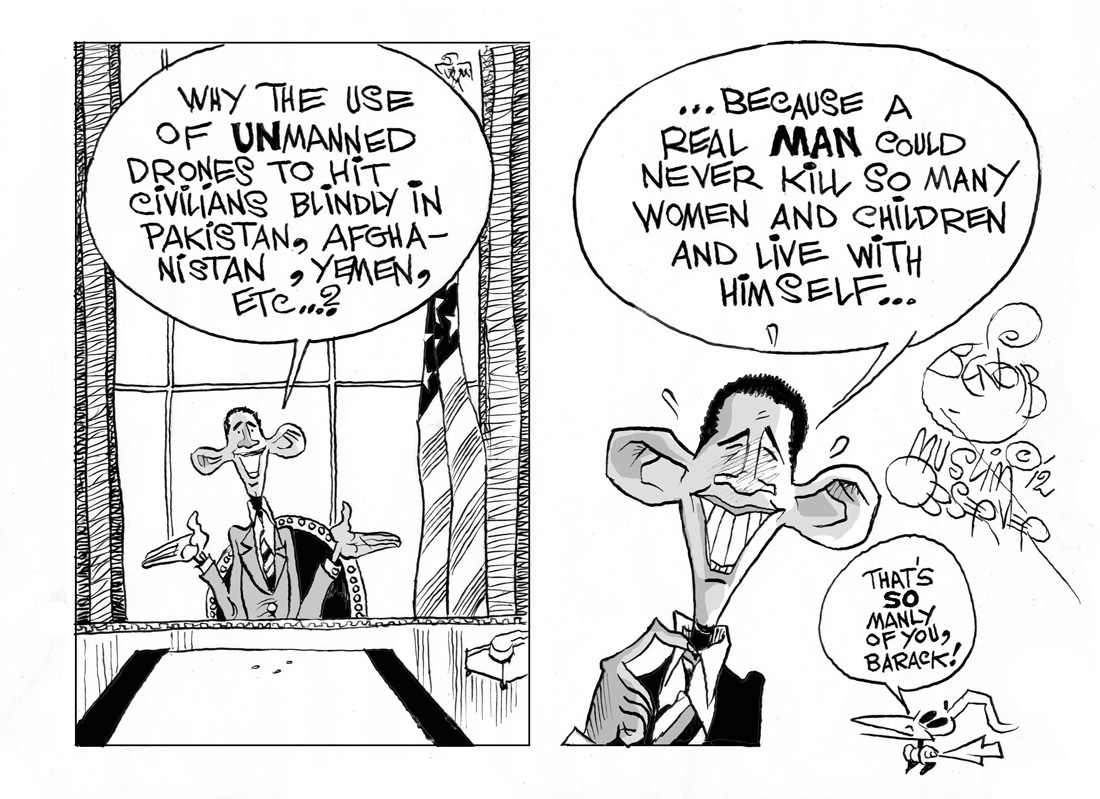
The Myth of the Drone War “Successes”
Assassination Campaigns Do Not Win Wars, and They Create as Many Enemies as They Destroy
by PATRICK COCKBURN
CounterPunch
"As the US and its allies ponder what to do about Syria, one suggestion advanced by the protagonists of armed intervention is to use unmanned drones to attack Syrian government targets. The proposal is a measure of the extraordinary success of the White House, CIA and Defense Department in selling the drone as a wonder weapon despite all the evidence to the contrary......
Unmanned drone strikes are all about American domestic politics rather than about the countries where they are used. They cater to illusions of power, giving Americans a sense that their technical prowess is unparalleled, despite the Pentagon’s inability to counter improvised explosive devices, which are no more than old-fashioned mines laid in or beside roads. The drones have even been presented as being more humanitarian than other forms of warfare, simply by claiming that any dead males of military age killed in a strike must have been enemy combatants.
The downside to these exaggerated successes is that the White House and the US security agencies believe more of their own propaganda than is good for them. Ramshackle insurgent movements in Iraq, Afghanistan, Pakistan and Yemen are not like regular armies, in which the elimination of officers or senior cadres might be a crippling blow to the organization. Just as important, in the long term, assassination campaigns do not win wars, and they create as many enemies as they destroy."
by PATRICK COCKBURN
CounterPunch
"As the US and its allies ponder what to do about Syria, one suggestion advanced by the protagonists of armed intervention is to use unmanned drones to attack Syrian government targets. The proposal is a measure of the extraordinary success of the White House, CIA and Defense Department in selling the drone as a wonder weapon despite all the evidence to the contrary......
Unmanned drone strikes are all about American domestic politics rather than about the countries where they are used. They cater to illusions of power, giving Americans a sense that their technical prowess is unparalleled, despite the Pentagon’s inability to counter improvised explosive devices, which are no more than old-fashioned mines laid in or beside roads. The drones have even been presented as being more humanitarian than other forms of warfare, simply by claiming that any dead males of military age killed in a strike must have been enemy combatants.
The downside to these exaggerated successes is that the White House and the US security agencies believe more of their own propaganda than is good for them. Ramshackle insurgent movements in Iraq, Afghanistan, Pakistan and Yemen are not like regular armies, in which the elimination of officers or senior cadres might be a crippling blow to the organization. Just as important, in the long term, assassination campaigns do not win wars, and they create as many enemies as they destroy."
Al-Jazeera Video: حديث الثورة - انعكاسات الأزمة السورية على لبنان
"انعكاسات الازمة السورية على لبنان والمخاوف من انتقال العنف من سوريا إلى الداخل اللبناني
تقديم : غاده عويس
تاريخ البث: 2012/06/09
الضيوف : هيثم المالح
محمد عبيد
أحمد فتفت
جهاد الخازن
"


Why has there been no 'Palestinian spring'? One word: Oslo

The 1993 accords turned the Palestinian struggle from one of resisting Israeli colonialism into occupation management
Ben White
guardian.co.uk, Monday 11 June 2012
"Ever since the uprisings in Tunisia and Egypt began a regional earthquake 18 months ago, commentators have wondered about the absence of a "Palestinian spring". Attempting to explain this is useful, since it also helps to shed light on key problems with the now-comatose peace process.
To some extent, the question "Why no Palestinian spring?" can be answered with one word: Oslo. The Oslo accords, signed in 1993, established a paradigm where the Palestinian struggle for return and decolonisation was turned into a facade of sovereignty, piecemeal concessions and occupation management......
In Amnesty International's most recent global human rights report, both the PA and Hamas are criticised for mistreating detainees and restricting freedom of expression. Low tolerance for dissent in the media or in public demonstrations has been one example of the human rights violations that the Palestinian Centre for Human Rights says are "motivated by the ongoing state of political division, apparently as mutual reactions by each side towards the other one".
Add to this the lack of a political programme representing Palestinian national aspirations, as well as the leadership vacuum brought about by the Fatah-Hamas conflict, and it's no wonder that mobilisation is a tough challenge.
But that's not to say it isn't happening. Palestinians are mobilised but their mobilisation is decentralised and disparate – the energy is there but not in a way that may be immediately apparent. Multiple strands of activism are at play, some of which are aimed at directly, or indirectly, challenging the obstacles to resisting Israeli colonialism.
Until now, mass Palestinian action in the occupied territories is inhibited by a number of factors. But that's not say things are standing still – and as we know from both Palestinian history and more recent events in the region, things can change in an instant."
Mubarak Convicted, but Abuses Continue in Egypt

Corruption and human rights abuses continue to plague Egypt despite the conviction of Hosni Mubarak
by Joe Stork
Human Rights Watch
"......
Perhaps, the most astounding feature of the Mubarak and Adli verdicts is that the four high-ranking Interior Ministry officials also facing charges got off scot-free. They included the commander of the Central Security Forces and the head of Cairo security. Egyptian rights activists used to spot them frequently on the scene directing security forces during confrontations with demonstrators. The other conclusion one can draw is that Mubarak's conviction and sentencing comes nowhere close to meeting Egyptian demands for comprehensive accountability for systematic abuses under Mubarak's nearly 30-year rule. A survey of a cross-section of Egyptians over the past year found that they care deeply about accountability for human rights abuses.
The serious crimes this trial addressed were limited to those that took place January 25 to 31 - the initial week of the uprising that led to Mubarak's ouster. What is still needed are credible and impartial investigations and prosecutions for torture, enforced disappearances, and other systematic human rights abuse - not to mention serious rights violations, including torture, under the generals who eased Mubarak out of power. Mubarak after all was tried before an ordinary criminal court, subject to ordinary criminal law and procedures, as he should have been. But since he was forced from office in February 2011, some 12,000 civilians have faced military court trials for ordinary crimes as well as protest-related offences."
Egypt group calls on voters to void ballot

Bikya Masr
"CAIRO: The Egyptian group Mobteloon, who call on Egyptians to void their votes in the run-off of the presidential elections on June 16 and 17, said they would not allow Egyptian’s votes be stolen or manipulated and invited others from different points of view to join their call, the group said at a press conference in Cairo on Sunday.
“We aim to lower the percentage of both candidates and we are planting a seed of opposition to the winner from the beginning,” said Ghada al-Shabander, a volunteer with the campaign, during the press conference that took place on Sunday at noon.
The press conference was called for to announce the birth of the campaign that took the slogan “bring down their legitimacy, void their votes.”
The group asked Egyptians to mark both candidates and write their own personal message of why they refuse both candidates.
The group’s Facebook page published pictures from Egyptians abroad who voted this week, with their voting ballot with messages they wrote in opposition to both candidates.
“From today we decided to reclaim our unique and courageous revolutionary path and rewrite our country’s future ourselves,” said Mohamed Ghoniem from the campaign.
“We tell you now that we will not let our votes be manipulated or our will frauded and we will make sure to document all our void votes through all means,” said Ghoniem, addressing those responsible for the elections in the country.
To keep track of the process, they invited voters who plan to void their votes to text the word Mobtel, or one who voids, and their city to count the numbers of participation in the campaign.
Large numbers of Egyptians, mostly pro-revolutionaries, found themselves in a predicament after the first round of elections brought about the Muslim Brotherhood candidate Mohamed Morsi in a face-off with Mubarak’s last prime minister Ahmed Shafiq.
The campaign said that the first round of the election saw many violations, yet the elections committee chose to ignore them, which produced, according to the campaign, “the worst possible outcome.”
“We will not elect Shafiq as the first president in post-revolution Egypt, the military bred minister from the old regime and Mubarak’s last prime minister,” they said. “We will not elect Morsi, the head of a political party that repeatedly promised to not monopolize the political scene and give a chance to everyone and broke his promise.”
The group added that “our votes will not be a stepping stone for you to the ruling palace rather a thunder chant that will bring down your walls if Egyptian freedom is compromised.”"
The third way
By Khaled Fahmy
Al-Masry Al-Youm
".....A third way?
There is no doubt that we are now witnessing a revealing moment in the history of the revolution. More and more people are realizing that the gloves are now off and that the political landscape that has been shaped by the revolution has acquired a new shape. The huge multitudes who took to the streets following the verdict indicate the strong repulsion for the institutions of the deep state and suggest a growing belief that a third alternative, one that is neither the security state nor the religious state, may hold the key to getting us out of the current impasse.
It is too soon to figure out what this third alternative looks like, and only the following few days will reveal which form it will take. Soon we will be able to find out whether or not this third alternative can avoid the trap choosing between the military fascism that former Prime Minister Ahmed Shafiq is offering us and the religious populism that Brotherhood candidate Mohamed Morsy represents. But a short detour to modern Egyptian history might shed light on the harbingers of this third way, and show how it has become nearly inevitable.......
As for the second flank that formed Egypt’s political scene over the past 60 years, the Muslim Brotherhood, the group was equally caught off-guard by the Mubarak trial verdict. It is true that the verdict has increased the chances of the Brotherhood’s candidate winning the second round of the presidential election, but it is not the first time since the revolution that the Brotherhood has found itself winning tactically but losing strategically. For what is the ultimate goal of acquiring posts and controlling institutions if you lack vision, if you cannot deliver and if you lose supporters? The Brotherhood, like the military, is facing an existential crisis stemming from its realization that its long historical experience has not proved useful in dealing with the current revolutionary moment.
The only force that is capable of extracting us from the present crisis is this third way whose history can be traced all the way back to the 19 century, which has ignited the 25 January revolution, and which is gaining self-confidence day after day. In contrast to other political forces that bask in past glories or that are mired licking their own wounds, this third way, which does not even have a name, face or shape, is the only force that has a vision. And as politically savvy this third way appears to be, it is its poetry - not its politics - that promises a salvation."
Al-Masry Al-Youm
".....A third way?
There is no doubt that we are now witnessing a revealing moment in the history of the revolution. More and more people are realizing that the gloves are now off and that the political landscape that has been shaped by the revolution has acquired a new shape. The huge multitudes who took to the streets following the verdict indicate the strong repulsion for the institutions of the deep state and suggest a growing belief that a third alternative, one that is neither the security state nor the religious state, may hold the key to getting us out of the current impasse.
It is too soon to figure out what this third alternative looks like, and only the following few days will reveal which form it will take. Soon we will be able to find out whether or not this third alternative can avoid the trap choosing between the military fascism that former Prime Minister Ahmed Shafiq is offering us and the religious populism that Brotherhood candidate Mohamed Morsy represents. But a short detour to modern Egyptian history might shed light on the harbingers of this third way, and show how it has become nearly inevitable.......
As for the second flank that formed Egypt’s political scene over the past 60 years, the Muslim Brotherhood, the group was equally caught off-guard by the Mubarak trial verdict. It is true that the verdict has increased the chances of the Brotherhood’s candidate winning the second round of the presidential election, but it is not the first time since the revolution that the Brotherhood has found itself winning tactically but losing strategically. For what is the ultimate goal of acquiring posts and controlling institutions if you lack vision, if you cannot deliver and if you lose supporters? The Brotherhood, like the military, is facing an existential crisis stemming from its realization that its long historical experience has not proved useful in dealing with the current revolutionary moment.
The only force that is capable of extracting us from the present crisis is this third way whose history can be traced all the way back to the 19 century, which has ignited the 25 January revolution, and which is gaining self-confidence day after day. In contrast to other political forces that bask in past glories or that are mired licking their own wounds, this third way, which does not even have a name, face or shape, is the only force that has a vision. And as politically savvy this third way appears to be, it is its poetry - not its politics - that promises a salvation."
Sunday, June 10, 2012
Al-Jazeera Video: Syrian cities endure intense shelling
"Violence is continuing in Syria, with activists reporting government assaults on the southern city of Deraa and Homs in the centre of the country.
Activists in Homs said several neighbourhoods were under intense shelling for the third day in a row on Saturday. They said al-Khaldiyeh, Jouret al-Shayyah, al-Qusour and Old Homs were being bombarded with mortars and rockets.
Al Jazeera's Khadija Margadie reports."
Syria rebels gaining ground, strength
The Washington Post
"BEIRUT — An increasingly effective Syrian rebel force has been gaining ground in recent weeks, stepping up its attacks on government troops and expanding the area under its control even as world attention has been focused on pressuring Syrian President Bashar al-Assad to comply with a U.N. cease-fire.
The loosely organized Free Syrian Army now acknowledges that it is also no longer observing the truce, although rebel commanders insist they are launching attacks only to defend civilians in the wake of concerns generated by two recent massacres in which most of the 186 victims were women and children.
The rebels say they are acquiring access to ammunition and funding that had been in short supply a few months ago, streamlining their structures to improve coordination and steadily eroding the government’s capacity to control large swaths of the country..........
U.S. officials and Syrian opposition figures said last month that a discreet effort by Arab gulf states to channel funds and weapons to the rebels — an undertaking the United States is helping to coordinate — had begun to gear up. The rebels’ apparent progress suggests that the assistance is having an effect, driving the dynamic toward a deepening conflict and perhaps intensifying pressure on the government to make concessions, even as world powers continue to rule out military intervention, analysts say.
The lightly armed rebels, equipped mostly with assault rifles, rocket-propelled grenades and some mortars, are still a long way from being able to inflict defeat on the superior Syrian army. They are also far from achieving the capabilities of Libya’s rebels, who quickly seized control of a large chunk of territory and a sizable arsenal.
The Syrian rebels “are never going to be capable of driving on Damascus and driving out the regime,” said Jeffrey White, a former Defense Intelligence Agency official who is now with the Washington Institute for Near East Policy. But, he said, with their repeated hit-and-run attacks on Syrian outposts and convoys, it is clear that “they’re increasing pressure on the regime, increasing attrition and increasing defections.”
“They’re looking stronger to me, and better,” White said. “People have been calling them a ragtag force, and I just don’t think that’s accurate anymore. I would describe them as an increasingly capable guerrilla force.”
The rebels are also gaining confidence.
“Every day we control more territory, every day we have more defections, and we are having better organization in our ranks,” said Maj. Sami al-Kurdi, a spokesman for the Homs Military Council, one of the new military structures that are being established around the country. “The regime now controls only the territory under its tanks, and the evidence is that they don’t dare step out of their tanks.”
Growing effectiveness
Verifying such claims is difficult because the Syrian government restricts access to journalists. But military experts who monitor the evolving conflict say they have detected a significant uptick in the number of videos of rebel attacks posted online.
The rebels also say they are inflicting heavy casualties on government troops, and though confirming that is impossible, the official Syrian Arab News Agency has recently reported a growing number of deaths. In the past 10 days, 234 members of the security forces killed in the violence have been buried at honorary military funerals, according to a tally of the reports — a record 57 of them Saturday.
The intensified fighting of the past two weeks offers further evidence of the rebels’ growing strength. The Free Syrian Army said it overran three government positions in the northern province of Idlib last week, and there have been battles in areas previously untouched by the violence, such as the rural area north of Aleppo.........
But after driving rebels from strongholds in the Baba Amr district of Homs and several Idlib towns in March, the government has since seemed unable to press home the advantage. Repeated efforts to dislodge the Free Syrian Army from the provincial Homs towns of Rastan and Qusair have failed, and a major offensive launched last week against a previously unnoticed rebel stronghold in the town of Haffa, northeast of Latakia, faltered despite intense shelling and the deployment of combat helicopters.
The government still has the capacity to use overwhelming force against rebel strongholds, but it “can’t bring force to bear everywhere at the same time,” said Amr al-Azm, a professor of history at Shawnee State University in Ohio who is active in the Syrian opposition.
“They can go in and suppress an area, but as soon as they leave it, it is out of their control,” he said.
The result is that many parts of northern and central Syria have effectively fallen under the sway of the rebels, said Joseph Holliday, a researcher who tracks Free Syrian Army activity for the Washington-based Institute for the Study of War.
“They’re making it really hard for the regime to move around, for them to get out of their little checkpoints that they’re barricaded into,” said Holliday, a veteran of the Iraq war who compared the predicament of Syrian forces to that of U.S. troops in Iraq during the height of the fighting there. “We were pinned down. We couldn’t get around,” he said.
Signs of cohesion
Rebel commanders credit the growing demoralization of the regular army, in part, for their performance. Defections continue at a steady rate and troops are weary after nearly 15 months of continuous deployment in the effort to suppress the rebellion, they say.
And though they deny receiving foreign help, the rebels say the money they are receiving now is enabling them to buy more weapons on the thriving black market.
“We are getting weapons from dealers who are very active in Syria now,” said Col. Aref Hammoud, a spokesman for the Free Syrian Army in southern Turkey. Rebels are also seizing more weapons in attacks on government forces, he said......."
"BEIRUT — An increasingly effective Syrian rebel force has been gaining ground in recent weeks, stepping up its attacks on government troops and expanding the area under its control even as world attention has been focused on pressuring Syrian President Bashar al-Assad to comply with a U.N. cease-fire.
The loosely organized Free Syrian Army now acknowledges that it is also no longer observing the truce, although rebel commanders insist they are launching attacks only to defend civilians in the wake of concerns generated by two recent massacres in which most of the 186 victims were women and children.
The rebels say they are acquiring access to ammunition and funding that had been in short supply a few months ago, streamlining their structures to improve coordination and steadily eroding the government’s capacity to control large swaths of the country..........
U.S. officials and Syrian opposition figures said last month that a discreet effort by Arab gulf states to channel funds and weapons to the rebels — an undertaking the United States is helping to coordinate — had begun to gear up. The rebels’ apparent progress suggests that the assistance is having an effect, driving the dynamic toward a deepening conflict and perhaps intensifying pressure on the government to make concessions, even as world powers continue to rule out military intervention, analysts say.
The lightly armed rebels, equipped mostly with assault rifles, rocket-propelled grenades and some mortars, are still a long way from being able to inflict defeat on the superior Syrian army. They are also far from achieving the capabilities of Libya’s rebels, who quickly seized control of a large chunk of territory and a sizable arsenal.
The Syrian rebels “are never going to be capable of driving on Damascus and driving out the regime,” said Jeffrey White, a former Defense Intelligence Agency official who is now with the Washington Institute for Near East Policy. But, he said, with their repeated hit-and-run attacks on Syrian outposts and convoys, it is clear that “they’re increasing pressure on the regime, increasing attrition and increasing defections.”
“They’re looking stronger to me, and better,” White said. “People have been calling them a ragtag force, and I just don’t think that’s accurate anymore. I would describe them as an increasingly capable guerrilla force.”
The rebels are also gaining confidence.
“Every day we control more territory, every day we have more defections, and we are having better organization in our ranks,” said Maj. Sami al-Kurdi, a spokesman for the Homs Military Council, one of the new military structures that are being established around the country. “The regime now controls only the territory under its tanks, and the evidence is that they don’t dare step out of their tanks.”
Growing effectiveness
Verifying such claims is difficult because the Syrian government restricts access to journalists. But military experts who monitor the evolving conflict say they have detected a significant uptick in the number of videos of rebel attacks posted online.
The rebels also say they are inflicting heavy casualties on government troops, and though confirming that is impossible, the official Syrian Arab News Agency has recently reported a growing number of deaths. In the past 10 days, 234 members of the security forces killed in the violence have been buried at honorary military funerals, according to a tally of the reports — a record 57 of them Saturday.
The intensified fighting of the past two weeks offers further evidence of the rebels’ growing strength. The Free Syrian Army said it overran three government positions in the northern province of Idlib last week, and there have been battles in areas previously untouched by the violence, such as the rural area north of Aleppo.........
But after driving rebels from strongholds in the Baba Amr district of Homs and several Idlib towns in March, the government has since seemed unable to press home the advantage. Repeated efforts to dislodge the Free Syrian Army from the provincial Homs towns of Rastan and Qusair have failed, and a major offensive launched last week against a previously unnoticed rebel stronghold in the town of Haffa, northeast of Latakia, faltered despite intense shelling and the deployment of combat helicopters.
The government still has the capacity to use overwhelming force against rebel strongholds, but it “can’t bring force to bear everywhere at the same time,” said Amr al-Azm, a professor of history at Shawnee State University in Ohio who is active in the Syrian opposition.
“They can go in and suppress an area, but as soon as they leave it, it is out of their control,” he said.
The result is that many parts of northern and central Syria have effectively fallen under the sway of the rebels, said Joseph Holliday, a researcher who tracks Free Syrian Army activity for the Washington-based Institute for the Study of War.
“They’re making it really hard for the regime to move around, for them to get out of their little checkpoints that they’re barricaded into,” said Holliday, a veteran of the Iraq war who compared the predicament of Syrian forces to that of U.S. troops in Iraq during the height of the fighting there. “We were pinned down. We couldn’t get around,” he said.
Signs of cohesion
Rebel commanders credit the growing demoralization of the regular army, in part, for their performance. Defections continue at a steady rate and troops are weary after nearly 15 months of continuous deployment in the effort to suppress the rebellion, they say.
And though they deny receiving foreign help, the rebels say the money they are receiving now is enabling them to buy more weapons on the thriving black market.
“We are getting weapons from dealers who are very active in Syria now,” said Col. Aref Hammoud, a spokesman for the Free Syrian Army in southern Turkey. Rebels are also seizing more weapons in attacks on government forces, he said......."
جرائم الدكتاتوريات العربية وإسرائيل
By Azmi Bishara
"جرائم الدكتاتوريات العربية وإسرائيل
8 يونيو 2012
يظهر الاستبداد العربي ممارسات قمعية وحشية. ويروق لبعض الأخوة المندهشين أو المتأذين معنويا من حجم القمع الذي يمارسة الاستبداد بحق الشعوب العربية والإنسان العربي مقارنته بما مارسته إسرائيل ضد الشعب الفلسطيني، وفي الأرض المحتلة عام 1967 بشكل خاص.
ويبدو أن من يقوم بهذه المقارنة إنما يفعل ذلك بحسن نية، فهو غالبا ما يقصد أن السياسة الإسرائيلية هي شر معياري، اذا صح التعبير، وأن الشرور الأخرى تقاس به وعليه. ولكن يبدو لي من بعض المناقشات أن ما يقصده أصحابها (وهم قلة) هو دحض شر إسرائيل. بل ونجد محاولات لتقديم إسرائيل بصورة افضل، لا سيما من قبل المعارضين الذين لم يعتبروا يوما أن قضية الشعب الفلسطيني أو العراقي أو الجزائري قضيتهم، وكانوا دائما ينظرون الى أميركا كحليف.
وقد لفتت نظري تعليقات بعض الأخوة الإيجابية تجاه خطاب المندوب الإسرائيلي في مجلس الأمن تجاه سوريا وهي، على الرغم من ندرتها وقلتها، ليست في مكانها، فإسرائيل لا ترغب لا بوحدة سوريا ولا بتطورها ولا بديمقراطيتها، فضلا عن عروبتها. ومع ذلك فيما يلي بعض الملاحظات حول خطأ المقارنة:
1. لا تصح المقارنة الكمية لأن الصراع مع إسرائيل لا يقاس بحجم القتلى والشهداء. فإسرائيل القوية اقتصاديا وأمنيا وتكنولوجيا لم تعد بحاجة لهذا الكم من العنف البدائي، ولديها أدوات سيطرة وعنف أكثر "تطورا". ولكنها في الماضي استخدمت عنفا بدائيا، وما هو اكثر فداحة منه، في طرد شعب بأكمله. ولم تحاصر ولم تفرض عليها عقوبات، وما زالت حتى اليوم دولة الغرب المدللة... وهي تستغل ما يجري عربيا لمواصلة الاستيطان وتهويد القدس، وحتى الدول العربية التي تقيم معها علاقات سلام للأسف لم تقطع هذه العلاقات.
2. الشعوب العربية تناضل في أوطانها من أجل مستقبل أفضل. وسوف تناله بنضالها ضد الاستبداد. ولكن الشعب الفلسطيني فقد وطنه. فلسطين هي ارض محتلة من قبل استعمار استيطاني إحلالي... أحل شعبا مكان آخر.
3. إسرائيل هي النقيض للوحدة الوطنية والمحفّز الأول في مسارات البنية الطائفية السياسية للدول، فهي تنظّر للتعامل مع العرب ليس كشعوب بل كطوائف، وتمارس علاقاتها الإقليمية سياسيا على هذا الاساس.
4. قضية فلسطين هي قضية كل عربي ليس بسبب القمع الذي يتعرض له الشعب الفلسطيني، بل لأنها آخر قضية استعمارية في المنطقة، وهي التي تشكل محور الإملاءات الاستعمارية الغربية على دول المنطقة حتى الديمقراطية في المستقبل.
يجب ان نقف جميعا ضد الاستبداد، وان لا نسمح لاي نظام باستغلال قضية فلسطين في تبرير جرائمه، ولا يمكن أن يكون من يقمع شعبه صديقا حقيقيا لإحقاق العدل في فلسطين... ولكن علينا ايضا ان لا نسمح ان يجري بهدوء تهميش قضية فلسطين، أو تحويلها الى مسألة نسبية مقارنة بالقمع العربي، لا سيما من قبل أولئك الذين أعجبوا دائما بالسياسات الغربية في المنطقة، وناهضوا فكرة الرابطة العربية التي تربط شعبهم بشعب فلسطين والشعوب الأخرى، وانضموا الى الثورات لأسبابهم وليس من أجل الديمقرطية. وتحتاج الثورات لمن ينضم إليها ولكن علينا أن نكون حذرين بشأن النوايا والأهداف... فغالبا ما تكون النوايا هي الأهداف.
"
"جرائم الدكتاتوريات العربية وإسرائيل
8 يونيو 2012
يظهر الاستبداد العربي ممارسات قمعية وحشية. ويروق لبعض الأخوة المندهشين أو المتأذين معنويا من حجم القمع الذي يمارسة الاستبداد بحق الشعوب العربية والإنسان العربي مقارنته بما مارسته إسرائيل ضد الشعب الفلسطيني، وفي الأرض المحتلة عام 1967 بشكل خاص.
ويبدو أن من يقوم بهذه المقارنة إنما يفعل ذلك بحسن نية، فهو غالبا ما يقصد أن السياسة الإسرائيلية هي شر معياري، اذا صح التعبير، وأن الشرور الأخرى تقاس به وعليه. ولكن يبدو لي من بعض المناقشات أن ما يقصده أصحابها (وهم قلة) هو دحض شر إسرائيل. بل ونجد محاولات لتقديم إسرائيل بصورة افضل، لا سيما من قبل المعارضين الذين لم يعتبروا يوما أن قضية الشعب الفلسطيني أو العراقي أو الجزائري قضيتهم، وكانوا دائما ينظرون الى أميركا كحليف.
وقد لفتت نظري تعليقات بعض الأخوة الإيجابية تجاه خطاب المندوب الإسرائيلي في مجلس الأمن تجاه سوريا وهي، على الرغم من ندرتها وقلتها، ليست في مكانها، فإسرائيل لا ترغب لا بوحدة سوريا ولا بتطورها ولا بديمقراطيتها، فضلا عن عروبتها. ومع ذلك فيما يلي بعض الملاحظات حول خطأ المقارنة:
1. لا تصح المقارنة الكمية لأن الصراع مع إسرائيل لا يقاس بحجم القتلى والشهداء. فإسرائيل القوية اقتصاديا وأمنيا وتكنولوجيا لم تعد بحاجة لهذا الكم من العنف البدائي، ولديها أدوات سيطرة وعنف أكثر "تطورا". ولكنها في الماضي استخدمت عنفا بدائيا، وما هو اكثر فداحة منه، في طرد شعب بأكمله. ولم تحاصر ولم تفرض عليها عقوبات، وما زالت حتى اليوم دولة الغرب المدللة... وهي تستغل ما يجري عربيا لمواصلة الاستيطان وتهويد القدس، وحتى الدول العربية التي تقيم معها علاقات سلام للأسف لم تقطع هذه العلاقات.
2. الشعوب العربية تناضل في أوطانها من أجل مستقبل أفضل. وسوف تناله بنضالها ضد الاستبداد. ولكن الشعب الفلسطيني فقد وطنه. فلسطين هي ارض محتلة من قبل استعمار استيطاني إحلالي... أحل شعبا مكان آخر.
3. إسرائيل هي النقيض للوحدة الوطنية والمحفّز الأول في مسارات البنية الطائفية السياسية للدول، فهي تنظّر للتعامل مع العرب ليس كشعوب بل كطوائف، وتمارس علاقاتها الإقليمية سياسيا على هذا الاساس.
4. قضية فلسطين هي قضية كل عربي ليس بسبب القمع الذي يتعرض له الشعب الفلسطيني، بل لأنها آخر قضية استعمارية في المنطقة، وهي التي تشكل محور الإملاءات الاستعمارية الغربية على دول المنطقة حتى الديمقراطية في المستقبل.
يجب ان نقف جميعا ضد الاستبداد، وان لا نسمح لاي نظام باستغلال قضية فلسطين في تبرير جرائمه، ولا يمكن أن يكون من يقمع شعبه صديقا حقيقيا لإحقاق العدل في فلسطين... ولكن علينا ايضا ان لا نسمح ان يجري بهدوء تهميش قضية فلسطين، أو تحويلها الى مسألة نسبية مقارنة بالقمع العربي، لا سيما من قبل أولئك الذين أعجبوا دائما بالسياسات الغربية في المنطقة، وناهضوا فكرة الرابطة العربية التي تربط شعبهم بشعب فلسطين والشعوب الأخرى، وانضموا الى الثورات لأسبابهم وليس من أجل الديمقرطية. وتحتاج الثورات لمن ينضم إليها ولكن علينا أن نكون حذرين بشأن النوايا والأهداف... فغالبا ما تكون النوايا هي الأهداف.
"
مجزرة معرزاف( حي القبير)
"مجزرة معرزاف( حي القبير)
أورد هنا تفاصيل وخلفيات المجزرة كما تجمعت لدي بمساعدة مجموعة من الباحثين، وهي تفاصيل مفحوصة بدقة وأنشرها هنا لأول مرة:
1. حيثيات وتفاصيل المجزرة " حي القبير"
حصلت المجزرة بعد ظهر الأربعاء6-6-2012، وقد تزامنت مع عملية عسكرية واسعة قام بها الجيش النظامي في ريف حماه الشمالي والغربي. وكان أبرز المواجهات المسلحة تلك التي حصلت في قرية كفرزيتا، والتي تعتبر أحد مراكز تجمع المسلحيّن الذين يقومون بعمليات مستمرة على الحواجز العسكرية والأمنية المنتشرة بكثافة في ريف حماه الشمالي. ولإتمام حصار مدينة كفرزيتا وطيبة الإمام عمد الجيش إلى اقتحام القرى المجاورة التي تؤمن الإمدادات للمسلحين المتطوعين وعناصر الجيش الحر في المدينة.
انطلق القوات النظاميّة من النقطة العسكريّة الموجودة في قريّة المجدل، وتوجهت إلى معرزاف حيث تصدى لها مسلحون بالقرب من القرية فعمد إلى قصفها من بعيد، ما أدى إلى تراجع المسلحين وتحصنوا داخل القريّة لصد محاولة الاقتحام.
وقد رافق القوات النظاميّة أثناء الاقتحام شبيحة من قريّة أصيلة المجاورة لقرية معرزاف، وتوجهوا إلى حي زراعي ملاصق للقريّة يدعى حي القبير، وتسكنه عدد من العائلات البدوية والذي يصل تعداد ساكنيه إلى 250 شخص موزعين على 20 منزل، وقاموا بمجزرة قتل فيها حوالي 88 شخص بينهم 22 طفلاً، وعدد مشابه من النساء وتنوعت وسائل القتل ما بين الإعدام الميدانيّ بالرصاص، إضافة إلى السكاكين والأدوات الحادة، والقتل حرقًا حيث تم معاينة 8 جثث متفحمة.
بعد خروج الشبيحة وانسحاب الجيش إلى حاجز قرية المجدل نقل أهالي حي القبير القتلى إلى قرية معرزاف وبدأت مراسم دفنهم صباحًا، وقد منع الجيش النظامي عند حاجز المجدل اليوم وصول فريق بعثة المراقبين الدوليين إلى القريّة.
2. قرية معرزاف
تقع قرية معرزاف غرب مدينة حماه تبعد عنها مسافة 20 كم، وتقع جنوب مدينة محردة ( مسيحية) بمسافة 2 كم، وقد بدأ حراكها سلميّا بالتزامن مع تجذر الحراك الثوري في مدينة حماه في شهر أيار/ مايو 2011. ينحدر سكانها من أصول بدويّة ( عشائر النعيم) وفيها العديد من الضباط الذين انشقوا عن الجيش في مراحل متقدمة من عمر الثورة، وأبرزهم الرائد ماهر النعيمي الناطق الإعلامي باسم الجيش السوري الحر. ويبلغ عدد سكانها نحو 4500 نسمة، يعملون في الزراعة وتربية المواشي.
3. سياق الاضطرابات الأهليّة
انقسم الريف الحموي " الغربي" ،الذي يضم طوائف متعددة ( سنة، علويين، مرشدين، ومسيحيين)، في موقفه من الثورة والنظام منذ البدايّة. وتجذر الانقسام على خلفيات طائفيّة مع طول مدتها، إذ بدأت تحصل حوادث طائفيّة بعد انضمام شباب القرى العلويّة إلى الشبيحة ومشاركتهم في قمع المظاهرات، وقد حصلت عدة اشتباكات بين القرى السنية والعلويّة استطاعت الفعاليات الأهليّة والوجهاء احتواءها، لكن أعنف هذه الاشتباكات وقعت في بداية شهر آب/ أغسطس 2011، بعد دخول الجيش إلى مدينّة حماه.
إذ أقام أهالي قريّة معرزاف، وتيزين، واللطامنة، وحلفايّا حواجز ولجان شعبيّة لمنع الشبيحة الذين جندتهم القوى الأمنيّة من القرى العلويّة لقمع المظاهرة من النزول إلى المدينة. وعند حاجز قريّة تيزين حصل اشتباك بين الشبيحة، ومسلحي القرية قتل خلالها اثنين من قريّة تيزين، فتداعت القرى "السنية" بتضامنيّة طائفيّة وتوجهوا بالسيارات إلى قرية الربيعة بهدف "إبادة القريّة". وقد تمكن وجهاء الطرفيّن من حل الإشكال ومنعوا مواجهة طائفيّة مسلحة آنذاك.
بعدها شاع السلاح، وتولت كل قريّة حمايّة نفسها. ونتيجة لذلك، كانت تحصل وبشكل دوري حوادث اختطاف وقتل من الجانبين، لتعزز من الانقسام والاضطرابات. ففي شهر أذار/ مارس 2012 قتل 5 أشخاص من قريّة أصيلة من قبل مسلحي حلفايّا، كما اختطفت معلمة تنتمي لهذه القريّة بذريعة مشاركة أهالي القريّة في اقتحام مدينة حلفايّا، وحصلت مواجهات طائفيّة شارك فيها مسلحو قرية معرزاف. ويبدو أن السلوك العنفي، الذي حصل بالأمس من قبل سكان أصيلة أثناء محاولة اقتحام الجيش لمعرزاف يعود أيضا إلى أسباب ثأرية انتقاميّة. وقد استغل من نفذ المذبحة القصف الموجه الى معرزاف.
يمكن أن تنتشر هذه الظواهر في سوريا على خلفية استمرار عنف الدولة الذي يغذي العنف الأهلي. ولقد أنكر بشار الأسد في خطابه الأخير هذه الخلفيات في حالة مجزرة الحولة، ولم يعد بالقبض على القتلة ومحاسبتهم، بل نسب الأمر الى "الجماعات المسلحة". وهو يعرف الخلفية الحقيقية، ما يعني منح حصانة للقتلة، وربما شجع آخرين على أن يحذوا حذوهم.
هذه الاستراتجية لتخويف العالم من أن الثورة تقود الى الفوضى، والحرب والأهلية لم تعد تنفع. فالنتيجة التي استخلصها الجميع ان النظام هو المشكلة.
على القوى الثورة المسؤولة أن تؤكد على الوحدة الوطنية، وعلى مسؤولية النظام عما يجري. كما أنه من الضروري التأكيد على ان اي عنف أهلي يجر دورة من العنف المضاعف. فلا أحد يقتل في سوريا على خلفية أهلية من دون أن يكون أهله قادرين على القتل هم أيضا. المشكلة هي النظام الحاكم. وهو عدو جميع المواطنين، الذي يسعى لتحويل كل مواطن الى عدو للآخر.
"
Source: Azmi Bishara
7 يونيو 2012أورد هنا تفاصيل وخلفيات المجزرة كما تجمعت لدي بمساعدة مجموعة من الباحثين، وهي تفاصيل مفحوصة بدقة وأنشرها هنا لأول مرة:
1. حيثيات وتفاصيل المجزرة " حي القبير"
حصلت المجزرة بعد ظهر الأربعاء6-6-2012، وقد تزامنت مع عملية عسكرية واسعة قام بها الجيش النظامي في ريف حماه الشمالي والغربي. وكان أبرز المواجهات المسلحة تلك التي حصلت في قرية كفرزيتا، والتي تعتبر أحد مراكز تجمع المسلحيّن الذين يقومون بعمليات مستمرة على الحواجز العسكرية والأمنية المنتشرة بكثافة في ريف حماه الشمالي. ولإتمام حصار مدينة كفرزيتا وطيبة الإمام عمد الجيش إلى اقتحام القرى المجاورة التي تؤمن الإمدادات للمسلحين المتطوعين وعناصر الجيش الحر في المدينة.
انطلق القوات النظاميّة من النقطة العسكريّة الموجودة في قريّة المجدل، وتوجهت إلى معرزاف حيث تصدى لها مسلحون بالقرب من القرية فعمد إلى قصفها من بعيد، ما أدى إلى تراجع المسلحين وتحصنوا داخل القريّة لصد محاولة الاقتحام.
وقد رافق القوات النظاميّة أثناء الاقتحام شبيحة من قريّة أصيلة المجاورة لقرية معرزاف، وتوجهوا إلى حي زراعي ملاصق للقريّة يدعى حي القبير، وتسكنه عدد من العائلات البدوية والذي يصل تعداد ساكنيه إلى 250 شخص موزعين على 20 منزل، وقاموا بمجزرة قتل فيها حوالي 88 شخص بينهم 22 طفلاً، وعدد مشابه من النساء وتنوعت وسائل القتل ما بين الإعدام الميدانيّ بالرصاص، إضافة إلى السكاكين والأدوات الحادة، والقتل حرقًا حيث تم معاينة 8 جثث متفحمة.
بعد خروج الشبيحة وانسحاب الجيش إلى حاجز قرية المجدل نقل أهالي حي القبير القتلى إلى قرية معرزاف وبدأت مراسم دفنهم صباحًا، وقد منع الجيش النظامي عند حاجز المجدل اليوم وصول فريق بعثة المراقبين الدوليين إلى القريّة.
2. قرية معرزاف
تقع قرية معرزاف غرب مدينة حماه تبعد عنها مسافة 20 كم، وتقع جنوب مدينة محردة ( مسيحية) بمسافة 2 كم، وقد بدأ حراكها سلميّا بالتزامن مع تجذر الحراك الثوري في مدينة حماه في شهر أيار/ مايو 2011. ينحدر سكانها من أصول بدويّة ( عشائر النعيم) وفيها العديد من الضباط الذين انشقوا عن الجيش في مراحل متقدمة من عمر الثورة، وأبرزهم الرائد ماهر النعيمي الناطق الإعلامي باسم الجيش السوري الحر. ويبلغ عدد سكانها نحو 4500 نسمة، يعملون في الزراعة وتربية المواشي.
3. سياق الاضطرابات الأهليّة
انقسم الريف الحموي " الغربي" ،الذي يضم طوائف متعددة ( سنة، علويين، مرشدين، ومسيحيين)، في موقفه من الثورة والنظام منذ البدايّة. وتجذر الانقسام على خلفيات طائفيّة مع طول مدتها، إذ بدأت تحصل حوادث طائفيّة بعد انضمام شباب القرى العلويّة إلى الشبيحة ومشاركتهم في قمع المظاهرات، وقد حصلت عدة اشتباكات بين القرى السنية والعلويّة استطاعت الفعاليات الأهليّة والوجهاء احتواءها، لكن أعنف هذه الاشتباكات وقعت في بداية شهر آب/ أغسطس 2011، بعد دخول الجيش إلى مدينّة حماه.
إذ أقام أهالي قريّة معرزاف، وتيزين، واللطامنة، وحلفايّا حواجز ولجان شعبيّة لمنع الشبيحة الذين جندتهم القوى الأمنيّة من القرى العلويّة لقمع المظاهرة من النزول إلى المدينة. وعند حاجز قريّة تيزين حصل اشتباك بين الشبيحة، ومسلحي القرية قتل خلالها اثنين من قريّة تيزين، فتداعت القرى "السنية" بتضامنيّة طائفيّة وتوجهوا بالسيارات إلى قرية الربيعة بهدف "إبادة القريّة". وقد تمكن وجهاء الطرفيّن من حل الإشكال ومنعوا مواجهة طائفيّة مسلحة آنذاك.
بعدها شاع السلاح، وتولت كل قريّة حمايّة نفسها. ونتيجة لذلك، كانت تحصل وبشكل دوري حوادث اختطاف وقتل من الجانبين، لتعزز من الانقسام والاضطرابات. ففي شهر أذار/ مارس 2012 قتل 5 أشخاص من قريّة أصيلة من قبل مسلحي حلفايّا، كما اختطفت معلمة تنتمي لهذه القريّة بذريعة مشاركة أهالي القريّة في اقتحام مدينة حلفايّا، وحصلت مواجهات طائفيّة شارك فيها مسلحو قرية معرزاف. ويبدو أن السلوك العنفي، الذي حصل بالأمس من قبل سكان أصيلة أثناء محاولة اقتحام الجيش لمعرزاف يعود أيضا إلى أسباب ثأرية انتقاميّة. وقد استغل من نفذ المذبحة القصف الموجه الى معرزاف.
يمكن أن تنتشر هذه الظواهر في سوريا على خلفية استمرار عنف الدولة الذي يغذي العنف الأهلي. ولقد أنكر بشار الأسد في خطابه الأخير هذه الخلفيات في حالة مجزرة الحولة، ولم يعد بالقبض على القتلة ومحاسبتهم، بل نسب الأمر الى "الجماعات المسلحة". وهو يعرف الخلفية الحقيقية، ما يعني منح حصانة للقتلة، وربما شجع آخرين على أن يحذوا حذوهم.
هذه الاستراتجية لتخويف العالم من أن الثورة تقود الى الفوضى، والحرب والأهلية لم تعد تنفع. فالنتيجة التي استخلصها الجميع ان النظام هو المشكلة.
على القوى الثورة المسؤولة أن تؤكد على الوحدة الوطنية، وعلى مسؤولية النظام عما يجري. كما أنه من الضروري التأكيد على ان اي عنف أهلي يجر دورة من العنف المضاعف. فلا أحد يقتل في سوريا على خلفية أهلية من دون أن يكون أهله قادرين على القتل هم أيضا. المشكلة هي النظام الحاكم. وهو عدو جميع المواطنين، الذي يسعى لتحويل كل مواطن الى عدو للآخر.
"
Subscribe to:
Posts (Atom)