Friday, July 5, 2013

Egypt Q and A: What does this mean for Arab Democratisation?

Where next for a fledging Egyptian democracy? 

Larbi Sadiki
"As the situation unfolds in Egypt, attention turns to the wider implications of military intervention. Jacob Powell speaks to Dr. Larbi Sadiki, a leading scholar in the field of Arab democratisation and a regular contributor to these pages. He has authored two critically acclaimed books on the issue: Arab Democratization: Elections without Democracy (Oxford University Press, 2009) and The Search for Arab Democracy: Discourses and Counter-Discourses (Columbia University Press, 2004).

Jacob Powell: Do you think Egypt is ready for democracy?......

JP: In an op-ed you published in Al Jazeera immediately preceding the coup, you wrote “The age of grand leaders has passed…leaderless-ness is what captures the imagination of the masses more so than the presence of fallible mortals at the apex of power.” But during the 48 hour ultimatum, Mohamed El-Baradei was nominated as the opposition spokesman, appeared with General Sisi on TV, and seems to be the leader of the opposition movement. Do these developments conflict with your statements?

LS: Definitely. Neither El-Baradei nor Sabbahi will be iconic leaders. One year in politics was too long for Morsi, and this could prove the same for succeeding politicians in Egypt and the Arab World at large. It is no longer about Who rules; rather, it is How people are ruled that matters in this midst of this most revolutionary moment. This is an age where people are perpetually dissatisfied with the status quo. The public mood, especially in Egypt, is too volatile. I’m definitely sticking to my guns – the age of iconic leaders has passed.The public square ethos is today the only force that drives change – in whatever direction – that has the last word, even I ephemerally, in the Arab Middle East…I guess, it is a question of ‘stay tuned for more’."

Thursday, July 4, 2013

Legitimacy in Egypt

We can welcome Morsi's departure without welcoming the means by which it was achieved

By Brian Whitaker

"It is a sad testament to the failure of Mohamed Morsi's presidency that his claim to remain in office has been based on right rather than merit. 
Almost everyone accepts that he was legitimately elected, and that is certainly a strong point in his favour. But once a leader has been elected, continuing legitimacy is in the eye of beholders and unless nurtured it may be lost. 
During his 12 months in power, Morsi's performance was lacklustre and at times incompetent. That, however, was not the main reason why Egyptians took to the streets last weekend to protest in unprecedented numbers. Morsi put himself beyond the pale by promising inclusiveness and then spreading divisiveness, and by adopting a style of government that increasingly resembled that of the ousted Mubarak regime.
So why not wait a few years till the next election, then vote him out of office? This is a question I have heard a few people asking – especially American TV presenters. One answer is that there are numerous problems (above all, the economy) which need urgent attention but the question might also be framed another way: Why should a president be expected to complete his term if he has clearly lost the confidence of the public?
In the US, presidents – good and bad alike – are expected to serve their full term unless they happen to get caught in skulduggery like Richard Nixon, but that is not the only system. In Britain, only two of the last four prime ministers have been removed by the public at the ballot box and, worldwide, similar examples can be found in other democracies.
Margaret Thatcher – Britain's most divisive prime minister of the 20th century – was toppled by her own party when they realised she had become an electoral liability. The key difference between Thatcher and Morsi is that the perpetrators of the "coup" against Thatcher were not the military but her civilian colleagues. Thatcher, unlike Morsi, also agreed to go voluntarily once it became clear that her position was untenable.
Morsi might have heeded the warnings about his authoritarianism and divisiveness, but he chose not to. Now that he is gone, it's perfectly possible – and not inconsistent – to welcome his departure without welcoming the means by which it was achieved.
The need now, though, is to get the military back in their box as soon as possible. The military insist that they have no desire to rule Egypt, and that they are only protecting the "will of the people". Evidence so far, such as the appointment of a civilian (and a Morsi appointee) as interim president suggests they are sincere about that ... at least for the moment. 
The "will of the people" phrase, though, reasonable as it might sound today, does open the door to further meddling by the military which could easily turn into a habit.
Meanwhile, there's the task of assembling a new government which, given the history of Morsi's rule, needs to be inclusive and be seen as representing a broad swathe of political opinion. We have yet to see who will agree to join it, and if key elements cannot be persuaded to take part the military may then start thinking about a Plan B."

Al-Jazeera Video: Al Jazeera demands the release of journalists held in Egypt

Al-Jazeera Video: ما وراء الخبر- تصعيد النظام لهجماته على حمص

L'Etat, C'est Nous: Who will control the Egyptian state?

The Egyptian military stands in the way of revolution, and the revolutionaries will again have to take it on directly.

AN EXCELLENT LONG ARTICLE AND RECOMMENDED READING
By Mark LeVine
Al-Jazeera

".....The Egyptian military stands in the way of revolution, and sooner or later the revolutionaries will again have to take it on directly.The question is: Who does the Egyptian state belong to, the military and the power elite, or the people?  If the revolutionaries who have won two extraordinary victories in less than three years can find a way to keep the tens of millions of Egyptians who took to the streets to oust Morsi in the ring and on their side, they might just win the fight. But to do that they will need to develop and articulate the kind of progressive ideology that economic, political and religious elites around the world have spent decades doing everything in their power to delegitimise. It's a battle whose stakes involve us all."

Why Egypt is not Algeria

A GOOD ANALYSIS

By Khaled Fahmy

"Immediately after the Egyptian army issued its 48-hour ultimatum to political actors to set down their differences or else the army would initiate its own roadmap, in a thinly disguised threat to President Mohamed Morsi to step down, people started making comparisons with the Algerian army which, back in 1991, stepped in and annulled the results of the parliamentary elections thus preventing the Islamists' Front Islamique du Salut (FIS) from reaping the results of their electoral victory. Egypt according to this comparison is about to enter in a cycle of violence due to the Muslim Brotherhood’s feeling that it has been deeply wronged and denied the opportunity to run the country.

I don’t think this comparison holds for the following reasons:

1. Back in 1991, the Algerian government's Front de Liberation Nationale (FLN) suspended the elections immediately after the first round had showed a clear Islamist victory. The FIS never had a chance of forming a government. In Egypt, the situation is different. The Muslim Brotherhood did win, occupy the presidency, dominate parliament and form a government. It is their disastrous mismanagement and not a military fiat that caused their downfall. According to reliable opinion polls, Morsi lost half his own die-hard constituency in his first year in office.

2. The Algerian elections were not the result of a revolution the way the Egyptian elections were. This matters a lot since part of the reason of Morsi’s fall from grace is that he and his organization were not attentive enough to the aims of the revolution and in many respects have even betrayed these aims.

3. Egypt’s Islamists have already had their taste of violence. Throughout the 1990s, Egypt’s militant Islamist groups conducted a ferocious military campaign against the Egyptian state (the police, not the army), and ended up failing and their leaders admitted that that was the wrong strategy.

4. Egypt is still in a revolutionary moment (witness June 30’s huge demonstrations), something that was missing in Algeria in 1991. The revolution, especially the youth, is what prompted the army to issue its declaration. In other words, the army is also cornered and is not acting independently despite all appearances to the contrary. Youth still have the momentum, and everyone else is reacting to them.

This does not mean that there won’t be Egyptian Islamists who would like to revenge a wounded psyche. The sense of victimhood runs very deep in the psychology of the Brotherhood, and the latest events will only exacerbate it. And with the political situation very volatile, with the economy in shambles, and with so many weapons lying around, it is not difficult to imagine violence breaking up. It is also not farfetched for Islamists to use the sectarian card and inflame the situation even more. Some may adopt an après moi, le deluge mentality just like the feloul have been trying to do for two and a half years. Still, for the reasons mentioned above, I don’t think this will lead to a full blown civil war."

Real News Video: Egyptian Army Ousts Pres. Morsi From Power In Face Of Popular Protests

Gilbert Achcar Pt.1: Morsi removed by military coup but Egyptians should not expect improvements in socioeconomic conditions

 
More at The Real News
 

Egypt’s “Revocouption” and the Future of Democracy on the Nile

By Juan Cole
Juan Cole
".....
What Rebellion and al-Sisi have done is extremely dangerous. Not only does it risk undermining the legitimacy of democratic elections, it risks discouraging Muslim religious groups from participating in democratic politics. The danger is real. A similar revocation of the results of a revolution in Algeria late in 1991 threw the country into a decade and a half of civil war that left over 150,000 dead. The ‘debaathification’ program of the post-2003 Iraqi government, which was vindictive toward former members of the Baath Party, probably helped throw that country into a low-grade guerrilla struggle that continues to this day. Egyptians who think their country is immune from such phenomena are fooling themselves.

Egypt’s future stability and prosperity now depends on whether the officer corps and youth are mature enough to return to pluralist principals and cease persecuting the Muslim Brotherhood just because Morsi was high-handed. Their media has be be free and the 300 officials have to be released unless charged with really-existing crimes on the statute books. And it depends on whether the Muslim Brotherhood is wise and mature enough to roll with this punch and to reform itself, giving up its cliquish and cult-like internal solidarity in favor of truly becoming a nation-wide, center-right, democratic opposition party. If they take this course, they have a chance of emulating Turkey’s Justice and Development Party (AKP) and one day coming back to power (an observant Muslim prime minister was forced out in 1997, but members of his party just regrouped and ultimately came to rule the country). If the Muslim Brotherhood adherents instead turn to terrorism and guerrilla actions, they will tear the country apart and probably blacken the name of political Islam for decades.

At the moment, neither of those two groups is demonstrating the maturity and high-mindedness that would reassure me about the prospects for a genuinely democratic transition."

Real News Video: Egyptian Army Coup Topples President Morsi

Egypt on edge as military removes elected President after popular uprising brings million into the streets  

More at The Real News

Why it was necessary to remove Morsi

The revolution aimed to change the rules of the game, not just its players. When it was clear that Mohamed Morsi was picking up the mantle of Mubarak, he had to go

By Khaled Fahmy , Thursday 4 Jul 2013
Ahram Online

"I did not vote for Mohamed Morsi in the previous presidential elections. I invalidated my ballot in these elections because I realised that Egypt deserves better than either Morsi or Shafiq. Yet when the results were announced, I was glad because I realised that we had managed to carry out the first free and fair elections, and I considered Mohamed Morsi the legitimate president of the country, and on many occasions I have stated that my disputes with him and my lack of trust in him do not mean I deny his legitimacy.


Yet on 18 May I went to Tahrir Square and I signed the "Rebel" petition calling for the immediate departure of Mohamed Morsi, before completing his presidential term. And on 30 June I joined the millions to insist on the same demand.

What happened between June 2012 and May 2013 that prompted me to change my position?.....

Mohamed Morsi continues to speak of legitimacy, and by that he means the legitimacy of the ballot box. Yet the act of going to the ballot box was made possible, in the first place, by our revolution. This revolution did not start merely to hold fair and free elections that bring new faces and players. When I participated in the revolution with other Egyptians, my intention was changing the rules of the game and not to change the players. But when I became sure that it was not Dr Morsi's intention to change these rules but rather that he meant to play according to the same old rules, and when I realised that his priorities were attacking the judiciary and the media not purifying the interior ministry and subjecting the army to societal oversight, that was when Mohamed Morsi no longer became a legitimate president. Rather, for me he became a leader who had forgotten or missed the fact that there is a revolution that brought him to his place. This is the reason why it became necessary to rebel so that the revolution may continue."

أفكار حول المعضلة المصرية

عزمي بشارة

"1. لم يفهم الإخوان طبيعة المرحلة الانتقالية، وأن المسألة ليست مسألة حق الحزب الأقوى في إدارتها بقدر ما هو واجب الجميع على تحمل مسؤوليتها. قضى واجب الحكم أن لا يتركوا حتى قوةً ثورية واحدة تتهرّب من مسؤولية إدارة المرحلة، لا أن يستأثروا بها فيقعوا في منزلقات الاحتكار، ويستأثروا في الواقع بتحمل صعوباتها وإخفاقاتها. وبدلا من أن يرفضوا مشاركة أولئك الذين دعموهم في الجولة الثانية للانتخابات الرئاسية، كان عليهم من البداية أن يضغطوا هم على الآخرين كي يشاركوا. وكانت لحظة القوة يوم إقالة طنطاوي وعنان، وبدل استغلالها لجذب الآخرين للمشاركة صدر الإعلان الدستوري الذي أفقد مرسي رصيد ذلك اليوم. في النهاية أصبح الآخرون يتهربون من المشاركة، فقد أصبح الهدف هو إفشال تجربة الإخوان في الحكم. ولم تنعدم المبررات والأخطاء والذرائع. 

2. لم يفهم معارضو الإخوان أن الطرف الرئيس الذي يعرقل عمل الرئيس هو أجهزة الدولة والقضاء والإعلام، وهي أجهزة يسيطر عليها أتباع النظام السابق.3. لم يفهم الإخوان أنه لكي يواجهوا جهاز الدولة القديم لا بد لهم من التحالف مع أطراف في الثورة، أقصيت عن تحمل المسؤولية، واصبحت تدافع حتى عن بقايا النظام القديم مثل النائب العام، بحجة أن الخطوات التي اتخذت بحق هذه الرموز غير قانونية، في حين أن الطريق الوحيد للتخلص من بقايا النظام القديم كان اتخاذ خطوات ثورية "غير قانونية"، أو تغيير القوانين. الإخوان الذي كان عليهم اتخاذ خطوات ثورية تمسكوا بالشكليات حين أراد الآخرون مشاركتهم، وخرقوها حين كان هذا هو الطريق الوحيد لتحقيق الهدف.4. أدرك أنصار النظام السابق أنها فرصتهم، فصعدوا ضد الرئيس المنتخب في ظل "شماتة" قوى الثورة بالإخوان.
5. ثمة دوامة متعلقة بمدى خطورة تهميش رئيس منتحب (بتدخل الجيش) أو إقصائه بدون انتخابات في سياقات مواجهة قد تؤدي الى تعقيد عملية التحول الديمقراطي. وأخرى متعلقة بإنهاء تجربة مهمة للإسلاميين مع العملية الانتخابية بهذا الشكل، واستنتاجاتهم من عملية إفشالهم. هل سوف يستنتجون ما استنتجه حزب العدالة والتنمية التركي (فبعد كل إنهاء عسكري لتجربته كان يخرج أكثر ديمقراطية)، أما ستحصل ردة فعل ضد المشاركة الديمقراطية؟ لا يجوز الاستهانة بهذه الأسئلة! هذه أسئلة أي إنسان مسؤول. فهي متعلقة بمصير التجربة الديمقراطية وموقف قطاعات سياسية اجتماعية واسعة منها.
6. ثمة إشكالية متعلقة بدفاع بعض الثوريين عن قضاء فاسد يصدر قرارات متتالية في صالح النظام السابق بدلا عن المطالبة بتغييره وإصلاحه.
7. ثمة عطب رئيس هو عصبية الإخوان الحزبية (أكثر منها في الدينية)، والتي تمنعهم من إخضاع مصالح للحزب لمصلحة الوطن والمجتمع، ولكن ثمة مشكلة في عدم رؤية من يريد استغلال ذلك للانقلاب على الثورة من أتباع النظام القديم.
8. ثمة إشكالية في الصمت على خطاب النظام السابق الإعلامي التهريجي المشبع بالخرافات والأكاذيب بما في ذلك التحريض على الفلسطينيين بلا مبرر، ما يذكر بإعلام النظام القديم أثناء الحرب الإسرائيلية على غزة.
9. على الثوريين الديمقراطيين الحقيقيين ان يشقوا طريقهم في هذه الأيام عبر هذه الإشكاليات والمعضلات، وأن لا يتعثروا عند التمييز بين استمرار الثورة، أو ما يمكن تسميته بالثورة في الثورة إلى أن تتحقق الديمقراطية، من جهة، وبين الثورة المضادة من جهة أخرى.
10. الموضوع ليس موضوع إطاحة رئيس منتخب، فبالإمكان الاتفاق على تقديم موعد الانتخابات من خلال حكومة وحدة وطنية تتولى شؤون البلاد لفترة يتفق عليها إلى حين انتخابات برلمانية ورئاسية. فتقديم موعد الانتخابات بالاتفاق بحذ ذاته هو إجراء ديمقراطي. الموضوع هو فرض إرادة جزء كبير من المجتمع على جزء آخر، وكسره... هذه الرغبة بكسر إرادة جزء آخر من المجتمع بالقوة تؤدي إلى شرخ عميق... يشكل خطرا على عملية التحول الديمقراطي ويستفيد منه أعداء الديمقراطية المعروفون.
11. عملية التحول الديمقراطي طويلة ولن تحسم خلال يومين، ولا حاجة في استعجال التمترس. المهم أن تكون بوصلة جيل شباب ثورة 25 يناير صحيحة، فهم مستقبل مصر العربية الديمقراطية، وليس بقايا الخارطة الحزبية والسياسية القديمة التي تتصارع متطفلة على جهودهم.
"

Wednesday, July 3, 2013

ONtv Live


FANTASTIC COVERAGE.....
IT SIMPLY BOGGLES THE MIND: LIKELY THE LARGEST SIMULTANEOUS UPRISING IN HISTORY, ANYWHERE!

I AM EXTREMELY PROUD OF THE EGYPTIAN PEOPLE....
TAH'YA MASR!

Real News Video: Egyptian Pres. Morsi Strikes Down Army's Ultimatum While Deadline Quickly Approaches

Journalists Rania Al Malky & Mohamed ElMeshad discuss the potential for a coup and whether new elections would delay democracy and usher military rule  

More at The Real News

Real News Video: US & Qatar Play Hidden, Key Role in Possible Morsi Coup

Mohamed ElMeshad: US & Qatar strongly backed Morsi, but with growing protests future of Morsi's presidency looks dim

More at The Real News

Sharif Abdel Kouddous: As Morsi-Army Showdown Grips Egypt, Protesters Reject Authoritarian Rule

Democracy Now!

"Egypt is in a state of crisis as President Mohamed Morsi faces possible ouster from the military.
The Egyptian army is threatening to take over unless Morsi responds to a deadline of today to outline a "roadmap" for reconciliation after millions of Egyptians took to the streets to oppose his government. A leaked plan shows the military is prepared to overthrow Morsi, scrap a draft constitution and impose a government headed by an army general. We go to Egypt to speak with Democracy Now! correspondent Sharif Abdel Kouddous, reporting from Cairo’s Tahrir Square. "The more important struggle is the one that is coming from the ground up — and that is a rejection of authoritarianism and a paternalistic form of government," Kouddous says. "We saw a rejection of Hosni Mubarak that threw him out of office, a rejection of the Supreme Council of the armed forces ruling Egypt, and now a rejection and a revolution against the Muslim Brotherhood. [The people] are revolting against these authoritarian elements that deny them political and economic agency."...."

Novelist Ahdaf Soueif: By Ignoring Egypt’s Majority, Morsi Begat the Uprising Against His Rule

Democracy Now!

"Joining us from Cairo’s Tahrir Square, Egyptian writer and activist Ahdaf Soueif says the refusal by Egyptian President Mohamed Morsi and the Muslim Brotherhood to run an inclusive government has sparked the massive uprising now seen in the streets. "[Morsi] was not governing Egypt in the interests of Egypt," Soueif says. "He was not even seeing the Egyptian people or their demands and he lost an amazing opportunity to actually have a government that actually worked for the majority of the people." Soueif is the author of a number of books including "The Map of Love" and most recently, "Cairo: My City, Our Revolution."....."

In Egypt, all eyes are on the army

It looks like the end for Morsi. But the military council must not repeat the disastrous mistakes that got us here in the first place


guardian.co.uk,
View image on Twitter
Ikhwan Militias!

"There was no way this could end well. Mohamed Morsi and his supporters thought God was on their side, and their opponents concluded that they were up against religious fascists who would turn Egypt into another Taliban-ruled Afghanistan. The hyperbole reflects an intensely polarised society and highly charged political atmosphere, where the voice of reason and moderation has been drowned out by the clamour for jihad on one side and for the military to rescue the country on the other.

Morsi clearly thought his speech last night (most probably his last) would be perceived as a heroic stand for democracy. Instead, it was seen by the people he most needed to persuade of his sincerity as a coded message to his most militant followers to unleash war on their fellow Egyptians, viewed as "enemies of the true faith"......

Some predict the end for the Muslim Brotherhood as an organisation; others call for its complete annihilation; some warn against a witch-hunt that could exacerbate rather than avert the risk of civil war.

Morsi's biggest political mistake was managing to alienate real and potential allies, thus uniting all his enemies against him....."

Egypt counts down to army deadline - live updates


guardian.co.uk,
State TV

There continue to be conflicting reports about who controls state TV.
The source of the confusion appears to be whether the troops guarding the building are loyal to the president or the army.
Al-Jazeera's Rawya Rageh says the the president's troops guard the building, citing a state radio presenter....."

Tamarod's Roadmap

What would the fall of Morsi mean to the Islamists?

The political crisis in Egypt reached gridlock and the army intervened once again to find a resolution. This has triggered much speculation about the fate of President Morsi and the Muslim Brotherhood

Khalil Al-Anani , Wednesday 3 Jul 2013
Ahram Online

".....The key question now is: what will happen if President Morsi and the Muslim Brotherhood are overthrown? What are the repercussions for the Brotherhood and other Islamist forces? Will Egypt replicate the Algerian model when the army carried out a coup with the support of secularists against the Islamists which resulted in bloodbaths in the 1990s?......

Over the past weeks, I spoke to many senior Brotherhood leaders and was shocked by their utter disregard for the opposition and the popular rage building up against their rule. I realised how badly mistaken they are about the crisis when I asked Mahmoud Hussein, the Brotherhood secretary general, about his expectations for 30 June demonstrations. Hussein said: “A normal day and the people will protect us.” It was then that I realised the Brotherhood is living on another planet and is disconnected from what is happening.

After mass demonstrations on 30 June, I spoke to some Brotherhood leaders and I detected their regret. One of them told me: “We misjudged the situation and we will pay the price.”

The last card the Brotherhood holds today is converting the crisis into a religious and sectarian battle in order to win the sympathy of some sectors in society. I found many Brotherhood youth in Rabaa Al-Adawiya who believe they are defending Islam and Egypt’s identity, not only the president. One leader told me: “The Islamic project is under threat”, which is similar to what Brotherhood leader Mohamed El-Beltagi said: “We will protect President Morsi with our blood.”

If that were true, the Brotherhood will lose everything – not just the presidency."

That a revolution, as yet undefeated, may succeed

The forces that called for Egypt's 25 January Revolution and the 30 June revolt are by no means homogenous. But do successful revolutions require homogenous revolutionaries?

By Wael Gamal , Tuesday 2 Jul 2013
Ahram Online

".....The swelling popular momentum and its contingencies have shown that the revolution will continue its programme of abolishing the existing system, a programme that many have courted now for nearly two and a half years.  

The remarkable effectiveness of youth initiatives, a myriad of which have hiccupped to a halt before fruition, have sprung on a stifled political climate that is full of resentment. The January revolution has not yet realised a single success, with the exception of the ouster of Mubarak and a few of his men, and the dissolution of his ruling party.

In the meantime, the Supreme Council of the Armed Forces (SCAF) and, following on their heels, the Brotherhood, took care to reproduce the old regime, politically, economically and in the security services.

These reproductions were carefully tailored to prevent the translation of changes in the balance of social and political forces (at the hands of millions of ordinary people breaking into the world of politics) into actual authority. Not even one basic reform of the wage system, the redistribution of wealth, or corruption has been realised. The police have undergone no reforms whatsoever, and the security apparatus' grip on society is as tight as ever. 
And the poor continue, above all others, to shoulder the deterioration of economic conditions resulting from the insistence of the new rulers on making policy in accordance with the seasoned monopolistic interests that control them. .....

The alternative scenario is of the variety that does not accommodate rulers, or their epigones who provoke political battles through jasmine tea sessions or missions knocking on the doors of Washington. Its calculus resides in practice: a mass and massive ascent that does not content itself with mobilisation in the squares, but rather struggles against the rulers in their economic authority through the general strike.

It is a blitz made possible only through open, clear and visible confrontation against the alliances that work on reproducing the old regime in power, in any and all of its components, in competition or cooperation, from the Brotherhood, to the military, to the older remnants of the regime itself.

This blitz would be a blow. Its victory would open the door to a new politics and a new order whose institutions, ruling parties and prevailing democratic and organisational structures are created in the battle, and not before it, for the struggle conditions these structures, and not the opposite. 

Short of this assault, the June offering remains a pressure point whose importance lies in the size and significance of popular and broad-based mobilisation, and whose growth increasingly circumscribes the policies of the counter-revolution in both its wings.
It would be a pressure point that paves the way for another, forthcoming and inevitable battle, under a single banner representing our revolution: the people demand the downfall of the system."

General Abdel Fattah el-Sisi: top brass ready to defend the people

Egyptian military chief who issued ultimatum to Mohamed Morsi has history of Islamist sympathy, so motives are questioned

, Middle East editor
guardian.co.uk,

Tuesday, July 2, 2013

Egypt's revolution hones its skills

Tamarod demonstrates the ability to converge technological innovations and maintain the public's trust and attention.

By 
Al-Jazeera
A protester holds a poster that says, "Tamarod, the end of the Muslim Brotherhood's regime," in Cairo, June 30 [AP]

"Since Mubarak's dramatic toppling on February 11, 2011, Egypt has been centre stage in most discussions, theoretical and methodological, on the role of social media in political communication and dissent. There is no shortage of treatments on the topic from the popular press to scholarly writings. In just two years, notable manuscripts have been published that tackle every aspect of these online activities.[1] And while most of these address this question from complimentary perspectives, they are nevertheless confined to actions in the past rather than developments in the present or what might be anticipated in the future.

With Egypt on the eve of another dramatic showdown between the pro-Morsi groups and swelling numbers of dissenting demonstrators, it would be valuable to examine how this movement, known as "Tamarod" (Rebellion), adopted and innovated previously employed communication strategies....."

Lessons of the Egyptian revolution

Have the military learned what Morsi failed to learn?

By Brian Whitaker

"....
At the same time, though, I’m not sure that it’s wise to dump Morsi – at least, not yet. If he’s forced out of office now, the Brotherhood will claim to have been robbed by anti-democratic forces – and that will create more problems for the future. But there’s still no sign, even after the Sunday protests, that he’s ready to make the necessary compromises – and for that reason he may have to go. 

The great unknown quantity in all this is of course the Egyptian military. Are the generals merely trying – as their statements suggest – to nudge the politicians towards a solution, or is the country on the brink of an old-style coup?


Many Egyptians are fearful, and with good reason. But – and it’s a very important “but” – the revolution has changed the game for the military as much as it has for the Brotherhood. If the military fail to recognise that, they can expect to pay the price eventually, just as Morsi is doing now."

Al-Jazeera Video: Al Jazeera's Hoda Abdel-Hamid reports from Tahrir Square

Egypt, Brazil, Turkey: without politics, protest is at the mercy of the elites

From Egypt to Brazil, street action is driving change, but organisation is essential if it's not to be hijacked or disarmed


The Guardian,

".....
In the era of neoliberalism, when the ruling elite has hollowed out democracy and ensured that whoever you vote for you get the same, politically inchoate protest movements are bound to flourish. They have crucial strengths: they can change moods, ditch policies and topple governments. But without socially rooted organisation and clear political agendas, they can flare and fizzle, or be vulnerable to hijacking or diversion by more entrenched and powerful forces.

That also goes for revolutions – and is what appears to be happening in Egypt. Many activists regard traditional political parties and movements as redundant in the internet age. But that's an argument for new forms of political and social organisation. Without it, the elites will keep control – however spectacular the protests."

Video: #Mubasher - " بث مباشر - 2-7-2013 - .. مــصــــــر تــنــتــفـــض " تصوير المظاهرات بالطائرات

CBC: Army releases arial shots of anti protests taken by hovering helicopters on

'Something in the soul...'

Egyptians are overthrowing an Islamist regime, once again defying lazy stereotypes about the region

AS USUAL, A GREAT PIECE!

 Hani Shukrallah , Tuesday 2 Jul 2013

"Egypt is making world history; in particular, world revolutionary history. Already, it is firmly up there with the two axiomatic revolutions of the modern world, the French and Russian revolutions. The popular upsurge on 30 June has been described as the biggest demonstration in the history of mankind; we would be hard pressed as well to site other examples of two major revolutionary upsurges in the space of two and a half years, overthrowing two regimes (and make no bones about it, the Muslim Brotherhood regime in Egypt is over and done with), meanwhile putting somewhere between 30-40 percent of the nation’s adult population on the streets in a single day.


Simply, there is no historical precedent for any of this. Let alone that even in the grimmest of times during the past two and a half years, under the military/Muslim Brotherhood alliance, under the Muslim Brotherhood/Military alliance, and under the Muslim Brotherhood’s frenzied power grab, popular resistance did not cease for a single day. And it was thus that the first wave of the Egyptian revolution slipped – just like waves are known to do – into the second.
Also, for the first time in modern political history, a popular revolution is in the process of overthrowing an Islamist regime.....

All of which makes it doubly imperative for the revolutionary and democratic forces in the country to be fully aware of their place in history, and for God’s sake to not let the trees blind them to the wonderous magical forest that lies just beyond.......

Yet, ours’ was not an “orange revolution” of the kind so favoured by global capitalism; if it has any colour at all, it is the deep red of the blood of our martyrs, no less than as a reflection of the centrality of the social at its very heart. Egypt’s revolutionary banner back in Jan. 2011, as it is today proclaims: Bread, Freedom, Social Justice, and Human Dignity.”.......

I’ve spent the best part of the last thirty years critiquing this predominant paradigm, at a stage of our history which I had come to describe as the “Arabs’ age of ugly choices.” Today, on 2 July 2013, having just returned from Tahrir, it is with joyous glee that I thumb my nose at the literally thousands of pundits, academics, commentators, politicos and post-modern fashionistas, even as I, most humbly, bow to the indomitable spirit and love of freedom of my people: thank you Egyptians."

Al-Jazeera Video:في العمق/ قطر والسياسة الخارجية

Egypt's revolution continues as grassroots rage against fragmented elite

At least two separate struggles are playing out, between rival elements of the state and between defenders and opponents of the old system

A GOOD COMMENT
in Cairo
guardian.co.uk,
To understand what's happening in Egypt right now, it's important to distinguish between at least two separate struggles that are playing out, the outcomes of which will shape Egypt's ongoing revolution for some time to come.
The first is a factional conflict within the ruling elite. Since Hosni Mubarak's position was rendered untenable by the popular uprising in January 2011, those elements of the authoritarian state most invested in stability – the military, the security apparatus, the plutocrats – have worked hard to shield Egypt's status quo from the full brunt of revolutionary unrest.
From late 2011 onwards, that fragmented elite has been joined by higher echelons of the conservative Muslim Brotherhood movement, much to the chagrin of Mubarak-era loyalists whose antipathy towards the Islamists runs deep. The Brotherhood's leaders have done their best to maintain the autocratic nature of Egyptian politics and keep revolutionary demands at bay, but they have a sparked a popular backlash as a result.
Rival elements of the state are now seizing their chance to piggy-back on that grassroots anger and engineer a reshuffle at the top. So it is that among those jostling for Morsi's departure we find the felool, remnants of the Mubarak regime seeking to reclaim authority and preserve their privileges.
But there is a another, more critical struggle unfolding too, between those fighting to destroy the old authoritarian system that for decades has denied them political and economic agency, that plunders Egypt's public wealth in the name of private profiteers and arrests, tortures and kills those daring to defy it – and those seeking to protect it.
The majority of demonstrators have been drawn on to the streets not by a nostalgic yearning for the ancien régime but by their bitter sense of betrayal at Brotherhood rule. The president, they argue, has surrendered his legitimacy – through incompetence, through oppression, through a spectacular chain-breaking of promises that he offered up when, after a fatal split in the pro-revolutionary vote, he found himself in a presidential runoff with an icon of the Mubarak era......

Gaber Salah, 16, known as Jika to his friends, was killed in December 2012 at a protest against a decree placing Morsi above the oversight of any court in the land. Just before setting off for the protest, Jika wrote on his Facebook page: "If I fail to come back, I ask the people to continue with the revolution and claim our rights." Today Egyptians are heeding Jika's words, and the revolution continues."

Irhal (Depart) Campaign in Egypt, by Emad Hajjaj

Click on the Cartoon to send it to a friend!

Real News Video: Egyptian Army Threatens Coup Against President Morsi

As millions take to the street across Egypt calling for President's ouster, the Army threatens to take action if Morsi fails to reach agreement with protestors in 48 hours  

A VERY GOOD REPORT BY Sharif Abdel Kouddous


More at The Real News

Monday, July 1, 2013

What Will Bassem Youssef Do Now?


Memorabilia From a Job That Did Not Last....
What Will Bassem Youssef Do Now?

Al-Jazeera Video: Al Jazeera's Hoda Adbel-Hamid reports from Tahrir

Egypt military laying groundwork for new transitional phase: Military analysts

Military sources tell Ahram Online that Monday's ultimatum by armed forces reflected decision to side with demands of the people

Ahram Online
Abdel Fattah Sisi
Egyptian Defence Minister General Abdel Fattah Sisi (Photo: Reuters)

"Former deputy head of Egypt's General Intelligence apparatus Hossam Khairallah told Ahram Online that the armed forces' statement on Monday afternoon – giving political forces 48 hours to resolve the current political crisis – was "clear," stressing that all the chances the military had given to President Mohamed Morsi's regime had fallen on deaf ears.


On Monday afternoon, the Egyptian Armed Forces issued a televised statement giving political forces 48 hours to "fulfil the people's demands." Otherwise, he said, the armed forces would present a political "roadmap" for the country that would include all political currents.
Khairallah said the legitimacy of Morsi as president had expired, and that the 48-hour deadline set by the armed forces was intended for him to prepare his resignation speech.

Major-General Gamal Mazloum, a military expert, said that the army was rightfully fulfilling its role as protector of national security, denying that the institution had overstepped its mandate or was striving to overthrow the regime. 
On the contrary, Mazloum said that the armed forces had tried to support the Morsi regime, despite all the abuses it suffered at the hands of the Islamists......."

In Egypt, we thought democracy was enough. It was not

Mohamed Morsi broke his promises to the Egyptian people. He must go, and the revolution must continue

in Cairo
The Guardian,
"On Sunday Egypt staged gigantic protests, the culmination of an original experiment in mobilisation, where millions signed a document demanding the resignation of President Mohamed Morsi of the Muslim Brotherhood. On Monday the military stepped in. Its chief, General Abdel Fattah al-Sisi, issued a statement giving political parties 48 hours to deliver "the demands of the people".

Till then, Morsi had been holding on tight. The Brotherhood says that when Egyptians elected Morsi, they entered into an unbreakable contract to keep him for four years. The protesters say he was elected on a stated commitment to the goals of the revolution and promises he made, and that he's broken every one of those. So Morsi has broken his contract with the electorate....."

Egypt's presidency defies threat of military coup

Mohamed Morsi aide says army will not be able to act on 48-hour ultimatum over political unrest without US approval

in Cairo
guardian.co.uk,

"Mohamed Morsi's regime has indicated that it will not give in to the threat of a military coup, just hours after the Egyptian army gave it 48 hours to placate the millions who have taken to the streets calling for the president's departure.

The head of Egypt's armed forces, General Abdel Fattah Sisi, threatened direct military involvement in the political process "if the demands of the people are not realised", in a statement implying that Morsi should either step down or at least call early elections.

The presidency indicated that it viewed the statement as a coup d'etat, and implied that Morsi was safe as long as his administration still had US support.

"Obviously we feel this is a military coup," a presidential aide said. "But the conviction within the presidency is that [the coup] won't be able to move forward without American approval."
The aide's comments implied that the regime was hopeful of continued American support. They also suggested the presidency was banking on the likelihood that the military would not risk upsetting America, which provides it with significant funding...."

Egypt army hands Morsi ultimatum

Army gives President Mohamed Morsi and opposition groups 48 hours to calm protests, or face intervention.

Al-Jazeera

".....
'Huge pressure'

Al Jazeera's chief political analyst Marwan Bishara said the statement undermined the authority of Morsi.
"For the army to give the president 48 hours warning, the army are saying who is the boss," he said. "Morsi is no longer the same president as this morning in the eyes of those on the streets."
He said the statement placed "huge pressure" on the president to resolve the protests, "otherwise we can expect army intervention".

"That could be taking over the streets or taking over the government. This message is to the president. This undercuts his authority."

Tamarod, the main opposition group that has organised the protests, said the army tatement showed it was taking the people's side. It urged its supporters to stay on the streets and squares of Egypt until Morsi's rule was ended......."

Egypt protests: army issues 48 hour ultimatum - live updates

The Guardian

"Reuters has translated part of the Egyptian army's statement [The statement in Arabic is posted below]:
If the demands of the people are not realised within the defined period, it will be incumbent upon [the armed forces] ... to announce a road map for the future.
The people had expressed their will with unprecedented clarity in the mass demonstrations and wasting more time would only increase the danger of division and violence, army chief-of-staff General Abdel Fattah al-Sisi said.
The army would oversee the implementation of the road map it sought "with the participation of all factions and national parties, including young people", but it would not get directly involved in politics or government, the statement said......


This may be the first time in history that an army has told its people it plans to launch a coup d'etat

بيان من القيادة العامة للقوات المسلحة

‎الصفحة الرسمية للمتحدث العسكري للقوات المسلحة‎
"- شهدت الساحة المصرية والعالم أجمع أمس مظاهرات وخروجاً لشعب مصر العظيم ليعبر عن رأيه وإرادته بشكل سلمى وحضارى غير مسبوق .
- لقد رأى الجميع حركة الشعب المصرى وسمعوا صوته بأقصى درجات الإحترام والإهتمام ... ومن المحتم أن يتلقى الشعب رداً على حركته وعلى ندائه من كل طرف يتحمل قدراً من المسئولية فى هذه الظروف الخطرة المحيطة بالوطن .
- إن القوات المسلحة المصرية كطرف رئيسى فى معادلة المستقبل وإنطلاقاً من مسئوليتها الوطنية والتاريخية فى حماية أمن وسلامة هذا الوطن - تؤكد على الآتـــى :
* إن القوات المسلحة لن تكون طرفاً فى دائرة السياسة أو الحكم ولا ترضى أن تخرج عن دورها المرسوم لها فى الفكر الديمقراطى الأصيل النابع من إرادة الشعب .
* إن الأمن القومى للدولة معرض لخطر شديد إزاء التطورات التى تشهدها البلاد وهو يلقى علينا بمسئوليات كل حسب موقعه للتعامل بما يليق من أجل درء هذه المخاطر .
* لقد إستشعرت القوات المسلحة مبكراً خطورة الظرف الراهن وما تحمله طياته من مطالب للشعب المصرى العظيم ... ولذلك فقد سبق أن حددت مهله أسبوعاً لكافة القوى السياسية بالبلاد للتوافق والخروج من الأزمة إلا أن هذا الأسبوع مضى دون ظهور أى بادرة أو فعل ... وهو ما أدى إلى خروج الشعب بتصميم وإصرار وبكامل حريته على هذا النحو الباهر الذى أثار الإعجاب والتقدير والإهتمام على المستوى الداخلى والإقليمى والدولى .
* إن ضياع مزيد من الوقت لن يحقق إلا مزيداّ من الإنقسام والتصارع الذى حذرنا ولا زلنا نحذر منه .
* لقد عانى هذا الشعب الكريم ولم يجد من يرفق به أو يحنو عليه وهو ما يلقى بعبء أخلاقى ونفسى على القوات المسلحة التى تجد لزاماً أن يتوقف الجميع عن أى شىء بخلاف إحتضان هذا الشعب الأبى الذى برهن على إستعداده لتحقيق المستحيل إذا شعر بالإخلاص والتفانى من أجله .
- إن القوات المسلحة تعيد وتكرر الدعوة لتلبية مطالب الشعب وتمهل الجميــع [48] ساعة كفرصة أخيرة لتحمل أعباء الظرف التاريخى الذى يمر به الوطن الذى لن يتسامح أو يغفر لأى قوى تقصر فى تحمل مسئولياتها .
- وتهيب القوات المسلحة بالجميع بأنه إذا لم تتحقق مطالب الشعب خلال المهلة المحددة فسوف يكون لزاماً عليها إستناداً لمسئوليتها الوطنية والتاريخية وإحتراماً لمطالب شعب مصر العظيم أن تعلن عن خارطة مستقبل وإجراءات تشرف على تنفيذها وبمشاركة جميع الأطياف والإتجاهات الوطنية المخلصة بما فيها الشباب الذى كان ولا يزال مفجراً لثورته المجيدة ... ودون إقصاء أو إستبعاد لأحد .
- تحية تقدير وإعزاز إلى رجال القوات المسلحة المخلصين الأوفياء الذين كانوا ولا يزالوا متحملين مسئوليتهم الوطنية تجاه شعب مصر العظيم بكل عزيمة وإصرار وفخر وإعتزاز .

حفظ الله مصر وشعبها الأبى العظيم

والسلام عليكم ورحمة الله وبركاته

Egypt ministers resign amid unrest

Five quit Mohamed Morsi cabinet on second day of huge demonstrations across the country.


"Five Egyptian ministers have tendered their resignations from Mohamed Morsi's cabinet, a senior official has said, as protests against the president's rule filled the streets of cities throughout the country.
Earlier on Monday, the state news agency, MENA, said the ministers were considering resigning in sympathy with the protesters who were calling for the resignation of Morsi.
Those who resigned were the tourism minister, Hisham Zaazou; communication and IT minister Atef Helmi; the minister for legal and parliamentary affairs, Hatem Bagato; water minister Abdel Qawy Khalifa; and environment minister Khaled Abdel-Aal. 

They handed in their letters of resignation together to Prime Minister Hisham Qandil, the official said.
Al Jazeera's Hoda Abdel Hamim said the resignations were a "soft blow" for Morsi, as the ministers were not among his key Cabinet members. Tourism minister Zazou tried to resign last month after Morsi appointed Adel al-Khayat, a member of an Islamist party linked to a massacre of tourists in Luxor, as governor of the temple city. Khayat later quit......."

Sharif Abdel Kouddous: Millions Protesting Morsi Show Egyptian Revolution Still Going Strong

EXCELLENT.....EXCELLENT!
Democracy Now!

"Millions of people have rallied across Egypt calling for the ouster of President Mohammed Morsi one year after his inauguration. With turnout as high as 17 million, it’s Egypt’s largest protests since the 2011 revolution that ousted Hosni Mubarak. Clashes on Sunday left at least 16 people dead and nearly 800 injured. Tens of thousands of people remain in Cairo’s Tahrir Square and outside the presidential palace, vowing to stay until Morsi steps down. We go to Cairo to speak with Democracy Now! correspondent Sharif Abdel Kouddous....."

Video: اقتحام مكتب الإرشاد بالمقطم وحرقه وسرقة محتوياته

The seven deadly sins of the Muslim Brotherhood

AN EXCELLENT ARTICLE AND HIGHLY RECOMMENDED READING
By Khaled Fahmy 


"One of the biggest casualties of yesterday’s events in Egypt is US Ambassador, Anne Patterson. For months now, she has been insisting on a slanted reading of the political scene in Egypt, constantly letting the Muslim Brotherhood off the hook (in a bizarre move last week, she even visited Khayrat El-Shater, the strong man of the MB in his personal office), and giving erroneous accounts to John Kerry about the opposition to President Morsy......
I believe the Muslim Brotherhood is dead. It is a very tragic death as it happens paradoxically just when they thought that the future is theirs. Their best days are already behind them. And what makes it even more difficult for them to accept this tragic end is that it was brought about not because of the clever tactics or the insightful leadership of the opposition, as much as it was the result of their own bullheaded, stubborn leadership that, in the words of my dear friend Sherif Younis, had caused them to win all the battles but lose the war. This, and the friendly advice that Ms. Patterson has been giving Mr. El-Shater."

Video:uniformed police join the protest against president morsi, call for a military coup

مسيرة الشرطة تهتف ارحل ونموت وتحيا مصر

Obama Climate of Leaks

Adam Zyglis, Cagle Cartoons, The Buffalo News

Iraq/Jordan/Turkey: Syrians Blocked from Fleeing War

Border Closures Leave Thousands Stranded in Dangerous Border Areas

"(Hatay) – Iraqi, Jordanian, and Turkish border guards are pushing back tens of thousands of people trying to flee Syria. Iraq, Jordan, and Turkey have either closed numerous border crossings entirely or allowed only limited numbers of Syrians to cross, leaving tens of thousands stranded in dangerous conditions in Syria’s conflict-ridden border regions. Only Lebanon has an open border policy for Syrians fleeing the conflict.

On June 25, 2013, airstrikes reportedly hit the Syrian Bab al-Salam camp for displaced Syrians near the Turkish border, where thousands of people have been stuck since August 2012 because Turkey refuses them entry.A Syrian activist who visited the camp on June 26 told Human Rights Watch that the attacks injured seven people and residents. He said that the seven were allowed into Turkey for treatment but that the Turkish authorities had kept the nearby border crossing closed, despite protests from Syrians living in the Bab al-Salam camp.

“Syria’s neighbors should stop pushing desperate people back to places where their lives are in danger,” said Gerry Simpson, senior refugee researcher at Human Rights Watch. “International donors should help Syria’s neighbors by generously supporting them and humanitarian agencies assisting almost two million refugees.”

Human Rights Watch has documented the refugee situation on Syria’s borders:
....."

Al-Jazeera Video: Empire - Empire of Secrets: The Postscript


"We reveal 'the ultimate secret'."

Al-Jazeera Video:Ecuador president speaks to Al Jazeera on Snowden

Reuters Video: Demonstrators Overrun, Ransack Muslim Brotherhood Headquarters In Cairo


Guardian Cartoon: Martin Rowson on Mohamed Morsi and Egypt

Martin Rowson 01.07.13

Video: Huge turnout at Egypt's Presidential Palace protest مئات الآلاف في مظاهرة الاتحادية

Ahram Online

"Hundreds of thousands protesters aiming to oust Mohamed Morsi from power converge at the Egypt's presidential palace.
Video by Simon Hanna"

Sunday, June 30, 2013

Al-Jazeera Video: Empire : of Secrets

HOSTED BY MARWAN BISHARA

Don't Miss This Great Episode!

"As a presidential candidate, Barack Obama promised transparency and open government yet his administration is one of the most closed governments in US history, described as being worse than even the Nixon administration.The technology and information revolution allows the government to cast its net wider than ever before; collecting data, watching, spying and analysing. As revelations of systemic snooping continue to hit the headlines, Empire asks: who is watching the watchers? Joining us as we unpack some of the known unknowns are Oscar-winning film director Oliver Stone, and war reporters Jeremy Scahill and Richard Rowley. We unravel the psychology of secrets with psychiatrist Justin Frank, the author of Obama on the Couch and Bush on the Couch. We look at the impact of state secrets brought to light with Dana Priest, a leading Washington Post investigative reporter on national security and author of two books, including her most recent Top Secret America: The Rise of the New American Security State. We are also joined by Michael Ratner, president emeritus of the Center for Constitutional Rights and an attorney representing Julian Assange and Wikileaks; as well as Evgeny Morozov, an expert on internet and privacy issues, and author of two books: The Net Delusion: The Dark Side of Internet Freedom and his most recent: To Save Everything, Click Here: The Folly of Technological Solutionism."

الجيش والشرطة اكدا انحيازهما للشعب.. وانصار مرسي يتعهدون القتال لمنع سقوطه

مصر: انتفاضة شعبية ضد جماعة الاخوان والرئيس.. والنظام يترنح


القاهرة ‘القدس العربي’ من خالد الشامي: شهدت مصر انتفاضة شعبية الاحد مع اندلاع مظاهرات حاشدة وغير مسبوقة مطالبة برحيل الرئيس محمد مرسي ونظام جماعة الاخوان الحاكم وسط مخاوف من انفجار العنف وتفشي الفوضى، خاصة بعد ان اكتفت رئاسة الجمهورية بعقد مؤتمر صحافي لم يقدم اي مبادرة سياسية لحل الأزمة، ونفى وجود وساطة من الجيش لعقد حوار، فيما يتواصل اعتصام عشرات الالاف من المؤيدين لمرسي بهدف منع اسقاطه في ساحة رابعة العدوية غير البعيدة عن القصر الرئاسي.
وامتلأ ميدان التحرير عن اخره عند الساعة السادسة بالتوقيت المحلي (الرابعة بتوقيت غرينتش) رغم درجة الحرارة المرتفعة التي وصلت الى 36 في الظل، وقبل وصول العديد من المسيرات الشعبية المتوقع وصولها في وقت لاحق.
وقامت مروحيات تابعة للشرطة العسكرية بالتحليق فوق المتظاهرين في التحرير والعديد من الميادين للتأكد من عدم وجود قناصة، في رسالة لطمأنة المتظاهرين، والتأكيد على ان الجيش يساند الشعب وعازم على حماية حقه في القيام بالتظاهرات السلمية. وقال متحدث باسم نادي الشرطة ان القوات التي تم نشرها امس في القاهرة تحمل عنوانا يلخص مهمتها وهو (حماية الشعب).
وتجمعت المئات من السيدات في صدارة الميدان أمام المنصة الرئيسية محاطات بسلاسل من المتظاهرين، بعد ان ترددت انباء غير مؤكدة عن تعرض سائحة امريكية للتحرش في الميدان مساء السبت، فيما سادت الميدان أجواء حماسية واحتفالية، وتم إطلاق حمائم ألعاب نارية، وسط اغان وطنية ومشاعر حملت ملامح الثقة والتحدي.
واتجه الاف الصحافيين في مسيرة حاشدة من أمام نقابة الصحافيين إلى ميدان التحرير ثم غيرت مسارها بسبب الزحام الشديد بالميدان إلى قصر الاتحادية مباشرة لاستحالة الوصول إلى التحرير. وردد المتظاهرون هتافات ‘إرحل’، ‘إصحى يا مرسي صح النوم النهاردة أخر يوم’، ‘يسقط يسقط حكم المرشد’.
وباستثناء عشرات الاف المعتصمين تأييدا لمرسي في ساحة رابعة العدوية، لم تسجل اي مظاهرة مؤيدة للرئيس الذي اكمل امس عامه الاول في الحكم، والذي يؤكد كثيرون انه قد يكون الاخير ايضا. كما توجه الاف القضاة والمحامين والفنانين في مسيرات الى التحرير.
وردد انصار مرسي الذين تجمعوا تحت عنوان ‘نبذ العنف’ شعارات هجومية ضد معارضيه قال بعضها ‘النهاردة اخر الشهر، يا احنا يا انتم يا اهل الشر’. و(يا مرسي جنودك هننضفها لك وكلنا رجالتك ورهن اشارتك). و’واحد يعني وان.. الشعب المصري اتجن’. وقال احد المتحدثين انهم مستعدون للدفاع عن مرسي وان اضطروا للقتال، وقال (كتب عليكم القتال وهو كره لكم’.
وتكرست مشاعر الخوف من اعمال العنف بعد ان نقلت تقارير اعلامية وجود هجمات على معارضي مرسي في المنيا وبني سويف، وحرق لعدة مقار للاخوان في المحفظات، وان وزارة الداخلية القت القبض على 17 من اعضاء حزب البناء والتنمية التابع للجماعة الاسلامية متلبسين بحمل اسلحة في طريقهم للقاهرة.
وقالت الجماعة الإسلامية في بيان لها إنها مستمرة في ‘رسالتها السلمية وتظاهرها السلمي’ دعما للشرعية التي أتت بالرئيس المنتخب، وإنها لم تأمر أحدا من أعضائها بحمل السلاح.
وقالت الجماعة في البيان ‘قد يدفع الاعتداء المتكرر على الملتحين في المواصلات العامة البعض لحمل أداة يدافع بها عن نفسه وان محاولة بعض ‘الإعلام الكاذب’ تضليل الشعب بنشر أخبار غير دقيقة هو من قبيل الدعاية الكاذبة المعتادة التي لم تلفت النظر لحالات القتل المتعمد التي تقوم بها المعارضة ولا عن تعمد بعض رجال الشرطة القبض على الملتحين في حين يترك البلطجية يمرون بسلاحهم’.
ومع حلول المساء كان المشهد مهيبا في محيط قصر الاتحادية، حيث ادت الاعداد الغفيرة للمتظاهرين الى توقف حركة النقل واغلاق الشوارع في المنطقة، فيما بدأ الاف المتظاهرين في التوجه الى قصر القبة القريب بعد انباء عن وجود الرئيس مرسي هناك. وتحسبا للاسوأ اغلقت معظم المحال ابوابها، وقام كثيرون بتخزين المواد الغذائية الاساسية.
واعتبر مراقبون ان المشهد في 30 حزيران (يونيو) يفوق يوم 25 كانون الثاني (يناير)، مع مشاركة الملايين بالاحتجاجات في انحاء البلاد، الا ان تطوره سيعتمد على ما يحدث في محيط القصر الرئاسي، واحتمال انفلات الامن، واسلوب تدخل الجيش، الا انهم اعتبروا انه بغض النظر عن السيناريوهات التي قد تكشف عنها الساعات او الايام الحاسمة المقبلة، فان الانتفاضة التي اندلعت ضد الاخوان الاحد تؤكد انهم فقدوا الحاضنة الشعبية التي طالما مكنتهم من الصمود في وجه ازمات ومحن سابقة، ما يعني تغير القواعد الاساسية للعبة السياسية في مصر للابد.(

Real News Video: Massive Protests Across Egypt Demand President Morsi's Resignation

Lina Attalah: Millions expected to protest across Egypt demanding new elections as pro-Morsi forces stage counter demonstrations - fear that army may intervene and re-establish direct control

More at The Real News

Egypt's Mohamed Morsi faces mass protests: live updates


guardian.co.uk,

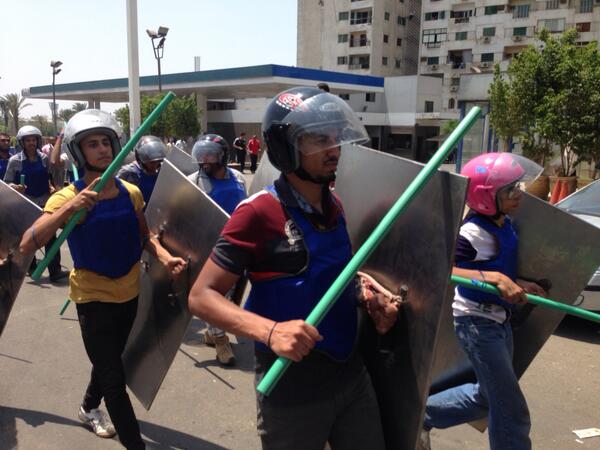
"......Shields, helmets and sticks at the very big pro Morsi gathering. "Morsi's men are everywhere." pic.twitter.com/iPf7mAlwMA..."

View image on Twitter

"A New York Times reporter has tweeted this photo of well-equipped pro-Morsi demonstrators."
IKHWAN MILITIAS??

Live Updates: Egypt braces for nationwide anti-Morsi protests

On a day that organisers have called a 'make or break' moment for President Morsi, millions expected to protest across the country calling for the ouster of Egypt's beleaguered leader

Ahram Online
Rebel
A military helicopter flies above Tahrir square as protesters opposing Egyptian President Mohamed Mursi demonstrate in Cairo June 30, 2013 (Photo: Reuters)
 

"....14:50 Ahram Online’s Bassem Aly speaks with prominent labour activist Kamal El-Fayoumi in Mahalla:
"The Muslim Brotherhood doesn’t dare to organise protests in Mahalla. The people of the city voted against the constitution and President Morsi and they reject the group’s presence in power.

"I am expecting around 1 million people to take to the streets of Mahalla this afternoon.

"Only 10 percent of workers at the state-owned Mahalla Misr Spinning and Weaving Company are working today, the others will be protesting."

El-Fayoumi describes President Morsi as "Mohamed Morsi Mubarak," adding that he has failed to fulfill any of his election promises.

"Mahalla contributed heavily to the removal of Mubarak from power, and we will do the same thing with Morsi." ........" 

Video: Al Jazeera talks to political analyst Shadi Hamid


"Shadi Hamid is the Director of Research at the Brookings Center here in Doha.

He comments about current political tension in Egypt."

Egypt's Mohamed Morsi remains defiant as fears of civil war grow

In exclusive interview with the Guardian, Morsi defiantly rejects call for elections, setting stage for trial of strength on the streets

and in Cairo
guardian.co.uk,

In an exclusive interview with the Guardian, Morsi rejected opposition calls for early presidential elections and said he would not tolerate any deviation from constitutional order. He said that his early resignation would undermine the legitimacy of his successors – creating a recipe for unending chaos......"