Monday, January 13, 2014

بين أَسَدَيْن!

الياس خوري

مات آرييل شارون بعد موته السريري الطويل. مات الرجل منذ ثمانية أعوام وطواه ما يشبه النسيان. لكن وفاته اليوم تذكّرنا بموته وتفتح أبواب المراثي والأسئلة حول مساره السياسي وجرائمه و’بطولاته’.
رجل سيبقى في ذاكرة ضحاياه نموذجاً لجلاد لا يرتوي من الدم، وعسكري حول الحـــرب الى مذبحة علنية، من قبية في الضفة الغربية عام 1953 الى شاتيلا وصبرا عام 1982 وصولا الى جنين عام 2002.
لكن سيرة هذا الرجل تأخذنا الى ما هو أبعد من مجرد تعداد جرائمه، و قراءة مسار سياسي وعسكري تميز بالتقلّب الذي أخذ بطله من القمة الى الحضيض ليعيده الى القمة من جديد. فشارون دخل تاريخ المنطقة بصفته الفضيحة التي حاولت الأيديولوجية الصهيونية إخفاءها طويلاً. غادر حزب العمل، لأن الحزب لم يحتمل صراحته، ليجد لنفسه بيتاً مؤقتاً في الليكود، ثم انقلب على بيته الجديد ليؤسس حزب كاديما الذي ضم في صفوفه شمعون بيريس، أحد القادة التاريخيين لحزب العمل. صار في الوسط حيث استعاد لغته القديمة بعدما أضاف اليها الحقيقة التي رفض معظم الإسرائيليين الإعتراف بها، وهي أن حرب النكبة مستمرة، وأن هذه الحرب لن تنتهي، في العرف الإسرائيلي، إلا بعد تدمير الشعب الفلسطيني بشكل كامل واحتلال كل فلسطين.
بدأ شارون حياته العسكرية في لواء الكسندروني في الهاغانا، وكان ابنا لبن غوريون الذي كلفه بتأسيس الوحدة 101 التي قامت بمذبحة قبية.
لكن ابن بن غوريون وربيب موشيه دايان وزميل اسحاق رابين، لم يجد فرصته للوصول الى رئاسة أركان الجيش الإسرائيلي، في ظلّ اللغة المزدوجة التي يتقنها اليسار الصهيوني. 
إنقلب على هذا اليسار كي يبقى مخلصاً للممارسات الوحشية التي رافقت تأسيس الدولة الصهيونية. فإسرائيل لم تتأسس إلا في مذابح اللد والرملة والطنطورة وعين الزيتون… لكن حلم استيطان ‘يهودا والسامرة’ واحتلال القدسلم يفارق لحظة المتخيل الصهيوني، الى أن جاءت لحظة الإحتلال بعد حرب 1967، لتعلن أن اسرائيل العمالية بقيادة غولدا مائير ليست معنية بالسلام، بل ان هدفها هو ابتلاع فلسطين وإحكام قبضتها على المنطقة. لذا أقيم الجدار الأول في سيناء الذي عرف باسم خط بارليف، قبل عقود من إقامة جدار الفصل العنصري في الضفة الغربية.
شارون هو سر بن غوريون الذي رفض مؤسس الدولة إعلانه، فكان لا بد من جنرال متعجرف ولد سياسياً في شلال الدم الذي صنعته حرب النكبة، كي يكشف الحقيقة.
كان شارون واضحاً وبسيطاً، لذا سيدخل التاريخ بصفته الرجل الذي حرر إسرائيل من أكاذيبها: من كذبة طهارة السلاح الى كذبة الشعب الصغير المحاصر الذي لا يسعى إلا الى السلام. فهذا الرجل الذي ذهب في منطق القوة الى حد احتلال بيروت، رأى في إسرائيل مشروعاً إستعمارياً يستطيع أن يمتلك نفوذاً وسطوة في البقعة الممتدة من باكستان الى الشمال الافريقي! كما رأى في الاستيطان استكمالاً طبيعياً لدولة نشأت كمشروع استيطاني استعماري، وكان يحتقر لغة أدعياء السلام الذين يغطون الجريمة بقفازات من الكلام.
وسط الدم الفلسطيني اللبناني عام 1982 كانوا ينشدون له ‘أريك ملك لبنان’، لكن مملكته اللبنانية سرعان ما تداعت، فنقل عرشه جنوباً، وصار ملك اسرائيل، وسط الإنتفاضة الثانية، حين قرر حزب العمل الحاكم التنكر لاتفاق أوسلو لكنه لم يجد في صفوفه قائداً يستطيع أن يخون لغته الكاذبة.
حاول ملك إسرائيل أن ينهي الإنقسام الأيديولوجي بين التصحيحيين وبين اليسار العمالي، فأسس حزبه، لكنه لم يعش ليرى أعجوبة وأد اللغة القديمة، فتلاشى حزب كاديما وعاد الليكود الى الساحة ومعه يمين يتسيّد اللحظة الإسرائيلية الراهنة، ويسار فقد معناه حين تجاوز الزمن ازدواجية لغته، وتخطت العولمة اليمينية الرأسمالية دولته.
وملك اسرائيل هو أسدها ايضا. لا أدري لماذا لم يتوقف المحللون السياسيون عند اسم الرجل. فهو يدعى اريئيل، والكلمة هي مزج لكلمتين: ارييه وايل، وهي في هذا تشبه الكثير من الأسماء العبرية كعزرائيل…
اسم ملاك الموت عزرائيل يعني مساعد الله، فهو مؤلف من كلمتي عزرا اي مساعد وايل اي الله. اما ارييه فتعني الأسد، واريئيل تعني اسد الله.
انه أسد إسرائيل، يا للمصادفة! اسرائيل تملك أسدها ايضاً! وهذا الأسد الإسرائيلي هدد بن اليعازار (فؤاد) بفضح مشاركة الضباط الإسرائيليين الى جانب الضباط السوريين في مذبحة تل الزعتر، وذلك عندما كان نواب حزب العمل يشنون عليه الهجوم في الكنيست بعيد مذبحة شاتيلا وصبرا.
أسد هناك يهدد بكشف أسد هنا! الأسدان فضحا خطاب والديهما: أسد اسرئيل فضح خطاب بن غوريون المراوغ وكشف عمق تجذره في الجريمة، وأسد سوريةفضح خطاب والده ‘القومي’ وكشف أن قوميته لم تكن الا غطاء لسحق الشعب السوري. وبينما اكتفى الأسد الإسرائيلي بقتل الشعب الفلسطيني ومحاولة سحقه، فإن الأسد السوري أضاف الى هذه الجريمة مشروع تحطيم سوريا وإحراقها.
أسدان يَلِغان في دم الضحايا، من تل الزعتر الى صبرا وشاتيلا، ومن جنين الى حلب، ومن ريف دمشق ومخيم اليرموك الى قرى فلسطين ودساكرها.
هذا ما كان يطلق عليه القائد الفلسطيني الراحل ياسر عرفات اسم استراتيجية الأكورديون، التي تحققت حين أطبق الأسدان على المقاومة الفلسطينية عام 1982.
شارون مات لكن شرط مواجهة الأسد الإسرائيلي الذي يتابع سياسة الفتك بالفلسطينيين، هو الخلاص من الأسد الآخر، الذي ربض على القلوب والصدور أربعة عقود وكان أحد ملوك طوائف هذا الإنهيار العربي.

Current Al-Jazeera (Arabic) Online Poll


Who is responsible for the deterioration of the situation in Anbar Provence in Iraq, the Maliki government or the tribal militias?

So far, 95% have said it is the Maliki goverment.

Noam Chomsky on the Legacy of Ariel Sharon: Not Speaking Ill of the Dead "Imposes a Vow of Silence"

Democracy Now!

"Former Israeli Prime Minister Ariel Sharon died Saturday after eight years in a coma at the age of 85. Sharon was one of the most dominant political figures in Israel’s history, involved in each of Israel’s major wars dating back to its founding in 1948. Among Palestinians, Sharon was one of the most reviled political figures in the history of the Israeli-Palestinian conflict. He is seen as father of the settlement movement and an architect of the Israeli invasion of Lebanon that killed a reported 20,000 Palestinian and Lebanese. We discuss Sharon’s legacy with three guests: Noam Chomsky, world-renowned political dissident, linguist, author and Institute Professor Emeritus at Massachusetts Institute of Technology; Rashid Khalidi, Edward Said Professor of Arab Studies at Columbia University; and Avi Shlaim, Emeritus Professor of International Relations at Oxford University, widely regarded as one of the world’s leading scholars on the Israeli-Arab conflict. "There is a convention that you’re not supposed to speak ill of the recently dead, which unfortunately imposes a kind of vow of silence, because there is nothing good to say," Chomsky says. "He was a brutal killer; he had one fixed idea in mind which drove him all his life — a greater Israel, as powerful as possible, as few Palestinians as possible… He doubtless showed courage and commitment to pursuing this ideal, which is an ugly and horrific one."......"

Noam Chomsky: Sabra & Shatila Massacre That Forced Sharon’s Ouster Recalls Worst of Jewish Pogroms

Democracy Now!

"We look at one of the most shocking incidents in the career of the late former Israeli Prime Minister Ariel Sharon: the Sabra and Shatila massacre. Up to 2,000 Palestinians died on Sept. 16-17, 1982, when the Israeli military allowed a Christian militia to attack the camp. Then-Defense Minister Ariel Sharon was forced to resign after a special Israeli investigative panel declared him to be "personally responsible" for the massacre. We air a description of the killings by Ellen Siegel, a Jewish-American nurse who was working at Gaza Hospital at the Sabra camp at the time of the attacks, and speak with Rashid Khalidi, Edward Said Professor of Arab Studies at Columbia University, and Noam Chomsky, world-renowned political dissident, linguist, author and Institute Professor Emeritus at Massachusetts Institute of Technology..."

Rashid Khalidi & Noam Chomsky: For Peace Today, US Must End Support for Sharon’s Expansionist Legacy

Democracy Now!

"Upon the death of former Israeli Prime Minister Ariel Sharon, we look at how his legacy of separating Gaza from the West Bank and building a "separation wall" to seal off Israeli settlements has impacted the peace process in the Middle East today. Noam Chomsky, world-renowned political dissident, linguist, author and Institute Professor Emeritus at Massachusetts Institute of Technology; Rashid Khalidi, Edward Said Professor of Arab Studies at Columbia University; and Avi Shlaim, Emeritus Professor of International Relations at Oxford University, widely regarded as one of the world’s leading scholars on the Israeli-Arab conflict. "What [Secretary of State] John Kerry should do is insist on implementing a very broad international consensus, virtually universal, calling for a two-state settlement on the internationally recognized border," Chomsky says. "This is supported by the entire world; it’s been blocked by the United States for 35 years. We should shift that policy, join the world, and carry out measures which might conceivably bring a semi-decent peace."...."

زمن الثورات العربية وآفاقها


قبل ثلاثة أعوام، وعبر "حادث عابر"، شهدنا ثورات كبيرة، بدأت من مدينة صغيرة في تونس هي سيدي بوزيد، حيث أشعل احتجاج شاب ثورة أفضت إلى تهريب بن علي، لتمتد بعد أيام من انتصارها إلى مصر، حيث جرى تنحية الرئيس محمد حسني مبارك بعد 18 يوما من الاعتصام في ميادينها.

ثم توسع الأمر لاحقا إلى البحرين واليمن وليبيا، وتحرك الشعب في الأردن والعراق والمغرب، بعد أن كان قد تحرك لفترة وجيزة في الجزائر، ثم تحرك أيضا في السودان.
ومازلنا في معمعان الثورات رغم ما أتت به، وما أوحى بأنها فشلت أو جرى الالتفاف عليها، أو حتى أنها انتهت، فقد أفضت، كما ظهر، إلى اللاشيء، حيث تكرّس النظام القديم بأسماء جديدة. 

وكانت قد قادت أطراف من السلطة القديمة مرحلة انتقالية سريعة، أوصلت في انتخابات أطرافا "إسلامية" (جماعة الإخوان المسلمين) إلى السلطة في كل من تونس ومصر، ووصل أيضا السلفيون، وبدرجة أقل مع سلطة أضعف في ليبيا التي جرى فيها تدمير الدولة والجيش معا، وبتغيير شكلي جدا في اليمن. 

وما زال الصراع الدموي قائما في سوريا، حيث تدافع السلطة عن وجودها إلى النهاية، حتى وإن قاد ذلك إلى تدمير البلد، وتراجعت التحركات في البلدان الأخرى دون أن تنتهي تماما.
أريد للثورة السورية أن تكون خاتمة للثورات من أجل أن "تتأدب" الشعوب، وتتعلم قبول الحكم القائم، والتكيف مع النمط الاقتصادي القائم، بعد أن ظهر أنها استمرأت التمرّد، وباتت تقلّد سابقاتها
السؤال الذي طرح خلال السنوات الثلاث تلك هو: هل هذه هي نهاية الثورات؟ وبالتالي ما الداعي لها ما دامت توصل إلى أن يسيطر الإسلاميون؟

خصوصا هنا مع ما جرى في الثورة السورية، التي تحولت إلى مجزرة بفعل الوحشية التي مارستها السلطة، وممالأة العالم، ومساعدته على ذلك بأشكال مختلفة، سواء ادعى دعم الثورة أو وقف على الحياد، حيث بدا أنها يجب أن تكون نهاية الانتشار الثوري، وخاتمته المأساوية.

وذلك من أجل أن "تتأدب" الشعوب، وتتعلم قبول الحكم القائم، والتكيف مع النمط الاقتصادي القائم، وتقبل ما يُعطى لها من النظم القائمة، بعد أن ظهر أنها استمرأت التمرّد، وباتت تقلّد سابقاتها بسرعة لا مثيل لها. 

وبعد أن ظهر أيضا أنها تحمل من الاحتقان ما يجعلها تهدم أحلام الطبقات المسيطرة، وتهدد مصالحها.

لا شك أولا في أن الثورات قد أحدثت صدمة كبيرة لدى التكوين السياسي القائم، الإقليمي والعالمي، حيث إنها فاجأت بأن الشعوب يمكن أن تنهض، وأنها بدأت فعلا بالنهوض، وهو الأمر الذي فرض وضع إستراتيجيات مواجهة، خصوصا وأن العالم يعيش أزمة كبيرة يمكن أن تجعل ما حصل هنا بداية لثورات عالمية كبيرة. 

لهذا كان الميل الأولي يتمثل في تحقيق التغيير السريع لتسكين الوضع الشعبي، وهو الأمر الذي حصل في تونس ومصر، لكن من ثم بدا الأمر أعقد من ذلك، لهذا جرى التدخل العسكري في ليبيا، وفرض حل شكلي في اليمن وسحق ثورة البحرين، وصولا إلى جعل الثورة السورية هي خاتمة المسار الثوري عبر تحويلها إلى مجزرة. 

وما زال الأمر كذلك، حيث أصبح إجهاض الثورات هو الهدف العام، وبات القلق الذي ينتاب الرأسمالية يفرض البحث عن سبل وقف تمرّد الشعوب. 

وستصوّر الثورة السورية كمثال على أن التمرّد يفضي إلى الدمار، وأن ما تأتي به الثورات هو الخراب.

لكن هل هذه هي حصيلة الأعوام الثلاثة من الثورات؟

ما يبدو اليوم هو أن التغيير الذي تحقق كان شكليا إلى حدّ كبير، وأن الثورات عممت الفوضى، وبالتالي لا يبدو أن التغيير الحقيقي ممكن، لأن النظم (أي الطبقات المسيطرة) تدافع عن سلطتها بكل العنف، وحتى الوحشية. 

وحيث إن الثورات قادت إلى الديمقراطية نجح "الإسلاميون" دون أن تتحقق مطالب الشعب، ومن ثم فالأفق مسدود، لأنه لا الطبقة المسيطرة تتخلى عن سلطتها ولا المعارضة تحمل مشروعا مختلفا، يمكن أن يكون مدخلا لتحقيق مطالب الشعب. 

ولهذا بعد الأمل الكبير الذي حكم الشعوب، والأوهام التي حكمت النخب، أصبح اليأس هو المسيطر، وبات الوهن هو الذي يحكم نشاط النخب.
إذا كانت التجربة قد أوضحت بأن "الإسلاميين" غير جديرين بالحكم، لأنهم لا يمتلكون برنامج تغيير يحقق مطالب الشعب، فقد أوضحت كذلك أن الحرية والديمقراطية هي أوهام نخب
طبعا لم تجرِ مساءلة الماضي لماذا سيطر الإسلاميون، ولم يجرِ التشكيك في ممارسات النخب، ولا في سياسات الأحزاب المعارضة، فكما فاجأت الثورات تلك النخب، فاجأها انتصار الإسلاميين، وأيضا فاجأها انهيارهم في مصر.
لهذا يجب ألا يؤخذ وضع هذه النخب بعين الاعتبار لأنها هي ذاتها من الماضي. ولقد توهمت بأنها يمكن أن تركّب على الثورات مطمحها الأساسي وهو: الحرية، لكي لا تتعرض للمساءلة فقط، وليس لكي تبني عليه مشروع تغيير كبير، ففوجئت بأن الحرية تأتي بالإسلاميين، لهذا أخذت تهرب إلى دكتاتور يحميها من سلطة هؤلاء.

وإذا كانت التجربة قد أوضحت بأن "الإسلاميين" غير جديرين بالحكم، لأنهم لا يمتلكون برنامج تغيير يحقق مطالب الشعب، فقد أوضحت كذلك بأن الحرية والديمقراطية هي أوهام النخب، وأن الأمر أعمق من أن يحلّ في انتخابات أو حريات يمكن أن تسمح للنخب بأن تعلي صوتها. 

فلا حريات حقيقية تحققت، ولا استقرار عاد، وظهر أن الأمور تسير نحو الفوضى. هذا الأمر فرض أن تميل بعض النخب لأن تقبل الاستقرار حتى في ظل "دكتاتور" على أن تسير الأمور نحو الفوضى أو نحو صراع دموي كما في سوريا.

لكن في كل الأحوال يمكن أن نشير إلى أن هناك ثلاث مسائل جوهرية توضحت خلال السنوات الثلاث، وهي التي تؤشر لماهية المستقبل بالضرورة. 

فأولا أن للشعب مطالب، وأن من يصل إلى السلطة بعد الثورات يجب أن يحققها أو أن يرفض من جديد، والمطالب لا تقف عند تغيير الأشخاص أو شكل السلطة بل تفترض إيجاد حلول اقتصادية لمشكلات مجتمعية عويصة. 

وقد ظهر أن التركيز على الحرية والديمقراطية ليس كافيا، وأصلا هو غير ممكن دون تلمّس المشكلات الأساسية التي فرضت ثورة الشعب. 

فقد سارت مصر نحو الانتخابات وتحققت حريات معينة لكن الشعب لم يتوقف عن الاحتجاج في مطالب اقتصادية واضحة، وبات الحراك الشعبي يتمحور حول المطالب الاجتماعية، وليس في التوهان خلف الانتخابات والصراعات السياسية. 

هذا الأمر يوضح بأن أفق الثورات مرتبط بتحقيق ما هو أبعد من تغيير شكل السلطة أو أشخاصها، أو حتى إعطاء قدر أعلى من الحريات، بل مرتبط بتغيير النمط الاقتصادي الذي فرض نشوء مشكلات البطالة والفقر الشديد وانهيار التعليم والصحة والبنية التحتية. 

ولهذا فإن المطلوب هو تغيير جذري يبدأ من البنية الاقتصادية، ليعيد صياغة الشكل السياسي، وكل تجاهل لذلك لا يفعل سوى استمرار الثورات، ومن ثم لا استقرار قبل تحقيق التغيير العميق ذاك. نحن في عقد من الصراعات إذن.

وثانيا أن مستوى التهميش والفقر والبطالة والسحق فرض على الشعوب أن تتمرد، وبالتالي أن تكسر حاجز الخوف الذي أقامته النظم عبر كل أجهزتها الأمنية وعنفها طيلة عقود طويلة. 

فقد قامت إستراتيجية النظم على إرعاب الشعوب عبر الاستبداد، وفرضت عليها قبول الأمر الواقع، لكن كان ممكنا قبول الأمر الواقع حينما كانت الشعوب قادرة على العيش، لكن أن تصبح غير قادرة على العيش يفرض كسر كل إمكانية للخوف.
لن يتوقف التغيير قبل أن يتحقق بما يعنيه من تغيير النمط الاقتصادي والتكوين السياسي، وهنا تندرج مطالب الحرية والدولة العلمانية الديمقراطية بمطالب العمل والأجر المناسب والتعليم والصحة
وهذا الأمر يعني بأن الصراع سيستمر، وأن الاستقرار لن يكون ممكنا قبل تحقيق التغيير الذي يحقق مطالب الشعب، وبالتالي نحن في مرحلة صراع ربما يكون ممتدا لعقد، ولن يتوقف قبل أن يتحقق التغيير بما يعنيه من تغيير النمط الاقتصادي والتكوين السياسي، وهنا تندرج مطالب الحرية والدولة العلمانية الديمقراطية بمطالب العمل والأجر المناسب والتعليم والصحة المجانيين والحقيقيين.

الشعب لم يعد يستطيع العودة إلى السكون والهدوء بعد أن تمرّد، وهو يريد التغيير الذي يغيّر من وضعه الاقتصادي أولا والسياسي بالتالي.

وثالثا أن الثورات قامت على أكتاف الشباب الذي كان قد "هرب" من السياسة والأحزاب السياسية، وأصبح منخرطا في السياسة بعد أن خاض الثورة، واكتشف أنه يخوض في غمار السياسة من أوسع أبوابها: الثورة.

وهذا الأمر فرض الميل العام لتطوير الوعي السياسي وزيادة الفعل السياسي، وهذا الأمر يعني تحقيق تجديد عميق في الفعل السياسي وفي الحركة السياسية، يقوم على مبدأ التغيير العميق انطلاقا من مطالب الشعب، وهو ما يؤشر على أن المرحلة القادمة سوف تشهد تبلورات سياسية جديدة وجادة، يمكن لها أن تخرج الثورات من عثراتها التي نتجت بالضبط عن غياب القوى السياسية والفعل السياسي.

هذه العناصر هي خلاصة سنوات ثلاث من الثورات، وهي البداية لثورات أعمق وأكثر تأثيرا، فالشعوب تريد التغيير الحقيقي لكي تتحقق مطالبها، وهي مصممة على الاستمرار بعد أن كسرت حاجز الخوف. وإذا كانت لم تحظَ بقوى تساعدها على التغيير فقد أخذت تفرز من ذاتها القوى التي يمكن أن تحمل مشروع التغيير

The whitewashing of Ariel Sharon

By Ramzy Baroud
Asia Times
Whitewashing Ariel Sharon
(Cartoon by Carlos Latuff)

"The death of former Israeli leader Ariel Sharon enlivened US media's interest in the legacy of a man considered by many a war criminal, and by some a hero. In fact, the supposed heroism of Sharon was at the heart of CNN coverage of his death on January 11. 

Sharon spent his last eight years in a coma, but apparently not long enough for US corporate media to wake up from its own moral coma. CNN online's coverage presented Sharon as a man of heroic stature, who was forced to make tough choices for the sake of his own people. "Throughout, he was called 'The Bulldozer', a fearless leader who got things done," wrote Alan Duke. 

In his article, "Ariel Sharon, former Israeli Prime Minister, dead at 85", Duke appeared to be confronting Sharon's past head on. In reality, he cleverly whitewashed the man's horrendous crimes, while finding every opportunity to recount his fictional virtue. "Many in the Arab world called Sharon 'the Butcher of Beirut' after he oversaw Israel's 1982 invasion of Lebanon while serving as defense minister," Duke wrote. 

Nevertheless, Sharon was not called the "The Bulldozer" for being "a fearless leader" nor do Arabs call him "the Butcher of Beirut" for simply "overseeing" the invasion of Lebanon. Duke is either ignorant or oblivious to the facts, but the blame is not his alone, since references to Sharon's heroism was a staple in CNN's coverage. 

Sharon's demise however, and the flood of robust eulogies will neither change the facts of his blood-socked history, nor erase the "facts on the ground" - as in the many illegal colonies that Sharon so dedicatedly erected on occupied Palestinian land. 

Following the Israeli occupation of Gaza along with the rest of Palestine in 1967, Sharon was entrusted with the bloody task of "pacifying" the headstrong Strip as he was the head of the southern command of the Israel Defense Forces. Sharon was dubbed the "Bulldozer" for he understood that pacifying Gaza would require heavy armored vehicles, and Gaza's crowded neighborhoods and alleyways weaving through its destitute refugee camps were not suited for heavy machinery. 

Therefore, he resolved to bulldoze thousands of homes, preparing the way for tanks and bulldozers to move in and topple even more homes. Modest estimates put the number of homes destroyed in August 1970 alone at 2,000. Over 16,000 Palestinians were made homeless and thousands were forced to relocate from one refugee camp into another. 

The Beach Refugee Camp near Gaza City sustained most of the damage. Many fled for their lives, taking refuge in mosques and UN schools and tents. Sharon's declared objective was targeting the terrorist infrastructure. What he in fact meant was targeting the very population that resisted and aided the resistance, for they indeed were the very infrastructure he harshly pounded for many days and weeks. 

Sharon's bloody sweep also resulted in the execution of 104 resistance fighters and the deportation of hundreds of others. Some were sent to Jordan, others to Lebanon, and the rest were simply left to rot in the Sinai desert. 

Sharon's violence was part of an equally disturbing logic. He believed that any strategic long-term plan to secure Israel must have at its heart a violent campaign aimed at disorienting Palestinians. He was quick to capitalize on the Allon plan, named after Yigal Allon, a former general and minister in the Israeli government, who took on the task of drawing an Israeli vision for the newly conquered Palestinian territories. 

Sharon recounted standing on a dune near Gaza with cabinet ministers, explaining that along with military measures to control the Strip he wanted "fingers" of settlements separating its cities, chopping the region in four. Another "finger" would thrust through the edge of Sinai, helping create a "Jewish buffer zone between Gaza and Sinai to cut off the flow of weapons" and divide the two regions in case the rest of Sinai was ever returned to Egypt. That legacy disfigured and isolated Gaza, even years after Sharon implemented his policy of unilateral "disengagement" in 2005. He relocated the settlers to other illegal colonies in the West Bank and imposed a hermetic siege on the Strip, the consequences of which remain suffocating and deadly. 

Sharon was keen on espousing or exploiting the division of his enemies. He moved against Lebanon in 1982, when the country was at its weakest point, exhausted by civil war. And when Israeli forces finally occupied Lebanon in 1982, as Palestine Liberation Organization fighters were shipped by sea to many countries around the Middle East, a triumphant Sharon permitted his Christian Phalangist allies to enter the defenseless Sabra and Shatilla refugee camps. 

In the days between September 16-18, 1982, as Israeli troops completely besieged the camps, the Phalangists entered the area and carried out a massacre that gruesomely defined both the Lebanese civil war and the Israeli invasion, killing thousands of Palestinian refugees, mostly butchered with knives, but also gunned down. 

Although Sharon was partly discredited after his disastrous war in Lebanon, Israeli voters brought him back repeatedly, to lead the rightwing Likud party in May 1999 and as a prime minister of Israel in February 2001. The aim was to subdue rebelling Palestinians during the Second Intifada. In fact, it was Sharon's provocative "visit" to one of Islam's holiest shrines a few months earlier that sparked anger among Palestinians and, among other factors, started the uprising. 

Sharon attempted to crush the uprising with the support and blessings of the US, but he failed. By the end of August 2001, 495 Palestinians and 154 Israelis were killed. International attempts at sending UN observer forces were thwarted by a US veto on March 27, thus paving the way for the Israeli army to thrash its way into Palestinian refugee camps and other areas formerly controlled by the Palestinian Authority. 

In March and April 2002, Sharon ordered Operation "Defensive Wall", which resulted in major military incursions into most West Bank cities, causing massive destruction and unprecedented bloodletting. The Israeli operation led to the killing of hundreds of Palestinians, the reoccupation of major Palestinian towns, the destruction of Arafat's headquarters in Ramallah, and the subsequent besiegement of the Palestinian leader in his barely standing office. 

Sharon was no hero. It is time for US media to wake up from its own coma, and confront reality through commonsense and the most basic human rights values. It should not be looking through the prism of the most rightwing, if not fascist elements of Israeli society. "

Egypt: Activists Arrested for ‘No’ Campaign

Repression Intensifies Ahead of Constitutional Referendum
Human Rights Watch

Egyptian citizens should be free to vote for or against the new constitution, not fear arrest for simply campaigning for a ‘no’ vote. Protecting the right to vote requires safeguarding the right to free expression.
Joe Stork, Middle East and North Africa deputy director
"(New York) – At least seven peaceful activists from the Strong Egypt party face criminal charges, apparently for hanging posters calling for a “no” vote in the forthcoming constitutional referendum. During interrogations with prosecutors and police, questions fixated on the posters and the men’s political views. The constitutional referendum will be held on January 14 and 15, 2014.
Police arrested the activists in three separate incidents after finding them in possession of posters calling for a “no” vote in the week preceding the referendum. Prosecutors charged the first group of three, arrested on January 7, under a section of the penal code that criminalizes “propogat[ing]… the call for changing the basic principles of the constitution…when the use of force or terrorism, or any other illegal method, is noted during the act.” A fourth party member detained on January 10 faces charges related to alleged involvement in terrorism. Three others, apprehended on January 12 for “distributing fliers, attempting to overthrow the regime, provoking citizens to reject the constitution, and engaging in incitement against the police and army,” will be brought in front of prosecutors on January 13 to face specific charges.

“Egyptian citizens should be free to vote for or against the new constitution, not fear arrest for simply campaigning for a ‘no’ vote,” said Joe Stork, Middle East and North Africa deputy director. “Protecting the right to vote requires safeguarding the right to free expression.”
The referendum comes in the midst of widening repression against political dissent in which arbitrary arrests solely for the exercise of peaceful expression and assembly have increased. While streets are awash with billboards and signs calling for a “yes” vote, “no” posters have been virtually absent from the public square.   
On January 7, police arrested three volunteers from the Strong Egypt party, a centrist party founded by Abd al-Moneim Abu al-Fotouh, who left the Muslim Brotherhood due to ideological differences in 2011. The three – 30-year-old accountant Ihab Abd al-Karim, the party’s secretary for public outreach in Giza; 21-year-old Islam al-Akabawy, a law student at Cairo University; and 22-year-old Ali Mohamed Ali, a law student at al-Azhar University – were arrested around 10 p.m., minutes after they had finished hanging several dozen “No to the Constitution” posters in the Garden City neighborhood of downtown Cairo, Abd al-Karim and a witness told Human Rights Watch.
Police approached the men from behind as they walked together on the Corniche al-Nil, a road along the Nile River, still holding a handful of posters, on their way to catch public minibuses home. After asking a few questions about the signs, the police arrested the men and transported them to the nearby Qasr al-Nil police station.
Police detained a fourth party activist, 35-year-old Mahmoud Emam, who runs a make-up and perfume store, in the early hours of January 10. He told Human Rights Watch that police pulled him off a minibus at a police checkpoint near the Ahmed Sa’ed Bridge in the Abbassiya district of eastern Cairo and discovered posters and fliers calling for a “no” vote inside a newspaper he was carrying. Emam had been on his way home after a night in which he had put up “no” signs in the Dokki neighborhood of western Cairo and had stopped at the Qasr al-Nil station to check on Abd al-Karim, al-Akabawy, and Ali.

The police arrested three other party members, Sami Ashraf, Mohamed Abu Leila, and Ahmed Badawi, as they finished hanging in Hadayek al-Qobba, a district in eastern Cairo, at around 7 p.m. on January 12, according to Abd al-Rahman Yusif, a Strong Egypt party lawyer who spoke to the men at the Hadayek al-Qobba police station where they were held later that night.

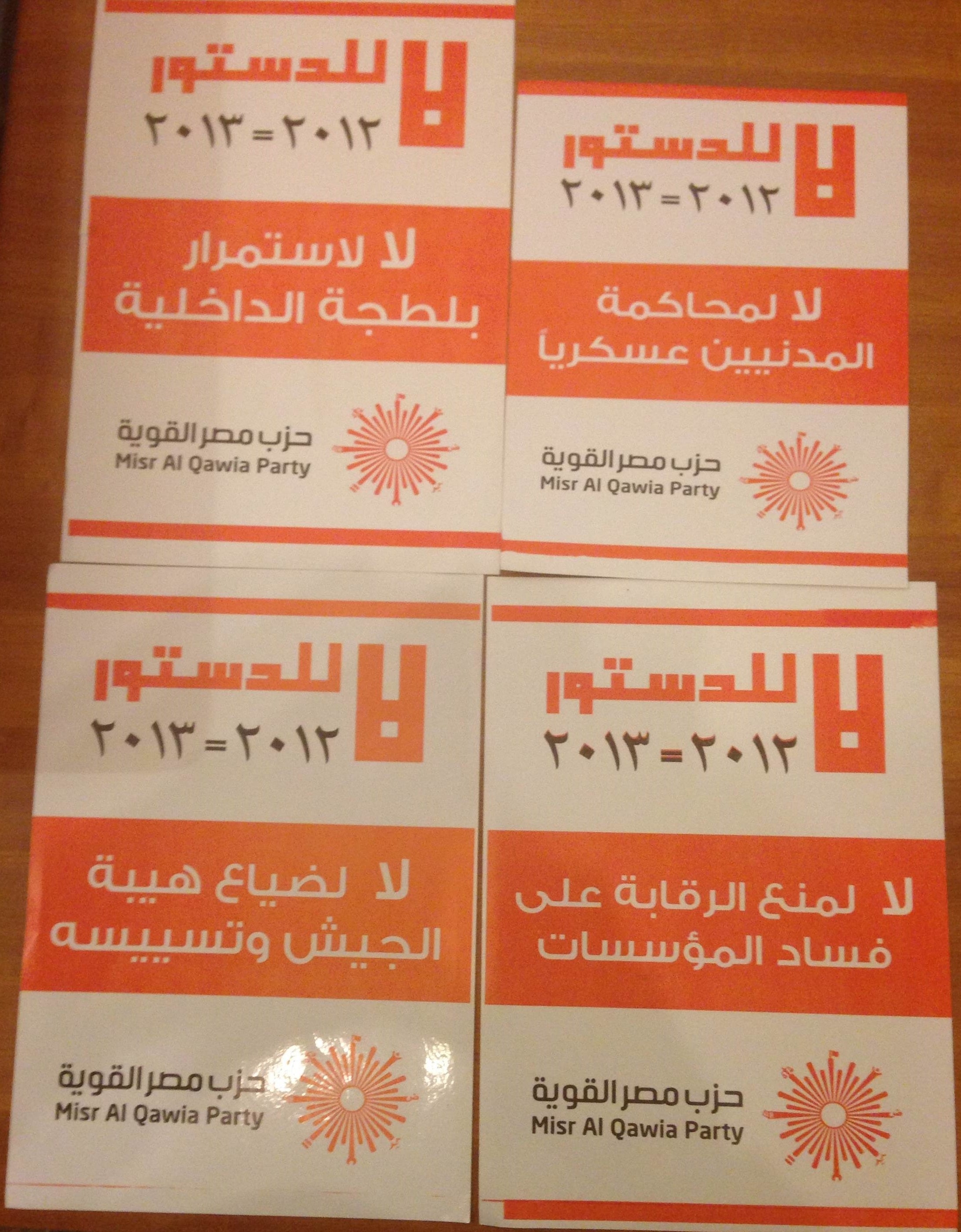
The posters read “No to the Constitution” and “2013 = 2012” in Arabic at the top, and include the name of the Strong Egypt party in both Arabic and English at the bottom. Different variations of the middle section contain one of five slogans in Arabic: “No to Military Trials for Civilians,” “No to the Army’s Loss of Prestige and Politicization,” “No to the Denial of Oversight Over the Corruption of Institutions,” “No to the Loss of the Rights of the Downtrodden to the Account of Businessmen,” and “No to the Continuation of the Interior Ministry’s Thuggery.”

Upon seeing this last sign, officers at the checkpoint who arrested Emam punched him repeatedly, exclaiming: “We will show you the thuggery of the Interior Ministry,” Emam told Human Rights Watch. Abd al-Karim and Emam both said that when police took their pictures at the respective stations they were being held at, they forced them to hold signs that read “Posters in Opposition to the Regime.”

Prosecutors interrogated Abd al-Karim, al-Akabawy, and Ali on January 8. According to Mohamed Atef and Yasmin al-Sheikh, lawyers present for the interrogations of each of the three men, prosecutors questioned the activists about where they got the posters, who funded the effort, and why they were putting them up. Having confiscated the men’s phones, they also asked about video footage of protests found on them. In none of the interrogations did prosecutors ask about or accuse the activists of using force or coercion of any kind.

Prosecutors charged the three men under article 98(b) of the penal code. The section prescribes penalties of not more than five years imprisonment and fines of no less than 50,000 Egyptian pounds (USD$7180) to:
Whoever propagates in the Republic of Egypt, by any means, the call for changing the basic principles of the constitution or the basic system of the social body, or condemning a social class with regards to other classes or eliminating social classes or to overthrow the basic state economic or social system, or destroying any core institution to the social body when the use of force or terrorism, or any other illegal method, is noted during the act.
Prosecutors initially questioned Emam on January 10 without a lawyer present, he told Human Rights Watch. Police focused on the posters calling for a “no” vote and on Emam’s political views, asking why he opposed the constitution and whether party head Abu al-Fotouh would run for president. On January 11, prosecutors again interrogated Emam, but this time in the presence of lawyers. Strong Egypt party lawyer Yusif, present for the interrogation, told Human Rights Watch that prosecutors decided to charge Emam under article 86 of the penal code, which proscribes penalties for involvement in acts of terrorism. The only evidence produced by the prosecutor were the posters and Emam’s involvement in the Strong Egypt party, Yusif said.

Prosecutors ordered al-Karim, al-Akabawy, Ali, and Emam released from custody pending charges. Al-Akabawy and Ali left the Qasr al-Nil police station in the early hours of January 10, while Abd al-Karim was released around 5 p.m. that day. The men told Human Rights Watch they spent their nights in custody in overcrowded detention cells in the basement of the police station, where they were crammed so tightly along with several dozen criminal detainees that they had no room to sit. Police released Emam from the al-Dhaher police station at around 10:30 p.m. on January 11, after two nights in tiny three-by-three meter underground cells with 20 criminal detainees, all of whom had been there over a month, Emam said.

Emam and Abd al-Karim told Human Rights Watch that before agreeing to release the four men, police turned them over to an officer with National Security for questioning. Abd al-Karim said that the officer from National Security told him he “should be thankful for your good luck. If the situation [in Egypt] had not calmed down, we would have renewed your detention for 15 days after 15 days and kept you in prison, where the conditions are like nothing you have seen. You have been spoiled.”

Hours before his release, police officers approached Emam in his detention cell and asked him to take off his undershirt and tear it up in front of the other detainees, Emam told Human Rights Watch. Then two police officers blindfolded him and whisked him out of the cell. Blindfolded and firmly held between the two officers, they forced him to run up two flights of stairs as they hit him repeatedly. At the top of the staircase, an unidentified officer interrogated Emam about his political views, asking him how he voted in previous elections, what parts of the constitution he opposed, and what he thought would happen in Egypt if the constitution did not pass.

At the time of writing, police had yet to release Ashraf, Abu Leila, and Badawi.

Police on January 11 arrested an eighth Strong Egypt party activist, 20 year-old engineering student Mohamed Baghat, in Khosous, a city in the Qaloybia Governorate north of Cairo, according to a Strong Egypt party member in the city who spoke with Baghat and requested anonymity. This person told Human Rights Watch that police detained and repeatedly struck Baghat after witnessing him spray-paint “No to the Constitution” on the wall of a public school, where a “Yes to the Constitution” conference was being held. Baghat was released without charge on January 12 after a night in a detention cell at the Khosous police station and interrogation by National Security officers.

Police held another party member, Mohamed Ahmed Mohamed Mohamed Abdullah, for several hours at the Khosous police station as he attempted to secure Baghat’s release, according to the party member who spoke with Abdullah and Human Rights Watch. While in detention, this person said, police violently beat Abdullah, including by hitting him in the head with the barrel of a rifle.

The arrests of the Strong Egypt activists fit an increasingly prevalent practice of police detaining political activists solely on the basis of peaceful expression, Human Rights Watch said. With specific regards to the campaign around the referendum, the ONA news agency reported on December 9, 2013, that police had arrested seven activists from al-Azhar University carrying banners calling for “No to the Constitution” and “No to the Protest Law.” According to the state-run al-Ahramnewspaper, police in Aswan in Upper Egypt arrested nine members of the Muslim Brotherhood on January 5, 2014, for distributing flyers calling for a boycott of the referendum.

In a January 10 news conference, Interior Minister Mohamed Ibrahim declared “every Friday no less than 500 to 600 get arrested… at the beginning, we used to wait for the demonstration to turn violent, but now we confront them once they congregate. When we confront them, there are some that run, but, whoever we can grab, we detain.” Over the past three Fridays police have arrested 703 protesters and killed 27, according to the Interior and Health Ministries. Ibrahim also warned that “any attempt to disrupt the referendum or to prevent citizens from voting will be confronted by a level of force and severity that has not been seen before.” 

As a state party to the International Covenant on Civil and Political Rights (ICCPR) and the African Charter of Human and Peoples’ Rights, Egypt is required to protect freedom of expression. The United Nations Human Rights Committee, the body of experts that reviews states’ compliance with the ICCPR, has written that the freedom of expression is “essential” to the full enjoyment of the right to participate in public affairs and vote.

Article 65 of Egypt’s draft constitution states that “[a]ll individuals have the right to express their opinion through speech, writing, imagery, or any other means of expression and publication.”

“The assessment of whether a vote is free and fair has to involve a comprehensive evaluation of the political climate,” Stork said. “Prosecutors should immediately drop the charges against the Strong Egypt activists and ensure that citizens can peacefully protest during the referendum.”"

'Man of peace'? Ariel Sharon was the champion of violent solutions

Sharon's legacy is the empowerment of some of the worst elements in Israel's dysfunctional politics


Andrzej Krauze illustration for Ariel Sharon
Ariel Sharon was 'essentially a fighting machine'. Illustration: Andrzej Krauze
"Ariel Sharon, who died on Saturday after eight years in a coma, was one of Israel's most iconic and controversial figures. His long and chequered career as a soldier and politician largely revolved around one issue: the conflict between Israel and its Arab neighbours. As a soldier he was involved at the sharp end of this bitter conflict. As a politician he became known as "the Bulldozer" on account of his contempt for his critics and his ruthless drive to get things done. Sharon was a deeply flawed character, renowned for his brutality, mendacity, and corruption. Yetdespite these flaws he holds a special place in the annals of his country's history.
Sharon was an ardent Jewish nationalist, a dyed-in-the-wool hardliner, and a ferocious rightwing hawk. He also displayed a consistent preference for force over diplomacy in dealing with the Arabs. ReversingClausewitz's famous dictum, he treated diplomacy as the extension of war by other means.
The title he chose for his biography aptly summed him up in one word – Warrior. Like Shakespeare's Coriolanus, Sharon was essentially a fighting machine. His critics denounced him as a practitioner of "gun Zionism", as a perversion of the Zionist idea of the strong, fair-minded, and fearless Jew. To the Palestinians Sharon represented the cold, cruel, militaristic face of the Zionist occupation.
In 1953 Major Sharon committed his first war crime: the massacre of 69 civilians in the Jordanian village of Qibya. In 1982, as minister of defence, he led Israel's invasion of Lebanon in a war of deception that failed to achieve any of its grandiose geopolitical objectives. A commission of inquiry found Sharon responsible for failing to prevent the massacre by Christian Phalangists of Palestinian refugees in Beirut's Sabra and Shatila camps. This verdict was etched on his forehead like a mark of Cain. But who foresaw that the man who was declared unfit to be minister of defence would bounce back as prime minister?
During the 2001 elections campaign Sharon tried to reinvent himself as a man of peace. His spin doctors cultivated the notion that old age was accompanied by a personal transformation from a sanguinary soldier into a genuine peace-seeker. President George W Bush famously described Sharon as "a man of peace". For the last 40 years the Arab-Israeli conflict has been my main research interest, and I have not come across a scintilla of evidence to support this view. Sharon was a man of war through and through, an Arab-hater, and a pugnacious proponent of the doctrine of permanent conflict. Following his rise to power Sharon therefore remained what he had always been – the champion of violent solutions.
The dominant preoccupation of Sharon's premiership was the "war on terror" against militant Palestinian groups. No peace negotiations with the Palestinian Authority took place between 2001 and 2006, and Sharon regarded this as something to be proud of. To his way of thinking negotiations necessarily involve compromise, and he consequently avoided them like the plague.
For this reason he also rejected all international plans aimed at a two-state solution. One was the 2002 Arab peace initiative, which offered Israel peace and normalisation with all 22 members of the Arab League in return for agreeing to an independent Palestinian state on the West Bank and Gaza, with a capital city in East Jerusalem. Another was the 2003 Quartet road map, which envisaged the emergence of a Palestinian state alongside Israel by the end of 2005.
Sharon was the unilateralist par excellence. His ultimate aim was to redraw unilaterally Israel's borders, incorporating large swaths of occupied territory. Stage one was to build on the West Bank the so-called security barrier which the Palestinians call the apartheid wall. The international court of justice condemned this wall as illegal. It is three times as long as the pre-1967 border, and its primary purpose is not security but land-grabbing. Good fences may make good neighbours, but not when they are erected in the neighbour's garden.
Stage two consisted of the unilateral disengagement of Gaza in August 2005. This involved the uprooting of 8,000 Jews and the dismantling of many settlements − a shocking turnaround by a man who used to be called the godfather of the settlers. Withdrawal from Gaza was presented as a contribution to the Quartet's road map but it was nothing of the sort. The road map called for negotiations; Sharon refused to negotiate. His unilateral move was designed to freeze the political process, thereby preventing the establishment of a Palestinian state and maintaining the geopolitical status quo in the West Bank.
The legal term "depraved indifference" refers to conduct that is so wanton, so callous, so reckless, so deficient in a moral sense of concern, so lacking in regard for the lives of others, and so blameworthy as to warrant criminal liability. Sharon personified this kind of indifference in his approach to the Palestinians.
Towards the very end of his active life he bolted from the Likud to create the centrist party Kadima, but Kadima did not survive his demise. Today it has only two seats in the 120-member Knesset. So Sharon's last-minute attempt to bring about a realignment in Israeli politics ended in failure.
His enduring legacy has been to empower and embolden some of the most racist, xenophobic, expansionist, and intransigent elements in Israel's dysfunctional political system."

Arab revolutions and Neoliberal illusions

It is naive to assume that the Arab people in face of setbacks have retreated from their democratic aspirations.


Al-Jazeera

In the waning days of 2013, the harsh tenets of neoliberalism seemed to be gaining ground [Reuters]

"Words “are witnesses which often speak louder than documents,” wrote Eric Hobsbawm in ‘The Age of Revolution 1789-1848.’  And in an age of Arab Revolutions (2010- ), words have become effective lethal weapons of counter-revolutions. No such a common word may capture this wisdom of the brilliant historian these days than the western category of liberal democracy preached by neoliberal Arab intellectuals as their people struggle for uprooting the neo-colonial system of oppression and the alliance between global capital and Arab economic elite.
The democracy concept illuminates not only the dynamics of the ongoing social and historical confrontations in the Arab homeland, but also highlights the failure of this concept, in the non western world, to address either the socio-economic root-causes of the Arab uprisings or address the critical question of democratizing (or transforming the structure of) the Arab state, and not simply ‘peacefully’ organize the intra-elite transfer of power.
And as the ongoing debate illuminates, this very concept of democracy and the sprouting liberal lingo embraced by a segment of Arab intellectuals are but tools to reproduce the ugly past of tyranny.
Pessimism of the intellect
From the end of 2013’s vantage-point, one cannot help but note that scores of attentive and highly alert Arab intellectuals are fearfully looking forward now (not backward), as their region is being propelled into the future, contemplating a possible catastrophic triumph of a sprouting western backed elite counter-revolutionary forces.
As they look forward, it is not precisely, and only, the massive ruins that have been accumulating by the process of history that catch their eyes or even have become their only source of dismay and anxiety. But, it is the possible triumph of neo-colonial (neo-liberal) forces whose lethal counter attacks have not only been economic, military, or political, but, probably in their most destructive form, have also been ideological.
The current storm that began at the end of 2010 as promising social revolutions, with unambiguously socio-economic and geo-political roots, unleashed what might possibly be modern history's most nasty force to which, I am afraid, modern Arab history and the impoverished and wretched popular classes in the Arab homeland were not prepared.
Of course there is nothing particularly Arab about this unpreparedness and it is neither cultural nor technological. The transformation of the Arab region might mean nothing less than changing the world. Had the Arab people been facing their elite only, the confrontation might have been settled in 2012. But as the US and Russia negotiate a settlement in Syria and struggle in Egypt, it is obviously a global conflict that embodies the fate of the world order and international relations, that Arab people face in their quest for freedom.
True, the storm might be far from over as of yet, and true, only revolutions, in the most orthodox sense of the word, can fundamentally change the political and economic regimes (what people want, as the slogan goes) and seriously address the socio-economic injustices that led to their outbreaks and address the geo-political and regional challenges.
But, as it seemed at the end of 2013, it is the tenets of harsh neoliberalism that are momentarily gaining ground. Aside from the daily bloody confrontations in the streets and public squares between opposing historical and political blocks desiring different futures, neoliberal counter revolutionary forces succeeded, until now, in steering the uprisings away from their original socio-economic quests and geo-political agenda. The hegemonic category of Western liberal democracy (and equally the ahistorical and false conception of nonviolent change) signify the fatal illusion through which counter-revolutions aspire to reproduce a putrescent old world. 
Click here to view the interactive
What democracy?
It is very fitting to recall Edmund Burke's infamous onslaught on the French Revolution. It is, I think, a necessary starting point that future Arab historians, sitting comfortably and free at the "New Bibliotheca Alexandrina" years from now, must consider to impartially construct the seemingly incomprehensible dynamics of the revolution counter-revolution in the Arab homeland into some sort of intelligible account.
Burk's piece, "Reflections on the Revolution in France", was not merely an attack on the idea of social revolution, but it was also a defining piece of modern conservatism and classical liberalism. It enfolded the seeds of conservative neoliberal ideology that currently informs the fierce counter-revolution in the Arab homeland.
Burke's assault on the very idea of social revolution and participatory democracy, his support for settler constitutional democracy in North America notwithstanding, goes on at the end of 2013 (the difference between the two revolutions of course explains Burke's posture). This time, through the appalling disconcerting efforts of some neoliberal Western-educated mainstream Arab intellectuals to reproduce the ugly past of neoliberal tyranny and avert people's revolts through the tools of liberal democracy, individual empowerment, citizenship, and nonviolence.
Three years later, and while looking backward and forward, it is not only the ghost of Burk and his onslaught on revolution that is still haunting revolutions everywhere, but also that of Friedrich Hayek's "Constitution of Liberty", and of course, the icons of neo-conservatism, Ronald Reagan and Margaret Thatcher. It is these faces and reactionary ideas that recalls as s/he listens to some Arab intellectuals preaching these ahistorical falsehoods and ignoring the very structure of oppression.   
What tyranny?
The anti-tyranny liberal democracy discourse promises merely, and only, another elite system of governance, just as tyranny is an elite system of governance. It might democratise governance and organise the inter-elite transfer of power. But it definitely fails to significantly transform the role of the state and the political and economic systems. It neither addresses the underlying socio-economic arrangements nor the geopolitical order. As such, the on-going debate in the Arab elite circles regarding constitutions, civil state, and the role of religion is really meaningless. They are merely manifestations of an ugly inter-elite power struggle within the context of the same old socio-economic arrangements and geo-political order. 
Tyranny is not, therefore, simply a nasty despot refusing the "peaceful" transfer of power, as the discourse of liberal democracy constructs tyrants. Tyranny is never individual, unless we ascribe to individual tyrants a personal power of "initiative unparalleled in world history", as goes Karl Marx's criticism of Victor Hugo's "Napoleon le Petit" characterisation of the 1852 coupe d'etat of Louis Philip of France in the "The Eighteenth Brumaire of Louis Bonaparte".
True, Mubarak and his ilk of Arab tyrants are a problem, but they are not the problem. They were and are nothing more than representatives of an oppressive alliance of local and global elite forces that recalls colonial times in its most dreadful times. Liberal democracy can hardly address either local or global dimensions of oppression as long as it does not address the question of the state structure and socio-economic arrangements.
To those who have no confidence in the power of the people, the Arab uprisings seemed like a bolt in a blue sky.
Optimism of will
It is a "good moment to be a social historian", wrote Eric Hobsbawm some four decades ago in his 1971 essay "From Social History to the History of Society". The historian's statement, of course, might have embodied a reference to growth and expansion in the field of historiography, to discursive shifts and epistemological uncertainties that continuously disturb the writing of history, and to methodological innovations that called the given assumptions of earlier traditions into question.
But historiographical sensibility is the least of my concerns in this short intervention. It is the story of the most colossal event in the modern history of Arab homeland; the story of astoundingly heroic people challenging not an Arab elite, but a global system of oppression and tyranny.
Three years after the Arab peoples amazing revolts unleashed unpredicted chain of events, it is, therefore, rather vital to be more than attentive, if not highly alert, not only to how events have been unfolding but also to how the history of these uprisings has been recorded. The neo-liberal onslaught on the revolutions in the Arab homeland has not been limited to disseminating illusions of individual empowerment and citizenship within the context of an excessive system of inequality, but also in narrating the story of the revolutions and mischaracterising the revolts as movements seeking individual rather than socio-economic demands.
The story of the Arab revolutions thus far dispels the illusion that regional and global powers are an unquestioned fate, if not an ageless fact of life. The utopia seemed very real and closely at hand just a year ago. Despite the hitherto tragic unfolding course, therefore, the real story of the Arab uprisings carries within it the hope for a just future.
In the year 2000, a few thousand Arab resistance fighters in Lebanon managed to defeat Israel, allegedly the most powerful force in the region. In an act of heroism that only confirmed the optimism engendered by the 2000 victory, they defeated Israel yet again in 2006. Similarly, in November of 2010 and despite and against a strong international alliance, the Arab people revolted. To those who have no confidence in the power of the people, the Arab uprisings seemed like a bolt in a blue sky.
Maybe this phase will ultimately end with defeat, but there is no doubt the Arab people have passed into the age of revolution. Thus, to doubt that the Arab people will definitely strike back is crass naivete at best. It is, as it has always been for believers in revolutionary change, a question of when, not if, any more."
Seif Dana is Professor of Sociology at the University of Wisconsin-Parkside. He is also associate editor of the Arab Studies Quarterly, contributes to Al-Akhbar Arabic and English, and Al Ahram Weekly.

Sunday, January 12, 2014

Video: Robert Fisk: Lies and Misreporting in the Middle East

Al-Jazeera Cartoon: Arab Dictators and their "Victories"

كاريكاتير: انتصارات


Real News Video: Sharon's Legacy Includes Massacres of Palestinians and Lebanese - Pt. 1

Sharon's Legacy Includes Massacres of Palestinians and Lebanese - Pt. 1


More at The Real News
Hever: Sharon Symbolized the Darkest Aspects of Israeli Society and Zionism - pt2
More at The Real News

Israel: Ariel Sharon’s Troubling Legacy

Evaded Prosecution Over Sabra and Shatilla Massacres

Human Rights Watch


"(Jerusalem) – Ariel Sharon died without facing justice for his role in the massacres of hundreds and perhaps thousands of civilians by Lebanese militias in the Sabra and Shatilla refugee camps in Lebanon in 1982. The killings constituted war crimes and crimes against humanity.
Sharon also escaped accountability for other alleged abuses, such as his role expanding settlements in the Occupied Palestinian Territory, prosecutable as a war crime. Sharon ordered the removal of all Israeli settlers from the Gaza Strip and from four West Bank settlements in 2005, but the overall number of settlers in occupied territory increased significantly during his term as prime minister.
“It’s a shame that Sharon has gone to his grave without facing justice for his role in Sabra and Shatilla and other abuses,” said Sarah Leah Whitson, Middle East and North Africa director at Human Rights Watch. “His passing is another grim reminder that years of virtual impunity for rights abuses have done nothing to bring Israeli-Palestinian peace any closer.” 
Sharon, as Israel’s defense minister in 1982, had overall responsibility for the Israel Defense Forces, which controlled the area of the Sabra and Shatilla camps. An Israeli commission of inquiry found that he bore “personal responsibility” for the massacre and that he decided Phalangist militias “should be sent in” to the camps from September 16 to 18, despite the risk that they would massacre the civilian population there. The militias killed between 700 and 800 people, according to Israeli military intelligence estimates; other estimates were much higher. The dead included infants, children, pregnant women, and the elderly, some of whose bodies were found to have been mutilated.
In February 1983, the Kahan Commission, Israel’s official commission of inquiry investigating the events, found that the “serious consideration… that the Phalangists were liable to commit atrocities… did not concern [Sharon] in the least.” Sharon’s “disregard of the danger of a massacre” was “impossible to justify,” the commission found, and recommended his dismissal as defense minister. He remained in the Israeli cabinet as a minister without portfolio and later became prime minister in 2001, serving until his stroke in January 2006.
Israeli justice authorities never conducted a criminal investigation to determine whether Sharon and other Israeli military officials bore criminal responsibility. In 2001, survivors brought a case in Belgium requesting that Sharon be prosecuted under Belgium’s “universal jurisdiction” law.  Politicalpressure led Belgium’s parliament to amend the law in April 2003, and to repeal it altogether in August, leading Belgium’s highest court to drop the case against Sharon that September.
Sharon long promoted establishing unlawful Israeli settlements in Gaza and the West Bank. In 2005 he ordered Israel’s withdrawal of nearly 8,000 settlers from the Gaza Strip and the evacuation of four West Bank settlements, but during his term as prime minister, the number of Israeli settlers in the West Bank, including East Jerusalem, and the Golan Heights, increased from roughly 388,000 to 461,000. The transfer by an occupying power of its civilians into an occupied territory is a grave breach of the Geneva Conventions, and a potential war crime.
A West Bank separation barrier that he approved in 2002 was largely built inside the West Bank, contrary to international humanitarian law, encompassing many settlements on the Israeli side.  Since 2003, the Israeli military has subjected thousands of Palestinians who live in areas of the West Bank between the barrier and the 1967 armistice line (the “Green Line”) to severe, discriminatory restrictions on their freedom of movement, with devastating economic and social consequences.
During Sharon’s term as prime minister, Israeli forces killed more than 1,430 Palestinian civilians, while Palestinians killed 640 Israeli civilians, according to data collected by the Israeli rights group B’Tselem. Israeli forces also unlawfully demolished hundreds of homes in the West Bank and in the GazaStrip.
“For the thousands of victims of abuses, Sharon’s passing without facing justice magnifies their tragedy,” Whitson said."