Hospital in rebel-held northern province of Idlib that specialized in pediatrics hit by series of airstrikes in broad daylight, leaving four staff and five children dead The Guardian
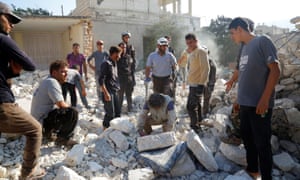
Men and civil defense members look for survivors after airstrikes on the hospital in the town of Millis on Saturday. Photograph: Ammar Abdullah/ReutersLink
A hospital supported by Doctors Without Borders and specializing in pediatrics in a rebel-held northern Syria province has been destroyed in a series of airstrikes over the weekend that killed 13 people, including four staff and five children, the international medical charity said on Monday.
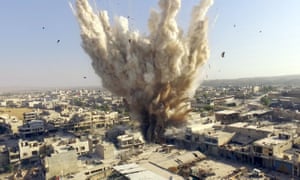
The group, known by its French acronym MSF (Médecins Sans Frontières), said that two of four airstrikes directly hit the hospital in Millis, in the northern province of Idlib, and put it out of service. Six other hospital staff members were wounded in the airstrikes in broad daylight on Saturday.
The bombing of the hospital that serves as a reference center specializing in pediatrics also destroyed the operating theatre, intensive care unit, pediatric department, ambulances and a generator, the charity said. It was not clear which government had conducted the airstrikes and the MSF statement did not specify.
MSF said the hospital attack deprived 70,000 people in Millis and surrounding areas of essential medical care. The hospital, supported by MSF since 2014, used to receive 250 patients a day, many of them women and children.
“The direct bombing of another hospital in Syria is an outrage,” said Silvia Dallatomasina, medical manager of MSF operations in north-western Syria. She called for an immediate end to attacks on hospitals, pointing that four out of five UN security council members were participants in the war in Syria.
Hospitals, mostly in rebel-held areas, are regularly attacked. In July alone, the UN said it had recorded 44 attacks on health facilities in Syria. Syria’s government and Russia, a major ally that has been carrying out airstrikes in Syria since last September, deny targeting health facilities.
In recent days, a number of attacks were reported on medical facilities amid increased violence, and ultimately increased pressure on the health facilities, in northern Syria.
MSF said two facilities it supports in Idlib, controlled by insurgents, have reported nine mass influxes of wounded in July that left 466 wounded and 37 dead. In the first six months of 2016, the same facilities reported only seven mass influxes of wounded, with a total of 294 wounded and 33 dead.
BEIRUT: Eight Hezbollah fighters were reported to have been killed in the north Syrian city of Aleppo on Sunday, a Lebanese security source told The Daily Star.
No further details about the fighters were given.
Hezbollah made public that it was fighting alongside Syrian President Bashar Assad’s forces in 2013. It is one of the major forces on the ground in the conflict, which erupted in March 2011.
Syrian regime forces were on the defensive around Aleppo on Sunday after a rebel alliance said it inflicted a major setback by breaking a three-week government siege of the battered city.
The fight for Aleppo, which has raged for weeks, is among the fiercest so far in Syria's chaotic multi-front war, which has killed more than 280,000 people.
Rebel and government forces have fought to control the provincial capital since mid-2012, transforming the former economic powerhouse into a divided, bombed-out city.
Syrian opposition forces blow up a tunnel under the regime headquarters in Aleppo’s Ramuse region. Photograph: Anadolu Agency/Getty ImagesThe GuardianLink
A Syrian military academy in the heart of Aleppo made for a bold, even reckless target for opposition forces trying to break a devastating siege, but the rebels gambled on a double advantage: surprise and suicide bombers.
Soon the rebels were sharing pictures of abandoned artillery and a smashed portrait of President Bashar al-Assad on Twitter, flaunted as triumphant proof that the army was routed and opposition forces were within a few hundred metres of their besieged comrades.
Hours later, the people of east Aleppo were dancing in the street, as rebels and activists confirmed that the month-long siege of the area had been broken. The fate of the opposition-held city was back in play. “Morale is very high now,” said activist and poet Mahmoud Rashwani, who had been living largely underground to avoid airstrikes, eking out his supplies of canned food.
The victory is a fragile one. The area is still a conflict zone and it may be some time before a secure corridor for food and medical supplies can be set up, and the regime has called in reinforcements.
“We expect revenge bombing by the regime, including, possibly, chemical weapons,” said Zaher Sahloul, a Syrian-American doctor who coordinates medical aid in the city.
Still, for the rebels, it has been a remarkable triumph against the odds. After months of retreat under pressure from government forces and Russian airstrikes, they have not only broken the siege, but overrun a key base the regime had used to enforce it and apparently taken possession of a large cache of weapons and artillery.
Days earlier, the area’s future had appeared grimly settled, its civilian population facing slow weeks of deprivation and fear, as aid groups warned of a humanitarian catastrophe.
More than a quarter of a million people were hemmed into the battered remains of streets by the guns of Assad’s conscripts, elite Iranian troops and a spectrum of Shia militias, patrolled from above by Russian planes. The rebels had fewer men, fewer weapons and, most crucially, no air force.
The opposition groups called a temporary truce to their own disputes, summoned hundreds of their most battle-hardened troops away from other fronts, and used tunnel bombs and suicide attackers to hit the military base to try to set a counter-siege of western Aleppo.
Both sides are throwing everything they can at the four-year battle for the city – a fight that has come to define the Syrian civil war, because each believes the fate of Aleppo will decide the outcome of the conflict.
“This battle’s results exceed simply opening the road for besieged people; it will overturn the balance of the struggle in the Levant,” said Abu Mohammad al-Jolani, leader of the powerful Jabhat al-Nusra faction that, until last month, was the official al- Qaida franchise in Syria.
Last month, the faction severed those ties, changed its name to Jabhat Fateh al-Sham and renounced international jihad, although observers said there was little sign of a parallel shift in ideology. Instead, experts reckoned the move was probably aimed at getting it off US airstrike target lists and easing coalitions with other factions.
That rebranding put the group in a strong position to capitalise on last week’s campaign, particularly if it can consolidate a victory that casts it as a champion of Aleppo’s battered civilians.
“We urge our people in Aleppo to remain steadfast,” Jolani added in the audio recording released on Friday. “The mujahideen will not fail you.”
The contrast with western powers, which condemned the siege but said they were powerless to stop it, is unlikely to be lost on Syrians, analysts warned.
“The world abandoned Aleppo; the jihadis came to the rescue. Al-Qaida’s rebranding could hardly have asked for more,” analyst Kyle Orton, from the Henry Jackson Society, said on Twitter.
Aleppo is both strategically and symbolically important. Damascus may be the capital but, before fighting broke out, the northern city was the most populous, the economic powerhouse – a diverse, vibrant cultural hub with a history stretching back millennia.
It was late to join the uprising against Assad, producing neither large-scale protests nor the bloody violence that swept through other cities in the first year of the civil war but, since the opposition stormed it in 2012, it has been a crucial battleground.
Aleppo was divided almost immediately into government- and rebel-controlled areas, along lines that have remained mostly static ever since: a stalemate unmoved by repeated and often ruthless attempts to dislodge the other side.
The years of bloody fighting have made it a symbol of Syria’s suffering, encapsulating in one place the bravery of its civilians and the terrible complexity of a war that, even before the rise of Islamic State, has set disturbingly extreme opposition groups against an ever more brutal government.
Fighters from the former Nusra – the groups has been renamed Fateh al-Sham but experts fear their ideology won’t change. Photograph: Omar Haj Kadour/AFP/Getty Images
The eastern half of the city has held out, despite an unforgiving aerial campaign by the Assad regime, whose barrel bombs have reduced much of it to ruins. Rebels have deployed “hell cannons” – crude artillery using gas cylinders – that have also been called indiscriminate.
Aleppo is now the last major urban centre where the rebels have a foothold, and success in breaking the siege would carry great psychological weight, reversing the momentum of months of setbacks brought about by an intense Russian air campaign in support of Assad.
Moscow intervened last year at a precarious time for Assad, who had lost all of Idlib province to a concerted rebel offensive. It was the first time a large coalition of opposition fighters had come together to fight the government and analysts spoke plausibly of Aleppo’s fall to the opposition.
The Kremlin’s campaign ended such hopes, pummelling the rebels, undoing their advances and leaving Assad secure in his strongholds. He, rather than opposition fighters, focused on the push for Aleppo, which culminated at the start of July in a long-feared siege.
Less than a month after being cut off, life in Aleppo has already slowed to a near halt. Markets are empty, schools have closed, hospitals and orphanages moved underground. Residents are woken by the first airstrikes of the day.
Those who chose to stay in Aleppo have stockpiled provisions in the knowledge that the regime and its backers would try to cut them off.
The Syrian army has honed the use of siege warfare to bring cities to their knees and then take them under government control – among them Homs, the birthplace and once the capital of the revolution, which opposition fighters abandoned last year.
Sieges allow Assad to avoid sending a depleted and demoralised Syrian army into close combat with the more highly motivated opposition forces. The Syrian military is down to as little as a third of its prewar strength and reliant on ground forces from Iran’s revolutionary guards, Hezbollah and a patchwork of other regional militias.
Like the opposition, Assad and his supporters are convinced that taking Aleppo will effectively end the civil war, breaking the morale of the opposition and condemning it to a marginal existence as a rural insurgency that can no longer claim to speak for large sections of Syrian society. Bringing all the country’s major cities under his control would also remove the threat that Assad’s international critics could push, as they once did, for a new Syrian settlement that does not include him as leader.
Moderate members of Syria’s opposition in exile say they fear not just for the people of Aleppo, but for the state of their wider cause, and believe the siege aimed not just to humble the city but also to polarise further a war that Assad has always cast as a battle between himself and extremists.
Isis does not have a major presence in Aleppo. Opposition groups in 2014 lost more than 1,000 men, pushing the jihadis back to a small stretch of territory near the town of Manbij, which is now under a concerted assault by US-backed Kurdish and Arab fighters. But many of the groups fighting there are conservative Islamists, and moderates are worried that for this assault they have gathered around Jolani’s group.
It has shored up finances and power base as rivals splintered, and success in Aleppo would further entrench the group. “If the regime, Russians and other supporters had not brought a siege on Aleppo, we could have avoided the coalition of Nusra and the other groups joining it to fight,” said Bassma Kodmani, a member of the main opposition High Negotiating Council team for peace talks.
“The most radical remain in the fight: that is the most alarming consequence of letting Aleppo come under siege,” she said. “The lack of some credible commitment from the international community leaves the opposition welcoming an offensive waged by Nusra because this is the only way to gain some leverage, to put some pressure on Russia and the regime. And that is really unfortunate.”
Rashwani confirmed that relief on the ground in Aleppo means there is little interest in who is doing the fighting.
“No one is now thinking about Nusra or [the hardline Islamist group] Ahrar al-Sham. We are seeing a group of rebels doing their best to break this siege,” he said. “I was one of those people who started this revolution, so I believe that one day we will get our victory, and I need to be here at that moment.”
President Bashar al-Assad. Photograph: AFP/Getty Images
Regime forces
The Syrian army numbered 300,000 before the war but, after five years of fighting, it is barely a third of that.
Hezbollah
Hezbollah began to support Assad covertly soon after violence broke out and, in 2013, its leader publicly declared it had joined the war. It is believed to have lost hundreds of fighters, including its top military commander.
Iranian Revolutionary Guards
Iran firmly supports Assad, whom it sees as a key ally in a regional power struggle, and is supplying arms, fuel and hundreds of soldiers. Last year, it released photos of its most celebrated commander on the ground in Syria.
Shia militias
Iranian troops are fighting alongside, and coordinating, Shia militias recruited from across the region, including from Iraq, Afghanistan and even Pakistan.
Russian air force
Last autumn’s Russian air campaign was key to turning the tide of the war in Assad’s favour. Its planes can fly in weather that grounds the Syrian air force and have more powerful and accurate weapons.
Anti-Assad forces in Aleppo
Free Syrian Army
The moderate FSA, made up of many smaller groups, was the dominant opposition force in the first two years of the war. It was initially backed by the Arab states and got cautious US support. After years of disunity and faltering advances, its influence and territory has shrunk, while Islamist groups have grown.
Jaysh al-Fateh
A broad coalition of Islamist factions that came together to fight Assad last year, when its advances forced Russia to come to his aid. Jaysh al-Fateh has been at the heart of the campaign to break the siege on Aleppo. The two most influential groups are as follows.
Jabhat Fateh al-Sham (formerly Jabhat al-Nusra)
The reconstituted al-Qaida affiliate renounced its ties to the global terror group last month and changed its name, but few observers believe that will herald any change in its ideology.
Ahrar al-Sham
Formed by hardliners with Muslim Brotherhood links, who aim to establish a Sunni theocracy in Syria, Ahrar al-Sham fought with Nusra when it was still part of al-Qaida, but rejects international jihad itself. It has a strong support base in Syria.
IN EGYPT they are the shabab al-ahawe, “coffee-shop guys”; in Algeria they are thehittistes, “those who lean with their backs to the wall”; in Morocco they go by the French term, diplômés chômeurs, “graduate-jobless”. Across the Arab world the ranks of the young and embittered are swelling.
In most countries a youth bulge leads to an economic boom. But Arab autocrats regard young people as a threat—and with reason. Better educated than their parents, wired to the world and sceptical of political and religious authority, the young were at the forefront of the uprisings of 2011. They toppled rulers in Tunisia, Egypt, Libya and Yemen, and alarmed the kings and presidents of many other states.
Now, with the exception of Tunisia, those countries have either slid into civil war or seen their revolutions rolled back. The lot of young Arabs is worsening: it has become harder to find a job and easier to end up in a cell. Their options are typically poverty, emigration or, for a minority, jihad.
This is creating the conditions for the next explosion. Nowhere is the poisonous mix of demographic stress, political repression and economic incompetence more worrying than in Egypt under its strongman, Abdel-Fattah al-Sisi.
Battle of the youth bulge
As our briefing on young Arabs sets out (see Briefing), the Middle East is where people are most pessimistic and most fearful that the next generation will fare worse than the current one. Arab populations are growing exceptionally fast. Although the proportion who are aged 15-24 peaked at 20% of the total of 357m in 2010, the absolute number of young Arabs will keep growing, from 46m in 2010 to 58m in 2025.
As the largest Arab state, Egypt is central to the region’s future. If it succeeds, the Middle East will start to look less benighted; if it fails, today’s mayhem will turn even uglier. A general who seized power in a coup in 2013, Mr Sisi has proved more repressive than Hosni Mubarak, who was toppled in the Arab spring; and he is as incompetent as Muhammad Morsi, the elected Islamist president, whom Mr Sisi deposed.
The regime is bust, sustained only by generous injections of cash from Gulf states (and, to a lesser degree, by military aid from America). Even with billions of petrodollars, Egypt’s budget and current-account deficits are gaping, at nearly 12% and 7% of GDP respectively. For all of Mr Sisi’s nationalist posturing, he has gone beret in hand to the IMF for a $12 billion bail-out (see article).
Youth unemployment now stands at over 40%. The government is already bloated with do-nothing civil servants; and in Egypt’s sclerotic, statist economy, the private sector is incapable of absorbing the legions of new workers who join the labour market each year. Astonishingly, in Egypt’s broken system university graduates are more likely to be jobless than the country’s near-illiterate.
Egypt’s economic woes stem partly from factors beyond the government’s control. Low oil prices affect all Arab economies, including net energy importers that depend on remittances. Wars and terrorism have kept tourists away from the Middle East. Past errors weigh heavily, too, including the legacy of Arab socialism and the army’s vast business interests.
But Mr Sisi is making things worse. He insists on defending the Egyptian pound, to avoid stoking inflation and bread riots. He thinks he can control the cost of food, much of which is imported, by propping up the currency. But capital controls have failed to prevent the emergence of a black market for dollars (the Egyptian pound trades at about two-thirds of its official value), and has also created shortages of imported spare parts and machinery. This is stoking inflation anyway (14% and rising). It is also hurting industry and scaring away investors.
Sitting astride the Suez Canal, one of the great trade arteries of the world, Egypt should be well placed to benefit from global commerce. Yet it lies in the bottom half of the World Bank’s ease-of-doing-business index. Rather than slashing red tape to set loose his people’s talents, Mr Sisi pours taxpayers’ cash into grandiose projects. He has expanded the Suez Canal, yet its revenues have fallen. Plans for a new Dubai-like city in the desert lie buried in the sand. A proposed bridge to connect Egypt to Saudi Arabia sparked protests after Mr Sisi promised to hand back two Saudi islands long controlled by Egypt.
Even Mr Sisi’s Arab bankrollers appear to be losing patience. Advisers from the United Arab Emirates have gone home, frustrated by an ossified bureaucracy and a knucklehead leadership that thinks Egypt needs no advice from upstart Gulfies—mere “semi-states” that have “money like rice”, as Mr Sisi and his aides are heard to say in a leaked audio tape.
Better the general you know?
Such is Egypt’s strategic importance that the world has little choice but to deal with Mr Sisi. But the West should treat him with a mixture of pragmatism, persuasion and pressure. It should stop selling Egypt expensive weapons it neither needs nor can afford, be they American F-16 jets or French Mistral helicopter-carriers. Any economic help should come with strict conditions: the currency should ultimately be allowed to float; the civil service has to be slimmed; costly and corruption-riddled subsidy schemes should be phased out. The poorest should in time be compensated through direct payments.
All this should be done gradually. Egypt is too fragile, and the Middle East too volatile, for shock therapy. The Egyptian bureaucracy would anyway struggle to enact radical change. Yet giving a clear direction for reform would help to restore confidence in Egypt’s economy. Gulf Arabs should insist on such changes—and withhold some rice if Mr Sisi resists.
For the time being talk of another uprising, or even of another coup to get rid of Mr Sisi, has abated. Caught by surprise in 2011, the secret police are even more diligent in sniffing out and scotching dissent. But the demographic, economic and social pressures within Egypt are rising relentlessly. Mr Sisi cannot provide lasting stability. Egypt’s political system needs to be reopened. A good place to start would be for Mr Sisi to announce that he will not stand again for election in 2018.
لا يمثل الأنفار التسعة الذين حاولوا التشويش على مؤتمر المركز العربي للأبحاث ودراسة السياسات في تونس "استراتيجية المقاطعة ضد الاحتلال الإسرائيلي ونظام الأبارتهايد" أنفسَهم فحسب، وإنما يؤشّرون إلى حالةٍ متفشيةٍ عريضةٍ في غير ساحةٍ عربية، من عوارضها أن المصابين بها يرفلون في جهلٍ غزير، فالمؤكد أن أياً من أولئك التسعة الذين تفوّهوا بما يدلّ على بؤس أخلاقيٍّ فيهم لم يطالع أياً من كتب المركز وتقديراته ودورياته، ولا عرف يوماً شيئاً من نتاج المركز وجهوده. ويبعثُ حالهم هذا على بعض الإشفاق عليهم، ثم على وجوب الرد عليهم، أولاً، بتعليمهم ما أمكن من الأخلاق، فالاعتداء على مؤتمرٍ أكاديمي فعلٌ مرذول. وثانياً، بتأكيد انتساب هؤلاء إلى عداء أشواق الشعوب العربية وتطلعاتها نحو التحرّر من كل استبدادٍ وفساد. كيف لا، والمذكورون لا يستحون من الجهر بشغفهم بمعمر القذافي، وبمحبّتهم نظام بشار الأسد.
توضح هذه الحادثة أن مواجهة هؤلاء، في تونس وغيرها، أصبحت شديدة الإلحاح، فلا يحسنُ الاستخفافُ بما يمثّلون، ولا بما يُحدثونه في الجسم الثقافي والاجتماعي العربي من أمراض. ولكن، ليس هذا من وظائف المركز العربي للأبحاث ودراسة السياسات، وإنما من مهمات أهل الإعلام والناشطين في التشكيلات المدنية والأهلية العربية، ممن يعتنقون الحرية والديمقراطية والعلم والأخلاق قيماً مبدئيةً، وممن ينتصرون للحقّ والحقيقة، ويعملون على إسناد الشعوب التي تنوء تحت احتلال أنظمة القتل والاستبداد، وفي مقدمتها الشعب السوري الذي يعاديه أولئك الصغار، وقد ظنّ تسعةٌ منهم أن سفالتهم ستُثني سبعين باحثاً مستضافين في الحمامات في تونس، من فلسطين وعدة دول عربية وأوروبا وأميركا والهند وماليزيا وإفريقيا، عن طرح إسهاماتهم بشأن وسائل مقاطعة إسرائيل، في مؤتمرٍ غير مسبوقٍ في سعة مباحثه بشأن موضوعه، نظمه المركز العربي من دون اكتراثٍ بشبيحةٍ هنا وجهلةٍ هناك.
ليس مصادفةً أن يتزامن تطاول أولئك التسعة، ومن يشبهونهم، على مؤتمر المركز العربي، مع نشر صحيفة ديلي تلغراف البريطانية ما نقلته عن مسؤولٍ إسرائيلي قوله إن دولة الاحتلال منزعجةٌ من المؤتمر، غير أن الفرق بين الشبيحة المفضوحين، ومعهم أنصارهم في صحيفتي الأخبار البيروتية واليوم السابع القاهرية، وإسرائيل، أن الأخيرة تعرف جيدا أهمية مؤتمرٍ عن مقاطعتها، يجمع نخباً من كل العالم للحديث العلمي عن هذا الأمر، فيما أولئك، ومعهم نظراؤهم في المطبوعتين المذكورتين، باقون على دروشتهم المعلومة، ورطانتهم إيّاها، عن دولة قطر والدكتور عزمي بشارة، فلا يجدون حاجةً في أنفسهم لأيِّ معرفةٍ بما ينجزه المركز العربي، ولا باستقلاليته الأكاديمية والبحثية. ويُشار، هنا، إلى التمييز بين حالتي إسرائيل وهؤلاء، بأسى، وبالطلب من محبي الصواريخ الروسية على حلب، ومن أنصار العمائم الإيرانية في دمشق، ومن المعجبين بعلي عبدالله صالح وعبد الملك الحوثي، أن يتعلموا من إسرائيل، شريكتهم في مناهضة مؤتمر المركز العربي، كيف يتبيّنون ما تحتاجه أفهامهم أن تتبيّنه، فلا يثرثرون فيما لا يعرفون، ولا يُنشئون الحقائق من خيالاتهم وأوهامهم.
يُتحدّث عن هذا الأمر، هنا، واليقين أن إسرائيل إنما تعمد إلى التحريض الذي تحترفه ضد كل من يؤذونها، وقضية مقاطعتها في العالم، والإفادة من تجارب الأمم والشعوب في مقاومة محتليها، في صدارة مشاغلها. وإذ أوضح المركز العربي، مجدّداً، في الردّ على مغالطاتٍ سقطت فيها "ديلي تلغراف"، استقلاليته الأكاديمية، معطوفةً على خياراته بشأن فلسطين، فإن التوضيح الذي يصلح لمن يمثلهم أولئك الزعران الذين اقترفوا ما اقترفوه في قاعة مؤتمر المركز في تونس أن إسرائيل سعيدةٌ بهم، وتغتبط كثيراً بما يصنعون، وهم على عدائهم القراءة والمعرفة، وعلى ولعهم بتدمير حاضرات الشام بصواريخ البلطجة الروسية، وبالبترودولار الإيراني. أما نحن، فنقرأ أبحاث مؤتمر المقاطعة، ونستفيد ونفيد.