Tuesday, February 14, 2017

Trump's Valentine: From the White House to IS, with love

Trump is shaping up to be the worst US president in history, but the chaos his administration is set to fuel in the Middle East will be a new low

By David Hearst

Link

George W Bush set the bar high for the accolade of worst US president in history.
Before 9/11, he ignored warnings of an impending attack, failed to respond to Hurricane Katrina, withdrew from the Kyoto Protocol lowering greenhouse gas emissions, set the US on a collision course with Russia by tearing up the 1972 Anti-Ballistic Missile Treaty, and invalidated the Geneva Convention protocols against torture. His invasion of Iraq, based on false intelligence, lit a regional fire that burns to this day.
To Arab eyes, America’s self-obsessed new ruler looks and sounds all too familiar
That said, the 45th president has made an impressive start to the title race. He has had an executive order struck down by the courts, pulled out of Obamacare with no idea of what to replace it with, authorised a raid on a hamlet in Yemen that killed as many as 23 civilians, including a newborn baby, cost the life of a Navy Seal, and trashed a $70m plane. 
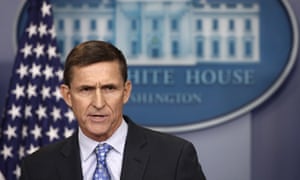
One of his key appointees, National Security Advisor Michael Flynn has resigned, after lying to the vice president about his calls with the Russian ambassador. The sword of Damocles remains over the heads of an inadequate chief of staff - Reince Preibus - and a boorish White House spokesman - Sean Spicer. Spicer has made Melissa McCarthy’s spoof on Saturday Night Live compulsory viewing, not least for Trump himself.
Swathes of civil servants have resigned. The National Security Council is in chaos. Trump has insulted the president of Mexico, the judges who overturned his order, John McCain, Arnold Schwarzenegger, Meryl Streep. There are more than 300 others listed by the New York Times.
Not bad going for just 26 days in office. Flynn’s forced resignation presents this crew of military has-beens, white supremacists, Christian evangelicals, and assorted floggers of the Trump brand with a paradox.

Breaking all the moulds?

To steady the ship, Flynn’s replacement needs political experience and pragmatism - the very qualities which the gurus of Trump’s revolution, Steve Bannon and Stephen Miller, claim have polluted the Washington swamp.
Flynn’s replacement needs political experience and pragmatism - the very qualities which the gurus of Trump’s revolution claim have polluted the Washington swamp
On these grounds, the front runner is former CIA director David Petraeus, who began to douse the flames of the sectarian fire the US Army lit in Iraq. He sponsored the Sahwa - or the Awakening Movement among the Sunni tribal chiefs in Iraq.  
Petraeus’ problem is the baggage he comes with. Politically, he is close to Hillary Clinton, and was mentioned as her choice for secretary of state. He is also only just recovering from a major fall from grace. Petraeus’s ambition knows no bounds and the man is instinctively competitive. Physically, he is small and wiry and once boasted how he could beat a US Marine escort half his age on his daily runs around Hyde Park.
David Petraeus, then commander of the Multinational Force in Iraq, in April 2007 before a Senate committee briefing (AFP)
His protagonist is a former Navy Seal and deputy commander of Centcom, Vice-Admiral Robert Harward. Unlike Petraeus, he is a behind the scenes man. "Someone who's a good briefer, who can get multiple agencies on the same page and who can work well with others, not someone who thinks he's more important than everyone else,” former Ambassador Chris Hill told Politico. 
Strange how important mould-forming qualities have become to an administration, which set out to break moulds. It says a lot about today’s competition, that Petraeus now re-appears as an old hand.

READ: Trump and Netanyahu: Mired in the swamp

Petraeus figured out that to defeat al-Qaeda in Iraq, you had to separate the group not only from its Sunni tribal base, but also from other Islamist groups, whose motivations for fighting the invader were nationalist rather than global or religious. 
He learned to see al-Qaeda in Iraq as a coalition of forces, and formulated a strategy to unpeel radical Islam of its constituent parts. He realised the most important part of that job could only be done by Islamists themselves.

Dictatorship or Da'esh

Exactly the opposite track is being applied by those who are attempting to fill Trump’s empty sceptic tank with various poisons of their own. They seek to conflate political and radical Islam, non-violent and violent actors, and crush the moderates who represent the real political threat to their autocracy.
Their motive is entirely personal. It is to maintain regimes based on torture, repression and autocracy by playing a zero-sum game: dictatorship or Da’esh. It's a tried and tested formula used by field marshals for over 70 years, but it will not solve any of the region’s problems.   
These are the despots and absolute rulers of the Middle East, on whose watch four Arab states have failed. The Egyptian president Abdel Fattah al-Sisi, has turned a local insurgency in Sinai into an international one, crushed political Islam at home, and is currently growing a new generation of al-Qaeda in his prisons. Trump convinced Sisi to withdraw a UN Security Council resolution on settlements, on Israel’s behalf.
Trump on a billboard at the Trump International Golf Club Dubai in the UAE (AFP)
Lurking behind him is Mohammad bin Zayed, the Crown Prince of Abu Dhabi, the site of Trump’s latest golf course. Bin Zayed believes he is on a holy war to destroy the Muslim Brotherhood wherever he can strike at it, in Yemen, Egypt, Libya, and Tunisia. This has remained the central goal of Emirati foreign policy, more important than the task of pushing Iran back or fighting the Islamic State (IS) itself. 
In Libya, one hundred percent of the military effort of Libyan renegade general Khalifa Haftar, the Egyptian and Emirati surrogate, has been devoted to fighting rival Libyan militias. He has not touched IS in Sirte. On the contrary, when he could, his forces let their convoys go free. In Yemen, the Emirati policy is to deny the Brotherhood-linked Islah the fruits of reconquest. This remains more important than ousting the Houthis themselves.
Mohammed bin Salman meets with Saudi air forces officers in 2016 (AFP)
Finally, there is the Saudi King Salman, whose young son, Mohammed, is in total control. Mohammed bin Salman listed the Brotherhood as the third on the list of Saudi enemies, after Iran and IS in conversations with journalists.

Protecting their own skins

All urge Trump to sign an executive order declaring the Brotherhood a terrorist organisation - against the advise of the CIA, according to a memo seen by Politico. The realists in Trump’s beleaguered band should realise that Sisi, Salman and bin Zayed all have their own skins to protect and that they fear the Brotherhood because it is, in the New York Times Editorial Board’s words, “the most influential Islamist group in the Middle East”. 
According to evidence given to a British parliamentary inquiry, it has one million members in Egypt alone. That is twice the size of the Labour Party, which is Europe’s biggest.
Trump should learn from David Cameron’s experience that the Emirati, Saudi and Egyptian interest is not coterminous with the British one. Strong-armed by bin Zayed to outlaw the Brotherhood, Cameron went through the painful motions of setting up an inquiry under a former UK ambassador to  Saudi Arabia, Sir John Jenkins. MI6 quickly spiked Jenkins’ guns by ruling out any links between the Brotherhood and terrorism in Egypt.

READ: When Cameron took the Muslim Brotherhood to lunch

Jenkins’ full report was never published, and an 11-page summary could only be issued under parliamentary immunity, such was the government fear of litigation. Trump should also expect a fight in the courts if he goes ahead with his ban. 
Further, Jenkins refused to testify before an independent parliamentary inquiry. This rejected Jenkins’ case that the Brotherhood was a rite of passage for the likes of Osama bin Laden, and concluded that the Brotherhood remained the strongest bulwark against extremism.

Lobbying exercises

Trump’s coterie has its own reasons to target the Brotherhood, which has no organisation in the US. It's principally a means of shutting down Muslim organisations, which they accuse, on no evidence, of being a front. 
Trump’s coterie has its own reasons to target the Brotherhood which has no organisation in the US
“The Muslim Brotherhood, amongst anti-Muslim bigots in the alt-right, has been merely code language for Muslims in general," said Dawud Walid, executive director of the Council on American-Islamic Relations (CAIR), one of the organisations in Trump’s crosshairs.
The Brotherhood ban could simply be another way of broadening the scope of the ban on citizens and refugees from seven Muslim countries, which has been suspended in the courts.
A bill by Republican Senator Ted Cruz has already been reintroduced, and the new secretary of state, Rex Tillerson, bracketed the Brotherhood with al-Qaeda and IS militants in his statement at his confirmation hearing. 
The Emiratis, in particular, have been assiduous in courting the Trump administration. They were behind the lobbying exercise that led to Cruz’s bill, and Yousef Al Otaiba, the United Arab Emirates ambassador to the US, has opened an important link to Trump’s son-in-law, Jared Kushner. Politico reported that the two are in almost constant contact by email and telephone.
In its potential effect to destablise the Middle East, a ban on the Brotherhood will rival even Bush’s claim that Saddam Hussein had weapons of mass destruction. At a stroke it could close down politics for what remains the largest single political grouping in most Arab countries, whether it is suppressed or not. Is this in America's interest? Does it want to shut down politics completely in the Middle East? Would it prefer to negotiate with rational actors or irrational ones? Trump and Israel should think about this.  Which would they prefer running Gaza - Hamas or ISIS?

'Like one of our despots'

America’s relationship with NATO’s second largest army, whose commander-in-chief is another Islamist, Recep Tayyip Erdogan, will once again be put under enormous strain, as will US links with what it terms the moderate Syrian opposition, which is also partly Islamist. That is to say nothing of Indonesia, Malaysia and mainly Muslim majority nations.  
The Islamic State will have received the biggest Valentine Trump could have conceived for it since Sisi’s military coup in 2013, a year that proved to be the turning point in the group’s fortunes. 
“Just leaving Florida," the 45th president tweeted. “Big crowds of enthusiastic supporters lining the road that the FAKE NEWS media refuses to mention. Very dishonest!”
To Arab eyes, America’s self-obsessed new ruler looks and sounds all too familiar. 
“He sounds just like one of our despots,” a friend told the New York Times columnist Mona Eltahawy in Cairo in a piece entitled 'An American Sisi'. To others, his promise of returning power to the people was stunningly similar to Gaddafi’s “rule of the masses”. Trump even gave Gaddafi’s clenched fist salute on Capitol Hill.
But Trump could be about to emulate the actions, as well as the words of a Gulf despot. That, for the region, would be fatal.
- David Hearst is editor-in-chief of Middle East Eye. He was chief foreign leader writer of The Guardian, former Associate Foreign Editor, European Editor, Moscow Bureau Chief, European Correspondent and Ireland Correspondent. He joined The Guardian from The Scotsman, where he was education correspondent.

نتنياهو وترمب يخططان لدولة فلسطينية بسيناء وغزة

Link

نشر الوزير الإسرائيلي بلا حقيبة أيوب قرا تغريدة على تويتر قال فيها إن رئيس حكومته بنيامين نتنياهو قد اتفق مع الرئيس الأميركي دونالد ترمب على تبني ما وصفها بخطة الرئيس المصري عبد الفتاح السيسي لإقامة دولة فلسطينية في غزة وسيناء.

 وقالت التغريدة حسب الترجمة الحرفية إن "ترمب ونتنياهو سوف يتبنيان خطة الرئيس المصري السيسي بإقامة دولة فلسطينية في غزة وسيناء بدل يهودا والسامرة. هكذا تعبد طريق السلام الشامل مع الائتلاف السني. علما بأن "يهودا والسامرة" هو وصف تطلقه إسرائيل على الضفة الغربية المحتلة.

......

مجرمٌ يبرّر جرائم زميله في الإجرام

جلبير الأشقر


خصصت مجلة «ذي إيكونوميست» البريطانية غلاف عددها الأخير ومقاله الافتتاحي[I POSTED THAT ON SUNDAY ]لموضوع سياسة إدارة الرئيس الأمريكي الجديد دونالد ترامب إزاء روسيا الرئيس فلاديمير بوتين. ويُظهر الغلاف رأسي الرئيسين متواجهين، ويسوده لونٌ رمادي بحيث تبرز في الصورة بقعتان باللون الوردي، إحداهما شفتا ترامب والثانية علامة شفتين على خدّ بوتين. ويوحي تصميم الغلاف برسمة باتت شهيرة تُظهر الرجلين في قبلة حامية تلتحم فيها شفاههما، وهي بدورها مستوحاة من لوحة شهيرة رُسمت على جدار برلين سنة 1990 وجمعت رئيس ألمانيا الشرقية السابق، إريش هونيكر، ورئيس الاتحاد السوفييتي السابق، ليونيد بريجنيف، في «قبلة أخوية» خلّدتها صورة فوتوغرافية لا تقلّ شهرةً وتزيد عن الرسمة غرابةً لكونها صورة حقيقية. 
ومن المرجّح أن يكون أحد مقاصد غلاف المجلة البريطانية العريقة التلميح إلى التعليق الذي ورد في أسفل اللوحة المرسومة على جدار برلين والقائل: «يا إلهي، ساعدني على أن أبقى حياً بعد هذا الحُبّ القاتل». والحال أن افتتاحية المجلة مكرّسة للتحذير من سياسة ترامب المُعلَنة في السعي وراء علاقة صداقة وتعاون مع زميله الروسي، وهو لم ينفكّ يكيل له المديح ويدافع عنه إلى حد جعله يردّ على معلِّق سأله على شبكة تلفزيون «فوكس نيوز» كيف به يحترم بوتين وهذا الأخير «مجرم»، فقال ترامب: «هناك الكثير من المجرمين. وهل تظنّ أن بلدنا بريء؟» وقد أثار هذا الردّ عاصفة من الاحتجاج في الولايات المتحدة وفي الدول الحليفة لها، وعلّقت عليه افتتاحية «ذي إيكونوميست» بالقول «إن إيحاءَ رئيس أمريكي بأن بلده لا يقلّ إجراماً عن روسيا قولٌ لا سابق له وهو خاطئ ويشكّل هديّة لأبواق دعاية موسكو».
والحقيقة أن قول ترامب صحيح تماماً، ولا بدّ لأكبر الكاذبين من أن يصدق بين حين وآخر مثلما تشير عقارب الساعة المتوقّفة إلى الوقت الصحيح مرّتين كل يوم. وليتَ ترامب، بدل حصر الأمر بالإرهابي بوتين الذي ما برح الناس يتساءلون عن سرّ المودّة التي يكنّها له، ليته يطبّق منطِقه في نقد الذات على جميع الذين يتهمهم بتصدير الإرهاب في حين أن بلده حقاً شيخ الإرهابيين، منه انطلقت وتنطلق أفتك العمليات الإرهابية منذ أن غدا أعظم قوة عالمية إثر الحرب العالمية الثانية. فبدل اتهام جميع اللاجئين السوريين بأنهم داعشيون متستّرون واتهام جميع العراقيين واليمنيين الإيرانيين والسودانيين والليبيين والصوماليين والإيرانيين بأنهم إرهابيون مرجّحون، كان أحرى بالرئيس الأمريكي أن يقول ما قاله تعليقاً على بوتين: «وهل تظنّ أن بلدنا بريء؟»
بل ليتَ الرئيس الأمريكي الجديد، الذي جرّه الدفاع عن بوتين إلى الإقرار بأن بلده مجرمٌ هو أيضاً، يذهب بهذا الإقرار إلى خلاصته الضرورية، ألا وهي الاعتراف بالحقيقة الفاقعة أن البلدان السبعة التي اتهمها بتصدير الإرهاب وأراد منع رعاياها من دخول الولايات المتحدة، تعاني جميعاً من مآسٍ هائلة يعود سببها الأول إلى دور واشنطن في صنعها. بل إن السبب التاريخي الأول والرئيسي في توليد الكارثة العربية الراهنة يعود إلى صيانة الولايات المتحدة للأنظمة العربية الرجعية وللأصولية الإسلامية المتطرّفة ولدولة الإرهاب الصهيوني في وجه الأماني القومية التقدّمية التي جسّدها الزعيم الكبير جمال عبد الناصر.
وليت دونالد ترامب يتذكّر أن أم العمليات الإرهابية غير الحكومية (تمييزاً عن الإرهاب الحكومي الذي تتفوّق فيه الولايات المتحدة على سواها)، أي عملية الحادي عشر من أيلول/ سبتمبر 2001، قام بها تنظيمٌ سبق أن تعاون مع أجهزة الولايات المتحدة في الحرب ضد الاحتلال السوفييتي لأفغانستان. وليت ترامب يتفطّن لكون سلفه جورج دبليو بوش هو الذي فتح باب العراق على مصراعيه أمام تنظيم القاعدة ويتفطّن لكون سلفه الآخر باراك أوباما هو الذي سمح بتدمير سوريا وشعبها بما أفضى إلى نشوء داعش، وهذه الأخيرة كارثة على شعوبنا أكبر بكثير مما هي على الشعب الأمريكي أو أي شعب آخر.
ولو أقرّ دونالد ترامب بكل هذه الحقائق، عوَض اقتصاره على تبرير جرائم زميله بالإجرام فلاديمير بوتين، لأدرك أن واجب الولايات المتحدة الأخلاقي ليس فقط التعويض عمّا تسببت به من قتل ودمار، بل أيضاً إشراع أبوابها أمام كافة طالبي اللجوء القادمين من بلدان منطقتنا المنكوبة.
٭ كاتب وأكاديمي من لبنان

الاتجاه المعاكس- لماذا يصمت العالم على المسالخ البشرية بسوريا؟

A VERY GOOD PROGRAM!


0:00 / 9:34 DNA - 14/02/2017 مُنتجعات سوريا الأسد

KISS TRUMP GOODBYE: Flynn's resignation likely the beginning of Trump's Russia woes – not the end

National security adviser is the third Trump adviser forced to leave over reports of Kremlin contact, further raising suspicions of the Trump-Putin relationship

 in Washington

The Guardian

Link


Michael Flynn resigned as national security adviser because of his contacts with the Russian ambassador to Washington and his subsequent attempts to cover up the true nature of those contacts.
But his resignation is unlikely to mark the end of the Trump administration’s crisis of legitimacy over its relationship with Moscow. The manner of this matter suggests that this is only the beginning.
Flynn is the third Trump acolyte forced out over the question of links to the Russian government of Vladimir Putin. Paul Manafort, the former campaign manager, and Carter Page, a businessman Trump described as an adviser, both left last summer after reports surfaced about their contacts with the Kremlin.
The question of the true nature of the relationship between the president and Putin – who Trump once claimed to have met and later denied knowing – hung over his campaign and now looms over his presidency.
Many administrations have rocky starts, but there has never been a case of a national security adviser being forced to leave in less than a month. It has broken through the aura of impunity around the Trump White House and emboldened critics in their demands to know what the president knew and when he knew it.
Trump may think Flynn is the sacrificial lamb, but the reality is that he is the first domino. To the extent the administration believes Flynn’s resignation will make the Russia story go away, they are mistaken,” said Susan Hennessey, a former NSA lawyer. 
Flynn’s resignation validates the suspicions of many in Washington that something is seriously amiss with regard to President Trump’s ties to Russia. This is the third member of Trump’s circle to be pushed out over Russia-linked scandals,” she said.
“This is only going to increase pressure from both the public and Congress demanding a full accounting of the nature of Trump’s connections to Russia both now and during the campaign.”


Trump clearly fought to keep his national security adviser in place, confident in his control of the executive branch and the grip of Republican loyalists on Congress.
The Washington Post reported on Monday that former acting attorney general Sally Yates informed him last month that Flynn’s misleading statements to Vice-President Mike Pence and other officials could leave him open to Russian blackmail. But it was Yates who was sacked, over her refusal to defend Trump’s travel ban, not Flynn.
The US intelligence agencies struck back, however, through an ever greater flow of leaks to the press, until Flynn’s position was untenable. The same leaks also suggest that the foundations of the whole administration are shaky.
Intelligence officials were quoted as saying that Flynn’s communications with the Russian ambassador to Washington, Sergei Kislyak, dated back to before the election, adding to the pile of unanswered questions about possible collusion between the Trump campaign and an operation, run by Vladimir Putin himself according to US intelligence agencies, to steer the US presidential election in Trump’s favour.
Flynn fell because he appears to have talked to Kislyak about measures the Obama administration was about to impose on Moscow at the end of December, including the expulsion of FSB intelligence officers, in retaliation for the interference in the election. According to the reports, he gave the impression that the sanctions would not last long, with the Trump administration less than three weeks from office.
Putin’s muted response took the Obama White House by surprise. He did not carry out tit-for-tat expulsions, but made a point of inviting the children of US diplomats in Moscow to the Kremlin for Christmas parties. Trump showed his approval in a 30 December tweet saying: “Great move on delay (by V. Putin) - I always knew he was very smart!”


Michael McFaul, a former US ambassador to Moscow, said: “This tweet does kind of make one wonder if the president-elect knew about the contents of Flynn conversation on sanctions with Kislyak.”
Numerous reports suggest that Trump did indeed intend to lift sanctions on Moscow and that executive orders were drafted to that effect in his first week in the White House, only to be deferred after protests from congressional Republicans, who have since started work on legislation that would take control over such sanctions out of the president’s hands. Theresa May also signaled her government’s determination that the sanctions should stay when she visited Washington.
But despite such concerted resistance from natural allies, Trump has persevered in defending Putin. When ultra-conservative talkshow host Bill O’Reilly suggested to Trump that Putin was “a killer”, the president replied: “There are a lot of killers. You think our country’s so innocent?”
Trump’s refusal to criticise Putin and his hurry to lift sanctions on Russia have still not been explained. In a leak to CNN on Friday, intelligence officials indicated that they have confirmed at least some of the allegations contained in a set of reports given to the FBI by a former MI6 officer, Christopher Steele, last year.
They said could not corroborate the suggestion in the Steele reports that Russian intelligence had personally compromising material on Trump from his behaviour on trips to Russia, but that they had independent evidence of contacts between individuals in Trump’s entourage and Russian officials.
The Foreign Intelligence Surveillance Act (Fisa) court is reported to have granted a wiretap warrant in mid-October to allow the justice department’s national security division to look into contacts between two Russian banks and Trump associates.
Those investigations appear to be continuing but within the hostile environment of an executive controlled from the Trump White House. However, intelligence officials have now signalled that they are prepared to leak aggressively if they feel they are being muzzled.
Ultimately, the fundamental questions about Trump’s links with Russia may only be answered in Congress. The Senate intelligence, armed services and foreign relations committees, as well as the House intelligence committee, have all voiced intentions to look into the allegations, and subpoena top officials if necessary. But so far those enquiries have not properly got off the ground in the face of Republican reluctance to maim an executive that is fast-tracking much of the party’s social, economic and fiscal agenda.
If the leaks continue at their present rate, however, it is possible that congressional Republicans will flip, and decide that Trump is more of a liability than an asset. That moment has not been reached yet, but the fall of Flynn has brought it closer.


Trump sons to open 'iconic' Dubai golf course

Critics have accused US president of a conflict of interest over his business operations in Dubai


US real-estate magnate Donald Trump is seen playing golf on a billboard at the Trump International Golf Club Dubai in the United Arab Emirates (AFP)

Link

US President Donald Trump's sons are set to inaugurate a branded golf course in Dubai on Saturday, the first launch for the business empire since Trump took office in January.  
"Join us as we celebrate the grand opening of the iconic golfing destination Trump International Golf Club Dubai," read the invitation from DAMAC Properties, a major regional luxury real estate developer.
The invitation card, embossed in gold and sealed in a golf course print envelope, specified the dress code as either business attire or national dress.
Donald Trump Jr and Eric Trump are to attend.
The launch comes just over one month after Trump, then president-elect, said he had rejected a $2 billion deal in Dubai as a personal, and not official, move.
"I didn't have to turn it down," Trump told a press conference in New York. "But I have a no-conflict-of-interest provision as president."
Since his November victory, Trump has publicly said he would remove himself from running his business empire, transferring corporate control to his sons. But he has resisted divesting despite calls by ethics organisations.

Conflict of interest 

The Trump Organization pledged on 11 January it would no longer pursue new deals outside of the United States. The 18-hole Dubai golf course however predates the pledge, with talks surrounding the project going back to 2015. 
Critics have raised questions of conflict of interest over Trump's business ties on the grounds that while the president is no longer nominally in charge of his eponymous empire, he may continue to profit from it. 
Ethics lawyers in the United States are now suing Trump alleging violation of the US constitution. 
Watchdog group Citizens for Responsibility and Ethics (CREW) filed a lawsuit in January alleging that Trump's business ties violate an emolument clause in the constitution which prohibits the acceptance of payments from foreign governments by US officials. 
US presidents are not legally required to give up business or investments while in office.
The UAE has been one of the few Muslim countries to defend a controversial ban on Muslims from seven countries imposed by the US President in an executive order.

UAE defends Trump

Sheikh Abdullah bin Zayed al-Nahyan, whose country is a close ally of Washington, said it was "wrong to say" that the decision by the new US administration was "directed against a particular religion".
"The United States has made... a sovereign decision," he said in early February at a joint press conference with his Russian counterpart, Sergei Lavrov, pointing out that it was "provisional" and did not apply to "the large majority" of the world's Muslims.
In his defence of the ban which has stirred widespread protests across the globe, Sheikh Abdullah also said that some of the countries on the blacklist had "structural challenges" on the security front that they still had to overcome.
Trump's controversial executive order singled out citizens from Iran, Iraq, Libya, Somalia, Sudan, Syria and Yemen to prevent "radical Islamic terrorists" from entering the United States.
But the 90-day ban, which could still extend to other states, exempted Muslim-majority nations associated with major attacks in the West.
Last week a US federal appeals court panel upheld a temporary suspension of the ban, which Trump has promised to challenge in the courts.

Russia used 'war on facts' to deny Aleppo bombings: Report

US think tank catalogues indiscriminate targeting of residential areas and use of cluster weapons by Russian, Syrian forces


Moscow employed tactics including disseminating fake satellite images of bombed hospitals to distort the truth, said report (AFP)

Link

Pro-government forces hit hospitals repeatedly, dropped incendiary and cluster bombs on residential areas and used chemical weapons during the battle of Aleppo in Syria last year, a report by the Atlantic Council, a Washington-based think tank said.
Several ceasefires were negotiated during the months-long siege of Syria's once largest city, which was fully recaptured by forces loyal to President Bashar al-Assad in December. According to the report released on Monday, the government used the halts in fighting to prepare for offensives and shift its focus to different frontlines.
"These breaches weakened the United States’ moderate opposition partners and undermined the confidence of US allies in the region," the report reads.
The report also accuses opposition forces of indiscriminate bombing of government-controlled areas of Aleppo. "However, there is little equivalence between the two sides when considering the scale and resources employed in the conflict," it adds.
The investigation relied on eyewitness accounts, photographs, video footage and satellite images. 

'Confusing and disorienting'

The report also accused Damascus and Moscow, which came to Assad's aid against the rebels, of engaging in a misinformation campaign, which it described as "nothing less than a war on objective facts".
"This was aimed less at convincing than at confusing and disorienting rivals, sapping confidence, sowing disunity and making truth entirely subjective, such that one party’s lie became just as good as another’s fact," the report, titled Breaking Aleppo, reads. "This obfuscation, even in the face of clear evidence of regime or Russian wrongdoing, exposed the 'post-truth' era of international relations."
For example, a hospital operated by the Syrian American Medical Society was bombed three times between September and October, the report said. The Russian ministry of defence tried to deny the attacks by releasing satellite images of the hospital that showed that it had not been targeted. But the report concluded that the Russian footage was deceptive.
"This misinterpretation of satellite and aerial imagery by the Russian MoD has been a frequent occurrence, both in the conflict in Syria and previously in response to the downing of flight MH17 in Ukraine," the report said. "It is fair to say that the MoD’s use of such imagery has revealed so many inaccuracies that it should be considered unreliable unless supported by corroborating independent evidence." 

Emad Hajjaj's Cartoon: Valentine's Day in the Arab World!

احتفالات الشرق الاوسط بعيد الحب !

Trump security adviser Flynn resigns after leaks suggest he tried to cover up Russia talks

The departure of Trump’s national security adviser is the most dramatic development yet to hit the president’s chaotic administration

AN IMPORTANT ARTICLE


THE GUARDIAN

Michael Flynn claimed in his resignation letter that he had mistakenly misled the vice-president about the nature of the phone calls to Russia.
Link


The US national security advisor, Michael Flynn, resigned late on Monday night amid a flow of intelligence leaks that he had secretly discussed sanctions with the Russian ambassador to Washington and then tried to cover up the conversations.
The resignation, with the Trump era less than four weeks old, is the latest and most dramatic convulsion in the most chaotic start to an administration in modern US history.
It was far from clear whether Flynn’s departure would steady an inexperienced and feuding White House, or resolve the lingering suspicions about the Trump team’s pre-election contacts with the Kremlin.


The White House issued a statement just after 11pm in Washington announcing the resignation, shortly after reports broke that the Trump administration had been warned weeks ago that Flynn might be vulnerable to Russian blackmail.
The statement also named retired army general Joseph Kellogg, who goes by his middle name Keith, as acting national security advisor, pending the appointment of a permanent successor. It was reported that a third general, former CIA director, David Petraeus, was due to meet Trump on Tuesday.
But Petraeus has legal issues of his own. He is currently nearing the end of two years probation for sharing classified information with his biographer and lover, Paula Broadwell.
In his resignation letter, Flynn claimed he had mistakenly misled vice-president Mike Pence and other Trump officials about the nature of phone calls in December to the Russian ambassador, Sergei Kisilyak. When intelligence leaks about the communications began appearing last month, Pence and other White House officials insisted that the contact had only involved an exchange of Christmas greetings and arrangements for a future phone conversation between Trump and Vladimir Putin.
However, subsequent leaks suggested that they had been more substantial, and concerned sanctions the Obama administration was about to impose on Moscow for interference in the presidential elections. Intelligence officials claimed that Flynn had given the impression the sanctions might be lifted once the Trump administration came to office on 20 January.
“In the course of my duties as the incoming national security advisor, I held numerous phone calls with foreign counterparts, ministers, and ambassadors,” Flynn said in his resignation letter. “These calls were to facilitate a smooth transition and begin to build the necessary relationships between the president, his advisors and foreign leaders. Such calls are standard practice in any transition of this magnitude.”
“Unfortunately, because of the fast pace of events, I inadvertently briefed the vice president elect and others with incomplete information regarding my phone calls with the Russian ambassador. I have sincerely apologized to the president and the vice president, and they have accepted my apology.”
Russian politicians offered a fierce defence of Flynn. Konstantin Kosachev, chairman of the foreign affairs committee at the upper chamber of the parliament, said in a Facebook post that firing a national security adviser for his contacts with Russia is “not just paranoia but something even worse”.
Kosachev’s counterpart at the lower chamber of the Russian parliament, Alexei Pushkov, tweeted shortly after the announcement that “it was not Flynn who was targeted but relations with Russia”.

Flynn is reportedly being investigated by the army for accepting money in late 2015 for a speaking engagement in Moscow.
Pinterest
 Flynn is reportedly being investigated by the army for accepting money in late 2015 for a speaking engagement in Moscow. Photograph: Carlos Barria/Reuters

On Monday afternoon, the White House appeared to struggle with how to handle the accusations. A White House statement that the president was “evaluating the situation” conflicted with White House counselor Kellyanne Conway telling reporters that Trump had “full confidence” in Flynn.


Flynn’s – and the Trump administration’s – problems run far deeper than the December phone calls with Kisilyak. The former Defense Intelligence Agency (DIA) chief is also reportedly being investigated by the army for accepting money in late 2015 for a speaking engagement in Moscow, which could have breached military rules. Furthermore, the repeated and detailed leaks by a disgruntled and alarmed US intelligence community suggested that Flynn’s contacts with Kisilyak dated back to before the election, raising more questions about whether the Trump campaign had any knowledge of the Russian effort to skew the elections.
A handful of intelligence agencies are looking into those suspicions, as are four separate congressional committees. Adam Schiff, the ranking Democrat on one of those panels, the House intelligence committee, demanded to know when contacts with Russian officials started and how far up the Trump chain of command did responsibility for those contact rest.
Schiff said: “The Trump administration has yet to be forthcoming about who was aware of Flynn’s conversations with the ambassador and whether he was acting on the instructions of the president or any other officials, or with their knowledge.”
At the time of his departure, Flynn appeared to have been losing a power struggle inside the White House in which the established institution and processes of the national security council (NSC) were being sidestepped by a small group of Trump advisors, led by Steve Bannon, Trump’s chief strategist and former head of Breitbart News, which has been a platform for the far right.
Alongside him are Stephen Miller, another rightwing ideologue, and Jared Kushner, the president’s son-in-law and advisor. They have set up the Strategic Initiatives Group, a parallel institution to the national security council inside the White House, which produces policies, in the form of quick-fire executive orders and memoranda, without consultation with the staff experts on the National Security Council (NSC).
Ignored at best, berated at worst, the NSC career staff began leaking copiously about Trump’s erratic phone calls with other world leaders and other missteps, infuriating the president, who ordered leak investigations, further deepening the discontent and dysfunction inside the White House. Any successor to Flynn would face the same struggle for influence and the president’s ear as he did.