Sunday, June 24, 2018

How can America call itself a Christian country if it treats children like this?

Bishop Michael Curry damns Trump’s immigration policy and its malign effects on families

A VERY GOOD COMMENT

THE GUARDIAN
Link


The screams of children being taken from their mothers and fathers at our border, under our flag, haunts the nation. Across political and religious divides, the nation – and the world – is aghast and Americans are refusing complicity in all the ways they can. Millions of people are crying, protesting and praying in our houses of worship and in the public square. In a moment of national shame, huge swaths of people are acting in love.
The families making treacherous and often dangerous journeys to seek refuge in the US are desperate. They face extreme violence, persecution and poverty in their home countries. You cannot deter people who are fleeing for their lives, even with policies as cruel as taking children away from their parents. People who come to our borders only hope to give their children a chance. We should be meeting these people with compassion.


Christians have recoiled against the notion that ripping children from their parents – euphemistically called “family separation” – in any way comports with the teachings of Jesus Christ. Jesus of Nazareth, his mother, Mary, and Joseph were refugees who fled persecution and emigrated to Egypt. Love thy neighbour is the Christian way. There is no biblical mandate or warrant for what is occurring on our borders. Christianity must never be confused with cruelty.
While the president has rightly declared families will no longer be separated at the border, he wrongly continues to promote a hurtful immigration policy greatly devoid of human compassion. Even with the new executive order, immigration officers will keep families who are legally seeking asylum in detention.


The agony of migrant parents at our border is immense. Every parent has feared the unthinkable: my child is gone. For me, it was a flash of dread in an everyday experience while shopping with my two young children in a department store. My oldest daughter wandered away and for the 10 seconds before I found her nestled between hanging clothes I felt a panic I had never before imagined.
Those remain the longest 10 seconds of my life and are seared in my memory. I can still taste the fear and I relive that sick feeling in my body remembering what it was like to be physically shaken by the fear that I had lost my daughter and would not be able to find her. Imagine those seconds multiplied by days and weeks and months.

Quick guide

Why are families being separated at US border?


Today, there remain thousands of children scattered in foster homes and child prison camps with no system in place for reunification. Each of these children needs our prayers, our voices of outrage and our help to reunite them with their families and heal from this terror. And the children who came before them, those who have crossed the border as children alone and some who were remanded to youth prisons that are under scrutiny for abusive practices – these children also need our intervention.
The rhetoric from our government leaders, which casts “the other” – in this case, families seeking refuge – as dangerous, inhumanely violates the Christian tradition. Selfishness is a sin. We cannot live up to our country’s ideals if we embrace only our own desires and put our needs above all others – even above God. Being a US citizen does not make us more human than people on the other side of our border.
We are in the midst of a global migration crisis, where millions of families have been separated after fleeing their homelands due to violence, conflict and persecution.


Play Video
1:04
 Separated migrant families held in cages at Texas border – video

This crisis touches almost every continent in the world. The US is on track to resettle the fewest refugees since the refugee resettlement programme began in 1980. God does not condone our attack on immigrants. Jesus says: “Love your neighbour.” Jesus says: “Love your enemy.” Jesus says: “Welcome the stranger.” We ask that our friends in Britain continue to pray for our country in hopes that we may continue to follow a moral compass pointing in the direction of love, compassion, goodness.
What is the Christian way to manage borders? Strength does not require cruelty. Indeed, cruelty is a response rooted in weakness. Jesus was clear about what true strength is and it always is driven by love. There may be many policy prescriptions, but the prism through which we view them should be the same: does the policy treat people with love, acknowledging our common humanity? If the answer is no, it is not a Christian solution.
Detaining and separating families – children and their parents – is not just happening at the border. Some immigrant parents and care-givers who have lived in the US for decades – and have children who are US citizens – are being rounded up and deported, leaving a trail of countless children in this country without their parents.


President Trump’s executive order has not quieted the cries of the children still separated from their parents. It has not comforted the parents still panicked because they cannot see their babies. It does nothing to stop the heartless deportations of immigrants who are longtime neighbours and members of our communities.
All of those families weep. And so we must respond to the weeping by working to help America to live out one of its core ideals, enshrined in words on the Statue of Liberty.
Give me your tired, your poor,
Your huddled masses yearning to breathe free,
The wretched refuse of your teeming shore.
Send these, the homeless, tempest-tossed to me.
I lift my lamp beside the golden door. 
• The Most Rev Michael Bruce Curry is presiding bishop and primate of the Episcopal church

Friday, June 22, 2018


NOT MY PRESIDENT!

ما وراء الخبر

Published on Jun 22, 2018
SUBSCRIBED 2.3M

كشفت مجلة "نيويوركر" الأميركية أن التعاون بين إسرائيل والإمارات ودول خليجية أخرى امتد إلى شبه جزيرة سيناء المصرية. فحسب المجلة نشرت الإمارات قوات لها في سيناء تحت ذريعة محاربة الإرهاب، بينما قدمت إسرائيل غطاء جويا للقوات المصرية هناك. تاريخ البث: 2018/6/22

فوق السلطة- إيناس الدغيدي فخورة بالشيطان

Tuesday, June 19, 2018

Monday, June 18, 2018

Trump is creating his American caliphate, and democracy has no defence


Officials quoting a holy text to justify repressive policies is something we who grew up in the Arab world have seen before
A VERY GOOD COMMENT
The Guardian
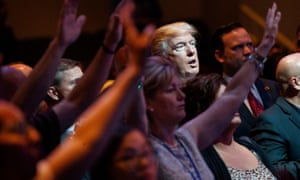
Donald Trump at an evangelical Christian service in 2016.
If there was a dictator’s playbook, the Donald Trump administration would now be on the “Instrumentalise Religion” chapter. Last week, in what sounded like the launch of a US caliphate, the attorney general, Jeff Sessions, reached for a biblical verse to defend his department’s policy of separating migrant parents from their children at the Mexican border, suggesting that God supports the government.
“I would cite you to the apostle Paul, and his clear and wise command in Romans 13 to obey the laws of the government because God has ordained the government for his purposes,” Sessions said. “Orderly and lawful processes are good in themselves. Consistent and fair application of the law is in itself a good and moral thing, and that protects the weak and protects the lawful.”
When the White House press secretary, Sarah Sanders, was asked about Sessions’ statement and challenged to produce the passage in the Bible that says it is moral to separate families, she said: “I’m not aware of the attorney general’s comments or what he would be referencing, [but] I can say that it is very biblical to enforce the law. That is repeated throughout the Bible.”
It is hard to make any coherent sense of the Trump administration’s policies. They are the result of the temperamental whims of a man-child president and the indulgences of a weak, cynical and ideological White House. There is no coherent plan, just a race to the bottom in order to appeal to a base animated by resentment and grievance. But there are moments that signal a gear change, that show us – even though there is no design – there is direction. A path has been plotted by the forces that put Trump in the White House, and they will be fed; and that feeding is then justified by any means necessary.
After Charlottesville, where a woman lost her life after being run over by a man who held racist, pro-Nazi views, Trump said that “both sides” were to blame for the violence. It was a normalisation of white supremacy. When Trump embarked on a policy of attacking the press, it was an assault on accountability. Now his administration’s use of religion to justify its laws is another step in an alarming direction . The government is not only unaccountable: it is doing God’s will. There should be no focus on the brutality of law, only on obedience to the sovereign. Sessions, the grand mufti, had pronounced his fatwa.
A rally in Los Angeles last week against Immigration and Customs Enforcement policies.
Pinterest
 A rally in Los Angeles last week against Immigration and Customs Enforcement policies. Photograph: Robyn Beck/AFP/Getty Images
To those of us who grew up in the Arab world, where Islam is often invoked by “secular” regimes in order to stem political opposition, and who are accustomed to this charade of piety, there is something chilling yet comforting in observing the authoritarian evolution of the Trump administration. There is a reason why some of those regimes will not do away with blasphemy laws, so handy are they in purging political opponents. It is chilling to see religion used this way in a supposedly sophisticated, liberal democracy, and in particular this element of it, which reduces politics to mere compliance. But it is comforting, in a macabre way, to have it proved that nowhere in the world have humans evolved beyond instrumentalising religion to justify tyranny. The most bewildering thing about US dictator creep isn’t that it’s happening: it’s that it is happening with such predictability.
The terror of the Trump doctrine is not in its innovation but in its imitation. The last few months are a testament to the fact that history is not past, that the passage of time does not necessarily imply progress. The words Sessions quoted were used in the 1840s and 50s to justify slavery. When abolitionists argued that slavery was cruel, and that separating families was a violation of religious ethics, they were met with the argument of religious compliance with the law. John Fea, a history professor at Messiah College in Pennsylvania, told the Washington Post: “Whenever Romans 13 was used in the 18th and 19th century – and Sessions seems to be doing the same thing, so in this sense there is some continuity – it’s a way of manipulating the scriptures to justify your own political agenda.”
The invocation of piety is also familiarly threadbare when the behaviour of this holy sovereign, allegedly with God’s will vested in him, is taken into account. Trump is a man mired in allegations of infidelity committed across the course of his three marriages. His church attendance was summed up in his statement that he had “never asked God for forgiveness”, and he referred to communion as “my little wine” and “my little cracker”. Yet he received 80% of the white evangelical vote. Of his unlikely Christian support base, Amy Sullivan, in the New York Times, says: “Decades of fearmongering about Democrats and religious liberals have worked. 80% of white evangelicals would vote against Jesus Christ himself if he ran as a Democrat.”
This is the most sinister and most powerful element of the dictator’s playbook: the pact with the base. Every policy, every utterance, becomes about what it signifies to its target audience rather than what it objectively means. During the presidential campaign, when Trump said that “you just don’t see the expression Merry Christmas any more”, he wasn’t expressing, or even reflecting, an earnest concern about the erosion of Christian values. He was feeding a paranoia and nativist angst about race and identity. There is no Trump doctrine, but there is a Trump code, transmitted from the pulpits of the White House to his voters.
Quick guide

Why are families being separated at US border?

Where others see panicked children and parents mad with distress when ripped away from their offspring, Trump supporters decipher the scene in terms of what Trump is projecting: your fears are real, your will is done, and I am its executor. Once this line of communication has been established, there is little that can disrupt it, no appeal to emotion or logic that is fruitful. It is a feedback loop that is not about values or religion or even conservatism. It is about prejudice against the other and anger at liberals, the perceived enablers of the other.
To those Americans shocked that ancient biblical texts preaching obedience to the law are being uttered by senior White House officials, those of us who have gone through the anguish of holy texts being used to justify crimes against humanity can extend much empathy but no comfort – and the certainty that there is more to come.
• Nesrine Malik is a Guardian columnist

Thursday, June 14, 2018

How Jordan's economic crisis exposed Saudi Arabia's leadership vacuum

Saudi Arabia did not save Jordan's ailing economy. Kuwait and Qatar did

By David Hearst

Link

Saudi Arabia did not come to Jordan's rescue with a $2.5bn aid package, although King Salman very much wanted to appear as if it had.
What happened was an attempt by King Salman to take the credit for the money that Kuwait had already pledged. What resulted was a scramble by rival Gulf states to support Jordan.

'Substantial financial support'

King Abdullah had sent an envoy to Kuwait, before street protests erupted at rising prices and a planned increase in income tax, a well informed source close to the Jordanian Royal Court told MEE. A Kuwaiti minister of state was in Jordan during the protests, and as a result Kuwait pledged to deposit $500m in the Central Bank of Jordan and promised another $500m in low interest loans. 
The next knock on the door came from Qatar. Sheikh Tamim bin Hamad Al Thani, the emir of Qatar, called Abdullah to offer Qatar's "substantial financial support". The call was not announced upon the request of Jordan, which was still hoping for Saudi Arabia to cough up.
Saudi Arabia did not come to Jordan's rescue with a $2.5bn aid package, although King Salman very much wanted to appear as if it had
Today Qatar's foreign minister, Mohammed bin Abdulrahman Al Thani, and the Qatari finance minister have arrived in Jordan to negotiate the aid package. This is the first such visit since Jordan downgraded relations with Qatar as a result of Saudi pressure to enforce the blockade a year ago. 
The Qatar Ministry of Foreign Affairs announced that Qatar decided to support Jordan's economy directly with more than 10,000 jobs, and $500m.
A few hours after the call from Qatar, and possibly because he had got wind of Qatar's move, King Salman called Abdullah. The meeting which followed included the emir of Kuwait, Sheikh Sabah al-Ahmad al-Sabah, and the emir of Dubai and prime minister of UAE, Mohammed bin Maktoum, who is theoretically second in command after the president.  
King Salman called the de-facto UAE ruler, Mohammed bin Zayed, but he declined to come and the UAE was represented by bin Maktoum. 
In a Saudi sleight of hand, Kuwait's $1bn was included in the total aid package announced by Salman, as if it had been decided in the meeting. In reality, Saudi and the UAE gave less than Kuwait by dividing the remaining $1.5bn between them.

Saudi leadership vacuum

There was, consequently, "a degree of disappointment" in the royal court with Salman's response, because Jordan already had received $1bn from Kuwait and they expected more from Saudi Arabia, particularly as the Saudis had stopped funding Jordan for two years.
What does all this mean?
Firstly, that King Salman was panicked into a reaction once he realised that the vacuum of Saudi regional leadership was being filled by his Gulf rivals. Kuwait has tried and failed to play the role of intermediary in the crisis sparked by the blockade of Qatar by Saudi, UAE, Bahrain and Egypt. But it has also been at loggerheads with Israel and the US over Gaza. 
The Kuwaiti reaction to Jordan is another sign that there is no love lost between it and Saudi
The US blocked a statement calling for an independent investigation of the killings of Palestinian protesters on the Gaza border, which Kuwait, a non-permanent member of the Security Council had written.
Having attempted to bully the Gulf Cooperation Council into submission, all Saudi Arabia has succeeded in doing is to split it. Kuwait now is pursuing its own policies with a degree of independence which it did not do before. The same can be said of Qatar. The Kuwaiti reaction to Jordan is another sign that there is no love lost between it and Saudi.
Secondly, it means that King Abdullah, who visited Kuwait on Tuesday, is less tied to Saudi Arabia after this aid package than everyone thinks. The Saudis do not have as much leverage over Amman as the headline figure of $2.5bn suggests. 
Jordan's King Abdullah II (R) meeting with Qatar's Emir Shiekh Tamim bin Hamad al-Thani during the Arab-African leaders summit meeting in Kuwait City on 19 November, 2013 (AFP)
Yes, there are 400,000 Jordanians working in Saudi and their remittances are worth around 10 per cent of Jordan’s GDP. But Jordan now has other sources of finance, from Gulf states that are closer to the issues that matter to Jordanians than Salman is.
I say Jordanians rather than the king himself, because that too is another factor.

Change the political formula 

King Abdullah understands that his legitimacy does not depend on buying the support of his people. He has to take into consideration the will of his people regarding the political direction of the kingdom more than any time in his reign.
Last week's protests and the continuing friction with the Beni Sakhr tribe, whose leader Fares al-Fayez, was arrested on Saturday after calling for political change, are a warning to the king that he can no longer take the loyalty of his people for granted. Al-Fayez broke the unwritten rule of making a personal attack on the king publicly. 
He not only said he wanted to "change the political formula", he added: "We will not accept you [Abdullah] as a king, prime minister, defence minister, police chief and governor. You are everything. You became a demigod, according to this constitution, and we are slaves."
What Jordanians think matters and this too is a factor limiting Salman's leverage, because as an absolute monarch he has no concept of civic society or public opinion
He also reminded the king that his family came from the land that is now Saudi Arabia. To be more precise, Jordan is all that is left of the kingdom his family once ran. "This is our country and our land. You came from the Hijaz, you, your father and your grandfather. My father welcomed your grandfather. You owe us, we do not owe you."
A demonstrator gestures and shouts during a protest near the prime minister's office in Amman, Jordan, on 5 June, 2018 (AFP)
The veteran political dissident Laith Shubeilat rubbed salt into the king’s wounds by telling the Lebanese newspaper Al-Akhbar that Jordan had been displaced by Saudi as Israel's loyal military servant. 
He said that "Jordan was an Israeli ally with a brigadier general rank, but now it has been downgraded to lieutenant and Saudi Arabia rose to be the general.”

An existential threat

Such bald and open affronts to royal authority are not accidental. They are a reminder to the royal court that public opinion in Jordan cannot be so easily bought off these days. 
What Jordanians think matters and this too is a factor limiting Salman's leverage, because as an absolute monarch he has no concept of civic society or public opinion.
For different reasons, both the East Bank and Palestinian halves of the Jordanian population are dead set against Saudi’s sponsorship of the Israeli demand that Palestinian refugees abandon their right of return.
READ MORE ►
This alone is being seen as an existential threat to the stability of the Jordanian state. But there are other threats too. The US recognition of Jerusalem as the undivided capital of Israel challenges, to say the least, the Hashemite custodianship of the holy sites in Jerusalem, as well as the Palestinian demand, backed by the Arab League, that East Jerusalem is the capital of a Palestinian state.
Whether he wants to or not, these are not issues on which King Abdullah can bend. His legitimacy depends on his role as custodian of the holy sites more than ever before.
Saudi Arabia has good reason to think that the fresh wave of people power in Jordan could easily migrate across borders. Kuwait and Qatar's growing importance as independent Gulf actors and donors to Jordan also gives King Abdullah the chance to give political reform in Jordan a chance. If he does not take it, the writing is on the wall.
- David Hearst is editor-in-chief of Middle East Eye. He was chief foreign leader writer of The Guardian, former Associate Foreign Editor, European Editor, Moscow Bureau Chief, European Correspondent, and Ireland Correspondent. He joined The Guardian from The Scotsman, where he was education correspondent.