For liberating them from their heads, their limbs, their lives, their freedom, their dignity, their electricity, their children, etc.,
Iraq's Valley of Peace helps overflowing morgues: "Most of the bodies were bound by chains so we always have to keep a cutter nearby to cut them. Most bodies were beheaded and they have a lot of holes in the head and face," said cemetery worker Riad Ahmed.

Friday, July 28, 2006


A "light" upon nations...
Israeli Justice Minister: IDF Entitled to Kill Everyone in South Lebanon: Ramon made these comments on Israeli Army radio. He was apparently not asked about the IDF’s practice of blowing up the cars full of civilians fleeing south Lebanon.
Criminalizing Civilians: Look at this logic: since Israel has asked civilians to leave, any that disobeyed have forfeited their status as civilians.
100,000 Whiners for War Crimes: Israel's Ministry of Foreign Affairs has called for 100,000 apologists for Israel to spam web sites reporting the Israeli Death Forces' horrors in Lebanon. (I knew that when that Gallup poll came out indicating that only half of Americans support what Israel is doing and that something like 70% did not believe Israeli claims that Hezbollah *started it* that we would be inundated with Zionist apologists. I think that 90% of the Zionists on As'ad's blog are being paid or are volunteering their time for Israel)
Syrian reporter: In Syria there is atmosphere of eve of war
"Exclusive: In conversation in Damascus, senior Syrian journalist tells about sentiments in Syria ('as if there will be war any moment'); talks about military preparations in his country ('identifying your reinforcements in Golan Heights'); and estimates that Israeli pounding in Lebanon to intensify grassroots support of Nasrallah and his organization. Also in Syria, he says, Nasrallah more popular than ever "
Hizbullah support tops 80 percent among Lebanese
Israeli strikes may boost Hizbullah base Hizbullah support tops 80 percent among Lebanese factions.
By Nicholas Blanford
TYRE, LEBANON
The ferocity of Israel's onslaught in southern Lebanon and Hizbullah's stubborn battles against Israeli ground forces may be working in the militant group's favor.
"They want to shatter the myth of Israeli invincibility," says Amal Saad-Ghorayeb, a leading Lebanese expert on Hizbullah. "Being victorious means not allowing Israel to achieve their aims, and so far that is the case."
Still, the intensity of the Israeli bombing campaign appears to have taken Hizbullah aback. Mahmoud Komati, the deputy head of Hizbullah's politburo told the Associated Press, "the truth is - let me say this clearly - we didn't even expect [this] response ... that [Israel] would exploit this operation for this big war against us."
When Hizbullah guerrillas snatched two Israeli soldiers from across the border, it appeared to be a serious miscalculation. In the days that followed the July 12 capture, Israel unleashed its biggest offensive against Lebanon since its 1982 invasion, smashing the country's infrastructure, creating 500,000 refugees, and so far killing more than 400 civilians.
Thursday, Israeli air and artillery strikes continued in southern Lebanon and the International Committee of the Red Cross said bodies were laying in the streets of some Lebanese border villages where fighting has trapped civilians. Also Thursday Al Qaeda's second in command, Ayman Zawahiri, called in a televised video for Muslims to join fighting in the Gaza Strip and Lebanon in a holy war against Israel. While al-Qaeda is a Sunni Muslim group which in general views Shiites, who make up Hizbullah's ranks, with disgust and not even as Muslims, they share a common hatred of Israel and the US.
In a televised address Tuesday, Hassan Nasrallah, Hizbullah's secretary general, said the Israeli onslaught was an attempt by the US and Israel to "impose a new Middle East" in which Lebanon would be under US hegemony.
"Our fate is to confront this plan ... we are waging a war for the liberation of the remaining occupied lands and the liberation of our detainees," Mr. Nasrallah said.
Ms. Saad-Ghorayeb says that Hizbullah's goals have changed, "assuming a wider strategic importance" in which the party is at the forefront of opposition to the Bush administration's agenda of transforming the Middle East into a series of pro-Western democracies.
"Hizbullah is in a unique position to confront the US agenda which if successful will be, by extension, a victory for Syria, Iran and Hamas," she says.
Hizbullah's top guerrilla fighters are mounting a stubborn campaign against the region's most powerful army in and around Bint Jbail, the largest Shiite town in the border district where support for the party runs high.
Hizbullah has had six years - ever since Israel withdrew from south Lebanon - to prepare for this climactic showdown. Instead of storing weapons and ammunition in vulnerable stockpiles, they are scattered throughout the south in natural caves, tunnels, and homes. Hizbullah officials say they have sufficient ammunition and high morale tofight for months.
Hizbullah's frontline fighters are battle-hardened veterans after fighting Israeli forces in the 1990s. They are armed with advanced Russian antitank missiles, which have proved deadly against Israel's vaunted Merkava tanks and use classic hit-and-run guerrilla tactics.
"Hizbullah is doing what it does best, harassing the enemy," says Timur Goksel, who served 24 years with the UN peacekeeping force in south Lebanon.
Indeed, Nasrallah has announced the launch of the "second phase of our struggle" in which his long-range rockets would "go beyond Haifa," Israel's third-largest city. Israeli officials have been bracing for possible rocket attacks on Tel Aviv, which would mark a major escalation in the conflict.
"If Hizbullah hits Tel Aviv, I think that Israel will totally wipe off the map Bint Jbail, Khiam, Tyre and Nabatieh," says Nizar Abdel-Kader, a columnist for Ad-Diyar newspaper and a retired Lebanese army general.
The stakes are high for Hizbullah, but it seems it can count on an unprecedented swell of public support that cuts across sectarian lines.According to a poll released by the Beirut Center for Research and Information, 87 percent of Lebanese support Hizbullah's fight with Israel, a rise of 29 percent on a similar poll conducted in February. More striking, however, is the level of support for Hizbullah's resistance from non-Shiite communities. Eighty percent of Christians polled supported Hizbullah along with 80 percent of Druze and 89 percent of Sunnis.
Lebanese no longer blame Hizbullah for sparking the war by kidnapping the Israeli soldiers, but Israel and the US instead.
The latest poll by the Beirut Center found that 8 percent of Lebanese feel the US supports Lebanon, down from 38 percent in January.
"This support for Hizbullah is by default. It's due to US and Israeli actions," says Saad-Ghorayeb, whose father, Abdo, conducted the poll.
The most favorable outcome for Hizbullah, analysts say, is to keep harassing Israel until there is a cease-fire agreement that essentially leaves Hizbullah intact. If Israel establishes an occupation zone along the border to police the area, Hizbullah will likely continue fighting, unhindered by a weakened Lebanese government and backed by a radicalized Shiite community. That growing radicalization is palpable in this laid-back coastal town where support for Hizbullah traditionally has been arbitrary.
Ghassan Farran, a doctor and head of a local cultural organization, gazes in disbelief at the pile of smoking ruins which was once his home. Minutes earlier, an Israeli jet dropped two guided missiles into the six-story apartment block in the centre of Tyre.
"Look what America gives us, bombs and missiles," says this educated, middle-class professional. "I was never a political person and never with Hizbullah but now after this I am with Hizbullah."
Sergeant Tells of Plot to Kill Iraqi Detainees
For more than a month after the killings, Sgt. Lemuel Lemus stuck to his story.
“Proper escalation of force was used,” he told an investigator, describing how members of his unit shot and killed three Iraqi prisoners who had lashed out at their captors and tried to escape after a raid northwest of Baghdad on May 9.
Then, on June 15, Sergeant Lemus offered a new and much darker account.
In a lengthy sworn statement, he said he had witnessed a deliberate plot by his fellow soldiers to kill the three handcuffed Iraqis and a cover-up in which one soldier cut another to bolster their story. The squad leader threatened to kill anyone who talked. Later, one guilt-stricken soldier complained of nightmares and “couldn’t stop talking” about what happened, Sergeant Lemus said.
As with similar cases being investigated in Iraq, Sergeant Lemus’s narrative has raised questions about the rules under which American troops operate and the possible culpability of commanders. Four soldiers have been charged with premeditated murder in the case. Lawyers for two of them, who dispute Sergeant Lemus’s account, say the soldiers were given an order by a decorated colonel on the day in question to “kill all military-age men” they encountered.
Continued
Israel will not allow UN to probe killing of observers in Lebanon
The United Nations will remove unarmed observers from their posts along the Israel-Lebanon border, moving them in with the peacekeeping force in the area, a spokesman said Friday. UNTSO has about 50 observers in four posts along the border, two of which have already been abandoned - the one that was destroyed at Khiam and a second near the village of Maroun al-Ras, which was abandoned after one of the observers was seriously wounded by Hezbollah gunfire on July 23, said Milos Struger, spokesman for the UNIFIL peacekeepers. Israel's ambassador to the UN ruled out Thursday major UN involvement in any potential international force in Lebanon, saying more professional and better-trained troops were needed for such a volatile situation. Dan Gillerman also said Israel would not allow the United Nations to join in an investigation of an Israeli air strike that demolished a post belonging to the current UN peacekeeping mission in Lebanon. Four UN observers were killed in the Tuesday strike.
'Everything In My Life Is Destroyed, So I Will Fight Them'
By Dahr Jamail
07/28/06
"I am in Hezbollah because I care," the fighter, who agreed to the interview on condition of anonymity, told me. "I care about my people, my country, and defending them from the Zionist aggression." I jotted furiously in my note pad while sitting in the back seat of his car. We were parked not far from Dahaya, the district in southern Beirut which is being bombed by Israeli warplanes as we talk.
The sounds of bombs echoed off the buildings of the capital city of Lebanon yesterday afternoon. Out the window, I watched several people run into the entrance of a business center, as if that would provide them any safety.
The member of Hezbollah I was interviewing-let's call him Ahmed-has been shot three times during previous battles against Israeli forces on the southern Lebanese border. His brother was killed in one of these battles. It's been several years since his father was killed by an air strike in a refugee camp."
My home now in Dahaya is pulverized, so Hezbollah gave me a place to stay while this war is happening," he said, "When this war ends, where am I to go? What am I to do? Everything in my life is destroyed now, so I will fight them."
That explains why earlier in the day, when driving me around, he'd stopped at an apartment to change into black clothing-a black t-shirt and black combat pants, along with black combat boots.
A tall, stocky man, Ahmed seemed always exhausted and angry."I didn't have a future," he continued while the concussions of bombs continued, "But now, Hassan Nasrallah is the leader of this country and her people. My family has lived in Lebanon for 1,500 years, and now we are all with him. He has given us belief and hope that we can push the Zionists out of Lebanon, and keep them out forever. He has given me purpose."
"Do you think this is why so many people now, probably over two million here in Lebanon alone, follow Nasrallah?" I asked.
"Hezbollah gives you dignity, it returns your dignity to you," he replied, "Israel has put all of the Arab so-called leaders under her foot, but Nasrallah says 'No more.'
"He paused to wipe the sweat from his forehead. The summer heat in Beirut drips with humidity. During the afternoon, my primary impulse is to find a fan and curl up for a nap under its gracious movement of the thick air here.
Earlier he'd driven me to one of the larger hospitals in Beirut where I photographed civilian casualties. All of them were tragic cases but one really grabbed me-that of a little 8 year-old girl, lying in a large bed. She was on her side, with a huge gash down the right side of her face and her right arm wrapped in gauze. She was hiding in the basement of her home with 12 family members when they were bombed by an Israeli fighter jet.Her father was in a room downstairs with both of his legs blown off. Her other family members were all seriously wounded. She lay there whimpering, with tears streaming down her face.
I think I won Ahmed's trust after that. I walked out the car, got in and sat down. He asked me where I wanted to go now.
Ahmed put his hand on my shoulder and said, "This is what I've been seeing for my entire life. Nothing but pain and suffering."
A photographer from Holland who was working with me was able to respond to Ahmed that maybe we could go have a look at Dahaya.
Ahmed had told me that it was currently extremely dangerous for a journalist to try to go into Dahaya. Before, Hezbollah had run tours for people to come see the wreckage generated by Israeli air strikes.
All you had to do was meet under a particular bridge at 11 a.m., and you had a guided tour from "party guys" (members of Hezbollah) into what has become a post-apocalyptic ghost town.
A couple of days ago I went there, without the "party guy" tour. A friend and I were driven in by a man we hired for the day to take us around. I was shocked at the level of destruction-in some places entire city blocks lay in rubble. At one point we came upon the touring journalists, all scurrying to their vehicles. Everyone was in a panic."What's going on?," I asked our driver. "A party guy who is a spotter said he saw Israeli jets coming," he responded, while spinning the van around and punching the gas as we sped past the journalists lugging their cameras while running back to their drivers.
While driving we were passed by several Hezbollah fighters riding scooters. Each had his M-16 assault rifle slung across his back and wore green ammunition pouches across his chest.
Ahmed told me he'd captured two Israeli spies himself. "One of them is a Lebanese Jewish woman, and she had a ring she could talk into," he explained as new sweat beads began to form on his forehead, "Others are posing as journalists and using this type of paint to mark buildings to be bombed."
I doubt the ring part, and also wonder about the feasibility of paint used for targeting, but there are no doubt spies crawling all over Beirut. In Iraq, mercenaries often pose as journalists, making it even more dangerous than it already was for us to work there.
Nevertheless, war always fosters paranoia. Whom can you trust? What if they are a spy? What are their motives? Why do they want to ask me this question at this time? These types of questions become constant I my mind, and so many others in this situation where normal life is now a thing of the past. I think they are some sort of twisted survival mechanism.
We drove back near my hotel and parked again. People strolled by on the sidewalks. Ahmed said, "I will never be a slave to the United States or Israel."
(c)2006 Dahr Jamail.
On a Red Cross mission of mercy when Israeli air force came calling
By Robert Fisk
The Indepedent
07/28/06
It was supposed to be a routine trip across the Lebanese killing fields for the brave men and women of the International Red Cross.
Sylvie Thoral was the "team leader" of our two vehicles, a 38-year-old Frenchwoman with dark brown hair and eyes like steel. The Israelis had been informed and had given what the ICRC likes to call its "green light" to the route. And, of course, we almost died. Trusting the Israeli army and air force, which are breaking the Geneva Conventions almost every day, is a dodgy business.
Their planes have already attacked - against all the conventions - the civil defence headquarters in Tyre, killing 20 refugees. They have twice attacked truckloads of refugees whom they themselves had ordered from their villages.
They have already attacked two Lebanese Red Cross ambulances in Qana, killing two of the three wounded patients inside and injuring all the crew - a clear and apparently deliberate breach of Chapter IV, Article 24 of the 1949 Geneva Conventions.
Continued

White House wary of war crimes charges...
Detainee Abuse Charges Feared
Shield Sought From '96 War Crimes Act
By R. Jeffrey Smith
Washington Post Staff Writer
Friday, July 28, 2006; A01
An obscure law approved by a Republican-controlled Congress a decade ago has made the Bush administration nervous that officials and troops involved in handling detainee matters might be accused of committing war crimes, and prosecuted at some point in U.S. courts.
Senior officials have responded by drafting legislation that would grant U.S. personnel involved in the terrorism fight new protections against prosecution for past violations of the War Crimes Act of 1996. That law criminalizes violations of the Geneva Conventions governing conduct in war and threatens the death penalty if U.S.-held detainees die in custody from abusive treatment.
In light of a recent Supreme Court ruling that the international Conventions apply to the treatment of detainees in the terrorism fight, Attorney General Alberto R. Gonzales has spoken privately with Republican lawmakers about the need for such "protections," according to someone who heard his remarks last week.
Continued

Is Condoleeza bleaching herself like Michael?
It must be hard to constantly struggle to fit in with those deranged, violent, racist white men in the White House.
So really, what is up with her feet? And legs?
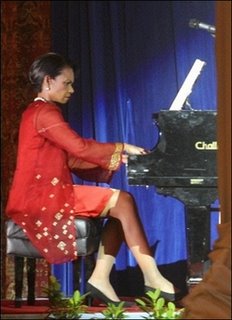
So really, what is up with her feet? And legs?

 BIRTH PANG?
Palestinian relatives carry the body of Anas Zoumlot, 12, during his funeral at the Jebaliya refugee camp, next to Gaza City Friday July 28, 2006. Zounlot was killed, according to Palestinian witnesses and officials, by Israeli troops during an army operation Thursday in Jebaliya. Despite a high death toll in Gaza, with 23 people killed on Wednesday alone, the world's attention has been focused on Lebanon.
Sorry, Mohammed but you're just a quota
Air Marshals say people added to watchlists to fill quotas
The American Civil Liberties Union has asked the Chief Privacy Officer of the Department of Homeland Security to investigate a recent news report that federal air marshals are labeling innocent Americans as "suspicious" after being directed to fill a monthly watchlist quotas, RAW STORY has learned.
The Air Marshals Service responded to earlier complaints by indicating that the complaints came from disgruntled Denver employees. However, Denver's KMGH-TV contacted 17 employees in 4 different states, who confirmed the story.
KMGH quotes one Air Marshal as saying, "Our job is to prevent another Sept. 11 from happening. We can't do that. Not under these circumstances, not under these conditions."
Continued
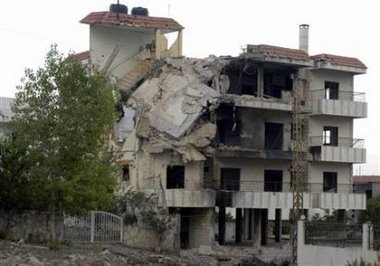
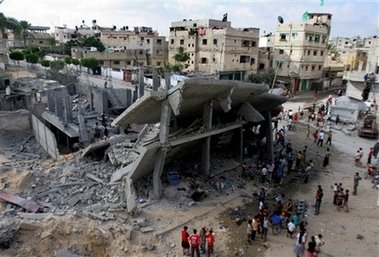
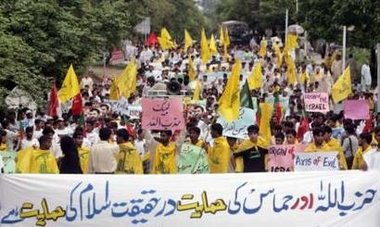
The War on Lebanon and the Battle for Oil
Is there a relationship between the bombing of Lebanon and the inauguration of the World's largest strategic pipeline, which will channel more than a million barrels of oil a day to Western markets?
Virtually unnoticed, the inauguration of the Ceyhan-Tblisi-Baku (BTC) oil pipeline, which links the Caspian sea to the Eastern Mediterranean, took place on the 13th of July, at the very outset of the Israeli sponsored bombings of Lebanon.
One day before the Israeli air strikes, the main partners and shareholders of the BTC pipeline project, including several heads of State and oil company executives were in attendance at the port of Ceyhan. They were then rushed off for an inauguration reception in Istanbul, hosted by Turkey's President Ahmet Necdet Sezer in the plush surroundings of the Çýraðan Palace.
Also in attendance was British Petroleum's (BP) CEO, Lord Browne together with senior government officials from Britain, the US and Israel. BP leads the BTC pipeline consortium. Other major Western shareholders include Chevron, Conoco-Phillips, France's Total and Italy's ENI. (see Annex)
Israel's Minister of Energy and Infrastructure Binyamin Ben-Eliezer was present at the venue together with a delegation of top Israeli oil officials.
Read the rest
Subscribe to:
Posts (Atom)