Friday, December 1, 2006


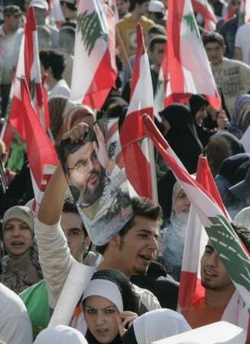
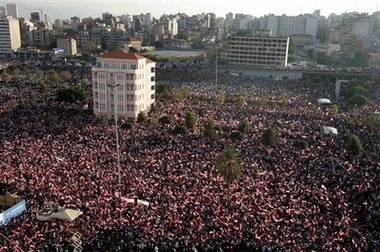
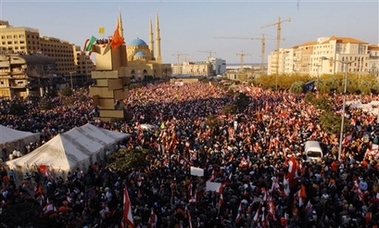
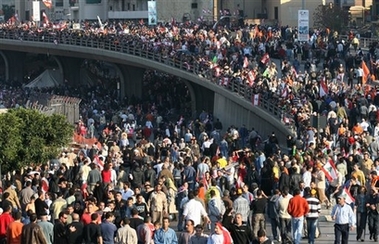
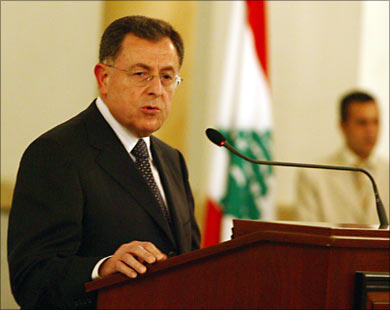
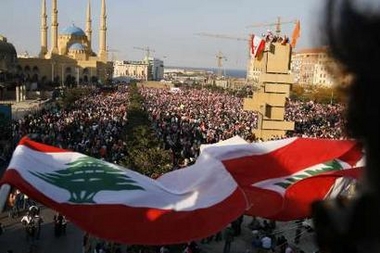
A general view of Lebanese Hezbollah supporters waving Lebanese flags during a demonstration to force the resignation of Western-backed Prime Minister Fuad Saniora, in Beirut, Lebanon Friday, Dec. 1, 2006. Hundreds of thousands protesters from Hezbollah and its pro-Syrian allies descended on downtown Beirut on Friday in a peaceful but noisy protest to force the resignation of U.S.-backed Prime Minister Fuad Saniora, who was holed up in his office ringed by hundreds of police and combat troops.(AP Photo)


A sea of flag-waving protesters demanded on Friday the resignation of Lebanon's Western-backed government at a Hezbollah-led rally. (REUTERS)

The Bush-Maliki Summit and the New Middle East Cold War

By Juan Cole

"Al-Hayat writing in Arabic sums up the results of the Bush-Maliki Summit:

1. The US and its Arab allies rejected the notion of making any concessions to Iran in return for Tehran's help in calming the situation in Iraq.

2. The al-Maliki government would be given "another chance" to crack down on Shiite militias such as the Mahdi Army and would be given greater freedom of movement in confronting them militarily.

In other words, Bush is trying to set al-Maliki up for a confrontation with the Sadr Movement and is trying to keep the Shiite-dominated government in Baghdad from too openly embracing Iran. (That cow is already out of the barn, of course).

Al-Hayat sees the influence of Arab allies of the US on Bush's policy as decisive. It says that informed sources in Amman report that the Arab diplomats warned Bush against giving Iran nuclear privileges and against giving Syria "Lebanese" privileges, in return for their help in Iraq. These Arab countries likely include Saudi Arabia, Jordan, Kuwait and Egypt. That is, there is a new Middle Eastern Cold War between the pro-Western Arab states (Riyadh-Amman-Cairo-Kuwait City) and the Tehran-Damascus axis. The pro-Western Arabs fear the Iranian nuclear program, and they generally support Saad Hariri, Fouad Seniora, and the 14 March Movement in Lebanon against Hizbullah, which is backed by Syria and Iran.

This Middle Eastern Cold War is pushing Washington, allied with the Arab conservatives, into a contradictory stance in Iraq, having installed a Shiite, pro-Iranian government there but remaining unable to work with this new reality on a geopolitical level. The Middle Eastern Cold War pitting the Saudis and Egyptians against the Iranians and Syrians is reinforced by Washington's other major ally in the region, Israel, which also wants to contain or roll back Syria and Iran. As is often the case, despite their rhetoric of seeming enmity, the pro-Western Arab regimes and the Israelis have not so dissimilar geopolitical aims in the region, with the disposition of the Palestine Authority really the only major dispute between them. Iraq is caught in the middle of this new Cold War and seems likely to be the major victim of it.

If Bush gets his way, we could see substantial Shiite on Shiite violence in the coming months, of which it is likely the Sunni Arab guerrilla movement will take advantage.

The Sadr Movement representatives in parliament and on the Iraqi cabinet announced that the setting of a timetable for US military withdrawal from Iraq is the minimum condition for their return to al-Maliki's coalition. They also said that they would work toward the creation of a parliamentary front that would demand a US withdrawal. Over 100 out of 275 members of parliament have already voted for the US to set a timetable and leave, but rather than let the whole parliament vote a resolution, the al-Maliki government sent the issue to committee, from which it may never emerge or not for months."

Neo-conservatism at the Vatican? Kissinger to become Political Adviser to Pope Benedict XVI

Pope Benedict XVI has invited Henry Kissinger, former adviser to Richard Nixon, to be a political consultant and he accepted.

BY EDWARD PENTIN
National Catholic Register Correspondent

"VATICAN CITY — Over the course of his long and controversial career, former U.S. Secretary of State Henry Kissinger has had many titles. Now he reportedly has one more — adviser to the Pope.

According to the Italian newspaper La Stampa, Pope Benedict XVI has invited the 83-year-old former adviser to Richard Nixon to be a political consultant, and Kissinger has accepted.

Quoting an “authoritative” diplomatic source at the Holy See, the paper reported Nov. 4 that the Nobel laureate was asked at a recent private audience with the Holy Father to form part of a papal “advisory board” on foreign and political affairs.

As the Register went to press, Kissinger’s office was unable to confirm or deny the report. La Stampa stood by its story, although the Italian press is less rigorous in its authentication of stories as is the United States Press.

If true, there is speculation on which issues Kissinger would advise the Holy Father. Relations with Islam, Palestine and Israel, and Iraq — Kissinger has been critical of the conduct of the war but opposes a quick withdrawal — are likely to be high up on the agenda.

It has also been speculated that, in view of the Muslim hostility to Benedict’s recent Regensburg speech, Kissinger might provide advice on dealing with an increasingly fractious Islamic world.

Furthermore, like the Pope, Kissinger has analyzed the challenges of globalization and might provide advice in this area as well.

....Continues "

Never Heard of al-CIA-duh Group Threatens Banksters


By Kurt Nimmo

"Once again, an “al-Qaeda” affiliate nobody has ever heard of, and will never hear from again, is threatening damnation and ruin.

“The U.S. government warned American private financial services on Thursday of an al Qaeda call for a cyber attack against online stock trading and banking Web sites beginning on Friday, a source said,” Reuters reports. “The source, a person familiar with the warning, said the Islamic militant group aimed to penetrate and destroy the databases of the U.S. financial sites.”

No doubt this will be accomplished from caves with fiber optic cables or maybe from the high-tech boondocks of South Waziristan.

Of course, this is simply more propaganda designed to convince the bovine masses that the internet poses a threat, as the neocon Newt Gingrich declared the other day, and serious measures will need be taken, that is if we value our safety over our liberty. Never mind what Ben Franklin allegedly said on this subject.

.... Continues"

Iraq Mission Accomplished: They're Not Fighting Us Anymore, They're Fighting Each Other

As chaos reaches all time high coalition prepares to scale back occupation and march onwards to Syria and Iran

by Steve Watson
Global Research, December 1, 2006

"Death tolls in Iraq are hitting all time highs and the worst cases of sectarian violence of the entire war are rampant throughout the country. Amid the chaos, the government has declared that everything is going well enough in Iraq for forces to be withdrawn. This statement is accurate, the strategy has always been one of dissolution and destabilization. We are not "cutting and running" because the mission has been accomplished.

The machinations of the Machiavellian's are unfolding according to plan. Let Iraq cascade into chaos and dilute the insurgency by manipulating it to become fractious and watch in-fighting ensue. Top analysts in the CIA and State Department, as well as large numbers of Middle East experts, warned that a U.S. invasion of Iraq could result in a violent ethnic and sectarian conflict.

Stephen Zunes, professor of Politics and chair of the Peace & Justice Studies Program at the University of San Francisco, recently wrote,

"One of the long-standing goals of neoconservative intellectuals has been to see the Middle East broken up into smaller ethnic or sectarian mini-states, which would include not only large stateless nationalities like the Kurds, but Maronite Christians, Druze, Arab Shi'ites, and others. Such a policy comes not out of respect for the right of self-determination – indeed, the neocons have been steadfast opponents of the Palestinians' desire for statehood, even alongside a secure Israel – but out of an imperial quest for divide-and-rule. The division of the Middle East has long been seen as a means of countering the threat of pan-Arab nationalism and, more recently, pan-Islamist movements."

Of course it is, because the Zionist agenda has always been to divide and conquer the middle East. After many previous attempts, it's mission accomplished in Iraq now thanks to the neocons, that is why we have already seen a shift towards fomenting trouble in Syria with the decimation of Lebanon.

Israeli policy documents have always stated that it would be beneficial to the overall strategy to engender strife in the middle east. In 1982, Oded Yinon, an official from the Israeli Foreign Affairs office, wrote: "To dissolve Iraq is even more important for us than dissolving Syria. In the short term, it's Iraqi power that constitutes the greatest threat to Israel. The Iran-Iraq war tore Iraq apart and provoked its downfall. All manner of inter-Arab conflict help us and accelerate our goal of breaking up Iraq into small, diverse pieces."

That agenda was again underscored recently when Daniel Pipes, a highly influential Straussian Neo-Con media darling, told the New York Sun that a civil war would aid the US and Israel because it would entangle Iran and Syria and enable those countries to be picked off by the new world empire without the need to sell a direct invasion to the public.

A host of analysts and political experts agree that 2007 will see the bombing of nuclear facilities in Iran, with or without the approval of the US Congress. This is not surprising given that we have recently seen a spate of neoconservative and Israeli calls for the bombing to begin......"

Deep inside the 'kingdom of heaven'


By Syed Saleem Shahzad
Asia Times

Editor's note: Syed Saleem Shahzad returned to Karachi on Wednesday after being held for six days in the captivity of the Taliban in Afghanistan. Along with fellow journalist Qamar Yousufzai, Shahzad was detained on November 21 after entering the Baghran district of the southern province of Helmand. They were accused of being spies and of not having the Taliban's permission to be in the area.

"KARACHI - When the Taliban came to power in 1996 they promised to establish a kingdom of heaven, with its center based in the rugged southwest of Afghanistan. The people were promised showers of blessings from the skies, and the earth would give up unlimited treasures.

The Taliban were welcomed, but in the five years until their ouster by US-led forces in 2001, the land remained barren and the heavens silent. The Taliban did, however, deliver peace - probably the most precious gift of all.

Then came the Americans, and they pledged a paradise on Earth. The dirt-poor tribespeople of the southwest voted unanimously to give this a chance, and they handed the defeated Taliban an ultimatum: "Be good sons of the soil and surrender your guns, or go to the mountains." The Taliban headed for the hills, and their insurgency was born.

Now, once again after a five-year cycle, the wheel has turned and the Taliban have been asked to come down from the mountains and re-establish themselves among the people of the southwest.

This has been a pivotal development, as it gives the Taliban a friendly environment from which to launch the first phase in their ultimate goal of retaking first Kandahar, and then the capital Kabul.
.........continues "

Like Hitler and Brezhnev, Bush is in denial

By Robert Fisk
The Independent


"More than half a million deaths, an army trapped in the largest military debacle since Vietnam, a Middle East policy already buried in the sands of Mesopotamia - and still George W Bush is in denial. How does he do it? How does he persuade himself - as he apparently did in Amman yesterday - that the United States will stay in Iraq "until the job is complete"? The "job" - Washington's project to reshape the Middle East in its own and Israel's image - is long dead, its very neoconservative originators disavowing their hopeless political aims and blaming Bush, along with the Iraqis of course, for their disaster.

History's "deniers" are many - and all subject to the same folly: faced with overwhelming evidence of catastrophe, they take refuge in fantasy, dismissing evidence of collapse as a symptom of some short-term setback, clinging to the idea that as long as their generals promise victory - or because they have themselves so often promised victory - that fate will be kind. George W Bush - or Lord Blair of Kut al-Amara for that matter - need not feel alone. The Middle East has produced these fantasists by the bucketful over past decades.......

....Iraqi Prime Minister Nouri al-Maliki, almost as loyal a retainer to Bush as Sahaf was to Saddam, receives the same false praise from the American president that Nasser and Brezhnev once lavished upon their generals. "I appreciate the courage you show during these difficult times as you lead your country," Bush tells Maliki. "He's the right guy for Iraq," he tells us. And the Iraqi Prime Minister who hides in the US-fortified "Green Zone" - was ever a crusader fortress so aptly named? - announces that "there is no problem". Power must be more quickly transferred to Maliki, we were informed yesterday. Why? Because that will save Iraq? Or because this will allow America to claim, as it did when it decided to allow the South Vietnamese army to fight on its own against Hanoi, that Washington is not to blame for the debacle that follows? "One of his frustrations with me is that he believes that we've been slow about giving him the tools necessary to protect the Iraqi people." Or so Bush says. "He doesn't have the capacity to respond. So we want to accelerate that capacity." But how can Maliki have any "capacity" at all when he rules only a few square miles of central Baghdad and a clutch of rotting ex-Baathist palaces?

There can be no graceful exit from Iraq, only a terrifying, bloody collapse of military power. The withdrawal of Shia ministers from Maliki's cabinet mirror the withdrawal of Shia ministers from another American-supported administration in Beirut - where the Lebanese fear an equally appalling conflict over which Washington has, in reality, no military or political control.....

...No, Bush is not Hitler. Like Blair, he once thought he was Winston Churchill, a man who never - ever - lied to his people about Britain's defeats in war. But fantasy knows no bounds."

Thursday, November 30, 2006

BIRZEIT STUDENTS AND LECTURERS CALL FOR ACADEMIC BOYCOTT

Over one thousand Birzeit University students and over 110 of its faculty members signed an open letter in support of the international boycott of Israeli academic institutions. The signatures were collected by the Right to Education Student Committee in the shape of a letter [full text below] thanking the 61 Irish academics who called for a moratorium on EU aid to Israeli universities until Israel abides by international humanitarian and human rights laws. The Committee calls on student groups all over Palestine to take similar action and for students abroad to support Palestinian students by doing the same.

Israeli academia has failed to denounce the illegal occupation, racist policies and war crimes committed in their name by the Israeli state, despite their position of influence and moral obligation to do so.

Moreover, the Israeli occupation stifles the development of Palestinian education through arbitrary checkpoints, arrests, detentions and deportations. Palestinians face ongoing Israeli attacks on their educational institutions and there is a growing clampdown in the occupied West Bank and Gaza Strip. This includes the arbitrary detention of students, the prohibition of Gazans from studying in the West Bank, the harassment of foreign students entering Gaza and the West Bank and the increasing difficulties facing ordinary academic exchange between Palestinians and the outside world.

While the world remains silent in the face of the massacres in Gaza and the colonisation and segregation of the West Bank, the academic boycott is an effective way for the international community to oppose Israeli policy both from the outside and within, by pressuring Israeli academia to take action against their state’s policies of apartheid and unconditional violence against the Palestinian population.

******************************************************

Open letter in support of Irish academics,

We, the undersigned, members of the Birzeit University’s community of students, teachers, faculty staff and employees, congratulate and thank the group of Irish academics who called for a moratorium on the European Union’s financing of Israeli academic institutions until Israel withdraws from the occupied Palestinian territories and abides by international humanitarian and human rights laws, including the right of return.

The recent attacks and re-invasion of Gaza and Lebanon expose the contempt with which Israel treats the UN, its resolution and its own bilateral agreements. We strongly condemn the death, chaos and destruction inflicted upon Gazans and Lebanese, and call upon the students, academics and staff of universities worldwide to collectively condemn these acts and take action to support us in our struggle to end Israeli military aggression and occupation.

The objective of such military force is to control and subjugate Palestinian society in order to sustain Israel's Jewish demographic supremacy and enforce its unilaterally declared boundaries. As a result, Israel has built an apartheid system of controlling the Palestinian population both inside Israel and under the occupied territories. Economically, the occupied territories served as cheap-labour reserves until the building of the Wall, now it serves to make daily life unbearable so that Palestinians decide to leave, continuing the ‘silent transfer’ of the indigenous population. The Israeli civil and military bureaucracy also obstructs the development of an independent Palestinian economy through its control of borders, immigration, collection of taxes and restriction on movement inside the territories. Racially, Palestinians in Israel are consistently denied equal access to social services, housing and education, and since 2005, denied equal rights to family. In Jerusalem and the occupied territories, Palestinians are segregated by different permits based on their residency at the time of issue, and each ‘category’ is granted different freedoms of movement – at the bottom of this structure are Gaza permit-holders, who cannot move from Gaza to the West Bank, nor inside the West Bank itself. This system of control is parallel to the racial hierarchy and control during Apartheid South Africa.

Israeli academic institutions have close links with the state, and the vast majority of Israeli intellectuals and academics either contribute directly to the Israeli occupation through research that justifies or improves the mechanisms of Israeli apartheid, or are complicit through their silence about it. As Shahid Alam, Professor of Economics at North-eastern University in Boston, has pointed out, "through their links with the military, the political parties, the media, and the economy, they (Israel's universities) have helped to construct, sustain, and justify the Apartheid (policies of the occupation).”

We therefore urge international civil society and the academic community to join our call to comprehensively boycott Israeli academics who contribute or refuse to stand up against the occupation, until: Israel withdraws its military from the occupied territories, including East Jerusalem; removes all its colonies in those lands and agrees to United Nations resolutions relevant to the restitution of Palestinian refugees rights.

Yours faithfully,

1,015 students of Birzeit University, and:

1. Zeyad Munawer, Accounting
2. Dr Abdul Karim Abu-Khashan, Arabic
3. Ahmad Daoud, Arabic
4. Dr. Ibrahim Musa, Arabic
5. Khitam Salman, Arabic
6. Dr Ghadir Kharoubi, Arabic
7. Dr Mahmoud Alatchan, Arabic
8. Salahaldin Alshakhshir, Architectural Engineering
9. Dr Salem Thawaba, Architectural Engineering
10. Dr Ademar Ezzughayar, Biology
11. Jamil Abu Sada, Biology
12. Dr Munir Qazzaz, Biology
13. Dr. Tamer Essawi, Biology
14. Dr. Ahed Abdul Khaliq, Biology and Biochemistry
15. Omar Yaseen, Business Administration
16. Dr. Grace Khoury, Business Administration
17. Rania Jaber, Business Administration
18. Prof. Abdul Hamid Laila, Chemistry
19. Dr. Jack F Mustaklem, Chemistry
20. Dr. Sami Asayrafi, Chemistry
21. Dr Yacoub Ziadeh, Chemistry
22. Dr. Zaki Hassan, Chemistry
23. Belal Ameens, Centre for Environmental and Occupational Health Sciences
24. Dr Jamal Zalatimo, Civil Engineering
25. Suheym Murchad, Civil Engineering
26. Mahmoud Srour, Clinical Laboratory Science
27. Dr Hanna Bullata, Computer Science
28. Dr. Iyad Jaber, Computer Science
29. Muna Khayyat, Computer Science
30. Dr. Wasel Ghanem, Computer Science
31. Dr. Yousef Hassouneh, Computer Science
32. Dr. Abdelrahman Abdelghani, Cultural Studies and Philosophy
33. Dr. Abdul-Rahim Al-Shaikh, Cultural Studies and Philosophy
34. Dr. Islah Jadd, Cultural Studies and Philosophy
35. Dr. George Giacaman, Cultural Studies and Philosophy
36. Lubna Abdul Hadi, Cultural Studies and Philosophy
37. Dr. Mudar Kassis, Cultural Studies and Philosophy
38. Dr Adel Zagha, Economics
39. Dr. Nidal Sabri, Economics
40. Dr Mohamed Nasr, Economics
41. Yasser Abu Hejleh, Economics
42. Adballah Bsharat, Education
43. Ahmad Aljanazrah, Education
44. Dr. Ibrahim Makkawi, Education
45. Haifa Sabassi, Education and Psychology
46. Maurice Bakleh, Education and Psychology
47. Refa’ Al Ramahi, Education and Psyhcology
48. Wafa Aramahi, Education and Psychology
49. Dr. Yusef Abu Samrah, Education and Psychology
50. Dr. Wasfi Kafri, Electrical Engineering
51. Wael Abdin, English
52. Dr. Fahmi Al-Aboudi, English
53. Muna Giacaman, English
54. Murad Hanasheh, Finance
55. Sari Ghanam, Finance
56. Abdul Khalim A. Tomazi, Geography
57. Ahmad Hammad, Geography
58. Dr Kamal Abdulfattah, Geography
59. Musa S. Jamhour, Geography
60. Dr. Othman Sharkas, Geography
61. Dr. Abed Aziz Ayad, History
62. Dr Muhsin Yusuf, History
63. Dr Awad Mataria, Institute of Community and Public Health
64. Prof. Rita Giacaman, Institute of Community and Public Health
65. Dr. Samia Halileh, Institute of Community and Public Health
66. Dr. Asem Khalil, Institute of Law
67. Dr. Firas Melhem, Institute of Law
68. Liana Amin, Institute of Law
69. Reem Al-Botmeh, Institute of Law
70. Dr. Samer Fares, Institute of Law
71. Chivvis Moore, Institute of Women’s Studies
72. Eileen Kuttab, Institute of Women’s Studies
73. Basma Al Omari, Languages and Translation
74. Mahmoud Abed Al-Fateh, Languages and Translation
75. Majdi Abu Zahra, Languages and Translation
76. Muhammad Abuzeid, Languages and Translation
77. Munira Zoroub, Languages and Translation
78. Rabah Ali Ahmed, Languages and Translation
79. Samir Ramaal, Languages and Translation
80. Moussa Abou Ramadan, Law
81. Yusef Shandi, Law
82. Ahlam Awajneh, Mathematics
83. Dr Khaled Tukhman, Mathematics
84. Dr Marwan Aloqeili, Mathematics
85. Prof. Mohammad Saleh, Mathematics
86. Rasem Kabi, Mathematics
87. Allan Tubaileh, Mechanical Engineering
88. Ibrahim Hamad, Mechanical Engineering
89. Dr. Simon Alaraj, Mechanical Engineering
90. In’am El-Obeidi, Media
91. Dr. Nashat A. Aqtash, Media
92. Dr Subhi Hamdan, Media
93. Dr. Wedad Al-Barghouthi, Media
94. Dr Walid Shurefa, Media
95. Rula Halawani, Photography Department
96. Sami Said, Photography Department
97. Kamal Shamshom, Physical Education
98. Sana’ Liftawi, Physical Education
99. Dr Ghassan Andoni, Physics
100.Dr Jamal Suleiman, Physics
101.Tayseer Arouri, Physics
102.Emad Ghayathah, Political Science
103.Dr. Samer Awad, Political Science
104.Dr. Othman Abu Libdeh, Quality Assurance
105.Mayada Albadawi, Public Administration
106. Prof. Simon Kuttab, Dean, Faculty of Science
107. Hasan Ladaduah, Sociology and Anthropology
108. Dr. Ismael Nashef, Sociology and Anthropology
109. Dr. Lisa Taraki, Sociology and Anthropology
110. Mohammad Abu-Hilal, Sociology and Anthropology
111. Dr. Suha Hindiyeh, Sociology and Anthropology
112. Dr. Zuhair Sabbagh, Sociology and Anthropology
113. Vera Tamari, Virtual Gallery Arts Programme

Meanwhile in Palestine

Bulldozing the rule of law: In the first years of the occupation, Israel regularly "requisitioned'' land, ostensibly to meet provisional military needs. Palestinian residents retained ownership, but not control, of their real estate. On some of that land, the government established settlements. Facing court challenges in the 1970s, the state argued that the new communities served Israel's security and were not permanent.

Report: Yaalon escapes arrest in New Zealand: Former IDF Chief of Staff Moshe Yaalon escaped an arrest during a visit to New Zealand. The warrant, which was filed by a New Zealand citizen against Yaalon for alleged war crimes, was cancelled at the last minute after the local Justice Ministry interfered, the Palestinian Center for Human Rights reported Thursday.

Army levels several houses south of Bethlehem: The Israeli army leveled two Palestinian houses located in the Iskarba area, south of the West Bank city of Bethlehem on Thursday. The houses are located on lands belonging to Mohamed Odah and Taysser Odah nearby the illegal Israeli settlement block of Kfar Atzion.

Army levels a number of shops in Salfit: The Israeli army leveled to the ground three Palestinian owned shops in the West Bank city of Salfit. The shops are located just on the outskirts of the city near the entrance of the illegal Israeli settlement of Ari'al.

In pre dawn invasions to several West Bank areas the army takes prisoner 21 residents:
Israeli army sources said that the arrest campaign troops conducted in the West Bank on Thursday at dawn targeted what the army calls "Wanted Palestinians." None of these families were told why their relatives were taken, nor were they told where they were taken to.

AIC Member Ahmad Abu Hannya Placed in Administrative Detention for an Additional Six Months: Ahmad, coordinator of the AIC youth group in Bethlehem, was detained at a checkpoint on his way to work on 18 May 2005 and placed in administrative detention, which is imprisonment without trial or charges. As with all of the approximately 600 Palestinian administrative detainees currently being held by Israel, Ahmad and his attorney are not even permitted to know the evidence against him.

Human Rights Watch Must Retract Its Shameful Press Release - By Norman Finkelstein: After Palestinians spontaneously responded to that "unknown voice on a cell phone" by putting their own bare bodies in harm's way, HRW rushed to issue a press release warning that Palestinians might be committing a "war crime" and might be guilty of "human shielding." ("Civilians Must Not Be Used to Shield Homes Against Military Attacks"). In what must surely be the most shocking statement ever issued by a human rights organization, HRW indicted Palestinian leaders for supporting this nonviolent civil disobedience.

UN report: “Israel violated all articles of Crossings agreement”:
Number of roadblocks increased by 44%, and movement between the West Bank and the Gaza Strip is totally blocked, the report added, the West Bank is currently divided in 10 isolated sections. The agricultural sector suffered a 30 Million US Dollar loss this year, the shelling and bulldozing of agricultural hothouses and barracks caused additional 6 Million US Dollar losses, and 4200 employee in the agricultural sector are jobless.

EU diplomat: Olmert refused European force to oversee ceasefire:
According to a senior European diplomat, Prime Minister Ehud Olmert said that Israel was not interested in a European force to uphold the ceasefire with Palestinians at a meeting Tuesday with European Union ambassadors in Herzliya.

Haneya: talks on unity gov't face differences: "Unity is the national interest of the Palestinians," said Haneya, adding that Palestinian factions have agreed to set up a unity government based on a prisoners' document. The document, which calls for a two-state solution, also guarantees Hamas to participate in the government.

Al Aqsa brigades says it will not abide to the truce since it excludes the West Bank:
The Al Aqsa brigades, the armed wing of Fateh movement, issued a statement on Thursday declaring its position that it will not abide to the truce since its excludes halting the Israeli attacks, and invasions in the occupied West Bank.

Sources: Rice will ask Olmert to lift roadblocks in West Bank:
Rice's visit to Jerusalem is meant to show American support for the new negotiating process, official sources say. That began with the cease-fire, and should presumably lead to setting up a Palestinian national unity government. In the next stage, the U.S. is expected to help jump-start the political negotiations between Israel and the PA.

Mideast prisoner exchange on table: In a separate development, Palestinian officials quoted in London-based Arabic daily Al-Hayat that the fractious Palestinian militant factions are united in their demand that high-profile prisoner Marwan Barghouthi be included in a prisoner exchange that would see the release of Israeli soldier Gilad Shalit.

Hundreds of Arab Bedouin are without Water, Because of Political Considerations: In a well-governed country which provides for the welfare of its citizens, the state supplies water to citizens as a basic necessity. However, in Israel in 2006, this commodity is supplied according to political considerations. Hundreds of Arab Bedouin families are living in the Naqab (Negev) in terrible conditions without infrastructure, and even without the supply of drinking water. According to a study commissioned by the Ministry of Health, this fact exposes most of these families to serious illnesses, including cholera, dysentery and typhus.

Palestinian FM: We need unity government that doesn't comply with US demands:
Meanwhile, Zahar said his government does not rely on the visit of U.S. Secretary of State Condoleezza Rice. "This endless series of meetings has achieved nothing for our people; instead, these visits come to justify more aggressions on the people."

IRCICA to Restore Ottoman Buildings and Monuments in Jerusalem:
Having realized a project entitled “Mostar 2004” preserving the cultural heritage of Bosnia and Herzegovina, the Research Center for Islamic History, Art and Culture (IRCICA) is now taking action in Jerusalem. A sacred city according to all three celestial religions, Jerusalem’s historical buildings from the Ottoman period will be restored one by one.

Gaza and Darfur:
As a zone of ongoing, large-scale bloodletting Darfur, in western Sudan, has big appeal for US news editors. Americans are not doing the killing, or paying for others to do it. So there's no need to minimize the slaughter with the usual drizzle of "allegations." There's no political risk here in sounding off about genocide in Darfur. The crisis in Darfur is also very photogenic.

Will US position change?
President Bush's expected trip to Amman, just like the meeting between Vice President Cheney and Saudi King Abdullah, has the potential to affect Israel's diplomatic situation in the near future. These visits show that the American Administration is considering not only steps that would extract it from the Iraq mess, but even wider Middle-Eastern moves.

Security group: Start Saudi Plan talks: The Saudi plan, adopted at the Arab Summit in Beirut in March 2002, called on Arab states to "normalize relations" with Israel in return for the establishment of a Palestinian state following an Israeli withdrawal to the Green Line and a just solution to the issue of Palestinian refugees in accordance with UN Resolution 194. This resolution called on Israel to allow the return of Palestinian refugees.

It seems to be serious this time: The process began with a Palestinian initiative. The Israeli prime minister did not have much choice nor did he have the option of refusing the proposal. After all, we have just emerged from one difficult war - can Israel continue to fight? And if it can, is it wise to do so when the president of the United States is in the region?

Palestine: Peace, not Apartheid: It's the title of a new book authored by former President Jimmy Carter, and according to this statesman who oversaw the first Middle East peace agreement between Egypt and Israel, the title was meant to provoke a much-needed discussion which rarely ever transpires in US politics and media.

Ramle Mayor apologizes for offensive comments about Arab residents:
"If they don't like it they should go live in Jaljuliya, that's an Arab name," Lavi was quoted as saying. "What happened, what? Because some Mohammed wants to change the name? He should change his Allah."

Arabic teachers: Security situation is damaging the subject's image:
Carmit Bar-On, an Arabic teacher in Rosh Ha'ayin's Begin high school, is frustrated. The Internet site she set up for Arabic studies won a prize from the European Union, after competing with 800 educational sites from some 30 countries, but has received no recognition from the Education Ministry.

Palestinian killed, two wounded by Israeli Occupation Forces near Nablus.

Hamas Sets New Terms For Soldier's Release: The London newspaper quoted Hamas politburo chief Khaled Mashaal as saying a new condition was Israel's release of Marwan Barghouti, a militant leader of the Tanzim Palestinian movement.

UN: Israel breaks border agreement:
A UN report has accused Israel of breaking all provisions in a year-old US-brokered agreement on Gaza's border crossings, as Condoleezza Rice visits the region.

Gideon Levy: Twilight Zone / Shock corridor: With all the focus on the bloodshed in Gaza, daily life in the West Bank has been forgotten. At the offices of the Medical Relief organization in Nablus, the medical director, Dr. Ghassan Hamdan, says that his city is on the brink of a humanitarian disaster.

Apartheid: Israelis adopt what South Africa dropped: As a South African and former anti-apartheid advocate who visits the Palestinian territories regularly to assess the human rights situation for the U.N. Human Rights Council, the comparison to South African apartheid is of special interest to me.

Meanwhile in Iraq

Iraq Panel to Recommend Pullback of Combat Troops: The bipartisan Iraq Study Group reached a consensus on Wednesday on a final report that will call for a gradual pullback of the 15 American combat brigades now in Iraq but stop short of setting a firm timetable for their withdrawal, according to people familiar with the panel’s deliberations.

Text of U.S. Security Adviser’s Iraq Memo:
Following is the text of a Nov. 8 memorandum prepared for cabinet-level officials by Stephen J. Hadley, the national security adviser, and his aides on the National Security Council. The five-page document, classified secret, was read and transcribed by The New York Times.

Iraq: At least 99 killed in another day of horror and bloodshed in Iraq: A total of 52 bodies, with gunshot wounds and bearing signs of torture, were found in different districts of Baghdad on Wednesday, an Interior Ministry source said.

Five young girls killed in US attack on Iraqi insurgents: Five young girls were among six Iraqis killed by US forces yesterday after troops used tanks and machine guns to attack what they said was a house occupied by insurgents

Iraqis could assume security by June 2007:
Iraqi Prime Minister Nuri al-Maliki said on Thursday that his country's forces would be able to assume security command by June 2007 -- which could allow the United States to start withdrawing its troops.

Sadr seeks anti-USoccupation bloc in Iraqi parliament:
Cleric Moqtada al-Sadr is building an anti-US occupation parliamentary alliance to demand the withdrawal of American troops from Iraq, some of his party's lawmakers have told AFP.

Bush vows to keep troops in Iraq until asked to leave:
"We're going to stay in Iraq to get the job done so long as the government wants us there."

Defense Eyeing More Deployments to Iraq: The Pentagon is developing plans to send four more battalions to Iraq early next year, partly to boost security in Baghdad, defense officials said Wednesday.

Why the U.S. study group won't solve anything: The forthcoming report by James Baker's Iraq Study Group has enjoyed the biggest public buildup since the Segway. And it is likely to be just as big of a bust.

Daily Show: US in Iraq until 2045

Democracy Now! Interviews 2 of the 6 imams removed from a US Airways flight last week

Six Muslim Leaders Removed in Handcuffs From US Airways Plane After Praying in Airport:

After their release, US Airways denied them passage on any of its other flights and refused to help them obtain tickets through another airline. Two of the imams join us in our firehouse studio.

Listen Here: Broadcast - 11/29/06 - Democracy Now!

The "Independent" Palestinian "State" Envisioned By Olmert And Rice
(Baha Boukhari, Al-Ayyam, 11/29/06).


Jordanians protesting the Bush visit to Amman (Al-Safir, 11/30/06).

Oh No, He Is Getting Ready To Cry Again!

Ethnic Cleansing and Israel’s Racist Discourse


The unfortunate reality is that Israel’s campaign of ethnic cleansing has never stopped and is now more active than it has been for decades

A Good Comment
By Ramzy Baroud

".....Any act of collective punishment — whether ethnic cleansing or genocide or any other — is often preceded and or adjoined by a racist discourse that dehumanizes the victim and justifies the crime on baseless grounds, a concoction of lies and fibs that may appeal to national or religious psyches, but fails the test of law, morality or basic human norms and expectations.

Without such discourse, which depicted the original inhabitants of Palestine as cancerous, subhuman and a nuisance in the face of civilization and progress — as defined by the founders of the Zionist movement — it would not have been possible to carry out a systematic campaign of murder and ethnic cleansing in 1947-48, which saw the killing of an estimated 13,000 Palestinians, the forcible eviction of 850,000 and the depopulation and subsequent destruction of nearly 500 villages and localities. Without such a racist discourse it would have been difficult, to say the least, to carry out scores of preempted massacres, including Deir Yassin, Tantoura, Abbasiyya, Beit Daras, Bir Al-Saba’, Haifa and so forth.

Were it not for a decided campaign of institutionalized racism that occurred on such a large scale and which is maintained until today, it would have been impossible and implausible to gun down scores of innocent people after lining them up against the crumbling wall of the old Tantura mosque in May of 1948, or to bulldoze the home of a crippled man in Jenin in April 2002 without giving his mother the chance to evacuate him. Or to describe as a “great success” the killing of 14 civilians, including children when a one-ton Israeli bomb slammed into their apartment building in the Zeitun neighborhood in Gaza in July 2002. Or the wanton murder of 19 people, most of them women and children of the same extended family in Beit Hanoun earlier this November. But according to Israeli officials, every other method has been tried, and failed. “With murderous, bloodthirsty terrorism that wants to wipe you off the map, you have to respond accordingly: Wipe it out,” as Ben Caspit commented following the brutal massacre of Beit Hanoun.

Ethnic cleansing is indeed back on the Israeli political agenda, as Avigdor Lieberman, an Israeli politician who has for long advocated the ethnic cleansing of the Arab inhabitants of Palestine, was recently appointed as Israel’s new deputy prime minister. One of his early ideas since the new post, aside from sending Palestinians packing, was the killing of the entire leadership of the elected Palestinian government. “They...have to disappear, to go to paradise, all of them, and there can’t be any compromise,” he told Israeli radio last week.

The unfortunate reality is that Israel’s campaign of ethnic cleansing, though it might have changed tactics and pace throughout the years, has never stopped and is now more active than it has been for decades. It’s also clear that the adjacent racist discourse that made such a policy sustainable for six decades is also at work, making advocates of war crimes heroes in the eyes of most Israelis.

Moreover, amid unabashed American backing of such policies and almost total silence or helplessness of the international community, Israel knows that the success of its colonial project in the West Bank is dependent on the element of time.

What’s even more disheartening is the fact that Palestinian infighting is distracting and wasting energies that should be put to work to provoke and sustain an international campaign against Israeli atrocities. Infighting over governments that have no sovereignty, the lacking of any national cohesion or consensus or a clear political program that unifies Palestinians at home and in diaspora around one political and national agenda, will certainly ensure the success of the Israeli program and further contribute to the racist discourse that sees Palestinians as incapable of taking on the task of leadership and self-determination. "

Ya'alon leaves New Zealand in wake of arrest warrant for war crimes


HAARETZ

"Former Israel Defense Forces chief of staff Lieutenant General (res.) Moshe Ya'alon left New Zealand this week, after a warrant was issued for his arrest for suspected war crimes.

The New Zealand Justice Ministry issued the warrant on Tuesday, several days after a request by a New Zealand resident that was co-signed by various local and international human rights organizations.

The warrant names Ya'alon for ordering an Israel Air Force attack on the home of senior Hamas official Salah Shehada in the Gaza Strip in 2002. Shahada, the founder of Hamas' military wing, and one of his aides were killed in the attack along with 13 civilians.

Transportation Minister Shaul Mofaz and Major General (res.) Doron Almog have evaded similar charges in Britain over the past two years.

Diplomatic ties between Israel and New Zealand have been rocky in recent years. In 2004, two members of Israel's Mossad espionage agency were imprisoned in the country for illegally trying to obtain New Zealand passports.

Wellington suspended ties with Israel in the wake of the affair, but restored relations after Jerusalem offered a formal apology."

CURRENT AL-JAZEERA ONLINE POLL (ARABIC)


The question is:

Do you expect that the mass protests planned by the Lebanese opposition will cause the fall of the Siniora government?

With over 3,600 people responding so far, here are the results:

Yes---------70.6%
No----------29.4%

Sayyed Nasrallah calls for peaceful gathering and open sit-in Friday in central Beirut


Al-Manar

"Hezbollah Secretary General Sayyed Hassan Nasrallah addressed the Lebanese in a televised speech on Al-Manar channel calling them to start their peaceful protest Friday afternoon at 3 p.m. (Beirut time) in downtown Beirut to demand the formation of a national unity government.

Prime Minister Fouad Saniora's government "has proven it is incompetent and has failed to fulfill its promises and achieve anything significant," Sayyed Nasrallah said

Sayyed Nasrallah said that if we want to build a united Lebanon, we must establish a unity government adding that the decision to go out to the streets was made after the opposition was left with no other legal choice.

He also accused the government of wanting to lead a monopoly and said that it had failed in managing the country’s business.

"The government's failure is the result of its being a one camp's government. In Lebanon, in its ethnic and multicolored composition, one camp cannot rule. This government has proved that it is unable to meet its obligations and it has failed, and therefore we call for a unity government," Sayyed Nasrallah said.

Sayyed Nasrallah said that the Lebanese opposition wants all political powers in Lebanon to be represented in a unity government which will be based on solidarity and understanding.

"Our aspiration if to establish a unity government which will be based on solidarity and understanding, and not on imposing once party's positions on the other," he said.

He added that the protest will begin in Beirut and will spread to all parts of the country saying that the next stage would be to escalate the demonstrations and demand early elections. Sayyed Nasrallah called on his supporters to ensure that the protests are peaceful and civilized and called on them to carry the Lebanese flag only and avoid party banners and posters.

"On Friday, we gather in Beirut, we meet in Beirut, the Arab capital of Lebanon, the capital of the resistance and the capital of national unity, to push our country into this national, logical and intact choice, into these squares, into that position, into that noble and national target. We have been called to meet there and come from across Lebanon, for the sake of this country, its dignity, unity and future," Sayyed Nasrallah said."