

- Civilians inspect a site hit by what activists said were barrel bombs dropped by forces loyal to Syria's President Bashar al-Assad in Aleppo on March 26, 2014.© 2014 Reuters
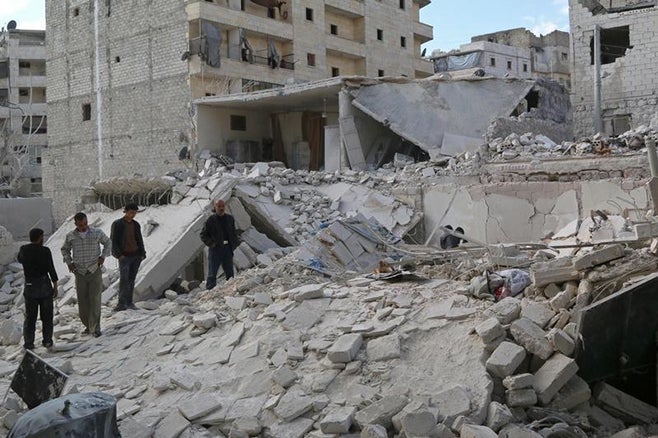
President Assad is talking about elections, but for Aleppo’s residents, the only campaign they are witnessing is a military one of barrel bombs and indiscriminate shelling. It is time for Russia and China to stop blocking the Security Council and allow a weapons embargo on Syria’s government and other abusive groups.
(New York) – The Syrian government is indiscriminately striking civilians and civilian objects in Aleppo with unguided, high-explosive barrel bombs. The attacks continue despite a United Nations Security Council Resolution unanimously passed on February 22, 2014, demanding that all parties in Syria cease the indiscriminate use of barrel bombs and other weapons in populated areas. The UN will meet to discuss its second round of reporting on compliance with the resolution on April 30.
Since the passage of the resolution Human Rights Watch has documented at least 85 strike sites in neighborhoods of Aleppo city held by armed groups opposed to the government, including two government barrel bomb attacks on clearly marked official hospitals. Two doctors and administrators in these facilities told Human Rights Watch that there were no military targets nearby and they believe that the government intentionally attacked them.
“President Assad is talking about elections, but for Aleppo’s residents, the only campaign they are witnessing is a military one of barrel bombs and indiscriminate shelling,” said Nadim Houry, deputy Middle East and North Africa director at Human Rights Watch. “It is time for Russia and China to stop blocking the Security Council and allow a weapons embargo on Syria’s government and other abusive groups.”
Activists and the government have said that armed groups, particularly after they opened an offensive in early April, have shelled government-held parts of Aleppo in some cases with improvised weapons prone to indiscriminate affects when used to attack populated residential areas.
Witness statements, satellite imagery analysis, and video and photographic evidence reflect that government forces have not significantly reduced their bombardment rate of the city since passage of the Security Council Resolution. Human Rights Watch had previously identified at least 340 distinct damage sites in areas held by non-state armed groups in Aleppo between October 31, 2013, and February 20, 2014, a 113-day period, by analyzing four satellite images recorded over the city between that period.
In the 40 days between February 22 and April 2 Human Rights Watch has identified at least 85 additional major impact sites in neighborhoods of the city held by armed groups opposed to the government. A substantial majority of these identified sites have damage signatures that are strongly consistent with the detonation of barrel bombs.
Barrel bombs, and other high explosive unguided bombs, tend to create larger zones of building destruction than is typically seen with other types of air strikes and artillery fire, often with irregularly shaped blast craters of shallow depth with scalloped edges.
These unguided high explosive bombs are cheaply made, locally produced, and typically constructed from large oil drums, gas cylinders, and water tanks, filled with high explosives and scrap metal to enhance fragmentation, and then dropped from helicopters. The damage to a small number of the identified sites was probably caused by other explosive weapons, either bombs delivered by conventional aircraft or prolonged artillery shelling.
Additionally, there is strong evidence that government forces on the ground have fired hundreds of mortar and heavy artillery shells during this period, Human Rights Watch said.
Witnesses told Human Rights Watch that bombings had continued since the passage of the Security Council resolution and, in some cases, increased in residential areas across eastern parts of the city of Aleppo and in the countryside. Human Rights Watch collected statements about 10 air strikes since February 22 that witnesses said used barrel bombs. Based on witness statements, published fatality figures, and video and photographic evidence, these attacks killed over 150 people.
Damage sites from barrel bomb attacks were concentrated in the neighborhoods of Masaken Hanano, al-Sakhour, Terbet Lala, Helwaniye, Jabal Badro, al-Haidariya and Owaija. A substantial majority of these damage sites are concentrated in neighborhoods at some distance from front-line positions, with a high density of residential buildings. In most of the cases about which Human Rights Watch spoke to witnesses, the witnesses said there were no military targets nearby.
One local group, the Violations Documentation Center, reported that aerial attacks killed 651 civilians in Aleppo governorate between February 22 and April 22. The Syrian Network for Human Rights alsoreported that between February 22 and April 16, barrel bomb attacks killed at least 920 civilians in Syria, over half of them in Aleppo governorate.
According to the Aleppo City Medical Council, an independent non-profit organization providing medical services in Aleppo city, four of their field hospitals admitted 589 people injured in barrel bomb attacks between February 22 and April 17 and 51 of them died from their injuries.
A doctor working in these hospitals told Human Rights Watch that government forces also attacked some of the medical facilities themselves, using barrel bombs. He said that barrel bombs hit two official hospitals marked as such in Aleppo, in the Hanano and al-Shaar neighborhoods. The location of the two hospitals, which are official hospitals predating the conflict, would be known to the government. The doctor told Human Rights Watch that the government began targeting hospitals with aerial attacks around January and struck hospitals in Hanano, al-Sukari, al-Sakhour, and al-Shaar.
Human Rights Watch has also received information about indiscriminate shelling by non-state armed groups opposed to the government. In early April, opposition forces opened an offensive attacking al-Layramoun and al-Zahraa neighborhoods of Aleppo. According to SANA, Syria’s state run news agency, as well as video footage reviewed by Human Rights Watch, the groups used mortars as well as an improvised rocket fitted with a gas canister – locally referred to as “hell's cannon” – for attacks that hit residential areas in government-controlled areas, including al-Hamdania, Ashrafieh, Sulaymania, al-Midan, Jamila, and Khalidiya.
Articles published by SANA indicate that 40 civilians were killed and another 149 injured in government-held territory during the period of these attacks. In one video reviewed by Human Rights Watch, fighters opposed to the government announced their offensive and warned residents to leave areas near military targets. However, at least some of the improvised weapons used are prone to indiscriminate effects when used to attack populated residential areas.
By using barrel bombs on densely populated areas, Syrian government forces also used means and methods of warfare that could not distinguish between civilians and combatants, making attacks indiscriminate and therefore unlawful.
Military commanders should not, as a matter of policy, order the use of explosive weapons with wide-area effects in populated areas due to the foreseeable harm to civilians, Human Rights Watch said. Military commanders should also never order strikes on protected civilian objects, including medical facilities and personnel, Human Rights Watch said.
In its February 22 resolution demanding that fighting parties cease using indiscriminate weapons in populated areas, the UN Security Council explicitly expressed “its intent to take further steps in the case of non-compliance with this resolution.”
Given Syria’s continuing air war against civilian areas, the Security Council should impose an arms embargo on Syria’s government, as well as on any groups implicated in widespread or systematic human rights abuses. Such an embargo would limit the Syrian government’s ability to conduct aerial attacks that violate international law, including by ensuring that Syria does not receive new helicopters or have its current helicopters serviced overseas. The Security Council should also impose a travel ban and an asset freeze on individuals credibly implicated in grave abuses, and refer the situation to the International Criminal Court, Human Rights Watch said.
Further, in light of compelling evidence that the Syrian army and security forces are responsible for ongoing war crimes and crimes against humanity against Syria’s people, companies, and individuals that provide arms, ammunition, or materiel to Syria, or to non-state armed groups that have been implicated in crimes against humanity or war crimes, risk complicity in these crimes, Human Rights Watch warned.
Under international law, providing weapons to forces or armed groups in Syria that are likely to be used in the commission of crimes against humanity may amount to assisting in the commission of those crimes. Any arms supplier could bear potential criminal liability as an accessory to those crimes and could face prosecution, Human Rights Watch said.
“Two months after the passage of a unanimous Security Council resolution demanding an end to indiscriminate attacks, the council finally needs to act to give meaning to its words – if for not its own credibility, then for the long-suffering Syrians,” Houry said.
For more details on the barrel bomb strikes, please see below.
Medical Facilities Under Attack
Barrel bomb strike on hospital in the Hanano neighborhood, April 21, 2014
Yousef (names have been changed to protect the identity of the witnesses), a doctor working in Aleppo city, told Human Rights Watch that on April 21 two barrel bombs struck an official hospital in Hanano, injuring patients and a member of the medical staff and causing extensive damage to the hospital, leaving it unable to operate. A video posted of the damaged hospital shows that it is clearly marked, with the hospital’s name displayed across the front of the building.
He told Human Rights Watch: “There are three operating rooms and we were setting up ICU rooms, but now the hospital is no longer operational. We closed it because there is no roof anymore and the main walls are completely destroyed. The generator was also destroyed by the airstrike, causing a fire at the main entrance.” Yousef told Human Rights Watch that the closest front line was three kilometers away.
Videos posted on YouTube reflect some of the damage caused by the aerial attacks on Hanano on April 21.
Hospital struck in al-Shaar, April 13
Yousef, the doctor working in Aleppo city, told Human Rights Watch that on April 13 two barrel bombs hit an official hospital in al-Shaar, causing damage to the hospital’s infrastructure.
He said that while no one was injured inside the hospital, 20 civilians were killed outside.
The Violations Documentation Center has identified three people killed by aerial attacks in al-Shaar on April 13. Yousef also said that the second bomb, which was dropped minutes after the first, injured an ambulance driver who went out to help the wounded, resulting in the amputation of one of his feet.
Several videos posted on YouTube show the impact of the strike on al-Shaar on April 13 and on the clearly marked hospital, with the hospital’s name written across the building.
Yousef told Human Rights Watch there were no military targets near the strike sites, adding: “They [the international community] promised us that they would work on keeping hospitals neutral and not subjecting them to the government’s violence, but hospitals in Aleppo are constantly being targeted with barrel bombs that are impeding our work…There are absolutely no front lines near the hospitals. In each hospital there is one armed guard who protects the hospital but he has nothing to do with the Free Syrian Army.”
Barrel Bomb Attacks In Aleppo Governorate Since February 22
Al-Fardous neighborhood, April 20
Malek, a member of the Aleppo Media Center who lives in al-Fardous, told Human Rights Watch that on April 20 at about 5 p.m., he saw a helicopter drop two barrel bombs on the neighborhood, the first within 50 meters of his house. “When the first barrel bomb fell the window glass in the apartment fell on our heads,” he said. “The second barrel fell less than one minute after the first barrel.”
Malek went to the strike sites after the attacks and saw that the first bomb fell on the main street next to the al-Fardous Local Council aid distribution office, injuring at least 20 people. He described the scene:
It was a chaotic scene because the barrel fell on the main street packed with civilians at that hour during the day. I saw children and women injured. I remember seeing six injured children. They were less than 15. I don’t remember how many women I saw. Their injuries were from the shrapnel. I am sure there were many more injuries. I don’t remember how many killed because the civil defense team was there removing corpses and helping the injured.
Malek said that the second barrel fell next to an intersection with a traffic light, and that there he saw four injured men, an injured child with her mother, and one man who was killed. He estimated that the strike sites were 150 to 200 meters away from each other.
On April 22, Dr. Fadi Hakim, the deputy chief of the Aleppo Health Office of the opposition-affiliated Council of Free Aleppo Governorate, told Human Rights Watch that barrel bomb attacks on the al-Fardous neighborhood killed at least 28 people on April 20. “I have carried four martyrs at least today from the ER in… [the hospital where I was working] during the Triage in the aftermath of Al-Fardous neighborhood bombing with TNT barrels,” he wrote to Human Rights Watch in an email.
The Violations Documentation Center reported that 39 civilians were killed in airstrikes on April 20 in al-Fardous, including 8 children and 3 women.
Several videos posted on YouTube also show the aftermath of the strikes on April 20.
Malek said that the front line is 4 kilometers from al-Fardous and that there are no bases for non-state armed groups in the vicinity of the attack.
Hreitan, April 12
Loutfi, a local resident, told Human Rights Watch that on the afternoon of April 12 he witnessed a barrel bomb attack that killed at least nine civilians, including at least two children and four women. “I was a few meters away from where the barrel was dropped,” he said. “I saw it coming down… Everything happened so fast.” Loutfi said that the area that was struck was residential and that it was full of people.
He identified the people killed in the attack as Malek Hijazi, 45; Jana Malek Hijazi, 7; Ruweida Azizi, 32; Fatme Hijazi, 10; Mostapha Khalil Sekhnyet, 35; Latifa Mohamad Selmou, 30; Raghda’ Hamid Qreish, 32; Samira Qreish, 40; and one unknown person. He said that another 20 were injured. Two women who were on the scene were still missing when Loutfi spoke to Human Rights Watch on April 16 and their fate was unknown.
The Violations Documentation Center has identified 10 fatalities from aerial attacks on Hreitan on April 12, including the eight people named by Loutfi and two unidentified people. Several videos published on YouTube also show the aftermath of the barrel bomb attack and efforts to remove deceased and injured civilians from affected buildings.
Loutfi said that Hreitan is approximately 10 kilometers from the front line and that there are no bases for armed groups in the town.
Al-Ansari al-Sharqi neighborhood, April 8
Jamal, a resident of al-Ansari al-Sharqi, told Human Rights Watch that on April 8 he witnessed two barrel bomb attacks on the populated residential neighborhood, when bombs fell about 200 meters from where he was. He said he knew they were barrel bombs because of the distinctive sound the bombs make and because he saw the second bomb falling. The bombs fell around 100 to 150 meters apart, he said. “The first barrel bomb fell on a building that is five stories,” he said. “The building luckily was empty. The second barrel bomb fell on another building, injuring a woman, her 14-year-old son and her 1-year-old girl. They were injured from the shrapnel.”
Several videos posted on YouTube also show the aftermath of the strike and efforts by civil defense members to rescue wounded residents.
Jamal said that there were no military targets in the vicinity of the strike, including bases, and that the front line is approximately one kilometer away.
Al-Shaar neighborhood, April 4
Fawzi, a local resident, told Human Rights Watch that on April 4 at around 9:30 a.m. two barrel bombs struck a bakery and vegetable market within meters and minutes of one another in al-Shaar neighborhood. He told Human Rights Watch that he arrived nearby just as the second bomb fell. “I arrived and saw four or five cars completely burned,” he said. “I saw people injured inside the cars, but they were still alive. I saw at least six or seven injured men just in these cars. There were several other people injured.”
Fawzi told Human Rights Watch that the market and bakery were both open and that as a result a lot of civilians were there. He estimated that 40 civilians, including women and children, were injured in the strikes.
He told Human Rights Watch that on that day he saw the bodies of 33 people who had been killed. “I remember counting them when we lined the bodies to take a picture,” he said.
Images posted on Facebook show at least 10 corpses of people that accompanying text said had been killed in al-Shaar on April 4. Other images were posted of people who had been injured.
The Violations Documentation Center identified 16 civilians killed in aerial attacks on al-Shaar on April 4.
Fawzi described al-Shaar as a residential neighborhood, 4 kilometers from the front line, without any bases or barracks for non-state armed groups.
Al-Sakhour neighbourhood, April 2 and 4
Two residents told Human Rights Watch about barrel bomb attacks on the al-Sakhour neighborhood on the morning of April 2 that killed civilians. Ahmad, who was in the neighborhood at the time of the attack, filmed its aftermath, and helped injured residents, said that a helicopter first dropped one barrel bomb next to an empty school and minutes later dropped a second approximately 50 meters away, on a pedestrian bridge.
A video published on YouTube on April 2 by Halab News shows the aftermath of a strike in the al-Sakhour neighborhood in which a footbridge is visible and people are seen rescuing residents injured in the attack.
Ahmad told Human Rights Watch that he saw the second bomb fall, and that he knew both were barrel bombs because of the sound the bombs made while falling and because the bombs take longer to drop than rockets. Salim, a second witness, also told Human Rights Watch that he recognized that the attack was with barrel bombs because of their sound and that he too saw the second bomb fall.
Ahmad saw one woman and three other residents injured from the first bomb. “The woman was on the street next to the school when the barrel fell,” he said. He said the second barrel bomb also killed passengers in a minibus that was hit:
When I went to the micro bus I saw one man with his leg amputated by the shrapnel. He’s in his early 20s and he was next to the micro bus. I also saw two men who were killed, both of them were passengers in their 30s. I saw a girl maybe about 10 years old who was injured and her father was trying to help her. He was injured as well. They were also micro bus passengers.
Salim, who also went to the scene of the attack minutes after the second barrel bomb fell, described the strike: “The micro bus was filled with passengers. I went to the micro bus. It was a catastrophe. Most of the passengers were killed. I think around 12 killed. I only saw a child, woman and man injured. The child was around 4 or 5 years. I stopped filming and helped her. We took her to the field hospital. She had injuries everywhere in her body. She was covered with blood.”
Videos and photographs posted on YouTube and Facebook are identified as showing the bus that was hit in al-Sakhour on April 2. In several of these images, injured residents are seen being pulled out of the bus, including one girl. Images of another injured girl were also published. Text with several other images says they show residents wrapped or covered in cloth who had been killed in the attack, including one girl.
The Violations Documentation Center reported that six civilians were killed in aerial attacks on April 2 in Al-Sakhour.
Both Ahmad and Salim told Human Rights Watch that the bombs on April 2 fell far from the front line, approximately one kilometer away. Salim told Human Rights Watch that there was an FSA checkpoint about 200 meters from the scene of the attack.
Marwan, a local resident, told Human Rights Watch that barrel bombs also hit the al-Sakhour neighborhood on April 4, striking the Abu Bakr al-Sadiq mosque and also destroying three homes. He said that he arrived on the scene minutes after the strike and saw one girl around 15 years old who had been killed in the attack along with a 10- or 11-year-old boy and that five or six other civilians who were temporarily trapped under the rubble were also injured.
Videos published on YouTube also reflect that a mosque and homes were struck in the attack, injuring children.
“I saw the helicopter roaming and I was waiting to see where it would strike,” Marwan told Human Rights Watch. “I did not see the barrel bomb falling but the destruction was clearly from a barrel bomb because the residential buildings completely collapsed.”
The Violations Documentation Center identified four civilians, including two children, killed in airstrikes on April 4 in al-Sakhour.
Al-Haidariya neighborhood, March 9
Bassam, a media activist working in Aleppo, told Human Rights Watch that, on March 9 between 9 and 10 a.m., he saw a helicopter drop two barrel bombs on the al-Haidariya neighborhood. He said that he went to the scene shortly afterward and saw people who had been wounded or killed, including Ali Mustapha, a Canadian journalist, who was killed by the second bomb. Bassam said that this barrel bomb struck the depot where taxis and minibuses gather to transport civilians to and from the city of Aleppo and the countryside.
Fouad, another media activist who also witnessed the attacks on March 9, told Human Rights Watch that the first barrel bomb fell about 100 meters from the second, which hit the al-Haidariya depot. Fouad estimated that at least 20 people had been killed in the two strikes, including the journalist and two first responders.
The Violations Documentation Center identified 12 civilians, including 2 children, killed in air strikes on March 9 in al-Haidariya.
Activists at the scene also took photographs of the aftermath of the attack, including of the woundedand those that were killed.
Bassam and Fouad both told Human Rights Watch that the neighborhood was far from the front line, at least 3 to 5 kilometers. Bassam also told Human Rights Watch that there were no bases for armed groups in the vicinity of the strikes.
The Syrian Air Force has repeatedly hit the Haidariya roundabout, a key intersection on one of the main roads connecting opposition-controlled Aleppo to the countryside.
Al-Sukari neighborhood, March 7
Two witnesses told Human Rights Watch that two barrel bombs struck the al-Sukari neighborhood of Aleppo on March 7 at around noon. Both witnesses observed the helicopter dropping the bombs and could identify them as barrel bombs. The witnesses, who went to the scene after the attack, said that the first bomb fell on two residential buildings al-Wikalat Street, destroying the buildings and setting cars on fire. A video posted on YouTube is identified as showing the aftermath of this attack. Khaled, one of the witnesses, said that the second bomb fell approximately 150 meters from the first minutes later and also struck residential buildings, completely razing them. A video posted on YouTube also shows the destruction from this strike.
“Residents told me that a family was stuck under the rubble and they couldn’t remove them,” Khaled said. He told Human Rights Watch that at both strike sites he saw civil defense workers transferring the wounded and dead to a field hospital. Tamer, the other witness, also told Human Rights Watch that he saw several injured people, including women and children, after the strikes.
The Violations Documentation Center has identified 14 civilians killed in al-Sukari from aerial attacks on March 7, including 8 children and a woman. Five of the children were siblings. One man, whosurvived, lost all of his children in the attack.
Tamer described al-Sukari as a residential area with a large civilian population still living there, because it is two kilometers from the front line. Both witnesses said that there were no bases for armed groups in the neighborhood. Tamer said that he thought armed groups were using apartments in al-Sukari to sleep in, but that these were not close to the street where the bombs fell.


 EMAIL
 Email


