Monday, February 8, 2016

Russia/Syria: Daily Cluster Munition Attacks

Increased Use of Widely Banned Weapon

Link

(Beirut) – The Syrian-Russian joint military operation in Syria has included the use of internationally banned cluster munitions in at least 14 attacks across five governorates since January 26, 2016. The attacks killed at least 37 civilians, including six women and nine children, and wounded dozens.
The International Syria Support Group, a group of 17 countries and three organizations that is scheduled to meet on February 11 should make protecting civilians and ending indiscriminate attacks, including with cluster munitions, a key priority, Human Rights Watch said.
© 2016 Ahmad al-Farouq
Unexploded O-10 submunitions from a 3-O-8 cluster munition mortar projectile found in Douma, Damascus, after a cluster muntion attack on January 27, 2016. © 2016 Ahmad al-Farouq
“Any solution of the Syrian crisis needs to address ongoing indiscriminate attacks,” saidNadim Houry, deputy Middle East director. “A good place to start would be a commitment by Russia and Syria to stop using cluster munitions.”
The surge in cluster munition use has taken place in the context of intensified Russian and Syrian military action to establish control over key strategic territory in the governorates of Aleppo, Damascus, Idlib, Homs, and Hama. The recent offensive around Aleppo has caused at least 20,000 people to flee towards the Turkish border. At least seven attacks also took place as government and anti-government forces met for peace talks in Geneva, which were suspended on February 3.
Any solution of the Syrian crisis needs to address ongoing indiscriminate attacks. A good place to start would be a commitment by Russia and Syria to stop using cluster munitions. 

Nadim Houry,

deputy Middle East director.
In the 14 documented cases, Human Rights Watch both interviewed at least one local source who was a witness to the attack or its immediate aftermath, and identified the type of cluster munition used by reviewing photographs or videos. Casualty numbers are based on name lists provided by medical personnel, local responders, and journalists.
The real number of cluster munition attacks is most likely higher, Human Rights Watch said. Local activists have reported at least eight additional attacks since January 26, including providing photographs and videos of remnants, but Human Rights Watch was not able to reach witnesses to those attacks.
© 2016 Firas Abdallah
Fragment pattern typical of the detonation of a submunition seen in the asphalt in Douma, Damascus, after a cluster munition attack on February 3, 2016. © 2016 Firas Abdallah
Some of the cluster munition attacks in recent weeks occurred in the northern governorate of Aleppo, near Nubbul and Zahraa, where government and pro-government forces attempted to break the siege imposed by armed opposition groups, including the Nusra front, on the two majority-Shiite towns.
In Anadan, seven kilometers from Zahraa, cluster munitions and other weapons were used in an air attack that also struck a field hospital on January 27, killing a nurse; two first responders and a local media activist said. A local television report shows fragmentation damage and flat tires on an ambulance and minivan--indicating cluster munition use--as well as the clearance of AO-2.5 RT/RTM submunitions.
Other cluster munition attacks have been recorded in pockets of opposition-controlled territory in government-controlled areas. For example, three witnesses told Human Rights Watch that on January 27, an aircraft dropped cluster munitions on Kafr Laha, a town in opposition-controlled territory near the city of Homs that is surrounded by Syrian government forces.
© 2016 Syria Civil Defense
Remnants of ShOAB-0.5 submuntions collected in Kafr Laha, Homs, after a cluster munition attack on January 27, 2016 © 2016 Syria Civil Defense
“I saw people who had their legs cut off,” a journalist with an opposition-affiliated media center who rushed to the area immediately after the attack told Human Rights Watch. “One person lost his eye. There were several people who were hanging between life and death. The injured were mostly women and children. All of them were injured from fragments from the submunitions, in the eyes, in the head, in the back. It was very hard to see.”
The journalist sent Human Rights Watch a list with the names of casualties. The list includes the names of 6 people, including a woman and 2 children, who were killed in the attack, and 59 people, including 13 women and 27 children, who were wounded.
Other witnesses, including a first responder, confirmed that six or seven people had been killed. All three witnesses said that those killed and injured were civilians. Graphic video that the Homs Media Center posted on YouTube shows injured people, including several women and children, being brought to a makeshift hospital for treatment.
Human Rights Watch received photographs taken by local people showing the remnants of an RBK-500 series bomb and its payload of ShOAB-0.5 submunitions. Three witnesses said there were no fighters or military targets near the impacted area. 
Cluster munitions are delivered from the ground by artillery and rockets, or dropped from aircraft and contain multiple smaller submunitions. A total of 118 countries have banned cluster munitions due to the harm caused at the time of attack and because their submunitions often fail to explode and threaten civilians and military alike, until cleared and destroyed. Syria and Russia should join the Convention on Cluster Munitions, Human Rights Watch said.
 © 2016 Syria Civil Defense
The remnants of the casing of an RBK-500 cluster bomb carrying ShOAB-0.5M submunitions found after a cluster munition attack on Kafr Laha, Homs, on January 27, 2016. © 2016 Syria Civil Defense

Human Rights Watch previously documentedat least 20 cluster munition attacks by the Russian-Syrian joint operation between September 30, 2015, when Russian aircraft began its military operations in Syria, and December 14.
Two types of the cluster munitions used in recent attacks were air-dropped and another two were ground-launched. Human Rights Watch was not able to determine whether the air-dropped cluster munitions were dropped by Russian or Syrian aircraft, or both.
At a news conference in Moscow on December 23, Major-General Igor Konashenkov, a spokesman for the Russian military, denied allegations that the air force has stockpiled cluster munitions in Syria,stating that “Russian aviation does not use them” and “there are no such weapons at the Russian air base in Syria.” However, the Conflict Intelligence Team open-source research organization has identified cluster munitions in photographs and video taken at Russia’s Hmeymim airbase in Syria by Russian media and the Russian Defense Ministry since the beginning of Russia’s air campaign. Based on an analysis of the distinctive physical characteristics of the weapons, Human Rights Watch has confirmed the identification of RBK series cluster bombs being loaded onto aircraft taking off from the base. On November 14, 2015, the Russian Ministry of Defense published a photo from its Syria operation that shows an Su-25 in flight with its munition visible. A Human Rights Watch weapons expert identified the munition as an RBK-500 ShOAB-0.5 cluster bomb.
Minutes after the January 27 cluster munition attack in Kafr Laha using RBK-500 series bomb and ShOAB-0.5 submunitions, a witness on the ground photographed a military aircraft that he said was flying near the attack site. He shared the photograph with Human Rights Watch which identified it as an Su-25. The photographer said that this was the only aircraft he saw in the air at the time of the attack. According to publicly available information, the Su-25 is not in service with Syrian forces. Russian forces have deployed at least 12 Su-25 to their airbase in Syria.
© 2016 Syria Civil Defense
An Su-25, an aircraft in service with Russian, but not Syrian, forces, photographed near Kafr Laha shortly after the town was attacked with cluster munitions. © 2016 Syria Civil Defense
Human Rights Watch is a co-founder of the Cluster Munition Coalition and serves as its chair. On October 1, the global campaign warned Russia against using any cluster munitions in Syria due to the “foreseeable and preventable” danger posed to civilians.
“Whether or not Russia dropped these cluster munitions, it is operating jointly with the Syrian government and as such has a responsibility to ensure that Russian-Syrian operations are not using indiscriminate weapons,” Houry said. “Russia should immediately ensure that cluster munitions are never again used in Syria, whether by its own or Syria’s forces.”
© 2016 Syria Civil Defense
Remnants of AO-2.5RT/RTM submuntions collected in Kafr Zita, Hama, after a cluster munition attack on January 30, 2016 © 2016 Syria Civil Defense
Human Rights Watch has documented the use of four types of cluster munition since January 26, which are listed in the table below.
 
DateLocationCivilian casualtiesTypeVisual confirmation
February 5, around 1 a.m.Talbiseh, Homs4 killed (1 child), 20 woundedRBK-500 series bomb with ShOAB-0.5 submunitions
Photos on file with Human Rights Watch
February 4, around 12 p.m.Douma, Damascus2 killed (1 child)3-O-8 cluster munition mortar projectile with O-10 submunitionsVideo: attack
February 3, around 11 a.m.Douma, Damascus1 killed, 10 wounded3-O-8 cluster munition mortar projectile with O-10 submunitionsPhotos on file
January 31, around 3-4 a.m.Hayyan, Aleppo2 killed (1 child; father and son), 5 woundedRBK-500 series bomb with AO-2.5RT/RTM submunitionsVideo: removal of submunition remnants
January 30, around 11 p.m.Hayyan, Aleppo2 children woundedRBK-500 bomb with AO-2.5RT/RTM submunitionsSame as above.
January 30, 1:30 p.m.Karam Howmad, Aleppo city1 woundedRBK-500 series bomb with AO-2.5RTM submunitions
Photos on file
January 30, around 1:30 a.m.Kafr Zita, HamaNoneRBK-500 series bomb with AO-2.5RT/RTM submunitionsVideo: submunition remnants
January 29, around 6:45 p.m.Azaz, Aleppo1 killed, 4 wounded9M79-series Tochka ballistic missile with 9N24 submunitions
Photos on file
January 29, around 3:30 p.m.Marea, Aleppo5 killed (1 child; all from same family), 15 woundedRBK-500 series bomb with AO-2.5RT/RTM submunitionsVideo: submunition remnants
January 27, around 3:30 p.m.Anadan, Aleppo1 killedRBK-500 series bomb with AO-2.5RT/RTM submunitionsPhoto: submunition remnants
January 27, around 2 p.m.Kafr Laha, Homs6 killed, 45 woundedRBK-500 series bomb with ShOAB-0.5 submunitionsPhotos on file
January 27, 10-11 a.m.Douma, Damascus1 killed (child)3-O-8 cluster munition mortar projectile with O-10 submunitions
January 26, around 10 p.m.Salqin, Idlib10 killed, 15 wounded9M79-series Tochka ballistic missile with 9N24 submunitionsVideo: missile remnant and impact craters
January 26, around 10 a.m.Douma, Damascus4 killed3-O-8 cluster munition mortar projectile with O-10 submunitionsVideo: projectile remnant

UN report: Syrian government actions amount to 'extermination'

Report finds ‘vast state resources’ used to cause civilian deaths on massive scale, which authors say must be dealt with in peace talks

The Guardian

Link

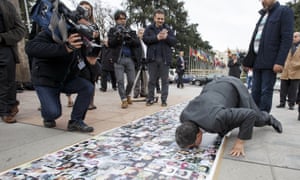
Syria’s negotiating committee spokesman kisses pictures of Syrian victims displayed at the UN in Geneva.
 Syria’s negotiating committee spokesman kisses pictures of Syrian victims displayed at the UN in Geneva. Photograph: Salvatore Di Nolfi/AP
Detainees held by the Syrian government are dying on a massive scale amounting to a state policy of extermination of the civilian population, a crime against humanity, United Nations investigators has said.
The UN commission of inquiry called on the security council to impose sanctions against Syrian officials in the civilian and military hierarchy responsible for or complicit in deaths, torture and disappearances in custody, but stopped short of naming individuals.
In their report released on Monday, the independent experts said they had also documented mass killings and torture of prisoners by two jihadi groups, al-Nusra Front and Islamic State, constituting war crimes.
“Over the past four and a half years, thousands of detainees have been killed while in the custody of warring parties,” the commission of inquiry on Syria said. 
“The killings and deaths described in this report occurred with high frequency, over a long period of time and in multiple locations, with significant logistical support involving vast state resources. There are reasonable grounds to believe that the conduct described amounts to extermination as a crime against humanity.”
Tens of thousands of detainees are held by President Bashar al-Assad’s government at any one time, and thousands more have “disappeared” after being arrested by state forces or gone missing after abduction by armed groups, the report said.
Through mass arrests and killing of civilians, including by starvation and untreated wounds and disease, state forces have “engaged in the multiple commissions of crimes, amounting to a systematic and widespread attack against a civilian population”.
There were reasonable grounds to believe that high-ranking officers, including the heads of branches and directorates commanding the detention facilities and military police, as well as their civilian superiors, knew of the deaths and of bodies buried anonymously in mass graves.
They are thus “individually criminally liable”, the investigators said, calling again for Syria to be referred to the prosecutor of the international criminal court.
Over the past four years, the investigators, who include former ICC prosecutor Carla Del Ponte, have drawn up a confidential list of suspected war criminals and units from all sides which is kept in a UN safe in Geneva.
Isis and al-Nusra Front have committed mass killings of captured government soldiers and subjected civilians to “illicit trials” by sharia courts which ordered death sentences, the report said.
“Accountability for these and other crimes must form part of any political solution,” the investigators said, five days after UN-sponsored peace talks were suspended without any result.

Why Obama fails the leadership test in the Middle East

The US "better safe than sorry" approach to the Middle East has proven dangerous


By Marwan Bishara


I'll be writing plenty about US foreign policy in the next few weeks as there is a lot to say about Barack Obama's two-term presidency, and there are various ways to scrutinise his approach to the greater Middle East, be it strategic, political, ideological or even personal. 
For starters, I'd like to focus on what struck me this past weekend listening to the Republican debate on  leadership. And by that I don't mean their bombastic bull***t about making the US "great again" through more bombing of the Middle East, or their paranoiac patriotism.
Once you've gone beyond the scripted speeches, soundbites and cliches, you'll notice how the debate about leadership is primarily divided between the three governors and two senators, the other two weasels, Donald Trump and Ben Carson notwithstanding.

All-talk, no-walk senators

Governor Chris Christie was explicit about the difference between being a governor and a senator candidate for the presidency.
During their heated exchange, the New Jersey governor bashed Senator Marco Rubio as another Washington show horse from the US Senate.


According to the Washington Post, Christie "owned" the senator when he ridiculed his stump 25-second speeches and contrasted Rubio's Senate speech-making with his own record as a governor who had to solve real problems.
They might appear sharp and controversial, even hostile on C-Span ... but in the hallways these back-slapping men are the best of friends.

"When you're president of the US, when you're a governor of a state, the memorised 30-second speech where you talk about how great America is at the end of it doesn't solve one problem for one person," said the hack-and-slash governor.
"Every morning when a US senator wakes up, they think about what kind of speech can I give, or what kind of bill can I drop?" the New Jersey governor lamented. "Every morning, when I wake up, I think about what kind of problem do I need to solve for the people who actually elected me. It's a different experience."
And in the previous debate, Christie joked some more: "I agree with what Senator Rubio said himself. He said just two weeks ago senators and congressmen can’t solve America's problems. I couldn't agree with him more."
Joking aside, not all senators-come-presidents can be judged solely on these grounds. The US has had 16 of them, including Richard Nixon, who was anything but indecisive and an all-but-convicted war criminal. The same goes for governors, and I don't only mean Christie's poor record. Look at George Bush. Need I say more?
So why is any of that relevant to US foreign policy, notably in the Middle East, and more particularly, Syria, Iraq and Palestine, for example?

Senators Obama and co.

With Christie's words about "all-talk-no-action" in mind, notice that Obama and his two secretaries of state, Hillary Clinton and John Kerry, as well as his vice president, Joe Biden, were all senators, the last two serving for two or three decades, respectively. Not forgetting the ill-fated secretary of defense, Senator Chuck Hagel.
Democratic US presidential candidate Hillary Clinton [REUTERS]
Their capacity for talking so much and saying so little is astonishing. Their verbosity is unpalatable.
Obama, a "commander-in-speech" in his own right,  can take on any crowd, preferably with prompter with unmatched skill and wit, to deliver one sermon after another, be it in Cairo, Istanbul, Jerusalem, or Oslo, Prague, and the United Nations.
His inspirational speeches promised a new world, but his policies, or lack thereof, deliver more or less the same old and tired world, and more chaotic
He might have ended the US war in Iraq in one way and signed a nuclear deal with Iran, but his inaction in Iraq, Syria, Egypt, etc, have made matters far worse than when he took office.


I don't mean he should have intervened militarily on the ground to remove dictators. Rather, acted decisively, both diplomatically and strategically, to prevent genocide in Syria, such as by establishing a no-fly zone along with Turkey and others. Or by limiting the Iranian intervention in Iraq and the rise of a sectarian regime in Baghdad under Nouri al-Maliki.
Certainly by pressuring Israel to end its occupation and punishing General Abdel Fattah el-Sisi for his coup d'etat and repression. 
It's perhaps telling that after taking its time to take a stand on Egypt's military coup, the Obama administration concluded: "We have determined that we don't need to make a determination."
To solve all these urgent crises and end the bloodshed, some of which Washington helped to start, Kerry reckons all we need to do to get things done is to talk the hell out of them. All you need to do to get enemies to kiss and make up is to get the protagonists into a room and talk them through it. That's what they do in the Senate.

The kings of pork

Unfortunately, there's more to the Senate political culture than just talk. Senators - or "the kings of pork", as they have been called - always ask what's in it for them before delivering any speech, taking any action or passing a law.
Senators ... always ask what's in it for them before delivering any speech, take any action or pass a law.

To them, "special interests" come first, constituency second, and the country a distant third. What's good for the world beyond their borders counts very little, if at all.
And regardless of their differences, they always act with such camaraderie and complicity among themselves.
They might appear sharp and controversial, even hostile on C-Span, the network dedicated to their stump speeches, but in the hallways these back-slapping men are the best of friends.
Take no risks; better to be safe than sorry. And you scratch my back, I'll scratch yours, should be the US Senate motto.
This political culture goes a long way to explaining the foreign policy mentality of the Obama administration, whose slogan has long been "Don't do stupid sh*t".
This comes from the guy who wrote The Audacity of Hope, and whose campaign was based on the slogan "Yes, we can".
Call me idealistic, but I think leaving hundreds of thousands of Syrians to die in vain is stupid sh*t.
Marwan Bishara is the senior political analyst at Al Jazeera.

معارك سوريا تحصد 36 عسكريا إيرانيا بـ5 أيام

THE MORE, THE BETTER!
جنازة ضابط إيراني قتل في سوريا قبل أسابيع (أسوشيتد برس)
Link


ذكرت مصادر إيرانية أن ثلاثة ضباط في الحرس الثوري الإيراني قتلوا في سوريا، ما يرفع عدد العسكريين الإيرانيين الذين قتلوا في سوريا خلال خمسة أيام إلى 36، بينهم ضباط كبار
ووفق وسائل إعلام إيرانية، فقد لقي ثلاثة ضباط من الحرس الثوري مصارعهم في معارك شمالي سوريا، وذلك خلال "قيامهم بمهامهم كمستشارين عسكريين".
وكانت وكالة أنباء فارس قد ذكرت أمس أن العميد في الحرس الثوري حسين رضائي قتل خلال معارك شمالي سوريا، بالإضافة إلى اثنين من عناصر قوات التعبئة المعروفة باسم الباسيج، وذلك خلال المعارك التي شهدتها أطراف بلدتي نبّل والزهراء في ريف حلب شمالي سوريا.
ومع سقوط القتلى الثلاثة اليوم، يرتفع عدد العسكريين الإيرانيين الذين قتلوا في سوريا خلال خمسة أيام إلى 36، بينهم ضباط كبار برتبة عميد وعقيد. 
وقبل يومين، قال قائد الحرس الثوري اللواء محمد علي جعفري، خلال تشييع مجموعة من العسكريين الذين قتلوا في سوريا، إن القتال في سوريا للدفاع عن جبهة "المقاومة الإسلامية". ونقل عن مرشد الثورة علي خامنئي قوله [THIS BASTARD SOUNDS LIKE GEORGE W. BUSH![Image result for khamenei
لولا هذا الدفاع لوصلت التهديدات إلى أراضينا".

Emad Hajjaj's Cartoon: Putin, a Certified Killer!

بوتين قاتل مرخص !

بوتين قاتل مرخص !

Sunday, February 7, 2016

الملك سلمان: ندافع عن بلاد المسلمين ونرفض التدخل بشؤوننا

ANOTHER TOOTHLESS SCARECROW.......

AS LONG AS THESE SCARECROWS ARE OBEDIENT TO THE US,

DON'T EXPECT ANYTHING GOOD FROM THEM.
أردوغان: لن ألتقي السيسي وروسيا تقتل السوريين

THIS SCARECROW IS NOT SCARING ANYONE.......

HIS DECLARATIONS ARE EMPTY AND TOOTHLESS......

THE SYRIANS SHOULD NEVER COUNT ON HIM.

Emad Hajjaj's Cartoon: The Siege of the Syrian People

حصار الشعب السوري

Kerry 'blames opposition' for continued Syria bombing

Syrian aid workers said Kerry told them on sidelines of donor conference that 'opposition will be decimated' and to expect 3 months of bombing 

Home


A VERY IMPORTANT ARTICLE

Link

US Secretary of State John Kerry told Syrian aid workers, hours after the Geneva peace talks fell apart, that the country should expect another three months of bombing that would “decimate” the opposition.
During a conversation on the sidelines of this week’s Syria donor conference in London, sources say, Kerry blamed the Syrian opposition for leaving the talks and paving the way for a joint offensive by the Syrian government and Russia on Aleppo.
“‘He said, ‘Don’t blame me – go and blame your opposition,’” one of the aid workers, who asked to remain anonymous to protect her organisation, told Middle East Eye.
Kerry told reporters on Friday, as tens of thousands fled the Syrian government and Russian bombardment of Aleppo, that both Russia and Iran, another of Syria's allies, have told him that they are prepared for a ceasefire in Syria.
He said he would know “whether or not these parties are serious” after a meeting of the International Syria Support Group – 17 nations including the US and Russia – scheduled to be held in Munich next week.
But Kerry left the aid workers with the distinct impression that the US is abandoning efforts to support rebel fighters.
The UN-based Geneva talks were suspended earlier this week after the government and opposition delegates refused to meet. The opposition delegates stated that all bombing must stop before talks could proceed, while the government said the rebels were "not serious" about the push for peace.
Kerry’s mixed messages after the collapse of the Geneva process have put more pressure on Turkey and Saudi Arabia, a senior Turkish source told MEE on Friday.
Turkish Prime Minister Ahmet Davutoglu warned at the donor conference on Thursday that tens of thousands of people were heading to the Turkish border from Aleppo. On the same day, Saudi Arabia said it could put troops in as part of a multinational force to fight the Islamic State group.
Both feel extreme unease at the potential collapse of the opposition US-recognised Free Syrian Army, according to the senior Turkish source.
Two Syrian aid workers said they approached Kerry at a donor conference drinks reception and told him that he had not done enough to protect Syrian civilians. He then said they should blame the opposition.
"He said that basically, it was the opposition that didn’t want to negotiate and didn’t want a ceasefire, and they walked away,” the second of the aid workers told MEE in a separate conversation and also on the basis of anonymity.
“‘What do you want me to do? Go to war with Russia? Is that what you want?’” the aid worker said Kerry told her.
Both aid workers said Kerry told them that he anticipated three months of bombing during which time “the opposition will be decimated”.
The second aid worker said the most that Kerry seemed prepared to offer were aid drops for besieged Syrian towns which he said he had discussed with Russia.
"He said they were close and they were talking to the Russians about it," she said.

US-Syria backchannel 

A third MEE source who claims to have served as a liaison between the Syrian and American governments over the past six months said Kerry had passed the message on to Syrian President Bashar al-Assad in October that the US did not want him to be removed.
Instead, the source claims, Kerry insisted that Assad should stop using barrel bombs, which terrify civilian populations.
The source claimed that Kerry said if Assad stopped the barrel bombs, Kerry could “sell the story” to the public, the source said.
Assad reportedly responded to Kerry that, in exchange, the US needed to “stop backing the rebels,” the source said.
Kerry’s line to Assad follows a series of reappraisals of American policy after the failure of its programme to train and equip Syrian rebel fighters.
The programme ended in a fiasco last August when a batch of newly trained fighters, called Division 30 and who were trained and armed by the US, was detected and apprehended after they crossed into Syria for the first time.
A month later, another group of fighters was seized by al-Nusra and their weapons were reportedly handed to al-Qaeda in Syria.  
A report in the London Review of Books by Seymour Hersh claimed that the training programme had been sabotaged by generals within the Pentagon who did not believe it would work and who provided Assad with information about troop movements.
Most recently, Kerry has been criticised for pressuring the opposition to attend the Geneva talks, reportedly saying that the opposition would lose US support if it didn’t go.
Equally, however, the US administration has been flayed by criticism that it had accepted that Assad will remain leader of Syria. This is a move that some experts say has weakened US leverage with Russia as well as creating tensions with its allies in the Free Syrian Army who vow this is a red line.
When MEE asked the State Department about the aid workers’ claims and about allegations made by the liaison source, it directed MEE to Kerry’s statements on Friday and to Friday’s daily State Department press conference, but it had not responded specifically by the time the story was published.