Brutal slaughter of MB designed to create a violent response and justify military rule

Thursday, August 15, 2013


It only gets worse from here
By
"........Over the last week there was much talk ... over whether or not to negotiate with the Brothers or break their sit-ins. The camp that eventually won does not just believe that the Brothers are not worth negotiating with. They want to encourage it in its provocative sectarian discourse, its supporters' desire for violence, and push as much as the Islamist camp as possible into being outlaws.
Those who nurture such eradicateur sentiment do not so much actually want to physically eradicate all Islamists as to provoke them into a situation where their political existence will be eradicated because they will have opted for violence. They are willing to endure that violence, even a return to the counter-insurgency of the 1990s, and sporadic sectarian and terrorist attacks, because they believe it will strengthen their camp and enable them to permanently block most Islamists from politics ...
Their thinking is cynical in the extreme, not unlike Bashar al-Assad's push towards militarising the political conflict he faced [in Syria] in 2011........"
Massacre in Cairo: Egypt on Brink After Worst Violence Since 2011 Revolution
Democracy Now!
"At least 525 people were killed in Egypt on Wednesday when security forces cracked down on two protest camps filled with supporters of ousted President Mohamed Morsi. The Muslim Brotherhood says the actual death toll tops 2,000 and has called new rallies for today. The Egyptian military has defended the crackdown and declared a state of emergency. We’re joined by three guests: in Cairo, Democracy Now! correspondent Sharif Abdel Kouddous, who covered Wednesday’s violence and visited the makeshift field clinics overrun with the dead and wounded, and Lina Attalah, chief editor and co-founder of the Cairo-based news website, Mada Masr. In Washington, D.C., we’re joined by Chris Toensing, executive director of the Middle East Research and Information Project and co-editor of the book, "The Journey to Tahrir: Revolution, Protest, and Social Change in Egypt."....."
"At least 525 people were killed in Egypt on Wednesday when security forces cracked down on two protest camps filled with supporters of ousted President Mohamed Morsi. The Muslim Brotherhood says the actual death toll tops 2,000 and has called new rallies for today. The Egyptian military has defended the crackdown and declared a state of emergency. We’re joined by three guests: in Cairo, Democracy Now! correspondent Sharif Abdel Kouddous, who covered Wednesday’s violence and visited the makeshift field clinics overrun with the dead and wounded, and Lina Attalah, chief editor and co-founder of the Cairo-based news website, Mada Masr. In Washington, D.C., we’re joined by Chris Toensing, executive director of the Middle East Research and Information Project and co-editor of the book, "The Journey to Tahrir: Revolution, Protest, and Social Change in Egypt."....."
Egypt: UN HR chief warns country becoming 'dangerously polarised'
Live• Death toll following crackdown stands at over 500
• Denmark halts aid
• Curfew keeps Cairo quiet overnight
• Governorate building in Giza burnt down
• UN HR chief warns country becoming "dangerously polarised"
".....
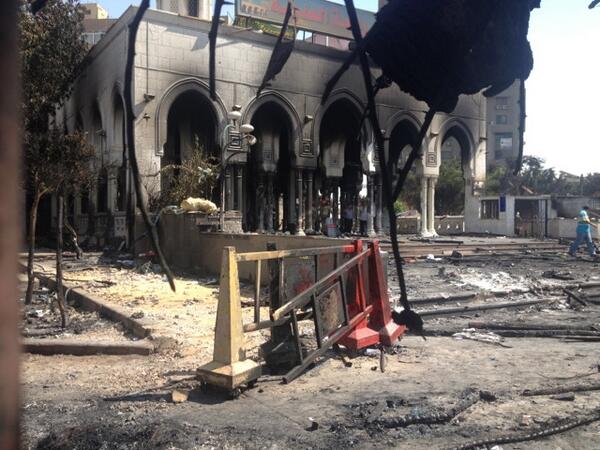
Two days ago Rabaa was almost a fully-formed settlement. Now even the mosque is burnt pic.twitter.com/4yLMqt2q8T
Updated: Experts reflect on Egypt's turmoil
A cross section of Middle East analysts discuss the implications of the latest wave of violence in Egypt.
Al-Jazeera
.....
....

"Larbi Sadiki is a professor at Qatar University, and an expert on Arab Democratisation. he is the author of Rethinking Arab Democratization: Elections without Democracy.
Al Sisi's imprint on Egyptian politics has been catastrophic: trigger-happy with a disproportionate use of force against civilians, totally out of step with the spirit and ethos of the January 25 revolution. Right now this general and his Interior Minister are no more than "damaged goods". Their time is up. In less than two months in power, they have done more harm to Egypt's democratisation, civilianisation and its reconciliation processes than anyone or anything else.
ElBaradi and the whole "Tamarrod" movement have been taken for a ride by remnants of al-Askar and the mukhabarat mode of politics. Even the April 6 Movement is now tarnished as it provided the regime that ousted Morsi with an undeserved legitimacy.
Egypt is a mess. However, blame doesn't lie in the hands of external forces. The Americans, Europeans and Israelis have little to do with these barbaric events. Fingers should be pointed in the direction of the so-called Arab liberals. Who are these Arab liberals? What is their liberalism? Who amongst them has one iota of Mill or Locke's political creativity? They have an obsession with bombing Iran, bashing Islamists, and being bed fellows with the enemies of democracy. It's not their political rhetoric but their relationship with the generals of security forces and intelligence services that is cause for most concern. Instead of learning about constitutionalism or putting together theories about legal and democratic governance, they unfortunately seek satiation of their hedonism…."
Al-Jazeera
.....
....
"Larbi Sadiki is a professor at Qatar University, and an expert on Arab Democratisation. he is the author of Rethinking Arab Democratization: Elections without Democracy.
Al Sisi's imprint on Egyptian politics has been catastrophic: trigger-happy with a disproportionate use of force against civilians, totally out of step with the spirit and ethos of the January 25 revolution. Right now this general and his Interior Minister are no more than "damaged goods". Their time is up. In less than two months in power, they have done more harm to Egypt's democratisation, civilianisation and its reconciliation processes than anyone or anything else.
ElBaradi and the whole "Tamarrod" movement have been taken for a ride by remnants of al-Askar and the mukhabarat mode of politics. Even the April 6 Movement is now tarnished as it provided the regime that ousted Morsi with an undeserved legitimacy.
Egypt is a mess. However, blame doesn't lie in the hands of external forces. The Americans, Europeans and Israelis have little to do with these barbaric events. Fingers should be pointed in the direction of the so-called Arab liberals. Who are these Arab liberals? What is their liberalism? Who amongst them has one iota of Mill or Locke's political creativity? They have an obsession with bombing Iran, bashing Islamists, and being bed fellows with the enemies of democracy. It's not their political rhetoric but their relationship with the generals of security forces and intelligence services that is cause for most concern. Instead of learning about constitutionalism or putting together theories about legal and democratic governance, they unfortunately seek satiation of their hedonism…."
"RESTORING DEMOCRACY"

Secretary of State John Kerry has said the Egyptian army did not take over when it ousted the country's first democratically elected president, but was instead “restoring democracy.”


Egypt: Brotherhood calls for new protests after deadly crackdown
Live• Death toll following crackdown stands at over 500
• Curfew keeps Cairo quiet overnight
• Strong US condemnation of military government
• Muslim Brotherhood calls for further protests
• Nobel laureate quits interim government
theguardian.com,
• Curfew keeps Cairo quiet overnight
• Strong US condemnation of military government
• Muslim Brotherhood calls for further protests
• Nobel laureate quits interim government
theguardian.com,
Wednesday, August 14, 2013
Military crackdown: Egypt's Tiananmen Square
The Egyptian military's bloody assault on its own people marks a point of no return for the government
A GOOD EDITORIAL
The Guardian,
A GOOD EDITORIAL
The Guardian,
Cairo doctors struggle to treat Morsi supporters during bloody crackdown
• At least 278 dead as pro-Morsi camps stormed
Patrick Kingsley in Cairo
• Bulldozers and live ammunition used in raids
• Doctor tells of 'barbaric' scenes at field hospital
Patrick Kingsley in Cairo
Generals and patrons: The American-Egyptian military
The US's cozy relationship with Egypt's military should be reexamined.
By Marwan Bishara
Al-Jazeera

"As the situation escalates into a full-fledged confrontation between the Egyptian military and supporters of the Muslim Brotherhood, Washington is once again playing catch-up with its own clients.
Happy to see the back of the Islamists, the US administration refrained from referring to the military overthrow of President Morsi as a coup even when influential members of Congress recognised it as such.
The Obama administration wanted the coup to work; it did not want blood on its hands. But if they hoped to appease and influence the military, they were wrong.
The generals adamant on containing, if not breaking the Brotherhood, saw the political challenges facing Egypt as security problems that require the use of force.
They imposed emergency laws that allows more control, but in reality it led to more escalation.
As they prepared to publicly crackdown on Morsi's supporters through force, Washington remained largely silent.
US calls for restraint, dialogue, and a return to the ballot box seemed more rhetorical than practical or effective.
America's eagerness to maintain a close relationship with the military and remain relevant in the country has prevented it from taking a clear stand.
Investing in the Egyptian military
Egypt is a "major non-NATO ally" with the military to military liaisons at its core. Egypt's military relationship with the West took off after the 1979 Peace Treaty between Israel and Egypt, rendering Egypt the second-largest recipient of its bilateral assistance after Israel.
This required, among others, a major military and financial investment that totalled $66bn since the peace treaty. The American wooing of the Egyptian generals has cost the US $1.3bn a year since 1987.
Heavy-duty gifts like 1,000 tanks and 221 fighter jets worth billions signified the US's commitment to Egypt.
In 2011 - the year of the revolution - Egypt received almost a quarter of all of America's Foreign Military Financing funds.
The American-Egyptian courtship has resulted in, among many things, an Americanized Egyptian defense force.
Over 500 Egyptian officers benefit from the American military education system every year. These include top Egyptian officers, including the country's defense chief, Abdel Fattah al-Sisi, who went to the US Army War College in Pennsylvania, as well as the commander of the Air Force, Reda Mahmoud.
The education stints of the Egyptian officers in US military colleges, the training programs, and the joint military exercises have led to enduring ties between the establishments of both countries.
Two positions add to one
The question then is, with the Egyptian military having been an acutely embarrassing partner of late - what was Washington supposed to do?
Should it have presented it with an ultimatum? Cut aid, after years of lavishing the military with significant funds?
The conventional wisdom among the Middle East policy establishment, especially those allied with Israel is that Washington needs to maintain a close relationship with the military at all times.
Some claim that the Egyptian military is an indispensable and reliable ally in a sea of turmoil, and supporting it serves US national security interests. For them, the emerging civilian forces - popular as they may be- whether Islamists or secular - are neither reliable nor friendly.
Others argue that refraining from criticising the generals allows Washington to exercise some degree of influence over their decision-making.
According to Washington's newly appointed Middle East "peace envoy", Martin Indyk, argues that the US should be communicating with the military of the Arab world's "largest, militarily most-powerful, culturally most-influential, and geostrategically most-important country" through private channels, and not work against it.
Reversing roles
Some within the minority of the Washington establishment advocate severing relations with the Egyptian military if it doesn't refrain from violence. They see any perceived complicity between the US and the authoritarian Egyptian military to be harmful for US interests in the long-term, especially since it allows for a backlash among Islamists in the region.
But it seems far-fetched that this warning would be heeded in Washington. Would freezing aid make sense at a time when the US is fast losing its relevance in the region?
Already losing its leverage and influence, notably regarding the dramatic events taking place in Syria, Iraq, Iran, Lebanon and the region in general, Washington is not about to give up one of its few strategic pillars in the Middle East.
The Egyptian military is privy to all of this and understands all too well its own utility for the US in the region.
For example, what if Egypt chooses to be the one to walk out? I reckon there would be major panic in the American capital and no less in Israel.
After all, isn't Egypt what helps America maintain stability in the region and help preserve Israel's security ?
The way forward…
Washington would've liked to see the generals refrain from violence, empower the civilian government, allow for a quick return to the democratic process, and eventually return to the barracks.
But the US did not voice its opinion loud enough, and didn't make it clear to the generals that failure to heed their advice has consequences.
As the spiral of violence gets underway on Egypt's streets, America needs to show the value of its leverage over Egypt's military.
The White House statement and Secretary of State's condemnation of the violence is hardly a good start. Everyone has condemned the violence; even the Egyptian generals!
Neither pillow talk in private nor regrets in public are useful to stop the escalation.
True leverage over a client starts with America telling the Egyptian generals: end the emergency law, stop the violence and allow a return to the ballot box. Or else."
By Marwan Bishara
Al-Jazeera
"As the situation escalates into a full-fledged confrontation between the Egyptian military and supporters of the Muslim Brotherhood, Washington is once again playing catch-up with its own clients.
Happy to see the back of the Islamists, the US administration refrained from referring to the military overthrow of President Morsi as a coup even when influential members of Congress recognised it as such.
The Obama administration wanted the coup to work; it did not want blood on its hands. But if they hoped to appease and influence the military, they were wrong.
The generals adamant on containing, if not breaking the Brotherhood, saw the political challenges facing Egypt as security problems that require the use of force.
They imposed emergency laws that allows more control, but in reality it led to more escalation.
As they prepared to publicly crackdown on Morsi's supporters through force, Washington remained largely silent.
US calls for restraint, dialogue, and a return to the ballot box seemed more rhetorical than practical or effective.
America's eagerness to maintain a close relationship with the military and remain relevant in the country has prevented it from taking a clear stand.
Investing in the Egyptian military
Egypt is a "major non-NATO ally" with the military to military liaisons at its core. Egypt's military relationship with the West took off after the 1979 Peace Treaty between Israel and Egypt, rendering Egypt the second-largest recipient of its bilateral assistance after Israel.
This required, among others, a major military and financial investment that totalled $66bn since the peace treaty. The American wooing of the Egyptian generals has cost the US $1.3bn a year since 1987.
Heavy-duty gifts like 1,000 tanks and 221 fighter jets worth billions signified the US's commitment to Egypt.
In 2011 - the year of the revolution - Egypt received almost a quarter of all of America's Foreign Military Financing funds.
The American-Egyptian courtship has resulted in, among many things, an Americanized Egyptian defense force.
Over 500 Egyptian officers benefit from the American military education system every year. These include top Egyptian officers, including the country's defense chief, Abdel Fattah al-Sisi, who went to the US Army War College in Pennsylvania, as well as the commander of the Air Force, Reda Mahmoud.
The education stints of the Egyptian officers in US military colleges, the training programs, and the joint military exercises have led to enduring ties between the establishments of both countries.
Two positions add to one
The question then is, with the Egyptian military having been an acutely embarrassing partner of late - what was Washington supposed to do?
Should it have presented it with an ultimatum? Cut aid, after years of lavishing the military with significant funds?
The conventional wisdom among the Middle East policy establishment, especially those allied with Israel is that Washington needs to maintain a close relationship with the military at all times.
Some claim that the Egyptian military is an indispensable and reliable ally in a sea of turmoil, and supporting it serves US national security interests. For them, the emerging civilian forces - popular as they may be- whether Islamists or secular - are neither reliable nor friendly.
Others argue that refraining from criticising the generals allows Washington to exercise some degree of influence over their decision-making.
According to Washington's newly appointed Middle East "peace envoy", Martin Indyk, argues that the US should be communicating with the military of the Arab world's "largest, militarily most-powerful, culturally most-influential, and geostrategically most-important country" through private channels, and not work against it.
Reversing roles
Some within the minority of the Washington establishment advocate severing relations with the Egyptian military if it doesn't refrain from violence. They see any perceived complicity between the US and the authoritarian Egyptian military to be harmful for US interests in the long-term, especially since it allows for a backlash among Islamists in the region.
But it seems far-fetched that this warning would be heeded in Washington. Would freezing aid make sense at a time when the US is fast losing its relevance in the region?
Already losing its leverage and influence, notably regarding the dramatic events taking place in Syria, Iraq, Iran, Lebanon and the region in general, Washington is not about to give up one of its few strategic pillars in the Middle East.
The Egyptian military is privy to all of this and understands all too well its own utility for the US in the region.
For example, what if Egypt chooses to be the one to walk out? I reckon there would be major panic in the American capital and no less in Israel.
After all, isn't Egypt what helps America maintain stability in the region and help preserve Israel's security ?
The way forward…
Washington would've liked to see the generals refrain from violence, empower the civilian government, allow for a quick return to the democratic process, and eventually return to the barracks.
But the US did not voice its opinion loud enough, and didn't make it clear to the generals that failure to heed their advice has consequences.
As the spiral of violence gets underway on Egypt's streets, America needs to show the value of its leverage over Egypt's military.
The White House statement and Secretary of State's condemnation of the violence is hardly a good start. Everyone has condemned the violence; even the Egyptian generals!
Neither pillow talk in private nor regrets in public are useful to stop the escalation.
True leverage over a client starts with America telling the Egyptian generals: end the emergency law, stop the violence and allow a return to the ballot box. Or else."
Egypt: Security forces must avoid further bloodshed


"Security forces must take urgent steps to avoid further bloodshed as a pro-Morsi sit-in is dispersed in Cairo today, said Amnesty International. The organization is working on the ground to verify any abuses that may have been carried out.
“Promises by the authorities to use lethal methods only as a last resort to disperse protesters appear to have been broken. All too often in the past the Egyptian security forces have used excessive force against demonstrators with catastrophic consequences,” said Philip Luther, Director for the Middle East and North Africa at Amnesty International.
“Security forces have a duty to prevent further loss of life. This must be an immediate priority.”
Access to the main hospital in the area near the sit-in at Rabaa al-Adawiya is also reported to be restricted.
“As an immediate step, any injured protesters must be granted unimpeded access to medical treatment. The authorities must also ensure safe exit for anyone wishing to leave the sit-in,” said Philip Luther.
More than 200 people have been killed during clashes and other political violence since President Mohamed Morsi was toppled following mass demonstrations in June."

بالفيديو.."المصريون" ترصد قناصة الداخلية تستهدف المتظاهرين

"رصدت كاميرا "المصريون" قيام عدد من القناصة التابعين لوزارة الداخلية باعتلاء أسطح عدد من العمارات بشارع عباس العقاد وإطلاق نيران حي على المعتصمين بميدان رابعة العدوية ما أدى إلى وقوع عشرات المصابين وعلى الجانب الآخر قام المتظاهرون برشق كل الشقق الموجودة بالعمارات بالحجارة ما أدى إلى إصابة عدد من المدنيين وتم نقلهم إلى المستشفى الميداني لإسعافهم. "
SHOOT THE MESSENGER: Egyptian forces thought to be targeting media workers
Sky news cameraman and Gulf newspaper reporter shot dead near Cairo amid crackdown on Muslim Brotherhood supporters
Martin Chulov and Josh Halliday
Martin Chulov and Josh Halliday
IT TOOK HIM THIS LONG; BUT BETTER LATE THAN NEVER! البرادعي يستقيل من رئاسة الجمهورية

"قالت وكالة الأنباء الفرنسية أن الدكتور محمد البرادعي نائب الرئيس المؤقت عدلي منصور تقدم باستقالته اليوم على خلفية أحداث العنف الي شهدتها مصر. وقال البرادعي في نص قرار استقالته : كما تعلمون فقد كنت أري أن هناك بدائل سلمية لفض هذا الاشتباك المجتمعي وكانت هناك حلول مطروحة ومقبولة لبدايات تقودنا إلي التوافق الوطني.
وأضاف : لكن الأمور سارت إلي ما سارت إليه. ومن واقع التجارب المماثلة فإن المصالحة ستأتي في النهاية ولكن بعد تكبدنا ثمنا غاليا كان من الممكن - في رأيي - تجنبه.
يذكر أن البرادعي هدد بالاستقالة في الفترة الماضية
ننشر نص استقالة البرادعي من الرئاسة
أعلن المكتب الإعلامي للدكتور محمد البرادعي نائب رئيس الجمهورية للشئون الدولية أنه تقدم بخطاب استقالة من مهام منصبه لرفضه فض اعتصامي رابعة العدوية والنهضة بالقوة.
وقال البرادعي في نص قرار استقالته: "كما تعلمون فقد كنت أري أن هناك بدائل سلمية لفض هذا الاشتباك المجتمعي وكانت هناك حلول مطروحة ومقبولة لبدايات تقودنا إلي التوافق الوطني". وأضاف: "لكن الأمور سارت إلي ما سارت إليه. ومن واقع التجارب المماثلة فإن المصالحة ستأتي في النهاية ولكن بعد تكبدنا ثمنا غاليا كان من الممكن - في رأيي – تجنبه".
وفيما يلي نص بيان الاستقالة: -
السيد المستشار/ عدلى منصور رئيس الجمهورية
أتقدم إليكم باستقالتي من منصب نائب رئيس الجمهورية , داعيا الله عز وجل أن يحفظ مصرنا العزيزة من كل سوء وان يحقق آمال هذا الشعب وتطلعاته ويحافظ على مكتسبات ثورته المجيدة في 25 يناير 2011, والتي أكدها بصيحته المدوية في 30 يونيو2013 , وهى المكتسبات التي بذل من أجلها التضحيات الجسام من أجل بناء وطن يعيش فيه الجميع متمتعين بالحرية والديمقراطية والعدالة الاجتماعية واحترام حقوق الإنسان والحكم الرشيد والتوافق المجتمع والمساواة التامة بين جميع المواطنين دون تفرقة أو إقصاء أو تمييز.
لقد ساهمت قدر ما وسعني الجهد وظللت أدعو لهذه المبادئ من قبل 25 يناير ومن بعدها دون تغيير ودون تبديل وسأظل وفيا لها وفاء لهذا الوطن الذي أؤمن بان أمنه واستقراره وتقدمه لايتحقق إلا من خلال التوافق الوطني والسلام الاجتماعي الذي يتحقق من خلال إقامة الدولة المدنية وعدم الزج بالدين في غياهب السياسة واستلهام مبادئه وقيمه العليا في كل مناحي الحياة.
إلا أن الجماعات التي تتخذ من الدين ستارا والتي نجحت في استقطاب العامة نحو تفسيراتها المشوهة للدين حتي وصلت للحكم لمدة عام يعد من أسوأ الأعوام التي مرت علي مصر حيث أدت سياسات الاستحواذ والإقصاء من جانب والشحن الإعلامي من جانب أخر إلي حالة من الانقسام والاستقطاب في صفوف الشعب.
لذلك كان المأمول أن تفضي انتفاضة الشعب الكبرى في 30 يونيو إلي وضع حد لهذه الأوضاع ووضع البلاد علي المسار الطبيعي نحو تحقيق مبادئ الثورة , وهذا ما دعاني لقبول دعوة القوي الوطنية للمشاركة في الحكم , إلا أن الأمور سارت في إتجاه مخالف فقد وصلنا إلي حالة من الاستقطاب أشد قسوة وحالة من الانقسام أكثر خطورة, وأصبح النسيج المجتمعي مهدد بالتمزق لأن العنف لا يولد إلا العنف.
وكما تعلمون فقد كنت أرى أن هناك بدائل سلمية لفض هذا الاشتباك المجتمعي وكانت هناك حلول مطروحة ومقبولة لبدايات تقودنا إلى التوافق الوطني, ولكن الأمور سارت إلى ما سارت إليه ومن واقع التجارب المماثلة فإن المصالحة ستأتي في النهاية ولكن بعد تكبدنا ثمنا غاليا كان من الممكن - في رأيي - تجنبه.
لقد أصبح من الصعب علي أن أستمر في حمل مسئولية قرارات لا أتفق معها وأخشى عواقبها ولا أستطيع تحمل مسئولية قطرة واحدة من الدماء أمام الله ثم أمام ضميري ومواطني خاصة مع إيماني بأنه كان يمكن تجنب إراقتها.. وللأسف فإن المستفيدين مما حدث اليوم هم دعاة العنف والإرهاب والجماعات الأشد تطرفا وستذكرون ما أقول لكم وأفوض أمري إلي الله.
وقى الله أرض الكنانة وشعبها العظيم وجيشها الباسل.
محمد البرادعي". "
Witness: Chaos and blood as Egypt forces storm protest camp


"(Reuters) - First came the tear gas, the bulldozers and the flames. Then came the bullets and the blood.
Egypt's security forces arrived after dawn on Wednesday to disperse the camp where thousands of Islamists have held vigil for six weeks. Helicopters roared above. Police fired tear gas into the crowd. Armored bulldozers knocked down the makeshift walls made of sandbags and piles of rocks.
Inside, thousands of supporters of deposed President Mohamed Mursi were waking up into panic.
Reuters correspondent Yasmine Saleh reached the camp shortly after the assault began, to hear desperate residents reciting Koranic verse and screaming "God help us! God help us!"
Masked police in dark uniforms were pouring out of police vans with sticks in one hand and tear gas bombs in the other. They tore down tents and set others ablaze.
"They smashed through our walls. Police and soldiers, they fired tear gas at children. We are peaceful, no weapons, we didn't fire a shot, we threw stones. They continued to fire at protesters even when we begged them to stop," said Saleh Abdulaziz, 39, a secondary school teacher clutching a bleeding wound on his head.
After shooting began, wounded and dead lay on the streets near pools of blood. An area of the camp that had been a playground and art exhibit for the children of protesters was turned into a war-zone field hospital.
Seven dead bodies were lined up in the street, one of a teenager whose skull was smashed, with blood pouring from the back of his head.
At another location in Cairo, Reuters reporter Abdul Moneim Haikal was in a crowd of Mursi supporters when he heard bullets whizzing past and hitting walls.
The crowd dived to the ground for cover. When Haikal looked up he saw blood gushing from the skull of a man next to him, killed by a bullet to the head. Police were firing from armored vehicles across the street......"
أ ف ب: استقالة نائب الرئيس المصري للعلاقات الدولية محمد البرادعي من منصبه
أ ف ب: استقالة نائب الرئيس المصري للعلاقات الدولية محمد البرادعي من منصبه
Subscribe to:
Posts (Atom)