Thursday, June 4, 2015

ISIS FORCES THAT NOW CONTROL RAMADI ARE EX-BAATHIST SADDAM LOYALISTS

The Intercept

Link

The fall of Ramadi, capital of Iraq’s Anbar Province, to the Islamic State last month has frayed nerves in Washington, but what few appear to grasp is that ISIS’s May offensive has given Ramadi back to its former owners — the ex-Baathist Sunni terrorists known as the Former Regime Loyalists. The FRLs, as they’re called, were Saddam Hussein’s most ardent followers, the same fighters whom the United States fought non-stop for eight years. Their resurgence has implications not just for the United States but for ISIS itself. For while these forces may fly the ISIS flag today, their ultimate plans for Iraq are quite different than those of the “caliphate.”
ISIS’s roots in Saddam Hussein’s Baath Party are deep — many of the group’s most devoted commanders, advisers and fighters started out as Baathists. The ex-Baathists essentially run ISIS, and their past is evident in the tactics they are using now.
After the 1963 coup that first gave the Baathists a share of power in Iraq’s government, Saddam became head of the secret Jehaz Al-Khass, or Special Branch, and collected meticulous dossiers on friends and enemies alike. Saddam used these dossiers to carry out a political putsch in the mid-sixties, as well as the bloodless 1968 coup that brought his party to full control of Iraq. From 1968 until 2003, Baathists controlled every aspect of Iraqi life and generalized the surveillance techniques that Saddam had used so effectively in his rise to power.
The Baath government amassed millions of personal records and forced its citizens to spy on family and friends for Saddam’s intelligence agencies. Those agencies, staffed almost exclusively by Sunnis, were masters at collecting and using the most intimate details of the lives of individual Iraqis. Stasi-level minutiae about family structure, births, deaths, relations and the aspirations of everyone who lived under the regime were documented and filed. The regime then used all its information to compel compliance, the alternative to which was death. After the invasion, the Baathists held the key to the human terrain of Iraq. All of these Saddamist traditions have been carried on by his disciples in ISIS.
One of these is Samir Abd Muhammad al-Khlifawi, usually known as Haji Bakr, a former spy for Saddam who became chief of military operations for ISIS.
From as early as 2004, al Qaeda in Iraq gradually sought to transfer control of the Iraqi jihad from foreign fighters like Abu Musab al-Zarqawi and Abu Ayyub al-Masri to local Iraqi commanders like Abu Umar al-Baghdadi. AQI became the Islamic State of Iraq (ISI) in 2006, just as many local captives were being released from U.S. military prisons such as Camp Bucca. One of them was Abu Bakr al-Baghdadi, the future caliph of ISIS. As an Iraqi, he had been held not with the high-value al Qaeda terrorists, but with low-level FRL and Iraqi religious extremist insurgents. At Bucca, al-Baghdadi formed bonds and apparently conceived the model that would eventually become ISIS, a consolidated force of Iraqi Sunni FRLs, joined with al Qaeda’s foreign fighters, that would take back their traditional tribal lands and then form a caliphate. That’s where he connected with Haji Bakr.
Der Spiegel magazine recently obtained Haji Bakr’s handwritten notes and organizational diagrams for creating an ISIS spy agency based on Saddam’s own intelligence agencies. The notes, the magazine reported, confirmed what American intelligence agencies had assumed for well over a decade — that the ex-Baathists ran almost everything in Iraq after the U.S. invasion. Since 2003 these ex-Baathists have been ruthlessly pulling the strings of the jihadists in Iraq. First they facilitated al Qaeda’s entry into the insurgency, then they built them hundreds of car bombs and provided intelligence on American operations.
Haji Bakr (Wikipedia)
Haji Bakr is a classic example of an ex-Baathist spy who brought his Saddam-era human intelligence skills to ISIS. He was a former Iraqi air force intelligence officer from the Directorate of Military Security who may have been part of the original IED development team, the Al Ghafiqi project. Working for ISIS, his flow charts, questionnaires, dossiers and biographical histories about anyone under their control were all straight from Saddam Hussein’s playbook. This level of micro-detail on enemies gave the FRLs and now ISIS information dominance in Iraq and Syria. But the FRL’s greatest achievement may be training ISIS to create similar databases of deeply personal, psychological profiles and factual knowledge on every foreign fighter, jihadi bride or Iraqi who either joins or is conquered by ISIS. That database is just waiting to be exploited by the world’s intelligence communities. (In fact, U.S. special forces may have captured a similar database related to ISIS finances in the May 2015 raid that resulted in the death of Nabil Saddiq Abu Saleh al-Jabouri, aka Abu Sayyaf, the ISIS oil and money facilitator.)
Recall that from the moment the U.S. Army entered Baghdad, the coming Sunni terror insurgency was manned by almost 100,000 FRL officers from the most loyal organizations. This number included 30,000 commandos from Saddam’s Fedayeen; 26,000 Special Republican Guards; 31,000 spies, analysts and enforcers from five major intelligence agencies; as well as 6,000 seasoned combat officers — all freshly fired by Ambassador Bremer through his General Order #2. These people didn’t vanish into thin air after the invasion; they went underground, as had been planned long before the war, and formed the largest insurgent group in Iraq, the Army of the Mujahideen. They also took over others, such as Ansar al Sunna, giving them an Islamic patina to inspire resistance.
The FRLs understood effective military command and control and organized the National Council of Iraqi Resistance, also known as the Unified Mujahideen Command, with forward operations centers in each city under direct command of Saddam Hussein and his sons Uday and Qusay. From Damascus, Syria, the NCIR/UMC operated a command center led by Izzat Ibrahim al-Douri, Saddam’s chief henchman. He and a council of ex-generals commanded the secret terror war in Iraq against the United States coalition. Granted, some Sunni tribes and insurgents grew sick of al Qaeda and cooperated with the Iraqi government in 2007, during the “Sahwah,” or “Anbar Awakening,” but most, like Haji Bakr, kept fighting from their homes or across the border in Syria, and many were eventually incorporated into the framework of ISIS.
Simply put, ISIS today is essentially a Baathist-organized amalgam of virtually every Sunni tribal and jihadist insurgent group the United States has fought since April 2003. It is fueled by the ideology of al Qaeda and is under the nominal leadership of foreign terrorists. No matter that foreign fighters are the amirs with high-level roles, and that it took 12 years to usurp and merge all of those groups and to liberate the Sunni governorates. Ex-Baathists like Haji Bakr and al-Douri have helped ISIS’s Iraqi “caliph,” Abu Bakr al-Baghdadi, manage it brilliantly.

Wednesday, June 3, 2015

بلا حدود- الجولاني: الإخوان انحرفوا.. وتنظيم الدولة "خوارج"

THIS JOLANI KOOK WANTS TO TAKE SYRIANS 1400 YEARS BACK.......

HE WANTS TO KILL, CONVERT BY FORCE OR MAKE ALL MINORITIES PAY A TRIBUTE (JIZYAH)! 

THIS IS NOT WHAT SYRIAN REVOLUTIONARIES WANT!

I DON'T SEE WHAT IS THE DIFFERENCE BETWEEN HIM AND ISIS.

PLEASE READ SALAMA KILA'S CRITIQUE POSTED BELOW. 

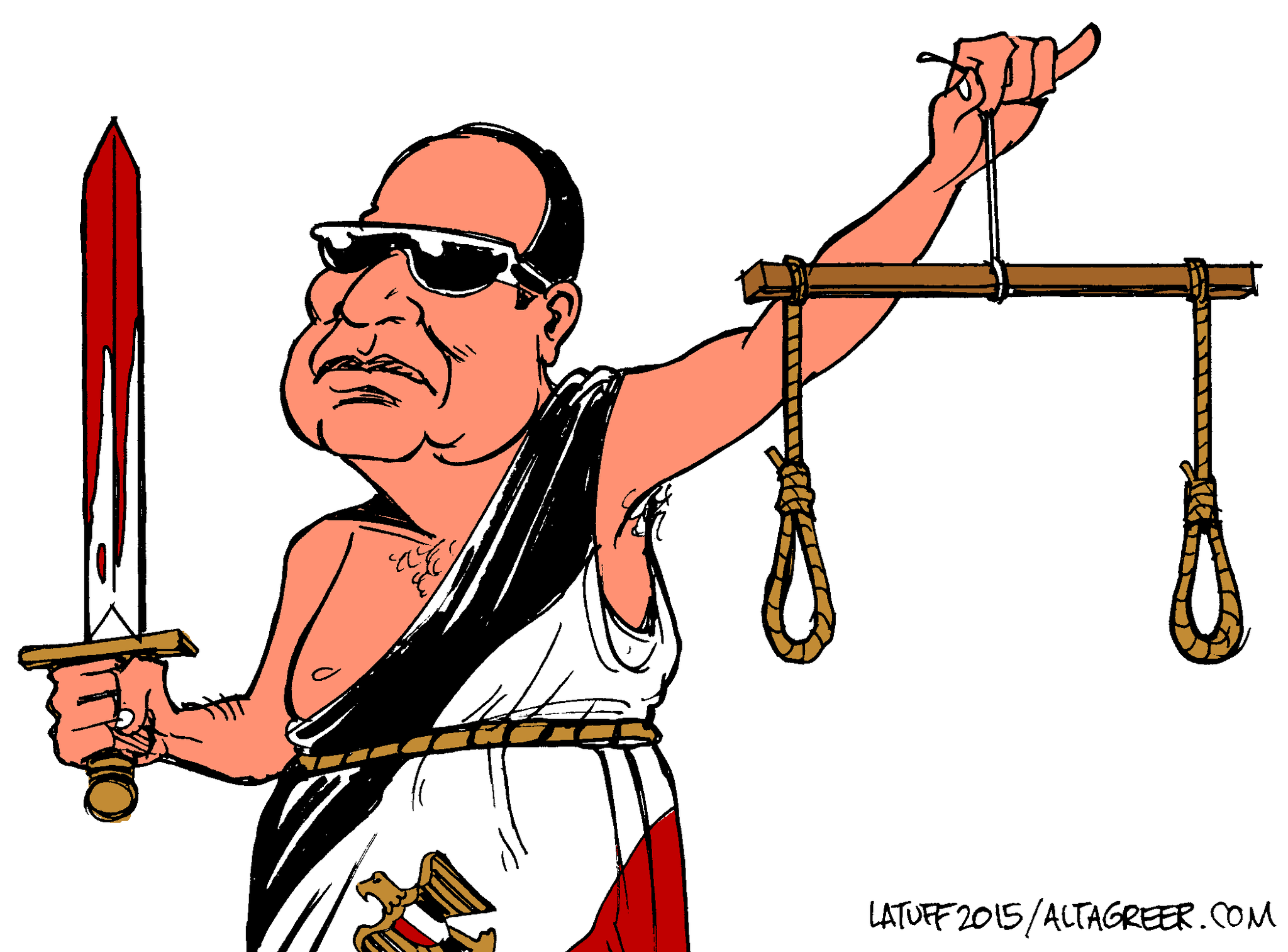
Carlos Latuff: Sisi's Justice

عن مقابلة الجولاني

سلامة كيلة

Link


أن يخرج أبو محمد الجولاني على شاشة "الجزيرة"، في هذا الوقت، أمر لافت، بل أظن أنه مربك ومقصود، فالكتائب المتوحدة في جيش الفتح تحقق تقدماً ملحوظاً في الشمال والغرب من سورية، وظهر أن جبهة النصرة باتت تخضع لمنظور مختلف عمّا كانت تطرح، خصوصاً بعد أن تسرب أنها قد تنفصل عن تنظيم القاعدة، وتصبح "جزءاً من الثورة".
لكن، أعاد الجولاني تكرار المعروف عن الجبهة، وعن هدفها بفرض الخلافة، وعن التعامل وفق "منظور ديني"، ينطلق من الوهابية يكفّر الأقليات والأديان، ويريد تطبيق "الشريعة"، كما تبلورت في شكلها الوهابي القائم على شكلية مفرطة في الفهم، حيث تؤخذ النصوص مجتزأة، وتطبق من دون تفكير، استمراراً لما أكده الإمام الغزالي أنْ "خذوا الحقائق من الألفاظ". والتكفير هو أولويته وأساس رؤيته، والقتل هو الآلية التي تتبع ذلك. بالتالي، لماذا يخرج الجولاني لقول ذلك؟ وماذا تريد قناة الجزيرة القول؟

ربما كان الهدف هنا هو فعل ما فعلته داعش، حين "توافقت" مع قوى عراقية ضد النظام في العراق، وسارعت سيطرة تلك القوى على مناطق واسعة غرب العراق لأن تعلن الخلافة، وتشرّد المسيحيين وتعتقل اليزيديين، وتمارس كل أشكال القتل. ليجهض الحراك ويصبّ في ما تريد السياسة الأميركية. فما قاله الجولاني يعني أن على "الأقليات" السورية أن تخاف، وأن تعيد ارتباطها بالنظام، بعد أن ظهر التفكك في الفترة الماضية، خصوصاً هنا الدروز، وأيضاً العلويين، وخصوصاً أيضاً أن "النصرة" باتت على حواف جبال العلويين، وهددت بالوصول إلى القرداحة.
وإذا لاحظنا كيف أن التقدم في الشمال الغربي توقف عند حدود السيطرة على منطقة إدلب يمكن أن نتوقع أن الحدود التي سُمح فيها من الدول المتحكمة أن يتوقف "التحرير" هنا، ومن ثم أن يجري شدّ العلويين خلف السلطة. ربما نربط ذلك بسماح السلطة لداعش لكي تسيطر على تدمر، وسعيها إلى التقدم غرباً، سواء نحو حوران أو ريف دمشق، وتقدمها في حلب. ومحاولة شلّ الجبهة الجنوبية كذلك. حيث كان المطلوب من التقدم العسكري خلخلة ميزان القوى، وليس أكثر.
وإذا كان وجود جبهة النصرة يربك الصراع منذ البدء، ويراد أن يربك التقدم بحيث يبقيه "تحت السيطرة"، فإن وضع جبهة النصرة أصلاً محل رفض في مناطق سورية كثيرة، حيث اعتبرت الكتائب المسلحة في منطقة درعا الجبهة تنظيماً متطرفاً تكفيرياً، ورفضت كل علاقة معه، كما دعت العناصر المنخرطة في التنظيم إلى تركه، والانضمام إلى صفوف الثورة. كما حدثت تظاهرات عديدة ضده، أدت إلى طرده من مناطق في جنوب دمشق (ببيلا وغيرها)، وأيضاً تظاهرات ضدها في مناطق عديدة في الشمال. وهي تسيطر في الشمال بفعل قوتها العسكرية، وليس بفعل قبول الشعب لها. لهذا، فإنها مرفوضة شعبياً، ويؤدي تكبير دورها إلى تخويف ليس الأقليات فقط، بل كل الشعب السوري من المصير الأسود الذي تسعى إلى فرضه.

لكن، من الواضح أن قوى عديدة تلعب خلف الجبهة، منها جماعة الإخوان المسلمين الذين يبدو أنهم قد دفعوا إلى انخراط عناصر منهم فيها، وأصبحوا يميلون إلى أن يعتبروها جزءاً من حراكهم. ومنها دول تريد أن تلعب بهذه الورقة، سواء لتخريب ترتيبات لا تريدها، أو للحصول على مكاسب خلال البحث عن تسويات في سورية. وربما أن هناك دولاً تريد أن تصل الجبهة إلى السلطة، لأنها تريد في سورية سلطة أصولية قروسطية وهابية.

مهما فعلت جبهة النصرة في مواجهة النظام، فهي قوة كبح وتفكيك، وهي تطمح إلى فرض سلطتها الأصولية على أي منطقة تسيطر عليها، وأصوليتها المغرقة في التخلف تجعلها في تضاد مع الشعب، وتفرض عليه صراعاً مضافاً، مع صراعه ضد النظام.
لكن، ماذا تريد قناة الجزيرة بإبراز الجولاني للمرة الثانية؟ تعميم الأصولية، كما فعلت منذ بدء الثورة؟

DNA 03/06/2015: عون..جعجع..وإعلان النوايا

وصول آلاف المقاتلين الإيرانيين والعراقيين إلى سورية لحماية دمشق

فرانس برس

وصل الآلاف من المقاتلين العراقيين والسوريين، في الآونة الأخيرة، إلى سورية للدفاع عن دمشق وضواحيها بدرجة أولى، بعد إعلان مقاتلين أن العاصمة تشكل هدفهم المقبل، وفق ما أعلن مصدر أمني سوري. وقال المصدر، اليوم الأربعاء، لوكالة "فرانس برس"، "وصل نحو سبعة آلاف مقاتل إيراني وعراقي إلى سورية، وهدفهم الأول هو الدفاع عن العاصمة"، موضحاً أن "العدد الأكبر منهم من العراقيين". ولفت المصدر، الذي رفض الكشف عن هويته، إلى أن "الهدف هو الوصول إلى عشرة آلاف مقاتل لمؤازرة الجيش السوري والمسلحين الموالين له في دمشق أولاً، وفي مرحلة ثانية استعادة السيطرة على مدينة جسر الشغور التي تفتح الطريق إلى المدن الساحلية ومنطقة حماة في وسط البلاد". 

Egypt: Beware al-Sisi’s claims of freedoms

By Hassiba Hadj Sahraoui, Deputy Director of Amnesty International’s Middle East and North Africa Programme, 

On his first official visit to Germany, Egypt’s President Abdel Fattah al-Sisi will present an image of himself that many back home would not recognise.
To his hosts, he will play the friendly democrat and reliable business partner – a fresh hope for Egypt.
But to the Egyptians who have seen through the smiles and handshakes, he is the face of brutal power – a throwback to a more repressive era.
Al-Sisi has praised Egypt’s youth as the “hope that lit the flames of change” of the “25 January Revolution” that drove ex-president Hosni Mubarak from office in 2011. Yet many of its youth leaders are behind bars, facing prison sentences on spurious charges.
As he meets Germany’s political and business elite, al-Sisi will hope to show that he is a leader they can trust to help create stability in Egypt and the region.
But since he ousted his predecessor from office two years ago, the violence and repression in Egypt is reminiscent of the darkest days of Mubarak’s three-decade rule.
Al-Sisi rose to prominence after ousting former president Mohamed Morsi in July 2013.
One month later, Egypt’s security forces dispersed sit-ins and protests by Morsi’s supporters across Egypt, resulting in up to 1,000 deaths in one day on 14 August 2013.
The Egyptian criminal justice system has increasingly become a blunt instrument for crushing dissent. The courts have rounded up hundreds of supporters of the Muslim Brotherhood, a movement to which Morsi belongs.
Yet in an interview with Der Spiegel in February, al-Sisi said “the independence of the judiciary must be respected” if Egypt was to develop like Germany.
Death sentences have been handed down after grossly unfair trials. In 2014 alone, 509 people were sentenced to death in Egypt – up from 109 sentenced in the previous year. Most are Muslim Brotherhood supporters – suggesting that the death penalty has become a tool for purging the political opposition.
Al-Sisi, who claims to be “saddened by even the loss of a single life”, has done nothing to halt the use of this punishment. And he has not reined in his security forces or ensured that those responsible for the unlawful killing of protesters are brought to justice.
In his comments to Der Spiegel this year, al-Sisi also insisted that he respected human rights and freedom of expression.
“Human rights should not be reduced to freedom of expression,” he said. “Even if this were the case, though, people in our country are free to say whatever they like,” he said.
Meanwhile, scores of journalists and media workers have been subjected to detention or criminal investigation for challenging the authorities’ official narrative and human rights record.
The government has also restricted the legitimate activities of non-governmental organizations that have criticised its policies.
Hundreds of people have been arrested under a repressive protest law that outlaws gatherings of more than 10 people not approved in advance by the authorities. Some have been held without charge for more than a year.
Detainees are typically kept in overcrowded and unsanitary conditions, where they are subject to torture and other forms of ill-treatment.
Egyptian officials will hope that al-Sisi’s Berlin visit confirms his legitimacy on the international stage.
However, Amnesty International and four other international rights organizations have stressed to Chancellor Angela Merkel in a 1 June joint letter that Germany must not choose the illusion of stability over the need to confront gross human rights violations.

Syria: New Chemical Attacks in Idlib

Security Council Should Urgently Determine Responsibility

Link

(New York) – The Syrian government renewed its use of apparent toxic chemicals in several barrel bomb attacks in Idlib governorate in April and May 2015. Human Rights Watch interviewed local doctors and first aid responders to the sites of three attacks and analyzed photographs and videos of weapon remnants. The attacks were in violation of the 1993 Chemical Weapons Convention, the laws of armed conflict, and a 2015 United Nations Security Council resolution.

The ongoing use of toxic chemicals in attacks gives greater urgency to tentative Security Council negotiations to create a mechanism to determine responsibility for the use of such illegal weapons. The Security Council is meeting on June 3 for its regular monthly briefing on chemical weapons in Syria.

“While Security Council members deliberate over next steps at a snail’s pace, toxic chemicals are raining down on civilians in Syria,” said Philippe Bolopion, UN and crisis advocacy director. “The Security Council should firmly establish responsibility and impose sanctions for these attacks, which defy its resolution and violate international law.”

Human Rights Watch conducted inquiries into three separate attacks in May in Idlib governorate, through interviews with three rescue workers who responded to the attacks, one of whom was affected by exposure to toxic chemicals, and two doctors who treated victims. Experts also reviewed photographic and video evidence. Two of the attacks took place just hours apart on May 2 in the nearby towns of Neirab and Saraqib, and the third on May 7 in the village of Kafr Batikh. The three attacks killed two people and affected 127 others, according to information collected by doctors who treated victims.

Human Rights Watch was not able to conclusively determine the toxic chemicals used in the three attacks. However the distinctive chlorine smell reported by rescue workers and doctors from attacks over the past two months, and the Syrian government’s previous use of chlorine, indicate this chemical was used in some if not all of the attacks.

Keith Ward, an independent expert on the detection and effects of chemical warfare agents, reviewed the clinical signs and symptoms described to Human Rights Watch and the videos of victims from the attacks on Neirab and Saraqib on May 2 and said they were consistent with exposure to a choking agent.

Ward noted that the best evidence of chlorine attacks are on-site descriptions of victims' clinical signs and symptoms, as well as the characteristic odor reported by the victims and first responders. Definitive detection of the agent involved is only possible by using a chemical detector near the site of the attack soon after it occurs, he said.

Human Rights Watch documented the use of barrel bombs embedded with cylinders of chlorine gas by government forces in Idlib in April 2014 and again in March 2015. Two doctors who treated victims in the May attacks also provided Human Rights Watch data they had collected from medical centers in the Idlib governorate on 21 additional attacks between March 16 and May 19 that led to symptoms consistent with exposure to toxic chemicals. They reported that the 24 attacks during this period killed at least nine people and affected more than 520 others with symptoms consistent with exposure to chlorine. Human Rights Watch has not yet been able to investigate the additional reported attacks.

The use of chlorine as a weapon in Syria has been previously documented. The Organisation for the Prohibition of Chemical Weapons (OPCW) fact-finding mission found in September 2014 “with a high degree of confidence, that chlorine was used as a weapon systematically and repeatedly in three villages in northern Syria.”

The Chemical Weapons Convention, which Syria acceded to in October 2013, prohibits attacks that use an industrial chemical as a weapon. Among other obligations, each member country agrees never to “assist, encourage or induce, in any way, anyone to engage in any activity prohibited to a State Party under this Convention.”

The laws of war applicable in Syria prohibit the use of chemical weapons. The use of prohibited weapons with criminal intent, that is deliberately or recklessly, is a war crime.

On March 6, the UN Security Council adopted Resolution 2209 in which it expressed concern that toxic chemicals had been used as a weapon in Syria and threatened to impose sanctions against any party using chemical weapons in Syria.

“The Syrian government has used barrel bombs with toxic chemicals for more than a year while the Security Council has failed to act,” Bolopion said. “If Security Council members still have doubts about who is to blame for these attacks, they should immediately create a mechanism to identify responsibility for these attacks so they can start discussing how to hold them accountable.”

For detailed accounts of the May 2 and 7 attacks please see below.

For past reporting on chemical attacks in Idlib in March 2015, see:

http://www.hrw.org/news/2015/04/13/syria-chemicals-used-idlib-attacks

For past reporting on chemical attacks in Idlib and Hama in April 2014, see:
http://www.hrw.org/news/2014/05/13/syria-strong-evidence-government-used-chemicals-weapon


The May 2 Attacks
On May 2 between midnight and 1 a.m., a barrel bomb struck the courtyard of a family home in the village of Neirab, injuring 12 members of the family. Firas Kayali, a rescue worker with the Idlib chapter of the Syria Civil Defense group, was among the first to arrive at the scene. The Syria Civil Defense is a group of rescue workers operating in areas outside the control of the government.

Kayali told Human Rights Watch that his medical response team was alerted that a helicopter was approaching their area by volunteers monitoring aircraft deployment to the south. He heard a helicopter overhead. Some minutes later, monitors in Neirab informed his team that a barrel bomb had been dropped.

When he arrived at the home in Neirab, Kayali told Human Rights Watch, he tried to enter three times but was overwhelmed by toxic fumes:
It was like the smell of household cleaning products, but much more concentrated. I couldn’t stay in the house for more than 30 seconds. My lungs and eyes were burning, my eyes began streaming. The second time, in addition to the burning and tears, I couldn’t breathe, I was coughing violently, just coughing, coughing. I saw a small child wrapped in blankets but I couldn’t reach him. The third time, fluid started streaming from my eyes, my nose, and my mouth. I felt like I was going to pass out. I started running and I lost consciousness. I didn’t wake up until other civil defense workers washed me with water.
At a nearby field hospital, Kayali was treated with oxygen and given a dose of atropine, a medicine with multiple uses that is commonly used to treat excessive buildup of fluids in nasal passages and airways to the lungs, as might be caused by exposure to choking agents such as chlorine gas. Two other responders to the attack who arrived after Firas noted the strong smell of chlorine in the air at the house, and on their clothing after they spent time at the site.

Mohammed Tennari, the head of the Sarmin field hospital, said he treated victims following the May 2 Neirab attack. He said they exhibited symptoms consistent with exposure to a toxic chemical including difficulty breathing, a feeling of choking, and burning eyes. Tennari said the victims of earlier chemical attacks exhibited similar symptoms. “We diagnosed them with exposure to toxic gases,” he said.

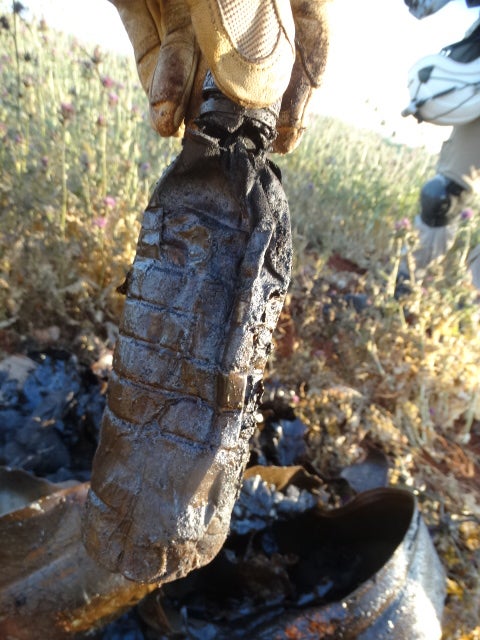
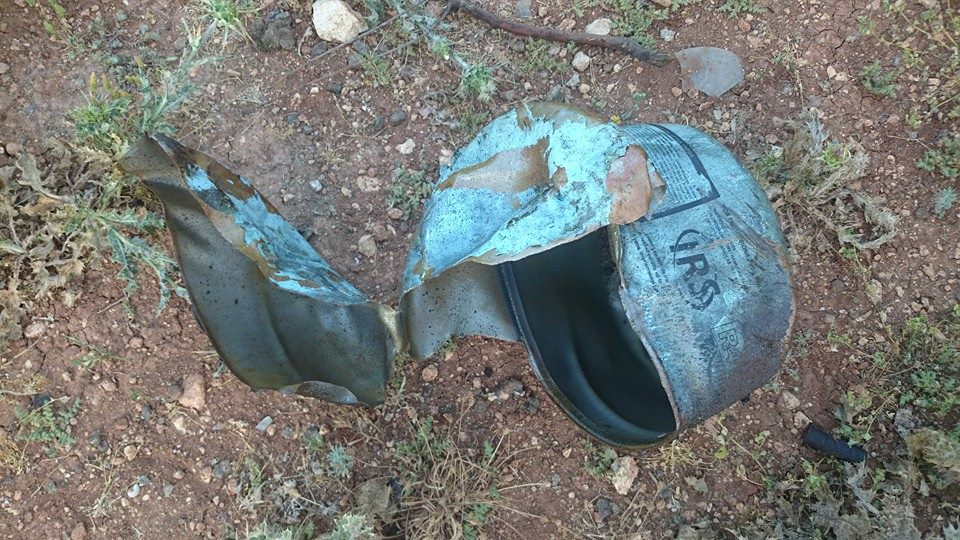
Two of those exposed during the May 2 Neirab attack later died: the young boy Kayali saw, who died within hours of exposure reportedly from suffocation, and his father, in his 60s, who died at a hospital in Turkey a few days after the attack. Human Rights Watch has not been able to establish the cause of death from doctors in Turkey. Human Rights Watch also reviewed video footage from the attack site, which showed metal fragments of a barrel, as well as what appeared to be remnants of a refrigerant canister.

Later on May 2, at about 3:30 a.m., two more barrels bombs struck the nearby town of Saraqib, said Laith Faris, an Idlib Civil Defense rescue worker who responded to both attacks that morning. Faris told Human Rights Watch that the barrels fell on neighborhoods in the eastern and western parts of the town, but that because of strong winds, fumes reached the town center. He said that the fumes affected about 75 people.

Another rescue worker, Mouti’a Jalal, who also responded to the Saraqib attack, said that victims had reddened eyes, difficulty breathing and the feeling of choking, and became red in the face. Some vomited, he said. He noted a strong smell of chlorine in the air at the attack site. Human Rights Watch also reviewed photographs of barrel bomb remnants from the Saraqib attacks, which included photographs of what appeared to be a refrigerant canister, a plastic bottle that a rescue worker said was filled with a reddish-purple powder, and metal remnants of the barrel bomb, also marked by a reddish-purple powder. It is unknown what role, if any, this powder may have played in the attacks or their medical consequences.

The May 7 Attack
Another chemical barrel bomb attack appeared to have occurred at about 3 a.m. on May 7, in the village of Kafr Batikh, in Idlib governorate. Faris, the rescue worker, was among the first to arrive at the attack site. He said that before the attack while he was in Saraqib, about seven miles from the village, he heard a helicopter approaching. However, Human Rights Watch was unable to review any videos or photos of the aftermath of this attack.

Walid Tamer, a doctor from Saraqib, told Human Rights Watch that following the attack he treated 17 people, including 8 children, at an emergency medical site. The victims vomited, and had reddened faces and eyes and painful and swollen larynxes. He said that their clothing had the strong smell of chlorine, similar to chemicals used for household cleaning purposes. Faris said he had also observed these symptoms in the victims he helped treat. 

Why BDS is replacing Iran as Israel’s biggest “existential threat”

By Ali Abunimah

Link

Israeli occupation forces surround Palestinian protestors near the village of Jabaa in the southern West Bank on 14 March.
 (Abed Al Hashlamoun / EPA)
Last month US President Barack Obama made a deal with Israeli Prime MinisterBenjamin Netanyahu.
In exchange for $1.9 billion in US high-tech weaponry that will likely be used to kill more Palestinians, Netanyahu will shut up about Obama’s deal with Iran over its nuclear energy program.
The cosmetic disagreements over Iran caused a lot of noise among pundits, but never any meaningful rift between Obama and his close Israeli ally.
But now that Obama has bought Netanyahu’s silence on Iran, the Israeli leader needs another bogeyman to replace the supposed existential threat from Tehran that proved so useful to whip up the Israeli public and distract world attention from Israel’s oppression of Palestinians.
Netanyahu has declared, in effect, that BDS – the Palestinian-led movement of boycott, divestment and sanctions – is the new Iran.
In doing so, he is hastening Israel’s transformation in the eyes of the world into the old South Africa.
Speaking on Sunday, after successfully fending off a botched Palestinian Authority effort to have Israel suspended from the football governing body FIFA, Netanyahu warnedthat his country is facing an “international campaign to blacken its name.”
“It is not connected to our actions; it is connected to our very existence,” Netanyahu claimed, adding that Israel was being singled out and held to unfair standards.

Israeli media go to war

Israeli media, often a willing conscript in Israel’s wars, rallied to his battle cry.
The mass circulation daily Yediot Ahronot splashed the headline “We are combating the boycott” on its front page.

on Twitter

It prominently featured an op-ed by Ben-Dror Yemini headlined “BDS is a threat to Israel’s very existence.”
Yemini laments that the “influence” of Palestinian rights campaigners “has invaded the Hillel groups on campuses.”
He warns of the dangers of exposing impressionable Jewish minds to facts about theNakba, the 1948 ethnic cleansing of Palestine.
Yemini says that BDS is “invading politics” – via “venomous” author Max Blumethal, whose father, he notes, was a senior advisor to former President Bill Clinton.
“This isn’t what happens in every Jewish family. Far from it,” Yemini writes, “But that’s the trend.”
Yemini attacks me and Omar Barghouti as “the leaders of the campaign” and contends that “almost everything the Nazis said about the Jews is said today by BDS supporters.”
In light of all these alleged horrors, Yemini states, my emphasis: “Yediot Ahronoth newspaper is also mobilizing for war.”
It followed up today with an op-ed by Noah Klieger demanding that Israel mount “an organized and coordinated counterattack and try to convince the world that the Palestinians’ arguments on most issues, if not on all, are nothing but a blatant lie rooted in [Nazi propagandist] Goebbels’ school.”
The New York Times enlisted too, with an article by Jodi Rudoren amplifying Netanyahu’s attack.
In another example of the newspaper’s typically biased coverage of BDS, it features quotations from five Israeli politicians but not one person actively involved in BDS campaigning to answer the lurid charges.
Rudoren, moreover, adopts as her own the racist Israeli rhetoric that the PalestinianBDS call’s inclusion of refugee rights amounts to a “demographic death warrant” for the “Jewish state.”
This ugly language – echoing frequent Israeli warnings about the supposed “demographic threat” from too many Palestinian babies – mirrors racist claims in the 1980s that giving votes to Black people would amount to “national suicide” for whites in South Africa.

Doubling down

There is nothing entirely new about Israel’s renewed attack on BDS. Indeed, Netanyahu used his speech to the Israel lobby group AIPAC in Washington, DC more than a year ago to sound the alarm over the growing campaign.
Nonetheless there is a new flurry of activity to try to slow its growth. Sheldon Adelson, the billionaire financier of Netanyahu’s political career and kingmaker for the US Republican Party, has summoned “Jewish mega-donors” for what the The Jewish Daily Forward terms a “secret anti-BDS summit.”

on Twitter

Among them will reportedly be Adam Milstein, the convicted tax cheat and vocal Muslim-hater, who has bankrolled much anti-Palestinian activity on US campuses.

Minister for BDS

Netanyahu has appointed Gilad Erdan, a far-right Likud Party stalwart, as minister for “public security, strategic affairs and public diplomacy,” with responsibility for leading Israel’s fight against BDS.
From the perspective of BDS campaigners, Erdan is a dream; his open bigotry and opposition to freedom of expression and democracy almost make the case for them.
“I think there are limits to freedom of speech, limits intended to protect the state from those who act against it under cover of our generous democracy,” he said in aFacebook comment aimed at Palestinian citizens of Israel who sit in its parliament. “When the right time comes, we will take care to clean the Knesset from its destroyers, who unfortunately operate from inside it.”
There are also new attempts to smear and intimidate students and faculty at US universities who support Palestinian rights by adding them to McCarthyite blacklists.
None of this is new, although Israel and its lobby groups appear to be doubling down on tactics that have been tried for years and have, by Israel’s own admission, failed to halt its slump into pariah status.

From 1986 South Africa to 2015 Israel

Israel’s repressive reaction against BDS is not even very original in the annals of settler-colonial regimes.
In the mid 1980s, South Africa’s apartheid regime made it illegal to call for boycotts or foreign sanctions, just as Israel has recently done.
And just as Netanyahu does today, in a 1987 New Year’s speech, South Africa’s apartheid leader PW Botha railed against the “wrong attitudes” of foreign governments and whined that South Africa was being pilloried while other “southern African countries [were] harboring terrorist forces against my country.”
The racist regime in Pretoria, just like its counterpart in Jerusalem today, also insisted that its problem was not the injustices created by its brutal policies but merely false perceptions fed by biased media.
“The kind of struggle in which South Africa currently finds itself is primarily a struggle of perceptions, not of conventional arms,” the government information bureau declared in 1986. “It is not so much the facts that create a psychological climate as the manner in which they are selected and presented.”
And just as President Obama lauds Israel today as a flawed but inspiring example for the world, President Ronald Reagan did as much for South Africa in a speech at the World Affairs Council in 1986.
Reagan even pointed to the racist regime’s supposed uplifting of women, just as Israel’s apologists today try to market that country as a feminist defender of LGBTQ rights:
We must remember, as the British historian Paul Johnson reminds us, that South Africa is an African country as well as a Western country. And reviewing the history of that continent in the quarter century since independence, historian Johnson does not see South Africa as a failure: ”… only in South Africa,” he writes, “have the real incomes of Blacks risen very substantially … In mining, Black wages have tripled in real terms in the last decade … South Africa is the … only African country to produce a large Black middle class. Almost certainly, he adds, “there are now more Black women professionals in South Africa than in the whole of the rest of Africa put together.” Despite apartheid, tens of thousands of Black Africans migrate into South Africa from neighboring countries to escape poverty and take advantage of the opportunities in an economy that produces nearly a third of the income in all of sub-Saharan Africa.
If you replace the names of the people and places, Reagan could well have been reciting a standard defense of Israel: despite its “imperfections,” Arabs are still better off there than anywhere else.
Though he called for reform, Reagan urged the US Congress and Europeans “to resist this emotional clamor for punitive sanctions,” as well as boycotts and divestment from South Africa, and to join him in urging “dialogue” and “negotiations” that the US would “support” without “dictating” an outcome.
Thankfully, Reagan, UK Prime Minister Margaret Thatcher and other supporters and apologists for the South African regime lost the argument.
Congress did pass sweeping sanctions, but only years after popular movements around the world had answered South Africans’ call for BDS.

Only one way out

There is no doubt some exaggeration in Israel’s alarmism about how much pressure and impact BDS has already had – wild exaggeration was also the key to its campaign against Iran.
But in some areas, such as academia, Israel is facing a “latent” or quiet boycott that may well exceed what is openly declared, as Israeli academics themselves attest.
Still, Israel enjoys tremendous backing in centers of corporate and political power in the United States and Europe. But it knows that as with South Africa, these bastions of support for injustice are always the last to fall.
There can be no doubt, however, that 10 years after Palestinians issued the BDS call, the momentum is with them. BDS is a strategic threat to Israel’s regime of occupation, apartheid and settler-colonialism.
In the battle for the hearts and minds of the world, the cause of justice and equality throughout Palestine is winning, and BDS provides a set of tactics for people everywhere to mobilize their support into effective pressure.
At this stage, Israel can no longer ignore the Palestinians but it still believes it can defeat BDS solely through repression.
Israel’s leading columnist Nahum Barnea understands that while Israel won the battle in FIFA it is set to lose many more as “a large part of Israel’s friends in the West” increasingly find its policies “morally and politically” indefensible.
Israel occupies and could coerce the Palestinian Authority into giving up its campaign against Israel at FIFA, Barnea says, “But as long as we have not occupied the rest of the world, we have a problem.”
In the next few critical years, BDS must and will help many more Israelis reach this conclusion: there is no other way out, no other path to peace and normality, except to respect Palestinian rights – all of them.

Hope for the best, pre-empt the worst in Middle East

The dangers behind Washington's Iraq strategy and its insistence it's winning against ISIL.


By Marwan Bishara


Every time one assumes that the Middle East is bound to bounce back once it hits rock bottom, it goes from one rock bottom to another, as in Iraq, Syria, Yemen, Libya, Egypt, Sudan, etc.
And every time one thinks superpowers are bound to learn from their fatal failures and change course to avoid more of the same short-sighted strategies that lead to more of the same failures, they double down instead.
And every time one thinks one has heard it all and there's absolutely nothing that could be said that might be surprising, one is faced with US Deputy Secretary of State Anthony Blinken speaking at this week's Paris gathering of the 24-member coalition against ISIL.
We are "winning", he said. The strategy is "working" against ISIL in Syria and Iraq, "politically and militarily".  Therefore, the US is going to double its efforts; it will send more arms to the Iran-supported Haider al-Abbadi government and launch more air strikes.
Iraqi PM asks for more support in fight against ISIL
It's not clear to me why exactly the Obama administration won't admit the obvious: Despite the global campaign against it, ISIL is fortifying, strengthening, and expanding. 
Is it public posturing? Or, worse, is it self-deception?
Mesopotamia burning
Iraq and Syria stand out for the horrors, destruction and death inflicted by their own regimes or due to foreign intervention. It's no coincidence that the two neighbours are today major importers and exporters of bloody extremism.
The regimes' repression - bloody and sectarian - has created the conditions that nurture, motivate and strengthen extremist groups like ISIL, and pave the way towards uniting the two into one bloody and protracted "civil war" in the whole of Mesopotamia.
Like the worst among the hundreds of "civil wars" over the last century, this has devolved into a brutal, merciless, and religious war with frightening long-term repercussions.
And like the more protracted among civil wars, this has taken roots so deep that it's going to be impossible to stop it in the near or intermediate future.
ISIL is benefiting from the break-up of fragile states, the breakdown of their bankrupt regimes, and the implosion of their societies.

Mounting demonisation and dehumanisation justifies using any and all types of violence along the lines of "either with us or against us". Just as claims of sacredness justify doing anything and everything along the lines of "the end justifies the means".
In the process, the moral fabric of these ancient civilisations is being destroyed along with their ancient heritage. Anything goes, everything is permissible and nothing is shocking.
Region on the brink
It's telling that the day Blinken and his coalition partners boasted of their strategic success, ISIL was busy bombing various military targets in Anbar, attacking Aleppo in Syria, and taking over the Libyan city of Sirt.
ISIL is benefiting from the break-up of fragile states, the breakdown of their bankrupt regimes, and the implosion of their societies.
ISIL has also benefited from violence becoming the new norm in the Middle East. After millions of casualties, the toll is rising exponentially as countless more meet similar fate, alas.
And most noticeably, ISIL has benefited from Washington's past blunders and present failures in Iraq (and Syria, etc) Does the Obama administration really think that missiles and mullah-supported-militias will defeat ISIL - when, in fact, they are its raison d'etre that keeps it alive and agitated?
If the rise of the Islamic State of Iraq and the Levant and its control of vast territories in the east of Syria and west of Iraq was shocking, it should have come as no surprise.
ISIL expands and exports
Once it eclipsed al-Qaeda and established itself as the new caliphate with a fixed address at the cradle of the world's civilisation, ISIL became the new magnate for religious extremism.
Iraqi prime minister, French foreign affairs minister, and US deputy secretary of state with ministers and members of the anti-ISIL coalition in Paris [AP]
And in no time, ISIL began to expand its dominion and cultivate new loyalties across the world and accept new allegiances from various extremists groups in Asia and Africa, including those who once vowed allegiance to al-Qaeda.
It's no doubt puzzling to see how a violent group modelled on 7th century Islamic tradition, garnered such support from even the most unlikely places like Belgium and Tunisia and spread its brand to faraway lands like Libya and Nigeria.
But that doesn't mean, as Blinken contends, that ISIL "stands for nothing and depends on people who will fall for anything".
In a region of instability, uncertainty and chaos, ISIL is unmistakably steadfast and clear. It espouses clarity of doctrine (terribly violent jihad), mission (fighting infidels, heretics, and apostates), and clarity of goal (establishment of the caliphate throughout the Muslim world).
On the other hand, its enemies are divided and they lack such clarity of vision and mission, including the United States.
Collateral damage
For all these reasons, I don't share the Obama administration's optimism. In these dark times, optimism entails a large dose of myopia, naivete or cynicism.
And I can't see how more bombings or arming sectarian forces helps, that's unless Washington is OK with sacrificing Iraq and Syria to defeat ISIL. That's not only criminal; it's idiotic. (As a wise man once said, it's insane to repeat the same thing over and over again expecting different results.)
Washington, Moscow, and their allies must realise that a longer bloodier conflict in Mesopotamia will have major blowback and grave global implications. And they must truly embrace political solution as the way forward.
I stress all of that because Iraqis and Syrians, like countless others before them, will prove incapable of ending their civil wars without credible outside mediation.
Paradoxically, it's those irresponsible powers that have long messed about with Iraq and Syria that will prove indispensable to bring about national reconciliation - adding insult to injury.
Marwan Bishara is the senior political analyst at Al Jazeera.