Wednesday, September 7, 2016

Jordan: New Satellite Images of Syrians Stranded at Border


Link

(Amman) – New satellite imagery dated August 31, 2016, shows the dire situation for tens of thousands of Syrians stranded at the Jordanian border. The imagery shows Syrians waiting in large numbers around at least seven water distribution sites.

Rukban Encampmant, Jordan (August 31, 2016)
“These latest satellite images confirm that the humanitarian crisis at the Rukban encampment has not been resolved, and appears to be getting worse,” said Nadim Houry, deputy Middle East director at Human Rights Watch. “Jordan should immediately allow humanitarian agencies to resume life-saving aid deliveries to alleviate their suffering.”
These latest satellite images confirm that the humanitarian crisis at the Rukban encampment has not been resolved, and appears to be getting worse. 

Nadim Houry

Deputy Middle East Director
Since July 2014, the Jordanian authorities have stranded tens of thousands of Syrian asylum seekers in a barren desert area inside Jordan just north of a raised sand barrier, or berm. The barrier marks the limit of a demilitarized zone, which ends several hundred meters south of the Syrian-Jordanian border.
After a June 21, 2016 attack by the extremist group Islamic State, also known as ISIS, on a nearby border post, the authorities suspended almost all aid to the approximately 70,000 people, mostly children and women, stuck there. Between August 2 and 4, the authorities lifted a limited amount of aid over the berm by crane, but since then no aid other than water has reached those in need.

Jordan syrian refugees trapped
Syrians refugees at the berm between the Jordanian and Syrian borders, January 14, 2016.
Over the summer, humanitarian workers appear to have modified the location of water distribution sites following the government’s decision to restrict humanitarian aid. These sites are located in Jordan proper, outside the demilitarized zone and between two berms. It appears Syrian families must carry water from these distribution sites by walking over the original berm back into the demilitarized zone and to their family shelters. Human Rights Watch analysis of the satellite imagery indicates that the number and density of Syrian tent shelters at Rukban on August 31 is about the same as that recorded on June 24.

Got milk? Egypt to check women’s breasts before supplying baby formula

Cash-strapped Egypt is trying to save money by restricting subsidies, even if that means forcing mothers to have their breasts examined
Egyptian mothers protested outside a pharmaceuticals company last week over shortages in subsidised baby formula (AFP)
Link

Struggling to feed your child is stressful in any country, but in cash-strapped Egypt the government is trying to save money by checking if women can breastfeed before supplying subsidised baby formula.
The Egyptian Health Ministry say they supply around $51 million in baby formula per year to help families across the country feed their infants. 
But following a recent 40 percent increase in formula prices, the ministry said this week that it will tighten the criteria to determine who is eligible.
Women who have more than one child, work full-time and suffer health conditions such as diabetes and high blood pressure will be prioritised – and breast-checking procedures will be brought in.
As of Monday, mothers who want subsidised forumla for their children will first be forced to undergo a medical examination and obtain written confirmation from a doctor.
Last Thursday, Egyptian mothers protested baby formula shortages and blocked traffic on a main road in Cairo outside one of the country’s main pharmaceutical companies.
The IMF recently agreed to provide Egypt a $12 billion loan over three years, and though the details are still being negotiated, harsh subsidy cuts and tax hikes are expected to be part of any future deal.
The Egyptian military has also waded into the baby formula debate, saying in a statement on Sunday that the rapid increase in prices was the fault of monopolistic practices by pharmaceutical companies.

Syrian government 'drops chlorine gas' on rebel-held part of Aleppo

  • Activists and rescue workers say government aircraft dropped chlorine bombs
  • Dozens of men, women and children suffer breathing difficulties, reports say
The Guardian
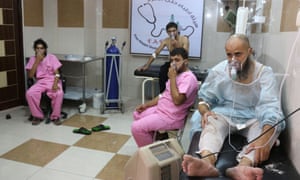
Syrians suffering from breathing difficulties are treated at a makeshift hospital in Aleppo after regime helicopters dropped barrel bombs on the rebel-held Sukkari neighborhood on Tuesday.
 Syrians suffering from breathing difficulties are treated at a makeshift hospital in Aleppo on Tuesday. Photograph: Thaer Mohammed/AFP/Getty Images

Syrian activists and rescue workers in the rebel-held part of the contested city of Aleppo said that government warplanes dropped suspected chlorine bombs on Tuesday on a crowded neighborhood, injuring dozens.
The report could not be independently verified and it was not clear how it was determined that chlorine gas was released.
Accusations involving use of chlorine and other poisonous gases are not uncommon in Syria’s civil war, and both sides have denied using them while blaming the other for using it as a weapon of war. Last month, there were at least two reports of suspected chlorine attacks in Aleppo, while the Syrian government also blamed the opposition for using the gas.
In Tuesday’s attack, a medical report from one of the hospitals in the besieged eastern rebel-held part of Aleppo was shared with journalists via text messages. It said at least 71 people, including 37 children and 10 women, were treated for breathing difficulties, dry cough, and that their clothes smelled of chlorine. The report said 10 of the patients were in critical care, including a pregnant woman.
Ibrahem Alhaj, a member of the Syria Civil Defense first responders’ team, said he got to the scene in the crowded al-Sukkari neighborhood shortly after a helicopter dropped barrels containing what he said were four chlorine cylinders. He said he himself had difficulty breathing and used a mask soaked in salt water to prevent irritation.
At least 80 civilians were taken to hospitals and treated for breathing difficulties, he said. A video by the rescuers shows children crying and men coughing.
“Most of those injured where women and children,” he told the Associated Press in a telephone interview. “It is a crowded neighborhood.”
The head of the Britain-based Syrian Observatory for Human Rights said 70 people suffered from breathing difficulties after a barrel bomb attack in al-Sukkari on Tuesday. The Observatory’s chief, Rami Abdurrahman, said he could not ascertain if it was chlorine gas attack.
A Syrian boy suffering from breathing difficulties is treated at a makeshift hospital in Aleppo.
Pinterest
 A Syrian boy suffering from breathing difficulties is treated at a makeshift hospital in Aleppo. Photograph: Thaer Mohammed/AFP/Getty Images
Chlorine gas is a crude weapon that can be fatal in high concentrations. In lower doses, it can damage lungs or cause severe breathing difficulties and other symptoms, including vomiting and nausea.
A team of international inspectors determined in late August that the Syrian government and Islamic State militants were responsible for chemical attacks carried out in 2014 and 2015. But the UN security council failed to agree on whether to impose sanctions on the government in line with a September 2013 resolution authorizing sanctions that can be militarily enforced for any use of chemical weapons in Syria.
The resolution followed Syria’s approval of a Russian proposal to relinquish its chemical weapons stockpile and join the Chemical Weapons Convention. That averted a US military strike in response to an alleged chemical weapons attack that killed hundreds in the Damascus suburb of Ghouta.
Russia, a close Syrian government ally, has blocked sanctions against President Bashar Assad’s government.
Fighting in the deeply contested city of Aleppo has not let up despite international efforts to establish a ceasefire. On Sunday, Syrian pro-government forces backed by airstrikes launched a wide offensive in the city, capturing areas they lost last month and besieging rebel-held neighborhoods once more after a breach in the siege a month earlier.
On Tuesday, a Turkish spokesman said Turkey was pushing for a ceasefire in Aleppo that would extend through the Muslim religious holiday of Eid al-Adha, due to begin on Monday. Spokesman Ibrahim Kalin said President Recep Tayyip Erdoğan spoke to his US and Russian counterparts during the G20 meeting in China about the ceasefire. Kalin told private broadcaster NTV on Tuesday that the initial plan was for a 48-hour ceasefire.
Erdoğan also repeated calls for a safe zone to be established between the Syrian towns of Azaz and Jarablus in Aleppo province, to protect civilians. Turkey has pushed for a safe zone in Syria since at least 2014.
Turkey sent tanks into Syria last month to support rebel forces against the Islamic State group in the town of Jarablus. It expanded its operation into nearby al-Rai over the weekend.

No to partitioning Syria

Calling for the partitioning of Syria is short-sighted and reckless.


By Marwan Bishara

Link

It's terribly annoying - not to say revolting - to read Western "experts" as they present a division of Syria as the "best", "most logical", or even "the only" solution to the civil war there.
I remember a few years ago when an academic drew a straight line through the map of Syria on CNN and, along with the host, agreed to partition the country. OK, so the guy had actually been to Syria - perhaps he felt somehow entitled to an opinion on the matter.
But what about those who've never even been to Syria and yet are so eager to prescribe partition of the country? No longer along one straight line but more along the lines of a Swiss cheese carving.
Syrian government blamed for Aleppo chemical attack
The problem with their thesis is not that partition in principle is blasphemous, unthinkable or improbable. It's rather how they're so blase about the unity or division of other nations, and who is best served by such analysis.
You may or may not have noticed, but the pomposity about Syria's future comes primarily from present or past seats of empire, whether it's Washington, New York, London, Paris or Moscow. Even non-Westerners get to feel imperial as soon as they teach, write or even reside in Western capitals, alas.
You just don't hear the same type of bombast about the casual partitioning of other states coming from Jakarta, Delhi or Brasilia.
A hundred years have passed since the original sin of partitioning the Middle East was imposed from outside the region, and there's no relief in sight. It seems the solution to bad partition is another partition. If partition doesn't work, more partition will.
Dividing Syria along ethnic and religious lines will create more - not less - conflict and violence.

I have some news for those analysts: Syria is not the Balkans; and the Middle East is not Europe. That's not to say that the partition of the former Yugoslavia is ideal. Without the European Union, time will prove it's anything but.
That's why dividing Syria along ethnic and religious lines will create more - not less - conflict and violence. 
Treating Syria or Iraq, Libya, Yemen and other troubled Arab nations like the former Yugoslavia (which was divided into seven states) will produce dozens more fragile conflicting mini-states. 
But even that isn't really my main point.
Of grave importance here is the fact that it's the Syrian regime (and ISIL) that's busy reshaping and dividing the country through bloodshed and ethnic cleaning along sectarian or/and defensible lines.
In fact, it's been going on for at least two to three years with the help of Iran and Hezbollah, and it will continue to go on for several more years if the Assad regime has its way. Even the last few ceasefire agreements have led to a degree of ethnic cleansing in places where the regime agreed to cease hostility.
In other words, what these brilliant experts are doing is rationalising through words what Bashar al-Assad and ISIL are doing through violence; hardly the role of an academic or a journalist.
The alternative to the failed imperial policies in Syria cannot and should not be its division. The larger coalition of Syrian opposition groups remain united and committed to a united Syria, as it must.
Marwan Bishara is the senior political analyst at Al Jazeera. Follow him on Facebook.

Current Al-Jazeera (Arabic) Online Poll


Do you support Bashar Assad staying as president during a transition period but leaving afterwards?

So far 85% have voted no.

Emad Hajjaj's Cartoon الجيش العراقي والميليشيات !

الجيش العراقي والميليشيات !

Tuesday, September 6, 2016

الاتجاه المعاكس- مقاومة وممانعة ضد إسرائيل أم لحسابها؟

عن وهم مواجهة إيران بإسرائيل

AN EXCELLENT ANALYSIS

مروان قبلان

عن وهم مواجهة إيران بإسرائيل
Link

من بين جملة تحديّاتٍ كبرى، يواجهها المشرق العربي اليوم، ثمّة مشروعان "إحلاليان"، يوشكان أن يفتكا ببنيانه، الأول (ايران) فرضته الجغرافيا، وهو ذو طبيعة إمبراطورية تبشيرية، تقوم على رفض "الآخر العربي"، تفكيكه والحلول محله، ليس بالمعنى المادي، إنما عبر تحويله ثقافياً ومذهبياً وحضارياً. والثاني (إسرائيل) متصل بمزاعم تاريخية في الأرض العربية، وهو ذو طبيعة كولونيالية، إحلالية، تقوم أيضاً على نفي "الآخر العربي"، إنما بالمعنى المادي (أي طرده واستيطان أرضه).
وعلى الرغم من نشوء إجماع عربي مطلق على رفض إسرائيل (الكيان الغريب المصطنع الذي جاء حلاً لمشكلة أوروبا اليهودية على حساب الشعب العربي الفلسطيني)، وعلى الرغم من إدراك الفرق بينها وبين إيران باعتبارها دولة "جارة"، وتمثل جزءاً "أصيلاً" من تاريخ المنطقة وجغرافيتها، إلا أن تفاوتاً في تقدير إلحاح الخطر ومداهمته ظهر بين دول المشرق العربي، خصوصاً مع خروج بريطانيا من سواحل الخليج العربي عام 1971، فدول الخليج العربية، وبسبب قربها الجغرافي من إيران، وصغر حجمها (أو) ومحدودية مواردها البشرية، فضلاً عن وجود مطامع إيرانية في أراضيها، رأت في إيران خطراً لم تشاطرها إياه بقية دول المشرق العربية (ما كان يعرف بدول الطوق خصوصاً) التي كانت أقرب جغرافيا إلى إسرائيل وأكثر إحساساً بخطرها.
ويمكن القول، أيضاً، أن النظرة إلى إيران تفاوتت حتى بين دول الخليج العربية، ففي 1973مثلاً، استعان سلطان عُمان بشاه إيران لقمع انتفاضة ظفار "اليسارية"، في حين مثلت السعودية، إلى جانب إيران، الضلع الآخر في الاستراتيجية الأميركية لضمان أمن الخليج بين 1969و1979. أما العلاقة مع إسرائيل، فقد اتسمت بحالةٍ مستقرة من العداء، ولم يكن أحد ليجرؤ على طرح فكرة التطبيع معها، حتى بعد أن قرّرت أكبر دولة عربية خلاف ذلك. وفي مؤتمر قمة بغداد عام 1978، صوّتت جميع دول الخليج العربية، باستثناء عُمان، على قرار طرد مصر من جامعة الدول العربية عقاباً لها على عقد صلح منفرد مع إسرائيل. صحيح أن العلاقات الخليجية -الإيرانية "غاصت" في حالةٍ من العداء غير المسبوق بعد 1979، نتيجة ميل إيران إلى تصدير ثورتها وسعيها إلى إطاحة الأنظمة الحليفة للغرب في الخليج، إلا أن التفكير بإسرائيل "حليفاً" في مواجهة إيران كان خارج حدود التصور. كما كان وجود العراق والتحالف الأمني مع واشنطن كفيلين باحتواء أي نزعاتٍ توسعيّة إيرانية. لكن هذا الأمر أخذ يتغيّر في الآونة الأخيرة، إذ بدأت تعلو أصواتٌ في الخليج وبين "حمقى"، لا يمثلون سوى أنفسهم في المعارضة السورية، تدعو إلى التطبيع مع إسرائيل لمواجهة إيران بذرائع مختلفة، منها سقوط العراق في الحضن الإيراني، وتخفف واشنطن من التزاماتها الأمنية تجاه المنطقة، وارتفاع منسوب الخطر الإيراني من اليمن إلى سورية.

المشكلة في هذا اللامنطق أنه معطوبٌ أخلاقياً وساذج سياسياً. أخلاقياً، يقتضي هذا التحول التخلي عن فلسطين والاعتراف بما قامت وتقوم به إسرائيل من ممارساتٍ ضد الشعب الفلسطيني ثمناً للحصول على "دعمها" في مواجهة إيران.
سياسياً، يفترض هذا التحول وجود تناقضٍ جوهري بين المشروعين الإيراني والإسرائيلي، وهو أمر، إذا استثنينا الخطاب العدائي، يفتقر إلى وقائع تؤيده. واقع الحال أن إسرائيل سوف تستخدم حالة الذعر السائدة في المشرق العربي تجاه إيران للحصول على اعتراف وتطبيع معها، وحتى تأييد سياساتها، في مقابل مزيد من التهديدات الجوفاء ضد إيران. فوق ذلك، سوف ترسو العلاقات الإيرانية – الإسرائيلية، على الأرجح، على حالة من تقاسم النفوذ، وليس المواجهة والصراع، كما يظن بعضهم. وسيكون هذا التقاسم على حساب العرب ومن جيبهم. ويكفي الاستدلال على ذلك بالسؤال عن عدد الإسرائيليين الذين سقطوا في معارك إيران اللفظية ضدها منذ ثورة 1979، بما فيها تهديدات أحمدي نجاد بإزالة إسرائيل من الوجود، وكذلك عن عدد الايرانيين الذين سقطوا بنيران التهديدات الإسرائيلية الفارغة ضد برنامج إيران النووي. في المقابل، يمكن بالتأكيد إحصاء آلاف، بل مئات الآلاف من العرب الذين سقطوا على يد إيران وإسرائيل على امتداد المشرق العربي، من فلسطين إلى سورية والعراق وغيرهما. على هذه الحقيقة، يجب أن يصحو كل دعاة التطبيع وباعة أوهام الاستعانة بإسرائيل لمواجهة إيران.

DNA - 06/09/2016 نصرالله: الدولة الإيرانية تكذِّب خامنئي

"تعفيش" داريا


"تعفيش" داريا

الصلاة بين الركام، لم تكن أكثر من رسالة عن هوية الحكام الجدد للمنطقة (انترنت)
Link

ما أن تمت عملية اخلاء داريا، وغادر آخر أهلها مدينتهم، حتى دخلتها مختلف مليشيات النظام لتسجيل "الانتصار" والتقاط الصور التذكارية. زيارة الأمين العام لـ"لواء الإمام الحسين" الشيعي العراقي، أمجد البهادلي الملقب بـ"أبو كرار"، لتفقد مقام مزعوم لـ"السيدة سكينة" والصلاة بين الركام، لم تكن أكثر من رسالة عن هوية الحكام الجدد للمنطقة.

المدينة فُتحت لكل من يريد أن يسرق، "يعفّش"، وسرعان ما امتلأت أسواق صحنايا والمزة 86 ومنطقة دويلعة والكباس بالأثاث المنزلي المنهوب والمعروض للبيع بأرخص الأسعار. الأمر الذي أثار غضب حتى صحافيين مواليين، صوّروا عمليات التعفيش والأسواق التي تُباع فيها البضائع، مطالبين بمحاسبة الفاعلين ووقف هذه الظاهرة التي "تُسيء لأرواح الذين استشهدوا لتحرير داريا"، بحسب وصفهم.

وعلى الرغم من استباحة المدينة و"تعفيش" كل ما فيها، منعت "الفرقة الرابعة" إخراج أي شيء يتعلق بالأنقاض والحديد. و"الفرقة الرابعة" التي يقودها ماهر الأسد، باتت مسؤولة عن مداخل المدينة بشكل كامل؛ وأبقت على "تجارة" الحديد والأنقاض حكراً على تجار يتبعون لرجل أعمال النظام محمد حمشو، والذي "سيساهم" في "إعادة إعمار المنطقة"، بحسب مصادر خاصة لـ"المدن".

كما مَنعت "الفرقة الرابعة" النازحين السابقين من أهل المدينة والمقيمين في مناطق سيطرة النظام، من العودة إلى منازلهم. وجرت مشاجرات بين عناصر من "الفرقة الرابعة" وآخرين تابعين لـ"المخابرات الجوية" و"الأمن العسكري"، بعد محاولة ادخال مدنيين إلى منازلهم، لقاء مبالغ مالية. المشاجرات تطورت إلى استخدام الأسلحة، قبل أن تتم معالجة الأمور من قيادة "الفرقة الرابعة".

أحد نازحي داريا، تمكن من الدخول إلى منزله ومنازل جيرانه، بعد وساطة من أحد عناصر "الفرقة الرابعة" ودفعه رشوة بمقدار 50 ألف ليرة سورية، روى لـ"المدن" تفاصيل رحلته إلى مدينته المدمرة. زيارة استمرت ساعتين، كانت كافية لرصد عمليات التخريب المتعمد؛فالقوات المسؤولة عن تمشيط داريا، والتابعة لـ"الحرس الجمهوري"، قامت بتدمير الأثاث الذي لم تتمكن المليشيات من تعفيشه. النازح وصف تخريب منزله الذي طال حتى الأبواب والنوافذ، والأثاث الذي تمّ تحطيمه بعد العجز عن حمله، حتى بلاط الأرضيات تمّ اقتلاعه وتكسير ما علق منه.

مصادر "المدن"، أكدت مقتل عدد من عناصر المليشيات الموالية، التي دخلت المدينة، إثر انفجار ألغام أرضية كانت المعارضة قد زرعتها أثناء المعارك وقبل انسحابها. وانقلبت سيارة شحن كانت تنقل الأثاث المسروق، وقتل اثنان من قوات النظام داخلها، بعد انفجار لغم أرضي فيها. كما قُتل ثلاثة عناصر في إحدى الطرق الزراعية بلغم أرضي أيضاً. وفي صحنايا انفجرت عبوة كانت مزروعة في براد سرقته المليشيات، وتسببت في قتل شخصين.

مصادر "المدن" أشارت إلى أن نقيباً من مرتبات "الفرقة الرابعة" يُدعى عروة، والمقرب من ماهر الأسد، أصبح المسؤول الأول عن أمن داريا ومداخلها، لما له من سجل حافل في "تعفيش" المليحة وبلدات ريف دمشق الجنوبي. ويقوم عروة بالترتيب مع التجار الذين يُحمّلون الحديد والأنقاض من المدينة، بواسطة سيارات شحن تمت مصادرتها عن طريق صحنايا-دمشق بشكل تعسفي، للقيام بعمليات النقل إلى مناطق التجميع، ليعاد تدوير الحديد والأنقاض، في معامل خاصة تُنتج مواد البناء.

إسرائيل تكشف: 1600 قتيل لحزب الله في سوريا

THE MORE, THE BETTER.....

عناصر من حزب الله يحملون نعش أحد قادتهم العسكريين الذي قتل في معركة داخل سوريا (رويترز)
Link

قال رئيس لجنة الخارجية والأمن التابعة للكنيست الإسرائيلي (البرلمان) إن حزب الله خسر في سوريا 1600 من مقاتليه، فيما أصيب ما بين خمسة وستة آلاف عنصر بجروح.
 
وأضاف آفي ديختر في مقال بموقع "أن آر جي" الإلكتروني أن ذلك يعني أن عدد قتلى حزب الله في الحرب السورية يفوق عدد قتلاه في حروبه ضد إسرائيل طوال ثلاثين عاما، معتبرا ذلك أخبارا إيجابية لإسرائيل.

وأفاد ديختر -بأن 
إسرائيل باتت ترى في سوريا ساحة تدريب قتالية للمنظمات المعادية رغم أن حزب اللهالشيعي فقد كثيرا من مقاتليه هناك.
وأضاف أن سوريا انزلقت إلى حالة من الحرب التي لا يبدو أنها في طريقها إلى الحل قريبا، وقد أنهت خمس سنوات من القتال المتواصل.
واستدرك قائلا إنه رغم كل ذلك فقد ظلت إسرائيل عند موقفها المحايد، وحافظت على أمنها في هضبة الجولان التي تفصل بين الدولتين، وفي بعض الأحيان نفذت بعض الهجمات الجوية داخل الأراضي السورية أو ردت على بعض قذائف الهاون التي تسقط داخل حدودها.
وأوضح ديختر -الذي سبق أن ترأس جهاز الأمن الإسرائيلي العام (الشاباك) وتولى حقيبة الأمن الداخلي- أنه في ظل القصف الجوي الذي تشنه روسيا ضد أهداف في سوريا انطلاقا من قواعد عسكرية داخل إيران، وتدخل تركيا في هجمات برية ضد تنظيم الدولة الإسلامية في العراقوسوريا فإن كبار المسؤولين في إسرائيل باتوا يعتقدون أننا أمام صراع ليس في طريقه للحل قريبا.
ويدور في إسرائيل حاليا نقاش بشأن ما إذا كان العالم إزاء صراع سوري لا يزال في بدايته أم شارف على الانتهاء.
ووصف ديختر في مقاله ما يحصل في المنطقة من تطورات ميدانية بأنه يشبه هزة أرضية بقياس تسع درجات على سلم ريختر.
واستطرد قائلا إن "فلتان" كلمة مقبولة نسبيا في إسرائيل قياسا بما هو حاصل في سوريا، ذلك أن ما يحدث هناك أكثر من فوضى عارمة.
فالفلتان الأمني -بنظر الكاتب- يمكن أن يستقر أخيرا، لكن الفوضى العارمة لا يعلم أحد نهايتها، "لأن الحرب الدائرة في سوريا والتي اندلعت في 2011 قسمت سوريا إلى عدة مناطق تسيطر عليها الحكومة وأخرى خاضعة للفصائل المسلحة، سواء كانت كردية أو إسلامية أو مليشيات متعددة".
وأكد أن ما يحصل في سوريا ربما يكون أخبارا جيدة لإسرائيل، إذ يعتبر تطورا إيجابيا يمكن من خلاله إعادة تصميم خريطة الشرق الأوسط بعد مرور مئة عام على ترسيم بريطانيا وفرنسالحدود المنطقة.
واعتبر الكاتب أن إعادة رسم خريطة المنطقة تمثل فرصة سانحة لإضعاف أعداء إسرائيل "وقد بتنا في وضع يتم فيه تقسيم المقسم، وهو ما يعني تخفيف التهديد الأمني لإسرائيل".
وختم آفي ديختر بأن حزب الله خسر في سوريا 1600 من مقاتليه، فيما أصيب ما بين خمسة وستة آلاف عنصر بجروح، وهو ما يعني أن عدد قتلاه في الحرب السورية يفوق عدد أولئك الذين قتلوا في حروبه ضد إسرائيل طوال ثلاثين عاما، معتبرا ذلك أخبارا إيجابية لها.

PARTNERS IN CRIME

Monday, September 5, 2016

في العمق-ما هي رؤية المعارضة السورية للانتقال السياسي؟

DNA - 05/09/2016 نصرالله: ما في شي بطرابلس

Meet the Banksy of Syria

As the Syrian Army takes control of Daraya, the work of a mysterious graffiti artist stands as testament to the rebels' spirit
The "Hope" mural of August 2014 was the first of al-Shami's works to bring him acclaim outside Daraya (MEE/Majd el-Maaddamani)
Link

DARAYA, Syria - Leaning into a slab of roof hanging precariously over one of Daraya’s many shattered streets, Abu Malek al-Shami worked furiously through the night. He strained his eyes against the shadows: the full moon was just bright enough to illuminate the tip of his brush, while just dark enough to obscure his skinny figure from the snipers training their gaze on the streets behind him.
As the early morning light crept across the bombed-out skyline, people woke to the sight of a new piece of street art overlooking the promenade. They excitedly gathered around it, whispering and laughing, amused by the depiction of a massive rifle aiming at a camera, a red “VS” hanging between them. The mysterious street artist had come and gone with the night.
Over the past three years, Shami’s canvas has been the besieged rebel city of Daraya. Splashed across the fields of destruction, a cityscape laid waste by four years of relentless bombing, are 32 of his murals. They crop up randomly, like wildflowers, adorning the ruins of what once were homes, schools and hospitals. 
But with the Syrian Army assuming control of the battered enclave, the fate of the work that has helped inspire the city’s remarkable four-year-old resistance is now in question. As one of about 1,000 rebel fighters who will be transported to Idlib, Shami faces an equally uncertain future.
Despite the public profile of his revolutionary murals, the 22-year-old’s true identity has remained a mystery - even to most of this close-knit community of rebels and activists. Shami is the pseudonym he uses to protect those friends and family who are living under government control. He has taken to signing his paintings with the simple, collective “Daraya”.
On the walls of schools and family homes, Abu Malek al-Shami's work highlights the surreal absence of life that once took place there (MEE/Majd el-Maaddamani)
“I was initially doing this work in secret,” he explains. “But people loved it when the work started appearing around town. They really encouraged me and began giving me suggestions on where and what to paint. One man asked if I could draw something on the wall of his destroyed house, but a few days later a barrel bomb fell and crushed the remainder of it.”
It was back in January 2013 that Shami left his home and struck out from the city towards the sounds of shelling that had rolled like thunder over the hills from Daraya since the FSA took up positions there a few months earlier. As part of a large family of political activists, Shami had begun marching in demonstrations in Damascus two years earlier, while still a high school student. But the government’s continuously heavy-handed and bloody response towards the civilian demonstrators convinced him that protests alone were not enough to prevail and he left to seek training with the FSA. 

Defiant spirit

In his backpack, he carried a change of clothes, a book of Arabic poetry, the Quran, a copy of Victor Hugo’s revolutionary epic Les Miserables, his sketchbook and some pencils. While he lacked a formal artistic background, he had been outlining graffiti and simple illustrations to support the democratic goals professed by the uprising. “When I arrived, the fighters initially laughed at my sketchbook and asked me, ‘What are you planning to do with that?’ At the time, I just thought it would keep me sane.”
After six months, Shami began quietly sketching on the walls in the areas he was patrolling for the FSA. These anonymous works soon captured the imagination of the locals, who were inspired by the art’s defiant spirit - an entertaining distraction from their lives under siege. Members of the Local Council of Daraya were swift to recognise the value of Shami’s murals and encouraged him. One member in particular, Majd el-Maaddamani, began to photograph the work and post it on the council’s Facebook page.
The murals span a range of political topics, invoking the hopes, fears, and dark humour born of years living under siege. Strategically angled so as to be seen from both “above and below”, the work is directed at the people of Daraya but also the world beyond its walls. Motivated by a deep commitment to the principles of democratic governance and pluralism that launched the Syrian uprising of March 2011, his work has stood as evidence of Daraya’s resistance while also being a cry for help.
In the light of the rebel defeat in this Damascus suburb, his message to the Syrian opposition has taken on a more urgent and dire dimension.
“There was a danger of people forgetting,” says Shami. “Forgetting about the struggle and forgetting the values that brought us here. There was a need to remind people exactly what they were fighting for, what this revolution meant.”
The “Hope” mural of August 2014 was the first of his works to reach an audience outside of Daraya. That image portrayed a young girl standing over a mound of helmet-clad skulls: a promise of future beauty that shines through the pain of the present. The photos soon beamed over television channels and streamed through Facebook feeds across the Arab world, launching Shami to newfound stardom among a community of rebels in need of encouragement.
Some pieces poke a finger in the eye of Bashar al-Assad, casting him and his advisors as Pinky and the Brain, the mismatched, genetically enhanced lab mice from the American television series, futilely plotting ways to breach the walls of the rebelling enclave during the four-year siege. Other murals, on the sides of ravaged homes and schools, poignantly depict the lives that used to be lived there before the conflict.
UN staff visiting Daraya during April's brief ceasefire estimated that 80-90 percent of the city had been destroyed (MEE/Majd el-Maaddamani)
Shami had no shortfall of suitable canvases. UN staff visiting Daraya in April estimated that approximately 80-90 percent of the city’s infrastructure had been destroyed by a combination of prolonged artillery fire, barrel bombs, and the tsunami of Russian shelling that began with the military intervention last September.

Breaking the resistance

It is not hard to see why the government prioritised breaking the resistance here. Until last week, Daraya stood alone as the last secular rebel stronghold in Syria, which residents and fighters proudly declared free of militants. With its democratic culture of local councils, communal farming arrangements, and fierce, grassroots resistance movements, the suburb was romantically called the “Idol of the Revolution” by opposition supporters.
The Assad government, however, has ruthlessly pursued a strategy of eliminating credible rivals that could join it at a future negotiating table, reducing the war to a brutal choice between dictatorship and bloodthirsty militants. Daraya was as a lingering obstacle to that goal, clinging on in a state of a crushing siege since early 2014.
With all access to the outside world cut off, supplies of food, medicine, and other essentials dipped to perilously low levels. The siege also limited the materials available to Shami, forcing him to unearth what he could from the crushed avenues of abandoned shops.
“There was a big store of paint, but the owner was out of Daraya,” he says. “I called and took his permission to use his paint. After two years of constant work, I have run through virtually everything in the storehouse.”
He counts on his fingers the colours that he had been reduced to working with: “Red, a little bit of black, pistachio green, shiny yellow, and brown. I now have to create murals that fit these colours.”
But in recent months, the Syrian government, backed by the firepower of Russian air support, seized the vast majority of farmland around Daraya that was critical to staving off mass starvation during the siege. Surrender followed.
Now, in the wake of the ultimate defeat of the rebellion in Daraya, the future of its fighters and inhabitants is hard to predict. Shami and his fellow rebels have begun the hard task of disengaging and making the long journey to Idlib.
However, their struggle to spread the values of freedom and democracy has been immortalised in Daraya’s remarkable four-year-old resistance. Shami hopes his murals can educate Syrians about what they are capable of and will stand as a testament to the self-determination that initially inspired Shami to leave his home for a life of struggle.
“When we started this uprising, it was for freedom and dignity,” he says. “We never wanted a fight. The need to carry a weapon was thrust upon us by the regime. I want to show that there are many like us left in Syria, whose goals are pure and who continue to fight for those same values the uprising started with.”