The White House worked behind the scenes last week to prevent a bipartisan bill to sanction the Assad regime for war crimes and atrocities against civilians from getting a vote in the House of Representatives. The Democratic leadership bowed to White House pressure and withdrew its support for voting on the bill for now.
Lawmakers and congressional staff had been preparing to bring up theCaesar Syria Civilian Protection Act this week and pass it out of the House with relative ease. The bill, named after a Syrian defector who presented the world with 55,000 pictures documenting Assad’s mass torture and murder of civilians in custody, has more than 50 co-sponsors, a majority of whom are Democrats.
Rep. Eliot Engel (D-N.Y.), the ranking Democrat on the House Foreign Affairs Committee, was the primary author of the bill, along with his committee counterpart Ed Royce (R-Calif.). Even liberal Democrats like Rep. Jan Schakowsky (D-Ill.) had signed on. But late Friday afternoon, just before the legislative calendar for the following week was to be released, White House legislative affairs staffers began calling leadership in both parties urging them to shelve the legislation.
The office of House Speaker Paul Ryan (R-Wis.) told me that the White House pressured House Democratic leadership to pull their support for moving the bill, and Democrats obliged.
“After President Obama’s disastrous handling of Syria, he’s now adding insult to injury by pressuring House Democrats to kill a bipartisan bill aimed at cleaning up his mess,” said Ryan’s press secretary, AshLee Strong. “We hope members will have a chance to vote on this important legislation soon.”
The bill would impose new sanctions on the Assad regime and its supporters, spur investigations meant to fuel the prosecution of war crimes in Syria, and encourage a process to find a negotiated solution to the crisis. Specifically, it would require the president to impose new sanctions on any entity that does business with or finances the Syrian government or its military or intelligence services, which includes Russia and Iran. It would also require sanctions on any entity that does business with several Syrian government-controlled industries, including the airline, telecommunications and energy sectors.
There had been an agreement between Republicans and Democrats to bring the bill to the House floor this week under a suspension of the rules, which provides for a streamlined process but also requires two-thirds support to pass. Once Democratic leadership went back on that agreement, the obstacles to passing it increased immensely. Royce, whose committee approved the bill in July, also put the blame on the Obama administration.
“I’m dismayed that the administration seems to be throwing up roadblocks to our bipartisan effort to cut off the resources Assad uses to annihilate his own people, and I will continue working to find a path forward for this important legislation,” he said.
An administration source told me that it’s normal for the White House to be in touch with congressional officials in both parties on any piece of legislation. The administration source said House Democrats opted not to move forward with this legislation on their own volition.
Several congressional officials disputed that assertion, saying that the administration argued that if Congress even voted on the Syrian sanctions bill, that could negatively affect the delicate cessation of hostilities that Secretary of State John Kerry negotiated with Russia.
“It was the desire of the National Security Council that this bill not move,” one senior congressional staffer who received a call told me. “White House legislative affairs staff said the timing was not good.”
Engel, in a statement, said that he agreed with the White House that a delay was appropriate and that although he was skeptical about the cease-fire, it should be given a chance to succeed. But he promised to work to ensure that, sooner or later, the sanctions bill will get a vote in the House.
“At the end of last week, the implementation of the cessation of hostilities in Syria was just beginning. It would have been short-sighted — even irresponsible — for the House to proceed with the consideration of the Caesar Syrian Civilian Protection Act as if nothing had changed,” he said. “That said, things can change quickly, and if they do, Congress should act quickly … If that happens, I will work day and night to move this bill through the House.”
Engel and the administration don’t agree on Syria policy. Engel has been a strong supporter of a no-fly zone to protect civilians and more robust support for the armed Syrian opposition. But Engel worked with the administration when crafting the bill in an effort to get the administration to buy in and prevent the White House from opposing the legislation.
Some of the congressional officials who worked on the bill believe the administration is intentionally trying to delay it because the White House opposes placing strong pressure on Syrian President Bashar al-Assad. Evan McMullin worked on the bill when he was policy director for Royce and then for the House Republican Conference. Now he is running as anindependent candidate for president.
“In 2014, the administration fought hard to prevent Caesar from testifying to Congress and the public of Assad’s crimes, all in the name of security,” he told me. “Now they’ve mobilized similarly against the sanctions bill, which is the very thing needed to help compel Assad to stop killing.”
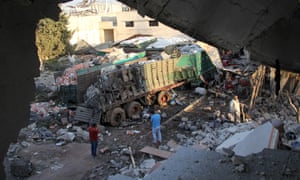
Syrian Civil Defence footage shows the immediate aftermath of an airstrike on a convoy of Red Cross and Syrian Red Crescent vehicles carrying aid destined for the town Urem al-Kubra, near Aleppo. At least 20 people were killed. An unidentified volunteer blames Russia and the Assad regime for the attack. The US has blamed Russia for the strike
Marwan Bishara is the senior political analyst at Al Jazeera.
It's like David Beckham meets Luis Suarez. Out of all the speakers and their litanies at the United Nations, US President Barack Obama and Turkish President Recep Tayyip Erdogan stood out with their contrasted worldviews, styles and perspectives.
Obama - like Beckham - sounded more like a brand than a political player. He's preoccupied with his legacy and far more interested in looking good than in scoring points. He's above the fray, tired of all the tackling and kicking and just wants everyone to get along.
So, in his last speech to the UN, the US president spoke in historic rather than political terms, lecturing the world body about the blessings of free trade, technology and globalisation, while warning against "aggressive nationalism" and "crude populism".
Syria war key concern at UN General Assembly
If there was no place for the Middle East tragedies in Obama's panorama, the in-your-face Turkish president made the Syria, Iraqi and Palestinian tragedies central to his speech.
Erdogan's was an outright diplomatic offensive; he scored points against the hypocrisy of the West and the negligence of the rest at the UN Security Council.
Since the failed military coup against his government, he's clearly in no mood to play with those ignoring the plight of those in the Middle East and seems ready to bite off the heads of those messing with Turkey.
Different perspectives
Obama and Erdogan presented different perspectives, but weren't necessarily playing for opposite teams. It is the sobering glass-half-empty argument completing the glass-half-full picture.
And yet, seen from the Middle East, and indeed from the rest of the world, Obama's claim that the world is in far better shape today than during the 20th century's world wars, while not incorrect, smacks of sloppiness and indifference.
United States President Barack Obama addresses the 71st session of the UNGA [AP]
He knows better than most that even in the US, his promise to bridge the gap between blacks and whites, red states and blue states, and pull the US out of Iraq and Afghanistan have led to more - not less - racial and ideological tensions.
And he has expanded the landscape of military conflict, albeit with less US troops on the ground in the Middle East.
He spoke of accountability, but not a single banker or politician was held accountable for the financial crisis and the illegal war in Iraq during his tenure.
In comparison to 20, 15, 10 and even five years ago, the world continues to heat up, and it's not just global warming. Despite much progress over the past half-a-century, the international political pressure cooker is gathering steam and there's no cooling down.
Conflict and bloodshed
I've witnessed this first hand over the past few years, travelling through different continents, countries and communities. I spoke to countless people but found little optimism and much scepticism about the future.
Despite much progress over the past half-a-century, the international political pressure cooker is gathering steam and there's no cooling down.
The enthusiasm that followed WWII, the liberation from colonialism, the end of the Cold War, the expansion of democracy and the various popular upheavals in Asia, Africa, Latin America and the Middle East have diminished if not vanished altogether.
It's a big mess out there; loss of compass, absence of leadership and little or nothing to believe in. To quote the eminent Irish poet, WB Yates: The best lack all conviction, while the worst are full of passionate intensity.
All of which begs the question: What's next for a world in trouble? Because it feels like the rise of "aggressive nationalism" in the beginning of the 21st century is looking more and more like that of the early 20th century - the same century that gave us some of history's worst atrocities from world wars to colonial wars.
After half a century of change
The establishment of the United Nations and the creation and independence of new states that make up the majority of today's UN was supposed to usher in a more humane and equitable phase in human development.
But the Cold War between the Soviet Union and the United States brought us nuclear proliferation, proxy wars and the clash of ideologies that exerted a huge cost on human development.
The end of that hot Cold War should have been another cause of celebration as numerous states were freed from the tyranny of dictatorships and war.
But the wars in the Middle East, the Balkans, Somalia, Angola, and Rwanda cast much pessimism as "never again" was repeated again and again, not in Germany but throughout the world, especially in Syria, Iraq and the greater Middle East, where millions of civilians died in the process.
And yet, people looked forward to the expansion of democracies and human rights in their societies. Eastern Europe was freed from Soviet totalitarianism and client regimes; Latin America freed itself from US domination and client autocrats; and Africa began to find its way to representative government. Even the Arab world followed suit in 2011.
Turkish President Recep Tayyip Erdogan addresses the UNGA in New York, US [REUTERS]
But as ideologies like communism, which inspired people, failed to meet the challenges and peoples' needs in the 20th century, the triumphant Western liberalism opened the 21st century with horrific wars and a global financial crisis. Throughout Europe and the United States, inequality has skyrocketed, middle classes are suffering and racism is mounting.
After a decade of failures
The past few years have witnessed the retreat of democracy, return of autocracy and the rise of popular nationalism. To paraphrase the words of the UN general secretary, citizens distrust their leaders in a world of "us vs them".
You might say there's nothing new here; it's always been like that. But there was always a vision of sorts; a way forward, a promise of better things to come; but not this day.
Countries big and small seem to embrace, coercively or willingly, demagogic populism and nationalistic autocrats. From the rise of Russia's Vladimir Putin through the ascendance of China's Xi Jinping, the election of India's Narendra Modi, and even the Philippines' Rodrigo Duarte.
Unfortunately, the Russian and Chinese alternatives to US leadership (imperial or otherwise) are lacking at best, and at times scary.
In Latin America, leftist leaders have failed to meet peoples' expectations. The Bolivarian revolution is on its knees in much of Central America as Brazil, Argentina and other Latin American nations suffer from corruption and misrepresentation.
Western Europe and the US aren't spared by the waves of nationalist populism as the radical right continues to make major strides.
And these trends are not ideological with coherent worldviews; rather voiced through empty slogans and even 140-characters-or-less tweets about Islam and defeating evil (Islamists, immigrants, and minorities) that are bent on ruining the glorious (Christian) Western civilisation.
The alternatives
It must be said, love him or hate him, we will miss Obama once his successor takes over in a few months, just as Erdogan would've been missed if he was removed by a military coup. It's both their blessing and curse that their immediate alternatives don't look so promising.
If there's a judgement or comparison to be made, it's certainly not between Obama and Erdogan. It's rather between Erdogan and his neighbours, and between Turkey and other developing/developed nations.
It's with Egypt's Abdel Fattah el-Sisi, Syria's Bashar al-Assad, Iran's Ali Khamenei; and between Turkey and Saudi Arabia, Algeria, and Kazakhstan, Malaysia, etc.
And the comparison is between Obama and Putin, and the US and China - over who provides a better vision for the future. Unfortunately, the Russian and Chinese alternatives to US leadership (imperial or otherwise) are lacking at best, and at times scary.
There is no point in searching for - or looking up to - the "one-der" leader or visionary. Not today, not ever. Certainly not in the real world. Progress comes through collective, civilisational and generational struggle that is earned tooth and nail.
Fortunately, as the US president argued, the new generation is better than his generation. But not when it's subject to war, violence, racism and alienation. They are more likely to end up in prison or as potential recruits for criminal and violent groups than community organisers and enlightened leaders. And yet, even in times of war,= and conflict, we see countless youth sacrificing their lives and freedom for the lives and freedom of others. One such silver lining appeared in Syria's dark days in recent years, called White Helmets.
If only political leaders would rise to the level of their peoples' sacrifice; if only they would stop sacrificing people for their own personal glory, the world would be a far better place.
If only the UN secretary-general could act like a referee and start slapping down each and every one of these rogue political players with the yellow and red cards they deserve.
Marwan Bishara is the senior political analyst at Al Jazeera. Follow him on Facebook.
قال المرصد السوري لحقوق الإنسان، اليوم الأربعاء، إنه حصل على معلومات من مصادر موثوقة عدة تفيد باستقدام روسيا أكثر من 3000 عسكري للقتال إلى جانب النظام السوري، وأوضح المرصد أن هؤلاء المقاتلين يحملون الجنسية الروسية، وجرى تجنيدهم من قبل القوات الروسية التي أرسلتهم إلى سورية، إذ تم جمع العدد الأكبر منهم في منطقة السفيرة بريف حلب الجنوب شرقي.
وأضاف أن هؤلاء المقاتلين وصلوا إلى سورية خلال الأسابيع الأربعة الماضية، وجرى نقل معظمهم من قبل القوات الروسية والنظام السوري إلى منطقة السفيرة، التي يسيطر عليها الأخير، والواقعة قرب معامل الدفاع في ريف حلب الجنوب شرقي، تمهيداً لبدء إشراكهم في المعارك الدائرة في مناطق سورية عدة.
وكانت عشرات الغارات، قد استهدفت، ليلا، مدينة حلب وريفها، في شمال سورية، أسفرت إحداها عن مقتل اربعة عاملين طبيين، بعد يومين من انهيار الهدنة، وفي وقت يعرقل التوتر الروسي الأميركي الجهود المبذولة لإعادة إحياء وقف إطلاق النار.
في نيويورك، يعقد مجلس الأمن الدولي، الأربعاء، جلسة حول سورية، يشارك فيها وزيرا الخارجية الأميركي جون كيري ونظيره الروسي سيرغي لافروف، غداة اتهام واشنطن موسكو ودمشق باستهداف قافلة مساعدات إنسانية في ريف حلب الغربي.
وبعد يومين على إعلان الجيش السوري انتهاء هدنة استمرت أسبوعا في سورية، بموجب اتفاق أميركي روسي، تعرضت مناطق سورية عدة، أبرزها مدينة حلب وريفها لغارات كثيفة ليل الثلاثاء الأربعاء.
وتسببت إحدى هذه الغارات بمقتل اربعة كوادر طبية جراء استهداف نقطة طبية تابعة لمنظمة غير حكومية في بلدة خان طومان، في ريف حلب الجنوبي.
ولم يتمكن المرصد من تحديد هوية الطائرات التي نفذت هذه الغارات، وتستهدف المناطق الواقعة تحت سيطرة المعارضة في محافظة حلب غالبا بغارات من طائرات سورية أو روسية.
>> مئة غارة
وأحصى المرصد السوري "تنفيذ طائرات حربية سورية وروسية عشرات الغارات ليل الثلاثاء الأربعاء، على مدينة حلب وأطرافها الجنوبية الغربية".
وقال مراسل لفرانس برس، في الأحياء الشرقية المحاصرة من قوات النظام في مدينة حلب، إن أكثر من مئة غارة استهدفت المدينة وريفها بعد منتصف الليل حتى ساعات الفجر، الأمر الذي منع السكان من النوم نظرا لشدة القصف.
وأشار إلى أن الغارات لم تتوقف إلا بعد أن بدأ هطول المطر بغزارة صباحا.
وأدى القصف، بعد منتصف الليل، على حي السكري في شرق مدينة حلب، إلى تدمير مبنى من ستة طوابق بالكامل.
ودارت، وفق المرصد، اشتباكات عنيفة بعد منتصف الليل، بين قوات النظام وحلفائه من جهة والفصائل الإسلامية والمقاتلة من جهة أخرى جنوب غرب مدينة حلب، ترافقت مع تنفيذ طائرات حربية غارات كثيفة على مناطق الاشتباك.
وأشار المرصد إلى "تقدم لقوات النظام في المنطقة" حيث استعادت السيطرة على أبنية عدة كانت خسرتها الشهر الماضي.
>> جهود في نيويورك
في نيويورك، يعقد مجلس الأمن الدولي، الأربعاء، اجتماعا حول سورية على ضوء التصعيد الميداني الأخير.
وازداد منسوب التوتر بين الولايات المتحدة وروسيا، أمس، بعدما حملت واشنطن موسكو مسؤولية استهداف قافلة مساعدات إنسانية في بلدة أورم الكبرى، في ريف حلب الغربي ليل الإثنين، ما تسبب بمقتل "عشرين مدنيا وموظفا في الهلال الأحمر السوري".
وقال مستشار الأمن القومي الأميركي، بن رودس، الثلاثاء، "كل المعلومات المتوفرة لدينا تشير بوضوح إلى أن هذه كانت ضربة جوية"، وبالتالي فإن المسؤول عنها "لا يمكن أن يكون إلا أحد كيانين، إما النظام السوري وإما الحكومة الروسية".
A witness describes the horror of the attack on aid lorries near Aleppo, which killed 20 people and left the ceasefire agreement perilously close to collapse The Guardian
Aid strewn on the ground in the town of Orem al-Kubra on the western outskirts of Aleppo on 20 September. Photograph: Omar Haj Kadour/AFP/Getty ImagesLink
Shouting for survivors amid the flaming ruins of lorries, the aid worker was panicking. “It’s September 19 and we have just been attacked by planes,” he yelled as men called frantically for help from the darkness.
The images captured on video in the immediate aftermath of the two-hour bombardment on the aid convoy on the western outskirts of Aleppo reveal the panic of those who survived and their shock at having been targeted on an approved journey to deliver supplies as part of the ceasefire deal brokered byRussia and the US.
Among the dead was Omar Barakat, a father of nine who was the head of the Syrian Arab Red Crescent in the town of Orem al-Kubra, a man directly involved in securing permits for the mission – the first of its kind in the struggling eight-day truce. A total of 20 civilians and aid workers were killed, officials said.
Omar Barakat of the Syrian Arab Red Crescent was killed in the attack. Photograph: Facebook
Barakat’s brother Ali told Reuters that more than 20 missiles hit the area, including the one that killed his brother, who was overseeing the unloading of lorries when a bomb hit the warehouse, killing him inside his car.
“The medical team couldn’t make it there for two hours to drag him out because of how intense the bombing was,” said another Red Crescent volunteer who was familiar with the incident. “He was still alive then, but he bled to death on the way to the hospital.”
A rescue worker told Associated Press that missiles pounded the area for hours, even hitting his team as they searched the debris for survivors. Hussein Badawi, who leads the Syrian Civil Defence, also known as the White Helmets, in Orem al-Kubra, said the strikes came from helicopters and land-based missiles.
“There were fires, martyrs, wounded people. We were able to pull out four survivors and five dead bodies at first,” Badawi said. “The bombardment was continuous, continuous. The rescue teams weren’t even able to work. Those who arrived in ambulances couldn’t come in.”
Repercussions from the strike appear to have shattered any hope of the truce enduring and have again highlighted the fraught task of negotiating outcomes in Syria’s raging five-year war. They have also dragged the architects of the deal into another public standoff, withRussia and Syria both denying that their air forces were responsible.
The UN and international aid bodies reacted with fury on Tuesday,suspending all aid deliveries across Syria for three days and raising the possibility that one of the most difficult humanitarian efforts in recent decades could be derailed for longer.
Desperately needed humanitarian relief was to have been a centrepiece of trust-building efforts that had been hailed as the most important peace initiative of the five-year war. But all attempts to deliver it had been stymied in the week since the truce took hold. Monday night’s mission outside Aleppo was meant to change that.
Details of the trip had been meticulously planned in advance, and all the right clearances had been granted by Syrian regime authorities in Damascus and Aleppo. Organising a “cross-line convoy” is no easy feat in the Syrian conflict, with regime officials adamantly opposed to allowing aid into opposition-held areas.
Officials familiar with the process of delivering aid across Syria’s battle lines said requests were first lodged by the UN body OCHA to the Syrian foreign ministry one week ago. Officials had told the Guardian that approval was granted.
The request was then submitted on Monday to the governor of Aleppo and to the security committee in Aleppo, which includes representatives from all the security agencies, the National Defence Front (a pro-regime home guard) and the Ba’ath party. Both the security committee and the governor gave their approval, which allowed the convoy to go ahead.
The application included the names of the organisations involved in the convoy, the planned route and the point at which the convoy would cross the frontline. The amount and type of aid and the point of distribution were also itemised. Before the 31-lorry convoy departed in late afternoon, the number of people travelling with it was also passed on, as were GPS coordinates of the route and destination.
A senior UN official familiar with the steps needed to get previous convoys moving said: “Loading starts in UN warehouses. Normally the Syrian army is watching over us. They monitor what we send. The biggest issue for them has always been surgical and medical supplies. They try to remove them at every chance they get. They don’t want medical supplies getting to the opposition.
“We gave them the coordinates of the convoy. They knew for sure that there was a convoy going to that area.”
The UN said 18 of the lorries were damaged or destroyed and insisted on Tuesday that the damage to them had been caused by airstrikes. Bystanders at the scene of the attacks reported multiple airstrikes.
An aid lorry damaged by an attack on the rebel-held town of Orem al-Kubra, western Aleppo. Photograph: Ammar Abdullah/Reuters
US officials said they believed that Russian aircraft had carried out the attack, but the White House did not confirm the allegations, saying Russia was ultimately responsible, whichever planes carried out the attack.
Robert Ford, a former US ambassador to Syria, who is now a fellow at the Middle East Institute in Washington, said: “Boxing the Russians in publicly would likely bring the ceasefire to a crashing halt. If they go privately, if Kerry says to Lavrov, ‘Hey, this is what we have,’ then the Russians can decide to cooperate.”
Russia attempted to shift blame to rebel groups in the area, suggesting that the damage to the lorries did not appear to have been caused by explosions and may have been the result of fire.
“They do this all the time,” said a senior official from the Free Syrian Army’s 101st division. “They lie like they breathe. It could only have been them or the regime, and the strikes were more accurate than Assad’s air force.”
Members of the Syrian Red Crescent, who had travelled from regime-held west Aleppo to make the delivery were too scared to share what they had seen, fearing punishment from Syrian officials.
“They want to kill humanity, but humanity will not die,” said one of Barakat’s colleagues, insisting his name was not used.


![People walk between rubble in the city of Homs in Syria [EPA]](https://lh3.googleusercontent.com/blogger_img_proxy/AEn0k_uPQFumuZcHFtG_2LwxM3x3hd0e9sumAh-xMxHOZg-GH8uVoNcYiMziXMk5RrXgmx0vmSaIH07Fnevm5t9xqxUpakIK-nQB95LAYt_UHqS5H18sJR7vi66rq7500OhUP7RZhR5NwmR0OTN2FmSlrlciw5sHXBjE1jaqNaW2m_iD1ELVFYh4OB1Cwcp5G1OuCfjuqDsUB69CRWuZ=s0-d "A world of dark clouds and silver linings")