THE 2016 Republican presidential primaries were a living nightmare for Muslim Americans. From start to finish, GOP candidates fell over one another to fan the flames of anti-Muslim bigotry, anti-Arab racism, and Islamophobic hysteria. We all recall, of course, Donald J. Trump calling for “a total and complete shutdown of Muslims entering the United States until our country’s representatives can figure out what the hell is going on.” But do you also remember Trump saying that he would “strongly consider” closing mosques and setting up a database for all Muslims in the United States? How about Sen. Ted Cruz’s pledge to “patrol and secure Muslim neighborhoods,” or Sen. Marco Rubio’s plan to shut down Muslim cafes and diners? “If I have to monitor a mosque, I’ll monitor a mosque,” proclaimed Sen. Lindsey Graham.
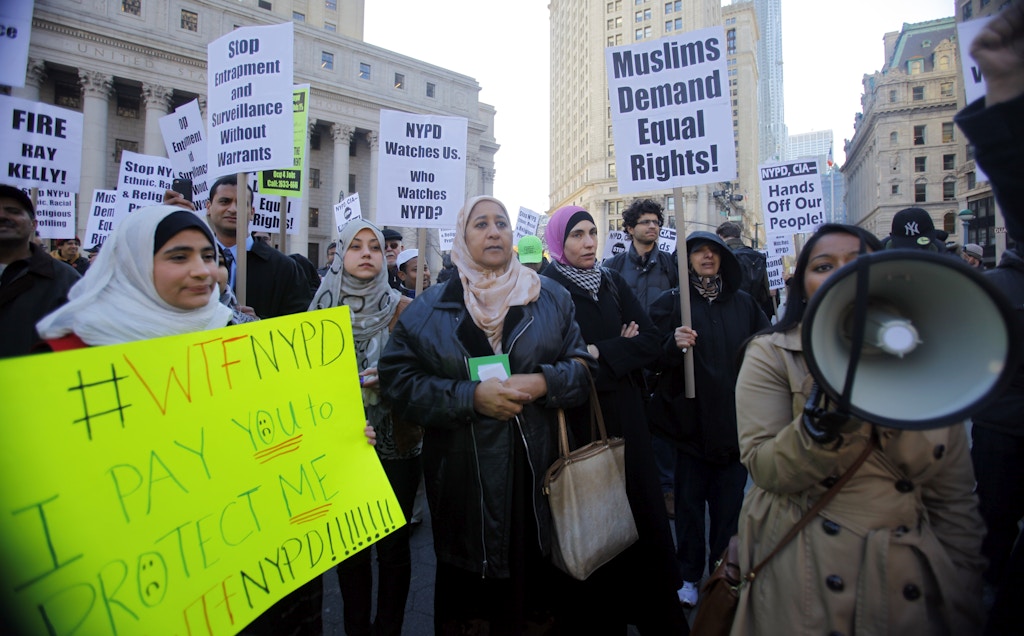
In 2016, Republican presidential candidates were openly fantasizing about surveilling and spying on Muslims. Yet just a few years earlier, in the nation’s biggest city, a Republican mayor had succeeded in going beyond mere rhetoric: Michael Bloomberg oversaw the mass warrantless, suspicionless surveillance of Muslim New Yorkers, as the New York Police Department “mapped” where they prayed, ate, studied, and worked.
Today, the billionaire media mogul is polling third in the race for the Democratic presidential nomination and has secured endorsements from dozens of high-profile Democraticmayors and members of Congress.
I cannot help but ask: Have these elected Democrats lost their minds? Have Democratic voters in, say, Florida, where Bloomberg is now leading in the polls, taken leave of their senses?
In recent weeks, much hasbeen made of Bloomberg’s support for racist and unconstitutional stop-and-frisk practices, which targeted and terrorized African American New Yorkers. Much less has been made of his support for racist and unconstitutional surveillance practices, which targeted and terrorized Muslim New Yorkers. Why is that? How to explain the shameful silence? Could it be because Islamophobia, as I have pointed out before, still isn’t taken seriously by the mainstream media, as well as many liberals and Democrats? Or is it maybe because billionaire Bloomberg has paid prominent liberal groups to turn a blind eye to his Islamophobic record?
During Bloomberg’s three-term tenure as mayor of New York, the NYPD worked with the CIA to deploy teams of undercover agents, known as “rakers,” into Muslim neighborhoods to gather information. “They’ve monitored daily life in bookstores, bars, cafes and nightclubs,” reported the AP. “Police have also used informants, known as ‘mosque crawlers,’ to monitor sermons, even when there’s no evidence of wrongdoing. NYPD officials have scrutinized imams and gathered intelligence on cab drivers and food cart vendors, jobs often done by Muslims.” The AP also noted that on one occasion officials “even sent an undercover agent on a whitewater rafting trip, where he recorded students’ names and noted in police intelligence files how many times they prayed.”
The NYPD, added the New York Times, “eavesdropped on thousands of conversations between Muslims in restaurants and stores in New York City and New Jersey and on Long Island.” Paid informants were “under orders to ‘bait’ Muslims into saying inflammatory things.”
In 2015, a federal court ruling compared the ethnic profiling and covert surveillance of Muslim communities living in Bloomberg’s New York to the discrimination faced by “Jewish Americans during the Red Scare, African-Americans during the Civil Rights movement, and Japanese-Americans during World War II.”
As with stop-and-frisk, Bloomberg defended surveillance as a vital crimefighting measure. “We have to keep this country safe,” he declared in 2012 — despite the fact that the surveillance of Muslims in New York produced “not one actionable piece of intelligence,” as even NYPD Police Commissioner Bill Bratton later admitted.
Yet on stop-and-frisk, Bloomberg has since apologized, telling a black church last November, “I want you to know that I realize back then I was wrong.” Last week, he apologized again to African American communities, saying that he had failed to “understand then the unintended pain it was causing to young black and brown families and their kids.” Whether we accept or even believe Bloomberg’s half-hearted and belated apology for stop-and-frisk, at least he felt the need to offer one.
But what about his warrantless surveillance of Muslims? What of the pain caused to young Muslim families and their kids? There has been no apology, no regret, no contrition whatsoever from the former mayor turned presidential candidate for his role in what has been described by civil rights activists as “one of the most chilling campaigns against religious liberty in modern American history.”
Nor does Bloomberg’s wider record on Muslims and Islam inspire much confidence. Yes, he defended the construction of a controversial Muslim community center in lower Manhattan; yes, he has criticized Trump’s Muslim ban. But the former Republican mayor has also referred to the “crazy Islamic world” while heaping praise on the Chinese dictatorship, perhaps the most Islamophobic government on earth right now. There are multiple tweets from Bloomberg praising the Chinese Communists for their record on climate change; zero tweets condemning their mass detention of the Uighur Muslims.
But back to surveillance: In recent days, with the emergence of audio recordings of Bloomberg making racist remarks and the renewed debate over stop-and-frisk, a number of publicfigures and activists have declared that they cannot bring themselves to vote for Bloomberg if he is the Democratic candidate against Trump. The Muslim American angle is important to consider here: On Sunday, Asad Dandia, a young Islamic studies graduate from Brooklyn who was a victim of the NYPD surveillance program, tweeted about the “enormous mental and emotional stress” that it caused to him and his family and called Bloomberg a “monster.”
Bloomberg terrorized me and my people. His surveillance brought enormous mental and emotional stress to my parents, who *still* ask me to vet any new friends.
But isn’t Trump worse than Bloomberg? The greater evil? Of course he is. It’s worth noting, however, that the former Republican mayor’s surveillance of Muslims in New York earned the praise and admiration of one particular Republican presidential candidate during the 2016 GOP primaries.
“You’re going to have to watch and study the mosques, because a lot of talk is going on at the mosques,” candidate Trump told MSNBC. “And from what I heard, in the old days … we had great surveillance going on in and around mosques in New York City.”
To be clear: Bloomberg spied on Muslim Americans. Trump praised him for it. And now, some Democrats want Bloomberg to defeat and replace Trump in November.
So I ask again: Have they lost their minds?
COMMENT
I PERSONALLY REFUSE TO VOTE FOR BLOOMBERG IF HE IS THE DEMOCRATIC NOMINEE. I SIMPLY WILL NOT VOTE, AS I DID IN 2016.
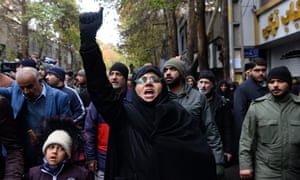
A funeral ceremony in Tehran last week for two security officers killed during protests against fuel price hikes. Photograph: Anadolu Agency/Anadolu
Turmoil in Baghdad, paralysis in Beirut and flames of unrest in Tehran; it has been a bad few months for Iran at home and elsewhere in the Middle East, where more than a decade of advances are being slowed, not by manoeuvrings on battlefields or legislatures – but the force of protest movements.
Early last week, Iran went dark for four days by closing its internet connections down. Even for the country’s autocratic leadership, this was a drastic step. But such are the stakes for a regime that is increasingly facing obstacles across its hubs of Shia influence. And those who laud Iran’s rise, as well as those who fear it, sense it is at a loss over how to respond.
The reaction to relentless anti-government protests in Iraq, which along with Lebanon is essential to Iran’s foreign projection, has so far been straight from a well-worn playbook. The initial weeks of the popular uprising were met with placatory speeches from Iraqi leaders, and a passive stance from security forces. But that changed in late-October and, since then, more than 300 people have been killed and thousands wounded as Iraq’s leaders – directed by Iran’s generals have changed tack.
Gone is any notion of compromise. Instead, the din of bullets, grenades and sirens have become a soundtrack to demonstrations in Baghdad demanding the overthrow of the entire political system. While the protests are aimed at domestic issues – the insatiable graft of its leaders and widespread lack of opportunities for the young central to them – the post-Saddam years have seen Iran embed itself in nearly all aspects of Iraqi governance.
Its role as overlord has also raised the protesters’ ire – just as it has in Lebanon, where Iran’s most important arm of its foreign policy projection, Hezbollah, plays a dominant role in the country’s affairs.
Since the US-led invasion that ousted the Iraqi leader and especially since the withdrawal of US forces from Iraq in 2011, Iran had methodically consolidated itself in both countries. The war in Syria gave its regional gains even more impetus, as did the war against Isis, which allowed its proxy forces to establish footholds in the plains of western Iraq and eastern Syria as they helped defeat the terror group.
As Isis crumbled from late 2015, each area became a platform for a regional project that would finally allow Iran to fulfil long-held ambitions to consolidate a presence on the shores of the Mediterranean and the northern frontier of Israel. Iran took a stake in the Syrian port of Latakia, established a toehold on the Syrian Golan Heights, and an overland supply line from Tehran through the ruins of Iraq and Syria and onwards to Lebanon.
Friend and foe alike saw the developments as a priceless strategic gain for Iran’s projection towards Israel and influence in the Arab world. Proxies in Baghdad and Beirut were not shy in touting what the land corridor meant for Iran’s ambitions. “This has established a historical presence for the Islamic Republic on Arab soil that will change the course of the region,” a senior member of the Iraqi militia, Asa’ib ahl al-Haq, told the Observer in late August. “The Zionists know this, and they fear it.”
Regional intelligence officials and Iraqi militia leaders say the overland route itself is a mish-mash of roads along the Iraqi/Syrian border, where a firm road is yet to be carved. Israeli airstrikes in the area have proven disruptive as have the chaotic departure – then re-arrival – of US troops, and the still simmering presence of Isis. Beyond the border area though, the paths to Damascus and west to Beirut, or northwest to Latakia are less problematic. “It becomes harder to monitor where things go from there,” said an official in Baghdad.
Over the past eight years, western diplomats have continually wrestled with what the unravelling of Syria meant for Iran, and for Hezbollah, which has played a prominent role in stabilising Bashar al-Assad since early 2013. Under the direction of Major General Qassem Suleimani, of the Iranian Revolutionary Guards, Hezbollah and Shia militia proxies from Iraq, Yemen, Afghanistan and Pakistan swung the war in Assad’s favour, strengthening Iran’s arc of influence. By earlier this year, Iran held a whip hand in four capitals outside Tehran, and was building even further momentum.
But Donald Trump’s decision earlier this year to overturn the nuclear agreement, the signature foreign policy deal of Barack Obama, and reimpose even tougher sanctions on Tehran marked a seminal moment. The sanctions regime amounted to an economic war, which many on the Iranian street railed against as a grave injustice imposed by a capricious foe who only several years earlier had wanted to do business.
With Iran’s economy now withering, some Iranians having revolted at a fuel price hike. And with its sources of projected influence under pressure elsewhere, Iran’s leaders are facing a reckoning, perhaps like no other in the post-Saddam period. Its gains, for now, remain secure.
“I’d say that Iran has undoubtedly used the chaos in Syria to strengthen its control over the strategic routes leading to Lebanon,” said one western diplomat. Syria has allowed Iran to make enormous progress in terms of military capacity transfers. For Hezbollah Syria has become a sort of backstage storage for sensitive military equipment.
Sir John Jenkins, one of Britain’s longest-serving regional ambassadors, who led missions in Baghdad, Riyadh, Damascus, and East Jerusalem, said: “There was a time when Iranian pretensions to defend the oppressed and punish the corrupt resonated more widely in the region. But what is left is only a distant, fading echo of this – as many Shia scholars warned would happen. We see the consequences in the reactions of Iraqi, Lebanese and now Iranian Shia protesters who are tired of being instrumentalised and want a better life now not in some Khomeinist paradise.
Iran can impose its will now only by massive violence. That might still work for the moment. And the regime has revolution-proofed itself by the construction of an interlocking system of praetorian guards. But the community of true believers is shrinking. Just look at religious observance inside Iran. It’s collapsed. And any real moral authority that the revolution might once have had is gone.
“Syria was a massive turning point. Iraq is another now. And we’re beginning to see protesters talk to each other across national boundaries. It’s a process of erosion. The last true believers are probably those on the European left who think Iran is a bastion against US neo-liberal orientalist-inflected neo-colonialism. That says it all.
“Iran has become normalised – just another repressive Middle Eastern state ruled by greedy self-serving elites who can’t even imagine let alone countenance what peaceful political evolution would look like.”
In Lebanon, where a cross-sectarian movement has taken to the streets as the country’s economy collapses around them, the narrative that the government and its patrons abroad supports their aspirations has broken. Under grave pressure too is a political system that has sustained a weak state, now exposed as untenable. In Beirut and Baghdad, protesters appear to have crossed a point of no return; they have more to lose by leaving the streets than they do by staying there.
The western diplomat said: “This is something Iran has never faced before. How it responds will determine whether its achievements survive.”
AN EXCELLENT OPINION PIECE FROM THE N Y TIMES Link
Throughout history, demagogues have used state power to target minority communities and political enemies, often culminating in state violence. Today, we face that threat in our own country, where the president of the United States is using the influence of our highest office to mount racist attacks on communities across the land. In recent weeks, he has lashed out unprompted against four freshman Democrats in the House of Representatives: Alexandria Ocasio-Cortez of New York, Ayanna Pressley of Massachusetts, Rashida Tlaib of Michigan, and me, from Minnesota.
Last week, as President Trump watched the crowd at one of his rallies chant “Send her back,” aimed at me and my family, I was reminded of times when such fearmongering was allowed to flourish. I also couldn’t help but remember the horrors of civil war in Somalia that my family and I escaped, the America we expected to find and the one we actually experienced.
The president’s rally will be a defining moment in American history. It reminds us of the grave stakes of the coming presidential election: that this fight is not merely about policy ideas; it is a fight for the soul of our nation. The ideals at the heart of our founding — equal protection under the law, pluralism, religious liberty — are under attack, and it is up to all of us to defend them.
Having survived civil war in my home country as a child, I cherish these values. In Somalia’s capital, Mogadishu, I saw grade-school children as young as me holding assault rifles in the streets. I spent four years in a refugee camp in Kenya, where there was no formal schooling or even running water. But my family and I persevered, fortified by our deep solidarity with one another, the compassion of others and the hope of a better life in the United States.
The America we arrived in was different from the one my grandfather had hoped to find. The land of opportunity he imagined was in fact full of challenges. People identified me in ways that were foreign to me: immigrant, black. I learned that these identities carried stigmas, and I experienced prejudice as a visibly Muslim woman.
But the beauty of this country is not that our democracy is perfect. It’s that embedded in our Constitution and democratic institutions are the tools to make it better. It was in the diverse community of Minneapolis — the very community that welcomed me home with open arms after Mr. Trump’s attacks against me last week — where I learned the true value of democracy. I started attending political caucuses with my grandfather, who cherished democracy as only someone who has experienced its absence could. I soon recognized that the only way to ensure that everyone in my community had a voice was by participating in the democratic process.
Today, that basic promise is under threat. Our democratic institutions have been weaponized. The Trump administration has sought to restrict people from exercising their voting rights. It has sought to undermine the basic checks and balances of our Constitution by not respecting subpoenas from Congress. And the president has used overtly racist rhetoric to strike fear and division in communities of color and religious minorities across the country.
The idea — explicitly expressed by this president and enshrined into law by executive order — that people from certain Muslim-majority countries cannot enter this country is not just bad policy; it is a direct threat to liberal democracy. The chants of “Jews will not replace us,” shouted at a rally in Charlottesville in 2017 by white supremacists, whom this president tacitly accepted, are a direct attack on the values of religious freedom central to the founding of our nation.
The reasons for weaponizing division are not mysterious. Racial fear prevents Americans from building community with one another — and community is the lifeblood of a functioning democratic society. Throughout our history, racist language has been used to turn American against American in order to benefit the wealthy elite. Every time Mr. Trump attacks refugees is a time that could be spent discussing the president’s unwillingness to raise the federal minimum wage for up to 33 million Americans. Every racist attack on four members of Congress is a moment he doesn’t have to address why his choice for labor secretary has spent his career defending Wall Street banks and Walmart at the expense of workers. When he is launching attacks on the free press, he isn’t talking about why his Environmental Protection Agency just refused to ban a pesticide linked to brain damage in children.
His efforts to pit religious minorities against one another stem from the same playbook. If working Americans are too busy fighting with one another, we will never address the very real and deep problems our country faces — from climate change to soaring inequality to lack of quality affordable health care.
The only way to push back is to be unequivocal about our values. It is not enough to condemn Mr. Trump’s racism. We must affirmatively confront racist policies — whether the caging of immigrant children at the border or the banning of Muslim immigrants or the allowing of segregation in public housing. It is not enough to condemn the corruption and self-dealing of this administration. We must support policies that unmistakably improve working people’s lives, including by strengthening collective bargaining, raising the minimum wage and pursuing a universal jobs guarantee.
The consequences of this fight will not just be felt here at home but around the world. Right-wing nationalism in Hungary, Russia, France, Britain and elsewhere is on the march in ways not seen in decades. America has been a beacon of democratic ideals for the world. If we succumb to the fever of right-wing nationalism, it will have consequences far beyond our borders.
The proudest moments in our history — from the Emancipation Proclamation to the civil rights movement to the struggle against fascism — have come when we fight to protect and expand basic democratic rights. Today, democracy is under attack once again. It’s time to respond with the kind of conviction that has made America great before.
Ilhan Omar is a Democratic congresswoman from Minnesota.
Survey of 25,000 people in Middle East and North Africa also shows 52% of 18- to 29-year-olds are thinking about migrating
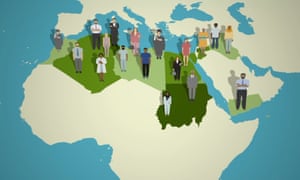
Trust in religious leaders decreased in each of the 11 states and territories surveyed bar Lebanon. Photograph: BBC
The Arab world is turning its back on religion and on US relations, according to the largest public opinion survey ever carried out in the region.
A survey of more than 25,000 people across 10 countries and the Palestinian territories found that trust in religious leaders has plummeted in recent years.
The study, compiled by BBC News Arabic and Arab Barometer, a Princeton University-based research network, also identified a marked rise in the proportion of people describing themselves as “not religious” – from 11% in 2012-2014 to 18% this year.
Just 12% of the countries surveyed – which included Algeria, Egypt, Iraq, Jordan, Lebanon, Libya, Morocco, Palestine, Sudan, Tunisia and Yemen – had a positive view of Donald Trump. More than twice as many (28%) felt positively towards Russia’s Vladimir Putin, while Turkey’s Recep Erdogan fared the best (51%).
At least 60% of respondents in eight of the 11 places surveyed said violence against the US was a logical consequence of interference in the region. The sentiment was most pronounced in Lebanon, Palestine and Yemen, where 75% or more of those surveyed were of this view.
Respondents also expressed concern over rising disquiet in their home countries: people in Algeria, Iraq, Jordan, Libya, Palestine and Sudan, said they felt they were sliding towards dictatorship. More than six in 10 Algerians, and four in 10 Sudanese, believe the last elections were not free and fair, the survey found.
Michael Robbins, the director of Arab Barometer, said the survey – which was conducted at random in private and face-to-face, and consisted largely of multiple-choice questions answered on a tablet–presented a number of significant findings.
“Most importantly, in the vast majority of countries surveyed, governments are not meeting the expectations of their citizens,” said Robbins.
“Often, trust in government tracks more closely with performance on providing security than on economic issues.”
Respondents expressed a change in attitudes over a number of other issues, from migration and mental health to women’s and LGBT rights.
RELIGION
The proportion of people who said they were not religious rose from 11% in 2012-14 to 18% in 2019. Trust in religious leaders has also decreased everywhere but Yemen. Iraq, Palestine and Sudan showed the steepest drops in confidence.
Trust in Islamist movements, such as Hamas, Hezbollah and the Muslim Brotherhood, is even lower than for religious leaders Faith in Tunisia’s Ennahda party has declined by 24% in Tunisia since 2011, by 21% in Jordan since 2012, and by 20% since 2013 in Morocco, the survey claims.
WOMEN’S RIGHTS
Across the region, most respondents supported a woman’s right to divorce her husband but felt that husbands rather than wives should have the final say on family decisions.
In 91% of the places surveyed, majorities said women should be allowed to serve as head of government in a Muslim country, but the same margin claimed that men are better political leaders.
The notion of a female political president or prime minister was most acceptable in Lebanon, Morocco and Tunisia, and least acceptable in Algeria and Sudan.
Dima Dabbous, Equality Now’s regional director for the Middle East and North Africa, said the apparent contradiction in responses was “indicative of the dominant mood in the region”.
“There is a realisation that gender equality is a marker of progress and the ‘right thing’ to say is to support women empowerment. But when the framing of the question focuses on the role of men, then the real patriarchal, male-centric bias comes to the surface,” said Dabbous.
“Women in the Middle East and North Africa are getting more educated and participating increasingly in the labour force, but their empowerment will remain incomplete as long as they are still excluded from decision-making positions and political participation.”
MIGRATION
More than half (52%) of 18- to 29-year-olds surveyed in Algeria, Egypt, Jordan, Lebanon, Morocco, Palestine and Tunisia said they were considering migrating – an increase of 10% from 2016 figures.
Moroccan adults under 30 exhibited the greatest desire to leave their home country, with 70% thinking about emigrating. But almost half the entire population surveyed in Jordan and Sudan, and one-third in Iraq, said they were contemplating leaving. Europe was the first choice for North Africans, while Egyptians, Sudanese and Yemenis favoured the Gulf. North America was the top destination for people in Jordan and Lebanon, according to the survey.
The figures also revealed that potential migrants would be willing to leave without official papers: more than 40% of Algerians, Sudanese and Tunisians, and 38% of Iraqis, Moroccans and Yemenis said they would leave without formal documentation.
LGBT RIGHTS
In the West Bank, only 5% of respondents said it was acceptable to be gay; in Lebanon, the figure was 6%, while in Iraq, Jordan and Tunisia it was 7%. Algeria showed the greatest tolerance, with 26% of respondents expressing no objection to homosexuality.
For taboo or difficult questions, respondents were asked to select “acceptable practices” from a series of options. People believed “honour” killings were more acceptable than being gay in all but one of the countries where this question was asked (Algeria, Jordan, Lebanon, Morocco, Palestine, Sudan and Tunisia).
In Algeria, for example, 26% of respondents said being gay was acceptable, while 27% believed “honour” killings were acceptable; in Jordan, the figures were 7% and 21%. Sudan was the only country where a greater number of respondents found homosexuality more acceptable than “honour” killings (17% v 14%).
Dabbous said the responses demonstrated a machismo still heavily prevalent across the region.
“Of course ‘honour’ killings are more acceptable than homosexuality. [They] preserve a social order based on ‘male honour’ and dominant masculinity – which is heterosexual – while homosexuality is a threat to it.”
MENTAL HEALTH
On average, one in three people surveyed said they felt depressed, with the highest proportion in Iraq (43%), Tunisia (40%) and Palestine (37%). Women and less affluent respondents appeared most affected, the survey found.
Only when we recognize Trump as a cult leader, and many of those who support him as cult followers, will we understand where we are headed and how we must resist
The cult leader constantly paints a picture of an existential threat, often invented, that puts the cult followers in danger. (Photo: Mr. Fish / Truthdig)
Editor’s note: The 45th president’s approval ratings remain steady despite numerous scandals and missteps. Below is a Oct. 29, 2018, column in which Hedges analyzes Donald Trump’s seemingly indefatigable appeal. Hedges is speaking in London on Monday and will return with a new column on Julian Assange on Tuesday.
Cult leaders arise from decayed communities and societies in which people have been shorn of political, social and economic power. The disempowered, infantilized by a world they cannot control, gravitate to cult leaders who appear omnipotent and promise a return to a mythical golden age. The cult leaders vow to crush the forces, embodied in demonized groups and individuals, that are blamed for their misery. The more outrageous the cult leaders become, the more they flout law and social conventions, the more they gain in popularity. Cult leaders are immune to the norms of established society. This is their appeal. Cult leaders demand a God-like power. Those who follow them grant them this power in the hope that the cult leaders will save them.
Donald Trump has transformed the decayed carcass of the Republican Party into a cult. All cults are personality cults. They are extensions of the cult leaders. The cult reflects the leader’s prejudices, worldview, personal style and ideas. Trump did not create the yearning for a cult leader. Huge segments of the population, betrayed by the established elites, were conditioned for a cult leader. They were desperately looking for someone to rescue them and solve their problems. They found their cult leader in the New York real estate developer and reality television show star. Only when we recognize Trump as a cult leader, and many of those who support him as cult followers, will we understand where we are headed and how we must resist.
It was 40 years ago next month that a messianic preacher named Jim Jones convinced or forced more than 900 of his followers, including roughly 280 children, to die by ingesting a cyanide-laced drink. Trump’s refusal to acknowledge and address the impending crisis of ecocide and the massive mismanagement of the economy by kleptocrats, his bellicosity, his threats against Iran and China and the withdrawal from nuclear arms treaties, along with his demonization of all who oppose him, ensure our cultural and, if left unchecked, physical extinction. Cult leaders are driven, at their core, by the death instinct, the instinct to annihilate and destroy rather than nurture and create. Trump shares many of the characteristics of Jones as well as other cult leaders including Marshall Herff Applewhite and Bonnie Lu Nettles, the founders of the Heaven’s Gate cult; the Rev. Sun Myung Moon, who led the Unification Church; Credonia Mwerinde, who led the Movement for the Restoration of the Ten Commandments of God in Uganda; Li Hongzhi, the founder of Falun Gong; and David Koresh, who led the Branch Davidian cult in Waco, Texas. Cult leaders are narcissists. They demand obsequious fawning and total obedience. They prize loyalty above competence. They wield absolute control. They do not tolerate criticism. They are deeply insecure, a trait they attempt to cover up with bombastic grandiosity. They are amoral and emotionally and physically abusive. They see those around them as objects to be manipulated for their own empowerment, enjoyment and often sadistic entertainment. All those outside the cult are branded as forces of evil, prompting an epic battle whose natural expression is violence.
“A cult is a mirror of what is inside the cult leader,” Margaret Thaler Singer wrote in “Cults in Our Midst.” “He has no restraints on him. He can make his fantasies and desires come alive in the world he creates around him. He can lead people to do his bidding. He can make the surrounding world really his world. What most cult leaders achieve is akin to the fantasies of a child at play, creating a world with toys and utensils. In that play world, the child feels omnipotent and creates a realm of his own for a few minutes or a few hours. He moves the toy dolls about. They do his bidding. They speak his words back to him. He punishes them any way he wants. He is all-powerful and makes his fantasy come alive. When I see the sand tables and the collections of toys some child therapists have in their offices, I think that a cult leader must look about and place people in his created world much as a child creates on the sand table a world that reflects his or her desires and fantasies. The difference is that the cult leader has actual humans doing his bidding as he makes a world around him that springs from inside his own head.”
George Orwell understood that cult leaders manipulate followers primarily through language, not force. This linguistic manipulation is a gradual process. It is rooted in continual mental chaos and verbal confusion. Lies, conspiracy theories, outlandish ideas and contradictory statements that defy reality and fact soon paralyze the opposition. The opposition, with every attempt to counter this absurdism with the rational—such as the decision by Barack Obama to make his birth certificate public or by Sen. Elizabeth Warren to release the results of her DNA test to prove she has Native American ancestry—plays to the cult leader. The cult leader does not take his or her statements seriously and often denies ever making them, even when they are documented. Lies and truth do not matter. The language of the cult leader is designed exclusively to appeal to the emotional needs of those in the cult.
“Hitler kept his enemies in a state of constant confusion and diplomatic upheaval,” Joost A.M. Meerloo wrote in “The Rape of the Mind: The Psychology of Thought Control, Menticide, and Brainwashing.” “They never knew what this unpredictable madman was going to do next. Hitler was never logical, because he knew that that was what he was expected to be. Logic can be met with logic, while illogic cannot—it confuses those who think straight. The Big Lie and monotonously repeated nonsense have more emotional appeal in a cold war than logic and reason. While the enemy is still searching for a reasonable counter-argument to the first lie, the totalitarians can assault him with another.”
The cult leader grooms followers to speak in the language of hate and violence.
The cult leader grooms followers to speak in the language of hate and violence. The cult leader constantly paints a picture of an existential threat, often invented, that puts the cult followers in danger. Trump is doing this by demonizing the caravan of some 4,000 immigrants, most from Honduras, moving through southern Mexico. Caravans of immigrants, are, in fact, nothing new. The beleaguered and impoverished asylum seekers, including many families with children, are 1,000 miles from the Texas border. But Trump, aided by nearly nonstop coverage by Fox News and Christian broadcasting, is using the caravan to terrify his followers, just as he, along with these media outlets, portrayed the protesters who flooded the U.S. capital to oppose the nomination of Brett Kavanaugh as unruly mobs. Trump claims the Democrats want to open the border to these “criminals” and to “unknown Middle Easterners” who are, he suggests, radical jihadists. Christian broadcasting operations, such as Pat Robertson’s The 700 Club, splice pictures of marching jihadists in black uniforms cradling automatic weapons into the video shots of the caravan.
The fear mongering and rhetoric of hate and violence, as I saw in the former Yugoslavia, eventually lead to widespread acts of violence against those the cult leader defines as the enemy. The 13 explosive devices sent last week to Trump critics and leaders of the Democratic Party, including Barack Obama, Hillary Clinton and Joe Biden, along with George Soros, James Clapper and CNN, allegedly by Cesar Sayoc, an ex-stripper and fanatic Trump supporter who was living out of his van, herald more violence. Trump, tossing gasoline on the flames, used this assault against much of the leadership of the Democratic Party to again attack the press, or, as he calls it, “the enemy of the people.” “A very big part of the Anger we see today in our society is caused by the purposely false and inaccurate reporting of the Mainstream Media that I refer to as Fake News,” he tweeted. “It has gotten so bad and hateful that is beyond description. Mainstream Media must clean up its acts, FAST!”
It should come as no surprise that on Saturday another enraged American white male, his fury and despair seemingly stoked by the diatribes and conspiracy theories of the far right, entered a Pittsburgh synagogue and massacred eight men and three women as he shouted anti-Semitic abuse. Shot by police and arrested at the scene was Robert Bowers, who believes that Jewish groups are aiding the caravan of immigrants in southern Mexico. He was armed with a military-style AR-15 assault rifle, plus three handguns. The proliferation of easily accessible high-caliber weapons, coupled with the division of the country into the blessed and the damned by Trump and his fellow cultists, threatens to turn the landscape of the United States into one that resembles Mexico, where at least 145 people in politics, including 48 candidates and pre-candidates, along with party leaders and campaign workers, have been assassinatedover the last 12 months, according to Etellekt, a risk analysis firm in Mexico. There have been 627 incidents of violence against politicians, 206 threats and acts of intimidation, 57 firearm assaults and 52 attacks on family members that resulted in 50 fatalities. Trump’s response to the mass shooting at the synagogue was to say places of worship should have armed guards, a call for further proliferation of firearms. Look south if you want a vision of our future.
Domestic terrorism and nihilistic violence are the natural outcomes of the economic, social and political stagnation, the total seizure of power by a corporate cabal and oligarchic elite, and the contamination of civil discourse by cult leaders.
Domestic terrorism and nihilistic violence are the natural outcomes of the economic, social and political stagnation, the total seizure of power by a corporate cabal and oligarchic elite, and the contamination of civil discourse by cult leaders. The weaponization of language is proliferating, as seen in the vile rhetoric that characterizes many political campaigns for the midterm elections, including the racist robocall sent out against Andrew Gillum, an African-American candidate for the governorship of Florida. “Well, hello there. I is the negro Andrew Gillum and I’ll be askin’ you to make me governor of this here state of Florida,” a man speaking in a caricature of a black dialect accompanied by jungle noises said in the robocall. Cults externalize evil. Evil is embodied in the demonized other, whether desperate immigrants, black political candidates and voters, or the Democratic Party. The only way to purge this “evil” and restore America to “greatness” is to eradicate these human contaminants.
The cult leader, unlike a traditional politician, makes no effort to reach out to his opponents. The cult leader seeks to widen the divisions. The leader brands those outside the cult as irredeemable. The leader seeks the omnipotence to crush those who do not kneel in adoration. The followers, yearning to be protected and empowered by the cult leader, seek to give the cult leader omnipotence. Democratic norms, an impediment to the leader’s omnipotence, are attacked and abolished. Those in the cult seek to be surrounded by the cult leader’s magical aura. Reality is sacrificed for fantasy. Those who challenge the fantasy are not considered human. They are Satanic.
Meerloo wrote:
The dictator is not only a sick man, he is also a cruel opportunist. He sees no value in any other person and feels no gratitude for any help he may have received. He is suspicious and dishonest and believes that his personal ends justify any means he may use to achieve them. Peculiarly enough, every tyrant still searches for some self-justification. Without such a soothing device for his own conscience, he cannot live. His attitude toward other people is manipulative; to him, they are merely tools for the advancement of his own interests. He rejects the conception of doubt, of internal contradictions, or man’s inborn ambivalence. He denies the psychological fact that man grows to maturity through groping, through trial and error, through the interplay of contrasting feelings. Because he will not permit himself to grope, to learn through trial and error, the dictator can never become a mature person. … It is because the dictator is afraid, albeit unconsciously, of his own internal contradictions, that he is afraid of the same internal contradictions of his fellow man. He must purge and purge, terrorize and terrorize in order to still his own raging inner drives. He must kill every doubter, destroy every person who makes a mistake, imprison everyone who cannot be proved to be utterly single-minded.
Behavior that ensures the destruction of a public figure’s career does not affect a cult leader. It does not matter how many lies uttered by Trump are meticulously documented by The New York Times or The Washington Post. It does not matter that Trump’s personal financial interests, as we see in his relationship with the Saudis, take precedence over the rule of law, diplomatic protocols and national security. It does not matter that he is credibly charged by numerous women with being a sexual predator, a common characteristic of cult leaders. It does not matter that he is inept, lazy and ignorant. The establishment, whose credibility has been destroyed because of its complicity in empowering the ruling oligarchy and the corporate state, might as well be blowing soap bubbles at Trump. Their vitriol, to his followers, only justifies the hatred radiating from the cult.
The cult leader responds to only one emotion—fear. The cult leader, usually a coward, will react when he thinks he is in danger. The cult leader will bargain and compromise when afraid. The cult leader will give the appearance of being flexible and reasonable. But as soon as the cult leader is no longer afraid, the old patterns of behavior return, with a special venom directed at those who were able to momentarily impinge upon his power.
The removal of Trump from power would not remove the yearning of tens of millions of people, many conditioned by the Christian right, for a cult leader. Most of the leaders of the Christian right have built cult followings of their own. These Christian fascists embraced magical thinking, attacked their enemies as agents of Satan and denounced reality-based science and journalism long before Trump did. Cults are a product of social decay and despair, and our decay and despair are expanding, soon to explode in another financial crisis.
The efforts by the Democratic Party and much of the press, including CNN and The New York Times, to discredit Trump, as if our problems are embodied in him, are futile. The smug, self-righteousness of this crusade against Trump only contributes to the national reality television show that has replaced journalism and politics. This crusade attempts to reduce a social, economic and political crisis to the personality of Trump. It is accompanied by a refusal to confront and name the corporate forces responsible for our failed democracy. This collusion with the forces of corporate oppression neuters the press and Trump’s mainstream critics.
Our only hope is to organize the overthrow of the corporate state that vomited up Trump. Our democratic institutions, including the legislative bodies, the courts and the media, are hostage to corporate power. They are no longer democratic. We must, like liberation movements of the past, engage in acts of sustained mass civil disobedience and non-cooperation. By turning our ire on the corporate state, we name the true sources of power and abuse. We expose the absurdity of blaming our demise on demonized groups such as undocumented workers, Muslims, African-Americans, Latinos, liberals, feminists, gays and others. We give people an alternative to a Democratic Party that refuses to confront the corporate forces of oppression and cannot be rehabilitated. We make possible the restoration of an open society. If we fail to embrace this militancy, which alone has the ability to destroy cult leaders, we will continue the march toward tyranny.