Thursday, September 5, 2013

المخطط الأسود

A GOOD ANALYSIS


- تفاصيل المخطط
- إجهاض الثورة المصرية
- إجهاض الثورة التونسية
- تحجيم قطر وتركيا
- إسقاط حكم حماس
- خلاصة

لا يمكن للعقل السياسي العربي السوي أن يجتزئ ما يجري في مصر اليوم عن سياقات الحدث الأخرى في المنطقة والإقليم، وأن يتعاطى مع الانقلاب المصري بسذاجة مفرطة بعيدا عن حلقات الاستهداف التي تحث الخطى نحو دوائر جغرافية أخرى في إطار مخطط مرسوم، تتوزع أدواره بشكل دقيق ونسق محدد لتغيير مجرى التاريخ، وإعادة صياغة الواقع السياسي في المنطقة ككل.

تفاصيل المخطط
المعطيات الدقيقة التي تسربت عن مصادر فلسطينية ومصرية وعربية عليمة تشير إلى تفاصيل مخطط أسود حُبكت حلقاته وأدواره ومراحله بعناية فائقة قبل عدة أشهر، وتم إنضاجه على نار هادئة والشروع في تنفيذه بدقة متناهية وتنسيق كامل على أعلى المستويات السياسية والعسكرية والأمنية بين الدول والأطراف المعنية.

أطراف هذا المخطط تتمثل في الولايات المتحدة التي تشكل رأس وقيادة المخطط، وإسرائيل، وقيادة السلطة الفلسطينية، وقيادة الجيش المصري وبعض القيادات السياسية التابعة لنظام مبارك والدولة العميقة، والنظام السعودي، والنظام الإماراتي، والنظام الأردني، وبعض رجالات السياسة والأمن في دول الإقليم، خصوصا تونس وتركيا.

لكن ما يميز هذا المخطط أن قيادته العليا (الإدارة الأميركية) لا تتصدر المشهد وتعمل في الواجهة الخلفية، وتحاول الظهور بمواقف رمادية حسب مقتضيات المصلحة والظروف، وتدير المعركة عبر إشرافها المباشر على الأدوات الإقليمية التي تشكل الأضلاع الأساسية للمخطط المذكور.

وتتمثل أهداف المخطط في إفشال ثورات الربيع العربي عبر إجهاض الثورتين المصرية والتونسية، وتقويض تجربة الإخوان المسلمين في الحكم، وتحجيم الدورين القطري والتركي اللذين شكلا رافدا أساسيا لدعم وتأجيج الثورات العربية، وإسقاط حكم حماس في غزة الذي يشكل بؤرة تحريض وإزعاج كبرى لإسرائيل والسلطة الفلسطينية والأنظمة العربية الدائرة في الفلك الأميركي.

ومع نجاح المخطط إلى حد ما في مرحلته الأولى ضد الثورة المصرية وجماعة الإخوان المسلمين، انتقل المخططون إلى محاولة تطبيق بقية عناصر وبنود المخطط الأخرى بشكل متزامن، إذ تعمل بعض الأطراف على الساحة التونسية على محاولة إسقاط الحكومة الائتلافية الحالية، والمجلس التأسيسي التونسي المنتخب، تحت غطاء تشكيل حكومة تكنوقراط غير حزبية، دون أن تعير اهتماما للمحاولات الجادة التي يبذلها بعض الساسة التونسيين لنزع الفتيل عبر حلول سياسية منطقية تقبل بها الأطراف والمكونات التونسية المختلفة.

وفي الوقت نفسه أغلق النظام المصري الجديد معبر رفح البري، ويوشك على الانتهاء من هدم الأنفاق الحدودية مع قطاع غزة، توطئة للمرحلة التالية التي تشاركه فيها السلطة الفلسطينية عبر تفعيل أدوات التحريض المختلفة ووقف الرواتب والمخصصات المالية عن أهالي القطاع، وتهيئة الأجواء نحو اندلاع حركة احتجاجات شعبية ضد حكم حماس تنتهي بإسقاطه كما يأمل المخططون.

بموازاة ذلك، لم تتوقف الضغوط الأميركية التي بُذلت لتحجيم الموقفين القطري والتركي طيلة الأشهر الأخيرة وخلال معركة الانقلاب على مرسي وآثارها الدموية، وهو ما يدعو لتوقّع استدعاء المزيد منها في المرحلة القادمة حسب المخطط المرسوم.

إجهاض الثورة المصرية
شكلت الثورة المصرية نقطة البداية وحجر الزاوية في تنفيذ المخطط المرسوم.


ولأن مصر هي قلب الأمة ونبضها الأصيل، ونظرا لطبيعة الدور الريادي وحجم الأثر السياسي والمعنوي الذي تتركه مصر على الأمة جمعاء، ولأن مصر تعد منبت جماعة الإخوان المسلمين وثقلها الأساس، فقد وضع المخطط الثورة المصرية على رأس أجندة الفعل والاستهداف، وأفرد لها من التحضير المسبق والعمل الدؤوب ما يضمن سحقها والقضاء عليها بأقل الخسائر الممكنة.

واستند المخطط في إحدى أهم زواياه على أن إجهاض الثورة المصرية سوف يترك آثارا بالغة السلبية على مجمل الربيع العربي في المنطقة، وأن إسقاط حكم الإخوان كفيل بإحباط تقدم تجارب الإسلاميين في مختلف الدول العربية وهزّ مشروعهم ودفعهم نحو التراجع والانكفاء.

لم تكن إمكانية الانقلاب على الثورة المصرية سهلة ميسورة، إذ إن نجاح مخطط الانقلاب عليها يتطلب توفير جزء لا بأس به من الأسباب الموضوعية لعزل الرئيس الذي ينتمي إلى جماعة الإخوان، وهو ما استدعى تجنيد كل قوى وطاقات الدولة العميقة المتحفزة من جهة، وتحشيد الجماعات الحزبية المعارضة لحكم الإخوان من جهة أخرى، وذلك في إطار جهد سياسي وإعلامي توسل التعبئة الشعبية قدر الإمكان، انتظارا للحظة الحسم التي اختير 30 يونيو/حزيران الماضي تاريخا لها تحت غطاء حركة "تمرد" التي تم صناعتها بواسطة الجيش.

وهكذا، تكاثف الجهد والإعداد ضمن إطار المخطط المذكور بقيادة قائد الجيش والقيادات العسكرية الأساسية، والعديد من الساسة التابعين لنظام مبارك والدولة العميقة، وبرعاية مباشرة من الإدارة الأميركية والسعودية والإماراتية، ومتابعة حثيثة من إسرائيل والسلطة الفلسطينية والأردن، إلى أن دقت ساعة الصفر، وكان ما كان.

ولأن المذابح الكبرى والجرائم البشعة التي اقترفها السيسي وزمرته الانقلابية ذات غطاء إقليمي ودولي معلوم ضمن إطار المخطط المرسوم، جاءت ردود الفعل على ما جرى محدودة القوة والأثر، وغير ذات قيمة عملية في موازين السياسة الراهنة، ودارت معظمها في فلك النفاق السياسي ليس إلا.

إجهاض الثورة التونسية
رغم ابتعاد تونس عن مركز الثقل السياسي العربي فإن إجهاض الربيع العربي لا يكتمل إلا بإنهاء ثورتها التي شكلت فاتحة الربيع العربي وثوراته العارمة، وهذا ما جعل استهداف الثورة التونسية بندا أساسيا على أجندة المخطط المذكور.


واللافت للنظر أن الوضع التونسي شهد استقرارا لا بأس به على المستوى السياسي والاقتصادي والاجتماعي في ظل "الترويكا" الحاكمة هناك، وأن إعطاء الفرصة لبرنامج التوافق الوطني الذي يتولى إدارة الحكومة والبرلمان في تونس من شأنه أن يقدم نموذجا ديمقراطيا رفيعا لتجربة سياسية راشدة، ويشكل مدخلا حقيقيا لحل المشكلات التي يعاني منها الواقع التونسي.

لكن ضرورات الانقلاب على الربيع العربي في إطار المخطط سيئ الذكر أملت على جهات نافذة داخل تونس التحرك لتخريب آليات التحول الديمقراطي، وضمان إفساد أجواء التفاهم والاستقرار الواعدة ضمن المكونات السياسية الرئيسية هناك، وذلك عبر تحريض قطاعات نقابية وحزبية محددة لاستنساخ التجربة المصرية الأخيرة في الانقلاب على نظام ما بعد الثورة، وإقصاء الإسلاميين (حركة النهضة) من صدارة المشهد السياسي.

ومن هنا لم يكن مستغربا أن تنطلق حملة "تمرد" جديدة في تونس، وأن تطلق بعض القوى الحزبية والنقابية التونسية العنان لمواقفها الرعناء التي لا تعنى بالجهد الوطني التونسي الذي يستهدف بلورة مقاربة سياسية مقبولة على كافة أطياف المجتمع السياسي التونسي، ولا ترفع سوى شعار إسقاط النظام السياسي الجديد المنتخب، حكومة وبرلمانا.

ومع ذلك، ينبغي الإقرار بأن حكمة حركة النهضة ورئيسها الشيخ راشد الغنوشي، ومرونتها الواضحة في التعامل مع مستجدات الواقع السياسي داخل تونس، تشكل تهديدا للمخطط الانقلابي المرسوم، وقد تعمل على إبطاله، ولو جزئيا، حال نجاحها في إبقاء البرلمان المنتخب دون حلّ، وقصر التغيير على الحكومة وبعض مستوياتها الإدارية فحسب.

تحجيم قطر وتركيا
تدرك الولايات المتحدة وحلفاؤها في المنطقة أن طيّ صفحة الربيع العربي لن يتم إلا بتحجيم وتدجين الدورين القطري والتركي اللذين ينشطان بقوة في الدفاع عن حق الشعوب العربية في الحرية والعدالة والكرامة، ويلعبان دور المحرض على الانتفاض في وجه الظلم والقهر والاستبداد.


ورغم الضغوط الأميركية التي مورست على قيادة البلدين لحرف بوصلتهما عن دوائر الربيع العربي، فإنهما أبدتا عنادا صريحا في تحدي الموقف الأميركي بهذا الخصوص، وأثبتتا قدرة بيّنة على احتواء كافة أشكال الضغوط الممارسة حتى اليوم.

وتجلى الموقف القطري بوضوح في معارضة الانقلاب العسكري في مصر ونتائجه الدموية، وعدم التدخل في مسار التغطيات المهنية القوية لقناة الجزيرة فيما يخص الشأن المصري بشكل خاص، وشؤون الربيع العربي وحرية الشعوب بشكل عام.

أما الوضع التركي فقد شابه الكثير من التعقيد إثر محاولات الانقلاب السياسي والميداني التي وجدت ترجماتها العملية في ميدان "تقسيم" في الأسابيع الأخيرة، والتي تم إنتاجها إثر فشل الإدارة الأميركية في إعادة العلاقات التركية-الإسرائيلية إلى سكّتها القديمة بعد إفلات رئيس الوزراء التركي رجب طيب أوردوغان من فخّ الاعتذار الإسرائيلي على حادث سفينة "مرمرة" الذي استهدف احتواء الدور التركي "المشاغب" على المستوى الإقليمي.

وهكذا، غدا التحريض الخارجي الخفيّ جزءا من الطبقة السياسية والحزبية التركية للخروج على "أردوغان" بهدف الإطاحة به وإعادة تركيا إلى بيت الطاعة الأميركي من جديد، أو إشغالها في همومها ومشاكلها الداخلية بعيدا عن تحدي السياسة الأميركية على أقل تقدير.


بل إن الموقف التركي بدا أكثر حدة من نظيره القطري حين رفض "أردوغان" التعامل مع حكومة وممثلي الانقلابيين في مصر، وأطلق حملة دبلوماسية لنصرة مرسي والشرعية الدستورية في مصر، وذهب أبعد من ذلك حين غرد تماما خارج سرب النظام الإقليمي والدولي عبر دعوته إلى إنشاء منظمة بديلة عن منظمة الأمم المتحدة قبل أيام.

إسقاط حكم حماس
في تفاصيل المخطط الذي بدأ تنفيذه لإسقاط حكومة حماس في غزة كامتداد طبيعي لجماعة الإخوان، يلعب النظام المصري الجديد دور الأسد، فيما تلعب السلطة الفلسطينية في رام الله دورا رئيسيا، بالإضافة إلى بقية الأدوار المسندة إلى الأطراف الأخرى بما تكتمل به صورة مشهد المخطط وحلقاته المرسومة.


الدور الأهم الذي يضطلع به الجانب المصري يكمن في هدم الأنفاق بشكل تام، وإغلاق معبر رفح الحدودي مع قطاع غزة، مما يزج بالقطاع في أتون أزمة اقتصادية خانقة تبلغ حد الكارثة الإنسانية بفعل توقف توريد المواد الغذائية والمستلزمات الأساسية ومشتقات الوقود عبر الأنفاق التي تباع في الأسواق الغزية بأسعار رخيصة.

بموازاة ذلك، تلجأ السلطة الفلسطينية في رام الله إلى وقف الموازنة الشهرية التي تخصصها شهريا لقطاع غزة بما فيها رواتب الموظفين، ولا يتبقى من منفذ سوى معبر كرم أبو سالم الذي يتحكم به الجانب الإسرائيلي، والذي يتم من خلاله إدخاله البضائع الإسرائيلية بشكل محدود وباهظ الثمن.


ذلك كله، يعني -عمليا- الدفع نحو شلل وتعطيل الحياة بشكل كامل في القطاع، خصوصا في ظل الأزمة المالية التي تعاني منها حكومة حماس، وقد تترك آثارها الواضحة في مختلف المجالات، مما يؤسس -حسب المخطط- لأرضية موضوعية نحو خلق تذمر شعبي واسع داخل القطاع.

ويتمحور المخطط بشكل دقيق حول مجموعة من الخطوات السياسية والإعلامية والميدانية يمكن تلخيص أهمها في التالي:

- اتهام حركة حماس باقتحام السجون المصرية أثناء ثورة 25 يناير/كانون الثاني 2011، وقيامها بتهريب قيادات من حماس والإخوان وعلى رأسهم الرئيس مرسي.

- الإعلان عن اعتقال عناصر تابعة لكتائب القسام متورطة في هجمات ضد الجيش المصري وقوات الأمن المصرية في سيناء، وتلفيق علاقة المعتقلين بالاشتباكات في كل من العريش، الشيخ زويد، ورفح الحدودية.

- اختباء قيادات من الإخوان المسلمين في قطاع غزة بعد هروبهم من مصر، ومنهم محمود عزت بهدف إدارة العمليات ضد الجيش المصري في سيناء.

- تصدير اعترافات مفبركة لعناصر من حماس في الإعلام حيث يتم التركيز على إبراز "المخططات التخريبية" التي أعدتها كتائب القسام داخل الأراضي المصرية دعما لمرسي، واستغلال من اعتقلوا من سكان القطاع الذين جاؤوا لمصر من أجل العلاج أو الدراسة لهذا الغرض.

- إغلاق كل الأنفاق الحدودية خاصة أنفاق الوقود والبضائع بهدف خلق جو من التذمر والهيجان لدى الرأي العام في غزة، وخاصة أن الأنفاق تشكل شريان الحياة لأهالي القطاع.

- إغلاق معبر رفح بهدف التضييق على الناس تحقيقا للتذمر الشعبي المنشود.

- بث إشاعات سلبية بين الناس، والتركيز على أن القطاع سيكتوى بنار الأحداث في مصر، خاصة بعد سقوط الحركة الأم لحركة حماس "جماعة الإخوان".

- إطلاق حملة تمرد في غزة على غرار حملة تمرد المصرية، وتحديد موعد لنهاية حكم حماس.


- السماح بإقامة معسكرات تدريب لعناصر دحلان الموجودة في مصر، وعناصر أخرى سيتم جلبها من الساحات الأخرى وتسكينها في الساحة المصرية.

- تموضع عناصر دحلان في عدة نقاط تماس مع قطاع غزة (رفح، معبر كرم أبو سالم، معبر إيرز، شرق مدينة غزة، شرق مخيمات المنطقة الوسطى ودير البلح، وخان يونس) بالتنسيق مع الجانب الإسرائيلي.


- إسناد جوي بواسطة المروحيات من الجانب المصري.

- اجتياز القوات المصرية لحدود قطاع غزة بحجة ملاحقة "العناصر الإرهابية" التي تقوم بعمليات تخريب في سيناء من خلال قوات خاصة.

خلاصة
أثبت مسار الأحداث أن السيناريو المرسوم لإنجاح المخطط الأسود لم يؤتِ أكله وفق ما يشتهي أهله، وأن مقاربته في النجاح تبقى جزئية، خصوصا في ظل العجز عن تحجيم الدورين القطري والتركي، والشكوك القوية حول إمكانية إجهاض الثورة التونسية، والعقبات الكبرى التي تواجه استمرار المخطط في مصر إثر دخول الأوضاع فيها على خط الانهيار الشامل.


وأيا يكن الأمر، فإن ما تمر به مصر والمنطقة العربية يعبر عن مخاض أليم ومرحلة انتقالية قاسية، إلا أن مآلاتها مبشرة، ونهاياتها تصب في صالح الأمة وشعوبها ومشروعها الإسلامي الأصيل

Al-Jazeera Video: حديث الثورة.. اتهام البرادعي بالتواطؤ مع الإخوان المسل

Debate: Will a U.S. Attack Help the Syrian Opposition’s Struggle Against Assad?

Democracy Now!

"As debate continues in Washington and worldwide over what action to take in Syria, we’re joined by two Syrian opposition activists with different takes on whether Congress should authorize military strikes. Joining us from London, Rim Turkman of the Syrian political opposition group Building the Syrian State Current says the United States has a "historic opportunity" to help achieve a diplomatic solution to the crisis in Syria. "If the U.S. resorts to military power to end this, that means [it’s] failed politically," Turkman says. Radwan Ziadeh, head of the Damascus Center for Human Rights Studies and former director of foreign relations at the Syrian National Council, says there are no other options to a military solution in Syria, in which U.S. involvement could prove decisive. "We don’t have other options," Ziadeh says. "Otherwise, Assad will continue his killing machine."......"

Abbas’s Village Leagues and Palestinian Silence

Oslo Dead but Still Matters

By Ramzy Baroud
CounterPunch


"....
But Israel was never to give up trying to mold local Palestinian leaders as alternatives to elected Palestinians or internationally recognized representatives of the Palestinian struggle. In 1978, Israeli leader Menachem Begin established the Village Leagues, giving its members relatively wide powers, including approving or denying developmental projects in the occupied territories.

He armed them and also provided them with Israeli military protection. But that too was deemed to fail. “The league members [were] widely regarded as collaborators by their fellow townspeople and villagers (And by 1983) Israel had begun recognizing the artificial nature of the Village Leagues and acknowledged the failure of the efforts to create political institutions capable of mobilizing

Palestinian support for the occupation,” wrote Ann Mosely Lesch and Mark Tessler in Israel, Egypt and the Palestinians: From Camp David to Intifada.

As a revamped version of the Village Leagues and their clan-like political apparatus, Abbas’ authority is working too well. Palestinians have to face up to the inescapable reality that their leadership has completely acquiesced and their continued silence is an affirmation of that defeat."

John Kerry reveals Arab countries have offered to PAY America to carry out full-scale invasion of Syria

MailOnline

"Secretary of State John Kerry said during a hearing Wednesday in the House of Representatives that counties in the Arab world have offered to foot the entire bill for a U.S. military mission that destroys the Bashar al-Assad regime in Syria.
'With respect to Arab countries offering to bear costs and to assist, the answer is profoundly yes,' Kerry said. 'They have. That offer is on the table.'.....

Florida Republican Rep. Ileana Ros-Lehtinen had asked Kerry to comment on the expenses related to carrying out attacks on Syria if Congress were to authorize them.
Following through on a use-of-force resolution, she said, 'could potentially cost ... billions.'
But Kerry said other nations that see Assad as a destabilizing force in the region have proposed to cover the costs......

As for 'the details of the offer, and the proposal on the table,' Ros-Lehtinen asked Kerry, 'what are the figures we are talking about?
'We don’t know what action we [will be] engaged in right now,' Kerry replied, 'but they have been quite significant. I mean, very significant.'
'In fact, some of them have said that if the U.S. is prepared to go do the whole thing, the way we’ve done it previously in other places [As in Iraq??], they’ll carry that cost. That’s how dedicated they are to this.'....

Kerry quickly clarified that the Pentagon was not planning to shake a tin cup in the Middle East in the hope of collecting donations.
'Obviously, that is not in the cards and nobody is talking about it,' he said. 'But they are talking about taking seriously getting this job done.'
Kerry also closed the loop on an embarrassing episode from his Senate testimony on Tuesday, when he said he wouldn't rule out the use of ground troops if hostilities in Syria were to escalate.
'There will be no boots on the ground,' he said Wednesday.
'The president has said that again and again. And there is nothing in this authorization that should contemplate it. And, we reiterate, no boots on the ground.'....."


Syria crisis: General deserts Damascus and flees to Turkey

If confirmed, Ali Habib would be the highest ranking figure from the minority Alawite sect to defect since the uprising began

The Independent


"A former Syrian defence minister who was once a top aide of President Bashar al-Assad has reportedly defected from the government side, fleeing across the border to Turkey in the dead of night.

If his defection is confirmed, General Ali Habib would be the highest ranking figure from the minority Alawite sect, to which Assad belongs, to defect since the uprising began two and a half years ago.
“Ali Habib has managed to escape from the grip of the regime and he is now in Turkey, but this does not mean that he has joined the opposition. I was told this by a Western diplomatic official,” Kamal al-Labwani, a senior member of the Syrian National Coalition said from Paris. Syrian state television denied that Gen Habib had left Syria and said he was still at his home. The general, who was Defence Minister from 2009 to August 2011, stepped down because of health reasons, according to the regime.
Rumours circulated that he was dismissed for opposing the killing of peaceful protesters, after which he pledged allegiance to the regime on state television. Mr Labwani said Gen Habib was smuggled out of Syria with the help of a Western country.
“He will be a top source of information. Habib has had a long military career. He has been effectively under house arrest since he defied Assad and opposed killing protesters,” Mr Labwani said.
Syrian opposition members have been hoping that the threat of US military strikes would lead to mass defections. “We’re getting a lot of calls from officers who want to defect,” said Adib Shishakly, who represents the Syrian Coalition to the Gulf Cooperation Council countries.
He says eight other generals, including an Alawite, are in the process of defecting. Their primary concern is for their families; in the past those left behind have been incarcerated or killed.
Damascus remained defiant in the face of the defection and said it was mobilising its allies against potential military strikes. Faisal Mokdad, the Deputy Prime Minister, said: “The Syrian government will not change position even if there is World War Three. No Syrian can sacrifice the independence of his country,“ he told the AFP press agency.
In an interview with The Wall Street Journal he threatened to hit not just Israel, but Turkey and Jordan too if they took part in the strikes."

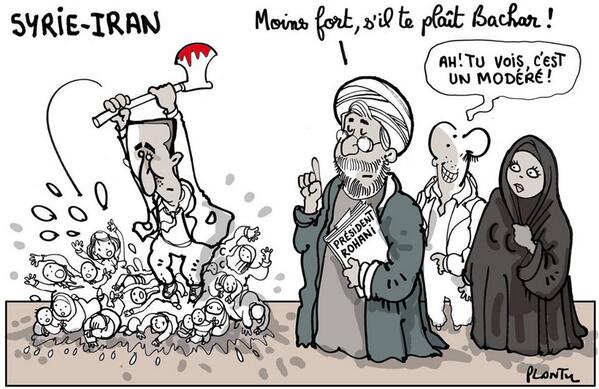
"Moderate" Iranian President

Rime Allaf‏@rallaf 52m
Iran President Rohani: "Not so hard please, Bashar." Man to woman: "Ah, you see? He's a moderate."

Wednesday, September 4, 2013

As U.S. Pushes For Syria Strike, Questions Loom Over Obama Claims in Chemical Attack

Democracy Now!

"During Tuesday’s Senate hearing on Syria, Secretary of State John Kerry insisted the administration has irrefutable evidence showing the Assad regime was responsible for the deadly chemical attack in late August. But questions remain over key parts of the administration’s case for military action. To explore these issues, we speak with journalist Mark Seibel of McClatchy, co-author of the article, "To Some, U.S. Case For Syrian Gas Attack, Strike Has Too Many Holes." "When it came to questions of the efficacy of a U.N. investigation, or the number of people killed in the conflict, or even the U.S. rendition of what happened in what order, there are contradictions," Seibel says. The United States has claimed it had "collected streams of human, signals and geospatial intelligence" that showed the Assad government preparing for an attack three days before the event. "That claim raises two questions," Seibel writes. "Why didn’t the U.S. warn rebels about the impending attack and save hundreds of lives? And why did the administration keep mum about the suspicious activity when on at least one previous occasion U.S. officials have raised an international fuss when they observed similar actions?"...."

With Focus on U.S.-Led Strikes, Global Failure to Meet Syria’s Humanitarian Crisis Goes Unnoticed

Democracy Now!

"While Washington debates the use of military force in Syria, the United Nations has revealed the number of refugees who have fled the country’s civil war has topped two million, with another four million internally displaced. The tide of children, women and men leaving Syria has risen almost tenfold over the past 12 months. On average, almost 5,000 people take refuge in Syria’s neighboring countries every day. The United Nations warned last month that the war is fueling the worst refugee crisis since the Rwanda genocide in 1994. Overall, the fighting in Syria has killed more than 100,000 since 2011, including some 7,000 children. In Beirut, Lebanon, we’re joined by Oxfam America President Raymond Offenheiser, just back from visiting refugee camps in Jordan and Lebanon....."

Cluster Munitions: Syria Use Persists

But Treaty Shows Progress as Many Countries Destroy Stockpiles

"(Geneva) – The Syrian government is still using cluster munitions in its conflict even as nations that have joined the treaty banning the weapons are rapidly destroying their stockpiles, Human Rights Watch said today at the release of Cluster Munition Monitor 2013, a global report reviewing adherence to the Convention on Cluster Munitions.

“Syria is persisting in using cluster bombs, insidious weapons that remain on the ground, causing death and destruction for decades,” said Mary Wareham, Arms Division advocacy director at Human Rights Watch and a final editor of the report. “Meanwhile, other countries around the world that have joined the treaty are showing a strong commitment to get rid of cluster bombs once and for all.”....."

Hezbollah says Assad made 'big mistake' with chemical attack: report

The Daily Star

"BEIRUT: German’s foreign intelligence agency intercepted a phone call between a Hezbollah official and the Iranian Embassy with the former confirming the regime’s use of poisonous gas, saying President Bashar Assad made “a big mistake,” Der Spiegel magazine reported Tuesday.
During a secret briefing to select lawmakers Monday, the head of Germany’s intelligence agency, Gerhard Schindler told politicians that the service listened in on a conversation between a high-ranking Hezbollah official and the Iranian Embassy.
“The Hezbollah functionary seems to have admitted that poison gas was used," Schindler was quoted as saying
According to Schindler, the Hezbollah official said that "Assad lost his nerves and made a big mistake by ordering the chemical weapons attack.”
Last week, a security source told The Daily Star that at least four Hezbollah fighters were receiving treatment in Beirut after coming into contact with chemical agents in Syria,
The source, who spoke on condition of anonymity, said between four and five members came into contact with the chemical agents while searching a group of rebel tunnels in the Damascus suburb of Jobar over the weekend.
In the Der Spiegel article, Schindler said the analysis of the evidence at hand has led the German intelligence service to believe that Assad's regime used sarin gas on its citizens."


Real News Video: Victory Out of Reach for US in Syria

Patrick Cockburn: US strike against Syria will further entangle America, as each military action will make it more difficult to retreat


More at The Real News

Ready to Press the Button

Olle Johansson, Cagle Cartoons, Sweden

What is a Revolution?

A Total Mess

By Tariq Ali
CounterPunch

"Ever since the beginning of the Arab Spring there has been much talk of  revolutions. Not from me. I’ve argued against the position that mass uprisings on their own constitute a revolution, i.e., a transfer of power from one social class (or even a layer) to another that leads to fundamental change. The actual size of the crowd is not a determinant unless the participants in their majority have a clear set of social and political aims. If they do not, they will always be outflanked by those who do or by the state that will recapture lost ground very rapidly.

Egypt is the clearest example in recent years. No organs of autonomous power ever emerged. The Muslim Brotherhood, a conservative social force, that belatedly joined the struggle to overthrow Mubarik, emerged as the strongest political player in the conflict and, as such, won the elections that followed. Its factionalism, stupidity, and a desire to reassure both Washington and the local security apparatuses that it would be business as usual led it to make several strategic and tactical errors from its own point of view. New mass mobilizations erupted, even larger than those that had led to the toppling of Mubarak. Once again they were devoid of politics, seeing the army as their saviour and, in many cases, applauding the military’s brutality against the Muslim Brothers.

The result was obvious. The ancien regime is back in charge with mass support. If the original was not a revolution, the latter is hardly a counter-revolution. Simply the military reasserting its role in politics. It was they who decided to dump Mubarik and Morsi. Who will dump them? Another mass mobilization?  I doubt it very much. Social movements incapable of developing an independent politics are fated to disappear.......

The idea that Saudia, Qatar, Turkey backed by  NATO are going to create a revolutionary democratic or even a democrat set-up is challenged by  what is happening elsewhere in the Arab world. The democrat Hollande defends and justifies the Moroccan autocracy, the Saudis prevent Yemen from moving forward and occupy Bahrein,  Erdogan has been busy with repression at home, Israel is not satisfied with a PLO on its knees and is pushing for Hamas to do the same (Morsi might have helped in that direction) so it can have another go at Hezbollah.

The region is in a total mess and most Syrian refugees in Lebanon and Jordan are only too well aware that US strikes will not make their country better. Many of the courageous citizens of Syria who started the uprising are in refugee camps. Those at home fear both sides and who can blame them."

Walking a fine line on Syria

Pursuing two strategies at the same time may lead to a muddle

By Brian Whitaker

"One consequence of President Obama's decision to refer the Syrian chemical weapons issue to Congress is that any action the US eventually decides upon risks being shaped more by the need for congressional votes than an objective assessment of what would be most effective.
As Wells Bennett points out on the Lawfare blog, any statute authorising force "must be broad enough to win support from intervention-ish Senators like Lindsey Graham and John McCain, but also narrow enough to command votes from congressional democrats". 

This could result in a jumbled compromise that satisfies nobody. Not that it necessarily will, but there's a possibility. Let's see how it's going so far.

A few days ago, Obama set out his own position: no open-ended commitment, no boots on the ground, and consideration of options "that meet the narrow concern around chemical weapons".

That's how it should be. Regardless of everything else that is happening in Syria, use of chemical weapons – anywhere – ought to be a red line, but not an excuse to join in the broader conflict. It should not become a backdoor way, as Anthony Cordesman of the Center for Strategic and International Studies recently advocated, of achieving other goals such as "limiting the growth of Iranian and Hezbollah influence". 

The latest draft of the senate resolution (full text here) does appear to follow Obama's preferred line quite closely, though it also opens up the possibility of broadening the goals. The current text, of course, may well be amended again in the days to come. Section 2(a) currently states:

The President is authorised ... to use the Armed Forces of the United States as he determines to be necessary and appropriate in a limited and tailored manner against legitimate military targets in Syria, only to:
(1) respond to the use of weapons of mass destruction by the Syrian government in the conflict in Syria;
(2) deter Syria's use of such weapons in order to protect the national security interests of the United States and to protect our allies and partners against the use of such weapons; and
(3) degrade Syria's capacity to use such weapons in the future.

The draft sets a time limit of 60 days for this authorisation, with one possible extension of a further 30 days.

The draft specifically limits military action to Syrian territory (a previous draft did not do so – opening up the possibility of strikes elsewere, such as Lebanon or Iran).

It has also been widely reported that the draft rules out "boots on the ground". That is not quite accurate. The document actually says it "does not authorise the use of the United States Armed Forces on the ground in Syria for the purpose of combat operations". In other words, troops could be sent to Syria in a non-combat role, such as "advising" and training rebel fighters.

While insisting that the issue is chemical weapons, the draft does allow scope for blurring of goals. It notes, for example, that the use of military force is "consistent with and furthers" the goals of the US strategy towards Syria, including achieving a negotiated political settlement to the conflict. Thus, degrading Assad's capacity to use chemical weapons, while not intended to overthrow him, is seen as assisting more general American objectives.

This is spelled out in more detail in Section 5 of the draft, which says:

Not later than 30 days after the date of the enactment of this resolution, the President shall consult with Congress and submit to the Committee on Foreign Relations of the Senate and the Committee on Foreign Affairs of the House of Representatives an integrated United States Government strategy for achieving a negotiated political settlement to the conflict in Syria, including a comprehensive review of current and planned US diplomatic, political, economic, and military policy towards Syria, including: 
(1) the provision of all forms of assistance to the Syrian Supreme Military Council and other Syrian entities opposed to the government of Bashar al-Assad that have been properly and fully vetted and share common values and interests with the United States; 
(2) the provision of all forms of assistance to the Syrian political opposition, including the Syrian Opposition Coalition; 
(3) efforts to isolate extremist and terrorist groups in Syria to prevent their influence on the future transitional and permanent Syrian governments; 
(4) coordination with allies and partners; and 
(5) efforts to limit support from the Government of Iran and others for the Syrian regime.

This is where it all gets rather tricky. The plan, while tackling chemical weapons, is also to pursue a "negotiated political settlement" by means that are at least partly military.

Referring to the chemical weapons issue yesterday, Obama
said: "What we are envisioning is something limited. It is something proportional. It will degrade Assad's capabilities," but then added: "At the same time we have a broader strategy that will allow us to upgrade the capabilities of the opposition."

So the US is pursuing two Syria strategies at the same time – one related to chemical weapons, the other to the wider conflict. Obviously it would be madness to have these two strategies working at cross-purposes, and if the response to chemical weapons helps to bring the general conflict to a swifter conclusion no one can complain. 

Equally, though, trying to maintain the worldwide ban on chemical weapons is a matter of principle and other policy considerations regarding Syria should not be allowed to get in the way of that. 

Pursuing these two strategies in parallel may just be possible but the more they become merged the more what was originally a principled stand on chemical weapons will be seen as an excuse for something else.

It's an extremely fine line. Will Obama be able to stick to it?"

Tuesday, September 3, 2013

Al-Jazeera Video: في العمق- الانقلابات العسكرية والتحول الديمقراطي

AN EXCELLENT PROGRAM!


"تناولت الحلقة النفوذ الذي ما زالت تتمتع به المؤسسة العسكرية في مصر رغم ثورة 25 يناير التي أطاحت بحكم حسني مبارك. والانقلابات العسكرية والتحول الديمقراطي.
تقديم: علي الظفيري
ضيوف الحلقة: عبيد الوسمي، يزيد الصايغ

"

Dubious Intelligence and Iran Blackmail: How Israel is Driving the US to War in Syria

By Max Blumenthal

".....
Iran blackmail, the coming campaign

Now that Obama has turned to Congress to authorize force against Syria, he is under relentless attack in Israel, with a chorus of pundits and politicians hammering him for his act of betrayal and cowardice in the face of evil. Amidst the din of condemnation, a talking point has emerged that will likely figure at the heart of Israel’s case to Congress and the American public this week.

The message was neatly summarized in the headline of a piece by the Likud-friendly correspondent Herb Keinon in the Jerusalem Post: “Weak world response on Syria boosts chance of strong Israeli action on Iran.” Referring to Obama’s decision and the British’ parliament’s vote against participating in a strike on Syria, Keinon wrote, “That kind of international dallying is not the type of behavior that will instill confidence in Israeli leaders that they can count on the world when it comes to Iran.”

At Haaretz, Amos Harel reinforced the talking point in a piece of analysis that claimed “Arabs perceive Obama as weak” – but which cited absolutely zero Arabs. Running through a litany of examples of supposed American weakness, Harel concluded, “it’s no wonder that Prime Minister Benjamin Netanyahu is becoming increasingly persuaded that no one will come to his aid if Iran suddenly announces that it is beginning to enrich uranium to 90 percent.”

The threat of a unilateral Israeli strike on Iran if the US does not act on Syria is slowly seeping into American media, and will almost certainly grow more pronounced this week as pro-Israel pundits and members of the Obama administration unite on their message. AIPAC may also join the push for congressional authorization, a move the night flower-style lobby managed to avoid during the run-up to invading Iraq. If the Israel lobby is forced into the open, it could hold the prospect of an attack on Iran like a gun to the heads of members of Congress, warning them that the price of inaction is a regional conflagration....."

Nine Tory MPs who did not back Syria strike received Assad's hospitality

MPs speak of their experiences on trips over past 10 years, and decisions to abstain or vote against motion for military action

, political correspondent
The Guardian,


Could U.S. Military Action Turn Syrian Civil War Into a "Widespread Regional War"?

Democracy Now!

"The White House has launched what it describes as a "flood the zone" campaign to persuade Congress to authorize bombing Syria days after President Obama surprised many by announcing he would seek congressional approval before taking action against the Syrian government. On Saturday, the White House released a proposed military resolution that authorizes the president to use the armed forces "as he determines to be necessary and appropriate in connection with the use of chemical weapons or other weapons of mass destruction in the conflict in Syria." Critics of military intervention say the draft resolution could open the door to possible use of ground troops or eventual attacks on other countries. “It would intensify sectarian tensions inside Syria and neighboring states in particular in Lebanon and Iraq,” says Fawaz Gerges, professor of international relations and Middle East studies at the London School of Economics and Political Science. “It would deepen the involvement of regional powers further in Syria, particularly Saudi Arabia, Turkey, and Qatar on the one hand, and Iran, Hezbollah and to a smaller extent, Iraq. It would rekindle the collective memory of Arabs and Muslims of previous Western hegemonic attacks. The Iraq model is very much alive in the Arab imagination.” While Washington debates the use of military force, the United Nations has revealed the number of refugees who have fled Syria has topped two million. The tide of children, women and men leaving Syria has risen almost 10-fold over the past 12 months......."

Current Al-Jazeera (Arabic) Online Poll


Do you think that the expected strike against Syria (by the West) will lead to a regional war in the Middle East?

With over 1,300 responding, 67% said no.

Insight: As Obama blinks on Syria, Israel, Saudis make common cause

القدس المحتلة- الرياض- (رويترز): إذا كان الرئيس الأمريكي باراك أوباما قد خيب آمال مقاتلي المعارضة السورية برجوعه إلى الكونغرس قبل قصف دمشق فإنه لم يبتعد أيضا عن إزعاج الحليفين الرئيسين...
"(Reuters) - If President Barack Obama has disappointed Syrian rebels by deferring to Congress before bombing Damascus, he has also dismayed the United States' two main allies in the Middle East.
Israel and Saudi Arabia have little love for each other but both are pressing their mutual friend in the White House to hit President Bashar al-Assad hard. And both do so with one eye fixed firmly not on Syria but on their common adversary - Iran.
Israel's response to Obama's surprise move to delay or even possibly cancel air strikes made clear that connection: looking soft on Assad after accusing him of killing hundreds of people with chemical weapons may embolden his backers in Tehran to develop nuclear arms, Israeli officials said. And if they do, Israel may strike Iran alone, unsure Washington can be trusted.
Neither U.S. ally is picking a fight with Obama in public. Israeli Prime Minister Benjamin Netanyahu said on Sunday that the nation was "serene and self-confident"; Saudi Foreign Minister Prince Saud al-Faisal simply renewed a call to the "international community" to halt Assad's violence in Syria.
But the Saudi monarchy, though lacking Israel's readiness to attack Iran, can share the Jewish state's concern that neither may now look with confidence to Washington to curb what Riyadh sees as a drive by its Persian rival to dominate the Arab world......"

Monday, September 2, 2013

Al-Jazeera Video: The Manufacturing of a New Pharaoh: دعوات لترشيح السيسي للرئاسة مـع حملات تمجّـده


COMMENT

This Hamdeen Sabahi has proved to be an unprincipled opportunist and Tamarrud is clearly a creation of the remnants of the old regime and the military.

I have given up hope on Egypt, and the rest of the Arab world for that matter.

Syrians want rid of President Assad, but without US bombs

There's little trust in America's motives, and an airstrike would not stop the brutal slaughter of civilians. Far better to help the rebels directly


The Guardian,


Al-Jazeera Video: حديث الثورة.. دعوات الجامعة العربية لدعم التدخل بسوريا

Al-Jazeera Video: ذبح بلا دم


"فيلم "ذبح بلا دم" عن مجزرة الكيميائي في الغوطة في سوريا "

Talking to Mr Assad

Crisis Group's call for 'far-reaching concessions' on Syria

By Brian Whitaker

"The International Crisis Group is a widely respected thinktank based in Brussels. Yesterday it posted a statement about Syria on its website and various people started tweeting in its praise. The comments sounded like those "reviews" you find on theatre billboards or on the back cover of books:

Naturally, I clicked on the link and found so many vague platitudes that for a moment I wondered if it was some kind of parody. I was relieved, therefore, to see a few hours later that I wasn't the only person concerned by what it said. Rime Allaf, a Syrian, tweeted:

"Stunned by ICG Syria statement, rehashing diplomatic generalities & even suggesting flexibility with Assad in power"

That, more or less, is what I had been thinking myself. Basically, the ICG's view is that there has to be a political settlement in Syria, and it seems to have decided that the chemical weapons crisis provides a good opportunity to re-state its case. As a result it blurs the lines between two issues which, though related in some ways, need to be kept separate..

Discussions about military action (over chemical weapons), the statement says, should be judged based on whether it helps to revitalise the search for a political settlement or further postpones it. 

That would be a catastrophic mistake: it confuses goals and could very easily lead to mission creep and a further escalation of the conflict. Obama has already said that any direct military action in Syria should "meet the narrow concern around chemical weapons" – and he's absolutely right about that.

It would be tedious to analyse the ICG statement line by line but I can see why so many people have been nodding with approval. At a very superficial level it offers a "peaceful" alternative for Syria without delving too deeply into the difficulties of achieving that.

No reasonable person would disagree that at some point there will have to be a political settlement to clear up the mess. The question is when, and on what terms.

The most troubling part of the ICG statement is where it says a political solution requires "far-reaching concessions" from all parties but then proposes keeping Assad in power – at least for a while:

"A viable political outcome in Syria cannot be one in which the current leadership remains indefinitely in power but, beyond that, the US can be flexible with regards to timing and specific modalities."

Apart from the fact the Assad's departure is the most fundamental of the opposition's goals, the idea of doing business now with a man whose hunger for power has cost more than 100,000 lives ought to be utterly abhorrent.

But let's suppose that a deal could be agreed, with "the current leadership" and opposition forming a coalition for some "transitional" period. A transition that "builds on existing institutions" – most notably Assad's army – rather than replacing them (as the ICG proposes). A transition in which the US reaches out to Russia and Iran for help in seeing it through (again, as the ICG proposes).

It's easy to imagine what would happen next. Assad would view it as a lifeline and immediately start re-establishing himself. We are not talking here about a normal government. Syria is not Austria or New Zealand – it has the most ruthless regime in the Middle East.

The ICG's statement also calls for renewed efforts to convene a Geneva conference by the joint UN/Arab League envoy, Lakhdar Brahimi – a man who has the distinction of having negotiated more failed ceasefires than any other international diplomat.

Looking back through the ICG's website, I found another statement headed "Now or Never: A Negotiated Transition for Syria", advocating much the same thing when Kofi Annan was appointed as envoy. It's dated 5 March 2012, so the moment, if there really was one, has long since passed. 

Tragic as it is, there's no hope of a political settlement until Assad goes. But that's a matter for the Syrians and we should not view the chemical weapons issue as a way to bring it about."

Real News Video: Unrest In Egypt Squeezes Gaza

Turmoil and unrest in Egypt harming Gazans who are relient on the Rafah crossing as the lone way to circumvent Israeli blockade 


More at The Real News

Scornful Syria hails 'historic American retreat' as Obama hesitates

Click on the Cartoon to send it to a friend!
"(Reuters) - Syria hailed a "historic American retreat" on Sunday, mockingly accusing President Barack Obama of hesitation and confusion after he delayed a military response to last month's chemical weapons attack near Damascus until after a congressional vote.
U.S. Secretary of State John Kerry said tests had shown sarin nerve gas was fired on rebel-held areas on August 21, and expressed confidence that U.S. lawmakers would do "what is right" in response.....

With Obama drawing back from the brink, President Bashar al-Assad reacted defiantly to the threat of Western retaliation, saying Syria was capable of confronting any external strike.
He left his most withering comments to his official media and a junior minister.
"Obama announced yesterday, directly or through implication, the beginning of the historic American retreat," Syria's official al-Thawra newspaper said in a front-page editorial.
Syrian Deputy Foreign Minister Faisal Mekdad accused Obama of indecision. "It is clear there was a sense of hesitation and disappointment in what was said by President Barack Obama yesterday. And it is also clear there was a sense of confusion as well," he told reporters in Damascus....."

Al-Jazeera Video: ما وراء الخبر.. تداعيات هدم منازل وأنفاق برفح المصرية


The Syrian Electronic Army, a group of political hacktivists working in support of Syrian President Bashar al-Assad, has hacked into a website of the US Marines.

The Syrian Electronic Army, a group of political hacktivists working in support of Syrian President Bashar al-Assad, has hacked into a website of the US Marines.

The Guardian

"....
The tone of the message is interesting, describing the Marines as their "brothers", appealing rather than threatening or ridiculing. It says:
This is a message written by your brothers in the Syrian Army, who have been fighting al-Qaida for the last 3 years.
We understand your patriotism and love for your country so please understand our love for ours.
Obama is a traitor who wants to put your lives in danger to rescue al- Qaida insurgents.
Marines, please take a look at what your comrades think about Obama's alliance with al-Qaida against Syria.
 Your officer in charge probably has no qualms about sending you to die against soldiers just like you, fighting a vile common enemy. The Syrian army should be your ally not your enemy.
Refuse your orders and concentrate on the real reason every soldier joins their military, to defend their homeland.
You're more than welcome to fight alongside our army rather than against it.
Your brothers, the Syrian army soldiers. A message delivered by the SEA 
Marines website hacked by Syrian Electronic Army
The Syrian Electronic Army has hacked into a website of the US Marines Photograph: /Screengrab from marines.com....."

Sunday, September 1, 2013

British Government let British company export nerve gas chemicals to Syria


The Government was accused of “breathtaking laxity” in its arms controls tonight after it emerged that officials authorised the export to Syria of two chemicals capable of being used to make a nerve agent such as sarin a year ago.


The Business Secretary, Vince Cable, will on Monday be asked by MPs to explain why a British company was granted export licences for the dual-use substances for six months in 2012 while Syria’s civil war was raging and concern was rife that the regime could use chemical weapons on its own people. The disclosure of the licences for potassium fluoride and sodium fluoride, which can both be used as precursor chemicals in the manufacture of nerve gas, came as the US Secretary of State John Kerry said the United States had evidence that sarin  gas was used in last month’s atrocity in Damascus.

Mr Kerry announced that traces of the nerve agent, found in hair and blood samples taken from victims of the attack in the Syrian capital which claimed more than 1,400 lives, were part of a case being built by the Obama administration for military intervention.

The Department for Business, Innovation and Skills insisted that although the licences were granted to an unnamed UK chemical company in January 2012, the substances were not sent to Syria before the permits were eventually revoked last July in response to tightened European Union sanctions.

In a previously unpublicised letter to MPs last year, Mr Cable acknowledged that his officials had authorised the export of an unspecified quantity of the chemicals in the knowledge that they were listed on an international schedule of chemical weapon precursors.

Syria – a chilling hypothesis

Has Assad borrowed Saddam's chemical strategy?
By Brian Whitaker

"Immediately after the chemical attacks near Damascus on August 21, the first reaction of many people – apart from horror at the mass slaughter – was to ask what the Assad regime could have hoped to gain from it. 
Some asked the question out of sheer puzzlement, others because they doubted the regime could have been responsible. Surely it would be madness to do such a thing while UN weapons inspectors were in their hotel just a few miles from the scene. How on earth could the regime expect to get away with it?

It's worth revisiting this question because we know somewhat more now than we did then, and trying to find an answer may give some pointers to the regime's future behaviour.

The chemical attacks on August 21 were by no means the first of the Syrian conflict. According to last week's US intelligence report, for example, the regime has used chemical weapons on a small scale against the opposition multiple times in the last year, including in the Damascus suburbs. The British government's intelligence report, also published last week, said the regime had used chemical weapons on at least 14 occasions in the past.

A recent article in Le Monde provided details about how such weapons were allegedly used in earlier attacks – basically to crack resistance in the areas of toughest fighting.

Up to a point, the August 21 attacks fit this established pattern – except that none had previously caused casualties on such an enormous scale. What we don't yet know is whether the huge number of deaths was unintentional – the result of careless use of chemical weapons – or deliberate.

Even though the UN inspectors were in Damascus at the time, the regime had little reason to fear them. They had arrived three days earlier with a very restricted mandate that had taken months for the UN to negotiate. 

During a two-week stay they were due to visit Khan al-Assal, near Aleppo, where rebels said the regime had used chemical weapons last March, plus two other sites which had not been publicly named. Khan al-Assal had since fallen into rebel hands and there were doubts as to whether they would actually get there.

In addition to that, under the UN's agreement with the regime they were allowed to investigate whether chemical weapons had been used, but not who used them.

With the inspectors thus confined in their straitjackets, the regime may have felt confident enough to carry on using chemical weapons regardless. If so, it was wrong. Once the scale of the Damascus attacks became clear, it had little choice but to let the inspectors visit – since refusal would amount almost to an admission of guilt. It delayed them for a while, though, possibly in the hope that evidence would be lost.

As with the attacks themselves, the question this raises is whether it was a cock-up or deliberate. Did the regime expect that the inspectors' presence would not be a problem, or was it trying to make a mockery of them?

Since the Syrian conflict began, Assad has escalated the violence ruthlessly but skilfully, stepping it up a notch at a time and each time getting away with it. In this way the world has become inured to it and reacts less strongly to further increases.

Even so, mass killing with chemical weapons is a big step, especially after Obama's "red line" warning a year ago. But here's a chilling hypothesis.

Suppose, for the sake of argument, that the regime is looking for a way to break the deadlock between its own forces and the rebels, that it has decided the only way to do this is with chemical weapons, and has calculated that other countries will not intervene to stop it.

I know many readers will think this is far too fanciful, even where the Assad regime is concerned. But there is a precedent. It happened once before, in Iraq during the 1980s. Take a look at
this article by Steve Coll in the New Yorker which begins:

Early in 1987, Saddam Hussein, the Iraqi President, decided to clear out scores of Kurdish villages, in order to undermine separatist rebels. He asked Ali Hassan al-Majid, a general and a first cousin, to lead the project. 
In tape recordings later produced by Iraqi prosecutors, Majid told Baath Party colleagues that the novelty and the terror of chemical weapons would “threaten” the Kurds and “motivate them to surrender.” 
On April 16th of that year, Iraq became the first nation ever to drop gas bombs on its own citizens; the gassing campaign lasted two years and killed thousands of people. 
“I will kill them all with chemical weapons!” Majid told his colleagues. “Who is going to say anything? The international community? Fuck them! The international community and those who listen to them!”

The article goes on to say:

Saddam saw great value in chemical arms during the nineteen-eighties, and his twisted logic bears examination in the light of Syria's deteriorating conflict. Saddam first used gas bombs to thwart Iran’s zealous swarms of "human wave" infantry. Chemical terror broke the will of young Iranian volunteers, a lesson that informed Majid’s subsequent Kurdish campaign. 
The Reagan Administration's decision to tolerate Saddam’s depravities proved to be a colossal moral failure and strategic mistake; it encouraged Saddam's aggression and internal repression, and it allowed Iraq to demonstrate to future dictators the tactical value of chemical warfare."


حرب "الأنفاق" تستعر في غزة

عــ48ــرب

كشفت مصادر فلسطينية مطلعة عن أن الجيش المصري يستعد لإقامة منطقة عازلة على طول الشريط الحدودي مع قطاع غزة تتراوح ما بين 250-500 متر بغية تدمير كافة الأنفاق الأرضية.

وقالت المصادر الفلسطينية إن الجيش المصري يهدف من إقامة المنطقة العازلة إلى مراقبة الشريط الحدودي وضبط كافة الأنفاق، والتي يعتبرها "تهديدًا للأمن القومي المصري".

بلاغات بإخلاء بيوت غزية

وشهدت المنطقة الحدودية بين مصر وقطاع غزة حالة استنفار أمني شديدة، حسب ما ذكرته صحيفة "اليوم السابع" على موقعها الإلكتروني، منوهة إلى أن قوات الأمن قامت بالتجمع في مناطق يشتبه وجود أنفاق بها. وطالبت القوات الأمنية المصرية أصحاب المنازل بمناطق الصرصورية بالابتعاد عنها ليتسنى تدمير عدد من الأنفاق بالمنطقة.

هذا وأشارت المصادر إلى أن الجيش المصري سيعمل على تطبيق المخطط على مدار الأسابيع المقبلة لإحكام قبضته على الحدود مع قطاع غزة.

رفض ودعوة للاحتشاد

وأضافت: "وزعت قوات الأمن المصرية بلاغات على أصحاب المنازل القريبة من الحدود بضرورة إخلاءها سريعا، تمهيدا لبدء عملية تدمير الأنفاق الحدودية."

وذكرت تقارير إعلامية مصرية أن أهالي المناطق الحدودية المستفيدين من عمل الأنفاق، على حد تعبيرهم، رفضوا تلك البلاغات ودعوا المواطنين، عبر مكبرات الصوت، للاحتشاد ومنع عمليات الهدم حتى لا يتم ترحيلهم من المنطقة، بحسب قولهم.

"الأحياء تحت الأرض" يؤمنون الأنفاق

في المقابل، رصدت صحيفة "ديلي ميل" البريطانية، وأكدت بالصور، استمرار عمل العديد من الأنفاق بلا توقف حتى الآن، رغم الحظر الذي تفرضه حكومة "حماس" على تجارة الأنفاق السرية بين سيناء وقطاع غزة.

ووثقت الصحيفة بالكاميرا حياة الفلسطينيين الذين يعملون بهذه الأنفاق، والتي وصفتهم بأنهم "الأحياء تحت الأرض" حيث يعيش عشرات الشباب في هذه الأنفاق ويعملون ليل نهار من أجل تأمين الأنفاق والحفاظ عليها من الانهيار، بالإضافة إلى تهريب البضائع.

نقاط تفتيش وضرائب

وبعد مفاوضات طويلة، وافقت حركة "حماس" على التصوير داخل الأنفاق، وذلك لتؤكد أنها مازالت قادرة على تشغيل الأنفاق حتى في ظل الحملة التي يقوم بها الجيش في سيناء حاليا.

وأشارت الصحيفة إلى أن "حماس" تفرض رقابة أمنية صارمة على الأنفاق وتقيم عدة نقاط تفتيش بالقرب من كل نفق لحراسته، بالإضافة إلى تحصيل الرسوم الخاصة بالبضائع التي يتم ترهيبها.

Real News Video: Chris Hedges on Obama Decision to Attack Syria and "Give Congress a Voice"

Chris Hedges and Paul Jay discuss President Obama's statement that he has decided to attack Syria and seek authorization from Congress . . . Even though he says he doesn't need it


More at The Real News

More Flip-Flopping From the Flopping Duo: KERRY BEATS WAR DRUMS AGAIN


"John Kerry: Evidence Of Sarin Gas Used In Syria, U.S. 'Case Is Building' For Strike ......"

"Red" Lines of Obama


ON SECOND THOUGHT.....

Thumbing His Nose, by Emad Hajjaj

Click on the Cartoon to send it to a friend!

Syria crisis: Reaction to Obama decision on military action - live updates

The Guardian

For Once I Agree with the Assessment of the Bloody Syrian Regime:

"Syria's permanent representative to the UN, Bashar al-Jaafari, has suggested that Barack Obama and David Cameron decided to seek approval before military action because they were looking for a way out after banging the drums of war, the state news agency Sana reports:
Jaafari said that US President Barack Obama and British Prime Minister David Cameron "climbed to the top of the tree and don't know how to get down," which is why they resorted to the House of Commons and the Congress to seek a way out of the trouble they got themselves into, or were placed in by others.
In a phone call with the Syrian TV on Saturday, Jaafari said that Obama is under a lot of pressure from the hardline right wing, neo-Zionists, Israel, Turkey and some Arabs, and that he did well by emulating Cameron by referring the decision of waging an aggression on Syria to the congress, which is how Cameron "got down from the tree."....."