Madawi Al-Rasheed: Powerful princes control various sections of the state and armed forces and often have their own contradictory agendas

Tuesday, April 8, 2014


Monday, April 7, 2014
Real News Video: Why do the Saudis Want the US to Attack Iran? (4/5)
Madawi Al-Rasheed: Saudi Arabia has the ultimate objective of becoming the arbiter of all regional politics
New US reality: An empire beyond salvation
By Ramzy Baroud
Asia Times
"After eight months of wrangling to push talks between Israel and the Palestinian Authority forward, US Secretary of State John Kerry has acknowledged the latest setback to be a "reality check" for the Palestinian peace process. But for the Americans, the last few years have been less a "reality check" around the globe, more the new reality itself.......
Even the "pivot" to Asia is likely to end in shambles. On the one hand, the US's opponents, Russia notwithstanding, have grown much more assertive in recent years. They too have their own agendas, which will keep the US and its willing European allies busy for years. The Russian move against Crimea had once more exposed the limits of US and NATO in regions outside the conventional parameters of Western influence.
If the US proved resourceful enough to stage a fight in the South China Sea and the East China Sea, the battle - over energy supplies, potential reserves, markets and routes - is likely to be the most grueling yet. China is not Iraq before the US invasion - broken by decades of war, siege and sanctions. Its geography is too vast to besiege, and its military too massive to destroy with a single shock and awe.
The US has truly lost the initiative, in the Middle East region and beyond it. The neo-cons' drunkenness with military power led to costly wars that have overwhelmed the empire beyond salvation. Now, US foreign-policy makers are mere diplomatic firefighters, from Palestine, to Syria to Ukraine. For the Americans, the last few years have been less a "reality check", more the new reality itself. "
Asia Times
"After eight months of wrangling to push talks between Israel and the Palestinian Authority forward, US Secretary of State John Kerry has acknowledged the latest setback to be a "reality check" for the Palestinian peace process. But for the Americans, the last few years have been less a "reality check" around the globe, more the new reality itself.......
Even the "pivot" to Asia is likely to end in shambles. On the one hand, the US's opponents, Russia notwithstanding, have grown much more assertive in recent years. They too have their own agendas, which will keep the US and its willing European allies busy for years. The Russian move against Crimea had once more exposed the limits of US and NATO in regions outside the conventional parameters of Western influence.
If the US proved resourceful enough to stage a fight in the South China Sea and the East China Sea, the battle - over energy supplies, potential reserves, markets and routes - is likely to be the most grueling yet. China is not Iraq before the US invasion - broken by decades of war, siege and sanctions. Its geography is too vast to besiege, and its military too massive to destroy with a single shock and awe.
The US has truly lost the initiative, in the Middle East region and beyond it. The neo-cons' drunkenness with military power led to costly wars that have overwhelmed the empire beyond salvation. Now, US foreign-policy makers are mere diplomatic firefighters, from Palestine, to Syria to Ukraine. For the Americans, the last few years have been less a "reality check", more the new reality itself. "
The Crucible of Iraq
By Chris Hedges
"“The Corpse Exhibition: And Other Stories of Iraq,” by Hassan Blasim, is the most important book to come out of the Iraq War. Blasim, whom I met with last week in Princeton, N.J., has a faultless eye for revealing detail, a ribald black humor and a psychological brilliance that makes every story in his book a depth charge. In this collection of short stories he explores through fiction the culture of violence unleashed under the bloody dictatorship of Saddam Hussein and exacerbated by an American occupation that has destroyed the damaged social cohesion and civil life that survived Saddam’s regime. His prose, courtesy of a brilliant translation by Jonathan Wright, is lyrical, taunt and riveting.
.....Blasim, like his characters, endures the covert racism of supposedly post-racial societies. Liberal white Europeans and Americans, he says, regard racism as wrong but continue to unconsciously express racist impulses. Blasim, for example, was reading a book in a subway car when an older woman next to him asked if it was in Arabic. “It is beautiful script,” she told him. “The writing goes from right to left, doesn’t it?” He nodded. “Are you reading the Koran?” she asked. “No,” he said, “Kafka.”
"“The Corpse Exhibition: And Other Stories of Iraq,” by Hassan Blasim, is the most important book to come out of the Iraq War. Blasim, whom I met with last week in Princeton, N.J., has a faultless eye for revealing detail, a ribald black humor and a psychological brilliance that makes every story in his book a depth charge. In this collection of short stories he explores through fiction the culture of violence unleashed under the bloody dictatorship of Saddam Hussein and exacerbated by an American occupation that has destroyed the damaged social cohesion and civil life that survived Saddam’s regime. His prose, courtesy of a brilliant translation by Jonathan Wright, is lyrical, taunt and riveting.
Militarism and violence are diseases. It does not matter under what guise they appear. Renegade jihadists, Shiite death squads, Sunni militias, Saddam’s Baathists and secret police, Kurdish Peshmerga rebels, al-Qaida cells, gangs of kidnappers and the U.S. Army 101st Airborne are all infected with the same virus. And it is a virus Blasim fearlessly inspects. By the end of this short-story collection the reader grasps, in a way no soldier’s memoir or journalistic account from Iraq can explicate, the crucible of war and the unmitigated horror of violence itself. The book is a masterpiece.
.....Blasim, like his characters, endures the covert racism of supposedly post-racial societies. Liberal white Europeans and Americans, he says, regard racism as wrong but continue to unconsciously express racist impulses. Blasim, for example, was reading a book in a subway car when an older woman next to him asked if it was in Arabic. “It is beautiful script,” she told him. “The writing goes from right to left, doesn’t it?” He nodded. “Are you reading the Koran?” she asked. “No,” he said, “Kafka.”
He described to me his ordeal of getting a visa so he could go to the United States to give readings. At the U.S. Embassy in Helsinki he had to pass through a security gantlet. When he eventually arrived before a woman behind a bulletproof window, she asked him the address he would be staying at in the U.S. He did not remember. When he said he would get the information from his bag, she shouted, “Don’t move!” “I felt I was back in Iraq. The U.S. Army does not need a visa to go to Iraq. No one invites them. They arrive with guns. But if you are a writer and try to go to America with an invitation from your publisher you are nothing because you are an Iraqi.”......."
Sunday, April 6, 2014
AFGHAN ELECTIONS FOR ANOTHER FAKE REGIME
By Eric Margolis

April 5, 2014
Afghanistan’s national election held this week is a sham. A group of candidates, handpicked by the US, will pretend to compete in an election whose outcome has already been determined – by Washington.
The candidates include US groomed politicians, and drug-dealing warlords from the Tajik and Uzbek north. Chief among them, Rashid Dostam, a major war criminal and principal CIA ally who ordered the massacre of over 2,000 Taliban prisoners.
Such is the rotten foundation on which Washington is hoping to build a compliant Afghan “democracy” that will continue to offer bases to US troops and warplanes. Afghanistan’s majority, the Pashtun tribes, have little voice in the election charade.
The largest, most popular party in Afghanistan, Taliban, and its smaller ally, Hisbi-Islami, have been excluded as “terrorists” from the current and past elections. They are boycotting the vote, rightly claiming it will be rigged and run by the western powers and their local collaborators. We see this same pattern of faux democracy across the Mideast.
If an open vote was held today, Taliban would probably win. Americans have no problem it seems working with Afghan Communists, war criminals, and drug kingpins. In fact, under American rule, opium, morphine and heroin production in Afghanistan has surged to all-time record highs. This is called “nation-building.”
After 12 years of using everything in its arsenal short of nuclear weapons, the mighty US military has failed to defeat lightly-armed Taliban forces. The Pashtun tribes are almost certain to keep on fighting indefinitely. A favorite Taliban saying: “the Americans have watches; we have time.” The Pashtun defeated four British attempts to colonize Afghanistan, the Soviet effort in the 1980’s, and now the US occupation.
Afghanistan has proved the longest war in America’s history. As US troops and heavy bombers attacked Taliban position, I wrote in the Los Angeles Times and other newspapers that invading Afghanistan was a terrible mistake, a war that would not be won. Not surprisingly, I was widely denounced.
My column of 26-years was blacklisted by a major newspaper chain after I dared to say the war was lost and a waste of blood and money.
I knew this having been in the field with the Afghan mujahidin during the 1980’s Great Jihad (holy war) against Afghanistan’s Soviet occupiers – recounted in my “War at the Top of the World.”
A few years later, I was present at the birth of Taliban. The Pashtun movement arose during the early 1990’s Afghan civil war to fight the mass rape of Afghan women, and combat foreign-backed Afghan Tajik and Uzbek Communists.
Washington’s current plan is to install a new, post-Karzai Afghan client regime in Kabul, and keep control of the 400,000-man Afghan police and army who fight for US dollars. The tame Afghan regime will then “invite” some 16,000 US soldiers and airmen, plus large numbers of tribal mercenaries, to stay on and keep Taliban at bay.
The key to ongoing US control of Afghanistan is airbases at Bagram, Kandahar, Herat, and Shindand, supported by bases in Central Asia, Pakistan and the Gulf. The US and its allies could not retain their bases across Afghanistan without mounting hugely expensive 24-hour combat air patrols that respond within minutes to any Taliban attacks. Without constant resupply and support from the air, western forces would be quickly cut off and defeated.
This is one big reason why the war in Afghanistan has so far cost the US $1 trillion dollars. Billions have disappeared due to massive corruption. Without a steady stream of US dollars, the Afghan regime in Kabul would collapse. Pakistan has been paid over $18 billion since 2001 to fight its own Taliban and allow US military operations.
Meanwhile, President Barack Obama’s efforts to cut US occupation forces in Afghanistan are being openly and brazenly challenged by his own insubordinate military commanders who cannot face admitting defeat at the hands of Taliban – the ultimate humiliation for the high-tech US forces.
But now that China and Russia have challenged the US, the Pentagon has found a new foe and reasons for ever-bigger budgets. So it may reluctantly abandon the Afghan misadventure. After all, who remembers the Vietnam War and the disgraceful flight from Saigon?
US: Stop Blocking Palestinian Rights
Support Commitment to Abide by International Law

 EMAIL
EMAIL
It is disturbing that the Obama administration, which already has a record of resisting international accountability for Israeli rights abuses, would also oppose steps to adopt treaties requiring Palestinian authorities to uphold human rights. The US should press both the Palestinians and the Israelis to better abide by international human rights standards.
(Jerusalem) – The US government should support rather than oppose Palestinian actions to join international treaties that promote respect for human rights.
On April 1, 2014, the Palestinian leader, Mahmoud Abbas, signed accession instruments for 15 treaties, including the core treaties on human rights and the laws of war. On April 2, the US ambassador to the United Nations, Samantha Power, testified in front of Congress, that in response to the “new Palestinian actions” that the “solemn commitment” by the US to “stand withIsrael,” “extends to our firm opposition to any and all unilateral [Palestinian] actions in the international arena.”
“It is disturbing that the Obama administration, which already has a record of resisting international accountability for Israeli rights abuses, would also oppose steps to adopt treaties requiring Palestinian authorities to uphold human rights,” said Joe Stork, deputy Middle East director at Human Rights Watch. “The US should press both the Palestinians and the Israelis to better abide by international human rights standards.”
Palestine’s adoption of human rights and laws-of-war treaties would not cause any change in Israel’s international legal obligations.
Abbas signed letters of accession to core human rights treaties including the International Covenants on Civil and Political Rights and on Economic, Social and Cultural Rights and the conventions on the rights of the child; the elimination of discrimination against women; and against torture, apartheid, and genocide. Abbas also signed requests for Palestine to accede to treaties on the laws of war, including the Hague Regulations of 1907, the four Geneva Conventions of 1949, and their first additional protocol.
The human rights treaties he signed would impose obligations on the Palestinian government to respect, protect, and fulfill the human rights of people under their authority and effective control. The Palestinian Authority in the West Bank was not eligible to sign human rights treaties but its officials had repeatedly pledged to uphold human rights norms. Human Rights Watch has documented serious abuses by Palestinian security forces, including torture, arbitrary arrest, and the suppression of freespeech and assembly.
Ratification of the Hague Regulations and Geneva Conventions would strengthen the obligations of Palestinian forces to abide by international rules on armed conflict. Palestinian armed groups are already obliged by customary international law on armed conflict, including prohibitions on targeting civilians and on carrying out attacks that do not discriminate between civilians and combatants. Armed groups in Gaza, which operate outside the authority or effective control of the Palestinian leadership that signed the treaties, have committed war crimes by launching indiscriminate rocket attacks against Israeli population centers.
Abbas signed the treaties for the state of Palestine, which the UN General Assembly granted non-member observer state status in 2012.
The US appears to oppose Palestine joining human rights treaties in part because it is afraid they will gain greater support for Palestinian statehood outside the framework of negotiations with Israel. According to Power’s testimony to a congressional subcommitteeon April 2, the US has “a monthly meeting with the Israelis” to coordinate responses to possible Palestinian actions at the UN, which the US is concerned could upset peace negotiations. Power said that the US had been “fighting on every front” before peace negotiations restarted in 2013 to prevent such Palestinian actions. Discussing US legislation that bars US funding from UN agencies that accept Palestine as a member, Power noted, “The spirit behind the legislation is to deter Palestinian action [at the UN], that is what we do all the time and that is what we will continue to do.”
The US may also fear that the Palestinian moves are only a first step towards joining the International Criminal Court (ICC). But Abbas did not sign the Rome Statute of the ICC, which would allow the court to have jurisdiction over war crimes, crimes against humanity, and genocide committed in Palestine or by Palestinians. Power, in her remarks, said that the US is “absolutely adamant” that Palestine should not join the ICC because it “really poses a profound threat to Israel” and would be “devastating to the peace process.”
In either case, the US is mistaken to oppose a step that might lead to greater respect for rights, which could help create a better environment for peace negotiations, Human Rights Watch said.
“The US should stop allowing its separate concerns to stand in the way of a step that could enhance Palestinian authorities’ and armed groups’ respect for basic rights,” Stork said. “The US made the wrong decision to oppose greater rights protections.”
On April 1, the day Abbas signed the accession instruments for the treaties, Israel reissued tenders for the construction of 708 settlement housing units in the Israeli settlement of Gilo, while Israeli forces demolished 32 Palestinian-owned homes and other structures in the occupied West Bank, forcibly displacing 60 people, according to data collected by Ir Amim, an Israeli civil society group, and the UN Office for the Coordination of Humanitarian Affairs. Under the Geneva Conventions and the ICC statute, settlement construction and the deliberate forcible transfer of civilians from their homes and communities in occupied territory are war crimes.
Israel has ratified core human rights treaties but officially claims that its rights obligations do not extend to Palestinians in the territory it occupies, where it says the laws of armed conflict apply exclusively. UN rights bodies have completely rejected this argument on the basis that an occupying power’s human rights obligations extend to people living under its effective control. Israel additionally claims, also in the face of nearly universal rejection, that the Fourth Geneva Convention, which prohibits transferring its civilian population into occupied territory, does not apply to its settlements in the West Bank.
On April 1, 2014, the Palestinian leader, Mahmoud Abbas, signed accession instruments for 15 treaties, including the core treaties on human rights and the laws of war. On April 2, the US ambassador to the United Nations, Samantha Power, testified in front of Congress, that in response to the “new Palestinian actions” that the “solemn commitment” by the US to “stand withIsrael,” “extends to our firm opposition to any and all unilateral [Palestinian] actions in the international arena.”
“It is disturbing that the Obama administration, which already has a record of resisting international accountability for Israeli rights abuses, would also oppose steps to adopt treaties requiring Palestinian authorities to uphold human rights,” said Joe Stork, deputy Middle East director at Human Rights Watch. “The US should press both the Palestinians and the Israelis to better abide by international human rights standards.”
Palestine’s adoption of human rights and laws-of-war treaties would not cause any change in Israel’s international legal obligations.
Abbas signed letters of accession to core human rights treaties including the International Covenants on Civil and Political Rights and on Economic, Social and Cultural Rights and the conventions on the rights of the child; the elimination of discrimination against women; and against torture, apartheid, and genocide. Abbas also signed requests for Palestine to accede to treaties on the laws of war, including the Hague Regulations of 1907, the four Geneva Conventions of 1949, and their first additional protocol.
The human rights treaties he signed would impose obligations on the Palestinian government to respect, protect, and fulfill the human rights of people under their authority and effective control. The Palestinian Authority in the West Bank was not eligible to sign human rights treaties but its officials had repeatedly pledged to uphold human rights norms. Human Rights Watch has documented serious abuses by Palestinian security forces, including torture, arbitrary arrest, and the suppression of freespeech and assembly.
Ratification of the Hague Regulations and Geneva Conventions would strengthen the obligations of Palestinian forces to abide by international rules on armed conflict. Palestinian armed groups are already obliged by customary international law on armed conflict, including prohibitions on targeting civilians and on carrying out attacks that do not discriminate between civilians and combatants. Armed groups in Gaza, which operate outside the authority or effective control of the Palestinian leadership that signed the treaties, have committed war crimes by launching indiscriminate rocket attacks against Israeli population centers.
Abbas signed the treaties for the state of Palestine, which the UN General Assembly granted non-member observer state status in 2012.
The US appears to oppose Palestine joining human rights treaties in part because it is afraid they will gain greater support for Palestinian statehood outside the framework of negotiations with Israel. According to Power’s testimony to a congressional subcommitteeon April 2, the US has “a monthly meeting with the Israelis” to coordinate responses to possible Palestinian actions at the UN, which the US is concerned could upset peace negotiations. Power said that the US had been “fighting on every front” before peace negotiations restarted in 2013 to prevent such Palestinian actions. Discussing US legislation that bars US funding from UN agencies that accept Palestine as a member, Power noted, “The spirit behind the legislation is to deter Palestinian action [at the UN], that is what we do all the time and that is what we will continue to do.”
The US may also fear that the Palestinian moves are only a first step towards joining the International Criminal Court (ICC). But Abbas did not sign the Rome Statute of the ICC, which would allow the court to have jurisdiction over war crimes, crimes against humanity, and genocide committed in Palestine or by Palestinians. Power, in her remarks, said that the US is “absolutely adamant” that Palestine should not join the ICC because it “really poses a profound threat to Israel” and would be “devastating to the peace process.”
In either case, the US is mistaken to oppose a step that might lead to greater respect for rights, which could help create a better environment for peace negotiations, Human Rights Watch said.
“The US should stop allowing its separate concerns to stand in the way of a step that could enhance Palestinian authorities’ and armed groups’ respect for basic rights,” Stork said. “The US made the wrong decision to oppose greater rights protections.”
On April 1, the day Abbas signed the accession instruments for the treaties, Israel reissued tenders for the construction of 708 settlement housing units in the Israeli settlement of Gilo, while Israeli forces demolished 32 Palestinian-owned homes and other structures in the occupied West Bank, forcibly displacing 60 people, according to data collected by Ir Amim, an Israeli civil society group, and the UN Office for the Coordination of Humanitarian Affairs. Under the Geneva Conventions and the ICC statute, settlement construction and the deliberate forcible transfer of civilians from their homes and communities in occupied territory are war crimes.
Israel has ratified core human rights treaties but officially claims that its rights obligations do not extend to Palestinians in the territory it occupies, where it says the laws of armed conflict apply exclusively. UN rights bodies have completely rejected this argument on the basis that an occupying power’s human rights obligations extend to people living under its effective control. Israel additionally claims, also in the face of nearly universal rejection, that the Fourth Geneva Convention, which prohibits transferring its civilian population into occupied territory, does not apply to its settlements in the West Bank.
Real News Video: Chris Hedges on "Israel's War on American Universities" Full Event
Raw Footage: Chris Hedges Speaks in Support of the Now Banned Students for Justice in Palestine Chapter at Northeastern University
Saturday, April 5, 2014
Egypt must release three activists jailed under repressive new protest law
Egypt must overturn the convictions of three government critics sentenced to three years in jail for taking part in an “unauthorized” protest and immediately and unconditionally release them, Amnesty International said ahead of the prisoners’ appeal verdict.
Ahmed Maher and Mohamed Adel, both activists with the 6 April Youth Movement, and well-known blogger Ahmed Douma are the first Egyptians to be given jail terms for defying the country’s repressive protest law, adopted in November last year.
The appeal court is expected to issue its final verdict on the activists’ three-year sentence on Monday.
“Jailing government critics on trumped-up charges or for breaching the repressive protest law is part of the authorities’ ploy to silence dissenting voices and tighten their grip on the country,” said Hassiba Hadj Sahraoui, Middle East and North Africa Deputy Director Amnesty International.
“All three activists are prisoners of conscience, detained solely for peacefully exercising their right to freedom of expression and assembly. As such, they must be released immediately and unconditionally.”
The three activists were convicted of protesting without permission and “attacking” security forces outside Abdeen Misdemeanour Court on 30 November 2013. This is despite the fact that Ahmed Maher and Ahmed Douma were said to be inside the court at the time of the demonstration, while Adel was seen by witnesses trying to calm protestors outside the court.
Under Egypt’s new protest law, approved by interim president Adly Mansour in November 2013, protest organizers must submit their plans to the authorities three days in advance.
The law also grants the authorities sweeping powers, including the ability to cancel or reroute proposed demonstrations and to disperse unauthorized peaceful protests using unnecessary and excessive force, including firearms.
“It is a depressing sign that in Egypt, where in 2011 mass protests were the driving force for change, prominent activists are now being thrown behind bars merely for taking part in demonstrations,” said Hassiba Hadj Sahraoui.
The three men said they were beaten by security officials during their appeal hearing last month, with Mohamed Adel and Ahmed Douma showing marks of beatings on their hands, legs and stomach. Mohamed Adel also told his lawyers he was beaten during his arrest and while being held in an unknown location for at least four days following his arrest.
“The Egyptian authorities must investigate the beatings alleged to have taken place inside the court and during arrest and detention and bring those responsible to justice,” said Hassiba Hadj Sahraoui.
“The increasing reports of torture and other ill-treatment inside Egyptian police stations and prisons are deeply disturbing.”
Scuffles broke out outside the Abdeen court on 30 November when Ahmed Maher turned himself in to the Public Prosecutor, who had ordered his arrest for participating in an earlier unauthorized protest on 27 November outside the Shura Council, of which he was later cleared.
The security forces guarding the court fired tear gas at a group of Ahmed Maher’s supporters who were staging a protest.
According to eyewitnesses and lawyers, Ahmed Maher – accompanied by Ahmed Douma – was inside the court being questioned at the time of the clashes.
Lawyers also said there is no evidence that Mohamed Adel attacked officials. Videos screened during the trial instead show him helping a police officer who was suffering from the effects of tear gas.
Another police officer testified during the trial that Mohamed Adel had been trying to calm protesters and did not take part in the violence.
The three activists were convicted in December and sentenced to three years in prison with labour and a fine of LE50,000 (US$7,185).
Friday, April 4, 2014
Tutu condemns US efforts to curb free speech on Palestine
By Ali Abunimah

Archbishop Emeritus of Cape Town Desmond Tutu (Joshua Wanyama/Flickr)
Archbishop Emeritus of Cape Town Desmond Tutu, a legendary figure in the struggle against apartheid in South Africa, issued this statement on 2 April 2014 condemning escalating legislative efforts in the United States to curb freedom of speech and ostracize those who support justice in Palestine.
Statement by Archbishop Emeritus Desmond Tutu on US Efforts to Curb Freedom of SpeechI am writing today to express grave concern about a wave of legislative measures in the United States aimed at punishing and intimidating those who speak their conscience and challenge the human rights violations endured by the Palestinian people. In legislatures in Maryland, New York, Illinois, Florida, and even the United States Congress, bills have been proposed that would either bar funding to academic associations or seek to malign those who have taken a stand against the Israeli occupation of Palestine.These legislative efforts are in response to a growing international initiative, the boycott, divestment, and sanctions (BDS) movement, of which I have long been a supporter. The BDS movement emanates from a call for justice put out by the Palestinian people themselves. It is a Palestinian-led, international nonviolent movement that seeks to force the Israeli government to comply with international law in respect to its treatment of the Palestinian people.I have supported this movement because it exerts pressure without violence on the State of Israel to create lasting peace for the citizens of Israel and Palestine, peace which most citizens crave. I have witnessed the systematic violence against and humiliation of Palestinian men, women and children by members of the Israeli security forces. Their humiliation and pain is all too familiar to us South Africans.In South Africa, we could not have achieved our democracy without the help of people around the world, who through the use of non-violent means, such as boycotts and divestment, encouraged their governments and other corporate actors to reverse decades-long support for the Apartheid regime. My conscience compels me to stand with the Palestinians as they seek to use the same tactics of non-violence to further their efforts to end the oppression associated with the Israeli occupation.The legislations being proposed in the United States would have made participation in a movement like the one that ended Apartheid in South Africa extremely difficult.I am also deeply troubled by the rhetoric associated with the promulgation of these bills which I understand, in the instance of Maryland, included testimony comparing the boycott to the actions of the Nazis in Germany. The Nazi Holocaust which resulted in the extermination of millions of Jews is a crime of monstrous proportions. To imply that it is in any way comparable to a nonviolent initiative diminishes the horrific nature of that genocidal and tragic era in our world history.Whether used in South Africa, the US South, or India, boycotts have resulted in a transformative change that not only brought freedom and justice to the victims but also peace and reconciliation for the oppressors. I strongly oppose any piece of legislation meant to punish or deter individuals from pursuing this transformative aspiration. And I remain forever hopeful that, like the nonviolent efforts that have preceded it, the BDS movement will ultimately become a catalyst for honest peace and reconciliation for all our brothers and sisters, both Palestinian and Israeli, in the Holy Land.Archbishop Emeritus Desmond Tutu
Egypt: Failure to Meet US Aid Conditions
No Progress on Democratic Transition, Basic Freedoms
Human Rights Watch
Human Rights Watch
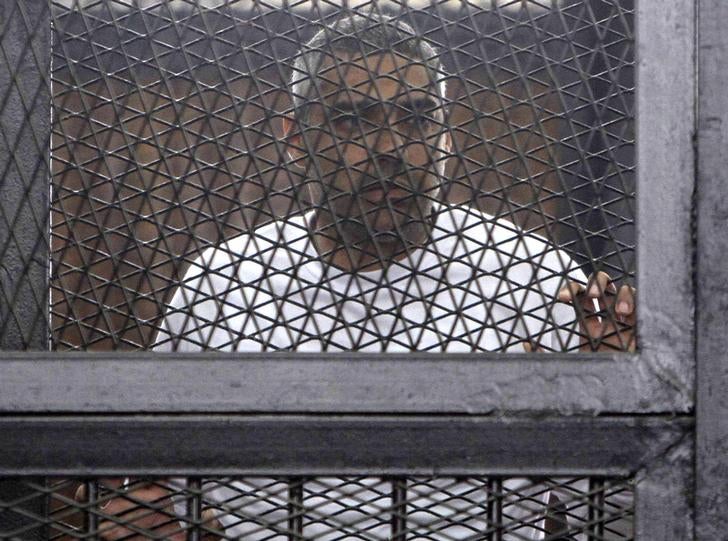
- Al Jazeera English journalist Mohamed Fahmy, a Canadian-Egyptian national, stands in a metal cage during his trial in Cairo on March 24, 2014.© 2014 Reuters
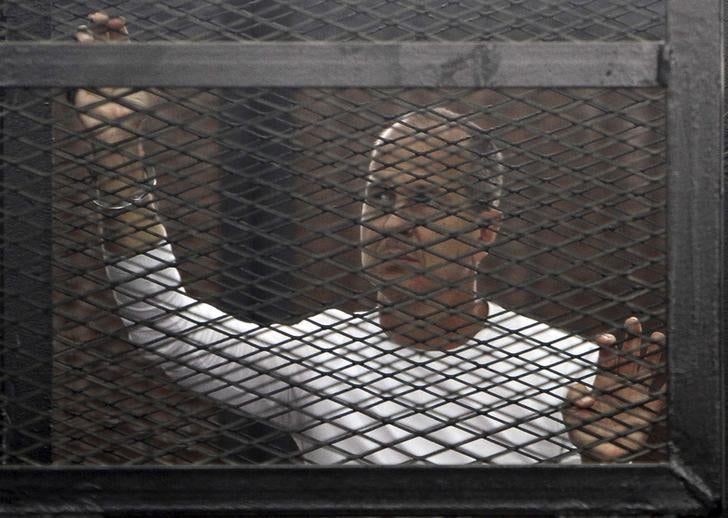
- Al Jazeera English journalist Peter Greste of Australia stands in a metal cage during his trial in Cairo on March 24, 2014.© 2014 Reuters
The question is no longer whether Egypt is on the road to democratic transition, but how much of its brute repression the US will paper over. An accurate appraisal of Egypt’s record since the military-backed overthrow of President Morsy would conclude that, far from developing basic freedoms, the Egyptian authorities are doing the opposite.
(New York)– The US should acknowledge in its certification review for resuming certain military aid that Egypt has made no progress on developing basic freedoms or on its democratic transition, Human Rights Watch said in a letter it delivered on March 31, 2014, to US Secretary of State John Kerry.
Since assuming power on July 3, 2013, Egypt’s military-backed government has killed well over 1,000 protesters and locked up more than 16,000 people, many solely on the basis of their peaceful exercise of rights to free expression, association, and peaceful assembly. The mass death sentenceshanded down by an Egyptian court to 529 alleged members of the Muslim Brotherhood on March 24, in a trial lacking even basic elements of due process, is but one example of an escalating climate of extreme political repression.
“The question is no longer whether Egypt is on the road to democratic transition, but how much of its brute repression the US will paper over,” said Sarah Leah Whitson, Middle East director at Human Rights Watch. “An accurate appraisal of Egypt’s record since the military-backed overthrow of President Morsy would conclude that, far from developing basic freedoms, the Egyptian authorities are doing the opposite.”
Under its Fiscal Year 2014 Omnibus Appropriations Bill, Secretary Kerry must certify that Egypt is “taking steps to support a democratic transition… and for the development of… basic freedoms including civil society and the media” before the release of certain assistance to Egypt. At a congressional hearing in March, Secretary Kerry expressed hope to make “the appropriate decision” on restarting aid in the “coming days.”
Human Rights Watch detailed the widespread deterioration in freedom of speech, assembly, and the press, in addition to the campaign against Muslim Brotherhood supporters. The military-backed government has broadened its net to include secular activists, dissident academics, and members of the media. The government has not provided any meaningful accountability for the killings of protesters or the excessive use of force by security forces.
Secretary Kerry should consider specific steps that Egypt should take to demonstrate meaningful effort to develop basic freedoms, Human Rights Watch said. That includes releasing political dissidents, amending the restrictive public assembly law it passed in November 2013, and initiating criminal investigations into the unlawful use of lethal force and abuse of detainees by security officials.
“Minor gestures, such as releasing a few high-profile detainees, that don’t address the overwhelming reality of political repression in Egypt would only be cosmetic,” Whitson said. “Any certification that Egypt is on the road to democratic transition will ring hollow while thousands of opposition activists remain locked up and the pervasive culture of impunity for serious abuses persists.”
Since assuming power on July 3, 2013, Egypt’s military-backed government has killed well over 1,000 protesters and locked up more than 16,000 people, many solely on the basis of their peaceful exercise of rights to free expression, association, and peaceful assembly. The mass death sentenceshanded down by an Egyptian court to 529 alleged members of the Muslim Brotherhood on March 24, in a trial lacking even basic elements of due process, is but one example of an escalating climate of extreme political repression.
“The question is no longer whether Egypt is on the road to democratic transition, but how much of its brute repression the US will paper over,” said Sarah Leah Whitson, Middle East director at Human Rights Watch. “An accurate appraisal of Egypt’s record since the military-backed overthrow of President Morsy would conclude that, far from developing basic freedoms, the Egyptian authorities are doing the opposite.”
Under its Fiscal Year 2014 Omnibus Appropriations Bill, Secretary Kerry must certify that Egypt is “taking steps to support a democratic transition… and for the development of… basic freedoms including civil society and the media” before the release of certain assistance to Egypt. At a congressional hearing in March, Secretary Kerry expressed hope to make “the appropriate decision” on restarting aid in the “coming days.”
Human Rights Watch detailed the widespread deterioration in freedom of speech, assembly, and the press, in addition to the campaign against Muslim Brotherhood supporters. The military-backed government has broadened its net to include secular activists, dissident academics, and members of the media. The government has not provided any meaningful accountability for the killings of protesters or the excessive use of force by security forces.
Secretary Kerry should consider specific steps that Egypt should take to demonstrate meaningful effort to develop basic freedoms, Human Rights Watch said. That includes releasing political dissidents, amending the restrictive public assembly law it passed in November 2013, and initiating criminal investigations into the unlawful use of lethal force and abuse of detainees by security officials.
“Minor gestures, such as releasing a few high-profile detainees, that don’t address the overwhelming reality of political repression in Egypt would only be cosmetic,” Whitson said. “Any certification that Egypt is on the road to democratic transition will ring hollow while thousands of opposition activists remain locked up and the pervasive culture of impunity for serious abuses persists.”
Palestinians must abandon the 'peace process'
Palestinians should not accept the current peace deal proposed by the US.
By Ghada Karmi

West Bank settlements are to expand with 2,553 new units, writes Karmi [EPA]
| ||||
No term in the Israeli-Palestinians political lexicon has been so abused or so denuded of meaning as the "peace process". It was set up after the Oslo Accords in 1993, to settle the conflict between Israelis and Palestinians by peaceful negotiations, but has led nowhere.
Yet it is still ongoing, its latest manifestation launched in August 2013, when US Secretary of State John Kerry put forward an ambitious plan to resolve all the major issues that have bedevilled the conflict within the space of nine months. The result he envisaged was a "final-status agreement" over borders, security, Jerusalem and refugees, which when resolved, would supposedly end the conflict for good.Now close to the deadline proposed by Kerry, it is clear that no settlement is in the offing. Desperate to salvage the process, Kerry has come up with the idea of a "Framework Agreement" that sets out basic principles for the two sides to negotiate on in future. This, he hopes, will keep the "peace process" going for longer.
Thwarting peace
Yet Israel's policy has been the exact opposite. In December 2013, Israeli ministers voted eight to threeto annex the Jordan valley, and from the start of this year, West Bank settlements were set to be expanded by 2,553 new housing units. A law preventing the Israeli prime minister from discussing the status of Jerusalem or the refugee issue at the peace talks without prior majority approval from the Israeli parliament, was proposed in January.
The Israeli prime minister subsequently assured his Likud party ministers and other Israeli political figures that he would reject any mention of a Palestinian capital in East Jerusalem in the Framework Agreement. Israel has also reiterated its refusal to permit any return of the Palestinians refugees within its borders, and Israeli Foreign Minister Avigdor Lieberman has been pushing for a transfer of Arabs living in the Triangle area of the Galilee to Palestinian Authority rule. To all these conditions has been added the requirement to recognise Israel as a Jewish state.
In an attempt to deter the US secretary of state further, senior Israeli officials have been accusing him of being ananti-Semite. The final straw came last week when Israel refused to release 26 Palestinian prisoners, the last of a total of 104 long time prisoners whose release was agreed on as a condition for the Palestinians' participation in the revived peace negotiations, last summer. Fearing that they would now pull out as a result of this Israeli breach of its commitments, the US has been making frantic efforts to prevent such an outcome, proposing an extension of the talks beyond the April 29 deadline. Israel has responded by offering to release the prisoners but only if the Palestinians agree to the talks' extension.
Simple facts
These absurd political manoeuvrings only serve to obscure the fundamental reality. In trying to resolve the Israeli-Palestinian conflict, Kerry's task is impossible to realise. This is not, as is often misleadingly asserted, because the issues are complex or because "painful compromises" are needed from both sides. The issues, in fact, are so embarrassingly simple it is an insult to the intelligence to have to set them down.
In plain English, one side has stolen land and resources belonging to the other and refuses to give them up. The thief is supported by powerful external agencies, while the losing side has no equivalent support. In this situation, it would be normal to call on an independent force or arbiter to compel the thief to return the stolen goods, and "compromise" would not be applicable.But in the peace process as configured by those on the side of the thief, there is no independent agency, only an "arbiter" whose starting point is one of total commitment to the thief's welfare. How then, to solve the conflict that has arisen because of the robbery, but without penalising the robber or forcing him to return the booty? That, in essence, is where the problem lies for Kerry and his predecessors. The "peace process" has all along been predicated on these lines, that Israel's welfare is paramount. What this has meant in practise is that pressure can only be applied to the Palestinians, and the ineffectual Arab states. Since Israel long ago won the battle to keep 80 percent of Palestine, the area behind the 1967 border and referred to as "Israel proper", it is the 20 percent that remains which Israel is fighting to keep.
Kerry's negotiations are concerned with how to divide that 20 percent in Israel's favour while giving the Palestinians something too. Since whatever he proposes requires Israel's agreement, the only room for manoeuvring he has, is to minimise the offer to the Palestinians even further to ensure Israel's acquiescence. On the other hand, if the offer is too inadequate, the Palestinians will not accept it. This dilemma has forced Kerry to draw up an interim agreement and to propose a time extension for further negotiations.
Dividing up the 20 percent
His Framework Agreement has not been published yet, as all peace talks have been conducted in total secrecy, but from various leaks and reports it would seem that it deals with all the major questions. Israel would retain its major West Bank settlements, annexing up to 10 percent of the land.
The Palestinians would receive 5.5 percent of as yet unspecified Israeli land in return. Israel would have to give up the Jordan Valley, to be subsequently policed by either NATO or combined Jordanian-US troops, or some combination of troops from friendly Muslim states, with Israeli oversight of the Jordan border and the right of veto over entrants. Gaza would be connected to the West Bank by bridges or tunnels. Israel would evacuate its forces from the new demilitarised Palestinian state over a period of five years, and NATO could take their place.
The Palestinian capital would be outside Jerusalem's municipal boundaries, in the villages adjoining East Jerusalem like al-Ram, Abu Dis, or al-Aizariyya, and a multi-national committee would be in charge of the holy places in the old city. The right of refugee return would be dealt with through an international compensation fund for refugees and offers of immigration to Australia, with a token number of returnees to Israel. If all that is agreed, it would constitute the end of the conflict. Kerry is reported to be pressing both sides hard to accept these ideas, many of which have been aired before and already largely accepted by the Palestinian leadership. It is Israel that is likely not to agree, and herein lies Kerry's problem.
Intimidation and redemption
Kerry's plan contains many of the features of previous peace proposals. None of them answers to international law, Palestinian rights or elemental justice. As a Haaretz article candidly put it on January 6, to succeed, Kerry's plan demands no less than a total and abject Palestinian surrender to Israeli and US diktat. And for that reason, it should be rejected outright without extensions or delays. The Palestinians should immediately join all the UN bodies open to "Palestine" as a non-member state and especially the International Criminal Court where they must initiate proceedings against Israel's breaches of international law. They must call for an international conference to discuss a settlement of the conflict and the resolution of all their fundamental rights.That none of this has happened so far is testament to the intimidation practised by Israel and its allies on the Palestinian leadership. They have been persuaded that pragmatism and real politik is the best option. Israel is too powerful to fight and so they should settle for what is possible. This pernicious idea has been the guiding principle of the Palestinian negotiators, with the inevitable consequence that they have been forced to concede more of their rights with each round of talks. To this sorry state of affairs has now been added an explicit US threat, that if the Palestinians reject the Kerry peace plan, they will face a political and economic blockade. All US and European aid will stop and they will be isolated. No Arab state has so far stepped in to make up for these threatened Palestinian losses, and most are, anyway, involved with conflicts inside their own borders. At this moment in history the world appears weary of the Palestine problem and wants to see it end. But it is imperative that the Palestinians do not respond to this situation by selling their case cheap. It is true they are weak, but they have one strength: to say "No". No peace plan can go ahead without their assent, and Kerry and his proposals will come to nothing if they refuse them. They have alternatives and it would be irresponsible not to use them. Applying to accede to 15 multilateral treaties and conventions as the Palestinian president has just done on behalf of "Palestine" is a good start, but it is not enough. The Palestinian leadership, for too long timid and self-serving, finally has a chance to redeem itself. |


Thursday, April 3, 2014
The Games the Stooge Abbas Plays: Palestinian U.N. moves designed to avoid U.S. retaliation

Palestinian President Mahmoud Abbas attends a meeting with Palestinian leadership in the West Bank City of Ramallah April 1, 2014.
CREDIT: REUTERS/MOHAMAD TOROKMAN
(Reuters) - When Palestinian President Mahmoud Abbas signed onto 15 international conventions on Tuesday, he shocked the U.S. sponsors of troubled Middle East peace talks. But the move was carefully limited to avoid American retaliation.
Abbas's action may have been designed more as a symbolic act of defiance to shore up his tenuous standing among Palestinians frustrated at the diplomatic impasse with Israel over their goal of statehood than a knife in the heart of peacemaking.
As a non-member state in the United Nations, Palestinians can join 63 international agencies and accords. However, by only signing conventions dealing with social and human rights instead of seeking full membership in U.N. bodies, the Palestinians' foreign minister said they would not provoke U.S. sanctions.
"Frankly speaking, I don't expect any consequences coming from the U.S. Congress regarding this step at all," Riad al-Malki told reporters on Wednesday.
"We did not talk about us becoming members of the U.N. specialized agencies in order for the Congress to activate their decision. We are talking about and we are still talking about letters of submission to protocols and conventions, and that's it."
Peace negotiations are near collapse amid mutual accusations of bad faith. In the latest such episode, Abbas inked the 15 conventions in search of more leverage against Israel after it refused to free a batch of Palestinian prisoners under terms of a previous agreement. Israel, in turn, said it would not release those detainees without a Palestinian commitment to continue negotiations beyond an initial end-of-April deadline.
U.S. officials criticized what they called "unhelpful, unilateral actions" by both sides.
Abbas's limited self-rule administration in the Israeli-occupied West Bank is dependent on U.S. support. Around $500 million in annual aid to the cash-strapped Palestinian Authority helps keep its bloated public sector and security forces afloat.
But Congress has repeatedly docked payments as punishment for Palestinian political decisions it disagrees with, including an earlier bid for statehood recognition. A 1990 law also bars U.S. funding to U.N. bodies which recognize a Palestinian state.
The law put the United States in the awkward position of losing its right to vote in the cultural and educational body UNESCO last year after Palestinians acceded to it in 2011.
U.S. Secretary of State John Kerry pleaded with a congressional foreign affairs committee last month to reassess its U.N. divestment policies - a sign of how badly his State Department wishes to avoid diplomatic damage arising from Palestinian moves.
"On the next issue of the U.N. waiver, please, I've got to tell you, this is a very one-sided event against us...whether or not the United States loses its vote and gets punished for (Abbas) going (to U.N. agencies) is irrelevant to him. He'll go, because it's a tool for him to be able to do things he hopes that, you know, make life miserable for Israel," Kerry said.
"They'll go again if they think it's in their best interests. And who will pay the price? The United States of America. We won't be able to vote."
"CLEVER"
Palestinians seek an independent state in Gaza, the West Bank and East Jerusalem - lands captured by Israel in a 1967 war. While all parties say negotiations are the best path to peace, Palestinians say they may eventually resort to international bodies to force the militarily vastly more powerful Israel to make concessions for peace.
The U.N. General Assembly voted to recognize Palestine as a non-member state in 2012, entitling them to join the accords which Abbas signed up on Tuesday, including conventions against discrimination against women and for the rights of disabled people as well as the Geneva Conventions.
They burden the Palestinians with few binding commitments on their government, which has been accused of corruption and abuses of detainees and journalists.
Nor do they court retaliation by immediately empowering them to lodge legal complaints against Israel or rattle U.S. foreign policy, a senior U.N. official told Reuters.
"The nuclear option for Abbas would be to go for the International Criminal Court and International Atomic Energy Agency. Those are the ones that matter," the official said.
"(The latest signing is) actually quite a clever move. Abbas is saying that the Palestinians want to be part of the global community and improve its state building mechanisms by signing up to a load of well-meaning conventions. He can turn around and say, 'Why should Israel feel threatened by us signing a convention protecting women's rights?'"
Peace moves by Abbas, a veteran negotiator who has chosen diplomacy over the violent militancy espoused by his predecessors and Palestinian rivals such as the Islamist Hamas, which controls Gaza, have not been welcomed by his countrymen.
Campaigns for recognition at the United Nations, while mostly symbolic, have been praised by many Palestinians.
The 78-year old president - who saw his term expire over five years ago but remains in office because of a stalemate with Hamas over conditions for the next elections - may have been keen to shore up his appeal after Israel over the weekend failed to free a fourth and final group of over two dozen Palestinian prisoners as part of a pledge to restart peace talks last year.
"That's when he reached his endpoint and said, 'I've got to do another measure that's going to improve my popularity,' and going to the U.N. has so far been successful in terms of boosting his popularity," said Diana Buttu, a former legal adviser to Palestinian peace negotiators.
"But as a measure, it's a weak one. He didn't go all the way to hold Israel accountable and he didn't abandon negotiations."
Subscribe to:
Posts (Atom)