AN EXCELLENT SEGMENT!

Friday, March 20, 2015


Four difficult and revolutionary years in Syria
By: Salameh Kaileh
Link
Link
Comment: The last four years have transformed Syria and Syrian society completely. There can be no going back.
Syria shows what can be the difficulty of revolutions. First, because the Syrian revolution started after a revolutionary spread from Tunisia and rapidly expanded, which struck fears in regional countries and perplexed others. It was necessary to stop the revolutionary wave from gaining more ground. It was also necessary to stop the wave because the world was experiencing an economic crisis, which could have led to the revolutions reaching beyond Arab borders and thus becoming uncontrollable.
Second, imperialist countries needed a example to demonstrate how rebellion and revolution against capital means drowning in massacres, terrorism and chaos. Therefore it was necessary for the Syrian revolution to turn into a "sectarian conflict", "civil war" and an actual massacre in which Syria is destroyed and its population killed and displaced. This became clear after a year and a half of revolution, as the main focus was to increase the regime's violence and escalate its brutality while providing it with the necessary tools for violence and brutality.
Second, imperialist countries needed a example to demonstrate how rebellion and revolution against capital means drowning in massacres, terrorism and chaos. Therefore it was necessary for the Syrian revolution to turn into a "sectarian conflict", "civil war" and an actual massacre in which Syria is destroyed and its population killed and displaced. This became clear after a year and a half of revolution, as the main focus was to increase the regime's violence and escalate its brutality while providing it with the necessary tools for violence and brutality.
 | The regime is capable of incredible brutality as it is run by a group that does not fear committing excesses in violence. |
Third, we must realize the regime is capable of high degrees of brutality given its composition and the fact that it is run by a group that does not fear committing excesses in violence. Further, the ruling family group considers Syria to be its personal property, which it inherited from Hafez al-Assad, and it would rather burn its inheritance than let go of it. It was this mentality that gave rise to the regime slogan "either Assad or we burn the country". The ruling family group decided to fight till the end, with all the brutality possible, to remain in control of power and the economy, and if that failed it would destroy the country before others could snatch it out of the group's hands. This mentality led to the regime committing all manner of crimes against humanity, in plain sight of the world and the international community who actually wanted the regime to carry out these actions regardless of the hollow statements of this or that president, or this or that country.
The forces of imperial capitalism
The actions of the Syrian regime were exactly what imperialist capitalism wanted, which is why those actions were turned into a clear example of brutality used in imperialist and Arab media to scare people of the consequences of rebellion against Mafiosi capitalism that plunders, impoverishes and exploits. However this form of capitalism now realizes that its plunder and exploitation has reached to crisis point and will definitely lead to an explosion of revolutions, therefore it was necessary to demonstrate the consequences.
Fourth, the imperial ambitions of Turkey and Iran contributed to the escalation of the violent conflict. The Iranian regime doggedly defended the Syrian regime and continues to do so not for the purposes of supporting the resistance or improving Hizballah's position, but because Syria is a card Iranians can use in international bargains. Therefore, a Shia force was mobilized to prevent the fall of the Syrian regime, and Iranian officials began publically stating that they were the ones who prevented the fall of Damascus (and Baghdad and Beirut). This gave a lifeline to the regime even after it had been weakened and was on the verge of collapse.
The Iranian Revolutionary Guard, Hizballah and sectarian militias from Iraq and elsewhere have become the forces fighting the Syrian people, after Syrians had shaken the regime and made paved the path to its collapse. The Syrian people are no longer fighting the regime, but fighting Iran's forces and allies who rely on Russian military and political support.
Despite that all, and after hundreds of thousands of martyrs and prisoners and millions of refugees, and despite the continuous barbaric violence, the Syrian people are still fighting for victory in a world that wanted to see them massacred. It is an immense revolution that shall continue.
Opinions expressed in this article remain those of the author and do not necessarily reflect the opinions of al-Araby al-Jadeed, its editorial board or staff.
This is an edited translation from our Arabic website.
The forces of imperial capitalism
The actions of the Syrian regime were exactly what imperialist capitalism wanted, which is why those actions were turned into a clear example of brutality used in imperialist and Arab media to scare people of the consequences of rebellion against Mafiosi capitalism that plunders, impoverishes and exploits. However this form of capitalism now realizes that its plunder and exploitation has reached to crisis point and will definitely lead to an explosion of revolutions, therefore it was necessary to demonstrate the consequences.
Fourth, the imperial ambitions of Turkey and Iran contributed to the escalation of the violent conflict. The Iranian regime doggedly defended the Syrian regime and continues to do so not for the purposes of supporting the resistance or improving Hizballah's position, but because Syria is a card Iranians can use in international bargains. Therefore, a Shia force was mobilized to prevent the fall of the Syrian regime, and Iranian officials began publically stating that they were the ones who prevented the fall of Damascus (and Baghdad and Beirut). This gave a lifeline to the regime even after it had been weakened and was on the verge of collapse.
The Iranian Revolutionary Guard, Hizballah and sectarian militias from Iraq and elsewhere have become the forces fighting the Syrian people, after Syrians had shaken the regime and made paved the path to its collapse. The Syrian people are no longer fighting the regime, but fighting Iran's forces and allies who rely on Russian military and political support.
Despite that all, and after hundreds of thousands of martyrs and prisoners and millions of refugees, and despite the continuous barbaric violence, the Syrian people are still fighting for victory in a world that wanted to see them massacred. It is an immense revolution that shall continue.
Opinions expressed in this article remain those of the author and do not necessarily reflect the opinions of al-Araby al-Jadeed, its editorial board or staff.
This is an edited translation from our Arabic website.
Egypt denies Qatar access to Gaza, so Doha turns to Israel
Link

President of the Qatari National Committee for the Reconstruction of the Gaza Strip, Ambassador Mohammed Al-Emadi said he entered the Gaza Strip for the first time in two years through Israel after the Egyptian authorities refused to grant him permission to cross through its territory.
Al-Emadi said the situation in Gaza is much harder than it was two years ago because of the accumulated problems caused by the Israeli blockade and aggression.
He pointed out that the Egyptian decision to prevent entry of building materials to reconstruct the enclave through the Rafah crossing not only delayed completing the projects but has increased their overall costs to three times more than their actual value after his country was forced to purchase them from Israel.
Al-Emadi revealed that although the Qatari-sponsored reconstruction projects stopped for six months because of the Israeli aggression and the closure of the Rafah crossing, progress is going well.
The Qatari ambassador expressed optimism over the speed of reconstruction; especially after the international community responded to calls to rebuild Gaza.
He pointed out that Qatar has been actively seeking to urge Arab and Western countries to expedite the start of reconstruction projects.
Qatar's reconstruction projects in the enclave will be completed in two years, he explained, and they will change the face of Gaza and affect the Palestinians' lives.
Al-Emadi stressed that his country does not interfere in the internal differences between Hamas and Fatah and its efforts are limited to providing humanitarian assistance to the Palestinian people.
Remarking on the electricity problem, the senior official said his country believes the problem could be solved by operating the power plants using natural gas which could be extracted off the coast of Gaza.
Thursday, March 19, 2015
Egyptian army fighting in Libya: military sources
Cairo is sending elite army battalions to fight with General Haftar's anti-Islamist forces in Libya, telling soldiers they are being posted to Egypt's western desert.
Egyptian troops are fighting in Libya to support General Khalifa Haftar's forces, according to military sources.
Cairo's support for the Libyan military commander has reached a new stage recently with Egypt also sending Haftar 12 military planes to support his anti-Islamist campaign.
Haftar, who has been appointed the Tobruk's parliament's army chief, is also said to be preparing for a visit to Cairo as a sign of official backing for the no-longer-renegade general.
Air support
According to military sources, Egypt's parachute battalion 94 are being deployed to Libya to back the general after entering the country through the Siwa Oasis.
Tobruk has repeatedly asked the international community to provide military backing in its fight against the rival Tripoli government, and a myriad of Islamist and extremist militias.
"Egyptian Air Forces are providing Haftar's forces with several fighter jets to be delivered soon," a military source told al-Araby al-Jadeed.
"There are four helicopters in the Mansoura airport in Egypt’s Delta region, four MiG aircrafts in the Hurghada Airport, and four other MiG aircraft at an unnamed location."
It is alleged that Libyan pilots will fly the aircraft to Libya via the Sidi Barrani Airport in western Egypt.
Egypt will also receive new recruits at its elite military academy Dahshour. Previously, cadets were required to hold higher education degrees, but the special forces training camp is now open to all.
Tricked into fighting
A source in Egypt's parachute battalion who is based in the camp said special anti-terror battalions were being formed, each made up of 16-members.
His battalion were told that they would be posted to the western desert in Egypt, before they discovered they had been posted to Libya, fighting alongside an anti-Islamist force.
"We worked with Haftar's forces, made up of men and women with highly advanced weapons,” the Egyptian soldier says.
Cairo's support for the Libyan military commander has reached a new stage recently with Egypt also sending Haftar 12 military planes to support his anti-Islamist campaign.
Haftar, who has been appointed the Tobruk's parliament's army chief, is also said to be preparing for a visit to Cairo as a sign of official backing for the no-longer-renegade general.
Air support
According to military sources, Egypt's parachute battalion 94 are being deployed to Libya to back the general after entering the country through the Siwa Oasis.
Tobruk has repeatedly asked the international community to provide military backing in its fight against the rival Tripoli government, and a myriad of Islamist and extremist militias.
"Egyptian Air Forces are providing Haftar's forces with several fighter jets to be delivered soon," a military source told al-Araby al-Jadeed.
"There are four helicopters in the Mansoura airport in Egypt’s Delta region, four MiG aircrafts in the Hurghada Airport, and four other MiG aircraft at an unnamed location."
It is alleged that Libyan pilots will fly the aircraft to Libya via the Sidi Barrani Airport in western Egypt.
Egypt will also receive new recruits at its elite military academy Dahshour. Previously, cadets were required to hold higher education degrees, but the special forces training camp is now open to all.
Tricked into fighting
A source in Egypt's parachute battalion who is based in the camp said special anti-terror battalions were being formed, each made up of 16-members.
His battalion were told that they would be posted to the western desert in Egypt, before they discovered they had been posted to Libya, fighting alongside an anti-Islamist force.
"We worked with Haftar's forces, made up of men and women with highly advanced weapons,” the Egyptian soldier says.
| The military announced that the soldiers were killed in Ivory Coast. - Egyptian military source |
"Three Egyptian soldiers were killed in one of the operations, but after the return of the battalion, the military announced that the soldiers were killed in Ivory Coast as part of the Egypt's peacekeeping mission."
He said the soldiers followed orders to target Libyan "soldiers and civilians".
When one soldier confronted his commander, he was reportedly re-deployed. He has not been seen since.
"Saaqa special forces stationed in Sinai were replaced by troops from the parachute battalion due to exhaustion," said the military source.
"We would go fight the protesters in Fayoum. One of our soldiers had a cousin in detention, and when we were ordered to strike, he refused, left his weapon and ran away. They could not catch him, so he was tried in absentia and sentenced to death."
In a symbolic act of intimidation, a firing squad allegedly shot his empty military uniform.
During Haftar's visit to Cairo next week the general is reportedly due to meet with Egypt's defence minister Sedki Sobhi and commander in Chief Mahmoud Hegazi.
This follows a deal allegedly struck by the Libyan military, to purchase Russian arms using Egypt as an intermediary.
This article is an edited translation from our Arabic edition.
Tunisia: Deadly assault in Tunis shows utter disregard for life

Today’s armed attack that killed at least 19 people, according to the Tunisian Prime Minister, and injured many more in a museum in central Tunis shows an utter disregard for the right to life, Amnesty International said.
The organization is calling on the authorities to ensure that all those involved in planning and carrying out this attack are apprehended and brought to justice.
This deadly attack, which in itself is utterly deplorable, must not be allowed to derail what many regard as the region’s most successful transition from authoritarianism to the rule of law and respect for human rights.
“This deadly attack, which in itself is utterly deplorable, must not be allowed to derail what many regard as the region’s most successful transition from authoritarianism to the rule of law and respect for human rights,” said Hassiba Hadj Sahraoui, Deputy Middle East and North Africa Programme Director at Amnesty International.
“The best answer to this atrocity would be bringing those responsible to justice in fair trials. A return to the draconian measures of the Ben Ali years which trample over human rights would compound the tragedy of this crime and is likely to play into the hands of those trying to undermine Tunisia’s transition.”
Security forces killed two gunmen at the scene of the attack – the Bardo Museum beside Tunisia’s Parliament. They are still searching for accomplices, and no group has yet claimed responsibility for the attack.
According to a statement by Tunisian Prime Minister Habib Essid, two Tunisians, including a police officer, as well as Italian, Spanish, Polish and German nationals were among those killed.
Deadly Shooting Rampage at Tunisian National Museum Leaves Birthplace of Arab Spring on Edge
Democracy Now!
"A shooting rampage at Tunisia’s national museum has left 22 people dead — 20 foreign tourists and two Tunisians. Nearly 50 people were injured. The two gunmen began the attack by opening fire on tourists as they got off a bus and then chasing them inside the museum. The Bardo museum is one of the most popular tourist attractions in Tunis and is adjacent to the country’s parliament building. The dead included residents of Japan, Italy, Colombia, Australia, France, Poland, Spain and Britain. It was the most serious attack in years in Tunisia, where the Arab Spring began in 2011. In recent years, thousands of Tunisians have left the country to fight with the self-proclaimed Islamic State in Iraq, Syria and Libya. In response to the attack, the Tunisian government has pledged to wage what it calls a "merciless war against terrorism." Thousands of Tunisians have marched in the streets to denounce the shooting. We are joined from Tunis by Amna Guellali, director of the Tunisian office of Human Rights Watch...."
"A shooting rampage at Tunisia’s national museum has left 22 people dead — 20 foreign tourists and two Tunisians. Nearly 50 people were injured. The two gunmen began the attack by opening fire on tourists as they got off a bus and then chasing them inside the museum. The Bardo museum is one of the most popular tourist attractions in Tunis and is adjacent to the country’s parliament building. The dead included residents of Japan, Italy, Colombia, Australia, France, Poland, Spain and Britain. It was the most serious attack in years in Tunisia, where the Arab Spring began in 2011. In recent years, thousands of Tunisians have left the country to fight with the self-proclaimed Islamic State in Iraq, Syria and Libya. In response to the attack, the Tunisian government has pledged to wage what it calls a "merciless war against terrorism." Thousands of Tunisians have marched in the streets to denounce the shooting. We are joined from Tunis by Amna Guellali, director of the Tunisian office of Human Rights Watch...."
A turning point in Tunisia
The last thing jihadists want for Tunisia is for democracy to triumph.
Link
What does it mean when fanatics attack relics and mosaics? Simply put, a jihadist front may be expanding to engulf Tunisia in chaos as it has done in neighbouring Libya.
There are three possible explanations. It would be easy to say that Tunisia's once-thriving tourism industry was the target of the attack. In fact, it is more than that. What is being targeted is the civic way of life enabling citizens to live at once as Muslims and democrats. This should be the primary concern of Tunisia's citizens and the new political elite shaping the country's "Second Republic" after the January 2011 Revolution.
Wednesday's deadly attack on a museum in Tunisia should not be oversimplified as a threat against tourism. It is far more serious than that. It may mark the assault against civic political organisation and a fledgling experiment combining Islam and democracy.
 |
That experiment, the Arab Spring's first approximation of a durable democratic transition since the 2011 Arab revolts is a blend of Islam and democracy. It seeks a two-fold synthesis: 1) between a moderate brand of Islam that tolerates ballots, gender equality, rule of law, pluralism, accountable government, and coexistence with the West; and 2) a form of democracy that is inclusive of all faiths and freedom of worship.
Anathema to jihadists
The experiment has a bigger chance of success in homogenous Tunisia than any other Arab state. Tunisia's famed religious scholar Muhammad Tahar Ibn Ashur (died 1973) came closest to elaborating an interpretation of Islam that promotes enlightened Muslim identity and rationality. His masterpiece "The Higher Goals of Islamic Law" (published in 1946) would be an anathema to jihadists and literalist religious preachers.
The terrorist attack against a museum adjacent to the country's parliament in the upscale Bardo neighbourhood, signals a tactical shift by jihadists in Tunisia and North Africa in general. Until Wednesday, attacks against state symbols, especially the army and security forces, were confined to the Jebel Chaambi, the mountain areas near Kasserine. Ambushes of army units in 2012, 2013 and 2014 by extremists, particularly the Uqba Ibn Nafaa group, caused dozens of fatalities among soldiers. Last July alone, 15 soldiers were killed by this deadly unit.
The daring operation executed in the heart of a rich suburb within the precincts of power is more than symbolic. It places the entire elite staffing of the so-called "Second Republic" on notice. This is the deadliest attack since the democratically-elected secularist president, 86-year-old Beji Caid Essebsi, was sworn into office three months ago.
Essebsi's secularist party Nidaa Tounes, winner of the November 2014 parliamentary elections, rules Tunisia in a consortium with Ben Ali associates and leftist partners - historically known for hostility towards Islamists, including the moderate Ennahda Party.
Tunisia's security apparatus suffers from incompetence if not out-and-out laxity. The stigma lives on. Back in 1988, a Mossad commando elite unit was able to assassinate the PLO's number two in command, Khalil al-Wazir, in Tunisia.
|
Tunisia's security apparatus
The last thing jihadists want for Tunisia is for democracy to triumph, much less for secularists even if democratically elected to run this North African - Arab and Muslim - country with a population of 11 million.
Tunisia's security apparatus suffers from incompetence if not out-and-out laxity. The stigma lives on. Back in 1988, a Mossad commando elite unit was able to assassinate the PLO's number two in command, Khalil al-Wazir (Abu Jihad), in Tunisia. Wednesday's attack will add to security woes in a country that needs to direct its limited resources towards the civilian economy in order to create youth employment and lower budgetary deficits and international debt.
The attack has always been on the cards. And there is no reason why it was allowed to happen with such ease.
The deteriorating security conditions in Libya, Syria and Iraq are proving infectious. Libya, more immediately, threatens stability in Tunisia. Borders are porous and the illegal transit of weapons and jihadists, including battle-hardened ISIL returnees, compound the threat to this Mediterranean country.
For over six months, intelligence about terrorist plans to expand the jihadist fronts have circulated in the country and it is known to most politicians. In late 2014, jihadist commanders close to Libya's branch of the Islamic State of Iraq and the Levant (ISIL) - including Torki al-Bina'ali of Bahraini origin - schemed to take the jihadist war to neighbouring Tunisia.
The Tunisian commander heading Uqba Ibn Nafaa, Khalid al-Chayieb, might have adopted such a strategy. He has hundreds - if not thousands - of Tunisian fighters in Syria's ISIL to call upon for the activation of this plan. And it is not inconceivable that Tunisian and Libyan returnees from Syria are mobilising to widen jihadist operations, bringing the war to Tunisia's urban centres.
Allegiance to ISIL
Like in Libya, where local militias have pledged allegiance to ISIL, Uqba Ibn Nafaa is following suit. As far as rhetoric is concerned, the war of words against the new political establishment in Tunisia began late last year. Wednesday's attack must be understood to fulfil this logic.
Yet it would appear as though this jihadist message was not taken seriously enough by security strategists in Tunisia. Many Tunisian citizens have not forgotten the not-so-veiled threat by Uqba Ibn Nafaa in September-October 2014 to carry out punitive operations against the army and security forces referred to as a "tyrannical" system (taghoot).
 |
| Tunisian security forces secure the area after attack on museum [AFP] |
In January, it was Paris, with the attack on Charlie Hebdo. In March, it is Tunis, with the attack on the museum in Bardo.
What is it about relics and ruins that keep on drawing fanatics? Whatever it is, it has nothing to do with Islam. The advent of Islam in Afghanistan did not spell the destruction of the Buddhas of Bamiyan (dynamited by fanatics in March 2001) - nor did it herald cultural erasure and historical vandalism such as that we witnessed at the hands of ISIL this month against the Assyrian archaeological site of Nimrud in Iraq.
Nor did it bring destruction to Roman or Carthaginian relics, including the largest collection of mosaics in the Mediterranean. The early Muslim proselytisers to Tunisia, as elsewhere, appreciated the Roman architectural genius. In the Zeitouna and Kairouan mosques, among the oldest in the Muslim world, they borrowed that genius using some of the most exquisite marble pillars to raise buildings, rather than erase them.
Indeed, if there is a pattern to be discerned from Wednesday's attack on the National Museum in Bardo, the threat is far graver than a loss of tourism for Tunisia.
Dr Larbi Sadiki is a senior lecturer in Middle East Politics at the University of Exeter, and author of Arab Democratisation: Elections without Democracy and The Search for Arab Democracy: Discourses and Counter-Discourses.
THE ZIONIST SISI! الدوحة: منعتنا القاهرة من إعمار غزة فدخلنا عبر إسرائيل
Link
قال السفير القطري محمد العمادي المسؤول عن متابعة مشاريع إعادة إعمار غزة إن قدومه إلى غزة للمرة الأولى عبر البوابة الإسرائيلية بعد انقطاع نحو عامين، جاء نتيجة رفض القاهرةمنح المسؤولين القطريين تصريحا بالمرور إلى غزة عبر أراضيها. وأكد أن حال سكان قطاع غزة أسوأ كثيرا مما كان عليه قبل عامين، نتيجة المشاكل المركبة الناجمة عن الحصار والعدوان.
وأوضح أن إيقاف القاهرة إدخال المواد الخام لمشاريع إعادة الإعمار القطرية عبر معبر رفح لم يتسبب في تأخير إنجاز المشاريع فحسب، بل زاد من كلفة المشاريع لتصل إلى ثلاثة أضعاف قيمتها بفعل اضطرار شرائها من إسرائيل.
وكشف العمادي في مقابلة له مع الجزيرة نت من غزة أنه رغم توقف مشاريع إعادة الإعمار القطرية لمدة ستة أشهر بسبب العدوان وإغلاق معبر رفح، فإن التقدم فيها يسير بشكل جيد.
وأعرب عن تفاؤله بتحرك عجلة إعادة الإعمار بفعل بدء تجاوب المجتمع الدولي مع النداءات المطالبة بإعادة الإعمار، لافتا إلى أن التحرك الفعلي للدوحة على هذا الصعيد جاء لحث الدول العربية والغربية على الإسراع ببدء مشاريع إعادة الإعمار.
ورجح السفير القطري أن تنتهي الدوحة من مشاريع إعادة إعمارها لغزة في غضون عامين، لافتا إلى أن المشاريع القطرية ستغير وجه غزة، وسيلمس المواطن الفلسطيني بغزة مدى انعكاسها إيجابيا على حياته في حله وترحاله.
وشدد على عدم تدخل بلاده في الخلافات الداخلية بين حركتي المقاومة الإسلامية (حماس) والتحرير الوطني الفلسطيني (فتح)، مشيرا إلى أن جهود الدوحة تقتصر على الهدف الإنساني وخدمة أبناء الشعب الفلسطيني.
وفيما يتعلق بمشكلة الكهرباء، أكد العمادي أن الدوحة لديها تصور لحل المشكلة عبر تشغيل محطة توليد محطة الكهرباء في قطاع غزة بالغاز الطبيعي، وأيضا محاولة دراسة إمكانية استخراج الغاز الطبيعي من قبالة شواطئ غزة من أجل هذه الغاية.
Turkey PM: Talks with Assad like handshake with Hitler
Link

Turkish Prime Minister Ahmet Davutoglu said yesterday that negotiating with Syrian regime President Bashar Al-Assad is inexcusable and likened it to negotiating with Nazi leader, Adolf Hitler.
The Anadolu Agency reported Davutoglu telling a parliamentary group meeting of his Justice and Development Party: "There is no difference if you shake hands with Hitler, or Milosevic, or Radovan Karadzic or Saddam Hussein or Assad."
"If you sit down with Al-Assad and shake hands, it will never be erased from the memory of the conscience of humanity," he said.
Davutoglu's remarks come in response to US Secretary of State John Kerry who pointed to the possibility of negotiating with Al-Assad to attaining a lasting peace in Syria.
"The United States would eventually have to negotiate with Bashar Al-Assad for political transition," Kerry said during an interview with CBS News which aired on Sunday.
On Monday, Turkish Foreign Minister Mevlut Cavusoglu voiced similar criticism saying: "What is there to negotiate [with Al-Assad]? How will you negotiate with a regime that has killed more than 200,000 people and used chemical weapons? What result have you been able to get from negotiations so far?"
Wednesday, March 18, 2015
Washington chooses Assad
By: Lamis Andoni
Link
US policy on Syria became clearer during the Geneva I talks in 2012.
The United States called for Assad to step down, while pushing for terrorism in Syria to be fought - in tacit agreement with the government there.
The US also pushed for the formation of "moderate" political and military factions, in what resembled the Sahawat, or Tribal Awakening groups in Iraq - though in that case, the move was meant to eliminate resistance, not to create alternatives.
For Russia and the Syrian regime, the fight against terrorism meant a way to criminalise the revolutionaries and prop up the legitimacy of the Assad regime, especially among Syria's Arab neighbours, taking advantage of fears felt both by peoples and regimes towards extremist organisations.
For Washington, it meant an alternative to the regime - one shorn of independence, one that would endorse and implement Washington's policies in the region.
Here, it is important to recall that the Syrian regime was never far from Washington's policies on several major events, especially but not exclusively in the years before the revolution.
Damascus was, for example, complicit in the so-called "War on Terror", torturing suspects - most famously Khaled (Maher, my correction) Arar - who was renditioned secretly by Canada to Damascus to be "interrogated" in Syria's dungeons.
The regime since 2005 had started implementing a policy of economic liberalisation, one of Washington's key demands.
This was followed by price rises and worsening conditions for farmers, arguably one of the reasons that led to the uprising in the provinces and the Damascus countryside. Above all, the economic manipulation of the poorest was a sign the regime was seeking to appease the United States.
In those years, John Kerry himself, a US senator at the time, played a key role in reaching accords with Bashar al-Assad - at least until the revolution began, which Washington saw as an opportunity to create an alternative leadership, which could then disengage from Iran.
Now, Kerry has returned to his old role, dealing a blow to opposition parties that had abandoned their role in representing the aspirations of the Syrian people for the sake of personal influence or power.
These parties had forgotten that Washington seeks lackeys, not allies, and furthers only "interests", not principles.
The Hazzm movement, for example, is a case in point. It was left to be eliminated by the Nusra Front, as Washington closes in on a deal with Iran.
The change in US policy will be subject to a successful deal with Iran. In the end, there is no consistent US policy, and this is a lesson that must be learned - by both regimes and oppositions that forget their peoples and supplicate themselves to Washington.
Lamis Andoni is the editor in chief of al-Araby al-Jadeed English.
This is an edited translation from our Arabic edition.
Link
Comment: The United States has once again decided that "stability" is preferable to peace or justice, writes Lamis Andoni.
The remarks of US Secretary of State John Kerry, suggesting negotiations with Syrian President Bashar al-Assad were a necessity, were not surprising.
Washington has chosen, in principle, "stability", especially after the political and military failures of the Syrian opposition factions - which had previously presented themselves as an alternative to Assad which could preserve US interests.
From the beginning of the Syrian uprising, the US had certain fundamental principles of policy.
First of all, Washington would not allow the emergence of a truly free regime and a pluralistic secular state that would guarantee even a bare minimum of social justice in Syria.
Secondly, Washington sought to have the biggest say in deciding what form change could take in Syria - in a way that would not affect US or Israeli interests.
True, Washington saw a revolution as an opportunity to reshape Syria, not to meet the demands of the Syrian people, but to establish a regime that renounced resistance, and severed ties between the Syrian state and Iran and armed groups from Hamas and Islamic Jihad to Hizballah.
However, Washington failed to put together a "moderate" alternative that could guarantee Syria would not become a staging ground for future attacks on Israel.
The United States, as always, played a double game by facilitating the entry of armed Islamist groups and indirectly supporting them through US allies in the region.
The purpose was to create a reality where the uprising mutated into a terrorist phenomenon that would justify US military intervention, and the creation of factions dubbed "moderate", all under the banner of fighting terrorism.
Washington has chosen, in principle, "stability", especially after the political and military failures of the Syrian opposition factions - which had previously presented themselves as an alternative to Assad which could preserve US interests.
From the beginning of the Syrian uprising, the US had certain fundamental principles of policy.
First of all, Washington would not allow the emergence of a truly free regime and a pluralistic secular state that would guarantee even a bare minimum of social justice in Syria.
Secondly, Washington sought to have the biggest say in deciding what form change could take in Syria - in a way that would not affect US or Israeli interests.
True, Washington saw a revolution as an opportunity to reshape Syria, not to meet the demands of the Syrian people, but to establish a regime that renounced resistance, and severed ties between the Syrian state and Iran and armed groups from Hamas and Islamic Jihad to Hizballah.
However, Washington failed to put together a "moderate" alternative that could guarantee Syria would not become a staging ground for future attacks on Israel.
The United States, as always, played a double game by facilitating the entry of armed Islamist groups and indirectly supporting them through US allies in the region.
The purpose was to create a reality where the uprising mutated into a terrorist phenomenon that would justify US military intervention, and the creation of factions dubbed "moderate", all under the banner of fighting terrorism.
| For Russia and the Syrian regime, the fight against terrorism meant a way to criminalise the revolutionaries |
US policy on Syria became clearer during the Geneva I talks in 2012.
The United States called for Assad to step down, while pushing for terrorism in Syria to be fought - in tacit agreement with the government there.
The US also pushed for the formation of "moderate" political and military factions, in what resembled the Sahawat, or Tribal Awakening groups in Iraq - though in that case, the move was meant to eliminate resistance, not to create alternatives.
For Russia and the Syrian regime, the fight against terrorism meant a way to criminalise the revolutionaries and prop up the legitimacy of the Assad regime, especially among Syria's Arab neighbours, taking advantage of fears felt both by peoples and regimes towards extremist organisations.
For Washington, it meant an alternative to the regime - one shorn of independence, one that would endorse and implement Washington's policies in the region.
Here, it is important to recall that the Syrian regime was never far from Washington's policies on several major events, especially but not exclusively in the years before the revolution.
Damascus was, for example, complicit in the so-called "War on Terror", torturing suspects - most famously Khaled (Maher, my correction) Arar - who was renditioned secretly by Canada to Damascus to be "interrogated" in Syria's dungeons.
| John Kerry himself... played a key role in reaching accords with Bashar al-Assad |
The regime since 2005 had started implementing a policy of economic liberalisation, one of Washington's key demands.
This was followed by price rises and worsening conditions for farmers, arguably one of the reasons that led to the uprising in the provinces and the Damascus countryside. Above all, the economic manipulation of the poorest was a sign the regime was seeking to appease the United States.
In those years, John Kerry himself, a US senator at the time, played a key role in reaching accords with Bashar al-Assad - at least until the revolution began, which Washington saw as an opportunity to create an alternative leadership, which could then disengage from Iran.
Now, Kerry has returned to his old role, dealing a blow to opposition parties that had abandoned their role in representing the aspirations of the Syrian people for the sake of personal influence or power.
These parties had forgotten that Washington seeks lackeys, not allies, and furthers only "interests", not principles.
The Hazzm movement, for example, is a case in point. It was left to be eliminated by the Nusra Front, as Washington closes in on a deal with Iran.
The change in US policy will be subject to a successful deal with Iran. In the end, there is no consistent US policy, and this is a lesson that must be learned - by both regimes and oppositions that forget their peoples and supplicate themselves to Washington.
Lamis Andoni is the editor in chief of al-Araby al-Jadeed English.
This is an edited translation from our Arabic edition.
أربع سنوات صعبة .. وثورية
سلامة كيلة
Link

صعوبة الثورات ظهرت في سورية. أولاً، لأنها أتت بعد انتشار ثوري بدأ في تونس، وتوسّع سريعاً، الأمر الذي أخاف دولاً إقليمية، وأربك دولاً أخرى. لهذا، كان يجب أن تتوقف هذه الموجة لكي لا تمتدّ أكثر. ويجب أن تتوقف، لأن الوضع الاقتصادي العالمي، وضع الرأسمالية، مأزوم إلى الحدّ الذي يمكن أن يؤدي إلى أن تتوسع الثورات خارج الحدود العربية، فتصل إلى بلدان أخرى، فلا يعود ممكناً التحكّم بها ووقفها. هذا رد الفعل الأول لدى دول، على أمل معالجة الوضع لتجاوز إمكانية توسعها عالمياً. وثانيها، لأن الدول الإمبريالية باتت بحاجة إلى "مثال" فظيع، يوضّح كيف أن التمرُّد والثورة على رأس المال يعني الغرق في مجزرة وانتشار الإرهاب والقتل والفوضى. وبهذا، بات ضرورياً أن تتحوّل الثورة إلى "صراع طائفي" و"حرب أهلية"، وإلى مجزرة فعلية، تدمّر سورية وتقتل وتشرِّد شعبها. هذا ما بات واضحاً بعد سنة ونصف السنة من الثورة، حيث بات الشغل على زيادة عنف السلطة وتصعيد وحشيتها، ومدها بكل ما يجعلها أكثر عنفاً ووحشية.
لكن، لا بد من أن نلمس، ثالثاً، أن نمط السلطة القائمة كان يفتح على وحشية عالية، حيث مفاصله ممسوكة من فئات لا تخشى العنف والوحشية ولكن الفئة العائلية المتحكمة بالسلطة تعتبر أن سورية "ملكية خاصة" لها، ورثتها من حافظ الأسد، ولا تتخلى عن ميراثها حتى وإن حرقته. من هنا، نبع شعار "الأسد أو نحرق البلد". قررت خوض الحرب إلى النهاية، وبكل الوحشية الممكنة، بالضبط، لكي تبقى حاكمة ومسيطرة على الاقتصاد.. أو أن تدمّر "ميراثها"، قبل أن ينزعه منها آخرون. هذا الأمر جعلها تقرر العنف، وتصعيد العنف، ومن ثم العنف الأقصى، لكي تسحق المتمردين، وتبقي سيطرتها على السلطة. جعلها هذا المنظور ترتكب كل الجرائم الممكنة ضد الإنسانية، تحت مسمع العالم ومرآه، وهو الذي يريدها أن تفعل ذلك، بغض النظر عن تصريحات جوفاء، كان يطلقها هذا الرئيس أو ذاك، أو هذه الدولة أو تلك.
كان نمط السلطة السورية مطابقاً لما أرادت الرأسمالية الإمبريالية، بكل فروعها. ولهذا، صنعت مثالاً هائلاً للوحشية والعنف، بات يستخدم في كل الإعلام الإمبريالي والعربي، من أجل إرعاب الشعوب لكي لا تتمرّد على رأسمالية مافياوية، تنهب وتفقر وتستغل بأقصى درجات الاستغلال. لكنها تشعر بأن نهبها واستغلالها أوصل العالم إلى أزمةٍ، سوف تفرض حتماً انفجار الثورات وانتشارها.
فوق ذلك كله، رابعاً، كان الطموح الإمبراطوري التركي/ الإيراني يسهم في تصعيد الصراع والعنف. دافع النظام الإيراني، بكل وحشية، عن النظام السوري، ولا زال، لا لدعم المقاومة أو تحسين مواقع حزب الله. بل، بالضبط، لأن سورية ورقة في إطار المساومات الدولية. ومن أجل ذلك، جرى تصعيد "الحشد الشيعي"، ولمّ كل من هبّ ودبّ من أجل منع سقوط النظام السوري. ولهذا، بات قادة إيران يصرحون، علناً، بأنهم من منع سقوط دمشق (وبغداد وبيروت). عزّز هذا الأمر من استمرارية السلطة السورية، حتى بعد أن ضعُفت، وباتت على شفير الانهيار. ولقد أصبح الحرس الثوري وحزب الله والمليشيا الطائفية العراقية، ومن كل أطراف العالم، هي التي تقاتل الشعب السوري، بعد أن ضعضع السلطة، وكسر شوكة بنيتها الصلبة، وفتح الطريق إلى إسقاطها. وبهذا، بات الشعب السوري يخوض الحرب ليس ضد السلطة، بل ضد كل قوى إيران وامتداداتها، والمستندة إلى الدعم العسكري الروسي، والحماية السياسية الروسية.
على الرغم من ذلك كله، وبعد مئات آلاف الشهداء والمعتقلين وملايين اللاجئين، وكل العنف الوحشي المستمر، الشعب لا زال يقاتل من أجل الانتصار، في عالم أراد أن يوقعه في المجزرة.
ثورة كبيرة وعظيمة وستستمر.
Link
صعوبة الثورات ظهرت في سورية. أولاً، لأنها أتت بعد انتشار ثوري بدأ في تونس، وتوسّع سريعاً، الأمر الذي أخاف دولاً إقليمية، وأربك دولاً أخرى. لهذا، كان يجب أن تتوقف هذه الموجة لكي لا تمتدّ أكثر. ويجب أن تتوقف، لأن الوضع الاقتصادي العالمي، وضع الرأسمالية، مأزوم إلى الحدّ الذي يمكن أن يؤدي إلى أن تتوسع الثورات خارج الحدود العربية، فتصل إلى بلدان أخرى، فلا يعود ممكناً التحكّم بها ووقفها. هذا رد الفعل الأول لدى دول، على أمل معالجة الوضع لتجاوز إمكانية توسعها عالمياً. وثانيها، لأن الدول الإمبريالية باتت بحاجة إلى "مثال" فظيع، يوضّح كيف أن التمرُّد والثورة على رأس المال يعني الغرق في مجزرة وانتشار الإرهاب والقتل والفوضى. وبهذا، بات ضرورياً أن تتحوّل الثورة إلى "صراع طائفي" و"حرب أهلية"، وإلى مجزرة فعلية، تدمّر سورية وتقتل وتشرِّد شعبها. هذا ما بات واضحاً بعد سنة ونصف السنة من الثورة، حيث بات الشغل على زيادة عنف السلطة وتصعيد وحشيتها، ومدها بكل ما يجعلها أكثر عنفاً ووحشية.
لكن، لا بد من أن نلمس، ثالثاً، أن نمط السلطة القائمة كان يفتح على وحشية عالية، حيث مفاصله ممسوكة من فئات لا تخشى العنف والوحشية ولكن الفئة العائلية المتحكمة بالسلطة تعتبر أن سورية "ملكية خاصة" لها، ورثتها من حافظ الأسد، ولا تتخلى عن ميراثها حتى وإن حرقته. من هنا، نبع شعار "الأسد أو نحرق البلد". قررت خوض الحرب إلى النهاية، وبكل الوحشية الممكنة، بالضبط، لكي تبقى حاكمة ومسيطرة على الاقتصاد.. أو أن تدمّر "ميراثها"، قبل أن ينزعه منها آخرون. هذا الأمر جعلها تقرر العنف، وتصعيد العنف، ومن ثم العنف الأقصى، لكي تسحق المتمردين، وتبقي سيطرتها على السلطة. جعلها هذا المنظور ترتكب كل الجرائم الممكنة ضد الإنسانية، تحت مسمع العالم ومرآه، وهو الذي يريدها أن تفعل ذلك، بغض النظر عن تصريحات جوفاء، كان يطلقها هذا الرئيس أو ذاك، أو هذه الدولة أو تلك.
كان نمط السلطة السورية مطابقاً لما أرادت الرأسمالية الإمبريالية، بكل فروعها. ولهذا، صنعت مثالاً هائلاً للوحشية والعنف، بات يستخدم في كل الإعلام الإمبريالي والعربي، من أجل إرعاب الشعوب لكي لا تتمرّد على رأسمالية مافياوية، تنهب وتفقر وتستغل بأقصى درجات الاستغلال. لكنها تشعر بأن نهبها واستغلالها أوصل العالم إلى أزمةٍ، سوف تفرض حتماً انفجار الثورات وانتشارها.
فوق ذلك كله، رابعاً، كان الطموح الإمبراطوري التركي/ الإيراني يسهم في تصعيد الصراع والعنف. دافع النظام الإيراني، بكل وحشية، عن النظام السوري، ولا زال، لا لدعم المقاومة أو تحسين مواقع حزب الله. بل، بالضبط، لأن سورية ورقة في إطار المساومات الدولية. ومن أجل ذلك، جرى تصعيد "الحشد الشيعي"، ولمّ كل من هبّ ودبّ من أجل منع سقوط النظام السوري. ولهذا، بات قادة إيران يصرحون، علناً، بأنهم من منع سقوط دمشق (وبغداد وبيروت). عزّز هذا الأمر من استمرارية السلطة السورية، حتى بعد أن ضعُفت، وباتت على شفير الانهيار. ولقد أصبح الحرس الثوري وحزب الله والمليشيا الطائفية العراقية، ومن كل أطراف العالم، هي التي تقاتل الشعب السوري، بعد أن ضعضع السلطة، وكسر شوكة بنيتها الصلبة، وفتح الطريق إلى إسقاطها. وبهذا، بات الشعب السوري يخوض الحرب ليس ضد السلطة، بل ضد كل قوى إيران وامتداداتها، والمستندة إلى الدعم العسكري الروسي، والحماية السياسية الروسية.
على الرغم من ذلك كله، وبعد مئات آلاف الشهداء والمعتقلين وملايين اللاجئين، وكل العنف الوحشي المستمر، الشعب لا زال يقاتل من أجل الانتصار، في عالم أراد أن يوقعه في المجزرة.
ثورة كبيرة وعظيمة وستستمر.
Iraq: Militia Attacks Destroy Villages, Displace Thousands
Serious Abuses During Fight Against ISIS
Link

The Iraqi government should rein in the militias with the aim of disbanding them, Human Rights Watch said. Prime Minister Hayder al-Abadi should take immediate steps to protect civilians in areas where militias are fighting, assess and provide for the humanitarian needs of people displaced by militias, and hold accountable militia leaders and fighters responsible for serious crimes, such as those documented in this report.
In a December 18, 2014 opinion article in the Wall Street Journal, al-Abadi pledged to “bring … all armed groups under state control. No armed groups or militias will work outside or parallel to the Iraqi Security Forces.” The abuses that Human Rights Watch documented show that it is imperative for al-Abadi to make good on this pledge.
The United Nations Human Rights Council should publicly document crimes by militias and security forces against civilians as well as the crimes of ISIS, Human Rights Watch said. Countries providing military assistance to Iraq, including the United States and Iran, should require the government to show that it is taking effective steps to end the very serious crimes by militias.
“Iraq clearly faces serious threats in its conflict with ISIS, but the abuses committed by forces fighting ISIS are so rampant and egregious that they are threatening Iraq long term.” Stork said. “Iraqis are caught between the horrors ISIS commits and abusive behavior by militias, and ordinary Iraqis are paying the price.”
Link
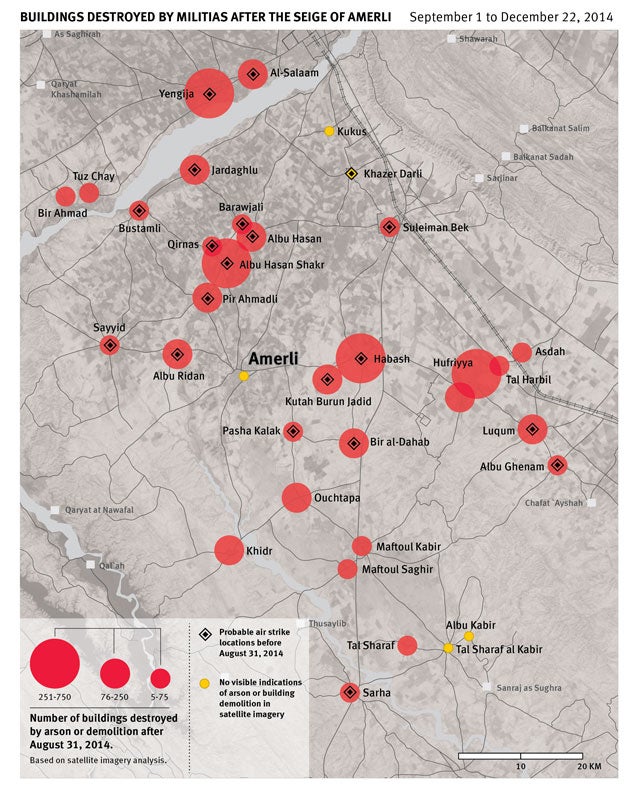
(New York) – Militias, volunteer fighters, and Iraqi security forces engaged in deliberate destruction of civilian property after these forces, following US and Iraqi air strikes, forced the retreat of Islamic State fighters (also known as ISIS) from the town of Amerliand surrounding areas in early September 2014, Human Rights Watch said in a report released today. The Iraqi government should rein in the militias and countries participating in the fight against ISIS, including the United States and Iran, should ensure military operations and other related support in the fight against ISIS are not paving the way for such abuses.
The 31-page report, “After Liberation Came Destruction: Iraqi Militias and the Aftermath of Amerli,” documents, through field visits, analysis of satellite imagery, interviews with victims and witnesses, and review of photo and video evidence, that militias looted property of Sunni civilians who had fled fighting, burned their homes and businesses, and destroyed at least two entire villages. The actions violated the laws of war. Human Rights Watch also documented the abduction of 11 men during the operation, in September and October.
“Iraq can’t win the fight against ISIS’s atrocities with attacks on civilians that violate the laws of war and fly in the face of human decency,” said Joe Stork, deputy Middle East and North Africa director. “Militia abuses are wreaking havoc among some of Iraq’s most vulnerable people and exacerbating sectarian hostilities.”
On March 2, 2015, Iraqi security forces and Shia militias launched an assault on Tikrit, the capital of Salah al-Din province, to rout ISIS from the area. Tikrit was the scene of a massacre of at least 1,000 Iraqi soldiers by ISIS last June.
At the end of August, following a three-month siege by ISIS, ground operations by pro-government Shia militias and Iraqi and Kurdish government ground forces, supported by Iraqi and United States air strikes, pushed ISIS away from Amerli, in Salah al-Din province. Except for some sporadic clashes, the area has since remained largely free of ISIS fighters, residents say.
Following the operations to end the siege, militias, volunteer fighters, and Iraqi security forces raided Sunni villages and neighborhoods around Amerli in Salah al-Din and Kirkuk provinces. Many were villages that ISIS had passed through and in some cases used as bases. Militias appear to have planned at least some of the attacks in advance, raising questions as to whether government political and military bodies that oversee the militias are responsible for planning the attacks.
Elsewhere in Iraq and in Syria, Human Rights Watch has documented serious abuses and war crimes by al-Qaeda and later ISIS, that most likely amount to crimes against humanity.
Many Sunni residents fled the area during the ISIS siege of Amerli. Individuals interviewed by Human Rights Watch said that ISIS had targeted the homes and property of those believed to be linked to the Iraqi government but otherwise had not attacked residents.
Twenty-four witnesses, including Peshmerga officers and local sheikhs, told Human Rights Watch they saw militias looting villages around Amerli after the offensive against ISIS ended and just before militias destroyed homes in the town. They said they saw militiamen taking items of value – such as refrigerators, televisions, clothing, and even electrical wiring – out of homes, then setting the houses on fire.
Residents told Human Rights Watch that the militias, whose vehicles and insignias identified them as including the Badr Brigades, Asa’ib Ahl al-Haqq, Kita’ib Hezbollah, and Saraya Tala’a al-Khorasani, destroyed, in part or entirely, numerous villages between the towns of al-Khales, in southern Diyala province, and Amerli, about 50 kilometers north.
Officers of the Kurdish Peshmerga forces that joined the government in the Amerli operation told Human Rights Watch they saw 47 villages in which militias had destroyed and ransacked homes, businesses, mosques, and public buildings.
Satellite imagery analyzed by Human Rights Watch corroborated witness accounts. The imagery showed that most of the damage resulted from arson and intentional building demolition inflicted after militias and security forces had lifted the Amerli siege and ISIS had fled the area, between early September and mid-November.
Human Rights Watch did not document reports of killings of civilians in this operation but has documented allegations of militia killings and other abuses in numerous other areas of Iraq in several reports in 2013 and 2014. Media reports of militia abuses during the course of fighting increased dramatically in late 2014 and 2015. On February 17, the Shia cleric Muqtada al-Sadr condemned militia abuses and announced a freeze of the activities of the two militias he oversees, Youm al-Mawoud and Saraya al-Salam, that had also been fighting against ISIS.
In a March 12 letter, Prime Minister Abadi’s office responded to Human Rights Watch’s February 25 letterconveying the main findings of the report. The prime minister’s office acknowledged that there were “individual lapses unconnected to government conduct.” The response noted that there were arrests in some of these individual cases, but that alleged victims did not appear before the court to testify regarding their allegations. It stated that abuses attributed to Hashd al-Shaabi (Popular Mobilization) forces were in fact committed by ISIS, and that “most of the material from Internet websites” was “false footage.” The response did not comment on satellite imagery evidence showing that most arson damage took place after the areas in question came under militia and Hashd al-Shaabi control.
The 31-page report, “After Liberation Came Destruction: Iraqi Militias and the Aftermath of Amerli,” documents, through field visits, analysis of satellite imagery, interviews with victims and witnesses, and review of photo and video evidence, that militias looted property of Sunni civilians who had fled fighting, burned their homes and businesses, and destroyed at least two entire villages. The actions violated the laws of war. Human Rights Watch also documented the abduction of 11 men during the operation, in September and October.
“Iraq can’t win the fight against ISIS’s atrocities with attacks on civilians that violate the laws of war and fly in the face of human decency,” said Joe Stork, deputy Middle East and North Africa director. “Militia abuses are wreaking havoc among some of Iraq’s most vulnerable people and exacerbating sectarian hostilities.”
On March 2, 2015, Iraqi security forces and Shia militias launched an assault on Tikrit, the capital of Salah al-Din province, to rout ISIS from the area. Tikrit was the scene of a massacre of at least 1,000 Iraqi soldiers by ISIS last June.
At the end of August, following a three-month siege by ISIS, ground operations by pro-government Shia militias and Iraqi and Kurdish government ground forces, supported by Iraqi and United States air strikes, pushed ISIS away from Amerli, in Salah al-Din province. Except for some sporadic clashes, the area has since remained largely free of ISIS fighters, residents say.
Following the operations to end the siege, militias, volunteer fighters, and Iraqi security forces raided Sunni villages and neighborhoods around Amerli in Salah al-Din and Kirkuk provinces. Many were villages that ISIS had passed through and in some cases used as bases. Militias appear to have planned at least some of the attacks in advance, raising questions as to whether government political and military bodies that oversee the militias are responsible for planning the attacks.
Elsewhere in Iraq and in Syria, Human Rights Watch has documented serious abuses and war crimes by al-Qaeda and later ISIS, that most likely amount to crimes against humanity.
Many Sunni residents fled the area during the ISIS siege of Amerli. Individuals interviewed by Human Rights Watch said that ISIS had targeted the homes and property of those believed to be linked to the Iraqi government but otherwise had not attacked residents.
Twenty-four witnesses, including Peshmerga officers and local sheikhs, told Human Rights Watch they saw militias looting villages around Amerli after the offensive against ISIS ended and just before militias destroyed homes in the town. They said they saw militiamen taking items of value – such as refrigerators, televisions, clothing, and even electrical wiring – out of homes, then setting the houses on fire.
Residents told Human Rights Watch that the militias, whose vehicles and insignias identified them as including the Badr Brigades, Asa’ib Ahl al-Haqq, Kita’ib Hezbollah, and Saraya Tala’a al-Khorasani, destroyed, in part or entirely, numerous villages between the towns of al-Khales, in southern Diyala province, and Amerli, about 50 kilometers north.
Officers of the Kurdish Peshmerga forces that joined the government in the Amerli operation told Human Rights Watch they saw 47 villages in which militias had destroyed and ransacked homes, businesses, mosques, and public buildings.
Satellite imagery analyzed by Human Rights Watch corroborated witness accounts. The imagery showed that most of the damage resulted from arson and intentional building demolition inflicted after militias and security forces had lifted the Amerli siege and ISIS had fled the area, between early September and mid-November.
Human Rights Watch did not document reports of killings of civilians in this operation but has documented allegations of militia killings and other abuses in numerous other areas of Iraq in several reports in 2013 and 2014. Media reports of militia abuses during the course of fighting increased dramatically in late 2014 and 2015. On February 17, the Shia cleric Muqtada al-Sadr condemned militia abuses and announced a freeze of the activities of the two militias he oversees, Youm al-Mawoud and Saraya al-Salam, that had also been fighting against ISIS.
In a March 12 letter, Prime Minister Abadi’s office responded to Human Rights Watch’s February 25 letterconveying the main findings of the report. The prime minister’s office acknowledged that there were “individual lapses unconnected to government conduct.” The response noted that there were arrests in some of these individual cases, but that alleged victims did not appear before the court to testify regarding their allegations. It stated that abuses attributed to Hashd al-Shaabi (Popular Mobilization) forces were in fact committed by ISIS, and that “most of the material from Internet websites” was “false footage.” The response did not comment on satellite imagery evidence showing that most arson damage took place after the areas in question came under militia and Hashd al-Shaabi control.
The Iraqi government should rein in the militias with the aim of disbanding them, Human Rights Watch said. Prime Minister Hayder al-Abadi should take immediate steps to protect civilians in areas where militias are fighting, assess and provide for the humanitarian needs of people displaced by militias, and hold accountable militia leaders and fighters responsible for serious crimes, such as those documented in this report.
In a December 18, 2014 opinion article in the Wall Street Journal, al-Abadi pledged to “bring … all armed groups under state control. No armed groups or militias will work outside or parallel to the Iraqi Security Forces.” The abuses that Human Rights Watch documented show that it is imperative for al-Abadi to make good on this pledge.
The United Nations Human Rights Council should publicly document crimes by militias and security forces against civilians as well as the crimes of ISIS, Human Rights Watch said. Countries providing military assistance to Iraq, including the United States and Iran, should require the government to show that it is taking effective steps to end the very serious crimes by militias.
“Iraq clearly faces serious threats in its conflict with ISIS, but the abuses committed by forces fighting ISIS are so rampant and egregious that they are threatening Iraq long term.” Stork said. “Iraqis are caught between the horrors ISIS commits and abusive behavior by militias, and ordinary Iraqis are paying the price.”
Syria: Evidence of a fresh war crime as chlorine gas attack kills entire family
Link

Eyewitnesses to an alleged chlorine gas attack last night in Idlib, northern Syria, have told Amnesty International about the horrific death of an entire family, including three children younger than three years of age.
Scores of other civilians were exposed to toxic chlorine gas in two apparent chemical weapons attacks allegedly carried out by government forces in and around the town of Sermine, Idlib, last night, eyewitnesses said.
These horrific attacks that resulted in civilians, including small children, suffering excruciating deaths, are yet more evidence that the Syrian government forces are committing war crimes with impunity. The situation in Syria must be referred to the International Criminal Court as a matter of urgency.
“These horrific attacks that resulted in civilians, including small children, suffering excruciating deaths, are yet more evidence that the Syrian government forces are committing war crimes with impunity. The situation in Syria must be referred to the International Criminal Court as a matter of urgency,” said Philip Luther, Middle East and North Africa Programme Director at Amnesty International.
Around 100 people in all were exposed to toxic levels of chlorine after Syrian armed forces helicopters dropped four barrels containing the gas in two attacks on Sermine and nearby Qmainass between 9:15PM and 11:00PM on 16 March, according to eyewitnesses. The injured included a small number of fighters from the Free Syrian Army armed group, but the vast majority were civilians.
A Syrian military spokesperson has denied responsibility for the attacks.
A doctor and a civil defence worker told Amnesty International that those affected by the attack had no injuries associated with explosive weapons, but showed symptoms characteristic of a chemical weapons attack, including reddened eyes, shortness of breath, continuous coughing, respiratory distress, vomiting, and drooling from the mouth.
A civil defence member who responded to a home near the attack site in Sermine told Amnesty International:
“The smell was horrible. We evacuated people. We were told that a family lives in the basement. Three of us went down the stairs. I took one breath and then when I took the second my throat burned, my eyes started burning. We didn’t have masks. We don’t have special clothes. I couldn’t proceed. I was holding my breath but couldn’t hold it further. I saw a woman on the stairs. She was blue and was not breathing. We evacuated her and a minute later the next team went in and evacuated the other family. They were wearing masks - that is why they were able to go all the way down. They evacuated the father, mother and three babies. They all died.”
The smell was horrible. We evacuated people. We were told that a family lives in the basement. Three of us went down the stairs...I saw a woman on the stairs. She was blue and was not breathing. We evacuated her and a minute later the next team went in and ... evacuated the father, mother and three babies. They all died.”
The names of the family members who were killed are Warf Mohammad Taleb, his mother Ayoush Hassan Qaq, his wife Ala al-Jati, and their three children: Sara Taleb, A’isha Taleb, and Mohamad Taleb.
A local activist posted video footage from a hospital in the aftermath of the attacks [Warning: very graphic footage that some viewers may find distressing]. It shows a dying infant lying naked on a table and the limp, naked bodies of the other two Taleb children being brought in and placed on top of their mother’s corpse on a hospital bed.
In September 2013, after hundreds of people died in alleged sarin gas attacks on Ghouta, outside Damascus, Syrian President Bashar al-Assad acceded to the Chemical Weapons Convention and pledged to destroy the country’s stockpile of prohibited chemical agents.
However, a year later, in September 2014, an Organisation for the Prohibition of Chemical Weapons (OPCW) fact-finding mission found “compelling confirmation” that a toxic chemical was used “systematically and repeatedly” as a weapon in villages in northern Syria earlier last year.
Subscribe to:
Posts (Atom)