Friday, September 16, 2016

150 مثقفاً سورياً: ضد لا أخلاقية الأزمة

150 مثقفاً سورياً: ضد لا أخلاقية الأزمة

Link

انفتحت معركة تقرير المصير السوري على صراع دولي موسّع تكشّف عن تقاطع وتقاسم مصالح بين "القوى الكبرى" ونظام الاستبداد، وكان لهذا الأمر انعكاساته التدميرية على أكثر من صعيد، منها انشطار المشهد الثقافي ضمن تصنيفات تُسقط الصراعات الدولية على مجتمع المثقفين، وهو ما وضعهم تحت ضغوطات جمّة ما انفكت تحد من فاعليتهم وقدرة صوتهم على التأثير.
اليوم يطلق مائة وخمسون مثقفاً سورياً، يمثلون أطياف الثقافة السورية وتياراتها الوطنية، بياناً ضد لا أخلاقية النظام الدولي كما تتجلى في السياسات الأميركية والروسية في سورية؛ وهو بيان يؤشر على لحظة بليغة دامية يحاول المثقف السوري فيها لملمة حنجرته المقطوعة ليكون صوت شعبه المنتهك من الطغاة وإنتهازيي السياسة الدولية. "العربي الجديد" حصل على نسخة من البيان وننشره كاملاً بالتزامن مع إطلاقه:

نحن كتابٌ وفنانون وصحفيون سوريون، ديمقراطيون وعلمانيون، معارضون لنظام الطغيان الأسدي طوال سنوات أو عقود، ومشاركون في النضال من أجل الديمقراطية والعدالة في بلدنا، وفي إقليمنا والعالم، نود أن نعبّر عن إدانتنا بأقسى العبارات لمقاربة القوتين المتدخلتين في سورية، الولايات المتحدة وروسيا، لشأننا السوري، وعملهما منذ عام 2013 على الأقل على إلحاق كفاح السوريين التحرري بـ"حرب ضد الإرهاب" ليس في سجلها قصة نجاح واحدة، لكن في السجل قصة تحطيم عدد من البلدان.
قبل ثلاث سنوات وقعت الدولتان الإمبرياليتان الصفقة الكيماوية المشينة التي حلت مشكلات للولايات المتحدة وإسرائيل وروسيا، وللدولة الأسدية التي كانت قتلت لتوّها 1466 من محكوميها.
لم يُعالج الاتّفاق أي مشكلة تخص الشعب السوري، بل أطلقت يد طغمة بالغة الإجرام في قتل السوريين وتدمير بلداتهم وأحيائهم وتهجيرهم. وكانت فوق ذلك هدية لا تقدر بثمن للمنظمات العدمية الإسلامية مثل داعش وجبهة النصرة.
وبعد ثلاث سنوات من تلك الصفقة الخسيسة، ومقتل نحو نصف مليون من السوريين، يتفق الروس والأميركيون على تجميد الوضع الحالي كي تستأنف القوتان الحربيّتان حرباً لا تنتهي ضد الإرهاب.
هذا، مع إغفال مصير عدد غير محدود من المعتقلين في شروط وحشية، ومن دون دعوة إلى فك الحصار عن المناطق المحاصرة، ودون ذكر ميليشيا حزب الله وميليشات طائفية أخرى تحارب إلى جانب الأسديين، ولا ربط ذلك بتصوّر سورية جديدة ديمقراطية. بل من دون استبعاد مشاركة طائرات بشار الأسد في قصف مناطق سيُتّفق عليها بين الروس والأميركيين لاحقاً.
هذا كله لا يدل فقط على انعدام تام للحس الأخلاقي وحس العدالة لدى الفريقين الأميركي والروسي، وإنّما يفضح أيضاً انحطاط المهنة السياسية وتدني مستوى سياسيي دولتين هما الأقوى في عالم اليوم.
أننا نشعر بغضبٍ شديد إزاء هذه الترتيبات وأصحابها ونرفضها بشدة جملة وتفصيلاً، ويزيدنا غضباً ورفضاً تواطؤ الأمم المتحدة التي تكشّف مؤخراً أنها كانت تموّل طغمة الإجرام الأسدي طوال سنوات حربها ضد السوريين.
كمثقفين سوريين، من كتّابٍ وفنانين وصحفيين، نرى أنّ عالم اليوم كله يسير نحو تبلّد أخلاقي غير مسبوق، ترتفع فيه مستويات الخوف والكراهية، وترتفع معها أسهم السياسيين الذي يستثمرون في الخوف والكراهية والانعزال. ونرى أنّ الديمقراطية في تراجع في العالم كلّه، وأن المراقبة والتقييد والخوف في انتشار وصعود. ونحن لا نعتقد أن هذه أقدار مقدرة، بل هي خيارات خطرة لنخب سياسية خطرة، يتعيّن أن نعمل معاً على رفع صوت الاعتراض عليها، الآن وفي كلّ مكان.
إن سورية المحطمة رمز لعالم اليوم. لقد تحطّمت ثورة السوريين على الجدار الصلب للنظام الدولي، وليس على جدار الفاشية الأسدية وحدها. وهذا النظام الدولي الذي يوفّر لسياسيين من أمثال أوباما وبوتين ووكلائهما وأشباههما من معدومي الإنسانية أن يتخذوا قرارات تنتهك حقّنا في تقرير مصيرنا، أفراداً وجماعاتٍ ووطناً، من دون أن ننتخبهم أو تتوفر لنا أيّة آليّةٍ لمساءلتهم، هو نظام غير ديمقراطي، معادٍ بشراسةٍ للديموقراطيّة، ويجب أن يتغيّر.
وللأسف لا يبدو أن خطورة هذا الواقع موضع إدراك كافٍ. يفضّل كثيرون، في الغرب بخاصة، الاختباء وراء نظريات قدرية تحيل إلى الدين أو الثقافة أو... إلى التغيرات المناخية. لكن هذا يجعل السيء أسوأ، ويحجب المسؤوليات السياسية لنخب السلطة النافذة، بما فيها طغمة بشار الأسد بالذات.
يجب أن يتغيّر هذا العالم الذي سمح بتحطم أحد أعرق مهود الحضارة طوال خمس سنوات ونصف. إنّ العالم اليوم قضية سورية كما أنّ سورية قضية عالمية. ومن أجل العالم، من أجلنا جميعاً، ندعو إلى إدانة إلى هؤلاء السياسيين، والتشهير بهم كقتلة عدميين وإرهابيين مثل خصومهم من العدميين الإسلاميين.
 الموقعون
1-ابراهيم الجبين- روائي وإعلامي
2-أحمد برقاوي- فيلسوف
3-أحمد حسو- صحفي
4-أحمد عمر- كاتب
5-أحمد عيشة- مترجم
6-أسامة محمد- سينمائي
7-أسامة نصار- صحفي وناشط
8-أسعد العشي-
9-إسلام أبو شكير- قاص
10-أنس يوسف- طبيب
11-أنوار العمر- صحفي
12-أنور عمران - صحفي
13-أوس المبارك- كاتب
14-إياد حياتلة- شاعر
15-إياد العبدالله- كاتب
16-إيلاف ياسين- صحفية
17-إيمان شاكر
18-آية الأتاسي- صحفية
19-باسل العودات - صحفي
20-بدر الدين عرودكي- كاتب ومترجم
21-برهان غليون- كاتب وأستاذ جامعي
22-بكر صدقي- كاتب وصحفي
23-تمام هنيدي- شاعر
24-جمال سعيد- كاتب
25-جميل نهرا- روائي
26-جهاد يازجي- اقتصادي
27-حازم النهار – كاتب
28-حازم كمال الدين
29-حذام زهور عدي- كاتبة صحفية
30-حسام السعد- أكاديمي سوري
31-حسام الدين محمد- كاتب وصحفي
32-حسكو حسكو- فنان تشكيلي
33-حسن شاحوت- شاعر
34-حلا عمران- ممثلة
35-حكمت شطا- مهندس وفنان
36-خالد سليمان الناصري- شاعر وسينمائي
37-خضر الآغا- كاتب
38-خطيب بدلة- كاتب
39-خلدون الشمعة- ناقد أدبي
40-خلف علي الخلف- شاعر
41-خليل الحاج صالح- مترجم
42-خيري الذهبي- كاتب وروائي
43-دارا العبدالله- كاتب
44-دريد البيك- صحفي ومهندس
45-ديما ونوس- كاتبة وإعلامة
46-رائد وحش- شاعر
47-راتب شعبو- كاتب ومترجم
48-راشد عيسى- صحفي
49-رستم محمود- كاتب سوري
50-رشا عباس- قاصة
51-رشا عمران- شاعرة
52-رشيد الحاج صالح- كاتب
53-روزا ياسين حسن- كاتبة
54-زاهر عمرين- كاتب
55-زويا بستان- إعلامية
56-سامر الأحمد- إعلامي
57-سعد حاجو- رسا كاركايتر
58-سعيد غزول- محرر أخبار
59-سمر يزبك- روائية
60-سميح شقير- فنان
61-سميح الصفدي- كاتب
62-سلام محمد- سيناريست
63-سليمان البوطي-
64-شربل كانون- فوتوغراف
65-صادق جلال العظم- مفكر
66-صادق عبد الرحمن- كاتب
67-صافي علاء الدين- ناشر
68-صبحي حديدي – كاتب وناقد أدبي
69-صبحي حليمة- كاتب وصحفي
70-ضاهر عيطة- كاتب
71-ضحى حسن – كاتبة
72-ضحى عاشور- كاتبة
73-طالب العلي- كاتب
74-طلال دقماق- مصور فوتوغرافي
75-عادل العايد- صحفي
76-عاصم الباشا- نحات
77-عاصم حمشو- كاتب
78-عبد الرحمن مطر- كاتب
79-عبد الرحيم خليفة : ناشط سياسي وحقوقي
80-عبد العزيز التمو- كاتب وسياسي كردي سوري
81-عبدالله تركماني- باحث
83-عبدالله مكسور- روائي
83-عروة الأحمد- إعلامي وممثل
84-عساف العساف- كاتب
85-علي سفر- كاتب وإعلامي
86-علي العائد- صحفي
87-عماد حورية- ناقد مسرحي
88-عماد عبيد- فنان تشكيلي
89-عمار الجمعة- شاعر
90-عمار قط- صحفي
91-عمر الأسعد- صحفي
92-عمر قدور- روائي
93-عمر كوش- كاتب
94-غسان المفلح- صحفي
95-غياث المدهون- شاعر
96-فادي ديوب- ناشط
97-فارس الحلو- ممثل
98-فاروق مردم بيك- كاتب ناشر
99-فايز الباشا- طبيب
100-فايز العباس- شاعر
101-فدوى كيلاني- شاعرة
102-فرج بيرقدار- شاعر
103-كريم العفنان- صحفي
104-لؤي سكاف- مهندس
105-ليلى الصفدي- إعلامية
106-لينا عطفة- شاعرة
107-ماجد رشيد العويد- روائي وكاتب
108-ماجد مطرود- شاعر وناقد
109-مازن حداد- مهندس
110-مازن درويش- حقوقي
111-مالك داغستاني- كاتب
112-مأمون الشرع- كاتب
113-ماهر جنيدي- كاتب وإعلامي
114-ماهر مسعود- كاتب
115-محمد حاج بكري- باحث وكاتب اقتصادي
116-محمد الحاج صالح- كاتب
117-محمد خليفة- كاتب وباحث
118-محمد العبدالله- محام ونشاط سوري
119-محمد عطار- مخرج مسرحي
120-مروان الأطرش- مهندس
121-مصطفى سليمان- فنان تشكيلي
122-معبد الحسون- كاتب
123-مفيد نجم- شاعر
124-ملاذ الزعبي- إعلامي
125-منصور السلطي- ممثل ومخرج مسرحي
126-منهل باريش- صحفي
127-منير الخطيب- كاتب
128-موريس عايق- كاتب
129-موسى رمو- فنان تشكيلي
130-مايا شربجي- فنانة
131-مي سكاف- ممثلة
132-ميشال شماس- محامي وحقوقي
133-ناهد بدوية- كاتبة
134-نشوان أتاسي- كاتب
135-نوري الجراح- شاعر
136-هالا محمد- شاعرة ومخرجة سينمائية
137-هالة العبدالله- سينمائية
138-هند مرعي-
139-هوشنك أوسي- كاتب
140-هيثم عبدالله- مترجم
141-وائل تميمي- إعلامي
142-وائل مرزا- كاتب
143-وجدان ناصيف- كاتبة
144-وفائي ليلى- شاعر
145-يارا بدر- صحفية
146-ياسر منيف- ناشط وأكاديمي
147-ياسين سويحة- كاتب
148-ياسين الحاج صالح- كاتب
149-يامن حسين- صحفي
150-يوسف دعيس- كاتب وصحفي

How to support a Libyan government - and kill it at the same time


By David Hearst

Link

Like Joseph Heller's protagonist in Catch 22, the UK is playing both sides of the war - and leaving Egypt and the UAE with the spoils
To plumb the depths of the insanity of British policy in Libya, factual reports are not enough. A day after he resigned as MP, the UK's foreign affairs committee gutted David Cameron’s reputation as war leader.
The British parliamentary enquiry found that “responsibility to protect” had been used as a cover for regime change (the Russian argument); that the imminent threat of Gaddafi’s forces to civilians in Benghazi was overstated; that intelligence was inadequate and that Britain followed France without an ability to influence it. Sound familiar? But even those judgements stop short of the whole truth. For that, you need to turn to fiction. 
Joseph Heller’s contribution to war studies was the character of Milo Minderbinder in his book,Catch 22. The mess officer on a US airbase in Italy said that as there was nothing any soldier could do about war, except die in it, the only rational thing to do was to profit from it. So when Milo found himself with a glut of Egyptian cotton, he invited the Germans to bomb his own airfield.
Milo hotly defended himself: “Oh I know what you are going to say. Sure, we are at war with them. But the Germans are also members of the syndicate and it's my job to protect their rights as shareholders. Maybe they did start the war, and maybe they are killing millions of people but they pay their bills a lot more promptly than some allies of ours I could name. Don’t you understand that I have to respect the sanctity of my contract with Germany?”
Is Heller parody or understatement?

Modern Minderbinders

A few hours before the select committee report, the Middle East Eye published recordings of conversations between Emirati pilots on bombing missions around Benghazi, and the control tower at Benina airport, the headquarters of the renegade general Khalifa Haftar. 
It's clear, from previously released recordings, that the pilots are not bombing IS targets in Sirte. The coordinates point instead to a neighbourhood of Benghazi called Souq al-Hout, the Fish Market, a crucial battleground during the 2011 intervention against Gaddafi and one of the main areas of fighting between Haftar and Islamist forces since 2014.
It is controlled by the Shura Council of Benghazi Revolutionaries (SCBR), a coalition of forces which includes Ansar al-Sharia, labelled a terrorist organisation by the UN, US, UK and Turkey, but also groups which are loyal to the Libyan defence ministry in Tripoli, such as the February 17th Martyrs Brigade.
British, American, French and Jordanian military air traffic controllers are heard on the same tapes. They sit alongside the Emiratis in Haftar’s control room.
This means that today’s Milo Minderbinders are helping opposing sides of the same war to fight against each other. Britain is placing an each-way bet. 
As MEE revealed when it published a briefing Jordan’s King Abdullah gave to US congressional leaders this January, British special forces are deployed in Libya alongside Jordanian ones, whose Arabic accent, the king said, is close to the Libyan slang.
We know from on the ground reports in Libya that British soldiers are helping Misratan militias, who are loyal to the government in Tripoli, push the Islamic State (IS) group out of Sirte.
Self-anointing
But at the same time as that battle is being waged, British military air traffic controllers, pilots and planes are helping Haftar’s forces prevail in Benghazi. Haftar’s forces are not, and never have been, engaged in the fight against IS in Sirte. His war is with the government in Tripoli.
His actions, like those of the IS, are aimed at telling Libyans that the UN-brokered and internationally recognised Presidential Council and its Government of National Accord (GNA) cannot control key state infrastructure, like the oil ports, and that he, Haftar, should be taken seriously. 
This led on Tuesday to a moment Milo Minderbinder would have been proud of. Two days after his so-called Libyan National Army (LNA) wrested control of four Oil Crescent ports in Ras Lanuf, Sidra, Zueitina and Brega, from militias controlled by Ibrahim Jadhran, commander of the Petroleum Defence Guards, Haftar had himself anointed field marshal.
A stand-off ensued. Haftar demanded the National Oil Corporation (NOC) lift force majeure and allow the ports to export oil, while the Presidential Council, the US, Britain, France and Italy, Spain and Germany reaffirmed their support for the GNA and their intent to enforce sanctions against illegal exports of oil. The export ban was lifted on Thursday after the NOC chairman Mustafa Sanalla “accepted a handover of the ports“ from Haftar’s men. 
It is difficult to know what this means as Hafter's takeover of the ports on Sunday was more a matter of negotiation between militias than actual combat. Sanalla also sowed seeds of doubt about GNA control when he said that the LNA's seizure could "lead to a new phase of co-operation" between the Libyan factions. Control is a moveable feast in Libya. 
A few weeks ago, a Western diplomat in Libya dismissed as conspiracy theory the notion that Britain, France and Italy were working to split Libya into three - that Britain would take Cyreneica, the Italians Tripoli and France the south. He admitted the risk of division was there, because of players like Haftar, but that every Security Council resolution had reaffirmed the sovereignty, territorial integrity and independence of Libya and that the collective effort was to try to bring all militias together under one umbrella.
How exactly? The same diplomat admitted his country used the Emiratis as a go-between with the east of Libya.

Intervention disaster

Egypt and the Emiratis are dictatorships with a track record of suppressing political opposition. Each has been highly active abroad, particularly in Libya, in making sure that Islamist governments do not get into or stay in power. The GNA is not Islamist, but the fact that Islamist groups have deferred reluctantly to its authority is enough for the Emiratis to do everything they can to bring it down.
Allowing the Egyptians and Emiratis to carve out an oil-rich client statelet in eastern Libya, while other Libyans are doing the job of fighting IS, is not a formula upon which national unity can be forged. The militias backing the UN-brokered government have a right to feel betrayed.
Cameron and Sarkozy are no longer in power. Their special forces continue however to provide Haftar with personal protection, while their governments issue statements condemning his defiance of the internationally recognised government in Tripoli. Should he prevail, one dictator in Gaddafi would have been replaced by another. 
Britain, France and Italy have effectively leased the franchise of their interests in Libya to regional Arab states, who have injected their own political agenda. That other former field marshal, Abdel Fattah al-Sisi, made the militant groups in eastern Libya his first foreign policy priority in the months after staging his coup in Egypt.
It puzzled experts at the time, because this was long before jihadis in Iraq had even come up with the IS name, let alone moved to Sirte. It will not be Western, nor will it be liberal, but the disaster of intervention will continue.
Milo Minderbinder: "We're gonna come out of this war rich!"
Yossarian: "You're gonna come out rich. We're gonna come out dead."
- David Hearst is editor-in-chief of Middle East Eye. He was chief foreign leader writer of The Guardian, former Associate Foreign Editor, European Editor, Moscow Bureau Chief, European Correspondent, and Ireland Correspondent. He joined The Guardian from The Scotsman, where he was education correspondent.

Thursday, September 15, 2016

اتفاق الهدنة وخيارات "فتح الشام"

ميشيل كيلو

Link

بقرار أميركا وروسيا اعتبار جبهة النصرة، أو جبهة فتح الشام بمسماها الجديد، تنظيماً إرهابياً تجب محاربته والقضاء عليه، يصير قيام نظام إسلامي في سورية ضرباً من الاستحالة، مهما وفّرت "الجبهة" له من قوى ميدانية، بشرية وسلاحية، وناصرتها التنظيمات "المعتدلة" أو شاركتها القتال من أجلها. بهذا القرار، تكتمل أيضاً حلقة المبادرين إلى رفض الدولة الإسلامية من العرب ودول الإقليم، الذين لم يتأخروا في الإفصاح عن موقفهم منها، كالأميركيين والروس، بل أعلنوا، في مرحلةٍ مبكرة من الثورة السورية، موقفهم حيالها، واعتبروها تهديداً خطيرا لأمن المنطقة ولنظمهم واستقرارها. 

إذا كان هذا التقدير صحيحاً، وهو صحيح، يكون من العبث الانضمام إلى "جبهة فتح الشام" في مقاتلة الروس والأميركيين، بالنظر إلى نتائجه الصفرية سياسياً التي تجعل تأسيس دولة إسلامية في سورية محظوراً عربياً ودولياً، ولأن الانضمام إليها سيجر التنظيمات المقاومة الأخرى، والصراع في سورية، إلى حال أفغانية، ستغوص بسببها في حربٍ لا نهاية لها، مرتفعة التكلفة إلى حد خطير، قد يقوّض مقومات وجود سورية واستمرارها دولةً ومجتمعاً، في حين يستطيع الأميركيون والروس التعاون على التعايش مع هذه الحرب إلى أن يتم القضاء على فرص قيام النظام الإسلامي العتيد، إن هو نجح في السيطرة على البلاد، أو إذا أعلنت بعض فصائل المقاتلين إقامته التي لن تبدّل الأمور، لأنه سيشبه نظامي "طالبان" و"داعش"، الموجودين افتراضياً، لكنهما لا يشكلان دولتين بمعنى الكلمة، ما دام حملتهما مقاتلين أفرادا جوّالين، وما دامتا تفتقران إلى ما يميز الدول من مؤسساتٍ، ويسمها من شمولٍ وعلانية، وتتمتع به من ولاء المواطنين لها وقبولهم بها. 
ليس تخلي جبهة فتح الشام عن هويتها القاعدية تنازلاً تقدمه لأحد، بل هو تدبير عقلاني تمليه الواقعية والحكمة: الواقعية التي يجب أن تكون من صفات قادتها، وتتركّز حول استحالة قيام النظام الإسلامي الذي يقاتلون من أجله، من جهة، وجسامة ما سيقدم من تضحيات مجانية في سبيله ستدفع الشعب إلى الانفكاك عنهم، ورفض مشروعهم من جهة أخرى، والحكمة التي ترى أن للواقع تجليات متنوعة، لا تقتصر على شكل وحيد قائم، إن تشبث قادة أي تنظيم سياسي أو عسكري به، ورفضوا بدائله الأفضل، كانوا مجموعة حمقى، وفشلوا في آنٍ معا في المحافظة على تنظيمهم وقضيتهم التي لا تنتصر، كأية قضية أخرى، إن لم تعرف كيف تتكيّف بنجاح مع تحولات الواقع، وبالأخص منها التي لا يمكنها تحدّيها ناهيك عن تخطيها، ويترتب على رفضها ثمن باهظ إلى درجةٍ تنتفي معها فرص النجاة والاستمرار. 
إذا كان من المحال أن تنجح "الجبهة" في إقامة نظام إسلامي، مهما قدّم الشعب السوري من  

تضحيات، وكان التشبث بانتمائها إلى القاعدة يهدّد بتقويضها هي، وبقية الفصائل المسلحة التي ستتعرّض للضرب مثلها في حال تحالفت معها، وستفقد قوتها الوازنة والمؤثرة في حال نأت بنفسها عنها. وستواجه، في الحالة الأولى، وضعا دولياً معادياً، وسيتناقص اهتمامه بها في الحالة الثانية، بسبب ما سيصيبها من تراجعٍ وضعف، علما أن العالم سيعتبرها، في حال التهاون مع الجبهة، تنظيمات إرهابية مثلها، وسيحول بينها وبين المشاركة في أي حل سياسي قادم، وسيزيل عنها صفة الاعتدال التي تؤهلها لأن تكون بديلاً محتملاً للنظام الأسدي. لن تربح "الجبهة" سياسياً من تحالف الفصائل معها، لاستحالة قيام نظام إسلامي في بلادنا، بينما ستخسر الفصائل قوتها أو أجزاء منها، وهويتها التي تجعلها شريكاً دولياً مقبولاً، فماذا يبقى، في ضوء هذه الحسابات التي أعتقد أنها واقعية وعادلة، غير فكّ علاقة "الجبهة "بالقاعدة، والانتماء إلى ثورة الشعب وعلمها، وإلى الجيش الحر وفصائله، لا سيما أن هذه الخطوات تمكّنها من الحفاظ على قوتها الوازنة في مواجهة النظام، وتحمي قوى الجيش الحر والفصائل، وتقلّص فرص إضعاف الثورة اليوم والتخلص منها غداً، وتوفر على شعبنا تضحياتٍ جسيمة، لا عائد سياسياً أو عسكرياً يسوّغها، وتعيد إلى الحراك الشعبي هويته الأولى، المعادية للاستبداد ولنظامه الأسدي، وتؤسس وضعاً سيقلب ميزان القوى تدريجياً لصالح شعب سورية، وسيجبر الدولتين الكبريين على الحد من تلاعبهما بمصيره، وتصارعهما بدمائه، بينما سيبعث الأمل بالخلاص في نفوسٍ كثيرة أصابها اليأس من الانتصار والعودة إلى الوطن، وسيحفظ وحدة دولتنا ومجتمعنا، أو يجعل تهديدها ضرباً من العبث. 
تقدّم التطورات فرصةً تاريخية "للجبهة"، إن اهتبلتها أنقذت شعبها وصانت حقوقه. عندئذٍ، سيدافع السوريون عنها بالأرواح والمهج، لأنها غلبت أمنهم ووجودهم وانتصار ثورتهم على حساباتها التنظيمية الضيقة. 
هل يُقدم قادة "الجبهة" على ما يلزمهم واجبهم تجاه أهل الشام بفعله، وتنتظره منهم قطاعاتٌ واسعةٌ منهم، أم يركبون رؤوسهم، ويضعون حساباتٍ حزبيةً وتنظيميةً فوق مصالحهم وأمنهم، فيهلكوا ويهلك معهم عدد غفير من المقاتلين من أجل سورية، وأبرياء بلا عدد ثاروا من أجل الحرية والحياة والكرامة، ولم يثوروا لكي تقتلهم الحسابات الخاطئة والأنانيات التنظيمية والمشاريع الوهمية والمستحيلة.


AMEN!

I COULD NOT AGREE MORE!

DNA - 15/09/2016 الظريف..في مقال ظريف

Syria-Jordan border: 75,000 refugees trapped in desert no man’s land in dire conditions


Link

Video footage and satellite images showing makeshift grave sites and burial mounds offer a rare glimpse inside a desert no man’s land between Jordan and Syria where tens of thousands of refugees who have been virtually cut off from humanitarian aid for two months are stranded, said Amnesty International.
The video footage was obtained from Tribal Council of Palmyra and Badia, which has a network of activists operating inside the area known as the berm, and independently verified using satellite imagery.
Fresh accounts gathered by the organization, paint a desperate picture of human suffering and highlight the tragic consequences of the world’s failure to share responsibility for the global refugee crisis. Next week, world leaders will gather in New York for two high-level summits to discuss refugees.
Second grave site at informal refugee camp in Rukban
Satellite image showing location of grave site at the informal refugee camp in Rukban on the Syrian-Jordanian border where tens of thousands of refugees are stranded. © CNES 2016, Distribution AIRBUS DS. Screenshot from video obtained via the Tribal Council of Palmyra and Badia
“The situation at the berm offers a grim snapshot of the consequences of the world’s abject failure to share responsibility for the global refugee crisis. The knock on effect of this failure has seen many of Syria’s neighbours close their borders to refugees,” said Tirana Hassan, Crisis Response Director at Amnesty International.
“It’s a desperate picture for people trapped at the berm, food is running out and disease is rife. In some cases people are suffering or even dying from preventable illnesses, simply because they are not allowed into Jordan and the authorities have blocked access for aid, medical treatment and a meaningful humanitarian response.”

Syria’s neighbours, including Jordan which is hosting 650,000 refugees, have taken in the vast majority of people fleeing the conflict, severely straining their resources. Ahead of the two summits next week Amnesty International is calling on world leaders to move beyond rhetoric and make concrete commitments to welcome their fair share of refugees, relieving the pressure on countries which are hosting large numbers of refugees. The organization is also calling on Jordan to grant immediate entry to refugees at the berm.

Starvation, sickness and death

Humanitarian assistance to the berm, which was already limited before, stopped completely when the Jordanian authorities sealed off the Rukban and Hadalat border crossings after a deadly attackkilled seven border guards on 21 June. Since then, only one delivery of food aid was made in early August to more than 75,000 people stranded there. Aid agencies are barred by the Jordanian authorities from accessing the no man’s land area and were forced to drop supplies over the sandy ridge (berm) using cranes.
Abu Mohamed, who has been living in the informal camp at Rukban for five months said the situation there has sharply deteriorated since the 21 June attack.
“The humanitarian situation is very bad, the situation of children in particular is very bad. We have drinking water but hardly any food or milk… [it] is awful,” he said.
“Many people have died… They distributed just rice and lentils and a kilo of dried dates, but that was all for a whole month, they gave us nothing but that. The mood among the people in Rukban is below zero.”
Video footage obtained by Amnesty International shows two makeshift grave sites in Rukban revealing dozens of burial mounds in close proximity to refugee tents.
Grave site in refugee camp at Rukban on Syrian-Jordan border.
Satellite imagery showing location of second grave site at Rukban. © CNES 2016, Distribution AIRBUS DS. Screenshot from video obtained via the Tribal Council of Palmyra and Badia
The lack of access to proper medical care and the dire conditions is a deadly combination. Poor hygiene, sanitation conditions and limited access to clean water are reported to have led to an outbreak of hepatitis, which is believed to be the leading cause of child deaths in Rukban.
Humanitarian sources indicate that since June there have been at least 10 deaths from hepatitis. Sources in Rukban and members of the Tribal Council of Palmyra and Badia said many of those who have died are children who were suffering from jaundice which occurs as a result of hepatitis.
Aid workers have also reported that at least nine childbirth-related deaths took place since 21 June. A significant number of pregnant women are reportedly among the refugee population unable to access medical care.
The total number of deaths that have occurred is difficult to verify given the lack of access to the berm.
Slide to display before and after image of shelters at Rukban
According to sources inside Rukban, in late August a 20-year-old man died from complications of jaundice most likely as a result of hepatitis. He is reported to have bled to death from gastrointestinal bleeding. The lack of medical treatment meant there was nothing that could be done to save his life.
Among the other most prevalent illnesses spreading in the camp are respiratory infections, dehydration, leishmaniasisand diarrhoea.
Satellite images obtained by Amnesty International show that since the end of 2015 the population density near the two informal border camps at Rukban and Hadalat has risen significantly.
Although the number of refugees at Hadalat decreased slightly following the halt to the humanitarian response in June and nearby Russian airstrikes in July, overall there has been steady rise in the number of refugees at the berm.
Shelters at Rukban border crossing, September 2016 © CNES 2016, Distribution AIRBUS DS. Data via UNOSAT
At Rukban the overall number of shelters rose from just 368 a year ago to 6,563 in late July 2016 and most recently increased to more 8,295 in September 2016. This dramatic influx highlights the fact that over the past few months thousands of people have continued to flee the conflict in Syria where war crimes and other grave violations are being committed on a daily basis. 

Security concerns heighten restrictions

The Jordanian authorities have repeatedly cited security concerns as their reason for closing the border, halting humanitarian operations at the berm. Jordan’s Minister of State for Media Affairs Mohammed al-Momani told Amnesty International that the area around the berm is “becoming a Daesh enclave” (controlled by the armed group calling itself Islamic State). While he acknowledged that the humanitarian situation there is difficult and said that Jordan is ready to assume its share of responsibility he also called on the UN and international community to do their fair share for the refugees at the berm.
“There is no question that security is an important consideration, but protecting people in Jordan should not come at the expense of providing humanitarian assistance and protection to those desperately in need,” said Tirana Hassan.
Jordan has previously welcomed refugees from Syria through its borders and carried out rigorous screening and registration processes prior to allowing their entry into the country. The authorities can use these processes again to open their doors to refugees fleeing the conflict in Syria, while ensuring security at the same time.
The UN is negotiating plans with the Jordanian authorities to shift humanitarian aid distribution points some 2km into the no man’s land area, away from the Jordanian border creating a buffer zone, to allow humanitarian operations to resume.
“Whether aid is distributed at the berm’s edge or 2km away does not change the fact that there are tens of thousands of people seeking international protection on Jordan’s doorstep, nor does it absolve the authorities’ obligation to offer a safe haven to those fleeing conflict and persecution,” said Tirana Hassan.
“Directly or indirectly forcing refugees to return to Syria by refusing access and imposing intolerable living conditions on them is a flagrant violation of Jordan’s international obligations. The authorities must allow unfettered humanitarian access to refugees who are trapped. Any attempt to coerce or ask them to move should be rejected.”
Any longer term solution however, needs to be a global one. Internationally, resettlement places for refugees from Syria remain woefully insufficient. Countries in the region continue to bear the brunt of the refugee crisis, with more than four million refugees in just three countries.
“Without real commitments to boost resettlement followed by concrete action, next week’s refugee summits will serve as little more than a token gesture,” said Tirana Hassan.
“Failing to provide a long term solution for refugees stranded at the berm will point not just to the world’s failure there, but their failure of refugees worldwide.”

Syria breaching ceasefire deal by blocking aid convoys, says UN

UN special envoy Staffan de Mistura condemns government’s failure to provide letters of permission for convoys

The Guardian

Link

The Syrian government is failing to provide letters of permission to allow UN aid convoys to travel to besieged cities, in clear breach of the US-Russian ceasefire agreement, the UN special envoy for Syria has said.
Staffan de Mistura also said the intended delivery of aid into eastern Aleppo, subject to a different permission regime, was also being blocked by hurdles put in place by the Syrian government and opposition fighters.
The delivery of aid is a precondition of the survival of a cessation of hostilities that came into effect on Monday and is designed to lead to unprecedented joint Russian-American action against terror groups inside Syria.
De Mistura insisted the Russians were as disappointed as the UN at the “deeply regrettable” refusal of the Syrian government to grant letters of permission in line with the agreement. He said he had been given fresh assurances by the Russians at a meeting on Thursday morning that the absence of the permission letters was a very severe disappointment, but he did not specify what pressure the Russians were placing on the Syrians to abide by the agreement.
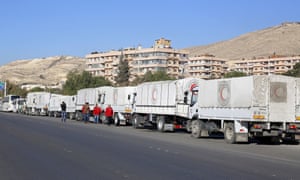
Hundreds of trucks were ready to be loaded, he said, and an opportunity to deliver aid and help solidify the ceasefire was being wasted. The UN has said it cannot cross front lines or checkpoints without Syrian permission.
The separate blockage over eastern Aleppo has left 20 UN trucks that travelled from Turkey into a buffer zone waiting for the past 48 hours for UN agreement that it is safe to travel along the Castello Road, the main supply route into the divided city, where 250,000 people are desperate for food and fuel.
Jan Egeland, head of the United Nations humanitarian taskforce for Syria, said the trucks were still in the buffer zone and “could go on a minute’s notice”. De Mistura said the aid could not move into Syria’s second city before the Castello Road route had been fully secured.
Syrians unload boxes after a 48-truck aid convoy entered the rebel-held town of Talbiseh, a besieged area in northern rural Homs, in July.
Pinterest
 Syrians unload boxes after a 48-truck aid convoy entered the rebel-held town of Talbiseh, a besieged area in northern rural Homs, in July. Photograph: Mahmoud Taha/AFP
The Russian-American agreement states trucks should be allowed to travel into eastern Aleppo without the need for written permission from the Syrian government. The Syrian government involvement is limited to being informed of the details of the aid being delivered, and details of what had been delivered.
In addition, as part of the agreement, regime checkpoints on the Castello Road should be withdrawn, and opposition forces inside the city’s east should not seek to block the delivery. “The trucks are ready and sealed, and the agreement is that once they move they will not be harassed and they will not be investigated and they will be moving along that road,” De Mistura said.
There have been reports that some opposition fighters are rejecting the delivery of the aid on the basis that it rejects the terms of the broader Russian-American agreement, including the plan to target fighters from the former al-Nusra front. The US says al-Nusra is linked to al-Qaida and is a legitimate target alongside Islamic State. But other groups in eastern Aleppo are reluctant to abandon al-Nusra.
Under the ceasefire plan the Russian and Americans are supposed to create a joint centre to agree legitimate targets to attack by air. The Syrian air force would then in effect be grounded in those specified areas.
Despite the problems, De Mistura insisted the Russian-American agreement “is and remains a potential game-changer”. He said it was too much to describe it as a cessation of hostilities, saying instead it had produced a reduction of violence, adding that “by and large it is holding and is, in fact, substantial”.

Emad Hajjaj's Cartoon: Syrian Truce

الهدنة في سورية

Wednesday, September 14, 2016

ما وراء الخبر-هل يمكن فصل المعارضة السورية عن "النصرة"؟

DNA - 14/09/2016 الاسد يسقط طائرة.. في منامه

Syrian regime is blocking aid from entering eastern Aleppo, claims UN

Twenty trucks are not being allowed to enter the beseiged city in spite of ceasefire agreement, says United Nations envoy

The Guardian
UN truck convoy in Syria

 Even though eastern Aleppo is desperately short of food and fuel, the UN supply convoy has not been allowed to move. Photograph: Uncredited/AP
Link

The first serious hurdle since a ceasefire in Syria came into effect on Monday has emerged after the UN said the regime was not giving permission to allow 20 UN aid trucks into eastern Aleppo.
UN special envoy Staffan de Mistura said the ceasefire agreement signed last week clearly stated that the government should simply be notified of aid entering the city.
As many as 20 trucks are ready to move and the agreed procedure is that the government is given details of the content of the trucks. Syrian government permission or inspections by its officials should not be required.
De Mistura said “the trucks are not moving” and implied the Syrian government was in breach of the agreement by refusing to allow unhindered access. “We need to do more homework,” said de Mistura.
He urged the eastern Aleppo council to drop any preconditions for the delivery of the aid. Nevertheless, he claimed the first 24 hours of the ceasefire had seen a significant drop in violence. “Calm has prevailed,” he said.
His remarks will be taken as a coded warning to the Russians to use their influence with the Syrian government to allow the aid trucks into eastern Aleppo on the terms agreed last week after marathon talks between Russia and the US in Geneva.
De Mistura insisted the process for eastern Aleppo was different from the rest of Syria where formal letters of authorisation are required before aid can be delivered. For months, the UN has faced a daily battle to wrest such permissions from the government in a bid to lift the sieges of Syrian towns.
In a statement, the Syrian government warned it would not allow Turkish humanitarian aid into the besieged city of Aleppo without its permission.
At the same time, opposition groups objected to the Russian presence along the Castello Road, the main supply route into the divided city, where 250,000 people are desperate for food and fuel. Under the agreement, the Russians are supposed to take over some of the checkpoints on the Castello Road.
De Mistura said the council should drop its preconditions for aid delivery.
A senior US official said neither Syrian government nor Kurdish opposition forces had pulled back from the Castello Road route into eastern Aleppo and that Washington was doing all it could to ensure the UN convoy safe access.
“We have spent much of today pressing the Russians and, through the Russians, pressing the regime. The UN wanted to make sure the trucks go through unhindered by the regime and unthreatened by the opposition. And we hope to get that done today,” he said.
“If an opposition group decides it doesn’t want to part of the cessation and wants to carry out attacks on the regime, then they take themselves out of the cessation of hostilities.”
Earlier, Russia claimed it was abiding by the ceasefire along with the Syrian government, but said the US government was not acting to rein in its client groups, citing 23 different violations of the terms of the ceasefire.
“Syrian government troops have completely stopped firing, with the exception of areas where Islamic State and Al-Nusra fighters are active,” said senior Russian military officer Viktor Poznikhir in a televised briefing.
“Unfortunately, the same cannot be said for armed units of the moderate opposition controlled by the US. After the start of the cessation of hostilities by this morning, 23 instances of firing on residential areas and government positions were registered.”
The ceasefire agreement for Syria, hammered out between Moscow and Washington, came into force on Monday evening. If it holds for seven days, it is designed to lead to unprecedented joint operations by Russia and the US against the twin targets of Islamic State and the Jabhat Fateh al-Sham terrorist group, formerly known as al-Nusra Front. The Syrian government air force would be grounded and debarred from attacking Al-Nusra, the US government insists.
Seeking to address confusion over the role of the Syrian air force under the US-Russian deal, another senior US official said: “For the time being, until we get seven continuous days of reduced violence, the only legitimate targets for anyone– Syrian, Russia or the US – are Nusra and Isil [Islamic State]. After that seven days, when the joint implementation centre [JIC] has been established, the regime air force will no longer be able to hit Nusra Front or opposition areas.”
But he noted that the regime had previously conducted airstrikes against other opposition groups or civilians under the pretext of targeting the Nusra Front. “We do need seven days of reduced violence. If that happens again during this period, we will not get to the JIC.”
As many as 20 opposition groups have said they will not accept the ceasefire, claiming there is no clear mechanism for punishing breaches. Some are wary of breaking with the former al-Nusra group.
But Anas al-Abdah, the president of the Syrian National Coalition, speaking in London, said he believed the ceasefire would be accepted by most rebel groups.
He said: “I think all our troops will go away from Nusra especially in seven days’ time because then Russia and the US [will be] co-operating and Nusra becomes a target like Isis. So our advice to all the troops on the ground is that they make sure they stay away from Nusra as soon as possible.”
In televised briefings from various locations around war-torn Syria, Russian military observers said that rebel violations had taken place in the provinces around Aleppo, Latakia, Damascus, Hama, Idlib and Daraa.
A Russian military officer said that “new violations” had also occurred around the ravaged city of Aleppo during the day.
As the televised briefing cut to a military monitor by the key Castello Road into Aleppo, which has been under Syria regime control, gunfire broke out and the Russian officer dived for cover.