Saturday, December 09, 2006
James Baker Versus the Lobby
By MIKE WHITNEY
CounterPunch
"The tension between the Bush administration and the members of the Iraq Study Group, illustrates the widening chasm between old-guard U.S. imperialists and "Israel-first" neoconservatives. The divisions are setting the stage for a major battle between the two camps. The winner will probably decide US policy in the Middle East for the next decade.
The failed occupation of Iraq has put the entire region on the fast-track to disaster. That's why James Baker was summoned from retirement to see if he could change the present trajectory and mitigate the long-term damage to US interests. Baker was opposed to the invasion from the onset but his 4 day trip to Baghdad convinced him that something had to be done quickly. The ISG report reflects the unanimous view of its authors that Iraq is disintegrating into chaos and that action must be taken to reduce the level of bloodshed.
Baker is not merely an objective observer in this process. He clearly "has a dog in this fight". As Secretary of State under Ronald Reagan he put together the basic scaffolding for America's imperial presence in the region and he continues to be connected to many of the corporations which benefit from US relations in the Middle East. But he has also always taken a "pragmatic" approach to regional policy and cannot be considered a war-monger. Some critics of Baker say that his business interests suggest that he indirectly supports the Bush policy. But this is an oversimplification. In fact, Baker sees war as a blunt instrument that is essentially incompatible with commercial interests. There are simply more efficient ways for clever men to achieve their objectives......
This is the real James Baker. He's not ideological and he's certainly not on a religious crusade. His approach may seem cynical, but it shows that he prefers commerce (even with a brutal dictator) over war. This proves that his role with the ISG is not simply to provide cover for Bush. Baker's task is to salvage the imperial system which he helped to create. Besides, it's clear that Bush is unhappy with the report and has already rejected its two critical recommendations; negotiations with Syria and Iran, and a commitment to troop reduction. Furthermore, Bush is doing everything in his power to minimize the effects of the report. In fact, he even flew Tony Blair to Washington so that he wouldn't look as isolated in his position........
Whatever one thinks about James Baker, he is a seasoned diplomat and a serious man. His record shows that he has broad support among the leaders in the American oligarchy, so he can't simply be ignored. He represents a powerful constituency of corporate chieftains and oil magnates who are conspicuously worried about the deteriorating situation in Iraq and want to see a change of course. Baker's their man. He's the logical emissary for the growing number of jittery plutocrats who see that the Bush policy-train has jumped the tracks.
But if Big Oil wants a change of direction than where is Bush getting his support for "staying the course"?
An AP poll conducted this week shows that only 9% of Americans believe that "victory" in Iraq is possible. Even the hard-core Bush loyalists have abandoned the sinking ship. The only group left touting Bush's failed policy is the "Israel first" camp which continues to wave the bloody shirt of incitement from their perch at the Weekly Standard and the American Enterprise Institute. These same diehards are leading the charge for a preemptive attack on Iran; a criminal act which will have catastrophic effects on America's long-term energy needs.
An article which appeared in the Israeli newspaper Ha'aretz shows how confident Prime Minister Olmert is in the ability of the Jewish Lobby to torpedo the Baker-Hamilton report and steer the US away from changes in Iraq:
"On his way home from Los Angeles, the Prime Minister calmed' the reporters and perhaps even himself"by saying there is no danger of the US President George Bush accepting the expected recommendations of the Baker-Hamilton panel, and attempting to move Syria out of the axis of evil and into a coalition to extricate America from Iraq. The Prime Minister hopes the Jewish Lobby can rally a Democratic majority in the new Congress to counter any diversion from the status quo on the Palestinians. (Akiva Eldar, "The Gewalt Agenda")
Olmert has good reason to be "calm". While the new Congress is being apprised of its duties to Israel, the Brookings Institute is convening a forum at the Saban Center for Middle East Policy entitled: "America and Israel: Confronting a Middle east in Turmoil". The meeting will be attended by Israeli right-wing extremist, Avigdor Lieberman, as well as political big-wigs, Bill and Hillary Clinton.
The context of the meeting suggests that right-leaning Israelis will be informing their friends in the Democratic Party about the anticipated attack on Iran, as well as discussing strategies for sabotaging Baker's report. If we see the Democrats lambasting the ISGs recommendations next week; we'll know why.
So, the battle lines have been drawn. On one side we have James Baker and his corporate classmates who want to restore order while preserving America's imperial role in the region. And, on the other side, we have the neo-Trotskyites and Israeli-Jacobins who seek a fragmented and chaotic Middle East where Israel is the dominant power. (see "A Clean Break")
The one group that has no voice in this "Battle of the Titans" is the American people. They lost whatever was left of their shrinking political-clout sometime around the 2000 Coronation of George Bush.
In any event, Baker and his ilk are not going to sit back and watch the empire (and the military) they put together with their own two hands be systematically pulverized by a cabal of zealots pursuing an agenda that only serves Israeli hardliners.
That ain't gonna happen. Expect Baker to wheel out the heavy artillery and fight tooth-and-nail to reassert the primacy of the American ruling class. "The Lobby" may be powerful, but it's going to be tough-going to take the country away from the people who believe they own it. The struggle between the political heavyweights is about to break-out into open warfare."
Photos confirm US raid child deaths


Photos courtesy of Iraqirabita
"Al Jazeera has obtained exclusive footage that confirms children were among the victims of a US air raid northwest of Baghdad. Local officials said that the bodies of 17 civilians, including six children and eight women, had been pulled from the debris of two houses in al-Ishaqi.
The US military had issued a statement on Friday saying that two women were among 20 suspected "al Qaeda terrorists" killed in the operation.
Al Jazeera's footage showed the bodies of men, women and children wrapped in blankets after they had been pulled from the rubble.
The Agence France Presse news agency said it passed its own photographs of the dead children to Lieutenant Colonel Christopher Garver, a US military spokesman, who said: "We've checked with the troops who conducted this operation - there were no children found among the terrorists killed.
"I see nothing in the photos that indicates those children were in the houses that our forces received fire from and subsequently destroyed with the air strike."
Faces unrecognisable
In Aljazeera's pictures angry villagers had gathered around the bodies, several of which were so badly charred that their faces were unrecognisable.
Local residents said that one entire family had been killed.
"The Americans have done this before but they always deny it," Amer Alwan, the mayor of al-Ishaqi, told Reuters news agency.
"I want the world to know what's happening here."
He also told the AFP news agency: "This is the third crime done by Americans in this area of Ishaqi. All the casualties were innocent women and children and everything they said about them being part of al-Qaeda is a lie."
He told Al Jazeera that he was calling for an international investigation into the attack.
Abdullah Hussain Jabbara, deputy governor of Salah al-Din governorate, told Al Jazeera: "Residents of the two houses [which were bombed] have nothing to do with al-Qaeda network. All the people killed are members of the same family."
Civilians killed
Jabbara said an investigation into the incident would be carried out.
"But what is the use of opening an investigation?" he asked. "The occupation still exists and Iraqi citizens are the victims."
Local officials and Iraqi police had said on Friday that they believed 32 civilians had been killed in the attack."
How Many More Will Die for Bush's Ego?
By PAUL CRAIG ROBERTS
CounterPunch
".......I couldn't believe my ears when I heard talking heads worrying about Bush's "comfort level" with the Iraqi Study Group's unanimous report. Bush's comfort level? What about the comfort level of the Iraqis and Americans who are losing family members while idiot talking heads worry about Bush's comfort level with the facts!
Try to imagine the impression the US gives to the rest of the world: The US cannot stop a war that is a catastrophe becoming a calamity because it would interfere with Bush's comfort level.
This disastrous war is a testament to the irresponsibility of the American people and their elected representatives. There were, of course, many dissenters. But the majority were too lazy and irresponsible to take the trouble to be informed. Most Americans allowed themselves to be deceived and emotionally manipulated. The consequence of this failure of the American people has been brutal for countless people and their families in Iraq, Afghanistan and Lebanon and for the thousands of American families who have suffered because Bush sent US troops on a fool's mission. The American people are stained with the blood of innocents. Are they still not sufficiently angry with the president who used them for his crimes to demand his impeachment?
As long as Bush remains in office, the neoconservatives will demand more wars. In the current issue of "Foreign Policy," neocon Joshua Muravchik stridently insists that Bush bomb Iran before he leaves office. Muracvchik urges his fellow neocon warmongers to "pave the way" for the bombing of Iran and to "be prepared to defend the action when it comes."
As Middle East expert Anthony Sullivan writes, the neoconservatives are "fifth columnists" whose "real concern is not the United States but Israel." Sullivan writes that "it is past time that neoconservatives and their movement be left to drown in the deepest reaches of the ocean."
Amen! And send Bush and Cheney and Rice with them."
What he's really thinking
"I can not believe I married this guy. All my friends warned me, but did I listen? Nooooo. 'You have nothing in common,' they said. 'You're too good for him,' they said. 'Oh sure, but if you were really my friend you would support me and want me to be happy,' I would say. Shite. Oh lord, is he going on about 'victory' and 'resolve' again? I used to think that was so cute... Bugger this. Should have insisted on that prenup."
Will Bush choose his new friends over his old?
The president's Shiite allies in Iraq really don't like some of James Baker's Sunni-friendly suggestions.
By Juan Cole
Dec. 8, 2006 | At a press conference on Thursday, George Bush was asked whether he was "in denial" about Iraq. "It's bad in Iraq," he shot back, to laughter. "That help?" He also noted that the report of the James Baker-led Iraq Study Group, which was released Wednesday, was important enough that he had read it.
But the immediate speculation in Washington was that even if the president has really accepted that things are "bad," it doesn't mean he's ready to follow the ISG's advice on how to make things better. Some wondered which prescriptions he would ignore, while others suggested he might be trying to sabotage the ISG's suggested remedies altogether.
The reality is that the president, via briefings, has probably long been aware of what the ISG report would say. In fact, when Bush met Iraq's two leading Shiite politicians in the week just prior to the report's release, he was almost certainly acquainting Prime Minister Nouri al-Maliki and Supreme Council for Islamic Revolution in Iraq party chief Abdul Aziz al-Hakim with the ISG's key proposals.
It is also true, however, that there are parts of the report that run counter to Bush's own strategy in Iraq, and not just in terms of how long to stay. In a real sense, Bush has developed Iraqi constituencies and political allies. Bush has already picked his horses in Iraq, and they are Shiite. And that puts him at odds with the panelists of the ISG, most notably James Baker, the very Bush family loyalist whose efforts on his behalf in Florida six years ago helped land him in the White House.When Bush met with al-Maliki in Amman, Jordan, one week ago, the timely leak of a scathing memo on the eve of the summit suggested that the administration was trying to undermine the Iraqi prime minister. In the memo, National Security Advisor Stephen Hadley wrote, "The reality on the streets of Baghdad suggests al-Maliki is either ignorant of what is going on, misrepresenting his intentions, or that his capabilities are not yet sufficient to turn his good intentions into action." The memo apparently so angered the prime minister that he declined to show up at a banquet where he was scheduled to dine with Bush and with Jordan's King Abdullah II.
In reality, though some Washington insiders were pushing for a change behind the scenes, Bush claims he's not switching horses. At the conclusion of the summit, he publicly endorsed Maliki. "He's the right guy for Iraq and we're going to help him and it's in our interest to help him." The Shiite fundamentalist United Iraqi Alliance has come out on top in both of Iraq's parliamentary elections, and al-Maliki heads a key component of the UIA, the Islamic Call Party (al-Da'wa). He is in coalition with the Supreme Council for Islamic Revolution in Iraq, which has also done well in the polls. Bush decided that since al-Da'wa and SCIRI were winners in Iraqi politics, he would have to develop good relations with them. Sources in Washington confirm to me that Bush thinks of the two Shiite leaders as "our guys," and he has entertained Da'wa and SCIRI officials at private White House functions.
In turn, Bush and Maliki are in accord on several of the ISG's key proposals. The ISG report envisages that the Iraqi army "would take over primary responsibility for combat operations." Maliki has the same vision, and Bush likely met with him precisely in order to explore the issue of the prime minister's control over his own army. That the president was open to the further transfer of authority over the Iraqi army to al-Maliki suggests that this recommendation by the ISG will form part of administration policy. On Monday, U.S. commanders transferred control of the Third Iraqi Army Division, stationed in the northern province of Ninevah, to the prime minister. It was the third division to be put under Baghdad's control; seven others still take orders from the Pentagon.
The prime minister's own timeline for taking control of the remaining divisions is even more ambitious than that of the ISG. "At the beginning of next year we will increase the training of our forces," said al-Maliki. "When they reach an acceptable level, we can talk about transferring power from multinational forces to Iraqi forces." He has long maintained that the Iraqi military is capable of taking over more security tasks faster than Washington imagines. He told ABC news after the meeting with Bush in Amman, "I can tell you that by next June our forces will be ready."
Bush and al-Maliki were also in full accord with another ISG tenet -- that there must be no partition of Iraq. At the Amman summit, Bush telegraphed his opposition to any decentralization of Iraq or its partition. "The prime minister made clear that splitting his country into parts, as some have suggested, is not what the Iraqi people want, and that any partition of Iraq would only lead to an increase in sectarian violence." The two were slamming proposals like that of Sen. Joseph Biden of Delaware that would create three ethnically based super-provinces in Iraq, over which a weak federal government would preside. Biden's plan does not actually call for partition, but many fear that such a reorganization would provoke a complete breakup of the country anyway.
As the ISG report put it, "The costs associated with devolving Iraq into three semiautonomous regions with loose central control would be too high." It points out that Iraq's population is mixed, so that such a devolution "could result in mass population movements, collapse of the Iraqi security forces, strengthening of militias, ethnic cleansing, destabilization of neighboring states, or attempts by neighboring states to dominate Iraqi regions."
President Bush is presumably in sympathy with one of the ISG's main concerns about partition, which is that there should be a central Iraqi government in control of the country's petroleum reserves and revenues. Both James Baker and the president have ties to U.S. petroleum companies, which would rather negotiate with a single central government than be forced to strike deals with each province or regional federation.
To forestall partition, and to promote national unity and reconciliation, the ISG recommends that the United States and the Iraqi government "support the holding of a conference or meeting in Baghdad of the Organization of the Islamic Conference or the Arab League." The Arab League is mostly made up of Sunni Arab states, and it has had a rocky relationship with the new Iraqi government, dominated by Shiites and Kurds. The Sunnis are supported by a majority of Iraq's neighbors, especially Saudi Arabia and Jordan. Baker also has long ties to the Saudis and other Sunni Arab powers. Only Iran supports Iraq's Shiites.
Whether Bush will adopt the idea of a conference involving Iraq's neighbors is not clear. But it is clear that his Shiite allies will resist it, and that here is where he may be forced to choose between his new Iranian-influenced Iraqi friends and his old Saudi friends and James Baker.
On Monday, Bush met with Shiite cleric Abdul Aziz al-Hakim, who heads up SCIRI as well as being the nominal leader of the United Iraqi Alliance, which has 128 seats in Iraq's 275-member parliament. Despite al-Hakim's close ties to Iran, he has been a consistent ally of the U.S. in Iraq. Bush works Iraqi politicians the same way he worked the Texas Legislature or Congress, and it may be difficult for him to buck his Shiite and Kurdish allies on this issue. By Monday, the ISG proposal for a regional conference to stop Iraq's sectarian violence had already leaked, and al-Hakim gave Bush an earful about it.
After the meeting, al-Hakim came out strongly against the ISG proposal. "We believe that the Iraqi issues should be solved by the Iraqis, with the help of friends everywhere. But we reject any attempts to have a regional or international role in solving the Iraqi issue."
On at least one subject, however, Bush will not have to choose between the Shiites and the ISG. Both groups already disagree with him.
In Amman, Bush said he wanted to start withdrawing American troops from Iraq "as soon as possible." He cautioned, however, that it might take time. He reassured al-Maliki that he was committed to keeping American troops in Iraq "until the job is complete." Al-Maliki seemed not to want the reassurance.
Maliki wants American troops out, and so does the ISG. The ISG wants most active combat troops out of Iraq by early 2008. Maliki wants them out faster.
Both timetables would be unrealistic even if the president weren't clinging to the idea of victory. But Bush is unable to let go of the neoconservative folly that a democratic Iraq will transform the Middle East and form a new pillar of U.S. policy in the region. As he said in Amman, "It's in our interests to help liberty prevail in the Middle East, starting with Iraq. And that's why this business about 'graceful exit' simply has no realism to it at all." On this issue, Bush has fewer friends of any description every day.
Israeli PM calls for Armageddon, now!

ISRAELI Prime Minister Ehud Olmert has called for more dramatic measures to be taken against Iran and declined to rule out a military attack against Tehran in an interview with Germany's Spiegel magazine.
From correspondents in Berlin
December 09, 2006 11:11pm
"Mr Olmert criticised the international community's hesitation in dealing with President Mahmoud Ahmadinejad.
The West fears Iran's nuclear program is aimed at developing nuclear weapons but Tehran denies this.
"I am anything but happy," Mr Olmert was quoted as saying in an interview released ahead of publication tomorrow.
"I expect significantly more dramatic steps to be taken. Here is a leader who says openly that it is his aim to wipe Israel off the map. Israel is a member of the United Nations."
"That someone says such a thing these days is absolutely criminal."
When asked if he would not rule out a military strike against Tehran, Mr Olmert replied: "I rule nothing out."
Mr Olmert repeated he was prepared to withdraw from the majority of settlements in the occupied West Bank.
"A prime minister should not make promises that he cannot keep but my message is clear: I am prepared to give up regions.
"That means that I am ready to evacuate territories. You know how hard this is," he said.
"And we are ready to do this in such a way that would allow the Palestinians in the West Bank to have a contiguous state. I am not making any conditions which would not be made by the international community."
Mr Olmert is due to visit Germany on Tuesday and will hold a joint press conference with Chancellor Angela Merkel."
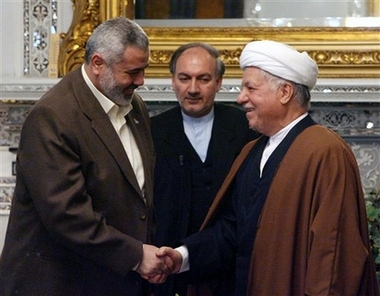
Palestinian Prime Minister Ismail Haniyeh, left, shakes hands with Iran 's former President Akbar Hashemi Rafsanjani, during an official meeting in Tehran, Iran, Saturday, Dec. 9, 2006. An unidentified translator is in center.(AP Photo)


Looking Presidential
Hudna or Not Palestinian Rights Must Be Preserved
"....The media, once more, indulged in analysing the recent developments, with the full confidence that Olmert's verbal commitment to ending the conflict was indeed genuine. The ball, once again, was placed in the Palestinian court. All eyes are now on Hamas: will it heed to the voice of reason and moderation, as embodied in the character of Abbas? Or will it continue to nurture its sinful alliance with Iran and Syria?
As western governments - led or intimidated by the United States - rushed to punish the Palestinians for their democratic choice, the media largely followed suit: exaggerating Hamas' military strength and its ability to 'destroy' Israel, its adherence to violence as the only means of struggle, its religious fanaticism, and all the rest. Such a portrayal helped contextualize the three unfair conditions imposed on the Palestinian government, to unconditionally recognize Israel, renounce violence and accept previous agreements signed between the former Palestinian Authority governments and Israel, starting with the infamous Oslo Accords, reached in total secrecy in 1993.
I took just 10 months to consolidate such a discourse: where the Palestinians, as always were forced on the defence, desperately trying to show that all the allegations made against their government are untrue. Meanwhile, Israel was left with the gift of time, a desperately needed factor in its colonial war against the Palestinians: robbing more land, expanding its apartheid wall, killing with impunity and so on. Though such means of repression are commonplace tools in the ongoing conflict, exasperated in the last six years of Palestinian Uprising or Intifada, the election of a Hamas-dominated parliament introduced a newer element: starvation, plain and simple.
The Palestinian government, armed with the popular support of its people, which is yet to fade despite all attempts, refused to succumb to such pressure. It continued to argue that recognizing Israel while the latter claims both historic Palestine and the 1967 Occupied Territories as theirs is out of the question. Who would so naïve as to accept the existence of its occupier, oppressor, while the latter does its outmost to deny the occupied its right to live or to exist? ........
.....However, it must be stressed that this position should neither serve as, nor be understood as a personal indictment; Palestinian violence is hardly comparable to that of Israel, the fifth strongest army in the world; death tolls on both sides effortlessly express the disparity of power. While proposing a hunda is maybe an expression of the current Palestinian government's commitment to peace, or perhaps a way out of a terrible bind; regardless, it should neither override nor cancel out the Palestinian people's uncompromising adherence to their just demands for freedom and rights, determined by a Palestinian national consensus and cemented in international law. "
Kurds reject Iraq report
"We are in no way abiding by this report," he said. Barzani, is a key ally of the US in Iraq.
Other Iraqi leaders, most of whom appear to have been familiar with the contents of the report prior to its official release, were cautiously optimistic about the proposals, especially those calling for national reconciliation.
In its efforts to promote greater unity for the country, the ISG report appears to have trodden on the Kurds' toes. Their autonomous region has escaped the violence raging in the rest of the country and is practically a separate entity. 
Barzani has otherwise been an ally of the US
The report suggested delaying the implementation of constitutional article 140 calling for a controversial referendum to decide the future of the northern oil city of Kirkuk, a tense mix of ethnic groups.
Washington talks
Barzani’s reaction was echoed by Ali al-Jarush, the Arab League’s official responsible for Iraq, who was quoted by the Mena news agency as being "astounded that the Baker-Hamilton report carries on regardless of the rights of Iraqis and limits itself to making it a priority to preserve the aura, interests and face-saving of the American administration".
"The people of America want to apologize to the Iraqis for the mistakes of our elected officials" Al Hajji Yusef, Mobile, US
The comments on Friday came after the head of the Cairo-based group, Amr Moussa, called the report "very interesting, full of very sound recommendations" after talks in Washington with Condoleezza Rice, the US Secretary of State. Your Views
That report said progress towards Arab-Israeli peace was key to saving the situation Iraq.
It also called for direct talks between the US and Iran and Syria.
The renewed focus on Mideast peacemaking and growing domestic pressure on US leaders to end the crisis in Iraq have Israelis worrying about a possible policy shift by George Bush, the US president, who for six years has largely steerd personally clear of the intricacies of the peacemaking process in the Middle East.
Concerns
Israel's leading newspaper, the Yediot Aharonot daily, said Bush was "trying to change his policy" and slammed the Iraq report, accusing its chief authors James Baker and Lee Hamilton of ignoring Israel during its preparation.
Q&A
"If the truth be told, they barely paid any attention to us," the newspaper said. "For 14 years, Israel enjoyed warm and pampering attention under Clinton and Bush. Now, in light of the catastrophe in Iraq, Baker and Hamilton wish to restore us to our proper proportions."
Edward Djerejian, a senior adviser to the Iraq Study Group, told the paper that were Washington to shift its tack, Israel would follow suit.
Ehud Olmert, the Israeli prime minister, has, however, expressed disatisfaction with the report's recommendations.
Speaking to reporters on Thursday, he said US problems in Iraq "are entirely independent of the controversy between us and the Palestinians".
Elsewhere, responding to the ISG report John Howard, the Australian prime minister and staunch supporter of Bush, admitted on Friday that the war in Iraq was progressing "very badly", but ruled out any hasty withdrawal of Australian troops.
THIS ATTEMPTED COUP WILL BE TELEVISED
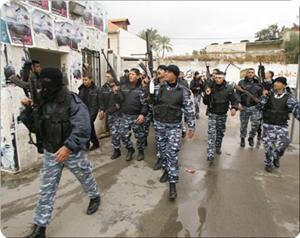


Palestinian security force officers, most loyal to Palestinian President Mahmoud Abbas, gather on the steps of the Legislative Council during a protest to demand their salaries from the Hamas-led Palestinian Authority in Gaza City, Saturday Dec. 9, 2006.(AP Photo)

Palestinian security force officers, most of them loyal to Palestinian President Mahmoud Abbas, chant slogans as they march during a protest to demand their salaries from the Hamas-led Palestinian Authority in Gaza City, Saturday Dec. 9, 2006.(AP Photo)

Palestinian security force officers climb the Legislative Council building during a protest to demand their salaries from the Hamas-led Palestinian Authority in Gaza City, Saturday Dec. 9, 2006. (AP Photo)

Palestinian police officers ride on a police vehicle as they and others march during a protest demanding their salaries in the West Bank town of Jenin, Saturday, Dec. 9, 2006. Some 4,000 members of the security forces staged the march to press for their salaries which have not been paid in full by the Hamas-led Palestinian Authority in months. (AP Photo)

Palestinian security personnel fire into the air, during a rally by uniformed police and other security officers demonstrating over the non-payment of their salaries, inside the parliament headquarters in Gaza December 9, 2006. A Palestinian parliamentary guard was wounded as demonstrators and parliamentary security guards exchanged fire at the Palestinian parliament building in Gaza City on Saturday, a Reuters witness said. (REUTERS)
THESE COWARDS WHOSE JOB IS THE SECURITY OF ISRAEL, NOT OF THE PALESTINIANS, WERE NOWHERE TO BE SEEN WHEN ISRAEL WAS SLAUGHTERING WOMEN AND CHILDREN IN BEIT HANOUN. BUT LOOK AT THEM NOW! ON COMMAND BY USRAEL THEY ARE TRYING TO USE THEIR GUNS TO MOUNT A COUP FOR ABBAS THE PUPPET! SPIT ON THEM!!!

While The Zionists Are Establishing "Greater Israel," The Palestinians Are Spending Their Energy Fighting Over A Fictitious "State," But In Reality Living In A Prison.
By Hamid Najeeb.
Friday, December 08, 2006
Israel-Firsters in US House of Representatives, Led by Lantos, Weiner, and Lehinen, Pass Yet Another Anti-Palestinian Legislation

By Hassan El-Najjar
"C-Span, December 7, 2006 aired speeches of three members of the US House of Representatives pushing for the adoption of their legislation to further starve the Palestinian people. The legislation punishes Palestinians for not surrendering to their Israeli occupiers who forced them out of their homeland and they want them now to legitimize the theft by recognizing the Israeli occupation government.
Israeli-Firsters and Zionist dinosaurs in the US House of Representatives, Led by Lantos, Weiner, and Lehinen, pressured other members of Congress to vote for yet another anti-Palestinian legislation.
The Zionist zealots Tom Lantos of California, Weiner of New York, and Lehinen of Florida spoke in a very hateful way against the Palestinian people. Lantos in Particular expressed gloating in starving the Palestinian people yet more for daring to vote for Hamas.
According to the new legislation (HR-2370, Palestinian Anti-Terrorism Act), which was passed by the AIPAC-controlled rubber-stamp US Congress, the US government should deny funding to the Palestinian Authority as long as the elected Hamas leaders run it.
The most important consequence of such legislation, however, is not denying US funding to the Palestinian Authority. Rather, to obligate the Bush administration to use its influence on other nations not to provide assistance to the Palestinian people.
Qatar's foreign minister was summoned to the US State Department yesterday to rebuke him for his country's announcement of paying salaries of Palestinian teachers. Condoleezza Rice does not want to see Palestinian government employees getting paid even by their Arab brethren.
This Lantos-Weiner-Lehinen legislation is an example for students of American politics of how Zionists control the US government in service of the Israeli occupation government policies. Any legislation bill presented by any number of Zionists in Congress about the Israeli-Palestinian conflict is going to pass automatically by the AIPAC-controlled US rubber-stamp Congress. (See Carter's new book, Walt and Meirsheimer's Israel Lobby paper, and Findley's famous book, Who dares to speak? for explanation).
This legislation comes also only one day after the Zionist Israeli occupation ideologue, Shimon Peres, announced a worldwide Israeli plan to throw out the Hamas government.
The Zionist Israeli plan focuses on starving the Palestinian people, as a punishment to them for electing Hamas, and a pressure on Hamas to give up the government to its Fateh rival, which is accepted by Israelis and their followers in the US and Europe.
The Zionists are mad that Hamas has refused so far to recognize Israel as an occupying power. They want the Palestinians to surrender and accept all Israeli conditions before negotiations. Well, Fateh did that and gained nothing in ten years.
These Zionist dinosaurs in US Congress have not realized yet that their days may be numbered after pushing the US to the disastrous invasion of Iraq in service of Israeli interests.
The Baker-Hamilton Commission recommended that the US address the Palestinian grievances and help establish the Palestinian state, in order for Arab and Muslim governments to be able to give a hand to America to get out of the Iraqi quagmire.
It doesn't seem that Lantos, Weiner, Lehinen, and their likes read the report.
They may never read it. "
LINK
BLOODIEST WEEK IN ALMOST 3 YEARS
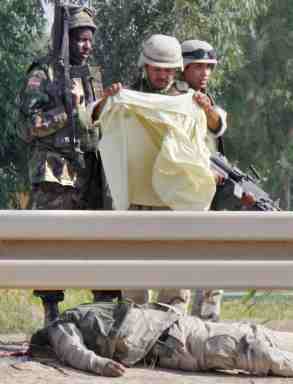
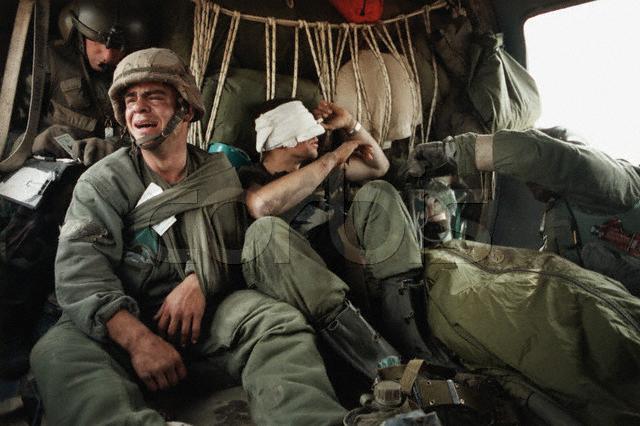
U.S. occupation forces in Iraq have suffered their deadliest week in almost 3 years. In the first week of December, 37 U.S. soldiers were killed, making it the worst week since April 2004, when fighting in Fallujah was raging.
So far a total of 2,927 U.S. service members have been killed in Iraq.
Speaking Frankly about Israel and Palestine
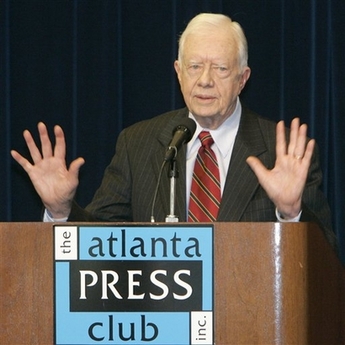
by Jimmy Carter
"I signed a contract with Simon & Schuster two years ago to write a book about the Middle East, based on my personal observations as the Carter Center monitored three elections in Palestine and on my consultations with Israeli political leaders and peace activists.
We covered every Palestinian community in 1996, 2005 and 2006, when Yasser Arafat and later Mahmoud Abbas were elected president and members of parliament were chosen. The elections were almost flawless, and turnout was very high — except in East Jerusalem, where, under severe Israeli restraints, only about 2% of registered voters managed to cast ballots.
The many controversial issues concerning Palestine and the path to peace for Israel are intensely debated among Israelis and throughout other nations — but not in the United States. For the last 30 years, I have witnessed and experienced the severe restraints on any free and balanced discussion of the facts. This reluctance to criticize any policies of the Israeli government is because of the extraordinary lobbying efforts of the American-Israel Political Action Committee and the absence of any significant contrary voices.
It would be almost politically suicidal for members of Congress to espouse a balanced position between Israel and Palestine, to suggest that Israel comply with international law or to speak in defense of justice or human rights for Palestinians. Very few would ever deign to visit the Palestinian cities of Ramallah, Nablus, Hebron, Gaza City or even Bethlehem and talk to the beleaguered residents. What is even more difficult to comprehend is why the editorial pages of the major newspapers and magazines in the United States exercise similar self-restraint, quite contrary to private assessments expressed quite forcefully by their correspondents in the Holy Land.......
Book reviews in the mainstream media have been written mostly by representatives of Jewish organizations who would be unlikely to visit the occupied territories, and their primary criticism is that the book is anti-Israel. Two members of Congress have been publicly critical. Incoming House Speaker Nancy Pelosi for instance, issued a statement (before the book was published) saying that "he does not speak for the Democratic Party on Israel." Some reviews posted on Amazon.com call me "anti-Semitic," and others accuse the book of "lies" and "distortions." A former Carter Center fellow has taken issue with it, and Alan Dershowitz called the book's title "indecent."
Out in the real world, however, the response has been overwhelmingly positive. I've signed books in five stores, with more than 1,000 buyers at each site. I've had one negative remark — that I should be tried for treason — and one caller on C-SPAN said that I was an anti-Semite. My most troubling experience has been the rejection of my offers to speak, for free, about the book on university campuses with high Jewish enrollment and to answer questions from students and professors. I have been most encouraged by prominent Jewish citizens and members of Congress who have thanked me privately for presenting the facts and some new ideas.
The book describes the abominable oppression and persecution in the occupied Palestinian territories, with a rigid system of required passes and strict segregation between Palestine's citizens and Jewish settlers in the West Bank. An enormous imprisonment wall is now under construction, snaking through what is left of Palestine to encompass more and more land for Israeli settlers. In many ways, this is more oppressive than what blacks lived under in South Africa during apartheid. I have made it clear that the motivation is not racism but the desire of a minority of Israelis to confiscate and colonize choice sites in Palestine, and then to forcefully suppress any objections from the displaced citizens. Obviously, I condemn any acts of terrorism or violence against innocent civilians, and I present information about the terrible casualties on both sides.
The ultimate purpose of my book is to present facts about the Middle East that are largely unknown in America, to precipitate discussion and to help restart peace talks (now absent for six years) that can lead to permanent peace for Israel and its neighbors. Another hope is that Jews and other Americans who share this same goal might be motivated to express their views, even publicly, and perhaps in concert. I would be glad to help with that effort. "
The Baker Agenda: Troops out, Oil Companies in?

By Tom Hayden
"Recommendations 62 and 63 confirm that control of Iraqi oil is a fundamental premise of Administration policy. This was denied in the first years of the war, but this week the President confirmed his belief that Islamic extremists will “gain access to vast oil reserves and use Iraq as a base to overthrow moderate governments all across the broader Middle East.” [LAT, 12-6-06]. Then James Baker revealed the interest of his longtime oil industry allies, as well as key financial and corporate interests, in an Iraq resolution favorable to their narrow interests.
Recommendation 62 says the US government should help draft an oil law that “creates a fiscal and legal framework for investment.” It further recommends that the US, in conjunction with the International Monetary Fund [IMF], should “pres Iraq to continue reducing subsidies in the energy sector...until Iraqis pay market prices for oil products...” That is, in a country besieged by civil war, bombings of infrastructure, unemployment at 50 percent levels, and the lack of necessities, the Baker Report proposes to make everyday life harder for average Iraqis so that the oil industry profits.
Recommendation 63 says the US should “assist” Iraqi leaders in privatizing the national oil industry into a “commercial enterprise” to encourage investment by the multi-national oil companies.
Who said it was not about blood for oil?
There’s more to uncover. But at this point we know that the Baker commission is sprinkled with heavyweights from oil, construction, and financial entities with interests in Iraq. Baker is a Texas oilman whose law firm has interests in debt repayment to Kuwait and other Gulf States. Lawrence Eagleberger has ties to Halliburton and Philips Petroleum, and is a former head of Kissinger Associates, a corporate consulting firm whose clients remain secret [Paul Bremer was managing partner of the Associates]. Vernon Jordan is a power lawyer at Akin Gump who is closely associated with the secretive Bilderberg Group [as well as the Clinton circle and civil rights firms]. Leon Panetta served on the board of the New York Stock Exchange. The expert working groups for the ISG include leaders of Bechtel, PFC Energy, and two representatives of Citygroup, Inc., the firm of Robert Rubin, leading neo-liberal advocate and member of Clinton’s cabinet.
Not a single person from the peace movement, women’s, environmental, civil rights or labor organizations were among the “expert” consultants listed in the ISG Report, although the Heritage Foundation and the American Enterprise Institute were there.
The Report acknowledges that “senior members of Iraq’s oil industry” argue for a nationalized oil company to centralize and allocate revenues fairly by region and group. But the Baker team dismisses any such idea on grounds that simply favor private multinationals. They approve of “aggressive” Kurdish investment deals with oil companies in northern Iraq, and note that Shi’a leaders are reported to be negotiating for foreign oil companies as well.
The Sunni armed nationalist groups have consistently stood for the Iraqi right to control Iraqi oil, while also offering a generous role for American contractors and corporations in their vision of the future.
All this suggests that the ideological goal of the US invasion was not simply to displace Saddam Hussein but to dismantle the Arab nationalist state as a whole, opening the oil fields to private penetration. It is even possible that the grand alliance behind the Baker report includes support for US military disengagement in exchange for permanent guarantees that privatize the second largest oil fields on the planet.....
Continued."

Ahmad Yousef, Haniyyah's Senior Advisor And P.R. Consultant

Is It All About Image? Is This What Ahmad Yousef Advises?
We Must Prevent Permanent Bases in Iraq
Did you notice something about the Baker-Hamilton Iraq Study Group Report? It recommends all sorts of changes, all of them far short of actually ending the war, but it recommends them all to the same person responsible for the disastrous situation we're in now. It doesn't suggest what Congress should do to rein in an out-of-control president. Rather, it recommends that the President do dozens of things. Here's one of them:
Recommendation 22: The President should state that the United States does not seek permanent military bases in Iraq. If the Iraqi government were to request a temporary base or bases, then the U.S. government could consider that request as it would in the case of any other government.
Bush came close to stating this on April 13, 2004, when he said "As a proud and independent people, Iraqis do not support an indefinite occupation and neither does America." But the Iraq Study Group does, and so -- judging by other remarks and actions, does Bush. When you refuse to set a definite time for getting out, you are supporting an indefinite occupation. Robert Gates, the new Rumsfeld, told the Senate Armed Services Committee on Tuesday that he thought the "war on terror," which he dishonestly connected to the War on Iraq, would last "a generation." That's pretty indefinite.
But what if Bush were to state that the United States does not seek permanent bases? How would that differ from Bush stating that he had no warning of Katrina, or that he knew Iraq had weapons of mass destruction, or that the United States does not torture, or that he planned to keep Rumsfeld on another two years?
Speaking of Rumsfeld, on February 17, 2005, Secretary of Defense Donald Rumsfeld, testifying before the same Senate Armed Services Committee, said: ''We have no intention, at the present time, of putting permanent bases in Iraq.'' Now, in Rumsfeldspeak this probably meant that he would build temporary bases and then decide later to make them permanent, or that they would just be "enduring," which would mean permanent but not, you know, permanent -- in the same way that an "enemy combatant" is a prisoner of war without the rights of, you know, a prisoner of war. In any case, what is gained by having Bush or Rumsfeld say the words? Wouldn't it make more sense to recommend to Congress that it do something that used to be the role of Congress: namely, pass a law?
But there's the catch. Congress already has. Since the moment we entered Fiscal Year 2007 in October, every dime spent on permanent military bases in Iraq has been illegal. But no one even knows how to find out how many dimes that is. And that illustrates a broader problem. Bush not only began this war in secret with money that Congress had approved for something else, but he also immediately turned it into a permanent occupation and began constructing permanent bases. It took Congress three years to get around to cutting off the funding for more such construction, but Congress had never approved the whole idea. Neither, of course, had the Iraqis.
This past weekend there was a huge protest in Italy where a permanent U.S. military base plans to expand with the construction of a new base nearby. In South Korea it's a similar story, with the added kicker that our military is evicting townspeople, eliminating their village, and building a new base with a golf course attached. There's a global meeting planned in March in Ecuador on eliminating foreign military bases. It was U.S. bases in Saudi Arabia that enraged Osama Bin Laden. Americans pay a fortune to maintain bases all over the world, and the primary product of them is anger.
Last March, when Congress passed the "emergency" supplemental funding for the war for 2006, both houses of Congress included language banning the use of funds to build permanent bases. A Republican-run conference committee "reconciled" this agreement by deleting it.
But leaders on this issue like Congresswoman Barbara Lee (D-Calif.) didn't give up. Similar language was included in the "Defense" Appropriations bill for 2007. Rep. Steve King (R-Iowa) introduced an amendment on the floor of the House to again delete the language on no-permanent-bases. But most of the Republicans and almost all of the Democrats went against him. Appropriations Committee Chairman C.W. Bill Young (R-Fla.) urged King to withdraw his amendment: "If we strike this prohibition from this bill that was well thought out, what we are saying to the Iraqi people and what I am satisfied the propaganda machine of al Qaeda in Iraq are going to do is use this and say: see there, we told you so. The Americans plan to occupy us for the rest of our lives." The House voted 376-50 for no-permanent-bases. It's been the law since October. The 2007 "Defense" Authorization bill passed including the same language.
Why did King want to allow the construction of permanent bases? He argued on the floor: "I believe that we should not foreclose our options in Iraq ... Historically, basing rights agreements have been a necessary part of diplomatic relations with foreign governments." Well, yes, but that's exactly what the Iraq Study Group recommends: working the basing arrangements out with the puppet government. Indications are that the Iraqis are not fooled.
When a number of us wrote to Congressional leaders to thank them for cutting off funds for permanent bases, we noted that: "This important step comes as evidence increasingly points to its need. A University of Maryland poll recently showed that 77 percent of Iraqis believe that the United States intends to maintain permanent bases in that country, while a State Department study found that a majority of Iraqis are calling for U.S-led military forces to withdraw immediately. The recently issued National Intelligence Estimate confirmed what many of us had feared for so long: the U.S. presence in Iraq is increasing terrorist threats and not making America’s homeland more secure."
So, over three-quarters of Iraqis are hip to what we're doing. Americans don't lag so far behind. In a new study released by the same university this week, we learn that 66 percent of Americans (including a near majority of Republicans) believe that a majority of Iraqis oppose the establishment of permanent U.S. bases in their country, and 68 percent of Americans (including a majority of Republicans) believe that, in any case, we should not have such bases. Tom Engelhardt points out that: "This is an especially remarkable set of figures, given that the permanent bases have received next to no attention in the American mainstream media."
Enough has been reported, however, for us to know that we are spending billions of dollars to construct bases in Iraq for the U.S. military. The new Democratic majority in Congress knows this, knows the damage these bases are doing, and knows the good that could be done by making better use of all that money, not to mention the lives lost in the process. If we speak up, perhaps the new majority will also know how quickly it can become a minority again if it does not seize this issue, expose it, and set it right. As Congressman Dennis Kucinich said on the floor of the House on Wednesday: "The American public did not vote for the Iraq Study Group. They voted for a new congress and a new direction in Iraq -- OUT."
Milan Rai on Iraq Study Group Report
AMY GOODMAN: We continue in London with Milan Rai, co-founder of the group Justice Not Vengeance and also Voices in the Wilderness. His latest book is called 7/7: The London Bombings, Islam and the Iraq War, joining us from London. Milan Rai, The news conference that Bush and Blair held at the White House yesterday, can you respond?
MILAN RAI: Well, I think that what happened was that, as several commentators said in the British press, Tony Blair used to enjoy the privilege of coming and conferring with the President, the leader of the free world, so to speak, but now it looks more like a penance, and it’s more of an act of demeaning the Prime Minister than elevating him, in the eyes of many commentators over here.
I think that there are serious differences between Bush and Blair, but Blair still has some things that he wants to get from President Bush, as he enters the last phase of his premiership, because, of course, Tony Blair has said that he’s going to leave power next year, and that might only be a few months away. And one of the things that he wants, as we know from the conversation that was recorded without their knowledge at the G8 Summit, is this trip to the Middle East that’s about to take place, where he wants to once again play the role of a great statesman, as part of his farewell to holding power here in Britain, and to try to advance what they call the peace process in relation to Israel and Palestine.
Now, one of the differences between Bush and Blair is to do with what’s happening in Iraq, and another difference is to do with Iran. On Iran, Tony Blair has been trying to halt a US assault on Iran since before the Iraq war started. And in fact, if you go back to September 2002, in the speech in which Tony Blair unveiled the famous 45 minutes to attack dossier to the world and to the House of Commons, he said in that that one of the reasons why there should be an attack on Saddam Hussein was that there was no moderate wing of Saddam Hussein's government that could be appealed to. And that half a sentence, that phrase was inserted, as far as I can make out, to start building the case against an assault on Iran, which has a much more open and pluralistic political system than then obtained in Iraq.
Of course, there are differences also on what should happen in Iraq. But what is outlined in the Iraq Study Group and what Tony Blair has been pushing for for some time and, in fact, the British government is following in relation to its control of Southern Iraq is a process of what has been called a repeat of the Vietnamization strategy of the 1970s in Vietnam, where what you do is you reduce the Western combat troops from the frontline and you instead substitute local fighters who will fight on your behalf. So what the Iraq Study Group report is about and what the handover of provinces in Southern Iraq by the British forces is about is not about real withdrawal or real exit strategy. It’s about a modification of the occupation.
And what’s going to happen in the southern zone of Iraq for Britain is that provinces will be handed over to local forces, but the British forces will continue to remain in Iraq, and they will have a number of roles, including protecting the US supply chain coming out from Kuwait, which means that as long as there is a US military presence in Iraq, there will continue to be a British military presence, because that's their role now or that's their intended role at a reduced level.
And what Tony Blair wants to do is to shift attention to Afghanistan, where the political cost internationally and domestically is much lower, and, in fact, a similar strategy is outlined in the Iraq Study Group report, thich says that even after all of their plans have been completed, if they’re successful, there will still be a significant US military presence in Iraq.
AMY GOODMAN: And what do the British people want? What is the sense of the British public right now? And was the Iraq Study Group report played large in Britain?
MILAN RAI: Well, there was a significant amount of reaction in the media to the Iraq Study Group report. And generally it was called uncontroversial, unexpected, not surprising, and so on. It’s not seen as something that is likely to have a dramatic effect. People are calling it, in the media, an opportunity for reality and sanity in mainstream terms.
Now, what’s happening, I think, is that a lot of people in Britain, including perhaps in sectors of the antiwar movement -- and, in fact, I was ringing around people in the antiwar movement around the UK this morning -- I think that in a large part of the population here, the sense is that with these handovers in the South, with the talk in the Iraq Study Group, the US and UK are moving towards real withdrawal, which is not the case at all.
And I think that that’s a real problem that the media coverage of the Iraq Study Group report, of the British withdrawals from or of handovers of provinces, is creating. It’s creating a misimpression that what we're seeing is a real intention to withdraw control. What’s on the table is control at a reduced political and military cost, and that’s what Tony Blair is talking about, and that’s what the Iraq Study Group are talking about.
AMY GOODMAN: In 20 seconds, what do you feel needs to happen right now, Milan Rai, long antiwar activist in Britain and political analyst?
MILAN RAI: Well, I think there needs to be a resurgence of the antiwar movement, and there are different strands of opinion within the antiwar movement, but I think that we can all unite to try to expose the propaganda that’s going on and to say that what's on the table is continued occupation and control of Iraq, and that’s rejected by the Iraqi people, by the British people and by the United States public, as well.
AMY GOODMAN: On that note, Milan Rai, I want to thank you for being with us, co-founder of the groups Justice Not Vengeance and Voices in the Wilderness.
Bush's Iraq approval at new low
Just 27 percent of those questioned in a new A-P-Ipsos poll approve of the way he's handling the war. At the same time, dissatisfaction has climbed to an all-time high of 71 percent.
Ohio State University's John Mueller, who's an authority on presidents and public opinion, says Bush's support is continuing to erode and there no reason to think it can be turned around.
The poll also indicates nearly two-thirds of the American people do not think Iraq is going to end up with a stable, democratic government. Only nine percent think the Iraq war will end with a clear-cut victory."
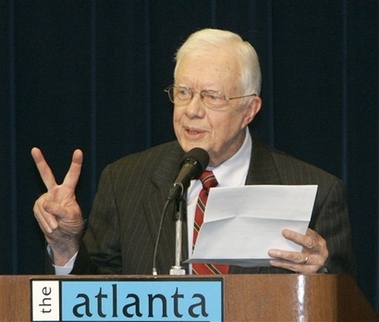
The Media Lynching of Jimmy Carter
Words Even an Ex-President Can't Say in America
By NORMAN FINKELSTEIN
CounterPunch
"It seems Israel's "supporters" have conscripted me in their lynching of Jimmy Carter. Count me out. True, the historical part of Carter's book, Palestine Peace Not Apartheid, contains errors in that it repeats standard Israeli propaganda. However, Carter's analysis of the impasse in the "peace process" as well as his description of Israeli policy in the West Bank is accurate - and, frankly, that's all that matters.
A wag once said that there is no Pravda (Truth) in Izvestia (News) and no Izvestia in Pravda. The same can be said of our Pravda (The New York Times) and Izvestia (The Washington Post). Today both party organs ran feature stories trashing Carter using Kenneth Stein's resignation from the Carter Center as the hook. (I was sitting in the airport when this earth-shattering story came on CNN.) But like John Galt, many people must have wondered, Who (the hell) is Kenneth Stein? Stein wrote exactly one scholarly book on the Israel-Palestine conflict more than two decades ago (The Land Question in Palestine, 1984). Even in his heyday, Stein was a nonentity. When Joan Peters's hoax From Time Immemorial was published, I asked his opinion of it. He replied that it had "good points and bad points." Just like the Protocols of the Elders of Zion.
Later Stein wrote a sick essay the main thesis of which was, "the Palestinian Arab community had been significantly prone to dispossession and dislocation before the mass exodus from Palestine began" - so the Zionist ethnic cleansing of Palestine in 1948 was really no big deal ("One Hundred Years of Social Change: The Creation of the Palestinian Refugee Probem," in Laurence Silberstein (ed.), New Perspectives on Israeli History, 1991).
The Pravda ( NYT) story was written by two reporters who seem to have made a beeline for the newsroom from their bat mitzvahs. They quote Stein to the effect that Carter's book is "replete with factual errors, copied materials not cited, superficialities, glaring omissions and simply invented segments". I doubt there's much to this. Most of the background material is Carter's reminiscences. Maybe he copied from Rosalyn's diary (she was his note taker). Then Pravda reports that "a growing chorus of academics...have taken issue with the book". Who do they name? Alan Dershowitz and David Makovsky. Makovsky is resident hack at the Washington Institute for Near East Policy, the Israel Lobby's "think"-tank.
Pravda saw no irony in citing Dershowitz's expertise for a story on fabrication, falsification and plagiarism regarding a book on the Israel-Palestine conflict. As always, one can only be awed by the party discipline at our Pravda. It makes one positively wistful for the days when commissars quoted Stalin on linguistics."
Mr. Lieberman Comes to Washington

Brookings Hosts an Ethnic Cleanser
By WILL YOUMANS
CounterPunch
"When far-right leader Avigdor Lieberman and his Yisrael Beiteinu party joined the Israeli government, pro-peace Israelis expressed outrage. The Brookings Institution extended an invitation.
Brookings' Saban Center for Middle East Policy is holding the third annual Saban Forum in Washington, D.C. from December 8 through the 10th. This year's forum is entitled "America and Israel: Confronting a Middle East in Turmoil" "turmoil," meaning pissed off Arabs, of course.
In his new book Palestine Peace Not Apartheid, Jimmy Carter charges that we lack a national discussion about our nation's support for Israel. This invitation proves his point, as does the entire forum which doesn't think any Arabs, not even the empire butt-kissers, need be present. For some reason, they invited Supreme Court justice Stephen Breyer, but not a single Arab.
An Arab-less discussion of the Middle East fits comfortably with one prominent guest's vision of the holy land. Lieberman is one of Israel's leading advocates of forcibly removing masses of Palestinians in order to alter the country's demographic outlay permanently. This has a more common name: ethnic cleansing.
.....Continued."
Uneasy Havens Await Those Who Flee Iraq
Ms. Reyahi is one of nearly two million Iraqis who have fled the vicious chaos of their country since the American invasion nearly four years ago, flooding neighboring states, especially Jordan and Syria, but also Lebanon and Egypt.
As they leave Iraq at a rate of nearly 3,000 a day, the refugees are threatening the social and economic fabric of both Jordan and Syria. In Jordan, hundreds of thousands of Iraqis are trying to blend into a country of only 6 million inhabitants, including about 1.5 million registered Palestinian refugees. The governments classify most of the Iraqis as visitors, not refugees.
The United Nations High Commissioner for Refugees estimated in a report released last month that more than 1.6 million Iraqis have left since March 2003, nearly 7 percent of the population. Jordanian security officials say more than 750,000 are in and around Amman, a city of 2.5 million. Syrian officials estimate that up to one million have gone to the suburbs of Damascus, a city of three million. An additional 150,000 have landed in Cairo. Every month, 100,000 more join them in Syria and Jordan, the report said.
In a report released this week, Refugees International, a Washington-based advocacy group, put the total at close to two million and called their flight “the fastest-growing humanitarian crisis in the world.” Its president, Kenneth Bacon, said, “The United States and its allies sparked the current chaos in Iraq, but they are doing little to ease the humanitarian crisis caused by the current exodus.”
Every night, hulking orange and white GMC Suburbans and sedans pull into the taxi garage in downtown Amman stuffed with Iraqis and their belongings, adding to the growing social problems they pose while fueling growing fears that Iraq’s sectarian tensions will spill over here.
As Iraq seems to disintegrate into warring factions of Sunnis, Shiites and Kurds, the risk that their dispute will be transferred here and increase local social problems is frightening the authorities. As a result, restrictions on Iraqis have been tightened in Egypt, Syria and Jordan, which has been increasing patrols seeking to evict those who have overstayed their visas.
Most of the émigrés bring tales of horror and sadness. Ali Ghani, a onetime champion Iraqi body builder, said that his father had been grabbed from their house in Iraq, apparently because he was a Shiite; his body was later found in the street. Several other friends have met a similar fate, he said.
Partly as a result of such strife, refugees here claim, there is a growing sectarian dimension to the official crackdown. They say the authorities of this officially Sunni country have paid more attention to deporting Iraqi Shiites, fearing that their militias are trying to organize here.
“There is only disrespect for us now,” said Qais Attiyeh, 36, a Shiite sculptor who says he has been granted refugee status in Amman. “And now I increasingly find Jordanians who ask me, ‘Are you a Shiite or a Muslim?’ ” he said, referring to extremist Sunnis’ rejection of Shiism as a branch of Islam.
“I read their facial expressions and tell them what they like to hear,” he said.
continued...
US and Israel Targeting DNA in Gaza? The DIME Bomb: Yet another genotoxic weapon, Part III
".....Return to Gaza: The mythology of murder
Israel has denied using DIME weapons. Nonetheless, Israel’s military has used the occupied Palestinian territories as a weapons development zone for decades, testing bright ideas like depleted uranium and poison gases. It would not surprise us to find that it is now testing a weapon for the US Air Force on Palestinians in Gaza. (23)
Unfortunately, the DIME hypothesis is the most plausible explanation for the grotesque effects of Israel’s new weapon. We can only pray that we have not witnessed the first experiment in the effects of embedded HMTA in human subjects.
Still, DIME may not explain all of the evidence. For example, one of the metals found in victims’ wounds was copper. DIME bombs are not known to contain significant copper, but another US marvel, the Sensor Fuzed Weapon (SFW), sprays slugs of molten copper at its targets. Is Israel also testing the SFW? (24)(25)
If DIME weapons are designed to reduce civilian casualties, why has Israel’s ‘mystery weapon’ increased the civilian death toll? Perhaps this question should be addressed to the advocates of Focused Lethality Munitions, and to the remote-control operators of Israel’s drone aircraft and their commanders and politicians.
Although much remains unclear about Israel’s new weapon, a few devastating facts are indisputable:
The weapon causes enormous and indiscriminate pain and suffering.
It operates as both a chemical weapon and an anti-personnel explosive. At the very least, it is likely to induce heavy metal poisoning in its surviving victims.
The weapon has significantly increased civilian mortality rates, in part because it inflicts virtually untreatable wounds.
Despite this public parade of horrors, Israeli forces have continued to use this weapon against Palestinians in the Gaza Strip for nearly five months........
.....We will likely be told that DIME weapons provide a more “humane” way to fight “terrorism” by “reducing collateral damage” and “helping US troops win hearts and minds”. At the same time, we’ll be assured that the new weapon “packs quite a punch” and will “give our troops more options” to “take the battle to the enemy”, even if he is “hiding among civilians”.
Whether Israel’s new weapon is the Air Force’s DIME bomb or another similarly dreadful invention, the horrors unfolding in Gaza make it clear that “Focused Lethality” is a blood-drenched lie. It promises only a deadlier form of indiscriminate warfare.
US plans to explode payloads of cancer-causing genotoxic heavy metal powder “wherever and whenever necessary” may portend an escalation of a campaign currently limited to the vicinity of “hard targets” we attack with DU and NDU. Whatever we make of the intent behind these weapons, the habitual result is chemical-genetic warfare. It cannot be allowed to continue."
Sayyed Nasrallah vows no retreat and no surrender; some ruling bloc figures asked US to give Israel green light to crush Hezbollah

Al-Manar
"Hezbollah Secretary General Sayyed Hasan Nasrallah made a fiery speech Thursday and addressed the Lebanese and the Arab World in a live television speech broadcast by Al-Manar channel and several other satellite channels. Sayyed Nasrallah vowed that the Lebanese opposition will not "surrender" in its mass protests to bring down the Western-backed government. "At the mass protest on Sunday we will show that those who are betting on our surrender are having an illusion. We will not go out of the streets before we achieve our objective to save Lebanon," he said. "We insist on our demands, for the formation of a real government of national unity... because it is the only means to prevent any foreign tutelage on Lebanon, so that we have Lebanese decision-making." "We reject any tutelage, from any party, whether it is the enemy, brother or friend," he said, signaling Syria, Iran and other states. But Nasrallah said "the opportunity is still there and the doors of negotiation are still open, let us change the current government into a government of national unity headed by Saniora." "But if you (ruling majority) remain stubborn... we will reach a stage in which we will not accept any of you to head the next government... we will form an interim government that will hold early elections," he said.
The Secretary General paid respect to the family of National Opposition martyr Ahmed Mahmoud who was shot in the back by supporters of the ruling bloc and insisted Hezbollah "will not be dragged into any strife even if you kill a thousand of us." "We will not raise our arms in the face of anyone in Lebanon. "When they killed Ahmed Mahmoud, they wanted to push us to clashes. I tell them that we refuse civil war and discord. Our weapons have only been raised against our Israeli enemy," he said.
Sayyed Nasrallah also blasted Arab and Western governments that have sided with Saniora's ruling bloc and called them to come to Lebanon and seek facts and remain neutral. He also reminded Saniora's bloc that the United States administration has been cornered by the Baker Hamilton report on Iraq and that Lebanon is no longer a top priority on Washington's agenda. "You have been counting on American backing. It will not bring you any benefit. How can you count on Bush and its army when they are sinking in the mud of the region, in Afghanistan, Palestine, Iraq and Lebanon?"
Sayyed Nasrallah accused "some members" of the ruling majority of having asked Washington to let Israel launch a war against Hezbollah in the summer to crush Hezbollah. His eminence said that those who made this request know themselves very well and "we know them by name," and called for an Arab probing panel to be formed to look into this issue. "I hope that I would not be obliged to name them in the future," his eminence said. "Can anyone accept that in a time of war, the prime minister ordered the Lebanese Army to seize weapons being delivered to us as we were trying to defend our country from Israeli attacks?" Nasrallah asked, also calling for an independent committee to investigate events during the war.
His eminence added: "We in Lebanon pay taxes to the government and the government pays the salaries of employees and security services personnel who are supposed to protect the Lebanese and their properties. During the war, some pro-ruling majority bloc security services were supposed to track down spies and Israeli networks that are giving information to the Israelis for bombing missions. But unfortunately, and I'm with calling for an independent committee to investigate events during the war, one of the security services loyal to the ruling bloc was operating during the war to identify and locate Hezbollah leaders and a unit of this security service had sought to locate the place where used to stay during the war."
Sayyed Nasrallah called upon his supporters to "refrain from insulting and disrespecting ruling politicians." He also said that the Maronite Bishops' initiative deserves consideration and it has many positive points. Sayyed Nasrallah concluded that "the door is open for negotiations, but we will not leave the street before achieving the goal of saving Lebanon." "We will win with our voices, and not with our arms!" vowed Nasrallah, calling for a greater turnout for yet another mass demonstration on Sunday aimed at forcing the government to step down.
As a gesture of reunification among Muslim Shiites and Sunnis, he invited adherents of both sects to show up Friday "and pray at the same time" in the heart of the capital, with prominent Sunni religious figure, Sheikh Fathi Yakan leading the prayers. "
Baker wants Israel excluded from regional conference
| Former Secretary of State James Baker (left) of the Iraq Study Group speaks while his co-chair Lee Hamilton looks on in September 2006. (AFP/File/Mandel Ngan) |
| |
The White House has been examining a proposal by James Baker to launch a Middle East peace effort without Israel.
The peace effort would begin with a U.S.-organized conference, dubbed Madrid-2, and contain such U.S. adversaries as Iran and Syria. Officials said Madrid-2 would be promoted as a forum to discuss Iraq's future, but actually focus on Arab demands for Israel to withdraw from territories captured in the 1967 war. They said Israel would not be invited to the conference.
�As Baker sees this, the conference would provide a unique opportunity for the United States to strike a deal without Jewish pressure,� an official said. �This has become the most hottest proposal examined by the foreign policy people over the last month.�
Officials said Mr. Baker's proposal, reflected in the recommendations of the Iraq Study Group, has been supported by Secretary of State Condoleezza Rice, Undersecretary of State Nicholas Burns and National Intelligence Director John Negroponte. The most controversial element in the proposal, they said, was Mr. Baker's recommendation for the United States to woo Iran and Syria.
�Here is Syria, which is clearly putting pressure on the Lebanese democracy, is a supporter of terror, is both provisioning and supporting Hezbollah and facilitating Iran in its efforts to support Hezbollah, is supporting the activities of Hamas," National Security Advisor Stephen Hadley told a briefing last week. "This is not a Syria that is on an agenda to bring peace and stability to the region."
Officials said the Baker proposal to exclude Israel from a Middle East peace conference garnered support in the wake of Vice President Dick Cheney's visit to Saudi Arabia on Nov. 25. They said Mr. Cheney spent most of his meetings listening to Saudi warnings that Israel, rather than Iran, is the leading cause of instability in the Middle East.
�He [Cheney] didn't even get the opportunity to seriously discuss the purpose of his visit�that the Saudis help the Iraqi government and persuade the Sunnis to stop their attacks,� another official familiar with Mr. Cheney�s visit said. �Instead, the Saudis kept saying that they wanted a U.S. initiative to stop the Israelis� attack in Gaza and Cheney just agreed.�
Under the Baker proposal, the Bush administration would arrange a Middle East conference that would discuss the future of Iraq and other Middle East issues. Officials said the conference would seek to win Arab support on Iraq in exchange for a U.S. pledge to renew efforts to press Israel to withdraw from the West Bank and Golan Heights.
�Baker sees his plan as containing something for everybody, except perhaps the Israelis,� the official said. �The Syrians would get back the Golan, the Iranians would get U.S. recognition and the Saudis would regain their influence, particularly with the Palestinians.�
Officials said Mr. Baker's influence within the administration and the Republican Party�s leadership stems from support by the president's father as well as former Secretary of State Henry Kissinger. Throughout the current Bush administration, such senior officials as Mr. Hadley and Ms. Rice were said to have been consulting with Brent Scowcroft, the former president's national security advisor, regarded as close to Mr. Baker.
�Everybody has fallen in line,� the official said. �Bush is not in the daily loop. He is shocked by the elections and he's hoping for a miracle on Iraq.�
For his part, Mr. Bush has expressed unease in negotiating with Iran. At a Nov. 30 news conference in Amman, Jordan, the president cited Iran's interference in the government of Iraqi Prime Minister Nouri Al Maliki.
�We respect their heritage, we respect their history, we respect their traditions,� Mr. Bush said. �I just have a problem with a government that is isolating its people, denying its people benefits that could be had from engagement with the world.�
Mr. Baker's recommendation to woo Iran and Syria has also received support from some in the conservative wing of the GOP. Over the last week, former and current Republican leaders in Congress�convinced of the need for a U.S. withdrawal before the 2008 presidential elections�have called for Iranian and Syrian participation in an effort to stabilize Iraq.
�I would look at an entirely new strategy,� former House Speaker Newt Gingrich said. �We have clearly failed in the last three years to achieve the kind of outcome we want.�
In contrast, Defense Department officials have warned against granting a role to Iran and Syria at Israel's expense. They said such a strategy would also end up undermining Arab allies of the United States such as Egypt, Jordan and Morocco.
�The regional strategy is a euphemism for throwing Free Iraq to the wolves in its neighborhood: Iran, Syria and Saudi Arabia,� said the Center for Security Policy, regarded as being close to the Pentagon. �If the Baker regional strategy is adopted, we will prove to all the world that it is better to be America's enemy than its friend. Jim Baker's hostility towards the Jews is a matter of record and has endeared him to Israel's foes in the region.�
But Defense Secretary-designate Robert Gates, a former colleague of Mr. Baker on the Iraq Study Group, has expressed support for U.S. negotiations with Iran and Syria. In response to questions from the Senate Armed Services Committee, which begins confirmation hearings this week, Mr. Gates compared the two U.S. adversaries to the Soviet Union.
�Even in the worst days of the Cold War, the U.S. maintained a dialogue with the Soviet Union and China, and I believe those channels of communication helped us manage many potentially difficult situations,� Mr. Gates said. �Our engagement with Syria need not be unilateral. It could, for instance, take the form of Syrian participation in a regional conference.�
Conspiracies Behind Haim Saban’s Closed Doors

A Very Good Piece
By Kurt Nimmo
"As if to finally dispel the myth there is a difference between Israel First neocons and Democrats, consider the upcoming “closed session” at the Saban Center for Middle East Policy at the Brookings Institution, a “think tank” bankrolled by Israeli-American millionaire Haim Saban.
“Among the many officials attending are Israeli Foreign Minister Tzipi Livni; David Welch, the current top U.S. envoy to the region; Shimon Peres, Israel’s deputy prime minister; Sen. Hillary Clinton (D-N.Y.) and her husband, former President Bill Clinton; Amos Yadlin, director of Israel’s military intelligence; Avigdor Lieberman, Israel’s minister of strategic planning; and many other Bush administration officials and U.S. and Israeli lawmakers,” reports the Jewish Telegraph Agency.
Interesting a hopeful presidential candidate, and her former president husband, will be rubbing elbows with the likes of Avigdor Lieberman, who “advocates Transfer, the expulsion of the Arab citizens from Israel,” according Uri Avnery, Israeli journalist, peace activist, and Knesset member. “He threatened to destroy Egypt by blowing up the Aswan Dam. He demanded the execution of the Israeli Arab Knesset members for meeting with Syrian and Hamas leaders.” But this is nothing new, Avnery shrugs, because “Rehavam Ze’evi, whose memory was honored … by a special commemoration session of the Knesset, proposed ethnic cleansing, and General Effi Eytam, the chief of the National Union party, uses similar language.” In other words, ethnic cleansing is business as normal in Israel.
Imagine Bill and Hill embracing a Grand Wizard of the Knights of the Ku Klux Klan and attending a “Klonvocation,” a gathering of racists. In essence, this is what they will be doing when they go behind Saban’s closed doors with Lieberman and crew.
“Haim Saban has been a very good friend, supporter and adviser to me,” effused Bill Clinton in 2004. “I am grateful for his commitment to Israel, to a just and lasting peace in the Middle East and to my foundation’s work, particularly on reconciliation issues.”
Lasting peace, naturally, translates into more dead Palestinians, more Palestinian refugees, more malnourished Palestinians, more targeted assassinations, more demolished homes and flattened olive groves.
As for Saban and his Brookings center, the roundly excoriated John Mearsheimer and Stephen Walt write: “For many years, [the Brookings Institution] senior expert on the Middle East was William Quandt, a former NSC official with a well-deserved reputation for even-handedness. Today, Brookings’s coverage is conducted through the Saban Center for Middle East Studies, which is financed by Haim Saban, an Israeli-American businessman and ardent Zionist. The center’s director is the ubiquitous Martin Indyk. What was once a non-partisan policy institute is now part of the pro-Israel chorus,” a glee club that includes no shortage of Democrats, even though the more reactionary among the Jabotinskyites are suspicious of Democrats, prompting Democrats to bend over backwards, flip somersaults, and engage in all manner of political tumbling routines in order to please the ethnic cleansers.
It does not take a lot of imagination to envision what will be talked about behind Saban’s closed doors. “To me he will always be a dear personal friend,” waxed Ariel Sharon before he slipped into a coma. “Haim Saban is a great American citizen and a man who always stood by Israel and the Jewish people in times of need. His contribution to strengthening ties between Israel and American political leaders from all parties has been quite remarkable and outstanding.'’
At the Saban Center tomorrow, “dignitaries will discuss a plethora of issues, including the situation in Lebanon and the threat of Hizbullah overthrowing the sitting government, Hamas’ control of the Palestinian Authority and the continued Qassam attacks on Israel despite the ceasefire, the rising challenge of the Iranian-Syrian-Hizballah alliance, options for dealing with the threat from Iran, energy independence, democracies and the media in wartime and how Israel should deal with its neighbors,” reports Yedioth Internet.
In short, “dignitaries,” mostly war criminals, will discuss war and how to wage it.
Of course, such topics are of particular importance, as Democrats will soon assume control of Congress. Strategy must be worked out in advance. It is a sure bet this strategy will not differ significantly from the strategy of the neocons. In fact, with Avigdor Lieberman in attendance, throwing his weight around as the Minister of Strategic Affairs and as a Deputy Prime Minister of Israel, we may even expect things to get worse, possibly far worse....
“When there is a terrorist attack, I am Lieberman. Sometimes to the right of Lieberman,” Saban told Haaretz.
No word if Mr. Saban will consent to beat up kids. On the other hand, he apparently sleeps well at night, knowing Palestinian school children are shot at point-blank range.
“Look, I don’t see a solution today. People are saying hudna [truce]. I don’t know what kind of hudna. Or tahadiya [cease-fire], shmahadiya. A cease-fire within a tahadiya within a hudna. Leave it, it’s all stuff and nonsense. And the facts on the ground are the facts on the ground. When your enemy believes in a faith that is rooted in religion, it runs very deep. In this situation I don’t know how to mediate between one nation and the other.”
Never mind Saban’s enemy, presumably Hamas, was financed and encouraged by the Israeli government, so as to undermine Palestinian nationalism.
As for the “facts on the ground,” these are relatively easy to ascertain—more than one fifth of Palestinian children under five are suffering from malnutrition, unemployment stands at 70%, and more than two thirds of the population lives below the poverty line on less than $2 a day.
I’d violate the tahadiya, too, if my baby sister was shot in the head on the way to school or beaten to death by rabid settlers of the sort praised by Avigdor Lieberman and Israel Beytenu.
Obviously, Bill Clinton and his wife, possibly the next president of the United States, support the cold-blooded murder of Palestinian children, dumped on the side of the road. But then Clinton, with all the passion of Adolf Eichmann, oversaw the murder of more than a million Iraqis, 500,000 of them children.
If elected, his wife will carry on the tradition, as Avigdor Lieberman and the Israelis demand, and have demanded now for some time, and the United States may very well attack Iran, the next target on the list. No doubt this will be discussed over the coming weekend behind closed doors.
Meanwhile, the rest of us will likely be fleeced and bamboozled once again, tricked into going to “war” against the enemies of Saban, Lieberman, and the comatose Sharon."
It's still about oil in Iraq


A centerpiece of the Iraq Study Group's report is its advocacy for securing foreign companies' long-term access to Iraqi oil fields.
An Excellent Piece
By Antonia Juhasz
(a visiting scholar at the Institute for Policy Studies and author of "The Bush Agenda: Invading the World, One Economy at a Time.")
The Los Angeles Times
December 8, 2006
"WHILE THE Bush administration, the media and nearly all the Democrats still refuse to explain the war in Iraq in terms of oil, the ever-pragmatic members of the Iraq Study Group share no such reticence.
Page 1, Chapter 1 of the Iraq Study Group report lays out Iraq's importance to its region, the U.S. and the world with this reminder: "It has the world's second-largest known oil reserves." The group then proceeds to give very specific and radical recommendations as to what the United States should do to secure those reserves. If the proposals are followed, Iraq's national oil industry will be commercialized and opened to foreign firms.
The report makes visible to everyone the elephant in the room: that we are fighting, killing and dying in a war for oil. It states in plain language that the U.S. government should use every tool at its disposal to ensure that American oil interests and those of its corporations are met.
It's spelled out in Recommendation No. 63, which calls on the U.S. to "assist Iraqi leaders to reorganize the national oil industry as a commercial enterprise" and to "encourage investment in Iraq's oil sector by the international community and by international energy companies." This recommendation would turn Iraq's nationalized oil industry into a commercial entity that could be partly or fully privatized by foreign firms.
This is an echo of calls made before and immediately after the invasion of Iraq......
...In July, U.S. Energy Secretary Samuel Bodman announced in Baghdad that oil executives told him that their companies would not enter Iraq without passage of the new oil law. Petroleum Economist magazine later reported that U.S. oil companies considered passage of the new oil law more important than increased security when deciding whether to go into business in Iraq.
The Iraq Study Group report states that continuing military, political and economic support is contingent upon Iraq's government meeting certain undefined "milestones." It's apparent that these milestones are embedded in the report itself.
Further, the Iraq Study Group would commit U.S. troops to Iraq for several more years to, among other duties, provide security for Iraq's oil infrastructure. Finally, the report unequivocally declares that the 79 total recommendations "are comprehensive and need to be implemented in a coordinated fashion. They should not be separated or carried out in isolation."
All told, the Iraq Study Group has simply made the case for extending the war until foreign oil companies — presumably American ones — have guaranteed legal access to all of Iraq's oil fields and until they are assured the best legal and financial terms possible.
We can thank the Iraq Study Group for making its case publicly. It is now our turn to decide if we wish to spill more blood for oil. "
Time out from a siege

A battle-hardened mujahideen leader during the anti-Soviet resistance and now a Taliban field commander in the middle of a siege of a NATO base, Abdul Khaliq shares a sparse meal and a blanket with Syed Saleem Shahzad.He explains how divisions in Afghan society are being healed in the face of a common enemy: the occupation forces
By Syed Saleem Shahzad
Asia Times
".......These were the men on whom the resistance depended. Yet remarkably, after years of meritocracy, this year's spring offensive was a stunning success, extending Taliban control over vast swaths of the south and southwest and inflicting heavy casualties on foreign forces.
There is no doubt that increasing public disenchantment with the administration of President Hamid Karzai in Kabul helped the Taliban win popular support, but it does not explain their dramatic military success.
One might argue that the youthful Taliban leaders have matured into intelligent and savvy commanders. Not so. They remain about as blinkered and shortsighted as they have ever been.
What did happen was that around April, military operations were handed over to legendary mujahideen commander Maulana Jalaluddin Haqqani, a non-Taliban veteran of the campaign against the Soviets in the 1980s (see Taliban's new commander ready for a fight, Asia Times Online, May 20). In the mid-1990s, after the bloody civil war that followed the Soviets' withdrawal, Haqqani had surrendered to the Taliban when they reached Khost province.
In preparation for this year's spring offensive, Haqqani quickly replaced the highly dedicated but militarily naive Taliban field commanders with his team of battle-hardened mujahideen. His motto was, "Where there is no vision, there is no hope." Haqqani made an agreement with Mullah Omar under which once his men brought victory to a front, they would depart for a new one, leaving the Taliban behind to administer as they saw fit under their brand of Islam.
This arrangement can best be described as a marriage of convenience. On the one hand, it would be wrong to assume that the Taliban are the most popular movement in southwestern Afghanistan. Rather, they are seen as the best alternative to corrupt and inefficient local administrations.
On the other hand, the mujahideen certainly don't see themselves as subservient to the young Taliban. What they have in common is a hatred of the occupying forces.
Thus the Taliban movement acts as a unifying force for all anti-American forces in the country, while at the same time bringing discipline and order into local affairs......."
***
It is sad to observe that the Iraqis do not display the unity and the sophistication of even the Taliban. I was hoping otherwise.
The neocons have finished what the Vietcong started
A Good Comment
By Martin Jacques
The Guardian
".....Before our eyes, the neoconservative position is disintegrating. Its foreign-policy tenets have been shown to be false. As is now openly admitted, they have brought the US to the verge of disaster in Iraq, which is why the American version of the "men in grey suits" has ridden to the rescue. After less than six years in office, elected at a time when the US was unchallenged as the sole superpower, the Bush administration has managed to deliver the country to the edge of what can only be compared to a Vietnam moment: the political and military defeat of the central and defining plank of American foreign policy.....
But the Iraq moment is far more dangerous for the US than the Vietnam moment. Although one of the key justifications for the Vietnam war was to prevent the spread of communism, the US defeat was to produce nothing of the kind: apart from the fact that Cambodia and Laos became embroiled, the effects were essentially confined to Vietnam.....
The regional consequences of the Iraq imbroglio are, in comparison, immediate, profound and far-reaching. The civil war threatens to unhinge more or less the entire Middle East. The neoconservative strategy - to remake the region single-handedly (with the support of Israel, of course) - has been undermined by its own hubris......
From a longer-term perspective, moreover, it is already clear that it will be impossible for the Americans to restore the status quo ante in the region. The failure of the occupation has shown the limitations of its power - which every country, from Iran and Syria to Israel and Saudi Arabia (not to mention Hizbullah and Hamas), will have noted. The US has been the decisive arbiter in the Middle East since the end of the Suez crisis in 1956, albeit with the Soviet Union playing a secondary role until 1989. The American era is now over.....
...Far from the US being in the ascendant, deeper trends have moved in the opposite direction. The US might enjoy overwhelming military advantage, but its relative economic power, which in the long run is almost invariably decisive, is in decline. The interregnum after the cold war, far from being the prelude to a new American age, was bearing the signs of what is now very visible: the emergence of a multipolar world. By misreading global trends, the Bush administration's embrace of unilateralism not only provoked the Iraq disaster but also hastened American decline....."
TRASH TALKING
ONE OF LATUFF'S LATEST CARTOONS
Thursday, December 07, 2006
Meanwhile in Palestine
Sources: Abbas not intending to sack Hamas-led gov't: "Abbas made it clear that his favorite choice was the national coalition in spite of calls by the Palestine Liberation Organization (PLO) for a technocratic government," a Palestinian official close to Abbas said.
US and Israel targeting DNA in Gaza? The DIME bomb, yet another genotoxic weapon: Since early July, Israeli forces have been using a new weapon in the Gaza Strip that inflicts strange and deadly wounds. Doctors and medics say the unidentified device has significantly increased fatalities from Israel's attacks.
Baker panel's mention of Palestinian "right of return" raises eyebrows: "This report is worrisome for Israel particularly because, for the first time, it mentions the question of the 'right of return' for the Palestinian refugees of 1948," said a senior Israeli official, who was reacting to the US policy report on condition he not be identified. A Middle East analyst who was involved in the Iraq Study Group discussions but did not participate in drafting the report expressed surprise when the reference was pointed out to him by a reporter.
Egyptians offer to represent Beit Hanun victims at The Hague : Representatives of the Egyptian Bar Association have offered to represent the victims of the Israeli artillery barrage in Beit Hanun at the International Court of Justice in The Hague. The mayor has asked the families of the victims to authorize a transfer of power of attorney, so the Egyptian lawyers can proceed with bringing the case before the International Court.
Israel predicts no switch of US policy: However, few Israeli officials expected to see sustained US engagement, such as that displayed by the Clinton or first Bush administrations, despite the latest recommendations. Israel has common cause with Washington and Sunni regional states that fear rising Iranian hegemony. This could translate into concessions towards the Palestinians but fall short of a comprehensive solution while talks with Syria remain distant, say analysts.
Strong in spite of themselves - By Azmi Bishara: Olmert's announcement that Israel would be willing to agree to a geographically contiguous Palestinian state on the West Bank is far from original. It was almost a word for word repetition of Sharon's announcement after having received Bush's letter of guarantees, the White House's version of the Balfour Declaration. Of course, what Sharon, Bush and then Olmert meant was that they would agree to a Palestinian state in exchange for the Palestinians relinquishing their demands for the right to return, for Jerusalem as their capital and even for Israel to withdraw to pre-June 1967 borders.
Women and development in eastern West Bank: The most current women's projects developed through the municipality involve education, a central vegetable market and children. There are more vital projects, participants assured, including cultural facilities and a library .
Olmert rejects talks with Syria, says conditions are 'not ripe': Olmert also rejected linkage of the Iraqi war with the Israeli-Palestinian conflict by the Iraq Study Group... "The attempt to create linkage between the Iraqi issue and the Mideast issue - we have a different view," Olmert told reporters in Tel Aviv, in his first response to the report issued Wednesday by the Iraq Study Group.
Israelis skirmish over textbook border lines: "Maps are a cultural manuscript, a declaration of political ideology," said Yoram Bar-Gal, a geographer at Haifa University who has studied the use of maps by the Zionist movement and in Israel. "It depends on your perspective. What is viewed from the inside as an educational issue is seen from the outside as propaganda."
Rice to return to Mideast in 2007 to push Israeli-Palestinian track: News of the trip, Rice's eighth to Israel and the Palestinian territories in two years, came a day after publication of a high-level policy report that urged a renewed US drive for Arab-Israeli peace as part of a broader plan also aimed at stabilizing Iraq.
Blair to launch "even-handed" Middle East mission: British Prime Minister Tony Blair said he will soon launch a Middle East mission to show an "even-handed" US and British approach towards Israel and the Palestinians and the wider region. "Your strong leadership on this issue matters a lot," Bush told Blair.
Palestine Still Main Agenda For Malaysia: "Malaysia has in fact agreed to cooperate with the United Nations secretariat to organise the UN Regional Meeting For Asia and Pacific On The Question Of Palestine in Kuala Lumpur over three days from Dec 15 to 17," he said in reply to a question from Senator Fatanah Datuk Ahmad in Dewan Negara here Thursday.
Blair reaffirms linkage of Mideast conflict, Iraq war : Responding to a direct question on whether the two issues are linked, Blair said both the U.S. and U.K. governments agree that the successful stabilization of Iraq depends on addressing the broader regional issues.
Stephen Hawking to visit Israel : Hawking found fame with his 1988 book A Brief History of Time, which attempts to explain a range of subjects including black holes to the big bang. Speaking from his Cambridge office, Hawking said: "I am looking forward to coming out to Israel and the Palestinian territories and excited about meeting both Israeli and Palestinian scientists."
Internal IDF investigation finds serious flaws in conduct of recent war : Levine said that the call-up of reservist units and their deployment was delayed to the point where it gave Hezbollah an advantage in countering a ground offensive.
Israelis piqued by nuclear "confirmation": During his Senate confirmation hearing on Tuesday, Gates mentioned why Iran might be seeking the means to build an atomic bomb: "They are surrounded by powers with nuclear weapons: Pakistan to their east, the Russians to the north, the Israelis to the west and us in the Persian Gulf," he said. The remark led Israeli news bulletins.
Putting back the Green Line - once we find it: The Green Line-textbook affair has taught Education Minister Yuli Tamir an important lesson about politics. Her colleagues in the government and the Labor Knesset faction, including her friend from Peace Now, Defense Minister Amir Peretz, abandoned her to the right's offensive. The only one who came to her assistance (aside from the Meretz bear hug) was Prime Minister Ehud Olmert of Kadima, formerly an advocate of Greater Israel.
The Administration / Old idea still fresh: James Baker and former representative Lee Hamilton were careful to say yesterday that it is a complete package and adopting just some components will not succeed. But that is exactly what the president said he plans to do. If he opts to pick and choose, he will have to maneuver carefully to convince the public he has chosen wisely. So far, the committee has done far better than Bush in garnering public support.
Questionnaire on the Holy Land: Today The Tablet is launching a major survey asking readers for their views about the search for peace in the Holy Land and the decision by Church leaders in England to pay a Christmas visit in support of the dwindling Christian population.
LARGEST EMERGENCY HUMANITARIAN APPEAL FOR PALESTINIANS: "Two-thirds of Palestinians in the West Bank and the Gaza Strip are now living in poverty. Growing numbers of people are unable to cover their daily food needs and agencies report that basic services such as health care and education are deteriorating and set to worsen much further", he added.
Five Palestinians abducted, one injured, by Israeli forces during West Bank invasions : Ma'mun Jabir, 24, Rami Al Fara, 25, Iyad Al Fara, 25, were taken when troops attacked and searched their family houses located Kufer Saba neighborhood, Kassem Jabir,55, the father of Ma'mun, was injured when a soldier hit him with a stone during the abduction of his son, he sustained light wounds, medical sources reported.
Israeli surgeons repair young Palestinians' hearts : She was unable to have the operation in Gaza, where many hospitals are suffering from worsening conditions since a Western aid embargo was imposed... Over the past year, "Save a Child's Heart" has treated more than 100 children from Gaza and the West Bank, and hundreds from elsewhere in the region, including a growing number from Iraq.
Army injures a second Beit Lahyia resident on Thursday : Banat was working in his land in Beit Lahia town in the northern part of the Gaza strip when troops shot him in his leg; he was moved to a nearby hospital for treatment; his wounds were described as moderate.
Website Name or Title of Link
Israeli police level 17 Arab homes in the Negev : Forty years ago the State of Israel moved the families of this village from their original land (8000 dunums) to the current location (400 meters squared per family) after the 1965 Planning and Construction law, yet the State of Israel never recognized the village, and to this day has not supplied it with the proper services even though the residents are Israeli citizens and pay taxes to the Israeli government.
28 Nov. 06: Interior Ministry denies status to children of East Jerusalem residents : Children between the ages of fourteen and eighteen, to whom the Law applies, are not allowed to obtain a status in Israel , even if they live inside Israel with a parent who is a resident of Israel . They are only entitled to a permit to stay temporarily in Israel . This permit is given for short periods, of three to six months, and does not entitle the minor to any social rights.
Meanwhile in Iraq
The Roman Empire is falling - so it turns to Iran and Syria : The Roman Empire is falling. That, in a phrase, is what the Baker report says. The legions cannot impose their rule on Mesopotamia.
Catastrophe Still Awaits: What will be the U.S. government's response to the lost war and the terrible calamity that Bush has created in Iraq?
Oil for Sale: Iraq Study Group Recommends Privatization : The oil companies are trying to get what they were denied before the war or at anytime in modern Iraqi history: access to Iraq's oil under the ground. They are also trying to get the best deal possible out of a war-ravaged and occupied nation.
At least 17 killed in occupied Iraq : Police found three bodies, with gunshot wounds and signs of torture, in the town of Iskandariya, 40 km (25 miles) south of Baghdad, police said.
11 U.S. occupation troops killed in one day in Iraq : The toll in one of the U.S. military's deadliest days in Iraq rose to 11 today when the military confirmed that another soldier had died in fighting west of Baghdad.
Warning over spiralling Iraq refugee crisis: The surging violence in Iraq has created what is becoming the biggest refugee crisis in the world, a humanitarian group said today.
Iraqis Say Report Offers Little Hope : "I think this report was written in the first place to generate agreement among the Americans themselves and to find cooperation between the Democrats and the Republicans in order to achieve U.S. interests," Mahmoud Othman said. "The absence of an Iraqi representative on the panel is a shortcoming."
Only six fluent in Arabic at US Iraq embassy-panel: Among the 1,000 people who work in the U.S. Embassy in Iraq, only 33 are Arabic speakers and only six speak the language fluently, according to the Iraq Study Group report released on Wednesday.
Patrick Cockburn: Cautious words conceal the true savagery of life in Iraq : The cautious words of the Baker-Hamilton report stand in sharp contrast to the savagery and terror that dominate everyday life in Baghdad. Many of the terrible disasters it fears may occur in future are in fact already happening.
A damning indictment of a President and his policy: A more devastating indictment of the strategy of a sitting American president could not be imagined. The cross-party Iraq Study Group's recommendations on future US policy in that blighted country were made public yesterday. Gone are the illusions of "progress" and "victory" peddled by George Bush.
Israelis piqued by Gates nuclear "confirmation" : Robert Gates, the incoming U.S. secretary of defense, won plaudits in Washington this week for his candour on the Iraq war. Some Israelis were less pleased, however, to hear Gates mention with equal frankness what U.S. administrations have long avoided saying in public -- that the Jewish state has the Middle East's only nuclear arsenal.
An illusive unity

While Haniyeh scores victories for all Palestinians, Abbas is frustrated in his hopes to bring down the Hamas government
By Khaled Amayreh
Al-Ahram Weekly
".......This apparent change of tactics was the result of two main factors. First, a number of Arab states, especially Egypt, reportedly asked Abbas to refrain from taking any dramatic and uncalculated steps at this time, telling him that a confrontation with Hamas would be disastrous for the Palestinian cause. Second, Hamas's own strong reactions to Abbas's remarks in Jericho, which came while Abbas was in the company of Secretary Rice, also militated against the Palestinian leader and probably convinced him that Hamas was not going to hand him the government on a silver platter.
There is a third important psychological factor that may have prompted Abbas and his aides to reconsider their options. Haniyeh's Arab tour has thus far been successful, even beyond expectations. In Egypt, Haniyeh was accorded a dignified reception and had meeting with high-ranking Egyptian officials. And in Qatar, a "miracle" occurred -- to use the words of a Palestinian official -- when the emir of the small but influential Arabian Gulf Emirate, Hamad Ibn Khalifa Al-Thani, undertook to pay the salaries of more than 40,000 Palestinian teachers for six months........
Similarly, Haniyeh's high-profile speeches in Damascus, especially at the Yarmouk Refugee camp, the largest in Syria, portrayed the Palestinian prime minister as more of a national Palestinian leader than of a leader of a single Palestinian faction, Hamas.
In such atmosphere, it was difficult for Abbas to appear as undercutting, even backstabbing, the Palestinian prime minister while he was making every effort possible to lift the throttling siege on the Palestinian people and alleviate their suffering. Indeed, any action against the Hamas-led government or Haniyeh -- for example, sacking him -- under such circumstances would have portrayed Abbas and his aides as stooges working for America and Israel......."
Strong in spite of themselves

Now is the time for America's Arab allies to whisper advice to Washington, thanks to the resistance in Lebanon, Iraq and Palestine
By Azmi Bishara
Al-Ahram Weekly
".....The Arabs still seem unaware they've become more powerful in spite of themselves. Perhaps they are suffering a form of jetlag from the rush of post-11 September events, because they act as though the US still wants to overthrow their regimes and, therefore, they feel that in order to get the US to back off with regard to their domestic affairs they have to offer concessions on Iraq, on Palestine and a range of other Arab issues and, above all, that they have to placate Israel. So, in spite of the fact that they don't have to ingratiate themselves to the US because now they have considerable leverage, they are still determined to play the butler ever vigilant over his employer's interests. Many Arabs are incapable of recognising their own strength when it's staring them in the face. But even if they do -- if, for example, they find people speaking to them more deferentially now in some conference or summit -- they get confused, avert their eyes, and continue taking orders. They're now so comfortably settled into playing the weakling before the American bully that any thought of standing up for themselves throws them entirely off balance.
But the fact is that with the American quagmire in Iraq, the failure of American plans to sort Lebanon out after the assassination of Rafik Al-Hariri and the failure of the Israeli adventure in Lebanon to straighten that out the Arabs could adopt a tougher tone towards the US. They could, for example, pound the table and insist the Europeans and Americans accept the results of the Palestinian consensus over the national unity government as reason to lift the blockade and they could caution them as to what might happen if they refuse this demand. They, or at least some of them, could offer advice to Washington over the folly of its confrontational policy against Syria and its determination to ignore Syrian opinion.
Any sane person who knows Iraq will never regain independence and security unless its neighbours, notably Saudi Arabia, Iran and Syria, agree to cooperate in restoring stability in exchange for a complete and comprehensive withdrawal of American forces. America's Arab allies are in a position to persuade Washington that such an understanding among regional powers is the sensible course of action and that to obstruct it would only compound its follies. Similarly, Washington could really use a third party to tell it to pressure its allies in Lebanon into accepting the idea of national unity and not to prod them towards civil war by means of disastrous promises and reassurances that everything will be alright and nothing changes, least of all American policy.
But, in addition to the regimes that don't realise that thanks to the Iraqi, Lebanese and Palestinian resistance movements they are in a position to do all of the above, there are regimes that prefer not to offer any advice at all. They're simply happy to bask in America's attention. It's not just that these regimes have grown accustomed to the indentured servant relationship they have with Washington, they have also developed an interest in keeping the relationship on that footing. Some of these are now economically dependent upon selling their security services to the Americans and, therefore, have no desire to see American policy change. Others have linked themselves so strongly to American policies that they were as upset by the outcome of the Congressional elections as any gung-ho Republican.
Some of these countries built up their sources of strength stealthily and resolved to use every piastre they have to ensure the perpetuation of the principle that an ounce of old policies is better than a pound of new. Rather than pressing their advantages on behalf of Arab causes and in defence of Arab positions, they press for their old list of demands pertaining to their narrow interests, or the interests of facilitating dynastic succession.
These are not regimes which regard rule as an instrument for implementing political, economic and social projects that promise to enhance the welfare of their countries. These are regimes that are incapable of thinking in any other terms than the benefits of rule to those who rule."
The Poodle To Bring The Palestinians A Bone

Bush rejects Iraq report's key recommendations
"WASHINGTON (AFP) - US President George W. Bush rebuffed key recommendations from the Iraq Study Group but agreed after talks with British Prime Minister Tony Blair to launch a new Middle East peace push.
The embattled US president announced that Blair would soon travel to the region for talks with Israel and the Palestinians and promised "concerted efforts to advance the cause of peace."
A day after getting the heavyweight Iraq commission's stinging report, Bush kept tight conditions on any talks with Iran and Syria and refused to endorse the panel's target date of early 2008 for withdrawing most US combat troops."
***
The Decider has decided to do the one thing that will cost him nothing: create the illusion of motion in the "peace process." Arab puppet regimes, including Abbas, always jump on this as a "proof that Bush now sees the errors of his ways." Abbas loves the new photo opportunity to be seen with the poodle.
It never fails, when the Decider wants to deflect attention, use the Palestinians and show "how much you care for them." Next The Princess of Darkness will be on her way to the region to hold Abbas' hand, again.
Stay tuned, as the stomach turns.
Catastrophe Still Awaits
By PAUL CRAIG ROBERTS
CounterPunch
"The real difficulty in changing any enterprise lies not in developing new ideas, but in escaping from the old ones."
John Maynard Keynes
".........A minority of Americans still believe the US can defeat the Iraqi insurgency if only the US would use enough force. Americans hear this from neoconservatives and from the right-wing crazies of talk radio. These are the same Americans who believe the US could have won the Vietnam war by invading or nuking North Vietnam.......
.......Many Americans have the absurd notion that the only limit to US power is the will to use it. This absurd idea provides the Israeli lobby with a vocal American minority that is easy to exploit in behalf of "standing tough" in the Middle East. The main reason that neither Republicans nor Democrats can come to their senses about Iraq and America's disastrous Middle East policy is that the Israeli Lobby will not let them.
Right-wing Israeli governments suffer the same delusion as neoconservatives about limitless US power. They believe that the power of their lobby can ensure that American power will be used to destroy all of Israel's enemies.
The US is likely to remain mired in Iraq until Israelis cast out this delusion. No amount of US power can make it possible for Israel to both steal Palestine from Palestinians and have peace. No number of US invasions of Islamic countries can win "the war on terror." As long as right-wing extremism prevails in Israel and as long as the US interferes in the internal affairs of Muslin countries, the formula for calamity remains in place."
US and Israel Targeting DNA in Gaza? The DIME Bomb: Yet another genotoxic weapon, Part II


By James Brooks
"............Concerns have been voiced about tungsten sport ammunition for several years. Tungsten alloy bullets, some also containing nickel and cobalt (for superior hardness), were found to pose potential environmental hazards in several studies. A probable link between industrial tungsten and leukemia has been identified. Compared to these findings, however, the toxicity of HMTA may be of a different order. (17)(18)
The “who knew?” apologia offered by the AFRRI researchers asks us to assume that the scientists who developed DIME weapons proceeded in sheer ignorance of the existing science. They were so incompetent that they merely “assumed” that they could use any tungsten alloy.
Does this implausibility jibe with the rest of the picture? A multi-billion dollar military weapons program is stung by the “controversies” surrounding its toxic DU-uranium weapons, and is under pressure to produce an expedient alternative. Would this program’s scientists have been allowed to be so cavalier about consulting the literature? Would the replacement metal be chosen on blind faith, without bothering to conduct even simple studies of its potential health impacts?
Logically, we must conclude that the military developed HMTA in the knowledge that it could have significant carcinogenic and genotoxic effects. Did they “assume” that saying “tungsten is safer than DU” would take care of the matter?
Perhaps relatively non-toxic tungsten carbide, famed for its hardness and cutting ability, would not have sufficed for the purposes of the DIME bomb. Focused Lethality Munitions like DIME must kill all of their victims. Slicing off their arms and legs is not enough.
The last installment of this article will trace the roots of HMTA in depleted uranium and decades of US warfare with poisonous, DNA-damaging powders. Then we will return to Gaza to consider the damage done, and the damage to come, if the warmakers have their way."
Apartheid Israel
By Virginia Tilley
Johannesburg, South Africa
On November 27, Ehud Olmert responded to frantic international pressure and US hand signals by delivering what was billed as a "landmark" policy speech. The BBC has raised a faint cheer for the "new mood" it seems to signal. But the occasion, an annual memorial for Ben Gurion, was appropriate: in silky language, Mr. Olmert baldly reiterated the same terms and conditions that have blocked all progress toward Middle East peace for years.
Talks with the Palestinian Authority, Mr. Olmert declared, will begin only after a newly elected Palestinian government "renounces violence", recognizes Israel's right to exist as a Jewish state, abandons the right of return on behalf of the entire Palestinian people, and agrees that the large urban Israeli settlements that now dismember the West Bank will be permanently annexed to Israel.
After this abject betrayal of all Palestinian national aspirations and social needs, Mr. Olmert said, Israel will then open "negotiations" with the new government (unless Israel doesn't like that government), "significantly diminish the number of roadblocks" (how many does Israel consider "significant"?), "improve the operation of the border crossings to the Gaza Strip" (what does "improve" mean?), and release Palestinian VAT funds that Israel is illegally withholding.
In this dubious context, what about progress toward a regional peace agreement? Of the Arab states' 2002 peace initiative, which offered Israel a full peace upon its withdrawal from the West Bank, Mr. Olmert says that "some parts" are "positive" but responds only with diplomatese: "I intend to invest efforts in order to advance the connection with those States". Well then, how about talks with the Palestinians? He hopes the Arab states will "strengthen their support of direct bilateral negotiations between us and the Palestinians." But the Palestinian Authority and Fatah have been scraping their knees asking for bilateral talks with Israel, so this is meaningless - unless it means that the Arab states should pressure the Palestinians to capitulate to the model he is proposing, which even Arab quisling governments cannot successfully do.
Israel will also "assist" the new Palestinian government "in formulating a plan for the economic rehabilitation of the Gaza Strip and areas in Judea and Samaria," which might sound promising until we consider that "assist in formulating a plan" does not mean Israel will assist in implementing any plan. But "areas in Judea and Samaria" is especially ominous wording. First, "Judea and Samaria" are biblical-era terms for the West Bank used by Israelis to conceptualize the West Bank as an intrinsic part of Israel. Using them in diplomatic language regarding peace negotiations signals that Mr. Olmert is now so secure in this notion that he is willing to deploy it casually as a political given. Second, Israel will evacuate only "areas" (plural) of the West Bank. Later, Mr Olmert again uses the plural form when he says that Israel "will agree to the evacuation of many territories and communities which were established therein". To everyone else, the West Bank is one territory. Now carved up by Israeli settlements, it is several territories only if those settlements remain.
In other words, we are back to Olmert's old Convergence Plan, already combusted on the altar of Lebanon. The entire speech was a stale reiteration of the same old hogwash.
continued...
Nasrallah addresses Lebanese opposition demonstrators and the ruling block is still in denial despite lack of popular trust

Al-Manar
"Hezbollah Secretary General Sayyed Hasan Nasrallah addresses Lebanese National Opposition demonstrators at the Riyad el-Soloh and Martyrs Squares Thursday at 8:30 pm Beirut time (1830 GMT). As the open sit-in entered its seventh day, the determination to topple the unconstitutional government of Fouad Saniora is increasing. On the other hand the die-hard ruling bloc looks in denial. They seem more and more willing to monopolize power in Lebanon claiming they still have the support of the Lebanese. But the last seven days proved to the world that Saniora and his ruling team have lost the trust of their people. German Foreign Minister Frank-Walter Steinmeier said after meeting Saniora last week, that Saniora and his bloc might have an international support but they lack the support of their people. The follow up committee for the so called February 14 powers has refused all local and international initiatives to solve the crisis and vowed to stick to the proposal of Saniora. The committee held its meeting at the Parliament office of Future Movement member MP Walid Ido, who earlier said that he would sell his blood to buy arms to confront the opposition. It also refused what it called an attempt to bring down or disable the government, though a so called "disabling third" of seats in the cabinet. The committee also discussed "constitutional paths" for the next stage and convening the parliament to endorse the tribunal of international character. The National opposition says that Saniora's government is unconstitutional and lacks popular support and therefore, it does not represent the Lebanese and cannot take decisions on their behalf. "
Pro-US Lebanese Government getting ready to use force to stay in power
by Mahdi Darius Nazemroaya
Global Research, December 7, 2006
".......The U.S.-sponsored Lebanese government has no solid hope of maintaining power unless it uses force or if there is foreign intervention on its behalf. There are growing indications that both these options are being considered. Lebanon is being militarized once again, primarily at the expense of its people.
It seems that Lebanon is possibly on the verge of erupting into an Anglo-American sponsored civil war, something that the Israeli siege against Lebanon, as planned, failed to initiate during the summer of 2006.
Saudi Arabia has also played a major role in creating divisions both in Lebanon and the Middle East between Shia and Sunni Muslims. Reports have also suggested that pro-government/government controlled militias, including Walid Jumblatt’s PSP (Progressive Socialist Party) and Samir Geagea’s LF (Lebanese Forces) are arming themselves in various areas of Lebanon........
Moreover, the Lebanese government has–since the Israeli siege last Summer–been upgrading its forces and increasing its manpower. The current government has also entered into military cooperation agreements (including the supply of weapons) with several European NATO members/countries as well as with Arab countries,such as the U.A.E., which are members of the NATO sponsored Mediterranean Dialogue and the expanding NATO initiative into the Persian Gulf......."
Iraq’s Death Squads: An Instrument Of The Occupation

by Ghali Hassan
Global Research, December 7, 2006
"On November 14, 2006 militias and death squads dressed as police commandos kidnapped up to 150 staff and visitors in broad daylight raid – one of daily raids throughout Iraq – on the Higher Education Ministry annexe in central Baghdad. Although some hostages have been released, the fate of others is unknown. It is alleged that large number of the hostages have been tortured and others were murdered. The totality of the raids, kidnapping, torture, ongoing civilian massacres and murder were part of the illegal and racist war of aggression perpetrated by the U.S. and Britain against a defenceless nation in disregard of International Law and contempt for International institutions.
Let me stating the obvious. The U.S. did not invade Iraq to establish “democracy” and “free Iraqis”. The U.S. invaded and destroyed Iraq in order to humiliate and divide Muslims – Arabs in particular –, protect Israel’s Zionist expansion and control Iraq’s natural wealth. So, the U.S.-imposed democracy by force is fraud. ‘Democracy is like a plant; it grows from bottom up, not from top down’. The U.S. sabotage of democracy in Palestine and U.S. support for Israel’s criminal destruction of Lebanon are just two current examples of U.S. love for democracy. Also the idea that the U.S. and its allies are in Iraq to stabilise the situation is a falsehood. Destabilisation was one of the aims of U.S. foreign policy. The unprovoked war of aggression and the continuing U.S. presence in Iraq, including the illegal building of U.S. military bases and the largest C.I.A. station in the world on Iraqi soil, are major destabilising factors. The U.S. objectives have always been to weaken Iraq, divide the people and control Iraq behind a façade of corrupt stooges, with poorly trained and poorly armed army and police.
Long before the invasion, the U.S. and its allies were involved in the training and arming of tens of thousands of militias and anti-Iraq collaborators....
In target=_new>Let a Thousand Militias Bloom , Arun Gupta writes that ‘the U.S. government is not only aware of these illegal militias but is arming, training and funding them for use in their counter-insurgency operations’. According to Greg Jaffe of the Wall Street Journal, the “special police commandos” – is being used throughout Iraq and has been conducting criminal assassinations known as the “Salvador option” with the full knowledge of U.S. forces. “Pound for pound, though, they are the toughest force we’ve got”, Col. Dean Franklin, a senior officer in Gen. David Petraeus’s command told Greg Jaffe (WSJ, February 16, 2005). The occupying forces have also succeeded in turning one militia group against the other using the civilian population as a fodder. “And it's all happening under the eyes of US commanders, who seem unwilling or unable to intervene”, revealed Deborah Davies in a special Channel 4 investigation, ‘Iraq’s Death Squads’.
To destroy Iraq as an independent nation, the U.S. initiated the criminal campaign of “De-Ba’athification”, which implied the liquidation of anyone associated with the Ba’ath Party as well as anyone with anti-Occupation nationalist views. “De-Ba’athification” is simply a murderous campaign for inciting violence and destroying the Iraqi society. Together with the Israeli Mossad, U.S. Special Forces, the pro-Occupation militias and death squads have embarked on deliberate campaign of assassinations and ethnic cleansing. Thousands of scientists, including more than 350 scientists specialized in nuclear science have been assassinated. Thousands of professors, prominent politicians, and medical doctors have been murdered in cold blood. The Ministry of Higher Education reported that at least 210 teachers have been murdered and some 3,700 have fled Iraq to neighbouring countries. According to the UN more than 3,000 Iraqis flee to Syria and Jordan every day to avoid being killed. More than 1.7 million Iraqis have fled the country.
....Continued."
The elephant gives birth to a mouse

By Anthony Cordesman
Asia Times
"It is going to take time to make a full appraisal of all the annexes and content of the full Iraq Study Group (ISG) report, but the principal recommendations of the James Baker-Lee Hamilton Commission are very unlikely to produce success. The bipartisan report, presented to President George W Bush and the US Congress on Wednesday, does recognize that the situation in Iraq is deteriorating and that the current strategy is unworkable - but then so does virtually everyone else.
...Continued."
The Roman Empire is falling - so it turns to Iran and Syria

By Robert Fisk
The Independent
"The Roman Empire is falling. That, in a phrase, is what the Baker report says. The legions cannot impose their rule on Mesopotamia.
Just as Crassus lost his legions' banners in the deserts of Syria-Iraq, so has George W Bush. There is no Mark Antony to retrieve the honour of the empire. The policy "is not working". "Collapse" and "catastrophe" - words heard in the Roman senate many a time - were embedded in the text of the Baker report. Et tu, James?
This is also the language of the Arab world, always waiting for the collapse of empire, for the destruction of the safe Western world which has provided it with money, weapons, political support. First, the Arabs trusted the British Empire and Winston Churchill, and then they trusted the American Empire and Franklin Delano Roosevelt and the Truman and Eisenhower administrations and all the other men who would give guns to the Israelis and billions to the Arabs - Nixon, Carter, Clinton, Bush...
And now they are told that the Americans are not winning the war; that they are losing. If you were an Arab, what would you do?
Be sure, they are not asking this question in Washington. The Middle East - so all-important (supposedly) in the "war on terror" - in itself, a myth - doesn't really matter in the White House. It is a district, a map, a region, every bit as amorphous as the crescent of "crisis" which the Clinton administration invented when it wanted to land its troops in Somalia. How to get out, how to save face, that's the question. To hell with the people who live there: the Arabs, the Iraqis, the men, women and children whom we kill - and whom the Iraqis kill - every day.
Note how our "spokesmen" in Afghanistan now acknowledge the dead woman and children of Nato airstrikes as if it is quite in order to slaughter these innocents because we are at war with the horrid Taliban.
Some of the same mindset has arrived in Baghdad, where "coalition" spokesmen also - from time to time - jump in front of the video-tape evidence by accepting that they, too, kill women and children in their war against "terror". But it is the sentences of impotence that doom empires. "The ability of the United States to influence events within Iraq is diminishing." There is a risk of a "slide towards chaos [sic] [that] could trigger the collapse of Iraq's government and a humanitarian catastrophe."
But hasn't that already happened? "Collapse" and "catastrophe" are daily present in Iraq. America's ability "to influence events" has been absent for years. And let's just re-read the following sentence: "Violence is increasing in scope and lethality. It is fed by a Sunni Arab insurgency. Shiite [Shia] militias, death squads, al-Qa'ida and widespread criminality. Sectarian conflict is the principal challenge to stability."
Come again? Where was this "widespread criminality," this "sectarian conflict" when Saddam, our favourite war criminal, was in power? What do the Iraqis think about this? And how typical that the American media went at once to hear Bush's view of the Baker report - rather than the reaction of the Iraqis, those who are on the receiving end of our self-induced tragedy in Mesopotamia. They will enjoy the idea that American troops should be "embedded" with Iraqi forces - not so long ago, it was the press that had to be "embedded" with the Americans! - as if the Romans were ready to put their legions amid the Goths, Ostrogoths and Visigoths to ensure their loyalty.
What the Romans did do, of course - and what the Americans would never do - is offer their subjects Roman citizenship. Every tribe - in Gaul or Bythinia or Mesopotamia - who fell under Roman rule became a citizen of Rome. What could Washington have done with Iraq if it had offered American citizenship to every Iraqi? There would have been no insurrection, no violence, no collapse or catastrophe, no Baker report. But no. We wanted to give these people the fruits of our civilisation - not the civilisation itself. From this, they were banned.
And the result? The nations we supposedly hated - Iran and Syria - are now expected to save us from ourselves. "Given the ability [sic] of Iran and Syria to influence events and their interest in avoiding chaos in Iraq, the United States should try to engage [sic] them constructively."
I love those words. Especially "engage". Yes, the "influence of America" is diminishing. The influence of Syria and Iran is growing. That just about sums up the "war on terror". Any word yet, I wonder, from Lord Blair of Kut al-Amara?
The strategies
The Baker panel considered four options, all of which it rejected:
Cut And Run
Baker believes it would cause a humanitarian disaster, while al-Qa'ida would expand further.
Stay The Course
Baker accepts that current US policy is not working. Nearly 100 Americans are dying every month. The US is spending $2bn (£1bn) a week and has lost public support.
Send In More Troops
Increases in US troop levels would not solve the cause of violence in Iraq. Violence would simply rekindle as soon as US forces moved.
Regional Devolution
If the country broke up into its Shia, Sunni and Kurd regions, it would lead to ethnic cleansing and mass population moves.
Baker outlines a fifth option - 'responsible transition' - in which the number of US forces could be increased to shore up the Iraqi army while it takes over primary responsibility for combat operations. US troops would then decrease slowly. "
Baker's predictable plan is what Bush is already doing

Given the reasons for its creation, no wonder the Iraq Study Group failed to properly consider the one way to end this war
This Should Have Been The Guardian's Leader; It Is By Far More Truthful
By Jonathan Steele
Thursday December 7, 2006
The Guardian
"James Baker is a lawyer, a fixer, a Republican, a friend of the Bush family, and a deeply political animal. He is not an independent radical or a man known for original thinking. So the question in the wake of his Iraq Study Group's predictably uncontroversial report is why it was ever set up.
The first purpose was to provide an alibi for the president ahead of last month's congressional elections. Critics of his disastrous strategy in Iraq could be told that Bush was listening to the American people and understood their concerns. That was why he had set up a blue-ribbon panel to evaluate all options. Nothing was taboo. The tactic did not work, and Bush and his Republican party took a heavy beating. It was not Baker's fault so much as a sign that voters felt they had to send a message to Baker as well as Bush. A majority of Americans, as well as Iraqis, want US troops to leave.
The second purpose of the study group was to co-opt the Democrats, to get them behind Bush's war. Having a bipartisan panel with an equal number of members from both parties was intended to make it hard for Democrats to reject its report...........
Now the plan is to lock the Democrats into agreeing with the main thrust of Bush's Iraq policy over the next two years, with the aim of preventing it from provoking a major divide during the 2008 campaign for the White House. It is not a difficult task. The main Democratic contenders, starting with Hillary Clinton, are weak fence-sitters who show no desire to challenge Bush directly.........
The third purpose in appointing Baker's panel is the most extraordinary. The country's political elite wants to ignore the American people's doubts and build a new consensus behind a strategy of staying in Iraq on an open-ended basis, with no exit in sight. "Success depends on unity of the American people at a time of political polarisation ... Foreign policy is doomed to failure - as is any action in Iraq - if not supported by broad, sustained consensus," say Baker and his Democratic co-chair, Lee Hamilton, in their introduction. In other words, if things go wrong, it will be the American people's fault for not trusting in the wisdom of their leaders.
The Baker panel recognises, as does Bush, that the central plank in US policy in Iraq over the next two years has to be a dramatic reduction in US casualties.......What Baker proposes is essentially a continuation of what Bush is already doing - trying to reduce US deaths by moving troops out of the frontline while avoiding any commitment to a full US withdrawal. Baker fails to consider an early withdrawal objectively, describing that option as "precipitate" and "premature".........It smells exactly like the Vietnamisation strategy of the 1970s, which was similarly designed to lessen US opposition to an unpopular war........
.....With the prospect that it could appoint a genuine unity government committed to peace, this internal conference is the right way to go. But - as with the regional conference - the precondition for its success has to be a clear commitment from Washington that it is leaving Iraq. Fudging the end date or hoping it need never be promised will not end the war. Baker is not suggesting anything as radical as this, of course. No one should ever have thought he might."
If not now, when?

Leader
Thursday December 7, 2006
The Guardian
"With a lot of luck and even more resolve, yesterday's report of the Iraq Study Group may eventually be seen as a pivotal moment in the reassertion of a realistic American role in Iraq and the world, and not remembered as the well-intentioned but failed political rescue mission that it risks becoming, given the all too seriously worsening situation in Iraq. The report is not merely a repudiation of the disastrous United States policy in Iraq - though it is certainly that too. It is also something larger and more strategically potent in the history of the early 21st century - an implicit repudiation of the entire divisive international and domestic political project that President George Bush has pursued since 9/11, with the unfailing and dismaying public support of Tony Blair.
We in Britain need to be very clear about this, as do the American people: when Mr Baker called for a new consensus both in the US itself and internationally he was, in effect, indicting the failure of the knowingly unconsensual policies followed so foolishly by Mr Bush both at home and abroad, and supported so recklessly by Mr Blair.......
It is imperative in Washington today that Mr Blair puts himself publicly and unambiguously on the side of Messrs Baker and Hamilton. Even at this late stage, the prime minister must not go to the White House counselling caution in the acceptance of the study group's proposals. He should use his influence - if it exists at all - to demand broad changes of US policy in the region, especially over Israel-Palestine, and make clear both to the president and in public the increasing reality that Britain is getting out of southern Iraq as soon as practicable anyway. No grovelling. No blurring of advice. Just hand Mr Bush the revolver and tell him he must do the honourable thing with his failed policy......
Much now rests on Mr Bush. Does he have the vision, commitment and willingness to make bold strategic changes that are now required? His abysmal record says no. But the imperatives of the current disaster brook no alternative. The central political allure of the report - an end to the US combat role in Iraq before the 2008 presidential election campaign - is surely tempting even to a leader who may go down in history as America's worst. It is still possible for America to minimise the damage not only in Iraq but to the US's role in the region and the world. And if not now, when?"
Odwan urges Maliki's government to protect Palestinians in Iraq

"Gaza - The noticeable increase in numbers of Palestinian refugees killed and kidnapped in Iraq has apparently spurred PA refugee affairs' ministry to urge the government of Iraqi premier Nuri Al-Maliki to protect Palestinian refugees in his country.
In an open letter he sent to Maliki, Dr. Atef Odwan, the PA refugees' affairs minister, deplored the unexplainable silence on the part of the Iraqi government vis-à-vis those heinous crimes, and called on the Iraqi clergymen and high-ranking religious leaders to shoulder their religious and human duties in sparing lives of those innocent refugees.
"As you know, harsh circumstances had forced those refugees to land in your country as temporary visitors after they were driven out of their homes at gunpoint, believing that their stay in Iraq won't last long; yet, their fate in addition to political circumstances made them stay till now", Odwan explained.
However, Odwan added, "The American occupation of Iraq changed a lot of political, social, and economic equations in Iraq amidst increasing internal conflicts that turned Palestinian refugees in your country into targets of armed militia groups sanctioned by the American occupation".
So, Odwan furthermore explained, "We talk to the Arab chivalry in you to help us save those refugees who have nothing to do with the conflict in your country".
Scores of Palestinian refugees in Iraq were killed or kidnapped at the hands of armed militias affiliated with a number of Iraqi political parties and sanctioned by the American occupation forces since the American invasion of that Arab country in 2003.
Thousands others of those refugees managed to flee the war-torn Iraq to a number of Arab and foreign countries; yet tens of thousands of them, including children and women among others still reside in Iraq. "

Puppet Arab Regime: We are Capable And Ready To Respond To Israeli Aggression, Provided Israel Accepts!
(By Hamid Najeeb)
Wednesday, December 06, 2006
Meanwhile in Palestine
Israel destroys 42,000 homes of Palestinian Bedouins :The Israeli interior minister, Roni Bar-On, declared that his ministry has planned the demolition of more than 42,000 homes of Palestinian Bedouins that were built even before 1948 when Israel was proclaimed.
Group: Hotline 100 lacks Arabic speakers: The police emergency hotline 100 does not have receptionists who can answer Arab women in distress, says Kayan - an Arab feminist group.
Israeli Arabs demand veto on decisions affecting them: It stipulates that Israeli Arabs will demand that during the next two decades Israel become a binational state alongside an independent Palestinian state. Monitoring Committee officials say the document is a cornerstone in the history of the Israeli Arabs, as it was produced by the Monitoring Committee and sponsored by the local authorities committee, two bodies representing all the political factions of the Arabs in Israel."
UN asks for record $450 million in aid for Palestinians next year: The United Nations will ask donor countries to contribute a record $450 million in aid to the Palestinians, whose economy has been devastated by international economic sanctions on the Hamas-led government, UN officials said Wednesday.
Peretz: Talks on prisoner exchanges must be kept out of public eye: "You don't negotiate in the media," said Peretz during a visit to the Mateh Asher Regional Council in the western Galilee. "We cannot discuss names [of potential prisoners Israel would release], or discuss the various options, but rather we must make an effort, and that is what we are doing."
Hamas awaits Israeli response to offer on release of Gilad Shalit: Hamdan, who is on a visit to Damascus, said Hamas political bureau head Khaled Meshal has provided Egyptian intelligence chief Omar Suleiman with several suggestions regarding Shalit's release." Suleiman passed the ideas on to the Israeli side last week, but as of now we are continuing to wait for a response from the Israeli side to these ideas," Hamdan told the Ramatan news agency.
Livni to press Chirac not to give up road map: According to Israeli diplomatic officials, Livni will also be carrying a message that the Gaza cease-fire and Prime Minister Ehud Olmert's address at Sde Boker last week have created a new momentum and laid out a political horizon, and therefore there was no reason to begin developing new diplomatic plans or initiatives.
For 5 years, a mother is prohibited from visiting her son in Israeli prison : Thirty five year old Mohammad Ibrahim Abu Al Zalav is a political prisoner in the Israeli Damon Prison. He was arrested as part of a campaign against the armed resistance, as he is among the leadership of Fateh's Al Aqsa Brigades. His family lives in Jenin Refugee Camp and his mother is in her sixties. Life has been difficult since Mohammad's arrest, as he was the family's breadwinner. His mother Fawzia has not been allowed to see her son in five years.
Israel refuses to process visa renewal requests : In a new escalation of Israel's policy of denying Palestinians and their families access to the Israeli occupied Palestinian territory (oPt), the Israeli Civil Administration at Beit El is refusing to accept at least 140 passports for visa extensions. The passport holders are mostly spouses and children of Palestinian I.D.-holders and are residing in the oPt. Many of them have been forced to become "illegal" since their visitor visas have expired while waiting to be renewed by Israel.
Israeli Government Demolishes Entire Bedioun Village: At 5:00am today, 6 December 2006, hundreds of police accompanied six bulldozers and demolished 17 homes and 3 animal pens in the village of Twail Abu-Jarwal. The entire village is demolished. People are sitting by the piles of tin that were their modest dwellings and wondering what to do, where to go… even their family cannot host them, as no one has a house standin g.
Army bars scores of residents from reaching their homes: The Israeli army barred scores of residents from arriving to their homes in the Jordan valley area in the West Bank, on Wednesday afternoon. Troops stationed at Tayaseer military checkpoint, located on the way to the Jordan valley villages and towns, closed the checkpoint and did not allow the residents to cross
Israeli violence against children and youth in custody: An international court of law ought to take the testimony of this 15-year old whose incarceration and interrogation was characterized by threats of rape. Well this most certainly explains how people like Nancy Pelosi and Hillary Clinton can stand up and tell the American people that Israel and America share the same values.
One child injured and four taken prisoners in the southern West Bank: Rabi' Awad, 9, was injured, on Wednesday afternoon, by a rubber round in his leg and was moved to a nearby hospital during clashes between the school boys and the Israeli soldiers who invaded Ithna village south of Hebron.
45 Palestinians arrested from the same northern West Bank village: In the ongoing "silent war," as the major arrest campaign was described by former Director of the Palestinian Prisoner Society and current Legislative Council member, Issa Qaraqa', Israeli forces arrested 45 Palestinians from Jenin's Kafr Dan Village on Wednesday. That is addition to the 23 in Ramallah, Bethlehem and Hebron taken to unknown locations this morning.
Two residents injured by army fire in northern Gaza strip: Two Palestinian residents were shot and injured, on Wednesday, when Israeli army troops positioned in the northern Gaza borders opened fire and a group of residents.
Carter Explains Failure Of Mideast Peace Process: But when Rabin was assassinated, [Ariel] Sharon and [Benjamin] Netanyahu had the idea: Let's use the wall for a different purpose. Let's use it to confiscate Palestinian land. We won't build the wall on our border. We'll build the wall on Palestinian land. And we'll make tremendous intrusions to encompass settlements that already exist and other areas on which we want to build settlements. So that's what they've done .
Troops level two Palestinian homes in Jerusalem: "My children were sleeping, soldiers said they will demolish the house over our heads if we don't leave immediately", Abu Ghalia said, "I called my lawyer and informed him on what was going on". The lawyer, Hasan Ghanyim, headed to the municipality to void the demolishing order, but the army did not want to wait until legal documents are presented, and started demolishing the house.
Olmert backs Tamir's proposal to include Green Line in textbook maps : Olmert said. "But there is an obligation to emphasize that the government's position and public consensus rule out returning to the 1967 lines."The Likud faction introduced a no-confidence motion to the Knesset yesterday over Tamir's proposal, charging the minister with introducing politically-motivated changes to the national curriculum in line with what they called her extreme leftist ideology. They added that the proposal ignores Israeli law, including the Jerusalem Law and Golan Heights Law.
Livni: International pressure on Hamas beginning to bear fruit : Despite the boycott of Hamas, the European Union has found ways to increase its total aid to the Palestinian people, most recently helping support thousands of needy families, an EU official said Tuesday. The EU said its contribution to the Palestinians has increased by 27 percent from last year, to $865 million
Israeli police partly demolish house in Arab section of Jerusalem's Old City : Israeli police demolished part of a house belonging to Arabs in Jerusalem's Old City on Wednesday, raising charges of discrimination by the Jewish-run administration against Palestinian residents. Rotem said he didn't bother applying for the permit, which he said would take about three years to process and cost about $25,000 in fees "because the (Jerusalem) municipality doesn't give building permits to Arabs."
Azzun 'Atma Farmer Resists Land Annexation : Azzun 'Atma farmer Sameh Yousef scored a small victory in his struggle against the theft of his land today when the IOF pledged to erect a fence on the edge of his field rather than 15 metres inside it. The IOF is constructing a second wall around the village of Azzun 'Atma, 2 kms from the Green Line between the Israeli colonies of Sha'are Tikva and Oranit. Despite a 100-metre strip of topsoil and crops having been excavated and dumped beside the road Sameh was determined not to accept the loss of 27 dunums of his land .
Prodi pushes for Jewish Israeli state: Israel needs a guarantee it will be able to maintain its character as a Jewish state, Italian Prime Minister Romano Prodi has said in a statement pregnant with diplomatic significance since it implies acceptance of Israel's rejection of Palestinian demands for a "right of return" for refugees and their descendants.
How Israel lost to the Iranians: This partnership had four main components: Iranian assistance for the immigration operations for Jews from Iraq; Israeli-Iranian cooperation in the area of intelligence (the Mossad, the Shin Bet security services and the Israel Defense Forces helped to establish, train and operate the Iranian army and the units of Sawak - the Iranian security service. In exchange, Israel's intelligence organizations received Iranian assistance in gathering information and operating agents in Iraq to assist the Kurdish revolt); agreements for military cooperation; and the supply of Iranian oil to Israel.
Palestinians: Americans understood cause of conflict : "The Americans have understood that the source of the region's problems is the Israeli-Palestinian conflict and that it must be resolved." Harisha added that the report was achieved after the Americans sank in the Iraqi mud, and under the pressures of that mud "the Americans realized that the reason for the Iraqi crisis, the instability in the Middle East and their situation here in the region all starts with our conflict and the need to resolve it."
U.S. panel: Mideast peace drive may help stabilize Iraq: "This commitment must include direct talks with, by and between Israel, Lebanon, Palestinians [those who accept Israel's right to exist], and Syria," the report said, adding that Israel must return the Golan Heights to Syria if a comprehensive peace is achieved.
A regrettable indifference: It is regrettable that, even now, Israel refuses to discuss the essence of imprisonment of Palestinians as part of the occupation of the Palestinian territories and the struggle against it. The essence of the occupation is attacking civilians, negating their rights to the point of undermining their right to live. But the occupation apparatus also appropriates the right to decide that anyone who opposes it is a criminal.
Palestinian- Egyptian trade talks aim to improve import and export markets between the two nations : The Palestinian ambassador to Cairo, Munther Dajani, discussed with Egyptian minister of trade and industry, Rashid Mohammad Rashid, ways to support and develop trade and industrial relations between Egypt and the occupied Palestinian territories.
Jordan, Israel, PA to launch study into Dead Sea canal: Jordan, Israel and the Palestinian Authority meet Sunday to launch a feasibility study to build a canal linking the Red Sea to the slowly vanishing Dead Sea, a Jordanian official said Tuesday. "Representatives of Jordan, Israel, Palestine will meet on the shores of the Dead Sea with representatives of the World Bank and countries willing to finance the project."
Meanwhile in Iraq
Snow battles press over Iraq Study Group report: 'I'm not trying to be snide': White House spokesman Tony Snow battled the press during this afternoon's briefing over the significance of the bipartisan independent Iraq Study Group.
Full Text: Iraq Study Group Report: [PDF] "We do not recommend a stay-the-course solution; in our opinion, that approach is no longer viable." James A. Baker III, co-chairman of the Iraq Study Group.
The Democratic co-chairman of the Iraq Study Group said on Wednesday that America's ability to resolve the crisis in Iraq is narrowing and the costs could rise to more than $1 trillion.
'This is unfair' say Iraqis on US panel threat: A call for President George W. Bush to reduce US support to Iraq if Baghdad fails to improve security drew a sour response from Iraqi politicians, who said Washington had an obligation to back their government.
GORE: IRAQ WAR WORST MISTAKE IN HISTORY OF USA: ABC News' Teddy Davis Reports: Calling the Iraq war "the worst strategic mistake in the entire history of the United States" and "worse than a civil war," former Vice President Gore urged President Bush to find a way to get U.S. troops out of Iraq "as quickly as possible without making the situation worse" while appearing this morning on NBC's "Today."
Why the Baker Report Leaves Iraqis Cold :Nobody living in this country needs a high-powered bipartisan Washington committee to tell them that (a) the situation is "grave and dangerous"; (b) there's no "magic bullet" solution; (c) talking to Iran and Syria is the smart thing to do; and (d) the government of Prime Minister Nuri al-Maliki isn't up to scratch.
New Pelosi Appointee Wants More Troops In Iraq: Rep. Silvestre Reyes, the soon-to-be chairman of the House Intelligence Committee, said he wants to see an increase of 20,000 to 30,000 U.S. troops as part of a stepped up effort to dismantle the militias.
Study Group says administration's policy has led to chaos in Iraq: President Bush's policy in Iraq "is not working," a high-level commission said bluntly on Wednesday, prodding the administration to use diplomacy to stabilize the country and allow withdrawal of most American combat troops by early 2008.
At least 28 killed in another bloody day in Iraq: Mortar rounds fell on a busy commercial district of central Baghdad, killing 10 people and wounding 54, police said.
No More Victims!Its time we did something to help repair the broken bodies of children who have been injured by U.S. bombs and bullets. Our government has spent hundreds of billions to destroy Iraq and hundreds of thousands of children have been injured. Watch this 15 minute video and discover how you can help restore an injured Iraqi child to health.
Syria, Iran willing to help in Iraq for incentives: Syria and Iran are willing to help try to stabilize Iraq but they will want something in return and neither has a magic solution to the country's bloodshed, Mideast officials and analysts said Wednesday ...
No More Victims!
Its time we did something to help repair the broken bodies of children who have been injured by U.S. bombs and bullets. Our government has spent hundreds of billions to destroy Iraq and hundreds of thousands of children have been injured.
No More Victims works to find medical sponsorships for war-injured Iraqi children and to forge ties between the children, their families and communities in the United States. We believe one of the most effective means of combating militarism is to focus on direct relief to its victims.
Please visit No More Victims so that we may help as many injured Iraqi children as possible.
Video Runtime 15 Minutes
Democrat Senator Calls for 30,000 More Troops to be Sent into the Iraqi Meat Grinder

By Kurt Nimmo
"As the so-called Iraq Study Group “recommendations” hit the street, dubiously entitled “The Way Forward: A New Approach,” Texan Democrat, soon-to-be chairman of the House Intelligence Committee, Rep. Silvestre Reyes, has called for sending more “dumb, stupid animals,” as Henry Kissinger once fondly called our soldiers, into the Iraqi meat grinder.
Reyes “wants to see an increase of 20,000 to 30,000 U.S. troops,” according to Newsweek. “We have to consider the need for additional troops to be in Iraq, to take out the militias and stabilize Iraq … We certainly can’t leave Iraq and run the risk that it becomes [like] Afghanistan,” apparently a reference to the presence of “al-Qaeda” and the Taliban, both created by the CIA and Pakistan’s ISI.................
.....In the months ahead, we should expect the Democrats to follow the script, as authored by the neocons and the Israelis, albeit with possible management style tweaking. More troops will be sent to Iraq and vague assurances of “withdrawal,” probably with “honor,” as Nixon claimed during a previous war.
In fact, Nixon is the template here, as he promised peace with honor in 1968, although he never offered to end the war in Vietnam, prompting Democrat nominee Hubert H. Humphrey to allege that he must have had some “secret plan.” It took seven agonizing years from Nixon’s promise to Operation Frequent Wind, when evacuees scrambled to Air America (CIA) helicopters for a mad dash out of the country. "
Lebanon opposition calls for another mass demo Sunday; open sit-in enters sixth day

Al-Manar
"The Lebanese National Opposition has called for another mass demonstration on Sunday before resorting to "other means" to bring down the Western-backed government of Fouad Saniora. "We call on the Lebanese to participate en masse in a demonstration Sunday in central Beirut at 3 pm (1300 GMT) in the hope that this will be an historic day on which our voices are heard," the opposition said in a statement. It also asked the Lebanese to "be ready for other forms and means of peaceful protest" to obtain the fall of the government. Meanwhile, tens of thousands have been holding a rally and open sit-in near the government's offices in central Beirut for the past six days. Key opposition figures vowed no end to their campaign to topple the government. Parliamentary Speaker Nabih Berri told Lebanese As-Safir newspaper that the street protests will continue, but urged calm .Berri appealed for calm and warned that "if some have not learned from past discords in Lebanon and want to take back the country to what it was 16 years ago, let them bear the responsibility. And the head of the Free Patriotic Movement MP General Michel Aoun warned that the Lebanese opposition will escalate its street protests if the Western-backed government of Fouad Saniora fails to accept demands for a unity cabinet. "If the prime minister and his camp continue to monopolize power, there will be an escalation of popular pressure," Aoun said. "We will paralyze the government; we will force it to go into a deep coma.""
U.S. confirms death of 10 U.S. soldiers in Iraq

"12/06/06 Reuters: U.S. confirms death of 10 U.S. soldiers in Iraq
Ten American soldiers have been killed in four incidents in Iraq on Wednesday, a U.S. military spokesman said. "We can confirm 10 U.S. soldiers have died in four separate events," spokesman Lieutenant Colonel Christopher Garver said..."
Iraq Study Group: How Big a Change?
"Today's release of the Iraq Study Group report raises as many questions as it answers. A few highlights of the report and its 79 recommendations follow.
Troop Withdrawals?
Despite some early headlines suggesting that the Iraq Study Group would be calling for a withdrawal of U.S. combat forces from Iraq by the beginning of 2008, a look at the fine print suggests otherwise. The group's recommendations look more like an exercise in "bait and switch" than an actual commitment to U.S. withdrawal.
Greater Honesty, Less Spin
Does Size Matter?
By padding the length of its report and releasing it as a Vintage Press book, the Iraq Study Group seems to be trying to make its analysis and recommendations look as if they are as "hefty" and substantive as the 9/11 Commission Report.
Throwing Bones to Critics
While the study group studiously avoids making a timeline for U.S. withdrawal - leaving the way clear for the very "open-ended" U.S. troop commitment that it claims to oppose - it does suggest a few small reforms along the lines suggested by some critics of the war.
The Politics of Withdrawal
By offering the prospect of some change - even if it leaves tens of thousands of combat troops and trainers in Iraq in 2008 and beyond -- the Baker-Hamilton report could take pressure off Republicans and Democrats alike. Major figures in both parties could be relieved of the demand to push for a genuine withdrawal prior to the 2008 presidential elections.
Citizens who want a quicker timeline for U.S. withdrawal and a genuine military disengagement from Iraq will need to make their voices heard if U.S. policy is to go beyond the half-measures set out by the Baker-Hamilton panel."
Iraq Study Group Report Rebuffs Neo-Conservatives, But Still Seeks “Success” Through Lower-Profile War
By Tom Hayden
"The report of the Iraq Study Group, if implemented, closes the door on the neo-conservative dreams which have been a nightmare for the people of Iraq and the United States. Since the Nov. 7 election, we have applauded the disappearance of Donald Rumsfeld and John Bolton. The ISG report would bury their fantasies.
But the ISG equivocates on the alternative to prolonged war, speaking of “one last chance” to “succeed.” The panel’s proposed gradual pullback of 15 US combat brigades by early 2008 is a welcome alternative to presidential rhetoric about “staying the course.” But there is no deadline attached to the recommendation. There is no recommendation that they all be brought home. The ISG envisions keeping at least 70,000 or more US troops in Iraq for the long-term. Does the ISG imagine that the Iraqi nationalist insurgency will fade away? Does the ISG imagine that a “new” Iraqi army with US trainers will succeed against a nationalist insurgency and militias? Will US trainers be successful where US ground troops failed? Or is this the revival of the “decent interval” doctrine that ended in the collapse of South Vietnam after the US withdrew? No one knows what may be between the lines of this report.
But on their face the ISG recommendations fail to reflect the desire of the American people, and the Iraqi people, for military withdrawal, as measured in polls. Sixty-two percent of all Americans favor withdrawing all our troops, either immediately or within one year. Eighty percent of all Iraqis feel the same way, even more strongly; sixty percent favor armed resistance against US troops.
A diplomatic offensive will succeed only if the US counter-insurgency, bombing and occupation is abandoned. Merely proposing to talk with Iran and Syria only postpones the question of whether US troops will be withdrawn. The American government should end its Cold War towards Iran and Syria and begin open-ended talks about solutions to regional problems, including the humanitarian crisis of cross-border refugees and a political settlement of the Palestinian crisis. But state-to-state diplomacy is no substitute for addressing directly the grievances of the nationalist resistance movement who have been fighting the occupation since 2003. Above all, they are demanding a timetable for withdrawal and support for a national reconciliation process.
The political goal of the ISG report appears to be a reduction of US casualties and maintenance of a low-visibility US occupation as another American national election looms in 2008. The danger is that many Americans will be lulled with the familiar and deceptive promise that “peace is at hand”. .....
The alternative to the ISG recommendations is to stop the unwinnable war now by the following measures:
1) Declare a US intention to withdraw by a date certain, in months rather than years.
2) Immediately end offensive operations against the Sunni resistance in al-Anbar province, and begin peace talks with such prominent Sunni leaders as Sheik Harith al-Dhari, the Muslim Scholars Association, and the parliamentarian Saleh al-Mutlaq.
3) Immediately cancel plans for an urban offensive against the Shiite cleric Muktada al-Sadr, which would mean a massive bloodbath. Consistent with the plan to withdraw, disengage American forces immediately from the house-to-house war of attrition already occurring.
4) Support the 100-plus Iraqi parliamentarians, and thousands of civil society groups, who are demanding a withdrawal timetable.
5) If peace requires a change of regime in Iraq, so be it. A new transitional Iraqi government is far better than propping up unrepresentative puppets with bags of money, as openly advocated last month by Stephen Hadley and Donald Rumsfeld.
The proposed “special envoy” should be a peace envoy charged with conflict resolution, not a military solution. Only an American commitment to withdraw will create an incentive for Iraq’s thousands of insurgents to de-escalate the violence and turn to the tasks of reconstruction and reconciliation. According to all reports, America’s presence is the cause of the violence, not its remedy. While there is no assurance that violence will end overnight if American troops withdraw, it is evident that there was no civil war before the American invasion and occupation of 2003. The longer the American occupation, the more Iraqis have turned against it. American withdrawal will remove the primary rationale, and sharply reduce the base, for continued armed resistance from al-Qaeda in Iraq as well."
There is much more at stake for America than Iraq

Contributed by Steven Rix
By Zbigniew Brzezinski
Published: December 5 2006
"This is the week in which a painful truth finally came calling on power in the Oval Office of the White House. The president, though still mouthing his self-reassuring slogans to the public, has on his desk two documents, each telling him in effect that "mission accomplished" has turned into mission bust.
Superficially, the two documents could not be more different. Donald Rumsfeld's memo on the conduct of the military operations in Iraq, submitted just prior to his sudden dismissal, is a very brief and highly personal summary of the various tactical adjustments that might be considered in the light of the setbacks in fighting the Iraqi insurgency. It conveys anxiety but offers no strategic alternative.
The long-awaited Baker-Hamilton Study Group report assessing broader US policy options in Iraq is a lengthy compromise statement reflecting a typical, middle-of-the-road consensus among an elite Washington "focus group", composed of esteemed individuals not handicapped by much historical or geopolitical familiarity with the region's problems.
Arguing for conditional military redeployment from Iraq, it offers sound advice on the desirability of wider diplomatic initiatives to engage Iraq's neighbours in a collective search for regional stability, including the belated need to tackle seriously the lingering Israeli-Palestinian conflict.
The real importance of both documents is in what they do not say explicitly but implicitly convey: that the war has been a disaster; that the US must find a way to disengage by handing over the mess it created to the Iraqi leaders that the US itself had elevated to power; and that eventually the US may have to leave while blaming those same leaders for the US failure to cope. That notion is implicit even in some of Mr Rumsfeld's options and it is inherent in the 16-months deadline set by the Baker-Hamilton group for eventual US military disengagement.
Neither document faces squarely two basic and troubling realities: that since in Iraq (except for Kurdistan) real power is not in the hands of the Iraqi politicians resident in the US-protected Green Zone in Baghdad, any political solution must engage the Shia theocracy, with its militias; and that the longer the American occupation continues, the already declining US influence in the Middle East will give way to regional extremism and instability, especially if continuing indecision over the basic strategic choices in Iraq continue to be matched by US unwillingness to address the negative regional consequences of Israel's prolonged and increasingly repressive occupation of the Palestinians.
The combination of the two has already elevated Iran's geopolitical power in the region. Hence the need of the moment is not for tactical tinkering or long consensus reports. Can one imagine Charles de Gaulle in the late 1950s waiting weeks for a long study by French public figures on how to end the Algerian war that was damaging France's national unity and international reputation? Leadership derived from a sense of history requires sometimes the cutting of Gordian knots, not tying oneself up in knots.
The president, and America's political leadership, must recognise that the US role in the world is being gravely undermined by the policies launched more than three years ago. The destructive war in Iraq, the hypocritical indifference to the human dimensions of the stalemate in Israeli-Palestinian relations, the lack of diplomatic initiative in dealing with Iran and the frequent use of Islamophobic rhetoric are setting in motion forces that threaten to push America out of the Middle East, with dire consequences for itself and its friends in Egypt, Israel, Jordan and Saudi Arabia..........
In brief, the immediate dilemma is Iraq but the larger stake is the future of the Middle East."
The Boomerang Effect
By WILLIAM S. LIND
CounterPunch
"....One of the things U.S. troops are learning in Iraq is how people with little training and few resources can fight a state. Most American troops will see this within the framework of counterinsurgency. But a minority will apply their new-found knowledge in a very different way. After they return to the U.S. and leave the military, they will take what they learned in Iraq back to the inner cities, to the ethnic groups, gangs, and other alternate loyalties they left when they joined the service. There, they will put their new knowledge to work, in wars with each other and wars against the American state. It will not be long before we see police squad cars getting hit with IEDs and other techniques employed by Iraqi insurgents, right here in the streets of American cities.
I know this thought not to speak of the reality when it happens will be shocking to some readers. To anyone who really understands Fourth Generation war, it should not be. Fourth Generation war does not merely work on the will of a state's political leaders, as some theorists have said. It does something far more powerful. It pulls an opposing state apart at the moral level.
We saw this phenomenon in the effect the defeat in Afghanistan had on the Soviet Union. Just as that defeat led to the disintegration of the USSR, so defeat in the current Afghan war will bring the disintegration of NATO. We are seeing 4GW pull Israel apart today, to the point where a leaden blanket of Kulturpessimismus now oppresses that country.
We will see the same thing here, powerfully I think, as a result of our defeat in Iraq. It will manifest itself in many ways, and one of those ways will be the progression of inner-city and gang crime into something close to warfare, including war against the state.
Police will not be surprised by this prediction. I have talked with cops about Fourth Generation war, and they "get it" much better than do American soldiers and Marines. Many have told me that they already recognize elements of war in what they are encountering, especially in inner cities. Cops have been killed while just sitting in their cruisers, because they represent the authority of the state. How big a step is it for those cruisers to get hit with IEDs instead of pistol shots?
The Bush administration, as usual, has it exactly backwards. The danger is not that the "terrorists" we are fighting in Iraq will come here if we pull out there. Rather, American involvement in 4GW in Iraq will create "terrorism" here from among the people we have sent to fight the war there. Well educated in the ways of successful insurgency, they will come home embittered by a lost war, by friends dead and crippled for life to no purpose. Thanks to America's de-industrialization, they will return to no jobs, or lousy "service" jobs at minimum wage. Angry, frustrated and futureless, some of them will find new identities and loyalties in gangs and criminal enterprises, where they can put their new talents to work.
It will, of course, be only a small minority of returning troops who will go this route. But something else they will have learned from the Iraqi insurgents, along with how to make and deploy IEDs, is that it takes very few people to create and sustain an insurgency.
The boomerang effect is a central element of Fourth Generation war. When a state involves itself in 4GW over there, it lays a basis for 4GW at home. That is true even if it wins over there, and all the more true if it loses, as states usually do. The toxic fallout from America's 4GW defeats in Iraq and Afghanistan will be far greater than most people expect, and it will fall most heavily on America's police. "
Mounting crises in escalating chaos

A Very Good Commentary
By Hasan Abu Nimah, Electronic Lebanon, 6 December 2006
"The people of this region are being abandoned by the world to escalating chaos. The political crisis in Lebanon is a manifestation of this chaos, linked more broadly to the catastrophe in Iraq, and the butchery in Palestine. Despite empty gestures, fake goodwill and worn out slogans from a parade of prominent visitors to Jericho, Gaza and some regional capitals, there is no reason at all for hope.
Hypocrisy and double standards have reached new levels of shamelessness. Members of the so-called "international community" refused to take any position on the inclusion in October of an openly fascist party in the Israeli government, on the grounds that this is a purely internal matter. The real reason, shall we painfully deduce, is they do not have any objection to ethnic hatred and religious extremism as long as its victims are mere Arabs and Muslims. God forbid.
The current crisis in Lebanon is also a purely internal matter. Nevertheless, countless Western and other officials have rallied to offer support to the cabinet of Lebanese prime minister Fouad Siniora, against peaceful mass demonstrations calling for its resignation. The same forces who condemn the demonstrations against Siniora, and implicitly consider them an attempted coup, hailed the mass demonstrations that brought down the previous government a "Cedar Revolution" and hailed them as a great wave of people power. At the same time, those who view the Siniora government as democratic and demand that it survive at all costs, are often the same people who participate in the starvation and siege of the Palestinian people under occupation to overthrow the Hamas administration they democratically elected last January.
The crisis in Lebanon is a direct outgrowth of Israel's devastating aggression on the country last July. Israel exploited a Hizbullah border raid in a long running war to try to decisively change the political make up of the region. If Israel had truly been troubled by Hizbullah forces crossing its border, as it alleges, it had many lawful means to pursue, including going to the UN Security Council. Instead, it launched an all out attack on Lebanon's civilian population and infrastructure, deliberately sowing death and destruction among the innocent in the hope of turning the people of Lebanon against the movement. It was a move that some forces in the region, other than Israel also thought they would benefit from. In addition to standing in the way of Israel's aggression and colonization, Hizbullah articulates the hopes and demands of Lebanon's poorest, the Shia plurality long marginalized from power by the elite. If Hizbullah had been destroyed on the battlefield, it would have become a lesser factor in Lebanese politics.
But the opposite happened. Hizbullah defeated Israel, and is now emboldened to demand a unity government in which the party receives a rightful share of power on behalf of the masses it represents. Of course Hizbullah does not stand alone, but with other factions representing a cross section of the country's sects. While the lazy and biased Western media routinely repeat the propaganda that Hizbullah is simply doing Teheran's bidding, and that the opposition demonstrations in Beirut are "pro-Syrian," they forget that among the leaders of this movement is the Christian general Michel Aoun, who fought a bitter war against Syria.
All of this can only really be understood when we step back and look at the big picture. While there are attempts to portray the crisis in Lebanon, the civil war in Iraq, or the tension between Hamas and Fatah in Palestine as local squabbles, or irrational sectarian hatreds, the reality is that these faultlines mark the division between those who have supported and benefitted from Western intervention in the region, and the effort to reshape its politics to suit Israel, and those who have chosen to resist culturally, politically and at times militarily. All those who accept foreign hegemony are labelled "democrats," no matter how narrow their base; everyone else is accused of being a "terrorist" or a puppet of Iran or Syria. Similarly, all those in Iraq who opposed the invasion and occupation of their country were labelled either supporters of Saddam or Al-Qaida, closing the door to dialogue that could have ended that country's agony.
Parties like Hamas and Hizbullah, which are able to mobilize the masses in their countries and inspire millions more across the region, have called the bluff of those who use the language of democracy. Neither has asked for anything more than the fair share of power it won at the ballot box, on behalf of the people it represents.
The approach of slamming the door on all the forces that oppose Western hegemony in the region, can only have the effect of increasing the conflict in all these arenas. In Iraq it seems already beyond control. The dangers in other areas of escalation are clear to all.
The answers seem crystal clear. If, for example, there is opposition to Hizbullah retaining its weapons as a resistance movement, then all international efforts should be aimed at ending the Israeli occupation and constant violations of Lebanese territory. This week Israel talked about unilaterally withdrawing from the Lebanese village of Ghajar in order to prop up the Siniora government by showing that Lebanon can retain its rights by means other than resistance. But the Israeli move only further discredits the Lebanese government and vindicates the widely held view that only resistance works. After all, Resolution 425 of 1978 called on Israel to withdraw from Lebanon "forthwith." Israel did not do so until it was forced by Hizbullah in 2000.
In Palestine too, the Hamas-led Authority is demanding nothing except that election results be respected, and offering Israel a full truce for ten years to allow negotiations. For the first time ever, Israel verbally accepted a truce offer (although continues to murder people on the ground), not because it is strong, but because it failed to stop resistance even after carrying out daily atrocities in the Gaza Strip that briefly shocked even the calloused consciences of European Union officials.
Those who continue to offer advice to the region should understand that unless they are willing to drop their double standards, apply the principles they proclaim but violate every day, and support the rights of ordinary people to a life free from foreign occupation and colonization, then they have nothing to contribute. And the situation will continue to deteriorate."
The Iraq Study Group Report (pdf)
Israeli Arabs seek autonomy and veto on government
educational autonomy, and the right to veto government
decisions on national issues that affect them.
The Higher Arab Monitoring Committee Tuesday released a
document entitled "The Future Vision of the Palestinian
Arabs in Israel." It stipulates that Israeli Arabs will
demand that during the next two decades Israel become a
binational state alongside an independent Palestinian
state.
Monitoring Committee officials say the document is a
cornerstone in the history of the Israeli Arabs, as it was
produced by the Monitoring Committee and sponsored by the
local authorities committee, two bodies representing all
the political factions of the Arabs in Israel.
"Our main objective is to ignite the spark of the
political debate on the future of the Palestinian Arabs in
Israel," said Shawki Hatib, chair of the Monitoring
Committee.
The document demands that Israel recognize the Arab
community as a national minority with the right to be
represented in international forums. Jewish Israelis need
not see it as a threat, Hatib said.
The document has eight chapters, each outlining the vision
regarding land policy, economic development, education,
etc. The chapter about relations with the state does not
say that Israeli Arabs recognize Israel's Jewishness, but
that they are willing to see it as a "joint homeland" for
the two nations.
"This means we recognize the Jewish nation's rights in
Israel as individuals and a group. But not at the Arabs'
expense. We will respect each other if they respect our
rights," said Dr. Asad Ghanem, a political scientist, who
wrote the chapter.
The chapter presents Israel as a state created by
colonialism, which grew strong due to the increased Jewish
migration to Palestine in the wake of World War II's
consequences and the Holocaust. It says Israel imposed a
colonial policy on its Arab citizens, including
confiscation of their land and redefining the culture as
Jewish.
The document demands changing the state's symbols. "After
60 years we must grow up and speak the truth. This state
must contain both groups on all levels. Let the Jews have
Zionist symbols in their space. I support that. But why
impose those symbols on me?" asked Ghanem.
The chapters presented Tuesday will be part of a book to
be published by the Monitoring Committee. It was initiated
by Hatib, prepared by the local authority heads' committee
and financed by the United Nations Development Program
(UNDP).
"The Or Committee also ruled that the Israeli Arabs'
weakness is the lack of group rights. That was written by
a Jew, and nobody felt threatened, but when the Arabs say
it, it's threatening," he said.
The chapter about the Palestinian state says the Israeli
Arabs support the establishment of a Palestinian state
adjacent to Israel. It would belong to the Palestinian
people, while Israel would be a binational state, as it
has a Jewish majority and a large Arab minority. It calls
for setting up a democracy constituting a coalition of
Jews and Arabs in Israel. Each side would run its own
affairs and each would have a right to veto the other's
decisions.
The document says the Arab public does not see Israel's
present government system as a democracy, and says Israel
is an ethnocracy, like Turkey, Sri Lanka, Latvia and
others.

What More Do You Want Me To Concede, Mr. Peres?
I Have Already Conceded Everything! There Is Nothing Left.
A regrettable indifference
"....... Israel's refusal to release the Palestinians convicted of murdering and wounding Jews, as part of the Oslo Accords, is one of the factors that weakened the status of the ruling Fatah party in the eyes of its public. This refusal portrayed the senior members of the Palestinian Authority, some of whom gave orders for the acts for which their activists and underlings were sent to prison, as having abandoned the wounded at the front. This refusal has served as an effective weapon in the hands of those opposed to the agreements, mainly in Hamas, who claimed that like the confiscation of lands and the building of the settlements, the failure to release veteran prisoners proves that Israel is not interested in reconciliation.
It is regrettable that, even now, Israel refuses to discuss the essence of imprisonment of Palestinians as part of the occupation of the Palestinian territories and the struggle against it. The essence of the occupation is attacking civilians, negating their rights to the point of undermining their right to live. But the occupation apparatus also appropriates the right to decide that anyone who opposes it is a criminal.
Of course, this phenomenon is not unique to Israel: The British, the whites in South Africa, the French, also portrayed those who were active in the resistance movement to their imposed rule as bloodthirsty terrorists. They also had difficulty understanding the argument that those same criminals with blood on their hands (whom the opposing side describes as freedom fighters) have the same right to be free as do the soldiers and policemen who under the orders of the dominant country killed and wounded civilians from among the dominated population.
It is regrettable that the tragedy and pain of the Shalit family is what is likely to help Israel overcome its desire for revenge and to release al-Atabeh and his friends, before they begin their fourth decade of imprisonment."
Odd bedfellows: Bush woos Shi'ite leader

An Interesting Article Which Sheds Light On The New Alliance With Hakim And SCIRI
By Sami Moubayed
Asia Times
".......When Truman received the package he had no clue who Husni al-Za'im was or how the new Syrian leader looked. Reportedly, when seeing the picture he gasped, angrily telling his advisers that this man reminded him of Benito Mussolini, saying: "You have brought a Mussolini to Damascus!"
This story came to mind when reading about President George W Bush's meeting with Abdul Aziz al-Hakim, the Iran-backed turbaned cleric who leads the Supreme Council for the Islamic Revolution in Iraq (SCIRI). It would not be surprising if the president said: "You have brought an ayatollah Ruhollah Khomeini to Baghdad!" in reference to the leader of the Iranian revolution of 1979......
Bush might have been uninformed about Hakim's open call for the partitioning of Iraq and the creation of a Shi'ite south, because he added: "I assured him [Hakim] the United States supports his work and the work of the prime minister [Nuri al-Maliki] to unify the country." What unification? It is Hakim, after all, who has broken the norms in Iraq and aggressively called for partition. Unity can only be achieved, Bush added, if the extremists are eliminated, because they "stop the advance of this young democracy".
Does the president know that this man's militia, the Badr Organization, is one of the strongest armed groups in Iraq, with an estimated 10,000 warriors, causing much of the inter-Iraqi fighting? After all, Michael Hayden, the director of the CIA, had only recently said that only 3.5% of the Iraqi insurgency was composed of Sunni members of al-Qaeda.....
The State Department, after all, had put forward a proposal earlier in the week calling on the White House to abandon reconciliation efforts with the Sunnis and instead give priority to the Shi'ites and Kurds. The proposal, part of a much-needed review of Iraq policy, argues that when the US troops came to Iraq they initially embraced and collaborated with the Shi'ites, and deliberately alienated the Sunnis.....
To return to the relatively calm period of March-December 2003, when the Shi'ites were on America's side, the White House now has decided to change course and adopt what has been labeled the "80% solution", based on a recent State Department study by Philip D Zelikow......
It is also unwise in that it would give an impression that the US is taking sides in a purely domestic sectarian conflict. The decision to abandon the Sunnis would certainly be frowned on by America's allies in the Arab world, mainly Saudi Arabia, Jordan, Egypt and Kuwait. Sensing the outcry caused by the "80% solution", State Department spokesman Tom Casey refused to comment on it.....
Why the Iran-backed Hakim? One reason is that he is one of the strongest politicians in Iraq today, equaled only by Muqtada al-Sadr. His visit to Washington comes days after Muqtada distanced himself from Maliki because the Iraqi leader had met with Bush in Amman, Jordan. Muqtada, who commands a large group in Parliament as well, suspended his followers' membership in the Iraqi Parliament and the Maliki cabinet.If this gap is not filled immediately, it could cause serious embarrassment to Nuri al-Maliki. Hakim hurried to fill it by praising and supporting the Maliki cabinet, after it had lost Muqtada's endorsement. Hakim, after all, is powerful and influential among the affluent in the Shi'ite community. Although Muqtada is king in the slums and among the poor, he has no connections to rich and powerful Shi'ites. Hakim does, through his family history and through the money of Iran.
True, Maliki might have lost the support of the poor with the walk-away of Muqtada, but he still commands support of the rich, thanks to Hakim. The latter's Iran-backed SCIRI holds the largest number of seats in the National Assembly. Hakim is the only leader who manages to keep a delicate balance between the Iranians and Americans, appearing to be an ally and friend of both. For long he and his party were based in Tehran, during the Iran-Iraq War (1980-88), for their opposition to the regime of Saddam Hussein.
At the time, Saddam's regime was backed by the United States because it was combating and weakening the Iranians. Not only were he and his men on the Iranian payroll, but Hakim made sure that thousands of well-trained Iraqis from SCIRI's Badr Brigade, which he commanded, joined the Iranian army in its war against Saddam. To send off young Iraqi men to fight other Iraqi men meant nothing to Hakim, since to him, Shi'ite loyalties to Iran were (and still are) stronger than patriotic affiliations to Baghdad.....
His arrival in Washington has overlapping and sometimes conflicting layers to it, all of which are linked directly to Iran.
First, this is a final coordinated effort to destroy - or at least curb - the rising power of Muqtada al-Sadr. Many doubted that Maliki would actually dare to meet with Bush, and face the wrath of Muqtada, who threatened to walk away from the Maliki regime if the premier met the US president in Jordan. By going ahead with the meeting anyway, Maliki was clearly feeling strong enough to take such a bold action, and alienate his loudest supporters in the Shi'ite community....
Muqtada's Mehdi Army has threatened his opponents once too often and many would like to see it eliminated. Hakim's Badr Corps can do the job, if given cover by the US and Maliki. Rather than have two powerful Shi'ite militias, one would be enough, and this one would be friendly toward the United States. Muqtada's men have been accused recently of storming the Sunni-led Ministry of Higher Education and kidnapping civilians.
Most of the sectarian violence recently has been blamed on the young Shi'ite leader. The campaign against him started last month, when multiple bombs went off in Sadr City, killing more than 200 of his followers.
Second, Hakim in Washington means Iran in Washington...
This shows that the Sunni street will not be pacified simply by the engagement of Syria in Iraqi affairs. The Americans must find a solution to Iran to make the efforts of the Syrians work, and pacify the anger of the Saudis. Rather than ask the Syrians to talk to the Iranians on their behalf, the Americans are doing it through Abdul Aziz al-Hakim.
Whether he looks, acts or thinks like Khomeini, therefore, is of little interest to President Bush so long as he can deliver in Iraq. The US is desperate for assistance in Baghdad. If Khomeini were alive and could help the Americans minimize their losses, then he too probably would be welcome in Washington, DC. "
Iraq: One by one, they tell the truth

As Tony Blair flies out to meet George Bush, the latest admission of failure in Iraq has made the two leaders appear even more isolated
"Colin Powell
After telling the UN assembly in 2003 that Saddam Hussein had weapons of mass destruction, the former Secretary of State admitted in May 2004 the claims were "inaccurate and wrong and, in some cases, deliberately misleading".
Colonel Tim Collins
The Army colonel made a famous rousing speech to troops on the eve of battle. But in September 2005, he declared:
"History might notice the invasion has arguably acted as the best recruiting sergeant for al-Qa'ida ever."
Paul Bremer
The former head of the Coalition Provisional Authority in Iraq admitted in January 2006:
"It [the invasion] was a much tougher job than I think I expected it to be... we really didn't see the insurgency coming."
Zalmay Khalilzad
Contradicting the usually upbeat rhetoric, the US ambassador in Iraq said in March: "We have opened a Pandora's box". And unless the violence abated, Iraq would "make Taliban Afghanistan look like child's play".
Jack Straw
The former foreign secretary, one of the cheerleaders for the war, said in September: "The current situation is dire. I think many mistakes were made after the military action - there is no question about it - by the United States administration."
Gen Sir Richard Dannatt
The British General admitted in an interview in October: "I don't say that the difficulties we are experiencing round the world are caused by our presence in Iraq but undoubtedly our presence in Iraq exacerbates [them]."
Richard Perle
Regarded as one of the intellectual godfathers of the war, Perle changed his tack in November, admitting that "huge mistakes were made" in the invasion of Iraq. "The levels of brutality we've seen are truly horrifying," he added.
Ken Adelman
Last month, the noted neoconservative said: "The national security team... turned out to be among the most incompetent in the post-war era. Not only did each of them have enormous flaws, but together they were deadly."
Donald Rumsfeld
A memo from the hardline former defence secretary revealed this week that he had been looking for a change of tactics. "In my view, it is time for a major adjustment... what US forces are doing in Iraq is not working well enough..."
Robert Gates
Yesterday, Mr Rumsfeld's proposed successor was asked at a Senate hearing whether the US was winning the war in Iraq. "No, sir," he replied. And he warned that the situation could lead to a "regional conflagration".
Tony Blair ...
George Bush ... "
World's richest 1% own 40% of all wealth, UN report discovers

First ever study of global household assets
50% of world's adults own just 1% of the wealth
James Randerson, science correspondent
Wednesday December 6, 2006
The Guardian
"The richest 1% of adults in the world own 40% of the planet's wealth, according to the largest study yet of wealth distribution. The report also finds that those in financial services and the internet sectors predominate among the super rich.
Europe, the US and some Asia Pacific nations account for most of the extremely wealthy. More than a third live in the US. Japan accounts for 27% of the total, the UK for 6% and France for 5%.
The global study - from the World Institute for Development Economics Research of the United Nations - is the first to chart wealth distribution in every country as opposed to just income, for which more comprehensive date is available. It included all the most significant components of household wealth, including financial assets and debts, land, buildings and other tangible property. Together these total $125 trillion globally.
The report found the richest 10% of adults accounted for 85% of the world total of global assets. Half the world's adult population, however, owned barely 1% of global wealth. Near the bottom of the list were India, with per capita wealth of $1,100, and Indonesia with assets per head of $1,400.
....continued."
***
The world needs more Hugos and fewer Sauds.
Neither Civil War Nor Sectarian Violence. It's Ethnic Cleansing Before the Partition of Iraq
By Hassan El-Najjar
"For more than three years, US politicians and journalists have been using the term "violence" to refer to the war between US occupation forces and Iraqi resistance groups.
During the first half of 2006, they started using the term "sectarian violence" to refer to attacks conducted by perpetrators, who are described as Shi'is (they use the derogatory term Shiite) or Sunnis. During the second half of 2006, some of them started wondering whether the war in Iraq is "sectarian violence" or "civil war."
After the Republican defeat in midterm Congressional elections this year, more voices dared finally to describe the US war in Iraq as "civil war."
Whether the terms used are violence, sectarian violence, or civil war, the goal is distracting the American people and the world from the truth.
What is going on in Iraq right now is neither civil war nor sectarian violence. The presence of foreign occupiers makes the war between the occupier and the occupied, between the invader and the invaded.
The US occupation forces have recruited Iraqis to fight the Iraqi resistance. This is an Iraqization of the war, like what happened in Vietnam, when the US used south Vietnamese to fight the resistance (the Viet Kong).
Using collaborators from the invaded population is an imperialist tactic to decrease casualties of the invading forces but it never succeeded in crushing the resistance. Lessons from history are numerous but the neo-con don't read history.......
The US-recruited forces took several forms, like army, police, death squads, and militias. But because they have been recruited by the occupying forces, they are part of these forces.
As a result, it's neither a civil war, nor a sectarian violence though majority of US recruits are Shi'is and Kurds, ultimately fighting on the side of the US occupation forces against the Iraqi resistance.......
Apparently, the new shift to the term of "civil war" is another spin to justify staying in Iraq "until victory," which is apparently dividing the country into better-controlled three mini states: Kurdish North, Shi'i South, and Sunni Middle. The battles raging in Baghdad everyday are nothing but ethnic cleansing to drive Shi'is and Sunnis to specific areas suitable to the partition.......
Simply, the perpetrators are mainly the Shi'i militias of Badr and Mahdi Army, together with the police death squads of the Interior Ministry. All of these belong to the US-backed ruling Shi'i alliance. They are on the US payroll. The US is in direct control over the Iraqi armed forces, including those of the Interior Ministry. The US is also in indirect control over the Shi'i militias because of its backing of the ruling Shi'i alliance....
Yesterday, the London-based Arabic newspaper, Al-Quds Al-Arabi, published a news report about a study conducted by the Iraqi Southern Research Center for Strategic Planning. The Center study concluded that about 400 Iraqis are killed daily in Baghdad alone. The killing is sectarian aiming at cleansing East Baghdad from Sunnis and West Baghdad from Shi'is. Perpetrators commit their crimes using car bombs, mortars, motorbikes, bicycles, and guns. They kill in day time with protection from security forces....
In addition, extended families and neighbors exert pressure on men to divorce their wives from another sect. Thus, many Sunni women have been divorced by their Shi'i husbands, who usually take the children in their custody. Many Shi'i women are also being divorced by their Sunni husbands, who keep children in their custody, too. The article tells some of these stories, with names of people and their locations.
A third article is about the opportunist Iraqi exiles, who were used by the Bush-Blair administrations to convince the public in the US-UK to accept the invasion and occupation of Iraq. After completing their role, they and their families are now back in the wealthy London neighborhoods. The article mentioned names and locations of residence of these Iraqis who helped destroy their country. These include Iyad Allawi, Ibrahim Al-Ja'afari, Ahmed Chalabi, Adnan Pajahji, Laith Kubba, and Ali Bin Al-Hussain......"
Tuesday, December 05, 2006
Iraq the Lost Generation
Kazem El Saher - Baghdad La Tataalamy (live)
The children of sad Baghdad are asking
For what reason are they being killed?
They are staggering on top of the ruins of hunger
They share the bread of death, then they die
God is Greater than the war’s destruction, Baghdad
And this unfair world full of hatred
God is Greater than those who start those wars on the innocents
And greater than all those blood traders
Baghdad don’t hurt…
Baghdad you are in my blood
Baghdad … Baghdad…
Shame on this civilized age… what a shame!
Has scaring nations become a slogan for glory and victory?
Has killing innocents become a sign of honor and pride?
God is Greater than the war’s destruction,
Baghdad And this unfair world full of hatred
God is Greater than those who start those wars on the innocents
And greater than all those blood traders
Baghdad don’t hurt…
Baghdad you are in my blood
Baghdad … Baghdad…
You are the path of the lovers, you are my wound
Leave your wounds on my shoulder and hug my small heart
The civilization will never live without a heart and conscience
God is Greater than the war’s destruction,
Baghdad And this unfair world full of hatred
God is Greater than those who start those wars on the innocents
And greater than all those blood traders
Baghdad don’t hurt…
Baghdad you are in my blood
Baghdad … Baghdad… Baghdad…
Meanwhile in Palestine
MK Bishara to MK Erdan: Go f*** yourself: MK Gilad Erdan (Likud) in favor of the legislation, told Chairman of the National Democratic Assembly MK Azmi Bishara - clearly in reference to the MK's meeting with Bashar Assad - that he could "go hold a position in Syria". In response, Bishara told him "you can go f*** yourself."
Israeli Arabs: Jewish co-existence a challenge: Higher Arab Monitoring Committee Chairman Shawki Khatib explained, "We've already seen the reality of which the Arab public says to the Jewish public, 'I want to live together, and I really mean it', but the Jewish public has still not reached the same conclusion."
Palestine core to peace in Mideast: Dr Nazif said that resolution of the Palestinian conflict is the core for the alleviation of tension in the Middle East. "The Arab region is subject to numerous political problems — in Palestine, Iraq, Lebanon and Sudan," Dr Nazif said.
Israel is the Worst Brand in the World: The Nation Brand Index surveys a regular list of 35 nations, with Israel added to the list for the first time for this survey and analysis. For example, respondents around the world were asked: "How strongly do you agree with the statement that this country behaves responsibly in the areas of international peace and security?" Israel scored the lowest of all 36 countries surveyed. Even Americans placed Israel 35th out of 36, with China last.
Meet the Green Line : "Most textbook maps label the area east of Egypt not as 'Israel' but as 'Palestine,'" Dr. Steinitz wrote. It would be interesting to know how Steinitz and his right-wing comrades will react to Education Minister Yuli Tamir's instruction that all maps in new editions of Israeli textbooks show the Green Line. Tamir says we cannot demand that our Arab neighbors note the 1967 borders when our education system has erased them from textbooks and student awareness.
Arab children may lose preschools : Almost 1,000 Arab and Bedouin children may soon face closed doors with some 300 preschools face closure as the Ministry of Education cracks down on groups operating in residential homes without the necessary permits.
Blair to call for Palestine move during US visit: Tony Blair is to fly to the US tomorrow for talks with President Bush and US congressional leaders to urge America to recommit itself to the wider Middle East peace process, as one way of dampening the near civil war in Iraq.
I n spite of sickness, detainee sentenced to twenty-two life terms: Al Hotari is suffering a sickness in his eyes, and is gradually losing his sight especially since he is not receiving the needed medical treatment and attention. His lawyer said that there were no convicting evidences against his client for the claimed involvement
PA crisis: Waiting for Abbas' speech: The failed efforts to form a unity government have thrown the Palestinian Authority into an even deeper political crisis. President Mahmoud Abbas is expected to address the Palestinian people in the coming days, perhaps as early as Tuesday, to explain the steps he plans on taking.
Palestinian PM says national unity gov't talks must continue : "The door for dialogue must be kept open and talks between the Palestinians must continue," he told reporters in the Syrian capital. "However, if there are sides among the Palestinians who want to close the door on dialogue, then they alone would bear responsibility for the results of their position," Haniyeh said .
Israeli army takes 14 residents prisoner in several West Bank areas : In the southern West Bank city of Hebron troops invaded the village of Sourif, Al Soura, Al Riha, and Al Fawwar refugee camp and took prisoner seven residents. Several army forces invaded the villages and the refugee camp, troops attacked residents houses, ransacked and searched them before taking the seven to unknown locations.
Arab MK Bishara to propose bill to return expropriated land : Attorney Suhad Bishara, representing the Adalah Center, a rights advocacy group which deals with land rulings, said the proposal is meant to complement a verdict reached by the High Court, "which clearly states that the bond between the expropriated land and its owners remains even after the land is taken."
Israel offers to free 1,000 in exchange for release of Shalit : "It is hard to envision a scenario in which Israel agrees to release Marwan Barghouti [a leading Fatah figure sentenced for his role in the deaths of Israelis] but in any case, it should be understood that names have not been discussed at this point. We have only talked about numbers," the Israeli source added.
Army hands out demolishing orders to several residents in Hebron : Army claimed that the huts are too close to a (ILLEGAL) settlers road known as Road 60. 40 families will be homeless in the military order was implemented, local sources reported.
Child detainee threatened with rape during interrogation: A Palestinian child detainee (Dhia' Mahdi Al Bostami, 15, from Nablus), who was taken prisoner by the Israeli forces two months ago, said that he was threatened with rape by Israeli interrogators unless he confesses to what they accuse him with. The child also said that he was tortured for 25 days and was confined to solitary in Petah Tikva prison.
Sabatash checkpoint closed indefinitely: The Palestinian man asked for one last favour before he was to be killed – for the soldiers to deliver the warm clothes to his son and wife. The soldiers then took the clothes and burned them in front of the man as he lay naked on the ground. After more than 12 hours of humiliation, the soldiers pushed the handcuffed man down a steep slope, cutting his skin on thorns and rocks. Nearby villagers rushed out to take care of him as the soldiers left and he eventually returned home, with both arms broken.
An appeal for an abandoned people: The Independent's Christmas Appeal will focus on the dispossessed of the Palestinian territories, for whom 2006 has been the worst of times .
Israel refuses visa extensions for foreign passport holders: In a new escalation of Israel's policy of denying Palestinians and their families access to the Israeli occupied Palestinian territory (oPt), the Israeli Civil Administration at Beit El is refusing to accept at least 140 passports for visa extensions. The passport holders are mostly spouses and children of Palestinian I.D.-holders and are residing in the oPt. Many of them have been forced to become "illegal" since their visitor visas have expired while waiting to be renewed by Israel.
Witness to checkpoint abuse "punished" by IOF: Police claimed that the HRW had struck one of the soldiers and asked him to sign a document promising never to visit Nablus again. The aggrieved HRW refused, pleading wrongful arrest and physical abuse. He was then asked to sign a document promising not to argue with Israeli soldiers at Huwwara checkpoint for a period of 15 days, before being released without charge at approximately 10pm.
Palestinian killed in attack : Palestinian security officials said the Israeli occupation soldiers opened fire at a restaurant on Monday, killing a civilian and wounding two others - the resistance fighter and a teenager.
Haniya reaffirms Palestinian right to resist Israel: Palestinian prime minister Ismail Haniya of the Islamist movement Hamas insisted on Tuesday on the right of the Palestinians to resist Israeli occupation of their land.
Rabbis ban use of schoolbooks showing pre-1967 border: An organization of right-wing rabbis on Tuesday issued a Halakhic decree forbidding students from using schoolbooks featuring maps of Israel which include the pre-1967 Green Line border, Israel Radio reported.
There has to be equality: If Britons can join the Israeli army, those who fight for Palestine can't be treated as terrorists.
Meanwhile in Iraq
DEFENSE SECRETARY NOMINEE GATES SAYS DOES NOT BELIEVE AMERICA IS WINNING IN IRAQ : Robert Gates, the White House choice to be the next defense secretary, conceded Tuesday that the United States is not winning the war in Iraq and warned that if that country is not stabilized in the next year or two it could lead to a "regional conflagration."
Tony Snow: President Disagrees, Says We Are 'Winning' in Iraq...
Arab silence allowed Iran influence in Iraq: FM :
Iran's influence over Iraq was made possible by the absence of decisive Arab involvement in the war-torn country, Iraqi Foreign Minister Hoshyar Zebari charged.
At least 30 killed in Baghdad attacks : Armed men killed 14 employees of a Shia religious foundation in the Iraqi capital, while three car bombs killed 16 people in a separate attack near a petrol station in a religiously mixed area.
Gates says U.S. not winning in Iraq : Robert Gates, nominated to replace Donald Rumsfeld as U.S. defense secretary, on Tuesday said he did not believe the United States was winning the war in Iraq.
U.S. plans to hand over control of Iraq military in 6-7 months, general says : This is part of an accelerated timetable discussed by President Bush and Prime Minister Nouri al-Maliki during their summit in Jordan last week.
Prime minister says Iraq will call for regional conference on stabilizing country : The prime minister said Tuesday he will call for a regional conference on ending Iraq's rampant violence, with the government appearing to back down from previous opposition to handing neighboring nations a say in Iraqi affairs.
Is John McCain now the most dangerous man in America? These statements certainly make it clear that he lacks the judgment and skill necessary to be President. Let's look at each of his wacky comments in turn.
More troops won't help: The latest serpent at which a drowning Washington Establishment is grasping is the idea of sending more American troops to Iraq. Would more troops turn the war there in America's favor? No.
Iran urges Arab countries to eject U.S. military : Iran's top national security official urged his Arab neighbors today to eject the U.S. military from American bases in the region and instead join Tehran in a regional security alliance.
Six comments on the situation : When the first Gulf War ended in 1991, Amnon Lipkin-Shahak, then chief of military intelligence, was asked why the Americans didn't finish off Saddam Hussein. His answer was prophetic: Better a live Saddam, slightly battered, than a dead one. Only he can prevent a battle of Gog and Magog between the Sunnis and the Shi'ites. Too bad Bush junior didn't consult Lipkin-Shahak before invading Iraq.
US and Israel Targeting DNA in Gaza?
:: Part 1 of 3 ::
by James Brooks
It’s been almost five months since the first report that Israeli drone aircraft have been dropping a “mystery weapon” on Palestinians in the Gaza Strip. Since then, news media around the world have run stories depicting the strange and “horrific” wounds inflicted by the new bomb. The international press has spoken with Palestinian doctors and medics who say Israel’s new device is a kind of chemical weapon that has significantly increased the fatality rate among the victims of Israeli attacks. [1][2]
In mid-October, Italian investigators reported forensic evidence that suggests the new weapon may also represent the near future of US “counterinsurgency warfare”. Combined with photographs of the victims and testimony from attending doctors, this evidence points to the use of Dense Inert Metal Explosives (DIME). [3]
DIME is an LCD (“low collateral damage”) weapon developed at the US Air Force Research Laboratory. Publicly, it is slated for initial deployment in 2008. DIME bombs produce an unusually powerful blast within a relatively small area, spraying a superheated “micro-shrapnel” of powdered Heavy Metal Tungsten Alloy (HMTA). Scientific studies have found that HMTA is chemically toxic, damages the immune system, rapidly causes cancer, and attacks DNA (genotoxic).[4-11]
It is unfortunate that the US media have virtually blacked out the story of Israel’s new weapon, not least because our own military may soon be using it in Iraq and Afghanistan. The story might also have told us something about the grossly disproportionate brutality of Israel’s war on the Palestinian people—reason enough for the media to suppress it. [12]
Thanks to the intrepid Italians, the story could even have introduced Americans to their government’s DIME weapons program. This three-part article will ask whether Israel is ‘testing’ US DIME bombs in the Gaza Strip, and explore the workings, dangers, and projected use of DIME weapons and their roots in depleted uranium (DU) research. These parallels will lead us to consider DIME in its historical context, as the latest innovation in the US military’s long-running development of genotoxic weapons.
continued...
لم يبق إلا الإنقلاب!
مع لحظة ظهور نتائج انتخابات مجلس الحكم الذاتي، أعلنت الرباعية الدولية حالة الاستنفار على وليدها، أقصد الإنتخابات التي فرضتها هذه الرباعية على الحكم الذاتي الفلسطيني. فالرباعية، التي هي في جوهرها طرف أحادي من شقين، اي غربي مكون من الولايات المحدة والإتحاد الأوروبي، هي التي فرضت على ياسر عرفات رئيس وزراء. وسارت الأمور كما أرادت حيث خُلق منصب رئيس وزراء وتولاه شخص مقبول على الرباعية هو محمود عباس الذي اصبح لاحقاً رئيساً للسلطة الفلسطينية. لكن الرباعية وجدت نفسها في مأزق مزدوج حول نتائج انتخابات مجلس الحكم الذاتي من جهة، وحول منصب رئاسة الوزراء الذي اختلقته من جهة ثانية حينما انتهيا بيد حركة حماس.
لم تُنبت البذرتان نفس النبت الذي أراده زارعوهما! ولعل ما قالته الرباعية للفلسطينيين في أراضي الحكم الذاتي، كما قال سيد لخادمه:
"سأزوجك هذه الأنثى، ولكن عليك أن تنجب منها توأمين بخلقتي أنا... كما أريدهما أنا"! ويبدو ان العبد لم يفهم المغزى، فأنجب على طريقته.
بكل جلال قدرها، لجأت الرباعية الدولية لما هو أقل من قامتها بكثير. نعم، بعد أن أُسقط في يدها. لم تعد قادرة على القبول، كما لم يكن بوسعها المجاهرة بإعلان الحرب على حماس. فكان لا بد من إخراج ما تسمى الأسرة الدولية من تحت إبط اليمين الجديد في أميركا، أو إخراج هذه السرة من جدثها، فهي قد ماتت بعد غزو العراف 1991، وأفغانستان والعراق ثانية 2003. صار مطلوب من حماس أن تعترف بإسرائيل، ومطلوب منها أن تمتثل لشروط ألأسرة الدولية. ولعل هذا أخطر طلب في تاريخ القضية الفلسيطينة. فمجرد الإعتراف بإسرائيل هو شطب لحق العودة. وأن تقوم هذه "الأسرة" الشريرة بهذا الطلب، فهي تعلن تصفية القضية بلا موارية. ومع ذلك هناك كثيرون يرددون نفس المطلب!
ولكن، هل هو شرط أن تعترف بلد ما ببلد اعترفت به الأسرة الدولية؟ ألم تنكر هذه الأسرة الصين الشعبية طويلاً لصالح الصين الوطنية؟ ماذا فعلت الأسرة الدولية باعتراف تركيا بجمهورية قبرص التركية؟
ولكي تدخل حماس مطهر التسوية التي لم تولد إلا الغث بامتياز، كان لا بد من إخضاعها لضغوط تقود إلى كسر ظهرها في حالتي:
الإعتراف بما يعنيه من تخليها عن موقفها الذي أعلنته ضمن برنامجها الانتخابي أو عدم الإعتراف وبالتالي مواجهة عواقب لا نهاية لها.
من هنا بدأ العمل لإنقلاب مديد، بدأ بخطاب بلاغي عن موقف الأسرة الدولية من الإسلام السياسي، وهنا علينا الملاحظة أن الرباعية الدولية (باستثناء الأمم المتحدة التي ليست طرفا تنفيذيا في الرباعية) لا توجد اية دولة عربية ولا إسلامية ولا اشتراكية ولا عالمثالثية! إذن هي رباعية ذات جوهر ديكتاتوري أو أقلوي على ألأقل.
بادرت الولايات المتحدة بفرض الجدار المالي ضد الفلسطينيين في الضفة والقطاع، وأوعزت لإسرائيل باختطاف المقتطعات الضريبيبة، وبدأت بإرسال تحويلات مالية إلى رئيس السلطة الفلسطينية الذي قبل بذلك بدل أن يرفض على الأقل إخلاصاً للديمقراطية التي وصل من خلالها. بمعنى، إذا كنتم تريدون للناس أن تنتخب من تريد وأن تقول ما تريد، فهذا قول الناس. وربما فات السيد الرئيس التنبه إلى أن مجرد قبوله بما تفعله الرباعية هو إقرار بأن الفلسطينيين أدنى من حق الانتخاب والتعبير عن الراي وأن الناضجين والعباقرة في الغرب هم الذين يقررون للفلسطينيين كيف يفكرون وماذا يعملون.
وتتالت بعد ذلك مكونات إنقلاب ديمقراطي معولم، سواء بتوقف الدول العربية عن تحويل المساعدات للأرض المحتلة، وتوقف مختلف دول العالم، وتوقف البنوك الأجنبية والمحلية عن تسليم رواتب للموظفين، مخافة التعرض للعقوبات الأميركية، بغض النظر فيما إذا كان فرض العقوبات شرعيا أم لا. لقد ارتعبت الدول وراس المال. ثم جاء الإضراب الذي شل العلم والثقافة والصحة في الضفة والقطاع، والذي اثبت أن الساحة الفلسطينية فقيرة للتقليد النقابي. فالإضراب اتى هذه المرة من القيادة السياسية الطبقية للحكم الذاتي، اي من البرجوازية البيروقراطية، وامتثل الموظفون. جاء من السلطة، مع أن أول من يجب أن يمنع الموظفين من الإضراب هي السلطة. وأثبتت هذه الأمور أن كل شيء في الضفة والقطاع مقلوب أو مشوه أو شبيه للشيء الحقيقي. لكن هناك حقيقة أخرى أشد إيلاماً وهي تنتمي إلى النظام الإقتصادي في الضفة والقطاع، "الإقتصاد السياسي للفساد". فبموجب هذا النظام، لا يسعك العيش ما لم تكن فاسداً أو ساكتاً على الفساد. فالغالبية الساحقة من موظفي السلطة هم من حركة فتح، ولذا، بدأ الإضراب "شاملاً" لأنه إضراب لتنظيم أكثر مما هو لنقابة أو للمجتمع. والطريف أن أشد دعاة الإضراب كانوا ممن يتلقون أكثر من راتب ولا يتواجدون على رأس عملهم، وممن لديهم قوائم بموظفين بين موتى أو يعيشون في الولايات المتحدة.
ثم تكونت لجنة مساندة الإضراب وهي لجنة من الأجهزة الأمنية التي فرضت إضراباً تضامنياً يوم 29-11-2006 على رام الله بالقوة، كما حصل ضد بلدية البيرة ومصلحة مياه رام الله . اي كان منع تجول في ثوب إضراب. أما يوم 2 -12-2006، فقد فوجىء المواطنون بمسيرة لقوات ال 17 قرابة ألف جندي باسلحتهم في عرض عسكري برام الله لم يكن مسبوقاً بمثله من قبل. وكأن المسألة هي نحن هنا.
وتتوجت المسألة بالمحادثات الماراثونية لحكومة الوحدة الوطنية. وفي هذا المستوى، وقفت مختلف فصائل منظمة التحرير إلى جانب الرئاسة وضد حكومة حماس. مع أنه ربما كان الأصح لهذه الفصائل وخاصة القوى الديمقراطية (الإسم الجديد للقوى اليسارية) أن تتخذ موقفاً يباعد ما بين نفسه وبين موقفي فتح وحماس. وأصبح الأمر كما لو كان بين منظمة التحرير وحماس! وفي هذا السياق كتبت مقالات كثيرة وعرائض ربما أبرزها التي احتوت على تواقيع 300 شخصية بين سياسيين ومثقفين تطالب حكومة حماس بالاستقالة وتسليم السلطة لحكومة مستقلين مزودة بشبكة "أمان" لمدة سنة. وهو الأمر الذي رفضته حماس. وهو أمر في الحقيقة يعني مبايعة مفتوحة لحكومة قد تكون ممتازة، ولكن إذا لم تكن كذلك، فبوسعها التفريط دونما مسائلة!
وتوقفت محادثات حكومة الوحدة الوطنية، وارتفعت وتيرة الاتهامات وحتى التنابذ. وعاد الحديث عن ما يسمى "الحرب الأهلية" في بلد ليست بها مذاهب ولا اثنيات ولا قوميات، وليست خبيرة بالطائفية حتى اليوم.
ما معنى هذه المؤشرات المركبة؟ هل هي مطالبة حماس بالتخلي عن الحكومة طوعاً؟ نعم هي هكذا. ولكن إذا واصلت حماس كسب الثقة، هل سيتم اللجوء لنقل الإنقلاب من التراكم الكمي إلى التغير الكيفي؟ هذا ما تريده أميركا، وإسرائيل بلا موارية، وحكام عرب كثيرون. فهل يفعله فلسطينيون؟
TERROR IN THE SKY
"NASHVILLE, Tenn. -- An American Airlines flight from Washington D.C. to Dallas made an an emergency landing in Nashville Monday after passengers reported smelling the odor of struck matches.
American Airlines Flight 1053 landed safely and 99 passengers on the plane were taken off the plane as an investigation was begun, according to The Tennessean.
Bomb-sniffing dogs found the burned matches in the cabin, the newspaper reported.
The FBI talked to a woman who admitted that she struck the matches in an effort to conceal flatulence.
The passengers and their luggage went through security again before the jet was allowed to continue the flight to Dallas. The woman was not allowed back on the plane."
***
Molly,
I thought you might like this story.
Only 9% in U.S. Say Iraq Situation is Getting Better

Angus Reid Global Monitor : Polls & Research
December 5, 2006
Polling Data
Do you think that the situation for U.S. troops in Iraq is…?
Getting better------9%
Getting worse------58%
No real change-----27%
Not sure-------------6%
How confident are you that U.S. policies in Iraq will be successful?
Confident----------17%
Not confident------63%
Not sure-------------19%
Net Neutrality Petition

"The giant phone and cable companies are trying to take control of the Internet away from the public and convert it into their own private, corporate network They’re boasting that they’ll create premium lanes on the Internet so that people who can pay get seen and those who can’t don’t. Tell Congress to keep the Internet open and free and to protect the rights of users to see what you want to see and go anywhere you want to go on the Internet – just as you can today.
Fill out the electronic petition and send it to your representative(s) today."
Israel denies Palestinian children are jailed illegally
Child prisoner Layth Ghaleb Bedwan, 14, from Azoun village in the West Bank.
UN Office for The Coordination of Humanitarian Affairs
Kid Glove Treatment From The "Light Unto The Nations"
"WEST BANK, 5 Dec 2006 (IRIN) - Palestinian Layth Ghalib Bedwan, 14, was arrested and detained by the Israeli authorities on 28 August 2006. Since then, his family has waited anxiously for him to return home.
"His mother is crying all the time. I contacted all the children’s rights organisations in the hope that they can do something to accelerate the release of my son, but all my efforts were in vain," said Ghalib Bedwan, 36, Layth’s father.
On 9 September, an Israeli military court accused Layth of throwing stones at Israeli soldiers, sentencing him to three months in prison, and imposing a US$400 fine on him.
"The occupation force stormed into our house at 2am in the morning on 28 August,” his father said. “They were shouting and threatening to use their guns. They asked me to get my son Layth, and soon after they tied his hands, covered his eyes and put him in a military vehicle and drove away."
Activists say the manner of the arrest and detention of children like Layth contravenes international laws protecting children.
Iyad Misk is a lawyer for the NGO Defence for Children International (DCI) in the occupied Palestinian territories (OPT). He said international law allows for the detention of children or adolescents under 18, but under specific conditions.
“A specialised interrogator for children should interrogate them. The interrogation should be filmed and the parents should attend to be sure that the child was not subject to psychological pressure or abuse,” Misk said.
He added that minors should appear before a special tribunal for children and only be detained in facilities dedicated exclusively for them, never with adults.
“All these conditions are not provided to Palestinian children detained by the Israeli authorities, although they do provide it for Israeli child prisoners," Misk said, adding that Israeli authorities try Palestinian children in military courts - another contravention of international law.
Misk said Article 37 of the UN’s Convention on the Rights of the Child states that detaining children should be a measure of last resort, and must be for the shortest possible period of time. Israel signed this pact in 1990 but the NGO’s lawyers say that it is only being applied to Israeli children.
There has been a marked increase in the number of Palestinian children detained in the West Bank since the start of the second intifada in 2000, a Palestinian uprising against Israeli occupation, according to the Palestinian Ministry for Prisoners Affairs and the NGO, Defence for Children International.
"Five thousand children have been either imprisoned or arrested in Israeli investigation centres for different periods of time since the start of the Intifada," said Dawood Dar'awi, head of the DCI office in OPT, adding that they were being detained for participation or "suspected participation" in intifada activities.
Dar'awi said 95 percent of detained children are from the West Bank and the rest from the Gaza Strip. This is because Israel maintains overall control over the West Bank and not the Strip, from where Israel disengaged in July 2005.
A landlocked territory bordering Jordan and Israel, the West Bank is home to 2.4 million Palestinian residents and some 400,000 Jewish settlers. As such, Israeli soldiers regularly patrol the streets and make arrests as they see fit.
The Palestinian Ministry for Prisoners’ Affairs and children’s rights activists like the DCI, confirmed the presence of about 450 Palestinian children from the West Bank in Israeli prisons, including three girls aged 15, 16 and 17. About 100 are ill, they said, three of them suffering from gunshot wounds."
Israeli politicians call for toppling PA government, installing another "moderate" one

"Nazareth - One of the leading politicians of the Israeli ruling party "Kadima" has called for toppling the Hamas-led PA government and installing a new "moderate" one through supporting PA chief Mahmoud Abbas and his Fatah faction.
The Hebrew radio quoted the Kadima MP, Otin'il Schnler, as asserting that the current PA government must be toppled and Tel Aviv should take part in the formation of an "alternative Palestinian government".
For his part, Binyamin Netanyahu, leader of the opposition Likud party, said that his party would adopt a new policy in fighting the Hamas-led government and would support the formation of a "moderate" one.
He championed continued military attacks on the Gaza Strip to wipe out what he called "terrorism" and advocated the closure of the Rafah terminal to block what he alleged was the smuggling of weapons into the Strip. "
***
All are lining up to support the coming Abbas coup.
Media Consensus: Stay in Iraq!
By NORMAN SOLOMON
CounterPunch
"The lead-up to the invasion of Iraq has become notorious in the annals of American journalism. Even many reporters, editors and commentators who fueled the drive to war in 2002 and early 2003 now acknowledge that major media routinely tossed real journalism out the window in favor of boosting war.
But it's happening again.
The current media travesty is a drumbeat for the idea that the U.S. war effort must keep going. And again, in its news coverage, the New York Times is a bellwether for the latest media parade to the cadence of the warfare state.
During the run-up to the invasion, news stories repeatedly told about Iraqi weapons of mass destruction while the Times and other key media outlets insisted that their coverage was factually reliable. Now the same media outlets insist that their coverage is analytically reliable.
......Continues."
Fight over Israeli textbooks
Ms Tamir (right) was a leading anti-settlement activist |
Yuli Tamir said changes were needed to give Israeli children a proper understanding of their history.
Currently, schoolbooks show Israel's territorial conquests in the 1967 war - the West Bank, Gaza, East Jerusalem and the Golan Heights - as part of Israel.
International law deems them occupied land that Israel has illegally settled.
The dovish minister is reported to have ordered the books to be changed. There has been no immediate comment from the prime minister's office.
Interest group
Ms Tamir's position is seen as a direct challenge to the Jewish settlement movement, which is a powerful interest group in Israel.
Settlers and their supporters have fought hard against any attempt by governments to withdraw from occupied land, either to foster peace with the Palestinians or enhance Israeli security.


