Saturday, November 18, 2006

Meanwhile in Palestine

Israel issues an order to annex hundreds of Dunams in the West Bank: Jerusalem Legal Aid and Human Right Center (Musaada) demanded the Legal Counselor of the Israeli so-called Civil Administration Office in the occupied West Bank, to cancel a decision that aims at annexing 1238 Dunams of farmlands that belong to residents of Anata town. The center reported that the Israeli Military Commander did not inform the residents and the Anata local council of the annexation order, which did not give them a chance to appeal against it.

Child killed in Beit Lahia, woman dies of heart attack as shell exploded near her home: Palestinian medical sources in Beit Lahia, in the northern part of the Gaza Strip reported that a 16-year old child was killed by Israeli military fire. A 70-year old woman died of a heart attack, on Friday evening, when a shell landed and detonated near her home in Gaza city.

A committed intellectual: Edward Said came to embody the Palestinian cause via the broader and more abstract gateway of his intellect, through his espousal of noble and universal humanitarian values and his finely honed sense of truth and justice. It was, in a sense, with his mind before his heart that he perceived the horror his people are living through, and grasped the extent of the crime perpetrated against them. He was simultaneously acute to the complicit hypocritical silence kept by various intellectuals, political bodies and international agencies.

Anti-wall demonstration in Bil’in suffers from Israeli violence: The demonstration against Israel's apartheid wall in Bil'in today was resolute, if small. Protesting against the construction of the barrier that is effectively annexing land to Israel for the use of Jewish-only settlements (illegal under international law), the villagers were once again joined by Israeli and international supporters — about 100 demonstrators in total. Six Palestinians were injured by rubber-bullets, tear gas canisters and shrapnel from the concussion grenades.

Israeli hospital refuses continued treatment for Palestinian shot by special forces: An Israeli hospital is refusing to continue the medical treatement of a Palestinian resident shot by Israeli special forces, Waleed Athba, 23, was near his home in the northwestern West Bank's Qalqilia city center when he was shot near the heart. Due to the severity of the injury, he was taken to an Israeli settlement hospital under guard.

Abbas, Shabir to hold first meet; source: Gov't to quit within days: Palestinian Authority Chairman Mahmoud Abbas is expected Friday to hold his first meeting with Mohammed Shabir, who is expected to take over as Palestinian prime minister once a new PA unity government is formed. Palestinian Prime Minister Ismail Haniyeh will also attend the meeting.

Beit Hanun families planning to sue Israel for monetary damages: The three Palestinian families who lost 19 relatives in last week's shelling by the Israel Defense Forces of Beit Hanun plan to sue Israel for monetary damages. Representatives of the Athamneh, Kassem and Aduan families have already hired attorney Ehud Segev to represent them in their suit.

Twenty-five Palestinians injured in Qalqilia, three taken prisoner: Palestinian sources in Qalqilia town, in the northern part of the West Bank, reported that twenty-five Palestinians were injured on Friday evening during clashes that erupted after the army surrounded a house of a Hamas activist, south of the town. Six residents, including three brothers were taken prisoner by the army.

EU, UN soften language of resolution on Beit Hanun deaths: European Union diplomats at the United Nations were busy yesterday with efforts to soften the language of a draft resolution on the deaths of at least 19 Palestinian civilians in an accidental IDF shelling of Beit Hanun last Wednesday. The resolution will be brought to a vote on Friday at an emergency session of the General Assembly.

Spanish FM: Nothing in peace plan 'Israel can reject': Spanish Minister of Foreign Affairs Miguel Angel Moratinos sought Friday to reassure Israel over a new Mideast peace initiative proposed the day before by Spain, France and Italy, saying that there was nothing in the plan "that Israel can reject."

Israel rejects European draft for Middle East peace initiative: Foreign Minister Tzipi Livni said Thursday that Israel rejected out of hand a new peace initiative sponsored by Spain, Italy and France, which calls for increased international intervention in the Israeli-Palestinian conflict. Livni told her Spanish counterpart, Miguel Angel Moratinos, that it was unacceptable for an initiative concerning Israel to be launched without cooridnation with (OCCUPIED) Jerusalem.

State to pay millions to families of October 2000 riot victims: Yesterday, Jabarin said the families had emphasized at all times the civil damages suit was filed in addition to the criminal proceedings. "In the criminal case, we will forge ahead until those responsible serve their sentences."

A project of dispossession can never be a noble cause: Before Donald Rumsfeld departed from the Pentagon, the "Transformation Group" he headed worked with an Israeli army team to develop ideas for controlling the Palestinians after Israel withdraws from the occupied territories. Eyal Weizman, an Israeli academic who has written about this cooperation, tells us that they decided to do this through an invisible occupation: Israel would "seal the hard envelopes" around Palestinian towns and generate "effects" directed against the "human elements of resistance".

Wanted: A moderate pro-Israel lobby: AIPAC claims that it champions the policies of the elected Israeli government, whatever they may be. But it does not faithfully live up to this promise: Over the past 20 years, it has supported right-wing governments in Israel wholeheartedly, while being halfhearted, or worse, about the policies of left-wing administrations. I am a member of the American Israel Public Affairs Committee (AIPAC).

Israel's UN envoy walks out of session on Beit Hanun shelling: Israel's Ambassador to the United Nations Dan Gillerman walked out of a UN General Assembly emergency session on Gaza Strip shelling in protest Friday, saying his words were falling on deaf ears and that he was better off holding a nearby press conference.

China feels deeply concerned about Israel-Palestine situation: Jiang Yu, Chinese Foreign Ministry spokeswoman, made the remarks Thursday in Beijing at a regular press conference. "China calls upon Israel to stop its military action immediately, and hopes the two sides respond to the mediating efforts and prevent deterioration of the situation," she said.

Blair: New initiatives could come soon to resolve Mideast conflict: Blair, who plans to travel to the Middle East in coming weeks, said leaders of Saudi Arabia, Egypt and Jordan are among the nations eager for progress in resolving the conflict, the Washington Post reported.

'Creating a balance of fear': On Tuesday morning, Martyrs' Square in the center of town here was practically deserted. A small group of children sat at the foot of the minaret of the Nasser Mosque, the only remnant of the 250-year-old structure, whose walls were razed by Israel Defense Forces bulldozers.

U.S. envoy in Jordan to revive peace talks: Welch's talks with Foreign Minister Abdul-Ilah al-Khatib in Amman came a day after he participated in a Cairo gathering of envoys from the "Quartet" of patrons of the peace process - the United States, Russia, the European Union and the United Nations.

PM nixes broad IDF operation in Gaza Strip: "There are many thoughts on how to deal with the Qassam rocket attacks, and we should remember that this is not a war with a 'quick fix' solution," Olmert told reporters on the plane to Israel.

In Memory of Edward Said, a Discussion on Orientalism: Though almost 30 years old, Orientalism, the late Edward Said’s famous thesis, has found renewed relevance in today’s climate. As such, it has also found recent appeal with Turkish audiences. For a closer look, Istanbul will host an international symposium Dec. 9-10 in memory of Edward Said (1935-2003), a Palestinian-born intellectual.

Realities of death - By Azmi Bishara: The premise might be correct but just think of the implications of such reasoning were it not. If the occupation did not rebound negatively on the society and government of the occupying power, then the only way for an occupied people to damage the occupier is to exact an ever greater price for the premeditated crime of occupation so as to open eyes, not only to the practical dangers of occupation, but to its moral dangers as well.

A simple solution: Rights or sovereignty for Palestinians: While peace has remained elusive, the solution is quite simple. Two people live in the same land. About five million Jewish Israelis enjoy the full range of rights accorded to citizens of any democracy. And roughly five million Christian and Muslim Palestinians live either as second-class citizens in Israel, or in the Occupied Territories, where they enjoy virtually no rights. Every aspect of their lives is controlled by a foreign army, and their land and resources are systematically taken for the use of Jewish settlers.

Washington gets real: Experts, diplomats and historians who only a few years ago believed in the power of the United States to transform the Middle East into a paradise of peace and prosperity are now bewailing "the end of American dominance" in the region. As they see it, the double failure of the U.S. army in Iraq and the Israel Defense Forces in Lebanon embodies the depth of the fall, and the rise of the counter-bloc of Iran, Syria, Hezbollah and Hamas.

The summit of the bunglers: Bush has let his secretary of defense go; Ehud Olmert is still in partnership with his. Both were dragged into a military campaign without thinking about the consequences or the price tag. Both are doing poorly in the opinion polls. Some 72 percent of Israelis are in favor of ousting the defense minister and the chief of staff, and Olmert's popularity has taken a similar dive.

There is something that can be done: How far can our curiosity be strained with Ehud Olmert's declarations that he is going to surprise the world with concessions, if Abu Mazen will just agree to talk with him? There is nothing to disturb Olmert from speaking with Palestinian Authority Chairman Mahmoud Abbas, and from revealing to him at last what he intends to do. Olmert is the one who is stopping Olmert from doing this.

Strife feeds the blues at West Bank zoo: The number of visitors dropped off, employees had to work under curfew, three zebras perished after tear gas was fired near their enclosure. And in 2002, during an Israeli incursion into the city, soldiers fired at demonstrating students from a nearby high school, and Brownie, terrified and galloping around his enclosure, ran straight into a metal pole. He fell over and died, leaving Ruti alone.

Founder of Holocaust museum in Nazareth invited to Tehran: The founder of a private Holocaust museum in Nazareth has been invited to address a Holocaust study conference to take place next month in Iran. Nazareth resident Khaled Ksab Mahamid is waiting for permission from the Foreign Ministry and final authorization from Tehran to attend the conference.

French troops in Lebanon take 'preparatory steps' over IAF jets: No hostile action from either side was reported in the incident, which was the second time in three weeks that French forces have come close to firing on Israeli aircraft over flying Lebanon.

Evacuate? Settlers continue to expand outposts: Settlers continue to expand outposts and to build permanent structures in blatant disregard for impending evacuation. This emerged from a Ynet tour of the Binyamin region of the West Bank. It turns out that a number of outposts north of Jerusalem are being built up under the noses of the civil administration.

Al Haq: Legal challenge to British government support of Israel: Al-Haq is cooperating with solicitor Phil Shiner of the Public Interest Lawyers firm (PIL) as part of its efforts to secure the implementation of the July 2004 International Court of Justice Advisory Opinion on Israel's wall. Al-Haq has provided PIL with documentation on numerous cases regarding the impact of the Wall. On November 15, 2006, PIL lodged a complaint against the UK government in the High Court in London on behalf of Palestinians suffering as a result of the construction of the Wall.

Soldiers, settlers obstruct families from harvesting their olive trees: Several families of Tal village, west of Nablus city, in the northern part of the West Bank, complained that Israeli soldiers and settlers are obstructing their Olive harvest in their orchards, which is costing the families significant losses.

State to compensate families of those killed in October 2000 riots: The Ministry of Justice said in a statement that "in light of the tragic outcome of the [October 2000] events, and out of a genuine wish to bring the lawsuit to a just and dignified closure, the State has agreed, beyond the letter of the law and despite its belief that it is not responsible for damages caused during the events, and without confirming the plaintiff's allegations, to pay the amount ..."

Oct. 2000 victims' families: Deal won't make up for loss: Bahajat Hamaisa, whose brother was killed in Kfar Qana, told Ynet: "Nobody can bring our sons back to us and nobody can compensate for the pain. The agreement to pay us is just a step on the way." "I have never heard such a bad joke," Siam said. "Do you know anyone who will agree to pay for something he is not responsible for? They are shooting themselves in the foot."

Israel secretly studies 'bold' peace bid: Bedevilled by the continuing scourge of homemade Qassam rocket attacks, Israeli officials are believed to be exploring a new diplomatic overture that calls for the surrender of large swathes of the West Bank to a new Palestinian leadership in exchange for a decade-long ceasefire.

Israeli police break up non-violent student demonstrations in Jerusalem: The Israeli occupation police on Wednesday, stopped a peaceful demonstration, organized by hundreds of Palestinian students, commemorating the 18th anniversary of the declaration of Palestinian independence. The police intervened immediately as the demonstration started, throwing tear gas bombs at the demonstrators in Sultan Solomon Street. They arrested a number of them, charging them with “sedition”.

Palestinian FM: Iran donated $120M to Hamas-led government: "Iran has so far given $120 million to the Palestinain government and they have told us that they will provide more financial help," Zahar told reporters in Tehran after talks.

PA lauds European draft for Mideast peace plan: Spain will sponsor a new Middle East peace initiative along with France and Italy, the Spanish prime minister said Thursday, stressing that the international community cannot remain idle as violence rages between Israel and the Palestinians. Palestinian Authority spokesman Nabil Rudineh said Thursday that his government welcomed the initiative, particularly it emphasis on international intervention.

Hamas official: Abbas and Meshal to meet on unity government: Hamas leader Khaled Meshal and Palestinian Authority Chairman Mahmoud Abbas plan to meet this month to iron out problems preventing the formation of a Palestinian unity government, a senior Hamas official said on Thursday.

New Israeli Cabinet minister threatens to target heads of Hamas, Islamic Jihad: Lieberman, who took post as deputy prime minister and minister of strategic affairs minister in late October, said leaders of Palestinian Islamic Resistance Movement (Hamas) and Islamic Jihad(Holy War) should be targeted, Israeli newspaper Yedioth Ahronoth reported on its website.

UN to convene session on Beit Hanun: A draft of the proposal includes the main operative measures that made up the Qatari proposal vetoed by the United States last week. The draft calls on the UN secretary-general to dispatch a "fact-finding mission" to investigate the Beit Hanun incident.

HUMAN RIGHTS COUNCIL DECIDES TO URGENTLY DISPATCH A HIGH-LEVEL FACT-FINDING MISSION TO BEIT HANOUN: The Council said the high-level fact-finding mission would assess the situation of victims, address the needs of survivors, and make recommendations on ways and means to protect Palestinian civilians against further Israeli assaults. The mission was requested to report to the Council no later than the middle of December 2006 on progress made towards the fulfilment of its mandate.

New European peace initiative: French President Jacques Chirac announced Thursday that his country, in cooperation with Spain and Italy, are drafting a new diplomatic initiative for the Middle East. Chirac said that he held a conference call Thursday with Spanish Prime Minister Jose Luis Rodriguez Zapatero and Italian Prime Minister Romano Prodi, in order to reach an agreement on an initiative aimed at finding a solution for the Palestinian problem.

Father of abducted soldier: Gov't not doing enough to free my son: Noam Shalit, the father of kidnapped Israel Defense Forces soldier Gilad Shalit, on Thursday criticized the government for what he called insufficient efforts to secure his son's release.

Soccer / Palestinian soccer team laments Gaza travel ban: The head of the Palestinian Football Association said his national team's no-show at an Asian Cup qualifier against hosts Singapore yesterday was due to Israel's refusal to allow players to travel from Gaza.

3 Qassams hit Negev; local schools to stay closed: The High Court of Justice on Wednesday gave the state two weeks to explain why clasrooms in the Sderot region have not been reinforced. The state had told the court that there was no way to protect Sderot schoolchildren from the threat of Qassam missiles.

Abbas tells Israel: 'Don't waste the chance for peace': Palestinian President Mahmoud Abbas on Wednesday called on Israel to resume peace negotiations and insisted on a full Israeli pullout from the West Bank, Gaza Strip and East Jerusalem. The appeal came as the so-called Quartet of Middle East peace mediators met in Cairo to discuss a common response to the much-awaited formation of a Palestinian unity government.

Hamas says talks on captive Israeli soldier frozen: He said Hamas officials learned during the trip that Israel had rejected the latest proposals for releasing Palestinian prisoners in exchange for Corporal Gilad Shalit.

Impact of the international embargo and the attacks by the Israeli army on Gaza's health status: Since February 2006, the Occupied Palestinian Territories have suffered the effects of the international economic embargo ordered by the main western donors after Hamas's victory in the parli amentary elections of 25 January 2006. The suspension of aid causes extra problems for the Palestinian civilian population, whose living conditions have continued to deteriorate ever more sharply since 2000.

Peretz warns: We will deliver painful blow to Gaza: Peretz said in the weekly security assessment held in his Tel Aviv office that if the current trends in the Palestinian Authority continue and the moderates aren't strengthened: "Israel will deliver terrorism a powerful blow, a hard and painful blow."

Olmert says he favors pinpoint strikes, not broad Gaza offensive: Israeli Prime Minister Ehud Olmert signaled on Thursday that Israel has no plans for a massive military operation in Gaza to try to stop deadly Palestinian rocket fire, easing fears of a new spasm of violence that could derail tentative progress toward getting Israelis and Palestinians talking again.

Students Gather For Gaza Vigil: The students, dressed in black, held signs listing the names of 18 civilians killed by Israeli shells on Nov. 8, along with their ages and the circumstances of their deaths. The vigil was organized by the Palestinian Solidarity Coalition (PSC), a Harvard student group.

Research: Dozens of Dutch companies support or facilitate Israeli occupation of Palestinian and Syrian territories: Dutch NGO platform United Civilians for Peace (UCP) today publishes a research about “Dutch economic links in support of the Israeli occupation of Palestinian and/or Syrian territories”. This research reveals that dozens of Dutch companies through their activities support or facilitate the Israeli occupation of Palestinian and Syrian territories.

ANALYSIS-A bold move by Hamas, or a crafty concession?: To some it's a concession. To others it shows Hamas's failure since coming to power. To the man himself, it's a sacrifice for the good of the people. The decision last week by Palestinian Prime Minister Ismail Haniyeh to offer to step aside, possibly allowing the formation of a new government and the lifting of Western sanctions, means different things to different people.

Sderot: Everybody wants out: Hundreds of Sderot residents flocked to the local city hall Thursday afternoon, with the hope of being granted a spot on one of the buses taking locals to Eilat for a week-long vacation courtesy of business mogul Arcadi Gaydamak.

Bush gives go-ahead for 'Bush Center' in Israel: U.S. President George Bush was informed on Tuesday of an initiative to establish a center under his name in Israel, as a sign of gratitude for his support for the country and its security. Outgoing Israeli Ambassador to the United States Daniel Ayalon asked Bush for the go-ahead to establish such a center during a farewell meeting with the president and his deputy, Dick Cheney.

Azzam Azzam suing Tefron for millions: Azzam Azzam, an Israeli Druze textile worker from the town of Mughar who spent eight years in an Egyptian prison for allegedly spying for Israel, is suing his former employer Tefron for millions.

Secret cell making explosive belts uncovered in West Bank: report: Israeli security forces had uncovered a West Bank militant cell manufacturing explosive belts with liquid material, which can not be detected by metal detectors, Jerusalem Post reported on Thursday.

Palestinian villagers to hold non-violent protest against Israeli ghettoization and annexation: It is feared that ten houses and large tracts of agricultural land will be cut off from the rest of the village and effectively annexed to Israel. Azun Atme, in the Qalqilya region and near the village of Mas’ha, is already surrounded on both sides by illegal Israeli settlements. The village is about 2 km outside of Israel and within the internationally recognized Green Line, or 1949 ceasefire line.

Israeli firm gets Mexico border wall contract: How ironic. We noted in August that ex-Israeli security chief Uza Dayan was warning the US against emulating Israeli strategies in securing the Mexican border. Now it appears that Elbit Systems, an Israeli firm which is building the "Aparthied Wall" in occupied Palestine, has been awarded a contract, along with Boeing, to build the wall on the Mexican border.

Journalists' Coverage of Middle East Shallow and Distorted - By Robert Fisk :Journalists in the "West" should feel a burden of guilt for much that has happened in the Middle East because they have, with their gullibility, sold a fictitious version of events. Their constant references to a "fence" instead of a wall, to "settlements" or "neighborhoods" instead of colonies, their description of the West Bank as "disputed" rather than occupied, has bred a kind of slackness in reporting the Israeli-Palestinian conflict.

Red Cross says strike worsening West Bank health situation: "Only two days ago, a child suffering from acute fever was turned away by the local hospital," ICRC health coordinator Eileen Daly said. "The doctors and nurses, unpaid for months, were on strike. The mother spent all morning traveling to various clinics, only to find out she could not afford their fees. Her little girl died."

Making a decent living: small business transforming lives in the West Bank: Trying to make ends meet in the West Bank is a daily battle, with spiralling costs, diminishing incomes, road blockades cutting off access to fields and markets and a worsening water shortage. Despite immense challenges, our SAFES project, is helping nearly 800 families increase their income and food supplies by providing sheep, goats and fodder as well as crucial training in how to make their flocks and gardens more profitable.

Palestine-Israel Peace Road Map Not Workable, Says Malaysia: Syed Hamid said Malaysia felt that there must be a new approach to the peace efforts because "the road map is being ignored and blatantly sidelined." He stressed that it was important to recognise the Palestinian issue as an international issue and not only as an Arab issue. "It is the issue of injustice committed against a nation and the international community must be able to handle it," he said.

Israeli forces raid southern West Bank and arrest two mothers: Both were blindfolded, bound, and taken to unknown locations. The Dura woman is the mother of five children and the Al Fawwar mother has eight sons. They are added to the 10,500 political prisoners in Israeli jails, the latest figure released by Palestinian Legislative Council deputy and former Director of the Palestinian Prisoner Society, Issa Qaraqa'.

International actions against Gaza massacres and Apartheid Wall: In Montreal on Saturday, protestors marched through the streets carrying a symbolic coffin with the writing ‘United Nations' to represent the international community's failure to condemn the Gaza atrocities. A vigil was held after the march. In New York on Saturday a day of action against the Apartheid Wall was held by the Ad-Hoc Coalition for Justice in the Middle East and DRUM (Desis Rising Up & Moving)...

“The truth here is plain for anyone with eyes to see it”: One woman and her daughter were startled by a concussion grenade thrown outside their window and, unable to go back to sleep, moved into the living-room. Ten minutes later, 12 soldiers crawled through a large hole in the wall, knocking a heavy wardrobe onto the bed where the two women had been sleeping only moments before. Sledgehammer in hand, the first soldier to enter the home ordered the women to get into the kitchen and locked the door.

The Guardian: “Getting to know the neighbours”: The 16-year-old was lying in bed when a bullet pierced her window and hit her thigh at around 3.30am. She screamed and the soldiers threw a percussion grenade at the window. It detonated, shattering glass over her sister, Sabrine, 18, who had gone to her aid. The pair are two of the 10 injured during a raid on al-Ein refugee camp in Nablus that began at 2am on Tuesday and ended at 10.30am.

Preparing for the next invasion: The management of the Beit Hanun hospital decided to dig a well in the hospital's yard. By Saturday, laborers and bulldozers were already on the job. That is how the hospital is readying itself for the next invasion by the Israeli army.

Palestine Independence Day - By Prof. Francis A. Boyle
Moreover, as another express condition for its admission to the United Nations Organization, the government of Israel officially endorsed and agreed to carry out UN General Assembly Resolution 194(III) of 1948, which determined that Palestinian refugees have a right to return to their homes, or that compensation should be paid to those who choose not to return. Furthermore, that same article 13(2) of the 1948 Universal Declaration of Human rights which Soviet Jews relied upon to justify their emigration from the former Soviet Union provides that: "Everyone has the right...to return to his country."

Historic Black Churches Delegation to Holy Land Finds Pain and Hope: A delegation of leaders from historic African American churches just returning from Jerusalem and the Holy Land says conditions for Palestinians in the West Bank painfully echo the injustices suffered by people of color during South Africa's apartheid era and during the pre-civil rights era in America.

Qatar's emir criticizes Western attitudes to Hamas: "The Palestinian government, formed by Hamas in accordance with the free will of the Palestinian people, should have the opportunity to work for the people who elected it," he told the European Parliament. But "instead of rewarding the Palestinian people for practising democracy, something rarely witnessed in our region, they have been punished for it," with an international embargo, he said. "Is this not a double standard: to demand free elections, and then object to the results?"

EU lawmakers criticize IDF maneuvers in Gaza: "Israel is a democratic country which needs to ask questions. We should ask them how they can describe something like Beit Hanoun as an accident. In democracy people who are responsible need to be held up to their responsibilities," said Martin Schulz, leader of the Socialists in the European Parliament.

UN Rights Council to send fact-finding mission to Gaza: Members of the Organization of the Islamic Conference were joined by China, Russia and Cuba in criticizing Israel for alleged rights abuses, deploring the IDF artillery barrage in the northern Gaza town of Beit Hanun that killed 19 civilians last week.

PA soccer team: No-show at qualifier due to Gaza travel ban: The head of the Palestinian Football Association said his national team's no-show at an Asian Cup qualifier against hosts Singapore on Wednesday was due to Israel's refusal to allow players to travel from Gaza.

Hamas: Unity government will not be based on our ideology: But hinting at a possible indirect recognition by the planned unity government of Israel's right to exist, he added: "Certainly the position of Hamas is different from that of the new national unity government, which would not be based upon (either) Hamas or Fatah ideologies, but on the prisoners' document."

Kidnappers blame Israel for impasse in Shalit hostage talks: Abu Obaydeh, a spokesman for Hamas' military wing, told Haaretz that Israel had withdrawn its consent to certain elements of an emerging agreement that it had previously accepted, and that is why the talks were halted. Among other things, he said, Israel is refusing to allow the Palestinian organizations to decide which prisoners from their ranks Israel should release as part of the exchange; instead, it insists it decide which prisoners (DETAINEES) to free.

Arab MKs slurred in Sderot: Barakeh told Ynet: "It was necessary for us to be in Sderot, as we need to make an unequivocal statement against harming citizens. We wanted to say enough to calls for revenge and plans for escalation. We are here to share the city's bereavement and that of the bereaved family. But, at the end of the funeral some teenagers shouted slurs at members of the Hadash faction. Residents were restrained."

Hamas deputy tries to enter Gaza Strip with 2 millio euros: A Palestinian official in Egypt confirmed Masri had been delayed while trying to take cash across the border, which is jointly operated by Egypt and the Palestinians, and overseen by European monitors. He said the money was aid for the Palestinian people.

Israel and Palestine are key to peace, says Blair: The Prime Minister - speaking by video link to the ISG, headed by former US Secretary of State James Baker - argued that without progress on a secure two-state solution, moderate Muslim countries would not support efforts to rebuild Iraq. Mr Blair said greater priority must be given to resolving the conflict between Israel and Palestine.

Speaker: We need to‘push people’ for peace: Arabs and Jews in Jerusalem have separate schools and for the most part speak different languages. The Palestinian Authority has designated East Jerusalem as the future capital of the Palestinian state. Many Jewish people are afraid to go to a mosque because they feel Muslims are terrorists. For the Muslim, it is the same, he said. Christians are caught in a delicate position. Their numbers have dwindled dramatically to about 2 percent of the entire population, he said.

Military sales to Israel challenged: The government is being taken to court today over the sale of military equipment to Israel including parts for Apache helicopter gunships, laser range finders, and communications equipment. Saleh Hasan, a Palestinian who lives in Bethlehem, argues that the sales are in breach of the government's guidelines covering arms exports and are unlawful. The guidelines say exports should be blocked when there is a "clear risk" they "might be used for internal repression".

Independence Day in Palestine: a lifeless holiday: Palestinians living under Israeli occupation aspire to liberation and freedom, but eighteen years after the Palestinian leadership, from exile, announced the Palestinian independence day, the Palestinian people are still under Israeli military occupation, facing daily attacks by the army, and even further from independence than they were in 1988 when the holiday was declared. The following is a segment of the declaration of independence, written November 14, 1988...

Dear student, what does Dad think of the army?: Although these numbers include Arab and ultra-Orthodox youth, even according to IDF statistics only 65 percent of those who are supposed to be drafted each year are in fact drafted, or complete three full years of service in the IDF. Of them, according to data recently published by the IDF Personnel Directorate, in 2005, 4.7 percent of the draftees were released for psychiatric reasons. In 2006 this percentage rose to 5.6 percent.

State: No way to reinforce all Sderot classrooms: The state claims that the NIS 210 million budget promised for the reinforcement of the Gaza envelope communities was already disbursed to the Home Front Command, and was used to secure communities near the Gaza border against terrorist infiltration.

Majority isn't always right: Fifteen months after the uprooting of Gush Katif, the northern Gaza Strip settlements, and settlements in northern Samaria, it seems that most people prefer not to talk about, and not even to think about, this traumatic event, at the time euphemistically misnamed disengagement.

Settlers attack residents in Hebron; three children and two women were injured: Three Palestinian children and two women were injured on Saturday when settlers of the Ramat Yishai illegal outpost carried several attacks against residents, houses and school students in Hebron city, in the southern part of the West Bank.

TOMORROW: Palestinians to hold non-violent demonstration at Qalandia checkpoint against Israeli war crimes in Gaza: Palestinian activists joined by international supporters will hold a non-violent demonstration at the Qalandia checkpoint near Ramallah against the ongoing Israeli attacks in Gaza and the Beit Hannoun massacre. The demonstration will be a “die-in”, with protesters donning white t-shirts splattered with mock-blood. Although the Western media’s attention seems to have moved on from it’s fleeting glance at the massacre in Beit Hannoun, the Israeli aggression there continues.

Israeli settlers harrass olive-pickers in Hebron: One Palestinian man and a settler were arrested for fighting. The soldiers formed a line and moved the Palestinians back from the tree. They continued to allow the settlers to trespass and trample the olives. The Palestinian family called Rabbis for Human Rights, who spoke to the DCO and alerted the press to what was happening. Eventually the Border Police asked the Palestinians to move off the land. They threatened to arrest the HRW who was filming with them unless she left too, which she did.

Foreign Ministry: UN hindering fight against terror: "Israel left the Gaza Strip and the Palestinians continued to fire Qassams at Israel and hurt innocent civilians," read a ministry statement. "Nonetheless, UN member nations prefer to oppose those who fight against terror instead of opposing the terrorists themselves."

Leftists: We have 1 casualty, they have 80: The protest, organized by Peace Now, was held under the title, “Only negotiations will stop Qassams.” Addressing the rally journalist Gideon Levi declared that there is no room for comparisons between Sderot and Beit Hanoun . “Sderot is weeping over one victim, while Beit Hanoun mourns 80,” Levi said.

2 Palestinians, ages 16 and 20, killed by IDF fire in northern Gaza: Two Palestinians, ages 16 and 20, were killed Saturday by Israel Defense Forces fire in the northern Gaza Strip town of Beit Lahia. Five Palestinians were wounded in the operation. Three Palestinians were killed and 30 wounded Friday night by IDF fire in the West Bank city of Qalqilyah.

Edward Said's son WSU law professor candidate protested: A pro-Israel group says the son of a prominent Palestinian intellectual should not be considered for a law professor post at Wayne State University, and local leaders of Palestinian and Arab descent say the effort is part of an attempt to marginalize their community in Metro Detroit. Said is a lawyer and professor in California.

Activists seize IDF tanks in Gaza in protest at army 'war machine': Activists of the left-wing group Anarchists Against the Fence on Saturday took over Israel Defense Forces tanks and bulldozers between the Erez and Karni crossings in the Gaza Strip. The activists said their intention was to "stop the war machine, as citizens in whose name the army operates."

UN slams Israel over Beit Hanun shelling, approves inquiry panel: Representatives of 156 countries voted in favor of the resolution, seven objected and six abstained. Voting "no" were the United States, Israel, Australia, the Marshall Islands, Micronesia, Nauru and Palau. Abstaining were Canada, Ivory Coast, Papua New Guinea, Tonga, Tuvalu and Vanuatu.

Palestinian group may consider "calm" with Israel: "The president asked us officially for calm (a ceasefire). We said that we would consider this but it must be reciprocal, Israel must first end its attacks in both the Gaza Strip and the West Bank," Habib told Reuters after meeting Abbas.

OIC vows to 'break blockade' on Palestinians: Members of the Organisation of the Islamic Conference have vowed to "break the blockade" gripping the Palestinian economy since Islamists Hamas swept to power earlier this year.

Hamas Spokesman: U.S. policy on group main obstacle to peace: "The Americans should not demand from the Palestinian side to commit or to abide by the Quartet conditions. The Americans should change their own policy and ask Israel to change its policies toward the Palestinian people," he added.

Ignore Abbas, wipe out Hamas leaders, take back Gaza border: Israel's deputy prime minister: Israel should ignore moderate Palestinian President Mahmoud Abbas, wipe out the Hamas leadership and walk away from the U.S.-backed "road map" peace plan, Israel's new deputy prime minister, Avigdor Lieberman, said Saturday, laying out his views on the conflict with the Palestinians. Olmert's spokeswoman, Miri Eisin, had no comment Saturday on Lieberman's latest remarks.

Palestine Welcomes Spain's Peace Plan: A Middle East peace plan presented by Spanish Prime Minister Jose Luis Rodriguez Zapatero on Thursday has been welcomed by Palestine but rejected by Israel. The five-part plan foresees an immediate ceasefire, a national unity government to be formed in Palestine that will be recognized by the rest of the world, the exchange of prisoners between Israel and Palestine, sending observation forces to the area to make sure the ceasefire holds and holding an international conference on Middle East peace.

Spanish FM: Nothing in peace plan 'Israel can reject': Moratinos said that he had been anticipating a poor reception, but remained confident that the plan would be taken seriously. "We assume our responsibilities," he said. "I knew that in the beginning there will be a negative reaction but I have full confidence that the initiative will go through."

Mideast Quartet talks should be expanded - Russia: The Quartet of international mediators on the Middle East conflict should meet again as soon as possible, and talks should ideally include Israel and Palestine as well as other regional states, Russia's foreign minister said Thursday.

PALESTINE: PALESTINIAN AMBASSADOR, OPEN TO ISRAELI COMMUNITY: The Palestinian ambassador to Italy, Sabri Ateyeh, also took part in the Milanese demonstration for "peace and justice in the Middle East. He pointed out that the aims of this demonstration "coincide with our own expectations, which are to have two peoples and two states living together in peace. A Palestinian state living together in peace with Israel".

US general: Islamic militancy could yield third world war: Abizaid said the world faces three major hurdles in stabilizing the Middle East region: Easing Arab-Israeli tensions, stemming the spread of militant extremism, and dealing with Iran, which Washington has accused of seeking to develop nuclear bombs.

Soccer / Palestinian soccer team laments Gaza travel ban: Afifi said the Palestinian FA had appealed to world soccer's governing body, FIFA, which he had urged to reschedule the match. "Israel has refused to allow the team to pass through the Erez crossing to travel to Jordan and from there to Singapore but FIFA insisted that the game must be held on time," Afifi told reporters in Gaza.

Concerns mount over Palestine's attendance: Palestine withdrew from its AFC Asian Cup qualifying match against Singapore on Wednesday due to the heightened political tensions in Gaza. The kingdom is concerned Palestine may not travel, meaning Group C will contain Thailand, Yemen and Kuwait.

Six months of failures: Anyone who is not blind must understand that the coming months are crucial. We must not waste them the way the first six months of 2006 were wasted. We must make every effort to prevent war and to enlist all our resources to prepare for war.

European states offer Middle East peace plan without UK: In a sign of growing frustration at diplomatic inaction as Israeli-Palestinian violence escalates, Spain, France and Italy yesterday unveiled a five-point peace initiative, taking Britain by surprise. Downing Street confirmed last night that it had not been consulted and had no prior knowledge of the plan, which envisages a leading role for Europe in ending the conflict. Foreign Office sources said they had first learned of it from a news item on the BBC.

HERE COMES THE "STRONGMAN"


Allawi shapes up as Iraq's iron man

Times Online

"A FORMER Iraqi prime minister who is tipped to return as a “strongman” leader if Baghdad’s faltering government falls has challenged the American-led coalition’s objective of creating a western-style democracy even though the country is in turmoil.

Iyad Allawi, an ally of the United States and Britain who ran the first Iraqi government after the fall of Saddam Hussein, said that elections were no solution when the overriding problem was a security crisis caused by militias who had infiltrated the police and were killing with impunity. The slaughter has triggered an exodus of middle-class professionals.

Iraq was not and is not ready for elections,” Allawi said in an interview last week.

With sectarian violence spiralling out of control and the government of Nouri al-Maliki unable to stop it, Allawi said that various political groupings were discussing alternatives.

These included the possibility that Iraq’s parliament might now be forced to override the results of last January’s elections and appoint a new administration of technocrats with free rein to confront the militias head on if necessary.

Maliki has repeatedly promised to disarm the death squads but has failed to curb the powers of the Mahdi army headed by Moqtada al-Sadr, the radical Shi’ite cleric, or the Badr organisation, the armed wing of one of the leading political parties, the Supreme Council for the Islamic Revolution in Iraq (SCIRI). Maliki depends heavily on the support of Sadr and SCIRI.

Allawi believes that if the militias refuse to halt their violence they should be wiped out. “We need to have a strong core of military and police loyal to the country with a clear cut leadership who can implement law and order in the country and take the militias out — by force if necessary, if dialogue fails,” he said.

He also warned that a crackdown would require a radical overhaul of the security forces and the establishment of a new police service capable of commanding trust. The current forces lacked a strong chain of command, he said, and most of the people in them owed their allegiance to particular political leaders rather than the country as a whole.

Allawi’s comments coincided with growing speculation that the Iraq Study Group, co-chaired by James Baker, the former US secretary of state, will conclude in its report next month that stability and security are the most important objectives, rather than an American-imposed ideal of democracy.

One idea circulating in Washington is to let a “strongman” impose order, allowing US forces to hand over responsibility for security to the Iraqis and begin a staged withdrawal. George W Bush recently had to reassure Maliki that he was not seeking to unseat him, but he has gone on to define success in Iraq as “a government that can defend, govern and sustain itself”, toning down his prodemocracy rhetoric.

Iraqi politicians have held discreet meetings in recent weeks to discuss a change of government, including talks in Dubai. Allawi denied taking part but confirmed that he was aware of the Dubai talks and others in Baghdad and Amman. Some are understood to have been conducted with the knowledge of American officials.

Asked whether he would be willing to lead a new government, Allawi said he had found his premiership “so lonely” — but hinted that he could be ready to “give it a final try”.

“Things cannot be left as they stand now,” said Allawi.

The present government needed help to be strong but if it could not do its job, new people should be appointed to senior posts or a fresh administration formed, he said. Otherwise violence, extremism and sectarianism would escalate and institutionalised militias would end up controlling every region of the country and even the judiciary." "

FROM THE LIGHT UNTO THE NATIONS


Israel orders killing of Hamas politicians

Times Online

"IN A desperate attempt to stop the barrage of rockets fired by Hamas at Israeli villages, Ehud Olmert, Israel’s prime minister, has ordered his security chiefs to target the Islamic movement’s political leadership.
According to Israeli security sources, a decision to assassinate leading Hamas politicians was taken by Olmert and his defence minister, Amir Peretz. Early yesterday Israeli missiles struck Hamas targets in Gaza, including a charity run by the group.

Since withdrawing from Gaza more than a year ago, Israel has targeted Hamas’s military activists, but that has not stopped the rockets. Outraged by an attack last Wednesday on the village of Sderot, Israel is determined to ensure the political leadership in Gaza, the West Bank and abroad will “no longer escape responsibility”.

The controversial change in tactics has been driven by Peretz, who broke down in tears when one of his bodyguards was badly injured in Sderot, his home village. The army has been battling against Palestinian rocket units in northern Gaza for months and has intensified its operations there in recent weeks. Since the beginning of this month, 98 Palestinians have been killed.

“The Gaza Strip is about to turn into the biggest terrorist compound on earth,” Yuval Diskin, the head of the Israeli internal security service, warned a parliamentary committee last week. “We have no choice but to consider a massive military operation there.”

Yesterday, deputy prime minister Avigdor Lieberman called for the assassination of Hamas and Islamic Jihad leaders. "They have to disappear, go to paradise, all of them," he said."

Bolton in extraordinary outburst against United Nations


"The U.S. Ambassador to the UN, John Bolton, launched a scathing attack on the United Nations Friday.

Bolton was furious over the adoption by the General Assembly of a resolution which said the assembly regretted the deaths of 19 civilians in an attack by the Israeli military in the town of Beit Hanoun last week.

Despite the resolution being significantly watered down at the behest of the United States, and being passing by 156 votes to seven, Bolton launched a blistering attack on the UN, and many of its members.

"Many of the sponsors of that resolution are notorious abusers of human rights themselves, and were seeking to deflect criticism of their own policies," he said.

"This type of resolution serves only to exacerbate tensions by serving the interests of elements hostile to Israel's inalienable and recognized right to exist."

"This deepens suspicions about the United Nations that will lead many to conclude that the organization is incapable of playing a helpful role in the region," Bolton continued.

"In a larger sense, the United Nations must confront a more significant question, that of its relevance and utility in confronting the challenges of the 21st century. We believe that the United Nations is ill served when its members seek to transform the organization into a forum that is a little more than a self-serving and a polemical attack against Israel or the United States," he said.

"The Human Rights Council has quickly fallen into the same trap and de-legitimized itself by focusing attention exclusively on Israel. Meanwhile, it has failed to address real human rights abuses in Burma, Darfur, the DPRK, and other countries," Bolton charged.

"The problem of anti-Israel bias is not unique to the Human Rights Council. It is endemic to the culture of the United Nations. It is a decades-old, systematic problem that transcends the whole panoply of the UN organizations and agencies," he continued.

The United States, and Australia joined Israel in voting against the motion, together with four small Pacific island nations. All countries in Europe, including Britain, voted to support the resolution.

The original text condemned Israel over the Beit Hanoun attack and its operations in Gaza, however the adopted resolution had the General Assembly expressing, "regret."

Rather than an outright investigation of the incident the assembly resolved to form a committee, "to look into the facts." The resolution also carried a demand that the Palestinian Authority take action to stop rocket attacks on Israel.

Bolton launched his attack despite gaining these concessions.

Equally critical was Israeli Ambassador Dan Gillerman who stormed out of the session after telling members, "I caution everyone who will support this resolution. By doing so, you will be an accomplice to terror. The blood of more innocents will be on your hands."

The resolution was taken to the General Assembly after the United States used its veto to squash a similar motion in the Security Council. It was the 31st time the U.S. had used its veto at the UN to stop resolutions concerning Israel and the Palestinians."

WHITEWASHING WAR CRIMES


By The Great Brazilian Cartoonist, Latuff

Palestinian leaders meet Barney


"Palestinian leaders met a key candidate for prime minister in Gaza on Saturday, suggesting progress was being made toward naming a unity government that could overcome a Western aid blockade, officials said.

It was the first time Palestinian Authority Chairman Mahmoud Abbas and Prime Minister Ismail Haniyeh of the ruling Hamas faction had met together with Mohammed Shabir since he agreed last week to be nominated to head a joint government.

A senior Palestinian official told Haaretz before the meeting with Shabir that Abbas was to present the candidate with his diplomatic proposals and his expectations of the new unity government, and expected Shabir to reply as to whether or not he could meet them.

Among other things, Abbas expects the new government to accept the two-state solution along the 1967 cease-fire lines, the U.S.-drafted road map for peace, and the "Prisoner's Document."

***

Barney told Abbas that he had no problems meeting his demands. He said that he was ready to recognize Israel, accept Oslo, the Road Map and anything the U.S. and Israel dictate AS LONG AS IT REMAINED SECRET.

He concluded by serenading Abbas, "I love you, you love me; we're a happy family!"


Palestinians inspect the rubble of a house after it was demolished by Israeli army bulldozers during a raid in the West Bank town of Qalqilya November 18, 2006.(REUTERS)


Palestinian women inspect the damage caused by an overnight Israeli missile strike at the building housing Al Islah, a Hamas charity organization, in Gaza City Saturday Nov. 18, 2006. The air strikes demolished the targets and damaged several neighboring buildings, Palestinian security officials said.(AP Photo)


A Palestinian boy searches the rubble of a house demolished by Israeli troops during an incursion into the northern West Bank town of Qalqiliya. Two Palestinians were killed. (AFP)


Palestinians inspect the damaged library of Al-Salah mosque in Gaza city following Israeli shelling overnight on Gaza City. Two Palestinians were killed as Israel continued air and ground operations in the Gaza Strip, a day after the UN General Assembly urged an end to the violence.(AFP)
Books Are Dangerous!


(Photo by Reuters)
A U.S. Helicopter, Flown By Israelis, Delivering Presents To Palestinian Children In Gaza.
But Why Do They Hate Us?

Iran Turns up the Heat

By Mike Whitney

"Iran is playing a clever game in Iraq using US occupation forces to crush the Ba’athist-led resistance while expanding their influence via the Shiite militias. This is a “lose-lose” situation for the United States. American troops must continue to focus on one enemy while they inadvertently strengthen the other. How long will it be before the Bush administration sees that they’ve been supporting the very group which is most hostile to American interests?

Al-Maliki has clearly cast his lot with his Shiite base.

While the militias do not take their orders directly from Tehran, it’s clear that there’s a tacit agreement between the two and their objectives are nearly identical. Both are determined to defeat the Sunni-led resistance so that the Ba’ath Party can never return to power. The mass abductions show that they are moving as quickly as possible to execute their strategy.

Who could have imagined that US forces would be acting as security guards for Iranian-backed militias?

Of course, Iranians have to be discreet in their support for the ongoing occupation, but the truth is obvious; Bush is laying the groundwork for a fundamentalist regime in Baghdad by quashing the secular, Ba’athist-backed resistance.

The Baker group was formed as a last-gasp attempt to avert the greatest foreign policy train-wreck in American history. It’s no surprise that Bush and Israeli PM Olmert decided to conduct their high-level meetings on the same day that the Iraq Study Group met in the Oval Office. It was clearly meant to subvert Baker’s impact on the news-cycle. As soon as Bush had used Baker as a prop for his public relations photo-op (showing Bush’s “openness to new ideas”) the ex-diplomats were bundled out the servants’ exit so Bush could put the final touches on the plans for bombing Iran’s nuclear facilities.

Bush has opened Pandora’s Box and there’ll be a terrible price to pay. He has allowed Iran to take root in Baghdad and upset the regional balance of power. Now, there really are no easy solutions. The only question is whether the impending holocaust is containable or if it will consume the entire region."

Top Democrats to Voters: Enough Already, Now Shut Up!

"We've Got a War to Run!"

By ALEXANDER COCKBURN
CounterPunch

"On the other side is the massed legions of cold war liberalism, of whom the notorious neo-cons ­ now denouncing Bush and Rumsfeld -- are but one battalion. Remember the origins of the neocons, as shock troops of the Israel lobby. Back in the mid-70s Norman Podhoretz, Irving Kristol , Albert Wohlstetter and the others saw the US facing impending defeat in Vietnam, and feared that the McGovernite peaceniks would rot the resolve of the Democratic Party to stand behind Israel. So they fanned out into the Committee on the Present Danger, the editorial page of the Wall Street Journal and stoked up the furnaces of the new cold war and greased the wheels of the Reagan campaign.

The apex neocons are a pretty discredited lot these days but there are legions like them spread across the nation's think tanks and policy institutes, all imbued with exactly the same fears that reverberated across the Wall Street Journal editorial page, Commentary, and the New Republic a generation ago: that America's "resolve" will soften; that there will be accommodation with Iran; that Israel will be abandoned. And in fact such fears are now more vivid. Thirty years ago the weight of the Israel lobby wasn't being excoriated by mainstream professors from Harvard and Chicago. Thirty years ago respectable professors like Tony Judt weren't publicly pillorying the Anti Defamation League. Thirty years the name of Israel, blowing apart children in Beit Hanoun and Gaza didn't stink in as many nostrils as it does today.

So the stakes are very high, and the party of permanent war ­ represented at its purest distillation in the form of senators like Joe Biden and congressmen like Rahm Emanuel are regrouping for a counter-attack, their numbers refreshed by a phalanx of incoming blue dogs, ranged against the 60-80 "out now" Democrats. You think pro-war Tom Lantos ­ one of the most rabid Zionists in Congress -- will be an improvement on antiwar Jim Leach as chair of the House International Relations Committee? The Democratic foreign policy establishment cannot and will not tolerate the notion of Cut and Run in Iraq. Expect the Israel lobby to say, post November 7, "We're back, stronger than ever!" Expect reassertions of the essential nobility of the attack that ousted Saddam Hussein, a deprecation of the destruction of Iraq as a society, a minimization of the outrages committed by US forces. "

Hollow Visions of Palestine's Future

Peace will need more than David Grossman – or Uri Avnery
by Jonathan Cook

David Grossman's widely publicized speech at the annual memorial rally for Yitzhak Rabin earlier this month has prompted some fine deconstruction of his "words of peace" from critics.

Grossman, one of Israel's foremost writers and a figurehead for its main peace movement, Peace Now, personifies the caring, tortured face of Zionism that so many of the country's apologists – in Israel and abroad, trenchant and wavering alike – desperately want to believe survives, despite the evidence of the Qanas, Beit Hanouns and other massacres committed by the Israeli army against Arab civilians. Grossman makes it possible to believe, for a moment, that the Ariel Sharons and Ehud Olmerts are not the real upholders of Zionism's legacy, merely a temporary deviation from its true path.

In reality, of course, Grossman draws from the same ideological well-spring as Israel's founders and its greatest warriors. He embodies the same anguished values of Labor Zionism that won Israel international legitimacy just as it was carrying out one of history's great acts of ethnic cleansing: the expulsion of some 750,000 Palestinians, or 80 per cent the native population, from the borders of the newly established Jewish state.

(Even critical historians usually gloss over the fact that the percentage of the Palestinian population expelled by the Israeli army was, in truth, far higher. Many Palestinians forced out during the 1948 war ended up back inside Israel's borders either because under the terms of the 1949 armistice with Jordan they were annexed to Israel, along with a small but densely populated area of the West Bank known as the Little Triangle, or because they managed to slip back across the porous border with Lebanon and Syria in the months following the war and hide inside the few Palestinian villages inside Israel that had not been destroyed.)

Remove the halo with which he has been crowned by the world's liberal media and Grossman is little different from Zionism's most distinguished statesmen, those who also ostentatiously displayed their hand-wringing or peace credentials as, first, they dispossessed the Palestinian people of most of their homeland; then dispossessed them of the rest; then ensured the original act of ethnic cleansing would not unravel; and today are working on the slow genocide of the Palestinians, through a combined strategy of their physical destruction and their dispersion as a people.

David Ben Gurion, for example, masterminded the ethnic cleansing of Palestine in 1948 before very publicly agonizing over the occupation of the West Bank and Gaza – even if only because of the demographic damage that would be done to the Jewish state as a result.

Golda Meir refused to recognize the existence of the Palestinian people as she launched the settlement enterprise in the occupied territories, but did recognize the anguish of Jewish soldiers forced to "shoot and cry" to defend the settlements. Or as she put it: "We can forgive you [the Palestinians] for killing our sons. But we will never forgive you for making us kill yours."

Yitzhak Rabin, Grossman's most direct inspiration, may have initiated a "peace process" at Oslo (even if only the terminally optimistic today believe that peace was really its goal), but as a soldier and politician he also personally oversaw the ethnic cleansing of Palestinian cities like Lid in 1948; he ordered tanks into Arab villages inside Israel during the Land Day protests of 1976, leading to the deaths of half a dozen unarmed Palestinian citizens; and in 1988 he ordered his army to crush the first intifada by "breaking the bones" of Palestinians, including women and children, who threw stones at the occupying troops.

Like them, Grossman conspires in these original war crimes by preferring to hold on to what Israel has, or even extend it further, rather than confront the genuinely painful truth of his responsibility for the fate of the Palestinians, including the hundreds of thousands of refugees and the millions of their descendants.

Every day that Grossman denies a Right of Return for the Palestinians, even as he supports a Law of Return for the Jews, he excuses and maintains the act of ethnic cleansing that dispossessed the Palestinian refugees more than half a century ago.

And every day that he sells a message of peace to Israelis who look to him for moral guidance that fails to offer the Palestinians a just solution – and that takes instead as its moral yardstick the primacy of Israel's survival as a Jewish state – then he perverts the meaning of peace.

Another Israeli peace activist, Uri Avnery, diagnoses the problem posed by Grossman and his ilk with acute insight in a recent article. Although Grossman wants peace in the abstract, Avnery observes, he offers no solutions as to how it might be secured in concrete terms and no clues about what sacrifices he or other Israelis will have to make to achieve it. His "peace" is empty of content, a mere rhetorical device.

Rather than suggest what Israel should talk about to the Palestinians' elected leaders, Grossman argues that Israel should talk over their heads to the "moderates," Palestinians with whom Israel's leaders can do business. The goal is to find Palestinians, any Palestinians, who will agree to Israel's "peace." The Oslo process in new clothes.

Grossman's speech looks like a gesture towards a solution only because Israel's current leaders do not want to speak with anybody on the Palestinian side, whether "moderate" or "fanatic." The only interlocutor is Washington, and a passive one at that.

If Grossman's words are as as "hollow" as those of Ehud Olmert, Avnery offers no clue as to reasons for the author's evasiveness. In truth, Grossman cannot deal in solutions because there is almost no constituency in Israel for the kind of peace plan that might prove acceptable even to the Palestinian "moderates" Grossman so wants his government to talk to.

Were Grossman to set out the terms of his vision of peace, it might become clear to all that the problem is not Palestinian intransigence.

Although surveys regularly show that a majority of Israelis support a Palestinian state, they are conducted by pollsters who never specify to their sampling audience what might be entailed by the creation of the state posited in their question. Equally the pollsters do not require from their Israeli respondents any information about what kind of Palestinian state each envisages. This makes the nature of the Palestinian state being talked about by Israelis almost as empty of content as the alluring word "peace."

After all, according to most Israelis, Gazans are enjoying the fruits of the end of Israel's occupation. And according to Olmert, his proposed "convergence" – a very limited withdrawal from the West Bank – would have established the basis for a Palestinian state there too.

When Israelis are asked about their view of more specific peace plans, their responses are overwhelmingly negative. In 2003, for example, 78 per cent of Israeli Jews said they favored a two-state solution, but when asked if they supported the Geneva Initiative – which envisions a very circumscribed Palestinian state on less than all of the West Bank and Gaza – only a quarter did so. Barely more than half of the supposedly leftwing voters of Labor backed the Geneva Initiative.

This low level of support for a barely viable Palestinian state contrasts with the consistently high levels of support among Israeli Jews for a concrete, but very different, solution to the conflict: "transfer," or ethnic cleansing. In opinion polls, 60 per cent of Israeli Jews regularly favor the emigration of Arab citizens from the as-yet-undetermined borders of the Jewish state.

So when Grossman warns us that "a peace of no choice" is inevitable and that "the land will be divided, a Palestinian state will arise," we should not be lulled into false hopes. Grossman's state is almost certainly as "hollow" as his audience's idea of peace.

Grossman's refusal to confront the lack of sympathy among the Israeli public for the Palestinians, or challenge it with solutions that will require of Israelis that they make real sacrifices for peace, deserves our condemnation. He and the other gurus of Israel's mainstream peace movement, writers like Amos Oz and A B Yehoshua, have failed in their duty to articulate to Israelis a vision of a fair future and a lasting peace.

So what is the way out of the impasse created by the beatification of figures like Grossman? What other routes are open to those of us who refuse to believe that Grossman stands at the very precipice before which any sane peace activist would tremble? Can we look to other members of the Israeli left for inspiration?

Uri Avnery again steps forward. He claims that there are only two peace camps in Israel: a Zionist one, based on a national consensus rooted in the Peace Now of David Grossman; and what he calls a "radical peace camp" led by … well, himself and his group of a few thousand Israelis known as Gush Shalom.

By this, one might be tempted to infer that Avnery styles his own peace bloc as non-Zionist or even anti-Zionist. Nothing could be further from the truth, however. Avnery and most, though not all, of his supporters in Israel are staunchly in the Zionist camp.

The bottom line in any peace for Avnery is the continued existence and success of Israel as a Jewish state. That rigidly limits his ideas about what sort of peace a "radical" Israeli peace activist ought to be pursuing.

Like Grossman, Avnery supports a two-state solution because, in both their views, the future of the Jewish state cannot be guaranteed without a Palestinian state alongside it. This is why Avnery finds himself agreeing with 90 per cent of Grossman's speech. If the Jews are to prosper as a demographic (and democratic) majority in their state, then the non-Jews must have a state too, one in which they can exercise their own, separate sovereign rights and, consequently, abandon any claims on the Jewish state.

However, unlike Grossman, Avnery not only supports a Palestinian state in the abstract but a "just" Palestinian state in the concrete, meaning for him the evacuation of all the settlers and a full withdrawal by the Israeli army to the 1967 lines. Avnery's peace plan would give back east Jerusalem and the whole of the West Bank and Gaza to the Palestinians.

The difference between Grossman and Avnery on this point can be explained by their different understanding of what is needed to ensure the Jewish state's survival. Avnery believes that a lasting peace will hold only if the Palestinian state meets the minimal aspirations of the Palestinian people. In his view, the Palestinians can be persuaded under the right leadership to settle for 22 per cent of their historic homeland – and in that way the Jewish state will be saved.

Of itself, there is nothing wrong with Avnery's position. It has encouraged him to take a leading and impressive role in the Israeli peace movement for many decades. Bravely he has crossed over national confrontation lines to visit the besieged Palestinian leadership when other Israelis have shied away. He has taken a courageous stand against the separation wall, facing down Israeli soldiers alongside Palestinian, Israeli and foreign peace activists. And through his journalism he has highlighted the Palestinian cause and educated Israelis, Palestinians and outside observers about the conflict. For all these reasons, Avnery should be praised as a genuine peacemaker.

But there is a serious danger that, because Palestinian solidarity movements have misunderstood Avnery's motives, they may continue to be guided by him beyond the point where he is contributing to a peaceful solution or a just future for the Palestinians. In fact, that moment may be upon us.

During the Oslo years, Avnery was desperate to see Israel complete its supposed peace agreement with the Palestinian leader Yasser Arafat. As he often argued, he believed that Arafat alone could unify the Palestinians and persuade them to settle for the only two-state solution on the table: a big Israel, alongside a small Palestine.

In truth, Avnery's position was no so far from that of the distinctly unradical Oslo crowd of Rabin, Peres and Yossi Beilin. All four of them regarded Arafat as the Palestinian strongman who could secure Israel's future: Rabin hoped Arafat would police the Palestinians on Israel's behalf in their ghettoes; while Avnery hoped Arafat would forge a nation, democratic or otherwise, that would contain the Palestinians' ambitions for territory and a just solution to the refugee problem.

Now with Arafat gone, Avnery and Gush Shalom have lost their ready-made solution to the conflict. Today, they still back two states and support engagement with Hamas. They have also not deviated from their long-standing positions on the main issues – Jerusalem, borders, settlements and refugees – even if they no longer have the glue, Arafat, that was supposed to make it all stick together.

But without Arafat as their strongman, Gush Shalom have no idea about how to address the impending issues of factionalism and potential civil war that Israel's meddling in the Palestinian political process are unleashing.

They will also have no response if the tide on the Palestinian street turns against the two-state mirage offered by Oslo. If Palestinians look for other ways out of the current impasse, as they are starting to do, Avnery will quickly become an obstacle to peace rather than its great defender.

In fact, such a development is all but certain. Few knowledgeable observers of the conflict believe the two-state solution based on the 1967 lines is feasible any longer, given Israel's entrenchment of its settlers in Jerusalem and the West Bank, now numbering nearly half a million. Even the Americans have publicly admitted that most of the settlements cannot be undone. It is only a matter of time before Palestinians make the same calculation.

What will Avnery, and the die-hards of Gush Shalom, do in this event? How will they respond if Palestinians start to clamor for a single state embracing both Israelis and Palestinians, for example?

The answer is that the "radical" peaceniks will quickly need to find another solution to protect their Jewish state. There are not too many available:

  • There is the "Carry on with the occupation regardless" of Binyamin Netanyahu and Likud;
  • There is the "Seal the Palestinians into ghettoes and hope eventually they will leave of their own accord," in its Kadima (hard) and Labor (soft) incarnations;
  • And there is the "Expel them all" of Avigdor Lieberman, Olmert's new Minister of Strategic Threats.
  • Paradoxically, a variation on the last option may be the most appealing to the disillusioned peaceniks of Gush Shalom. Lieberman has his own fanatical and moderate positions, depending on his audience and the current realities. To some he says he wants all Palestinians expelled from Greater Israel so that it is available only for Jews. But to others, particularly in the diplomatic arena, he suggests a formula of territorial and population swaps between Israel and the Palestinians that would create a "Separation of Nations." Israel would get the settlements back in return for handing over some small areas of Israel, like the Little Triangle, densely populated with Palestinians.

    A generous version of such an exchange – though a violation of international law – would achieve a similar outcome to Gush Shalom's attempts to create a viable Palestinian state alongside Israel. Even if Avnery is unlikely to be lured down this path himself, there is a real danger that others in the "radical" peace camp will prefer this kind of solution over sacrificing their commitment at any price to the Jewish state.

    But fortunately, whatever Avnery claims, his peace camp is not the only alternative to the sham agonizing of Peace Now. Avnery is no more standing at the very edge of the abyss than Grossman. The only abyss Avnery is looking into is the demise of his Jewish state.

    Other Zionist Jews, in Israel and abroad, have been grappling with the same kinds of issues as Avnery but begun to move in a different direction, away from the doomed two-state solution towards a binational state. A few prominent intellectuals like Tony Judt, Meron Benvenisti and Jeff Halper have publicly begun to question their commitment to Zionism and consider whether it is not part of the problem rather than the solution.

    They are not doing this alone. Small groups of Israelis, smaller than Gush Shalom, are abandoning Zionism and coalescing around new ideas about how Israeli Jews and Palestinians might live peacefully together, including inside a single state. They include Taayush, Anarchists Against the Wall, Zochrot and elements within the Israeli Committee against House Demolitions and Gush Shalom itself.

    Avnery hopes that his peace camp may be the small wheel that can push the larger wheel of organizations like Peace Now in a new direction and thereby shift Israeli opinion towards a real two-state solution. Given the realities on the ground, that seems highly unlikely. But one day, wheels currently smaller than Gush Shalom may begin to push Israel in the direction needed for peace.


    Plans for Redrawing the Middle East: The Project for a “New Middle East”

    “Hegemony is as old as Mankind…” -Zbigniew Brzezinski, former U.S. National Security Advisor

    A Good Report
    by Mahdi Darius Nazemroaya

    "U.S. Secretary of State Condoleezza Rice’s speech on the "New Middle East" had set the stage. The Israeli attacks on Lebanon --which had been fully endorsed by Washington and London-- have further compromised and validated the existence of the geostrategic objectives of the United States, Britain, and Israel. According to Professor Mark Levine the “neo-liberal globalizers and neo-conservatives, and ultimately the Bush Administration, would latch on to creative destruction as a way of describing the process by which they hoped to create their new world orders,” and that “creative destruction [in] the United States was, in the words of neo-conservative philosopher and Bush adviser Michael Ledeen, ‘an awesome revolutionary force’ for (…) creative destruction…”2

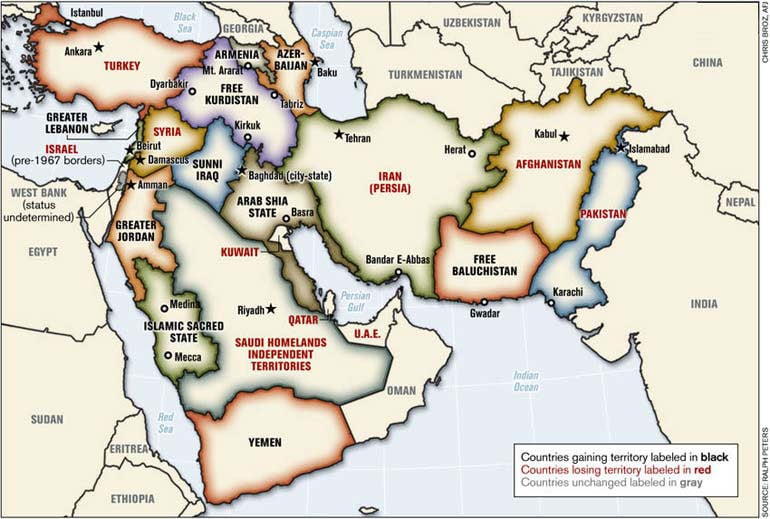
    Anglo-American occupied Iraq, particularly Iraqi Kurdistan, seems to be the preparatory ground for the balkanization (division) and finlandization (pacification) of the Middle East. Already the legislative framework, under the Iraqi Parliament and the name of Iraqi federalization, for the partition of Iraq into three portions is being drawn out. (See map below)

    Moreover, the Anglo-American military roadmap appears to be vying an entry into Central Asia via the Middle East. The Middle East, Afghanistan, and Pakistan are stepping stones for extending U.S. influence into the former Soviet Union and the ex-Soviet Republics of Central Asia. The Middle East is to some extent the southern tier of Central Asia. Central Asia in turn is also termed as “Russia’s Southern Tier” or the Russian “Near Abroad.”

    Many Russian and Central Asian scholars, military planners, strategists, security advisors, economists, and politicians consider Central Asia (“Russia’s Southern Tier”) to be the vulnerable and “soft under-belly” of the Russian Federation.3
    .....
    .....

    The redrawing and partition of the Middle East from the Eastern Mediterranean shores of Lebanon and Syria to Anatolia (Asia Minor), Arabia, the Persian Gulf, and the Iranian Plateau responds to broad economic, strategic and military objectives, which are part of a longstanding Anglo-American and Israeli agenda in the region.

    The Middle East has been conditioned by outside forces into a powder keg that is ready to explode with the right trigger, possibly the launching of Anglo-American and/or Israeli air raids against Iran and Syria. A wider war in the Middle East could result in redrawn borders that are strategically advantageous to Anglo-American interests and Israel.

    NATO-garrisoned Afghanistan has been successfully divided, all but in name. Animosity has been inseminated in the Levant, where a Palestinian civil war is being nurtured and divisions in Lebanon agitated. The Eastern Mediterranean has been successfully militarized by NATO. Syria and Iran continue to be demonized by the Western media, with a view to justifying a military agenda. In turn, the Western media has fed, on a daily basis, incorrect and biased notions that the populations of Iraq cannot co-exist and that the conflict is not a war of occupation but a "civil war" characterised by domestic strife between Shiites, Sunnis and Kurds.

    Attempts at intentionally creating animosity between the different ethno-cultural and religious groups of the Middle East have been systematic. In fact, they are part of carefully designed covert intelligence agenda.

    Even more ominous, many Middle Eastern governments, such as that of Saudi Arabia, are assisting Washington in fomenting divisions between Middle Eastern populations. The ultimate objective is to weaken the resistance movement against foreign occupation through a "divide and conquer strategy" which serves Anglo-American and Israeli interests in the broader region."

    CARTOON OF THE DAY


    THE LEBANESE GOVERNMENT

    THE SAME IS TRUE OF THE PALESTINIAN "GOVERNMENT"

    Olmert's drums of war


    By Aluf Benn
    Haaretz

    "In his address to the General Assembly of the Jewish Communities of North America in Los Angeles earlier this week, Prime Minister Ehud Olmert made it clear that Israel and Iran were headed down a road of confrontation. It is hard to interpret his message any differently: "We have reached the pivotal moment of truth regarding Iran... Our integrity will remain intact only if we prevent Iran's devious goals, not if we try our best but fail."

    Members of the UN Security Council are still talking about imposing ridiculous sanctions that will have little effect on Iran, and an international military operation against the Iranian nuclear installations is highly unrealistic. The Democrat's victory in midterm elections in the United States also lessened the likelihood that Bush will bomb Iran. Israel, it seems, is facing Ahmadinejad alone.

    "A weak prime minister who is dropping in the opinion polls suddenly found himself faced with Benjamin Netanyahu, Avigdor Lieberman and Effi Eitam, who are politicizing the issue, and with a public that does not have faith in the prime minister due to his lack of security experience," senior officials in Jerusalem explained.

    "Olmert is under attack for not being able to deal with the Qassam rockets, so he is under pressure and is moving away from the low-profile approach," they added.

    The public will justifiably want to know what has been done to prevent the threat to its existence posed by Iran, and to stop the possible mass exodus of Jews from Israel, as described by Deputy Defense Minister Ephraim Sneh. Domestic pressure calling for military action will intensify.

    However, experts on strategy have voiced doubts regarding Israel's ability to carry out an effective aerial attack on Iran's nuclear installations, similar to the raid that destroyed Iraq's nuclear reactor in 1981. The experts say there are three prerequisites for such an operation:

    * Accurate and updated intelligence on the locations of the targets, some of which are hidden underground and are well defended

    * The right kinds of munitions capable of destroying their targets with a high chance of success

    * Diplomatic coordination with the Americans. The U.S. forces in the region could become targets of Iranian retaliation, just like Israel, and therefore there is no way that an independent Israeli action can take place without authorization from Bush. Did Olmert get such a go-ahead and is this why he was pleased with his visit to the White House?

    International pressure and sanctions were supposed to delay the Iranians, at least until the regime there fell, or some miracle happened. However, it is not working out.

    The challenge Olmert has set for himself is not a simple one. But the more his warnings intensify, the more difficult he will find it to back down and convince the public that we can live with an Iranian bomb. Therefore, we can assume that the confrontation is moving closer."

    Hollow Visions of Palestine's Future

    Peace will need more than David Grossman – or Uri Avnery

    AN EXCELLENT PIECE
    by Jonathan Cook
    (I encourage reading the entire article)

    "Grossman, one of Israel's foremost writers and a figurehead for its main peace movement, Peace Now, personifies the caring, tortured face of Zionism that so many of the country's apologists – in Israel and abroad, trenchant and wavering alike – desperately want to believe survives, despite the evidence of the Qanas, Beit Hanouns and other massacres committed by the Israeli army against Arab civilians. Grossman makes it possible to believe, for a moment, that the Ariel Sharons and Ehud Olmerts are not the real upholders of Zionism's legacy, merely a temporary deviation from its true path.

    In reality, of course, Grossman draws from the same ideological well-spring as Israel's founders and its greatest warriors. He embodies the same anguished values of Labor Zionism that won Israel international legitimacy just as it was carrying out one of history's great acts of ethnic cleansing: the expulsion of some 750,000 Palestinians, or 80 per cent the native population, from the borders of the newly established Jewish state.

    Remove the halo with which he has been crowned by the world's liberal media and Grossman is little different from Zionism's most distinguished statesmen, those who also ostentatiously displayed their hand-wringing or peace credentials as, first, they dispossessed the Palestinian people of most of their homeland; then dispossessed them of the rest; then ensured the original act of ethnic cleansing would not unravel; and today are working on the slow genocide of the Palestinians, through a combined strategy of their physical destruction and their dispersion as a people.

    Yitzhak Rabin, Grossman's most direct inspiration, may have initiated a "peace process" at Oslo (even if only the terminally optimistic today believe that peace was really its goal), but as a soldier and politician he also personally oversaw the ethnic cleansing of Palestinian cities like Lid in 1948; he ordered tanks into Arab villages inside Israel during the Land Day protests of 1976, leading to the deaths of half a dozen unarmed Palestinian citizens; and in 1988 he ordered his army to crush the first intifada by "breaking the bones" of Palestinians, including women and children, who threw stones at the occupying troops.

    Every day that Grossman denies a Right of Return for the Palestinians, even as he supports a Law of Return for the Jews, he excuses and maintains the act of ethnic cleansing that dispossessed the Palestinian refugees more than half a century ago.

    Rather than suggest what Israel should talk about to the Palestinians' elected leaders, Grossman argues that Israel should talk over their heads to the "moderates," Palestinians with whom Israel's leaders can do business. The goal is to find Palestinians, any Palestinians, who will agree to Israel's "peace." The Oslo process in new clothes.

    This low level of support for a barely viable Palestinian state contrasts with the consistently high levels of support among Israeli Jews for a concrete, but very different, solution to the conflict: "transfer," or ethnic cleansing. In opinion polls, 60 per cent of Israeli Jews regularly favor the emigration of Arab citizens from the as-yet-undetermined borders of the Jewish state.

    By this, one might be tempted to infer that Avnery styles his own peace bloc as non-Zionist or even anti-Zionist. Nothing could be further from the truth, however. Avnery and most, though not all, of his supporters in Israel are staunchly in the Zionist camp.

    However, unlike Grossman, Avnery not only supports a Palestinian state in the abstract but a "just" Palestinian state in the concrete, meaning for him the evacuation of all the settlers and a full withdrawal by the Israeli army to the 1967 lines. Avnery's peace plan would give back east Jerusalem and the whole of the West Bank and Gaza to the Palestinians.

    But there is a serious danger that, because Palestinian solidarity movements have misunderstood Avnery's motives, they may continue to be guided by him beyond the point where he is contributing to a peaceful solution or a just future for the Palestinians. In fact, that moment may be upon us.

    All four of them regarded Arafat as the Palestinian strongman who could secure Israel's future: Rabin hoped Arafat would police the Palestinians on Israel's behalf in their ghettoes; while Avnery hoped Arafat would forge a nation, democratic or otherwise, that would contain the Palestinians' ambitions for territory and a just solution to the refugee problem.

    But without Arafat as their strongman, Gush Shalom have no idea about how to address the impending issues of factionalism and potential civil war that Israel's meddling in the Palestinian political process are unleashing.

    They will also have no response if the tide on the Palestinian street turns against the two-state mirage offered by Oslo. If Palestinians look for other ways out of the current impasse, as they are starting to do, Avnery will quickly become an obstacle to peace rather than its great defender.

    There are not too many available:

    * There is the "Carry on with the occupation regardless" of Binyamin Netanyahu and Likud;
    * There is the "Seal the Palestinians into ghettoes and hope eventually they will leave of their own accord," in its Kadima (hard) and Labor (soft) incarnations;
    * And there is the "Expel them all" of Avigdor Lieberman, Olmert's new Minister of Strategic Threats.

    Other Zionist Jews, in Israel and abroad, have been grappling with the same kinds of issues as Avnery but begun to move in a different direction, away from the doomed two-state solution towards a binational state. A few prominent intellectuals like Tony Judt, Meron Benvenisti and Jeff Halper have publicly begun to question their commitment to Zionism and consider whether it is not part of the problem rather than the solution.

    Avnery hopes that his peace camp may be the small wheel that can push the larger wheel of organizations like Peace Now in a new direction and thereby shift Israeli opinion towards a real two-state solution. Given the realities on the ground, that seems highly unlikely. But one day, wheels currently smaller than Gush Shalom may begin to push Israel in the direction needed for peace. "

    A terrible legacy of hatred and death

    This is the hell we have bequeathed to the Arab peoples of Iraq

    By Robert Fisk
    The Independent

    "So the Ministry of Fear now has a Dowager of Fear, the good Dame Eliza Manningham-Buller who has discovered in the sanctum of MI5 another 30 "terror plots" to terrify us - and an entire generation of plots before the show is over. And how Lord Blair of Kut al-Amara admires her. "I think she is absolutely right that it will last a generation," he announces. Absolutely, indeed. The favourite Blair adverb, always trotted out when he really, truly and of course absolutely believes he is right; which is not the same at all, of course, as actually being right, which needs a lot more than belief to support it.

    What is this trash? Accepting - which Blair can't do, can he? - that the risk to us is caused by his pusillanimous, mendacious policies in the Middle East (and that of his lord and master in Washington) would cut this latest bulletin from the Ministry of Fear down to a mere couple of years' worth of terror instead of a generation.

    And note the smarmy way that officials in the Ministry of Fear now try to squeeze in a little bit of truth to take the edge off all those lies. According to Lord Carlile of Berriew QC, the war in Iraq is not to blame for the "terror plots" we are facing. No, "it is now clearly the case that although the Iraq war did not create violent jihad, it has become a convenient excuse for violent jihad". Come again, my good Lord? Now, let me get this right. Iraq has nothing to do with the "terror plots" - this, he says, is "clearly" the case ("clearly" being a notch down the road of lies from "absolutely", which might be pushing Lord Carlile's luck on this occasion). So the threats have nothing to do with Iraq but, er, well, yes, he tells us that they have, because the inventors of the "terror plots" lie to us about the real reasons for their deeds.

    I am thinking of some real terror in Baghdad, the terror that comes through the letter box or is stuck on to walls. Now here are real terror plots for the Dowager of Fear to get her teeth into, plots to massacre and "cleanse" whole communities from their homes and cities on the grounds of their religious sect. And so let's take a look at some really ferocious terror, collected on the streets of Baghdad and from the front doors of those who are indeed facing a generation of threats, many of them scrupulously collected by local UN officials and put together by my Italian colleague, Mario Portanova, of the Milan magazine Diario. They are printed, not handwritten, and they are poisonous.

    ......

    It should be noted that many of these terrible notices of intent to murder are preceded by the first words of the Koran: "In the name of God, the compassionate, the merciful." Now here's another threat from the "Day of Atonement Brigades", a Shia group: "To the disloyal Palestinians, declared enemies and Saddamist Baathists, specifically those who reside in the al-Shououn district (of Baghdad). This is a warning that you will be liquidated if you do not move completely away from this district within a 10-day period. Let this be a warning to all, without exception."

    This, of course, is the hell we have bequeathed to all the Arab peoples of Iraq, this nightmare of genocidal threat and murder. All for non-existent weapons of mass destruction. And yet there is the Dowager of Fear trying to frighten us. That there may be "plots" I don't doubt. But given the hell-disaster we have helped to unleash in Iraq, is it any surprise? "

    Lieberman: Israel must reclaim control of Gaza-Egypt border


    FROM THE RACIST MIND OF A MOLDOVAN ZIONAZI:

    "Cabinet Minister Avigdor Lieberman told Israel Radio Saturday morning that Israel should reclaim control over the Rafah crossing and the Philadelphi Route on the border between Egypt and the Gaza Strip.

    In the interview, the Deputy Prime Minister said that Israel need not reoccupy the Gaza Strip, but must take control over the area from which "the fuel that drives terrorism arrives."

    Lieberman told Israel Radio that the proposals by Minister Shimon Peres and the Defense Ministry are senseless.

    "There is no point in new peace initiatives, and those who initiate them are irresponsible and unwise."

    According to Lieberman, the Palestinians do not truly desire a country, but instead "work in the service of international Jihad."

    "There is no point in striking refugee camps and Palestinians who have nothing to lose," Lieberman said. "Instead, we should strike the entire Hamas leadership roaming free in Gaza."

    Liberman said in the interview that "Judea and Samaria should be handled in cooperation with Jordan, and Abu-Mazen [Palestinian Authority Chairman Mahmoud Abbas] should be ignored as he is not relevant, hated and lacking any authority in he territories."

    He added that some people are interested in improving their situation, and that these are the people Israel should talk to.

    "We must improve their financial situation, but we mustn't repeat the mistaked of Oslo and the Road Map," Lieberman said.

    Prime Minister Ehud Olmert forged an alliance with Lieberman, one of Israel's most divisive politciains, last month to shore up his shaky coalition.

    Olmert's spokeswoman, Miri Eisin, had no comment Saturday on Lieberman's latest remarks."

    Friday, November 17, 2006

    Diplomats fear US wants to arm Fatah for 'war on Hamas'


    A Palestinian Pinochet In The Making?

    Times Online

    "AMERICAN proposals to strengthen Mahmoud Abbas’s Palestinian security forces with additional guns and fighters have alarmed other Western nations, who argue that it is tantamount to supporting one faction in a potential civil war.

    Fearing the strength of Hamas in Gaza, some US officials have urged that the moderate President Abbas should be given “deterrent capabilityso that his Fatah-dominated Palestinian Authority forces can confront the Islamist group if talks on a national unity government fail.

    The divisions have led to a stand-off over the past month, with US officials saying that the unity government proposal had “no legs”. Other members of the “quartet” of international mediators — made up of the United States, United Nations, European Union and Russia — say that it should be given a chance instead of arming one of the Palestinian factions.

    Proposals raised at meetings in London and Cairo include doubling the size of Mr Abbas’s presidential guard and persuading Israel to allow thousands of rifles into Gaza to alleviate its chronic shortage of weapons relative to Hamas. Fatah officials have asked for more than 1,000 reinforcements from the Palestine Liberation Organisation’s Badr Brigades, in exile in Jordan.

    One Western official said that non-American quartet members emerged from one meeting convinced that the US wanted President Abbas to dismiss the Hamas Government, and to use his security forces to “confront Hamas politically and militarily, having confronted it economically”.

    “There was effectively a stand-off. As far as we are concerned, what the Americans are proposing to do is back one side in an emerging civil war,” said a western official familiar with the discussions.

    Opponents argued that the international community had accepted the participation of Hamas in elections and should therefore look to support a national unity government. Hamas won elections last January but instantly became international pariahs. Sanctions and an aid freeze have left the Palestinian Government broke and unable to pay 160,000 civil servant salaries.

    The Spanish Prime Minister, José Luis Rodríguez Zapatero, announced a new Middle East peace initiative with France and Italy yesterday. Central to the plan were an immediate ceasefire, a prisoner exchange, talks between the Israeli Prime Minister and the Palestinian President, international ceasefire monitors and a national unity government. Israeli officials dismissed the overture.

    Some in Washington are sceptical about a new Palestinian coalition, believing that it will be too close to Hamas and will refuse three international demands — to recognise Israel, renounce violence and abide by previous agreements.

    “Everybody wants to support Abbas, but there is a difference of opinion on how best you do it — or how much you are supporting him against Hamas against how much you are supporting him as President, which are not necessarily the same things,” said one international observer.

    “A lot of what the Americans were saying was, ‘If there is going to be a fight, we might as well make sure the right person wins’. We would have a difference of opinion there. You really don’t want to be encouraging a civil war.”

    The US insists that it has a good relationship with its partners. “We are continuing discussions and working things out. I think it is a little premature to be talking about a civil war as talks about a national unity government are still ongoing,” said a spokeswoman at the US Consulate in Jerusalem yesterday.

    Sean McCormack, a State Department spokesman, confirmed that senior US diplomats travelled this week to Jordan to meet neighbouring Arab leaders, some of whom are hostile to Hamas.

    Mr McCormack said that Washington was doing what it could to try to make sure that if the Palestinians produced a government that met the standards of the quartet statement, He said that Hamas had had failed in its attempt to govern.

    The quartet has survived previous differences, notably the European insistence on alleviating Palestinian suffering with a temporary international mechanism that channelled salaries directly to some health workers when it became apparent that the international embargo on Hamas left Palestinian institutions near to collapse.

    Alvaro de Soto, the UN Special Co-ordinator for the Middle East Peace Process, said: “The need to get a grip on law and order is one of the key reasons for pushing ahead with an agreed new national unity government. Only this could bring about what has been desperately missing until now, which is the security bodies under the authority of the President and those controlled by the Government, instead of facing each other off on the streets and even shooting at each other, working cohesively not only to fight crime and ensure stability but also to act against those who fire rockets into Israel.”"

    ***

    THIS IS THE CLEAREST INDICATION YET THAT THE U.S. INSISTS ON THE "PINOCHET OPTION" IN PALESTINE: A MILITARY COUP AND A SUBSEQUENT REIGN OF TERROR. THE CHARADE OF "NATIONAL UNITY" GOVERNMENT IS INTENDED TO BUY TIME FOR ABBAS THE PUPPET.

    ARE YOU LISTENING HAMAS? OR ARE YOU STILL HAVING YOUR STUPID ILLUSIONS ABOUT "BROTHER" ABU MAZEN? READ A LITTLE BIT OF HISTORY YOU NAIVE PEOPLE!

    Iraqi Locals Accuse U.S. of Massacre in Ramadi


    by Dahr Jamail and Ali al-Fadhily

    "RAMADI, Iraq - U.S. military tank fire killed scores of civilians in Ramadi, capital of Al-Anbar province, late Monday night, according to witnesses and doctors. Anger and frustration were evident at the hospitals and during the funerals in the following days.

    Iraqi doctors and witnesses at the scene of the attack said U.S. tanks killed 35 civilians when they shelled several homes in the Al-Dhubat area of the city.

    On Tuesday, hundreds of people carried the 35 coffins of the dead to a graveyard in a funeral procession which closely resembled an angry demonstration. "We heard the bombing and we thought it was the usual fighting between resistance fighters and the Americans, but we soon realised it was bombing by large cannons," 60-year-old Haji Jassim explained to IPS at the burial. "We weren't allowed by the Americans to reach the destroyed houses to try to rescue those who were buried, so certainly many of them bled to death."

    Jassim claimed that everyone killed was innocent, that they were not fighters. He said that when he and others attempted to reach the rubble of the destroyed homes, located near mosques whose minaret's loudspeakers had broadcast pleas for help, "There was a big American force that stopped us and told us the usual ugly phrases we hear from them every day."

    Jassim, speaking with IPS while several other witnesses listened while nodding their heads, said that ambulances did not appear on the scene for hours because "we realised that the Americans did not allow them to move," and that as a result, "there were people buried under the rubble who were bleeding to death while there was still a chance to rescue them." Jassim then burst into tears and walked away saying prayers to Allah to bless the souls of the dead.

    A doctor at Ramadi's main hospital, Abdullah Salih, told reporters that 35 bodies had been brought in and he also believed that others had not been retrieved since access had been limited by ongoing U.S. military operations. Another doctor, Kamal al-Ani, said that in addition to the dead, another 17 wounded had been brought into the hospital.

    The scene at the hospital was tragic as doctors confirmed the reason of death for many as severe bleeding that had gone on for several hours. Most of the doctors were unwilling to discuss too many details for fear of U.S. military reprisals. "You can notice the number of dead is at least twice as high as the number of wounded," one of the doctors, speaking on condition of anonymity, told IPS.

    A local Iraqi policeman who identified himself as Khalif Obeidi told IPS that tanks had destroyed several houses in the area during the U.S. raid, killing more than 30 civilians. "We know that those killed were innocent," said Obeidi, "although there have been attacks on the Americans from near that area in the past."

    Residents of the city and relatives of the dead who were at the funeral were furious.
    "There is no other way for the Sunnis than to fight," Ali Khudher, a 25-year-old carpenter who lost a relative in the attack told IPS. "It is a religious war and no one can deny that now."

    Others who attended the mass funeral chanted anti-American, anti-Israeli, anti-Iranian and even slogans against the Islamic Party which is now part of the Iraqi government.

    Tempers run high in Ramadi also because the city has often been the scene of large-scale U.S. military operations and their inherent forms of collective punishment."

    ***

    SURE SOUNDS JUST LIKE WHAT THE ISRAELIS DID IN BEIT HANOUN. A COINCIDENCE? I THINK NOT.

    US Support for Bush's Iraq Policy Hits New Low

    AP

    "WASHINGTON — Americans' approval of President Bush's handling of Iraq has dropped to the lowest level ever, increasing the pressure on the commander in chief to find a way out after nearly four years of war.

    The latest Associated Press-Ipsos poll found just 31 percent approval on his handling of Iraq, days after voters registered their displeasure at the polls by defeating Republicans across the board and handing control of Congress to the Democrats. The previous low in AP-Ipsos polling was 33 percent in both June and August.

    Erosion of support for Bush's Iraq policy was most pronounced among conservatives and Republican men — critical supporters who propelled Bush to the White House and a second term in 2004. A month ago, approval of the president on the issue certain to define his presidency was 36 percent."

    Neocon Krauthammer Blames Iraqi Victims


    A GREAT PIECE
    By Kurt Nimmo

    "Charles Krauthammer, neocon columnist who is in fact a warmonger propagandist, and thus deserves a seat in the docket at the Hague, or preferably in a courtroom here in America, tells us that the Iraqi people only have themselves to blame for the violence in their country. Krauthammer refuses to handwring or place blame where it is deserved. “Americans flatter themselves that they are the root of all planetary evil. Nukes in North Korea? Poverty in Bolivia? Sectarian violence in Iraq? Breasts are beaten and fingers pointed as we try to somehow locate the root cause in America,” writes the neocon scribe. “Our discourse on Iraq has followed the same pattern. Where did we go wrong? Too few troops? Too arrogant an occupation? Or too soft? Take your pick.”

    How about America had no right to invade a country that did not pose a threat. But then, as Bush insider Philip Zelikow declared, the invasion was not about America or weapons of mass destruction or even Osama colluding with Saddam, but the “security” of Israel, that is to say Israeli hegemony in the Middle East.

    As for why “democracy” withered on the wine in Iraq, Krauthammer has his own theories. “In retrospect, I think we made several serious mistakes—not shooting looters, not installing an Iraqi exile government right away, and not taking out Moqtada al-Sadr and his Mahdi Army in its infancy in 2004—that greatly compromised the occupation. Nonetheless, the root problem lies with Iraqis and their political culture,” he writes.

    In other words, the United States fumbled the ball, thanks to Bush and crew. Of course, this is nonsense, as the neocons accomplished and continue to accomplish their objective of reducing Iraq, a first world nation prior to Bush Senior’s invasion, to a sub-Saharan condition, a decimated nation replete with poverty and almost unimaginable human misery. Over the last year or so, the final goal of the neocon plan—the violent balkanization of Iraq along ethnic and religious lines—has clipped along swimmingly.

    Krauthammer would have us believe the neocons, brimming with democratic idealism and love for the Iraqi people, simply goofed up, although we should credit them for trying. Rather, the “Arabs [are] intrinsically incapable of democracy” and “there are political, historical, even religious reasons why Arabs are less prepared for democracy than, say, East Asians and Latin Americans who successfully democratized over the past several decades,” essentially a racist conclusion, but then this is quite normal for Israel First neocons. As Krauthammer would have it, the “problem here is Iraq’s particular political culture, raped and ruined by 30 years of Hussein’s totalitarianism,” never mind the United States installed Saddam Hussein and fed him weapons when it served foreign policy objectives, for instance the continuation of a brutal war between Iraq and Iran. Krauthammer assumes we are idiots when it comes to history. But then, naturally, most of his readers are idiots, or at least struck with amnesia when it comes to the historical record.

    Iraq is a “social desert,” according to Krauthammer, never mind the Ba’athists created a health care and educational system envied by the Arab world prior to Bush Senior’s invasion, a fact admitted by none other than the Los Angeles Times. In Krauthammer’s hermetically sealed world, where historical facts are not allowed entrance, Iraqis attach themselves to “the mosque or clan or militia,” a quite natural phenomenon, considering the utter decimation of the social framework, thanks to depleted uranium enhanced bunkerbusters and cruise missiles. For the racist Krauthammer, who again and again utilizes the racist neocon yardstick when measuring Iraqis, “Iraqi national consciousness is as yet too weak and the culture of compromise too undeveloped to produce an effective government enjoying broad allegiance,” never mind most Iraqis know a spade when they see it—the installed government is beholden to the United States and its neocon political objectives, not the Iraqi people.

    Krauthammer tells us the “Maliki government is a failure” and “beholden to a coalition dominated by two Shiite religious parties, each armed and ambitious, at odds with each other and with the ultimate aim of a stable, modern, democratic regime.” However, Krauthammer and the neocons are not interested in a “modern, democratic regime,” as spelled out in the Clean Break document, subtitled “A New Strategy for Securing the Realm,” or maybe that should be eviscerating the realm. “Since Iraq’s future could affect the strategic balance in the Middle East profoundly, it would be understandable that Israel has an interest in supporting the Hashemites in their efforts to redefine Iraq,” the document states. According to the neocons, King Hussein of Jordan was a “direct descendant” of the Prophet Muhammad and thus should lead the Iraqis, an ideal situation for the Israelis as Hussein conducted peace negotiations directly with them and developed strong ties of friendship with Israeli prime minister Yitzhak Rabin, who joined Haganah, specifically Palmach, responsible in part for the Deir Yassin massacre. In short, the Israelis and their neocon allies expect the Arabs of Iraq to bow down to corrupt and decadent royalty complicit in the slaughter of fellow Arabs, including more than 5,000 during Black September at the behest of Henry Kissinger, the heads of the Defense Department, CIA, Joint Chiefs of Staff, Israeli and Jordanian ambassadors.

    Naturally, since Iraq is wholly artificial, a bastard son of the Sykes-Picot Agreement, or rather a secret agreement between Britain and France to carve up a large swath of the Arab world, it stands to reason the Shi’ites do not “have enough sense of nation,” or a nation now supposedly envisioned by the United States. In fact, for the neocons and Israelis, this “sense of nation” is anathema, as they desire a disserved and splintered Iraq along religious and ethnic lines, managed by the “moral and intellectual leadership” of the Israelis, as the Clean Break document arrogantly stipulates.

    For Krauthammer, the murderous sectarian warfare currently underway in Iraq is a good thing. “There is a glimmer of hope in this breakdown of the Shiite front,” he writes. “The unitary Shiite government having been proved such a failure, we should be encouraging the full breakup of the Shiite front,” a breakup that will eventually result in the sort of balkanization envisioned by the Israelis and their neocon cognates. Of course, Krauthammer does not say as much, but rather sticks to the absurdly transparent Bushian line that the United States hold out a hope, however futile, for a democratic Iraq.

    “One can tinker with American tactics or troop levels from today until doomsday,” writes Krauthammer. “But unless the Iraqis can put together a government of unitary purpose and resolute action, the simple objective of this war—to leave behind a self-sustaining democratic government—is not attainable.” Of course, such a “self-sustaining democratic government” will never come about, especially with P2OG and British SAS undertakings underway, making certain Krauthammer’s “social desert” remains a permanent feature of a disintegrated Iraq.

    Charles Krauthammer is a transparent shill for the neocon plan to balkanize, and thus murder a countless number of innocents, the entire Arab and Islamic world, although he masquerades as a champion of a maudlin “democracy,” in essence a social and cultural desertification. In normal, non-Bushzarro times, Mr. Krauthammer would be arrested as a criminal endangering the peace, as an exponent of mass murder and misery beyond measure. Instead, he is allowed to write columns for newspapers, infecting the intellectual weaklings among us, as Joseph Goebbels seduced the German people before him, resulting in over 56 million dead people."


    A Palestinian woman walks past Israeli soldiers, in the Old City in the West Bank town of Hebron, November 17, 2006. (REUTERS)


    Palestinians inspect a damaged house destroyed by an overnight Israeli airstrike on the northern Gaza Strip town of Beit Lahia. (AFP)


    Palestinians walk past a damaged house in the northern Gaza Strip refugee camp of Jabalia. (AFP)


    Palestinians inspect the rubble of a house targeted overnight by an Israeli missile strike in the northern Gaza Strip town of Beit Lahiya, Friday Nov. 17, 2006.(AP Photo)


    A Palestinian girl walks inside a room in a house targeted overnight by an Israeli missile strike in the northern Gaza Strip town of Beit Lahiya, Friday Nov. 17, 2006. (AP Photo)


    A Palestinian looks at the damage left by the recent Israeli military offensive in the northern Gaza Strip town of Beit Hanoun Friday Nov. 17, 2006.(AP Photo)

    After the Rain of Death

    Journey to Beit Hanun

    By GIDEON LEVY
    CounterPunch

    "This is Islam al-Atamna. A girl of 14. She is sitting in her black mourning clothes. Eight close relatives - including her mother, grandparents, uncles and aunts - were all killed before her eyes, one after the other. They were killed in the street after they awoke at home in horror at the sound of the first shell that exploded and then fled outdoors, where the next shells caught them. About 11 fell on a residential neighborhood, one shell a minute, a rain of death, pursuing them in their flight. Fatherless for some time already, the girl is left alone in the world with her two little sisters and her 3-year-old brother Abdullah, whose legs were severed and who is hospitalized in the Al-Hilal Hospital in Gaza.

    What should we say to Islam? What can we say to Islam? That the chip in the radar system is to blame? That the electronic component is responsible? Perhaps that the Palestinians are to blame?

    Since the accident the girl has not fallen asleep for even a moment, which one can see in her frozen face. Islam is now a girl in shock, whose entire world was destroyed last Wednesday morning, with a total of 22 relatives dead and dozens wounded.

    Islam's town is upside down. The roads are full of open pits, crushed electricity poles, smashed cars, torn houses and a sewage system whose effluents flow quietly in the streets.

    After the six-day war waged by the Israel Defense Forces against Beit Hanun during Operation Autumn Clouds - when soldiers also took over Islam's house, imprisoning on the first floor the 104 people who lived in the eight apartments in the building, all relatives - people here expected to wake up last week to a new dawn, a dawn without soldiers. The day before, IDF had left Beit Hanun after "completing its mission" - nobody knows exactly what that mission was - and the residents awoke to freedom. But just then the volley of shells landed. Between 6:30 and 7 A.M., on the row of houses in the street that ends in a recently planted orchard, a gift from the Japanese government.

    Now the survivors are sitting in the street of death, all of whose fatalities are members of one family, the Al-Atamna family. There has never before been such killing, of 22 members of one family, not even under direct Israeli occupation.

    In the hospitals in Gaza, Egypt and Israel the wounded, about 40 in number, are moaning, many of them with amputated limbs and head injuries, quite a number of them children. The dead also include children, and mainly women: The mass poster that was printed presents the portraits of the men and the children who were killed, whereas the pictures of the women are replaced by paintings of red roses, as is the custom.

    The entrance to Beit Hanun is horrifying. It is a town that is half destroyed and half deserted. Some of the residents, those who had a place to go, fled while they were still able to do so and have yet to return. Those who remain are walking around the streets like victims of shell shock, trying to assess the damages. A few people with initiative have already begun reconstruction: One is building a new fence, another is clearing the ruins from his yard, and technicians are repairing electricity and telephone cables, until the next invasion. An old woman is drying loofa in her ruined yard, as though nothing has happened.
    ......
    ......
    Taxi driver Raad Al-Atamna, a member of the family and an old acquaintance of ours from the Erez checkpoint: "Her uncle was also killed, and another uncle is in a hospital in Egypt. Now she has nobody. What can I tell you, only God will look after her and help her. Gideon, I'm begging God not to harm either a Muslim or a Jew - no person should be harmed like us. It's a tragedy, a Holocaust such as we have not had since 1956. I hope that what happened to us doesn't happen to anyone else in the world."

    Zahhar: Iran contributed 120 million US Dollars and promised more


    FROM THE WINDBAGS OF HAMAS:

    "Tehran – Dr. Mahmoud al-Zahhar, the PA Foreign Minister, told reporters in Tehran on Thursday that the Iranian government have already contributed 120 million US Dollars to the Palestinian government and promised more aid.

    Dr. Zahhar was speaking to reporters after meetings with Iranian officials he held in Tehran.

    The Iranian government announced last April that it will provide 50 million US Dollars in aid to the Palestinian government to compensate for the loss of funds as a result of the siege imposed by the US and Western governments.

    Dr. Zahhar also told reporters the intended national unity government will not recognize Israel.

    He added that the letter of assignment to the new proposed prime minister will be the same as the one Ismail Haneyya received, but the National Harmony Document will form part of the letter of assignment and there is no requirement in the document to recognize Israel or relinquish rights.

    He also stressed that one condition of forming this government is having guarantees that the siege will be lifted.

    The quartet committee requires that Hamas recognizes Israel, gives up resistance and respects all signed agreements between the PA and Israel. "

    ***

    Why do you have to disclose such information? To show off? To give Iran credit?
    You will never hear Nasrallah speak like this; but then we are talking about REAL LEADERS.

    Israel totally rejects new European "peace initiative"

    Spanish FM: Nothing in peace plan 'Israel can reject'
    By Akiva Eldar and Avi Issacharoff, Haaretz Correspondents, and The Associated Press

    Spanish Minister of Foreign Affairs Miguel Angel Moratinos sought Friday to reassure Israel over a new Mideast peace initiative proposed the day before by Spain, France and Italy, saying that there was nothing in the plan "that Israel can reject." Foreign Minister Tzipi Livni said Thursday that Israel rejected the new peace initiative out of hand. She told Moratinos that it was unacceptable for an initiative concerning Israel to be launched without coordination with Jerusalem. Livni also told Moratinos that if the sponsors of the initiative were so inclined, they should seek to hold dialogue with Israel on any new plan. But Moratinos told Haaretz on Friday he had spoken to his Israeli counterpart about the initiative, in what he described was a "good conversation," and had "tried to convince her that it's not an anti-Israeli plan." He said that, "at the end of the conversation it was fine," and promised to provide Livni with "all the details." Introducing the plan Thursday during a meeting with French President Jacques Chirac, Spanish Prime Minister Spanish Jose Luis Rodriguez Zapatero said it had five components, including an immediate cease-fire that would be monitored by an international presence in Gaza. Moratinos said that he had been anticipating a poor reception, but remained confident that the plan would be taken seriously. "We assume our responsibilities," he said. "I knew that in the beginning there will be a negative reaction but I have full confidence that the initiative will go through." The Spanish foreign minister acknowledged that there was still work to be done on the proposal, but said that the three countries had been driven by a desire to change the stalemate in the region. "It is not a final initiative, we will have to adapt. But we have a sense of urgency that something has to be done, and this stagnation and frustration which are affecting the lives of Israelis and Palestinians are [getting] worse." He also said that his own country has an interest in events in the Middle East, not least because they have a direct impact on Spain and its citizens. "We have police and civil guard [in Lebanon], two Spanish citizens were kidnapped in Gaza, because there is a big disaster," he said. "It's affecting my economy and security in terms of the whole situation. I have interests that are affecting my country, and so, what do I have to do, just wait and see?"According to Moratinos, European Union and American officials at the highest levels have been made aware of the initiative."We discussed with [EU foreign policy chief Javier] Solana and I discussed it this morning with the Americans, but the Americans have the Quartet," Moratinos said, referring to the foursome of the U.S., United Nations, Russia and the EU, who play a joint role in efforts to end the conflict." But we already discussed the general idea with [U.S. Secretary of State] Condoleezza Rice a long time ago. And so we want the Americans to lead the initiative, but we have to forward some ideas. If they have better ideas, I am ready to accept them."
    Hamas: Israel doesn't want peace
    Palestinian Prime Minister Ismail Haniyeh said Friday that Israel's rejection of the initiative was "proof that Israel doesn't want any form of stability or quiet in the region."
    Haniyeh also said the initiative contained "good points" that should be studied further.
    MK Tzachi Hanegbi (Likud), the chairman of the Knesset Foreign Affairs and Defense Committee, said Friday that, "the initiative presented by Spain is uncalled for, and if it's accepted, it would prevent Israel from operating against terrorist infrastructure in Gaza."
    "The Spanish initiative would indeed stop Qassams from being fired, but under the false calm Hamas will continue to expand and stockpile rockets, weapons and explosives," Hanegbi added.
    "As far as we know, even the European Union is not interested in the idea," said a senior Israeli official, casting doubt on whether the plan would draw interest. Palestinian Authority spokesman Nabil Rudeineh said Thursday that his government welcomed the initiative, particularly its emphasis on international intervention. Chief Palestinian negotiator Saeb Erekat, who is close to Abbas, said any international peace initiative was welcome, but he stopped short of a warm endorsement of the new one. "We don't need to reinvent the wheel, we don't need a new initiative. What we need is a mechanism for implementation and timelines," he said. Also Thursday, Livni encouraged commencing a political process with moderate elements within the Palestinian Authority. She said Israel must continue fighting the war on terror, but simultaneously send out a message for negotiations to those in the territories that do not support terror. "Our interests are not in war, but in a process that can bring forth a peaceful life," she said.
    Zapatero: Cannot remain impassive
    Speaking at the Thursday news conference in which he announced the new initiative, Zapatero told reporters that the Middle East conflict had a global impact and the international community could not remain idle as violence raged between Israel and the Palestinians. "Peace between Israel and the Palestinians means to a large extent peace on the international scene," he said. Middle East peace, Zapatero said, "is one of the factors that can contribute most to cornering fanaticism and terrorism." The peace plan will be presented to an EU summit next month, Zapatero said, adding he hopes to win the backing of Britain and Germany as well. "We cannot remain impassive in the face of the horror that continues to unfold before our eyes," Zapatero said."When I arrived, Zapatero said to me 'we have the same vision of problems and concerns over the Middle East and particularly Palestine. We should take a common initiative'," Chirac told businessmen and professors. "Our three countries have the sensitivity, the same interests and the same morals and maybe we can play a part in working out a solution to the Palestinian problem and putting it into action," he said. After a meeting on Franco-Spanish relations, Chirac said Zapatero had put the Middle East on the agenda of the bilateral talks in the Catalan town of Girona, near the French border. Speaking in Rome on Thursday, Italy's Prime Minister Romano Prodi said details of the initiative would be announced in the coming days. "I think the European countries present in the area, have an obligation to look for a way to get out of this situation and prepare - to prepare - a peace process," Prodi told reporters. There are hopes in Europe for a greater voice in world affairs, particularly after midterm U.S. elections in which voters punished President George W. Bush and gave control of Congress to the Democrats. Many people in Europe hope the results will usher in a more humble U.S. foreign policy, in which Washington seeks the advice and input of its European allies, rather than dictating policy to them. Zapatero cited the IDF shelling that killed 19 people last week in a Gaza town and the killing Wednesday of an Israeli woman in a Palestinian rocket attack in Sderot. The violence, he said, "has reached a level of deterioration that requires determined, urgent action by the international community." Eventually, a major international conference on Middle East peace should be held, he added, but did not specify if such a meeting should take place in Spain. Spain hosted a landmark peace conference in 1991 that laid the groundwork for the Oslo accords, which in turn led to the creation of the Palestinian Authority. Europe's efforts to help broker a peace deal have hit some speed bumps recently, and the continent could face problems this time as well. Many in Israel view European leaders as pro-Palestinian and are wary of their motives. Last month, Moratinos said that the road map plan for peace between Israel and the Palestinians was fatally stalled and that Europe should take the initiative to come up with a new plan. Israeli and Palestinian officials were quick to reject his comments as overly pessimistic. Both sides insisted that the road map was not dead, just in serious need of a mechanism for implementation. The U.S.-backed road map, devised in 2003, called for the creation of a sovereign Palestinian state alongside Israel, but it never got off the ground because neither side lived up to even their initial commitments under the blueprint.


    Lebanese daily publishes letter to MP Saad Hariri during July war, with plan to "terminate" Hezbollah


    Toni Nissi (right)


    THIS IS A BOMBSHELL

    "Al-Manar special report – Fatima Mussaoui – Translated / The Lebanese daily "Addiyar" unveiled a letter that was sent by Toni Nissi, the Policy Chief of the International Lebanese Committee to implement UN resolution 1559, to the head of the so called majority, MP Saad Hariri, on the 17th of July – four days after the Israeli aggression against Lebanon began. According to Addiyar, the letter said: "Your Excellency the head of the Future Movement parliamentary bloc Sheikh Saad Hariri, as a result to the work and follow up with the American administration in Washington, the Security Council in New York and the European Parliament in Belgium, particularly NATO members, we are glad to inform you of the following: A- The intended scenario: First: After three day on the Israeli army military campaign, the operations have radically transformed from an attempt to pressure the Lebanese government to disarm Hezbollah and bind Lebanon to sign a peace accord through creating a new "security zone" after destroying Lebanon's infrastructure, to stop this operation and move to an alternative plan. The agreed upon plan is to totally destroy Hezbollah's military structure and leave the mission of "pressure" to the United States and the international community. Second: After Hezbollah's military structure is totally destroyed, and not before that, the United States and France will present a draft resolution to the UN Security Council, that we would also take part in preparing, to deploy international forces under Chapter Seven of the UN charter, on the Lebanese-Israeli and the Lebanese-Syrian borders, with full authority to implement UN resolutions 1559 and 1680. Third: Any ceasefire, should it take place, will not be permanent unless it leads to a mechanism by which illegal weapons in Lebanon are withdrawn. Fourth: In this battle, Hezbollah has proven itself as a terrorist organization with huge potentials, and therefore, the international community, especially the United States and Europe, have decided that this campaign does not stop unless Hezbollah is totally crushed. In section "B" of the letter sent to MP Hariri, Toni Nissi explains the reasons behind the aggression saying: First: Because the "Cedars Revolution" has been frozen and the rounds of national dialogue have become a heterodoxy. Second: Because destroying Hezbollah is a US priority, especially if it is to go for standoff with Iran. Third: Because Hezbollah, without deploying deterrent international forces under Chapter Seven and without controlling Lebanon's border with Syria, no matter how much Israel or the United States hit it, will emerge stronger than before when a ceasefire is put into effect. In section "C" of the letter the Policy chief touched on the measures taken by Hezbollah during the aggression. And in section "D" Nissi asks "what should we do?" He then answers: First: Launch a massive media campaign against Hezbollah, with a Christian characteristic and a bid to involve some Shiites in it. Second: Issue a resolution by the Lebanese government calling the United Nations to interfere to implement international resolutions and help the government to practice its authority on all Lebanese soil, even if this leads to the withdrawal or resignation of the Hezbollah and Amal ministers from the government. "

    Nine Israeli human rights organizations speak out about Gaza

    Statement, Israeli human rights organizations, 17 November 2006

    Gaza humanitarian crisis - a joint statement by Israel's leading human rights organizations

    "Nine Israeli human rights organizations issued an unprecedented joint call to the international community to ensure human rights in the Gaza Strip. The statement comes in light of the dire humanitarian situation there:

    Some 80% of the population is extremely poor, living on less than $2 a day. A majority of the population is dependant on food aid from international donors.

    In the past four months, the Israeli military has killed over 300 Palestinians in the Gaza Strip. Over half of those killed were unarmed civilians who did not participate in the fighting. Among the dead, 61 were children.

    About 70% of Gaza's potential workforce is out of work or without pay.

    On 28 June, Israel bombed Gaza's only independent power station, which produced 43% of the electricity needed by the residents in Gaza. Since then, most of the population has electricity between 6 and 8 hours each day, with disastrous consequences on water supply, sewage treatment, food storage, hospital functioning and public health.

    The Gaza Strip is almost entirely sealed off from the outside world, with virtually no way for Palestinians to get in or out. Exports have been reduced to a trickle; imports are limited to essential humanitarian supplies.

    Israel cannot shirk its responsibility for this growing crisis. Even after its Disengagement in 2005, Israel continues to hold decisive control over central elements of Palestinian life in the Gaza Strip:

    Israel continues to maintain complete control over the air space and territorial waters.

    Israel continues to control the joint Gaza Strip-West Bank population registry, preventing relocation between the West Bank and Gaza, and family unification.

    Israel controls all movement in and out of Gaza, with exclusive control over all crossing points between Gaza and Israel, and the ability to shut down the Rafah crossing to Egypt.

    Israeli ground troops conduct frequent military operations inside Gaza .

    Israel continues to exercise almost complete control over imports and exports from the Gaza Strip.

    Israel controls most elements of the taxation system of the Gaza Strip, and since February has withheld tax monies legally owed to the PA, and amounting to half of the to tal PA budget.

    The broad scope of Israeli control in the Gaza Strip creates a strong case for the claim that Israel's occupation of the Gaza Strip continues, along with an obligation to ensure the welfare of the civilian population. Regardless of the legal definition of the Gaza Strip, Israel bears legal obligations regarding those spheres that it continues to control. Israel has the right to defend itself. However, all military measures taken by Israel must respect the provisions of international humanitarian law.

    The following Israeli human rights organizations call on the international community to ensure that Israel respects the basic human rights of residents of the Gaza Strip, and that all parties respect international humanitarian law:

    B'Tselem: the Israeli Information Center for Human Rights in the Occupied Territories
    Association for Civil Rights in the Israel
    Amnesty International - Israel Section
    Bimkom: Planners for Planning Rights
    HaMoked: Center for the Defense of the Individual
    Gisha: Center for the Legal Protection of Freedom of Movement
    Physicians for Human Rights-Israel
    Public Committee Against Torture in Israel
    Rabbis for Human Rights "

    WHO concerned about lack of access to healthcare in occupied Palestine


    Statement, World Health Organization, 17 November 2006

    "WHO is concerned about the rapid deterioration of Palestinians' equitable access to adequate and effective medical services. This is mainly the result of the Palestinian Ministry of Health's financial crisis which has followed the Palestinian Legislative Council elections in January 2006. The Government of Israel has stopped handing over the tax and customs revenues it collects on behalf of the Palestinian Authority (PA) and international donors have suspended direct aid to the Ministry of Health.

    As a consequence of these measures, the PA has been unable to pay regular salaries since March 2006. Health workers employed by the PA have since received provisional allowances through the Temporary International Mechanism established by the European Union . However they joined a general open-ended strike on 23 August demanding full payment of long-overdue salaries and guarantees that salaries in the upcoming months will be paid.

    According to media reports, unions representing health professionals in the West Bank have announced that as of 15 November public medical services will be further restricted. This will affect people requiring emergency care, chronic patients and deliveries of newborns as Primary Health Centers will be closed down and emergency rooms at public hospitals will stop operating.

    "WHO is very concerned about the announced reduction of services and the deterioration of vital medical services. This will further exacerbate the already difficult humanitarian situation affecting Palestinian lives and their right to enjoy the highest possible level of physical and mental health, " said WHO's Head of Office, Ambrogio Manenti.

    WHO calls on the parties concerned to work to reach an agreement that will guarantee Palestinians' access to essential medical services during the strike.

    WHO also urges the international community to support the Palestinian public health sector in this critical phase. In its statement of 20 September 2006, the Quartet noted that the resumption of transfers of tax and customs revenues collected by Israel on behalf of the PA would have a significant impact on the Palestinian economy. "

    Killing Hope in Beit Hanoun


    “I lost my whole family; is there anyone who is still alive? Anyone?” screamed a Palestinian mother from Beit Hanoun as she fell in the arms of her neighbor

    By Ramzy Baroud

    "“God is greater than Israel and America,” was the echoing cry of tens of thousands of Palestinians, who descended into the graveyard in grief stricken Beit Hanoun, in the northern Gaza Strip. They congregated in yet another familiar scene to bury their loved ones, killed by Israel’s brutal war against the Palestinians.

    This time, the loss was too great to bear, even by the standards of the people of Gaza: eighteen ambulances lined up, carrying the mutilated bodies of eighteen members of the same extended family, the majority of whom were women and children; all civilians.

    “I will avenge; I will avenge,” screamed a relative of one of those who died in the Israeli artillery attack on Beit Hanoun, on November 8.

    A man initiated the burial ceremony by stepping forward carrying the lifeless body of his one-year-old baby. The tough posture Gaza’s men often wish to exhibit was overshadowed by incomprehensive grief; relatives and friends were collapsing in droves; others reached to the sky, in despair.

    Only God could hear them now. Two more tiny bodies swaddled in white made their way through the crowd; more followed.

    The total number of those killed in the Israeli bombing of the civilian neighborhood rose to 20, adding to over 50 others killed earlier in the same Israeli military assault dubbed “Clouds of Autumn”, which converged mainly on Beit Hanoun. The latest two figures are to be included in the overall count of 350 Palestinians killed since last June, in the wider military operation carried out in Gaza and dubbed “Summer Rains”.

    The numbers are devastating, but the devastation takes on a new dimension when the limbless, maimed, injured, homeless and the forever scarred are factored in. Not that those spared such classifications are better off; since Israel laid its military siege on Gaza — preceded and further cemented by an international economic and diplomatic boycott against the Palestinians and their elected government — Gaza’s misery grows perpetually.

    First came the darkness — after the Israeli army bombed the strip’s primary power generator — then, poverty augmented, following the intricate plot to impoverish, thus topple the government (Israel refused to hand over tax revenues it collected on behalf of the Palestinian government, denying civil servants their salaries, thus crippling the economy of the occupied territories).

    Then the water got polluted, because of the electric shortage. Hospitals and all other public institutions were left in a state of near collapse; naturally, internal chaos prevailed, thanks in part to rogue Palestinian elements. Then there was Beit Hanoun, another black spot on the collective memory of this nation already overwhelmed by most tragic occasions.

    This latest episode, like the others before it, came courtesy of Defense Minister Amir Peretz — although the weapons technology is courtesy of our ever-generous US government — the rising star of Israel’s militancy. He pledged months ago to show his critics what sort of a tough man he was. The “leftist” media in Israel tried to sell him to the public as a populist leader with “socialist” tendencies — can Israel’s ideological classification be any more bizarre? Now even right-wing media and politicians are cheering Peretz’s terror.

    Israel’s deputy defense minister, Ephraim Sneh, told The Jerusalem Post that the “moral responsibility” for the deaths rested with Palestinian militants who were “cynically using their civilian population as human shields for terrorist activity”, reported Reuters; it also quoted the Israeli ambassador to the United Nations, Dan Gillerman, as saying that the attack hardly represented a “watershed moment (for) war is a dirty business and during war ugly things happen”.

    Strange that the leaders of a state that lives beyond the fringes of morality and law still speak as if they indeed possessed moral superiority. Even stranger how such wicked disregard for human life is skimmed over in Western media, without the mocking language that often accompanies ridiculous statements often made by war criminals who defend their crimes as moral and human imperatives.

    While some Israeli commentators had the courage to recognize the horror put forth by their malicious army, Ben Caspit was hardly one of them. He equated Gaza’s homemade rockets — which produced few injuries in many months — with his country’s barbaric “response”.

    “Every other method has been tried, and failed. With scoundrels you behave like a scoundrel, and with murderous, bloodthirsty terrorism that wants to wipe you off the map, you have to respond accordingly: wipe it out.”

    And with it, wipe out entire families, devastate whole communities, send a whole nation into a perpetual state of grief, loss and despair.

    What does the state of Israel hope to achieve from all this? After sixty years of Palestinian revolt against dispossession and occupation, does Israeli Prime Minister Ehud Olmert and his henchmen expect the Palestinians to raise the white flag of surrender? Haven’t they seen the ever-flowing footage of Palestinians burying their dead? Haven’t they read the defiance, the tenacity in the faces of the living?

    “I lost my whole family; is there anyone who is still alive? Anyone?” screamed a Palestinian mother from Beit Hanoun as she fell in the arms of her neighbor.

    “My husband, my sister, my children, my mother ...,” she counted what seemed like an endless list, but “I swear in the name of God, we will not surrender; this is our land and here we shall live and die.”

    But history offers no lesson to Israel; it shall remain isolated in its antiquated, ideologically racist, and inherently theological ideals, operating outside law and morality. But then there should be no surprises when more crude rockets burn their way towards Israel, when many more hideous suicide bombings detonate in crowded Israeli streets, creating further suffering. For, Israel’s insistence on living by the sword will continue to create the perfect environment for violence to prevail, for innocent people to die, and for people to lose everything, even their will to live."


    DUMB AND DUMBER
    Can't The Palestinians Do Better?

    A project of dispossession can never be a noble cause

    Israel's liberal intellectuals lament the malaise that grips their country - but refuse to face up to the ethnicide at the heart of it

    A GOOD COMMENT
    Ahdaf Soueif
    Friday November 17, 2006
    The Guardian

    "Before Donald Rumsfeld departed from the Pentagon, the "Transformation Group" he headed worked with an Israeli army team to develop ideas for controlling the Palestinians after Israel withdraws from the occupied territories. Eyal Weizman, an Israeli academic who has written about this cooperation, tells us that they decided to do this through an invisible occupation: Israel would "seal the hard envelopes" around Palestinian towns and generate "effects" directed against the "human elements of resistance". We saw this concept being implemented in Beit Hanoun last week when the Israeli army killed 19 sleeping people with a missile attack.

    The world can look forward to more of the same. According to Weizman, the chief of staff of the Israeli armed forces, Dan Halutz, confirms that the Israeli army sees the conflict as "unresolvable". It has "geared itself to operate within an environment saturated with conflict and within a future of permanent violence ... it sees itself acting just under the threshold of international sanctions ... keeping the conflict on a flame low enough for Israeli society to be able to live and prosper within it." So here's another function for the separation wall Israel is building: to shield Israeli society from too close a knowledge of the brutal acts their army carries out in their name. And yet Israeli intellectuals wonder at the malaise that grips their country. Two Nobel prize laureates, Yisrael Aumann and Aaron Ciechanover, were recently quoted bemoaning the "fatal disease: the depletion of spirit ... [the] cancer that has spread through Israeli society". They attribute it to a kind of generalised "selfishness" which, oddly, they think may be OK in Switzerland but not in Israel. It's nothing to do with "the enemy" they say, because they can handle the enemy with their "wisdom and technology". Again, as we saw in Beit Hanoun.

    Einstein, their distinguished predecessor, expressed grave doubts about political Zionism. A letter he signed, published in the New York Times in December 1948, warned against the emergence in Israel of (the future prime minister) Menachem Begin's "Freedom party". It cited Deir Yassin, where Begin and friends, eight months earlier, had killed 240 men, women and children and "were proud of this massacre". "This," the letter goes on, "is the unmistakable stamp of a fascist party for whom terrorism ... and misrepresentation are means, and a 'leader state' is the goal." Professors Aumann and Ciechanover might consider what Einstein would have made of the scenes in Beit Hanoun and Beit Lahiye over the last several weeks.

    David Grossman seemed to many commentators to be evoking Hamlet in his Rabin memorial address on November 4, published in the Guardian. But when Grossman in effect argued that something was rotten in the state of Denmark he was merely referring to the lack of a "king" in Israel - a leader "to appeal to the Palestinians over the heads of Hamas" to start another peace process. But the peace processes the Palestinians have been subjected to have only led to their further dispossession. The Palestinians elected Hamas last January because two decades of interacting with a variety of Israeli governments has bankrupted the secular Palestinian leadership politically and morally. So the wish to engage in yet more talks, to get the "peace process" back on track, is either catastrophically blind or expresses ill faith. It always comes with lamentations over a "noble" project that has somehow gone wrong.

    The secret rotting at the core of the state of Israel is its refusal to admit that the Zionist project in Palestine - to create a state based on the dispossession of the non-Jewish inhabitants of the land - was never noble: the land it coveted was the home of another people, and the fathers of the Israeli nation killed, terrorised and displaced them to turn the project into actuality. But the Palestinian nation lives on - visibly and noisily and everywhere. To make its own denial stick, Israel has to deny and suppress Palestinian history. To impose its design on Palestine, it has to somehow make the Palestinians disappear. "Things bad begun make strong themselves by ill"; and so the ethnicide continues. The new deputy prime minister, Avigdor Lieberman, plots against the Palestinians within Israel. The Israeli army kills and terrorises the Palestinians in the West Bank and Gaza. Zionists and their friends are desperate to silence the voices of and for Palestine. Meanwhile, Israel insists it is civilised, decent, peaceable - a light unto nations. How can a society caught in such delusion thrive? And how can people living within the Zionist project as privileged Jewish citizens bewail their embattled lot or be puzzled by it? Liberal Israelis of the left should heed another couple of lines from the bard: "Glamis hath murder'd sleep, and therefore Cawdor shall sleep no more; Macbeth shall sleep no more."

    Israel will not be well until it acknowledges its past and makes amends for it. The process has a name: truth and reconciliation. Israelis cannot remain within the Zionist framework and profit from it and think of themselves as good citizens of the world. Many thoughtful and brave Israelis have made a choice. Some have left Israel, others remain. Practically all have made it their life's mission to expose how Zionism really works - and what it costs.

    Since 1988, initiatives, peace talks and road maps have aimed to establish a Palestinian state in the West Bank and Gaza with its capital in Jerusalem, and to do justly by the Palestinian refugees. For 12 years none of this happened, and first-hand accounts of the Camp David talks in 2000 show that Israel did not have the political will then to make the necessary minimum offer. Presumably it still doesn't; hence the "sealed envelopes". But, perhaps because the stakes are now so high, people are once again speaking of the visionary solution: the secular democratic state, a homeland for both Israelis and Palestinians."

    Bush to face the ghosts of America's last failed war


    Thirty-one years after the US army left Saigon, President Bush flies in for a visit dogged by the unlearned lessons of history

    Suzanne Goldenberg
    Friday November 17, 2006
    The Guardian

    "On the morning of April 30 1975 a young corporal in the army of North Vietnam drove a tank through the streets of an unfamiliar city wreathed in smoke and resounding with gunfire, and stopped at a set of wrought-iron gates. Corpses lay on the pavement, and in the distance a lone helicopter rose above the US embassy and turned towards the river.T he soldier, Nguyen Van Tap, paused: could the gate be electrified? Then he gunned the engine and crashed into Saigon's Independence Palace. Moments later, Mr Nguyen's lieutenant, Vu Dang Toan, took the surrender of the South Vietnamese regime barricaded inside.

    The Vietnam war was over, and the two villagers from north of Hanoi had witnessed what would have once been unthinkable: the humbling of a superpower by a peasant army. In the paint factory on the outskirts of Hanoi where the two men work now, Mr Vu says the significance of the victory was apparent even then. "When a small country like Vietnam is invaded by a big country like America and wins, then all the other countries can learn a lesson - that they can win a war against America," he says.
    "They ran like cowards," says Mr Nguyen.

    "They simply didn't have the power to fight us," adds Mr Vu. He smiles.

    America has never really got over that morning in Saigon. Today, 31 years later, George Bush arrives in Hanoi for a visit steeped in the legacy of an old defeat - and haunted by the prospect of another.

    In reality, the most compelling parallel has little to do with either Iraq or Vietnam. It is about the nature of power: America's view of itself in the world, and its execution of foreign policy.

    In Vietnam, it was the August 1964 attack on US destroyer in the Gulf of Tonkin, which we now know never happened. In Iraq, it was the imminent danger that Saddam Hussein had weapons of mass destruction. And that is why this war has proven so painful - because the lessons of Vietnam were not absorbed."

    Thursday, November 16, 2006


    CONNECT THE DOTS:
    What Do All Three Have In Common?

    مطاردة قطاع غزة لإخراجه من دائرة الصراع


    ياسر الزعاترة

    الأهداف المعلنة للعمليات
    خلفيات الانسحاب من القطاع والدولة المؤقتة
    كاديما وغياب شارون ومجيء أولمرت
    القطاع كدولة من دول الجوار
    هل سينجح المخطط؟

    "القطاع كدولة من دول الجوار

    هنا يتبدى الهدف الأساسي أو الرئيس من كل العمليات العسكرية التي استهدفت القطاع وستستهدفه، مع وجود هدف آني أو مرحلي يتمثل في إسقاط حكومة حماس لكي تعود القيادة الفلسطينية المفضلة إلى مواقعها من دون منغصات، مع العلم أنها لم تغادر سوى القليل منها خلال الشهور الماضية.

    لا ينفصل هدف إقصاء حماس عن الحكومة عن الهدف الإستراتيجي الذي كان موجوداً وسيبقى قبل حكومة حماس وبعدها، فالحملات العسكرية القادمة ستركز بشكل أساسي على خلع أنياب حماس العسكرية من أجل تسهيل الانقلاب الفتحاوي عليها، وإعادة الوضع إلى نصابه، مع العلم أن إمداد الحرس الرئاسي بالمال والسلاح من الأردن ومصر هو جزء من الخطة الرامية لإسقاط حماس، فضلاً عن إنزال قوات بدر الموجودة في الأردن إلى القطاع والضفة.

    أما تشكيل حكومة الوحدة الوطنية فيتم في إطار ظرف سياسي خاص لا يغير في البرنامج الإستراتيجي لقيادة فتح المذكورة، ولا الجهات التي تدعمها، مع العلم أن أحداً من هؤلاء لم ييأس من إمكانية استدراج حماس إلى مواقف تضر بمصداقيتها وتسهل الانقلاب عليها، إبعادها من خلال الانتخابات القادمة.

    خلاصة اللعبة المطلوبة هي إخراج القطاع من دائرة الصراع مع الاحتلال، وهو هدف سمعناه منذ الأيام الأولى للانسحاب الإسرائيلي، حين فتح ملف أسلحة المقاومة، بخاصة حركة حماس، وذلك كي يصبح مثل الدول العربية المحيطة مع شعارات تتحدث عن التنمية والبطالة، وعندما تنجح التجربة سيكون بالإمكان نقلها إلى الضفة الغربية، وبالتالي قيام الدولة المؤقتة ذات النزاع الحدودي مع جارتها.

    من خلال المفاوضات وبعد التأكد من سيطرة القيادة الفتحاوية الجديدة على الوضع قد يجري تحسين شروط حياة تلك الدولة من خلال بعض مظاهر السيادة، لكن جوهرها من حيث المساحة والتسلح يبقى كما هو دولة كانتونات يتحكم الاحتلال بها، ولا يمكنها التمرد عليه في يوم من الأيام، فيما تفتح له أبواب التطبيع مع الدول العربية.

    جاءت حماس لتخرب هذه اللعبة، ليس فقط بفوزها في الانتخابات وتسلمها للحكومة، بل، وهذا هو الأهم، برفضها الاعتراف بدولة الاحتلال رغم الحصار والضغوط والابتزاز، أما الأكثر أهمية فهو رفضها للعبة إخراج القطاع من دائرة الصراع ونفض يده من المقاومة، على رغم أن أصواتاً من داخل الحركة قد خرجت تتحدث عن وجود المقاومة حيث يوجد الاحتلال، وعن أن القطاع قد تحرر ويجب وقف الأعمال المسلحة.

    ونتذكر ذلك الاحتفاء الفتحاوي بمقالين لأحد رموز حماس تصب في ذات الاتجاه الذي يهجو العسكرة والمظاهر المسلحة، مع الحديث عن القطاع كما لو كان منطقة محررة، من دون أن يكون قد قصد ما ذهبوا إليه.

    من خلال جميع الحملات العسكرية القادمة سيعمل الاحتلال على توفير الأجواء أمام إقصاء حماس من الحكومة، مع نزع مخالبها العسكرية، وضرب بنيتها التحتية، ومنح كل أسباب القوة للفريق إياه في فتح والسلطة، بما يستعيد المرحلة الثانية من أوسلو، وبما يوفر الأجواء لإخراج القطاع من دائرة الصراع ونقل التجربة إلى الضفة الغربية وصولاً إلى الدولة المؤقتة وتأبيد النزاع.

    مع العلم أن انتظار الانتخابات القادمة بعد ثلاث سنوات ليس مستبعداً أيضاً، إذ ربما يستخدم الوقت من أجل حسم سيطرة جماعة رفض العسكرة على حركة فتح، وبالتالي على السلطة.


    هل سينجح المخطط؟

    لا نمعن في التفاؤل حين نقول إن مشروعاً من هذا النوع لن ينجح، ليس فقط قياساً على اللعنة التي لازمت مشاريع المحافظين الجدد وحلفائهم في الدولة العبرية منذ ست سنوات، وإنما أيضاً لأن الشعب الفلسطيني لن يقبل بحكم كرزاي، ولأن روح المقاومة فيه تختلف كثيراً عما كانت عليه خلال النصف الثاني من التسعينيات، فضلاً عن إمكانية افتضاح المجموعة إياها في أوساط السلطة، والتصعيد عليها حتى ضمن دوائر حركة فتح ذاتها.

    الأهم أن فشل الأميركان في العراق وأفغانستان، وما سيترتب عليه سياسياً في المنطقة من تمرد شعبي، ووجود أجواء مقاومة وتحد منقطعة النظير في الأمة، كل ذلك يجعل من المستحيل تمرير مشروع من هذا النوع.

    كل ذلك يعني أنه ليس أمام الإسرائيليين سوى التراجع، والقبول بحل سياسي يرتضيه الوضع العربي برمته، وفي حين يصعب الجزم بإمكانية ذلك، فإن وقوع أمر من هذا النوع على ضآلة احتماله لن يمنع كثيرين في فلسطين وخارجها من المضي في مطاردة كيان كان ولا يزال عنواناً لسعي الغرب لإذلال هذه الأمة، وصولاً إلى شطبه من المنطقة برمتها.
    "

    AL-JAZEERA CARTOON


    A committed intellectual

    Mustafa Barghouti reflects on the work and life of Edward Said
    Al-Ahram Weekly

    "Edward Said saw the Palestinian cause as inseparable from its global environment. He defended the rights of our people from the standpoint of his commitment to the defence of the rights and dignity of all people and his revulsion for all forms of intolerance and narrow-mindedness. He brought Palestine to the world, just as he brought the world, and the best of its culture, ideas and civilisation, to Palestine. He became a towering pioneering figure for the Palestinians, the Arab world and the world at large, not by virtue of force of arms, control over material resources or the manipulation of political power, but by virtue of the power of his ideas and his moral influence, which he shaped through his personal rectitude, his love for people, and his insatiable thirst for knowledge and discovery.

    He will always be with us. Those who leave us are those who cling to the past even while still alive. In stark contrast, Edward Said represents the future, the future we dream of for ourselves, our children and our grandchildren, and for our nation which has been plagued by seemingly endless pain."

    Realities of death


    By Azmi Bishara
    Al-Ahram Weekly

    "General Elazar Stern, head of the Israeli army's Human Resources Directorate, said last week that "the Israeli army's hyper-sensitivity over the lives of its soldiers was responsible for some of the failures in the war [in Lebanon]." But you just can't choose to go to war and keep your soldiers safe. You have to say to your soldiers, "this is war and in war you kill and get killed," or if you're Israeli you say, "you kill Arabs and Arabs kill you." This hard and practical knowledge did not, though, prevent other Israeli generals from racing to the microphones to shout down Stern's statement and boast about the lengths to which the Israeli army goes to spare human lives.

    Israel certainly has a peculiar attitude towards its soldiers' lives. According to its creation myth, Israel was founded to safeguard Jews whose lives were at risk in the Diaspora. The Israeli soldier is a symbol of this. Its attitude has also been influenced by the 1967 War syndrome, the belief that the army can wage war with minimal risk to its own ranks by replaying the strategies used in 1967; massive aerial bombardment, carrying the war deep into enemy territory and exacting a high toll so as to reduce the risk to one's own soldiers.

    The last of these tactics was developed by Western colonialist powers and Israel has not departed from a Western colonialist sense of racial superiority that rates the lives of its own soldiers as being worth many times more than the lives of people in the colonies or the Third World in general. Were this not the case, then Palestinian spokesmen wouldn't bother cautioning Israel that the life of Corporal Gilad Shalit was being jeopardised by Israeli bombardment at a time when that same bombardment was harvesting Palestinian lives by the dozen.

    Israeli leftists accused the Israeli Human Resources Directorate chief of wanton disregard for human life, arguing that the indifference to Arab or Palestinian lives would inevitably infect attitudes to Israeli lives. Such are the arguments with which some political forces are trying to mobilise Israeli political opinion against the occupation. The reasoning is that the crimes perpetrated by the occupation ultimately corrupt Israeli society; the occupation is bad because it accustoms Israelis to killing. Apparently, it isn't enough for these moral pundits that the occupation oppresses those under occupation, it has to be proven that it is detrimental to the occupying power.

    That the victim of aggression can harm his aggressor seems to confirm that there is no such thing as an all-embracing humanity, except in our heads. Such a concept only acquires meaning if it is accepted as universally and determines actions. The Israeli military is more sincere than those who claim it no longer values Israeli lives because it accords no value to Arab lives, a claim that merely obfuscates a reality in which no equality exists in life or death.

    In general, though, the world is a far more complex place and countries can all too easily accommodate themselves to a set of double standards governing rights to life, dignity and prosperity; one for the enemy, another for the friend, one for the citizen another for the non-citizens, one for the occupier another for the people under occupation. The Israeli Supreme Court, that bastion of Israeli liberalism, has preserved the total separation between the standards pertaining to citizens inside the Green Line and those applied to people on the other side. The discrepancy extends beyond the martial law enforced in the territories to embrace the judicial and ethical standards of judges who find themselves in a real quandary when faced with a case of discrimination against an Arab inside Israel, but who have no struggles of conscience when dealing with a similar case in the occupied territories. The standards are different because people, including judges, inhabit a reality that is at heart schizophrenic.

    Everyone knows that equality is a myth, that a difference exists. Everyone knows that greater value is given to freeing Corporal Shalit than to freeing Palestinian detainees and, worse, that his life counts for more than the lives of 50 people in Beit Hanoun. It is no secret that world powers base their policies on such discrepant standards.

    It requires no great feat of the imagination to know what would happen if 600,000 Americans rather than 600,000 Iraqis had been killed in Iraq. Isn't that why American officials have kept such a close eye on the daily American death toll, all the while keeping their fingers crossed that the figure doesn't climb above an acceptable level so that the American public won't start clamouring for an immediate withdrawal?

    From another perspective, people accord greater importance to the death sentence handed to Saddam Hussein than they do to the death of thousands of Iraqi civilians, which is what made it possible for the current regime to bring the former Iraqi leader to trial while the ruling parties' own militias have been busy massacring Iraqis. Were there true equality in the right to life, it would be impossible to imagine such a trial and sentencing against a backdrop of corpses littering the streets. This applies as much to the current Iraqi government as it did to its predecessor; in some countries, particularly those with despotic governments, a single person's life and, hence, death, is valued above all others.

    The life of a Rwandan is not equal to the life of a Frenchman. The life of an inhabitant of Gaza is not equal to that of Shalit, not when the Arabs announce after every meeting -- and as a gesture meant to ingratiate themselves to Israel -- that they have discussed "his case"; and not when they do this gratuitously, in keeping with a custom of gate-crashing weddings so that they can flaunt their proximity to a superior culture, rub shoulders and get themselves photographed with the world's political heavy- weights, court the admiration of opinion pundits in Israel or boost their own image by showing themselves to be "involved" in the issues that "matter".

    It is possible to extrapolate further; to appoint to an entire hierarchy of value, public opinion accords to the life and death of different peoples. The individual in the West ranks highest. Next come those who live next door or in close proximity. In the US, the life of an African American is worth more than the life of an African. In Israel, the life of a Jew killed by a police bullet is worth more than an Arab's and the life of an Arab citizen in Israel is worth more than dozens of Arabs mowed down by occupation forces. In Gaza the death of dozens killed by the occupation triggers greater outrage than the death of Gazans killed by other Gazans. An Iraqi killed by an American receives more attention than 20 Iraqis whom the militias have kidnapped, murdered and mutilated overnight. A similar scale applies to Lebanon. The relative value of an individual's death not only depends on who he is but on who his killer is.

    It is a nightmarish hierarchy, a deadly reality."

    US goes from imperial offense to defense

    By Michael T Klare
    Asia Times

    "All of these may, in fact, have been contributing factors in Gates' appointment; yet on a deeper level, the move can also be read as signaling a momentous shift in America's global posture - from imperial offense to imperial defense.

    After all the setbacks and spilled blood in Iraq, it's nearly impossible even to recall those heady days in late 2001 when Bush and his acolytes announced that the US was entering a new epoch of enduring American greatness - a golden era in which the United States would use its overwhelming military might to spread its divinely inspired values to the rest of the world.

    This vision of American beliefs carried to the far ends of the Earth at the point of a sword (or, at least, the modern cruise- and Hellfire-missile-armed equivalents thereof) was first concocted in right-wing think-tanks and talk shops such as the Project for the New American Century during the second term of president Bill Clinton's administration. It was then quietly incorporated into the Bush campaign of 1999-2000.

    In perhaps the most evocative, if not yet fully militarized, expression of this messianic prospect, then-governor Bush told an appreciative audience at The Citadel military college on September 23, 1999, that in rebuilding the US military after the supposed neglect of the Clinton years, his goal would be "to take advantage of a tremendous opportunity - given few nations in history - to extend the current peace into the far realm of the future. A chance to project America's peaceful influence, not just across the world, but across the years."

    To achieve such a grandiose vision, as its planners imagined it, required a substantial expansion of the military's capacity to "project power" to remote areas of the developing world, far from the existing Pentagon infrastructure in Europe and the Pacific. "We must be able to project our power over long distances, in days or weeks," Bush explained at The Citadel. "Our forces in the next century," he added, "must be agile, lethal, readily deployable and require a minimum of logistical support."

    Here, the analogy of the US game of football was already unmistakably present. Surely, the president was describing a swift, no-huddle, run-and-pass offense. To captain this offense-oriented outfit, Bush chose Rumsfeld, a true fellow believer, who would oversee the "transformation" of the US military from a stodgy, ponderous Cold War relic into a fleet, agile, "readily deployable" tool capable of sustaining his global crusade.

    Then came September 11, 2001. In its wake, the president and his secretary of defense added a new element to their global agenda: the preemptive emasculation of hostile states deemed capable of posing a future threat to US dominance. This new policy - quickly dubbed the "Bush Doctrine" - was first spelled out in a June 2002 commencement speech Bush gave at the United States Military Academy in West Point, New York. "The 'war on terror' will not be won on the defensive," he exclaimed. "We must take the battle to the enemy, disrupt his plans and confront the worst threats before they emerge."

    This, of course, required yet another expansion of US military capabilities, focusing again on America's capacity for power projection to distant lands. In the view of Bush, Vice President Dick Cheney and his close pal Rumsfeld, as well as the neo-conservative punditry, it also required a willingness to employ force in a muscular and conspicuous manner, so as to intimidate potential rivals into submission. "In the world we have entered," Bush declared at West Point, "the only path to safety is the path of action. And this nation will act."

    It was this aggressive impulse more than anything else that tipped the balance toward war with Iraq. "At the extreme," commented John Ikenberry of Georgetown University, these newly introduced notions formed "a neo-imperial vision in which the United States arrogates to itself the global role of setting standards, determining threats, using force and meting out justice".

    And so began the rush to war with Iraq - with visions of victory not just in Baghdad but subsequently in Tehran, Damascus and who knows where else dancing in the minds of the Rumsfeld-Cheney-Bush backfield, their various offensive linemen, and a bevy of overly enthusiastic cheerleaders on the sidelines.

    A few months before the onset of hostilities, the administration adopted a new national-security strategy document enshrining the Bush Doctrine as formal US policy and indicating a readiness to conduct any number of "preventive" assaults on potential adversaries. "The publication of the strategy was the signal that Iraq would be the first test [of the new doctrine], not the last," a high official involved in its drafting told David E Sanger and Steven E Weisman of the New York Times after the attack on Iraq had commenced.

    If Bush goes down in history as a failed president, it will be for this. After it became inescapably evident that US forces needed to shift quickly to a defensive strategy and put in place leadership better suited to manage such a shift - a point reached well before the end of 2004 in Iraq - Bush chose to cling to the old strategy as well as the old leadership, and simply go on hallucinating about a last-second miracle touchdown that would avert certain defeat. It took a while, but the US public finally grasped the insane folly of this stance and voted for change in the November 7 mid-term elections.

    Of course, the president - his approval rating in the latest Newsweek poll at 31%, a personal low - was not up for re-election on November 7, or he, too, would be out of a job. Still, having dimly perceived the true nature of America's existential predicament, he did the next-best thing, and finally began to replace his top imperial team with defensive specialists.

    This is not to suggest that Gates and his patron, former secretary of state James A Baker III, are any less dedicated imperial managers than Cheney and Rumsfeld. Far from it: they are just as committed to some form of perpetual US global supremacy - but they seem to have some grasp of the actual limits of US power, as Cheney, Rumsfeld and the neo-con appointees under them never did.

    Cheney and Rumsfeld thought there was endless stretch to imperial overstretch and, as a result, managed to push US power (military and economic) so hard in the service of their dreams of global dominion that the actual imperial might of the US began to crack and give way under the strain.

    Gates is all too aware of the vulnerabilities this opens up - like a football coach whose team has suddenly found itself deep in its own territory. That's the moment, of course, when you need to pay closer attention to your adversaries; you need to psych out their strategies and tactics; you have to be able to play defense and give up some yards when endless blitzes of the other team's quarterback prove futile; you have to establish fall-back positions you can hold on to. Rumsfeld could never master those skills; Gates, with his long experience in the intelligence community, already has. It is for this reason, more than any other, that he was chosen at this pivotal moment in US history.

    It is too early to foresee what particular course Gates and his soon-to-be-selected associates will adopt in their effort to refashion US strategy in light of current international realities. But any notion of emerging triumphant from Iraq will now be abandoned, and the search will be on for a strategy that would allow the US to extricate itself from the Iraqi morass while retaining its dominant position in the greater Persian Gulf region. This has become the overarching objective.

    Such a withdrawal will require the tacit acquiescence of Iraq's neighbors, including Iran and Syria, both of which have a stake in the outcome of the Iraqi imbroglio and possess an ability to frustrate any US plans that run counter to their fundamental interests. Hence these nations must be consulted as part of the process, a move expected to be advocated by the Iraq Study Group (of which Baker is co-chair and Gates was, until recently, a member). This, in turn, will require that talk of air strikes against Iran or of "regime change" in Damascus be muzzled in Washington, at least for the time being.

    From a long-term strategic perspective, the most serious task facing the new imperial cadre is to rebuild US ground forces after three years of relentless combat in Iraq. The lean, agile machine envisaged by Bush and Rumsfeld before 2001 was never designed for the sort of brutal urban warfare it has been exposed to in Baghdad. ("Why carry heavy armor? It only slows you down" was the prevailing Pentagon attitude back then.) It will take several hard years and a great deal of money to restore the army and marines to any sort of combat proficiency.

    Messrs Gates, Baker and associates understand full well that a vision of enduring US supremacy will continue to govern US political thinking - and that there will be many tests of US hegemony to come. But more than others in and around the White House, they recognize that this is a time for adopting a defensive stance if the United States is ever to go on the offensive again. "

    Nasrallah Speaks


    "The elite are the men of religion, political leaders, media and press people, and teachers. Everyone can understand the truth and know what is right. These have the responsibility of showing this right and truth to the people. They should not remain silent....It is the responsibility of people to look for right and truth. As they hear me now, they should not accept everything I say. Even the masses of Hezbollah and the resistance should not do so....Forget what my faith is and what yours is. Hear what I say and see what I do and hear what others say and see what they do, and then decide." (Nasrallah)


    Palestinian women sit next to belongings salvaged from the damage of their destroyed house after an Israeli air strike at Jabaliya refugee camp in the northern Gaza Strip Thursday Nov. 16, 2006. (AP Photo/Khalil Hamra)

    A Palestinian boy sits on the rubble of his family house after it was bombed by the Israeli air force in northern Gaza strip November 16, 2006.REUTERS/Suhaib Salem (GAZA)

    A Palestinian boy lies at al-Shifi hospital in Gaza November 16, 2006. Health services across the Palestinian territories are running down for lack of funds and people are dying as a result, the International Committee of the Red Cross (ICRC) said on Wednesday. REUTERS/Mohammed Salem (GAZA)


    Palestinians sit on the ground next to their destroyed house following an Israeli airstrike on the northern Gaza Strip refugee camp of Jabalia.(AFP/Mohammed Abed)

    An elderly Palestinian stands in front of a damaged house destroyed by an Israeli airstrike on the northern Gaza Strip refugee camp of Jabalia. (AFP/Mohammed Abed)

    Operation Last Resort

    The New Media Offensive to Prolong the Iraq War

    A VERY GOOD PIECE
    By NORMAN SOLOMON
    CounterPunch

    "The American media establishment has launched a major offensive against the option of withdrawing U.S. troops from Iraq.

    In the latest media assault, right-wing outfits like Fox News and the Wall Street Journal editorial page are secondary. The heaviest firepower is now coming from the most valuable square inches of media real estate in the USA -- the front page of the New York Times.

    The present situation is grimly instructive for anyone who might wonder how the Vietnam War could continue for years while opinion polls showed that most Americans were against it. Now, in the wake of midterm elections widely seen as a rebuke to the Iraq war, powerful media institutions are feverishly spinning against a pullout of U.S. troops.

    Under the headline "Get Out of Iraq Now? Not So Fast, Experts Say," the Nov. 15 front page of the New York Times prominently featured a "Military Analysis" by Michael Gordon. The piece reported that -- while some congressional Democrats are saying withdrawal of U.S. troops "should begin within four to six months" -- "this argument is being challenged by a number of military officers, experts and former generals, including some who have been among the most vehement critics of the Bush administration's Iraq policies."

    Reporter Gordon appeared hours later on Anderson Cooper's CNN show, fully morphing into an unabashed pundit as he declared that withdrawal is "simply not realistic." Sounding much like a Pentagon spokesman, Gordon went on to state in no uncertain terms that he opposes a pullout.

    If a New York Times military-affairs reporter went on television to advocate for withdrawal of U.S. troops as unequivocally as Gordon advocated against any such withdrawal during his Nov. 15 appearance on CNN, he or she would be quickly reprimanded -- and probably would be taken off the beat -- by the Times hierarchy. But the paper's news department eagerly fosters reporting that internalizes and promotes the basic worldviews of the country's national security state.

    That's how and why the Times front page was so hospitable to the work of Judith Miller during the lead-up to the invasion of Iraq. That's how and why the Times is now so hospitable to the work of Michael Gordon.

    At this point, categories like "vehement critics of the Bush administration's Iraq policies" are virtually meaningless. The bulk of the media's favorite "vehement critics" are opposed to reduction of U.S. involvement in the Iraq carnage, and some of them are now openly urging an increase in U.S. troop levels for the occupation.

    These days, media coverage of U.S. policy in Iraq often seems to be little more than a remake of how mainstream news outlets portrayed Washington's options during the war in Vietnam. Routine deference to inside-the-Beltway conventional wisdom has turned many prominent journalists into co-producers of a "Groundhog Day" sequel that insists the U.S. war effort must go on.

    During the years since the fall of Saddam, countless news stories and commentaries have compared the ongoing disaster in Iraq to the Vietnam War. But those comparisons have rarely illuminated the most troubling parallels between the U.S. media coverage of both wars.

    Whether in 1968 or 2006, most of the Washington press corps has been at pains to portray withdrawal of U.S. troops as impractical and unrealistic.

    Contrary to myths about media coverage of the Vietnam War, the American press lagged way behind grassroots antiwar sentiment in seriously contemplating a U.S. pullout from Vietnam. The lag time amounted to several years -- and meant the additional deaths of tens of thousands of Americans and perhaps 1 million more Vietnamese people.

    A survey by the Boston Globe, conducted in February 1968, found that out of 39 major daily newspapers in the United States, not one had editorialized for withdrawing American troops from Vietnam. Today -- despite the antiwar tilt of national opinion polls and the recent election -- advocacy of a U.S. pullout from Iraq seems almost as scarce among modern-day media elites.

    The standard media evasions amount to kicking the bloody can down the road. Careful statements about benchmarks and getting tough with the Baghdad government (as with the Saigon government) are markers for a national media discourse that dodges instead of enlivens debate.

    Many journalists are retreading the notion that the pullout option is not a real option at all. And the Democrats who'll soon be running Congress, we're told, wouldn't -- and shouldn't -- dare to go that far if they know what's good for them.

    Implicit in such media coverage is the idea that the real legitimacy for U.S. war policymaking rests with the president, not the Congress. When I ponder that assumption, I think about 42-year-old footage of the CBS program "Face the Nation."

    The show's host on that 1964 telecast was the widely esteemed journalist Peter Lisagor, who told his guest: "Senator, the Constitution gives to the president of the United States the sole responsibility for the conduct of foreign policy."

    "Couldn't be more wrong," Sen. Wayne Morse broke in with his sandpapery voice. "You couldn't make a more unsound legal statement than the one you have just made. This is the promulgation of an old fallacy that foreign policy belongs to the president of the United States. That's nonsense."

    Lisagor was almost taunting as he asked, "To whom does it belong then, Senator?"

    Morse did not miss a beat. "It belongs to the American people," he shot back -- and "I am pleading that the American people be given the facts about foreign policy."

    The journalist persisted: "You know, Senator, that the American people cannot formulate and execute foreign policy."

    Morse's response was indignant: "Why do you say that? ... I have complete faith in the ability of the American people to follow the facts if you'll give them. And my charge against my government is, we're not giving the American people the facts."

    Morse, the senior senator from Oregon, was passionate about the U.S. Constitution as well as international law. And, while rejecting the widely held notion that foreign policy belongs to the president, he spoke in unflinching terms about the Vietnam War. At a hearing of the Senate Foreign Relations Committee, on Feb. 27, 1968, Morse said that he did not "intend to put the blood of this war on my hands."

    And, prophetically, Morse added: "We're going to become guilty, in my judgment, of being the greatest threat to the peace of the world. It's an ugly reality, and we Americans don't like to face up to it.""

    CARTOON OF THE DAY


    By Brazilian Cartoonist, Latuff

    HUMAN RIGHTS COUNCIL DECIDES TO URGENTLY DISPATCH A HIGH-LEVEL FACT-FINDING MISSION TO BEIT HANOUN


    Calls for Urgent International Action to End Gross Violationsof Palestinians in Occupied Territory
    15 November 2006

    "The third special session of the Human Rights Council concluded its work this afternoon after adopting a resolution in which it expressed its shock at the horror of Israeli killing of Palestinian civilians in Beit Hanoun and called for bringing the perpetrators thereof to justice; expressed its alarm at the gross and systematic violations of human rights of the Palestinian people in the Occupied Palestinian Territory by the occupying power, Israel, and called for urgent international action to put an immediate end to these violations; and decided to dispatch urgently a high-level fact-finding mission to be appointed by the President of the Council to travel to Beit Hanoun.

    In a resolution adopted by a roll call vote of 32 in favour, eight against and six abstentions, the Human Rights Council called for immediate protection of the Palestinian civilians in the Occupied Palestinian Territory in compliance with human rights law and international humanitarian law. It also urged all concerned parties to respect the rules of international humanitarian law, to refrain from violence against civilian populations and to treat under all circumstances all detained combatants and civilians in accordance with the Geneva Convention of 12 August 1949.

    The Council said the high-level fact-finding mission would assess the situation of victims, address the needs of survivors, and make recommendations on ways and means to protect Palestinian civilians against further Israeli assaults. The mission was requested to report to the Council no later than the middle of December 2006 on progress made towards the fulfilment of its mandate.

    The Representatives of Syria, Australia, Lebanon, Democratic People’s Republic of Korea, Yemen, Colombia, Organization of Islamic Conference, Holy See, African Union and Norway took the floor this afternoon in the general debate as did representatives of the following non-governmental organizations: World Union for Progressive Judaism, International Humanist and Ethical Union, Amnesty International, B’nai B’rith International, Palestinian Centre for Human Rights, United Nations Watch, Indian Movement “Tupaj Amaru”, Human Rights Watch and International Organization for the Elimination of All Forms of Racial Discrimination.

    Speaking in general comments and explanations of the vote before and after the vote were Canada, Israel, Palestine, Mexico, Guatemala, Finland on behalf of the European Union, Ecuador, Algeria, Canada, Japan, Uruguay, Argentina, France, Sri Lanka, Switzerland, Peru and Brazil.

    The resumed second session of the Human Rights Council will start on Monday, 27 November and will be immediately followed by the third session.

    Resolution

    The resolution, while taking note of the sense of shock expressed by the Secretary-General on the Israeli military operations carried out in Beit Hanoun on November 8, expresses its shock at the horror of Israeli killing of Palestinian civilians in Beit Hanoun while asleep and other civilians fleeing earlier Israeli bombardment; condemns the Israeli killing of Palestinian civilians, including women and children, as well as medics in Beit Hanoun and other Palestinian towns and villages, and calls for bringing the perpetrators thereof to justice; denounces the Israeli massive destruction of Palestinian homes, property and infrastructure in Beit Hanoun; expresses its alarm at the gross and systematic violations of human rights of the Palestinian people in the Occupied Palestinian Territory by the occupying power, Israel, and calls for urgent international action to put an immediate end to these violations including those emanating from the series of incessant and repeated Israeli military incursions therein.

    The resolution calls for immediate protection of the Palestinian civilians in the Occupied Palestinian Territory in compliance with human rights law and international humanitarian law; and urges all concerned parties to respect the rules of international humanitarian law, to refrain from violence against civilian population and to treat under all circumstances all detained combatants and civilians in accordance with the Geneva Convention of 12 August 1949.

    It further decides to dispatch urgently a high-level fact-finding mission to be appointed by the President to travel to Beit Hanoun to, inter alia, assess the situation of victims, address the needs of survivors, and make recommendations on ways and means to protect Palestinian civilians against further Israeli assaults; and requests the fact-finding mission to report to the Council no later than the middle of December 2006 on progress made towards the fulfilment of its mandate.

    The resolution was adopted by a roll call vote of 32 in favour, eight against and six abstentions. Cameroon was absent.

    The result of the vote was as follows:

    In favour (32): Algeria, Argentina, Azerbaijan, Bahrain, Bangladesh, Brazil, China, Cuba, Djibouti, Ecuador, Gabon, Ghana, India, Indonesia, Jordan, Malaysia, Mali, Mauritius, Mexico, Morocco, Nigeria, Pakistan, Peru, Philippines, Russian Federation, Saudi Arabia, Senegal, South Africa, Sri Lanka, Tunisia, Uruguay, and Zambia.

    Against (8): Canada, Czech Republic, Finland, Germany, Netherlands, Poland, Romania, and United Kingdom.

    Abstentions (6): France, Guatemala, Japan, Republic of Korea, Switzerland, and Ukraine,

    ONE LAST PUSH


    (Click on cartoon to enlarge)
    By Brazilian cartoonist Latuff

    America faces a future of managing imperial decline

    Bush's failure to grasp the limits of US global power has led to an adventurism for which his successors will pay a heavy price

    Martin Jacques
    Thursday November 16, 2006
    The Guardian

    "Just a few years ago, the world was in thrall to the idea of American power. The neoconservative agenda not only infused the outlook of the White House, it also dominated the global debate about the future of international relations. Following 9/11, we had, in quick succession, the "war on terror", the "axis of evil", the idea of a new American empire, the overarching importance of military power, the notion and desirability of regime change, the invasion of Iraq, and the proposition that western-style democracy was relevant and applicable to every land in the world, starting with the Middle East. Much of that has unwound with a speed that barely anyone anticipated. With the abject failure of the American occupation of Iraq - to the point where even the American electorate now recognises the fact - the neoconservative era would appear to be in its death throes.

    Here we can see the cost of Bush's adventurism for American imperial power. In failing to understand the inherent limits of US global power consequent upon deeper, though seemingly unrecognised, longer-term global trends, the Bush administration hugely overestimated American power and thereby committed a gross act of imperial over-reach, for which subsequent administrations will pay a heavy price. Far from the US simply conjoining its pre-1989 power with that of the deceased USSR, it is increasingly confronted with a world marked by the growing power of a range of new national actors, notably - but by no means only - China, India and Brazil.

    Just six years into the 21st century, one can say this is not shaping up to be anything like an American century. Rather, the US seems much more likely to be faced with a very different kind of future: how to manage its own imperial decline. And, as a footnote, one might add that this is a task for which pragmatists are rather better suited than ideologues."

    The neocons' last stand

    They scurried off Bush's sinking ship, but are still trying to stop a reversal of his Middle East policy

    A GOOD COMMENT
    Sidney Blumenthal
    Thursday November 16, 2006
    The Guardian

    "Even before the electoral repudiation of President Bush, the guardians of the Bush family trust surfaced as the presumptive executive committee of the executive branch. For years, George Bush Sr and his former national-security team have tried to rescue the president from himself - and from the clutches of Dick Cheney, Donald Rumsfeld and their neoconservative centurions. Earlier this year Bush Sr quietly approached a retired four-star general to inquire if he would be willing to replace Rumsfeld, but that premature coup came to naught. Several of the father's associates personally warned Bush Jr before the Iraq war that it would lead to sectarian civil war, only to be dismissed with disdain.

    James Baker - the elder Bush's campaign manager and secretary of state, charged for decades with cleaning up family messes - is now chairman of the Iraq Study Group (ISG) and has assumed the aura of a regent. He is burdened with more tasks than those specified in his commission's brief about Iraq. Not only is he developing a whole new US foreign policy, he is trying to salvage whatever can be retrieved from the wreckage of Bush's presidency for its last two years and to prevent the Republican party, having lost the crown jewel of the Congress, from being permanently tainted.

    The neocon logic in favour of the Iraq war was that the road to Jerusalem led through Baghdad: an invasion would install an Iraqi democracy that would force the Palestinians to submit to the Israelis. Now near-unanimity exists on Baker's commission to reverse that formula. The central part of a new policy must be, they believe, that the road to Baghdad leads through Jerusalem.

    In an article in the Washington Post in July, Brent Scowcroft, the elder Bush's national security adviser, who is very close to Baker, spelled out the notion that security and stability in the region, including Iraq, can only be achieved by re-establishing the Middle East peace process. Scowcroft's piece is a precis of Baker's views as well. On September 15, Philip Zelikow, Condoleezza Rice's legal adviser and a former Scowcroft protege, echoed Scowcroft's ideas in a speech at Washington's Middle East Institute. Afterwards, Cheney pressured Rice and she rebuked her closest deputy, underlining her own weakness.

    Then the electoral catastrophe intervened, giving Baker leeway (and sidelining Rice). Baker even summoned Tony Blair to testify on Tuesday in order to support a restart of the Middle East peace process. If Baker were to propose that, he knows - although he will not explicitly say so - that its enactment would require the firing of neocons on the national security council and Cheney's staff, in particular Elliott Abrams, the NSC's near-east affairs director.

    If Baker actually advocates what he thinks, Bush will have to either admit the errors of his ways and the wisdom of his father and his father's men - or cast them and caution aside once again."

    Wishful thinking

    If Tony Blair's new Middle East policy relies on splitting the alliance between Syria and Iran, he is making a big mistake.

    By Dilip Hiro
    The Guardian

    "In his speech on November 13 devoted mainly to the Middle East, British prime minister Tony Blair said that Syria did not have the same interests as Iran, thereby implying that it could be prised away from Tehran.

    This idea is not new. During the recent war between Israel and Hizbollah, several commentators in the American press dwelt on the subject, pointing out, inter alia, that Germany had made overtures to the Syrian government with the intention of weaning it away from Iran. To back their argument, they observed that Syria was ruled by the Ba'ath socialist party, which is wedded to Arab nationalism and secularism - putting it at variance with the theocratic system in the Persian-majority Iran. Historically, they added, there has been an animus between Persians and Arabs.

    But more seriously, western analysts visualising a rift between Syria and Iran fail to grasp the multi-layered, strategic alliance that Damascus and Tehran have forged since the 1979 Islamic revolution in Iran."

    US plans last big push in Iraq


    Strategy document calls for extra 20,000 troops, aid for Iraqi army and regional summit
    Simon Tisdall
    Thursday November 16, 2006
    The Guardian

    "President George Bush has told senior advisers that the US and its allies must make "a last big push" to win the war in Iraq and that instead of beginning a troop withdrawal next year, he may increase US forces by up to 20,000 soldiers, according to sources familiar with the administration's internal deliberations.
    Mr Bush's refusal to give ground, coming in the teeth of growing calls in the US and Britain for a radical rethink or a swift exit, is having a decisive impact on the policy review being conducted by the Iraq Study Group chaired by Bush family loyalist James Baker, the sources said.

    Although the panel's work is not complete, its recommendations are expected to be built around a four-point "victory strategy" developed by Pentagon officials advising the group. The strategy, along with other related proposals, is being circulated in draft form and has been discussed in separate closed sessions with Mr Baker and the vice-president Dick Cheney, an Iraq war hawk.

    Point one of the strategy calls for an increase rather than a decrease in overall US force levels inside Iraq, possibly by as many as 20,000 soldiers. This figure is far fewer than that called for by the Republican presidential hopeful, John McCain. But by raising troop levels, Mr Bush will draw a line in the sand and defy Democratic pressure for a swift drawdown.

    The reinforcements will be used to secure Baghdad, scene of the worst sectarian and insurgent violence, and enable redeployments of US, coalition and Iraqi forces elsewhere in the country.

    "You've got to remember, whatever the Democrats say, it's Bush still calling the shots. He believes it's a matter of political will. That's what [Henry] Kissinger told him. And he's going to stick with it," a former senior administration official said. "He [Bush] is in a state of denial about Iraq. Nobody else is any more. But he is. But he knows he's got less than a year, maybe six months, to make it work. If it fails, I expect the withdrawal process to begin next fall."

    The "last push" strategy is also intended to give Mr Bush and the Republicans "political time and space" to recover from their election drubbing and prepare for the 2008 presidential campaign, the official said. "The Iraq Study Group buys time for the president to have one last go. If the Democrats are smart, they'll play along, and I think they will. But forget about bipartisanship. It's all about who's going to be in best shape to win the White House."

    ***

    Authors such as William Lind have predicted that this will happen. U.S. politicians and Generals in the military are too cowardly to do what needs to be done, which is immediate withdrawal. Instead, they will play politics and escalate the killing. This is how the end arrived in Vietnam, and this will be no different.

    Wednesday, November 15, 2006

    The Death Squads

    THIS IS A MUST, MUST, MUST SEE

    Exposed: The reality of U.S. occupation Of Iraq
    Night after night death squads rampage through Iraq's main cities. In Baghdad, up to a hundred bodies a day are dumped on the streets. Often they've been tortured with electric drills. Yet those doing the killing have little to do with al Qaeda or Sunni insurgents.

    This shocking film investigates the links between the death squads and high-ranking Shia politicians. It reveals how the Shia militia that these politicians control have systematically infiltrated and taken over police units and even entire government ministeries. It investigates how these units are closely linked to the death squads, indeed they often are the death squads. And the killers act with impunity -- there's little investigation into their activities.

    Broadcast Channel 4 UK 11/07/06 - Runtime 47 Minutes

    Click Here To Watch This Must See Video

    الاحتلال الإسرائيلي يدمر مسجدا تاريخيا في بيت حانون


    أحمد فياض-غزة

    كلما حلقت عينا العجوز الستيني حسين الكفارنة، خادم ومؤذن مسجد النصر الأثري، إلى أعالي المئذنة التي بقيت شاخصة وحيدة بعد أن دمرت جرافات الاحتلال الإسرائيلي المسجد في اجتياحها الأخير لبلدة بيت حانون، فاضت عيناه بالدمع حزنا وحرقة على البيت الذي تربى فيه منذ نعومة أظفاره، وتولى رعايته بعد والده الذي غرس في نفسه حب ورعاية أقدم مسجد تاريخي عرفته غزة.

    ويقول العجوز الكفارنة "تفاجأت وأنا أنظر من منزلي الذي لا يبعد سوى أربعة أمتار عن المسجد فجر الثالث من نوفمبر/تشرين الثاني الجاري بالجرافات الإسرائيلية ترافقها خمس دبابات تهدم المسجد الذي خلا في تلك اللحظات من المقاومين تماما".

    وأضاف "عندما بدأت الجرافات بنهش جنبات المسجد شعرت بأنني فقدت شيئا من حياتي، لأنهم هدموا حقبة تاريخية مهمة تذكر المسلمين بانتصاراتهم على الصليبيين، فضلا عن أنه الشاهد الوحيد المتبقي بعد أن حرقت وقتلت ودمرت العصابات الصهيونية قرية بيت حانون عام 1948 وفي الأعوام 1954 و1956و1967".

    الأهمية التاريخية
    ويعتبر المؤرخ الفلسطيني سليم المبيض أن تدمير المسجد جريمة تتعدى حدود الدين واحترام المقدسات إلى تدمير موقع أثري بالغ الأهمية في بيت حانون.

    وأشار إلى أن مسجد النصر يعد من أقدم مساجد فلسطين قاطبة، لأنه يؤرخ في بلاطته الوحيدة موقعة كاد الصليبيون أن يطيحوا فيها بمصر وبلاد الشام.

    وأوضح أنه عندما وصلت الحملة الصليبية عام 1239م لمدينة يافا، أخذ الإفرنجة يفكرون بالهجوم على دمشق مركز الثقل العسكري الإسلامي بعد الانتهاء من الوصول إلى القاهرة، فاتجهت جيوشهم نحو الجنوب للاستيلاء على مدينة غزة ففجئوا بالجيش الإسلامي الذي أرسله الملك العادل فالتقى الجيشان في بيت حانون، وهربت الجيوش الصليبية المهزومة إلى المنطقة الواقعة غرب بيت حانون.

    وأوضح المؤرخ الفلسطيني للجزيرة نت أن قائد الجيش الإسلامي شمس الدين سنقر أراد أن يخلد تلك الموقعة فأطلق عليها أم النصر وأمر ببناء مسجد أطلق عليه جامع النصر، مشيرا إلى أن المسجد يحوي بداخله حجرا تأسيسيا يشير إلى أن بناءه كان في يوم الأحد النصف من ربيع الأخير عام 637هـ.

    وناشد السلطة الفلسطينية ورئيس بلدة بيت حانون التحرك السريع للبحث والعثور على الحجر التأسيسي، مشيرا إلى أن الحجر يعد بمثابة وثيقة تاريخية بالغة، لأهمية الحدث من ناحية ولقدمه من ناحية أخرى، ليبقى دوما عنوانا لمسجد يعاد بناؤه لهذه المدينة الخالدة التي تعود تسميتها للقائد الفلسطيني حانون أو حانو الذي تصدى للقائد الآشوري تفلات أفلستر 745-722 قبل الميلاد.

    سياسة لم تتغير
    من جانبه قال وكيل وزارة الأوقاف الفلسطينية الدكتور صالح الرقب إن العدو الإسرائيلي أقدم على هدم المسجد رغم تأكده من خلوه من المقاومين وذلك نكاية وانتقاما من أهل بلدة بيت حانون، لافتا إلى أن سياسة الاحتلال في هدم المساجد الفلسطينية لم تتغير منذ اغتصاب فلسطين عام 1948.

    وأضاف في تصريحات للجزيرة نت أن اعتداءات الاحتلال على المساجد والمقابر والممتلكات الوقفية لم تتوقف، مشيرا إلى أن الاحتلال لم يفرق في حرب المسعورة على الفلسطينيين منذ اندلاع الانتفاضة بين مسجد أو منزل سكني.

    وأوضح أن الآلة العسكرية الإسرائيلية المسعورة على الفلسطينيين منذ اندلاع الانتفاضة عاثت بعدد كبير من المساجد في الضفة الغربية وقطاع غزة تدميرا وتخريبا، لافتا إلى أن عمليات التدمير تلك تذكر بالحملة الصهيونية التي استهدفت المساجد في القرى والمناطق الفلسطينية المدمرة والمهجرة عام 1948.

    وأشار إلى أن الاحتلال الإسرائيلي حول أكثر من 35 مسجدا في الأراضي المحتلة عام 1948 إلى كنس وحظائر لتربية المواشي والخنازير وملاه للرقص وقاعات لشرب الخمر، مؤكدا أن العدوانية الإسرائيلية تستهدف المساجد أسوة باستهداف المقاومين، لأنها تعتبر أن هذه المساجد تنشأ الأجيال وتربي الشباب على التمسك والتشبث بالأرض والدين.

    Lieberman: Vocalizing Israel's Apartheid Reality


    Saree Makdisi, The Electronic Intifada, 15 November 2006
    (professor of English and Comparative Literature at UCLA and a frequent commentator on the Middle East)

    "Former President Jimmy Carter's new book, which slaps the "apartheid" label on Israel, comes out this week. Before the book hit the stands though, members of his own party rushed to distance themselves from his allegations. While the label makes supporters of Israel uncomfortable, there is ample evidence that Israel practices institutionalized discrimination against its non-Jewish citizens. Israel, in fact, goes further than South Africa. While whites in South Africa sought to control non-whites, Israel has since its establishment pursued various means of getting rid of its non-Jewish population altogether.

    The addition of Avigdor Lieberman's party to Israel's ruling coalition ù and the appointment of Lieberman himself as Minister in charge of "Strategic Threats to Israel" ù has also occasioned some discomfort among Israel's most earnest supporters. But Lieberman's ascent to deputy Prime Minister should give pause to those who so vigorously chided Carter for using the term "apartheid" to describe Israeli policies.

    Lieberman wants an Israel free of the land's indigenous population.

    His party's declared aim is to eject Israel's Palestinian minority ù now approaching a quarter of the population ù and to annex the parts of the occupied West Bank and east Jerusalem with heavy Jewish settler populations.

    The irony here, of course, is that Lieberman was born not in Israel but in a remote province of the former Soviet Union. He moved to Israel as an adult.

    Because he is Jewish, he was eligible for instant citizenship under Israel's law of return.

    But it was evidently not enough for Lieberman that, as a Russian-speaking immigrant fresh off the plane, he was instantaneously granted rights and privileges denied to Palestinians born in the very country to which he had just moved (not to mention those expelled during the creation of Israel in 1948). The very presence of an indigenous non-Jewish population in Israel was, in effect, unacceptable to him.

    So he wants the non-Jews out. And he says so bluntly.

    It is Lieberman's blunt racism ù rather than the policies he stands for ù that makes Israel's advocates, particularly the liberal ones, feel so uncomfortable. For the only significant differences between Lieberman and other mainstream Israeli politicians are matters of style rather than substance.

    All Israeli politicians are committed to preserving Israel's Jewishness. They have to be. It's the law. As the state of the Jewish people, Israel is, after all, the only country in the world that expressly claims not to be the state of its actual citizens (who include a million non-Jews), let alone that of the people whom it actually governs (half of whom are Palestinian Arabs).

    Most of Israel's land, for example, is the property not of the Israeli people, but of Jewish people everywhere. As non-Jews, Palestinian citizens of Israel are barred from access to state land, even though the land used to be Palestinian.

    Israel's newly revised nationality law, similarly, prohibits Palestinian citizens of Israel from marrying Palestinians from the occupied territories and living with their spouses in Israel. The same law does not apply to Jewish Israelis who marry Jewish settlers living in the occupied territories. Interestingly, similar legislation had been proposed in South Africa at the peak of Apartheid, only to be rejected by that country's supreme court. Israel's nationality law, however, was endorsed by Israel's High Court just this year.

    There is nothing new in all this, however. The simple fact of the matter is that non-Jews have always been, at best, an impediment to Israel's Jewishness.

    To citizens of the advanced Western democracies, the concept of a democratic and secular state ù a state of all its citizens ù seems elementary. To Israel, however, it is anathema.

    The only thing that distinguishes Avigdor Lieberman from run of the mill politics in Israel is that he is willing to take Israel's vision of itself to its logical conclusion. Rather than tolerating non-Jews as second or third class citizens, he wants them out altogether."

    The Gaza Crossing

    Alice in Erez

    A GREAT PIECE
    By JENNIFER LOEWENSTEIN
    CounterPunch

    "There is a problem, the driver explains to me in broken English. They won't let you through. On the other side of Erez where the gatekeepers sit in their park-rangers' office with the neon lights and the coffee-machine, my number isn't blinking approval on the computer. Or something like that. A furious volley of phone calls on my behalf commences ­ between the driver, friends in Gaza, PA security and the masters in Israel. Sorry, not coordinated. Sorry, it will take a while; sorry, you can't leave. Sorry, no. An American citizen in the Gaza Strip will stay with the prisoners for now because the keepers are not ready to let her out of the cage. Revenge for your audacity, I think. Live with the others since you like it so well; eat their dust and shower in their sewers. You wanted to go to Gaza, no?

    Drones can't tell a taxi from a car full of 'militants.' In the darkness on the road they won't know who we are-or at least it will make matters easier when the explanations for two dead civilians come in the next day, one of them an 'international'. It was dark, you see, and they were 'suspicious.' The suitcase might have been full of explosives. Therefore no investigation will be necessary. Therefore it was OK. Therefore it was our fault for being out. Therefore you should not go to Gaza. Is the message clear?

    In the tall apartment building teeming with prisoner families of Gaza, friends call back and forth to Israel for me ­ in their Hebrew and English. The ghosts of Kafka and Lewis Carroll are hovering about us bemused and mocking: prisoners of the Gaza Strip trying to arrange the release of an American citizen. They all have to give the Israeli authorities their names. I finally take the phone to speak to the boss and, for the first time in the history of my excursions to this god-forsaken land, an Israeli apologizes.

    What a blessing: Six-thirty in the morning I am ready again, suitcases in tow, just in time for the explosion down the street; just in time to view the melted mess of a once-automobile and four once-human beings smoldering in the middle of Gaza City, boys picking at the wreckage and ambulance sirens closing in. State-of-the-art incineration tactics: a gleaming helicopter gunship straight off the defense industry's spankingly efficient assembly line and loaded with glimmering precision-guided missiles. Tourist attractions are never-ending. If they'd only let more people in who would need Hollywood?

    The next set of steel bars appears. The final tunnel chamber is divided into three corrals: one for the sub-humans from Gaza currently not allowed out at all; one for the pain-in-the-ass-visitors they haven't figured out how to dispense with altogether like me; one ­wider than the other two- for the VIPs with diplomatic status who still have to be treated like guests. Anyone who has passed through Erez will find no hint of exaggeration in this description. Anyone who has ever raised a question about this sprawling, grotesque steel and concrete military-industrial guards' complex will have been told it is for their security that this must exist. Anyone who has set foot in the Gaza Strip will know at once what a revolting load of crap that is.

    This monstrosity is not for your security. This neo-fascist, Stalinist, gulag Guantanamo is there to keep you out, to keep you from even trying, from even wanting, to go in. It is there so you will not see the torn up streets, and ruined land; the bombed-out buildings and poisoned soil; the bull-dozed houses and bullet-holed refugee camps; the back-up generators chugging away; the destroyed central power transformer, the wrecked factories and shops; the caved-in mosques and unfinished clinics; the pressure-less water pumps; the lots full of rubble and trash; the wretched horse and donkey-carts and beggar-children; the worn out mothers, the humiliated fathers, the unemployed young men; the young girls holding whole families together; the exhausted teachers, the pay-less civil servants, the street vendo rs with last week's produce; the heaps of rust and stench of rot, the overcrowded book-and-desk-deprived schools full of troubled youth, bed-wetters, ptsd children; the travesties-of-hospitals; the wards of the sick and wounded; the morgues full of the dead; the merciful, silver-trayed freezers in the morgues where rest finally takes you unaware.

    Why? Because this blockade on human traffic into Gaza, this travesty of an experiment in collective human torture, is sanctioned, supported, condoned and blessed by the United States, the European Union, the United Nations, the Arab League, the G-8, the corporate masters, the "international community"; by heads of states, presidents, prime ministers, chancellors, kings; by foreign ministers and their trusty delegations; by politicians and diplomats, executives and organizations, academies and institutes, think tanks and centers for the study ofs; by departments of foreign affairs, interior, education and finance; by media lords, newspapers, radios, television stations, journalists, analysts, commentators and publics who don't dare open their mouths, write out their shock, register their objections, express their disgust, squeak out their "no's" lest they suggest that Israel's apparatus of inhumanity is an abomination on the face of the earth.

    Servility to power, obsequiousness, righteous barbarism, elitist racism, cowardice, complicity and denial fuel the engine of this dreadful machine, and those with the power to stop it at once refuse to utter a sound."

    ***

    She is such a terrific writer and a very courageous woman. I wish we had just a few like her in the Arab world.

    Bibi Woos Techies, Demands Bombing of Iran


    By Kurt Nimmo

    "Red Herring, on the other hand, provides an explanation. Netanyahu issued his warning about Iran, another in a long and tedious series of warnings designed to prompt America to invade the country, at the behest of Ken Wornick and Larry Greenfield of the Republican Jewish Coalition. Wornick said “he hoped that Mr. Netanyahu would help convince moderate Democrats in Silicon Valley to consider supporting Likud,” the fascist political party that grew out of the racist ideology of Ze’ev Jabotinsky. According to Wornick, there “are a lot of people on the fence,” that is to say they either don’t care about Israel’s obsession with Iran or don’t see what Iran has to do with technology stocks. Wornick and Netanyahu want to convert them to the cause, never mind it is hardly in their best interest.

    In fact, the event was staged primarily for Bibi’s diatribe, basically an anti-Iran dog and pony show tacked on to a speech about investment opportunities in Israel, a country that should have an investment image worse than the former apartheid state of South Africa, but doesn’t, thanks to the corporate media.

    In his view, he said, if Israel were to disappear, the threat posed by Islamic extremism would extend to Europe and eventually the United States. Thus, it is not any more a ‘Jewish issue’ than Hitler was, he said. He received a standing ovation,” mostly from the Republican Jewish Coalition and friends of Amatzia Ben Artzi, CEO and co-founder of NetPost along with Menachem Livni, an Israeli publishing tycoon.

    Naturally, as always, Bibi implored the United States to attack its declared enemy. It’s not enough the “Jewish State” lives off the succor of blindsided American taxpayers, who are generally none the wiser, but also demands the Pentagon expend its dwindling resources, supposedly marshaled to protect America, to go after the Iranians, who never did anything to America, or for that matter Israel. “We must do everything to ensure that [US President] Bush holds to his promises to prevent a [nuclear] armed Iran, but we must also prepare Israel for defending itself should the need arise,” avowed Bibi. It was, of course, a “promise” extracted by Israel First neocons in Bush’s administration.

    “Netanyahu claimed the international community was taking Ahamdinejad’s threats too lightly,” the Post concludes. In other words, a lot of folks are hep to Israel’s perennial scam and tired of its incessant exaggerations and endless Holocaust incantation, replete with bromidic references to Hitler.

    In other words, Israel will goad the United States into attacking Iran, thus keeping its “promise,” more akin to an economic death knell. No doubt more than a few Silicon Valley investors understand this madness will ultimately send their game spinning wildly off the skids. But then, if we are to believe Red Herring, it was primarily Jewish and Republican, that is to say neocon, technology investors who soaked up the fascist ambiance of Bibi Netanyahu, the possible next leader of Israel, that is if the people of the small outlaw state, citizens of the “only democracy in the Middle East,” continue their propensity to elect racists and warmongers."

    Democrats Must Offer A New Blueprint for Iraq

    By Scott Ritter, AlterNet. Posted November 15, 2006.

    A GOOD, LONG ARTICLE

    A few excerpts:

    "Lastly, we must recognize the role Israel, and America's support of Israel, plays in any policy decision involving the Middle East. As outlined here, the key to any successful American withdrawal from Iraq rests in America's willingness to initiate a new policy direction regarding Iran and Syria. Such a policy move would be strongly opposed by the current Israeli government, and those forces inside the United States supportive of this Israeli government. America must engage in an internal debate and discussion about the proper policy position we as a nation should take regarding the state of Israel. That Israel is a close friend and ally there can be no doubt. That America should be available to protect the legitimate national security interests of Israel, as compatible with international law, again goes without question. But to allow a situation to exist, as it currently does, where Israel can influence, or in some cases, using lobbyist proxies, dictate a given course of policy direction when such policies are not in the national interest of the United States, is unacceptable.

    There is a need today for an American policy shift regarding Iraq that seeks not only to bring peace and stability to Iraq, but also normalize America's relations with the entire Middle East. This policy direction should not, and cannot, involve the abandonment of Israel. However, it must be recognized that such a bold new policy regarding Iraq will not be to the liking of those who currently govern in Israel, and their American friends and allies. There is room for debate and discussion on this issue. Indeed, sound policy cannot be achieved without such a debate taking place. But this debate must be held free of the rancor of past debates of this sort, where irresponsible charges of anti-Semitism were thrown about by those unwilling to permit the discussion of any policy position deemed unacceptable to the political right in Israel, or their American allies in the pro-Israeli lobby.

    We must accept as a basic premise to any discussion about American-Israeli relations the notion that there are circumstances involving the Middle East in which American interests and Israeli interests diverge, and that America is right in pursuing policies which are best for the national security of the United States, even if Israel disagrees. Any new course of policy direction in Iraq that embraces a rapprochement with Iran and Syria represents a situation in which the possibility of a break with Israel exists. America must have the moral and intellectual courage to accept such a break, because at the end of the day it is what is in the best interests of this country that matters most. Peace in Iraq, and stability in the Middle East is a cause worth embracing, and fighting for, regardless of who might oppose it."

    TODAY'S IRAQ


    Preparing for the next invasion

    By Amira Hass
    Haaretz

    "The hospital learned other lessons as well. The refrigerator in its morgue had room for three bodies. Another refrigerator has been added, with room for six additional corpses. The hospital will also purchase an underground diesel fuel tank. The western part of the hospital was hit during last week's invasion, a precedent whose lesson is that in the future, flammable materials must be kept out of the range of IDF bullets. The hospital also asked for a budget for ambulances with front-wheel drive, since the current ones could not easily navigate the streets torn up by the tank treads.

    The assumption is that the Israeli army will continue to invade, destroy and damage infrastructure - either intentionally, or because that is the nature of tanks - impeding water and electricity supplies and shooting at civilian institutions. The army will not change, and no one will restrain it. Therefore, appropriate preparations must be made.

    The sterile, deceptive expression "IDF operation" commonly used in the Israeli media, conceals thousands of details of killing, destruction and terror carried out by the Israeli war machine and the commanders and soldiers that operate it - in Beit Hanun last week and in other assaults and invasions over the past six years that were termed "operations."

    The lack of desire by the Israeli public to know is reinforced and completed by the "lack of space" in the media and the hierarchy of editing that deletes critical information about the Israeli army and, in effect, about Israeli society - a society that is constantly manufacturing destructive capabilities, and sending its twenty something-year-olds to destroy lives, cities and futures."

    Conflict in the Middle East is Mission Implausible

    The UN troops claim they are in Lebanon to protect the Shia. The Shia think they're there to protect Israel from Hizbollah. Is this because the peacekeepers are really a Nato army in disguise?

    FOOD FOR THOUGHT
    By Robert Fisk
    The Independent

    "But these are incidents, not politics. The reality is that the people of southern Lebanon - Shia Muslims and a few Christians - know very well that the new force is there for Israel's protection, not for theirs. If it was to protect Lebanon as well as Israel, it would be on both sides of the border - in Israel as well as in Lebanon - which it is not. It is, in the words of one Lebanese landowner who stands to profit from the UN's presence, "placed here to do what Israel failed to do during its military operations - to keep the Hizbollah away from the frontier".

    So what is Unifil here for? As a symbol of the West's earnest desire, no doubt, to bring "peace" to the Middle East (whatever that means). As an attempt to "defang" Iran by disarming its protégés in the Hizbollah. But it will not do that. "You mustn't have this fixation about asking all the time if Unifil is going to disarm the Hizbollah," Pellegrini snapped at a Lebanese reporter this week.

    Hizbollah remains well-armed, south of the Litani river, and, according to its leadership, ready to fight the next war against Israel. Which is why Sayed Hassan Nasrallah, the Hizbollah commander, is demanding more seats in the Lebanese government.

    And this mission is not beginning well. The Israelis are daily over-flying Lebanon because, they say, they want to know what Unifil is doing to prevent the flow of arms to Hizbollah. The French have asked George Bush to end the flights, but Mr Bush hasn't the political will to do this. So the Lebanese Shias are asking why Unifil does not protect them from the Israeli aircraft which killed so many of their loved ones this summer. But there are other, more dangerous signs for Unifil.

    The UN's inquiry into the assassination is slowly disintegrating. The latest judge - a Belgian - is tacking away from the Syrians. Assad is no longer mentioned in UN reports. Is the way being cleared for Syria's assistance to America in Iraq? Does Damascus have enough power over the resistance to US forces in Iraq to make it powerful again in Lebanon? Answer: probably, yes.

    And the Hizbollah - here is a fact which will not sit happily with the John Boltons of this world at the UN - are watching every car that drives south of the Litani river. For they know that if a suicide bomber attacks the French, they - the Hizbollah - will be blamed. They will not be to blame. It will be the Sunni Muslim al-Qa'idists to the north who wish to attack Nato. So Hizbollah will be the most powerful defenders of the European armies in southern Lebanon. Now there's something to think about."

    THE NEW IRAQ


    Courtesy of Dr. Imad Khadduri

    Why stop the Great Satan? He's driving himself to hell

    Tehran can sit back and watch its tormentors sweat. But the US and Britain must start from diplomatic ground zero

    Simon Jenkins
    Wednesday November 15, 2006
    The Guardian

    "I remember asking a western intelligence officer in Baghdad, six months after the American invasion, what he would advise the Iranians to do. "Wait," he said with a smile. Iran has done just that. If I were Tehran I would still wait. I would sit back, fold my arms and watch my tormentors sweat. I would watch the panic in Washington and London as body bags pile up, generals mutter mutiny, alliances fall apart and electors cut and run.

    As we approach the beginning of the end in Iraq there will be much throat-clearing and breast-beating before reality replaces denial. For the moment, denial still rules. In America last week I was shocked at how unaware even anti-war Americans are (like many Britons) of the depth of the predicament in Iraq. They compare it with Vietnam or the Balkans - but it is not the same. It is total anarchy. All sentences beginning, "What we should now do in Iraq ... " are devoid of meaning. We are in no position to do anything. We have no potency; that is the definition of anarchy.

    Next month's Baker/Hamilton inquiry - surely the strangest way an army has ever negotiated its own retreat - will call for a hastening of such "redeployment" away from centres of population to giant bases in the desert. They can stay there to save face as Iraq's factions and provinces reorder themselves messily in the towns and cities. Units can then slip quietly away to Qatar by the month.

    Bush and Blair are men in a hurry, and such men lose wars. If there is a game plan in Tehran it will be to play Iraq long. Why stop the Great Satan when he is driving himself to hell in a handcart? If London and Washington really want help in this part of the world they must start from diplomatic ground zero. They will have to stop the holier-than-thou name-calling and the pretence that they hold any cards. They will have to realise that this war has lost them all leverage in the region. They can insult and sanction and threaten. But there is nothing left for them to "do" but leave. They are no longer the subject of that mighty verb, only its painful object."

    PA presidential guards receive more munitions under IOF protection


    "Ramallah - A truck loaded with weapons has crossed the Atara checkpoint in Ramallah city, heading to the PA presidential guard's headquarters in the city under full IOF troops' protection, local Palestinian sources revealed.

    The truckload of weapons came at time a positive atmosphere was prevailing in the Palestinian arena among the Palestinian factions that are striving hard to form a national coalition government; thus, stirring a lot of speculations on the real goals of shipping those weapons at this particular time.

    Palestinian security sources revealed in a statement to the PIC that the shipment was meant to strengthen loyalists to PA chief Mahmoud Abbas in confronting "rival" Palestinian resistance factions, especially Hamas.

    Yuval Diskin, the head of Israel's domestic intelligence apparatus (Shabak), urged his government Tuesday to support Fatah Movement against what he labeled as "extremists" in allusion to Hamas and other Palestinian resistance factions.

    Weeks ago, the Reuters news agency reported that American officials were encouraging the Hebrew state to allow more weapons and munitions to Abbas' loyalists from Jordan and Egypt.

    In Jericho, the USA was constructing a military camp and sent a number of its military officers to train Abbas' loyalists and members of the PA presidential guards.

    Israel had earlier approved supplying the PA PG with 1,000 M-16 rifles in a bid to bolster the "moderate leader" in allusion to Abbas against Hamas in the hope to ignite a civil war in the Palestinian arena.

    Four hundred of those rifles reached PA PG headquarters in Ramallah, and 550 other rifles settled in the PA PG headquarters in Gaza Strip, which is considered a Hamas stronghold.

    The Israeli occupation government, which is soaked in security and corruption scandals, is eager to ignite a Palestinian civil war; but it seems it failed in achieving its purpose so far.

    "I approved the shipment because we are running out of time, and we need [PA chief] Mahmoud Abbas' help in the PA at this point of time", Israel's premier Ehud Olmert said in justifying his approval to the shipment."

    Palestinian population close to 10 millions worldwide

    "Ramallah - Based on data revealed by the Palestinian central statistics apparatus, Palestinian population worldwide has reached 9.8 millions in mid 2005, including 5 millions living in the diaspora, 1.1 inside the 1948-occupied lands, and 3.7 millions in the Gaza Strip and West Bank.

    Head of the apparatus Luay Shabana anticipated that the number will double within the coming two decades, attributing his anticipation to the ability of the Palestinian community to maintain its demographic structure and the high fertility percentage it enjoys, which was estimated at 5.6 births in the year 2003.

    The data furthermore classified the Palestinian community as a "youthful community" with percentage of those falling in the age category of less than 14 years old estimated at 46%, those between 15-24 reach 33%, which is opposite to the Israeli community which was classified as an "aging" community. "

    DEAD HAVE TOPPED 3,100


    U.S. Troops Killed In Iraq-----------2,859

    "Coalition" Troops Killed In Iraq----3,105

    U.S. Troops Injured In Iraq---------21,678

    Tuesday, November 14, 2006

    Meanwhile in Iraq

    Iraq minister orders universities closed: Iraq's higher education minister ordered universities closed after gunmen wearing police commando uniforms kidnapped up to 150 people from a government institute on Tuesday. He said he had already asked the interior and defense ministries to protect universities and the ministry's departments.

    Iraq: At Least 38 Killed and more than 100 abducted in another day of U.S. occupation: Police found 11 bodies with gunshot wounds in the northern city of Mosul on Tuesday, police said

    35 killed in US raid on Ramadi: A doctor at Ramadi's main hospital, said 35 bodies had been brought in and that he believed others had not been retrieved because access was limited by continuing military operations.

    U.S. "raid" kills six in Shi'ite area: Sparks protest: Chanting slogans in support of a radical, anti-American, Shi'ite cleric, mourners carried coffins on Tuesday through a Baghdad district where Iraqi officials said U.S. forces killed six people in an overnight raid.

    Cleric al-Sadr may hold Iraq's future in his hands : Muqtada al-Sadr, the anti-American (occupation) cleric President Bush once dismissed as the head of a "band of thugs," has emerged as one of the most powerful forces in Iraq, commanding a large militia and a growing political organization.

    Bush against phased Iraq pullout: The US president has renewed his objection to any timetable for the withdrawal of US troops from Iraq after discussing the situation there with a bipartisan commission.

    Commission improbable: What chance Baker's Iraq Study Group coming up with something original? Don't hold your breath

    Premature US Exit From Iraq Will Boost Terrorists, Says Australian PM : Australian Prime Minister John Howard said Tuesday that the premature exit of the United States from Iraq will be seen as a victory for international terrorists and added that "Iraq will become a haven for terrorists".

    "Iraq Is Not Winnable": What happens next in the Middle East? SPIEGEL spoke to Richard Haass, president of the Council on Foreign Relations, to find out. A widely respected foreign policy expert, Haass warns that the Middle East could become dangerous for years to come.

    America Becomes Hostage to Iraq : The cut-and-run stage hasn't yet arrived. But it's close.

    Fourth US serviceman pleads guilty to Iraq civilian death charges : Prosecutors and witnesses in earlier hearings say the soldiers dragged Awad from his home and shot him before covering up the killing to make it look as if he was an Iraqi insurgent planting roadside bombs.


    Meanwhile in Palestine

    Take action against Israeli war crimes in Gaza: Since the Israeli “redeployment” from Gaza on August 20, 2005, Israeli occupation troops have killed over 700 Palestinians and wounded four thousand others. Israeli is literally starving the Gaza strip. Israel has also taken advantage of the western media's preoccupation with the US midterm elections to commit new war crimes including large scale home demolitions, indiscriminate firing on peaceful demonstrators and the massacre of civilians in their beds.

    Broader talks among Palestinian factions on forming government next week: Broader talks among all Palestinian factions on forming a national unity government would begin early next week, while rival mainstream movements of Hamas and Fatah are to finish their mutual talks on the coalition, a local source revealed Tuesday.

    Report: Fatah, Hamas agree on portfolios of new Palestinian unity gov't: According to the report, the deal authorizes 10 portfolios for Hamas (Islamic Resistance Movement) and 6 for Fatah in the upcoming government of national unity. Four ministries would be shared between the other political groups while the remaining five portfolios would be commissioned for independent ministers.

    Qaraqe': “420 residents taken prisoner since less that 14 days”: Palestinian Legislator, head of the detainees committee at the Legislative Council, Issa Qaraqe', said that the number of Palestinians being taken prisoner by Israeli forces has sharply increased as the army continued its invasions and military operations and took 420 residents prisoner since the beginning of November.

    After 18 Months, Israeli Judge to Rule on Palestinian's Detention: The Alternative Information Center (AIC) has called for the immediate release of the Palestinian coordinator of its youth program, who has been detained by Israeli forces for over 18 months without being charged, tried or allowed to defend himself. Ahmad Abu-Haniyeh was arrested at an Israeli checkpoint on May 22, 2005, and placed under administrative detention for six months. The order has been renewed twice and an Israeli military judge will review it for the third time on Sunday...

    Army invades Qalqilia and takes prisoner a photo journalist: Troops stormed the city and searched several houses including the house of Mohamed Al Shanti who was taken prisoner after soldiers confiscated his computers and cameras and 1000 NIS, Al Shanti family reported. Al Shanti works as a photo journalist for Reuters.

    US urges Arab League to honor conditions on Palestinian aid: The United States called on its Arab allies Monday to respect Western conditions on aid to the Palestinians after ministers meeting in Cairo pledged to sidestep a freeze on assistance to institutions controlled by the radical Islamic group Hamas.

    No clash of civilizations, says UN report: A UN-sponsored group called the Alliance of Civilizations, created last year to find ways to bridge the growing divide between Muslim and Western societies, released a first report Monday that says the conflict over Israel and the Palestinian territories is the central driver in global tensions.

    30 tons of explosives smuggled into Gaza since disengagement: In a reference to the large-scale 2002 IDF campaign in the West Bank, Likud MK Yuval Steinitz, a former chairman of the committee, said that the only way to keep Gaza from turning into southern Lebanon was to launch an "Operation Defensive Shield II" and to recapture the Philadelphi route, the border between the Strip and Egypt.

    Top Arab official: Quartet failing to advance Mideast peace: Ben Heli, the undersecretary-general of the Cairo-based league, said the "Quartet's failure to stand up to the Israeli attempts to abort all peace initiatives" was part of the reason it has failed to bring peace to the region.

    Gaza: Still no hope after disengagement: “You stand for 20 years, looking at the land you had slowly disappearing while things are built upon it, but not for us. It's a sight I don't wish on anybody. So I understand that it is painful for the settlers that they are forced to leave. Particularly those that were born here. Not their parents who came and stole our land. But thanks to Allah, land always returns to its owners.”

    EU extends mission on Gaza-Egypt border for six months: Some 70 European monitors have been overseeing the Rafah crossing under a 12-month agreement, which took effect at the end of November 2005 and was aimed at opening up Gaza after Israel's disengagement.

    PLO official slams U.S., Israel for irresponsibility for Palestine issue: Olmert's visit to the U.S. came amid mounting outrage against Washington in the Palestinian territories and the Arab world following deadly Israeli operations in the Gaza Strip that killed 19 civilians on Wednesday and a U.S. veto that blocked an Arab bid at the UN Security Council to condemn the Israeli offensive.

    Olmert and Bush / 45 minutes of smiles: Prime Minister Ehud Olmert promised there would be no big headlines or new political initiatives during his Washington visit, and he kept his word. His short meeting with President George Bush, a mere 45 minutes, did not provide a solution to the question, where is Olmert going and what is his agenda? It simply showed that the Israeli prime minister's indecisions are shared by his partner in the White House.

    Diplomats meet Israelis, Palestinians over Rafah: US and European diplomats on Tuesday convened the first session of a security working group with Israelis and Palestinians meant to assure regular opening of the only land link between Gaza and the Arab world, a Western participant said.

    EU ministers pound Israel over Beit Hanun: "The Council strongly deplores the Israeli military action in Gaza resulting in a growing number of civilian casualties, including women and children, and deplores the unacceptable military operation in Beit Hanun on November 8, 2006" The sharply worded statement "called on Israel to cease its military operations that endanger the Palestinian civilian population in the Palestinian Territory."

    Blair urges White House to shift focus to Israel-Palestine conflict: Tony Blair made an open plea yesterday to George Bush to recognise that a solution to the Israeli-Palestinian conflict lies at the core of any hopes for wider peace in the Middle East, including Iraq. Mr Blair, famously cautious about pressing the Republican administration in public, is trying to seize the rare indecision in Washington.

    Kuwait donates 500,000 U.S. dollars to Palestinians: The Kuwait Red Crescent Society (KRCS) announced Tuesday to donate 500,000 U.S. dollars to the Palestinian people in the wake of a bloody shelling by the Israel military on civilians.

    Elections not good news for PA: It may cripple the Bush agenda and goals in occupied Iraq, but in reality the Bush agenda was already crippled and even derailed by the tough resistance put up by the Iraqi insurgents themselves against the American occupation. Where change is really needed is in the continually worsening situation between Palestinians and Israelis. But not even this week's political Tsunami in American politics driven by American public anger at Bush’s Iraqi policies can reverse that tragedy.

    US confirms meeting of Mideast peace quartet: The sponsors of the Middle East peace process will meet in Cairo Wednesday to discuss efforts to revive negotiations between Israel and the Palestinians, the State Department confirmed.

    Elderly woman resists further land destruction: A 65 year old woman attracted international attention to the plight of Palestinian olive farmers when she grabbed hold of the trunk of an olive tree, refusing to allow Israeli forces to destroy it. The woman lived in the northern West Bank's Salem Village and the photographer who snapped her image won international acclaim. The story told by the image has occurred in Palestinian towns and villages for decades, with the olive tree having become a major victim the Israeli occupation.

    Poll: 64% of Lebanese say opinion of U.S. worsened after war: Almost half those polled described their opinions as "much worse" after the war in which Israel's mainly U.S-equipped military did substantial damage to Lebanese villages, roads, bridges and other infrastructure.

    Israel opted for cheaper, unsafe cluster bombs in Lebanon war: During the second Lebanon war, Israel made use of American-made cluster bombs that left behind thousands of unexploded bomblets, even though Israel Military Industries produces cluster bombs that leave nearly no unexploded munitions. The main reason for the use of the U.S.-made weapons: Israel uses military aid funds to purchase cluster bombs from the U.S., and in order to buy IMI-made bombs, the Israel Defense Forces would have to dip into its own budget.

    IDF to reopen guerrilla-warfare training center in wake of Lebanon war: IDF Chief of Staff Dan Halutz has himself called the results of the war "mediocre." The training at the facility will include navigation using GPS satellites, constructing hidden outposts and camouflage techniques, according to the report. The facility will also include a paintball course.

    Olmert calls Halutz to dispel reports, express full support: Sources in the Prime Minister's entourage expressed great embarrassment at the reports on Tuesday that he declined to reply to questions on whether he backed the IDF Chief. Reporters who attended the press conference inferred from his response that he refuses to express his backing of Halutz.

    Fury in U.S. over Olmert's comments on war in Iraq: Speaking after his talks with U.S. President George W. Bush at the White House, Olmert said the American operation in Iraq brought stability to the Middle East. Politicians from the Democratic Party said they wanted to speak to Olmert about his comments on Iraq before responding publicly, but expressed disapproval over the remarks.

    Minister: Schwarzenegger to promote business in Israel: Minister of Industry, Trade and Labor Eli Yishai has invited Californian Governor Arnold Schwarzenegger to visit Israel in order to advance business investments and promote the economic cooperation between Israel and California. According to Yishai, the governor, who visited Israel in 2004, has accepted the invitation and promised to visit in spring of 2007.

    Human rights organization claims Israeli army 'executed' 2 West Bank militants : The Israel Defense Forces on Monday denied claims by an Israeli human rights organization that the shooting death of two Palestinian militants near the West Bank town of Jenin last week was an "execution."

    EU ministers pound Israel over Beit Hanun: Deploring the action as "unacceptable" and saying that while Israel has a right to self defense, it "should not be disproportionate or in contradiction to international humanitarian law."

    Bush to Olmert: No international peace convention : The iSRAELI prime minister also claimed that President Bush did not pressure him to moderate the Israel Defense Forces' military activity in the Gaza Strip

    I voted for a war criminal : They say that confession is good for the stricken soul. So here's mine: I voted for a war criminal. My intentions were sound. I wanted a better life for the Israelis who had it the worst. I wanted a better life for the Palestinians, who had it worse than anyone.

    Hamas: No recognition of Israel : A future Palestinian national unity government will not agree to demands that it recognise Israel, the ruling Hamas faction has said.


    HELP IS ON THE WAY FOR OLMERT'S LION

    THE ABBAS COUP IS ALMOST HERE

    Israel prepares to allow Palestinian troops into Gaza

    "Israel is on the brink of a policy U-turn that would authorise 1,500 armed Palestinian soldiers based in Jordan to move into the West Bank and Gaza Strip.

    While Israel sees the move as a way to counterbalance the growing power of Hamas, such a policy shift could worsen the internecine violence between rival Palestinian factions which has claimed scores of lives this year.

    It reverses years of strict military sanctions imposed by Israel on the territories because of fears that weapons provided to Palestinians would end up being used for attacks on Israeli targets.

    The United States, which is behind the initiative, hopes that the arrival of the troops, trained and equipped to relatively high standards by the Jordanian armed forces, will restore badly-needed order in the occupied territories.

    No official announcement has been made although President George W Bush is understood to have formally requested the troop transfer before the 45-minute private meeting he held with Ehud Olmert, the Israeli prime minister, this week.

    Raised in the early 1970s from among the millions of Palestinian refugees living in Jordan, the Badr Brigade has never been allowed into the occupied territories because Israel has regarded it as an enemy force.

    But the rise to power of Hamas has led to a re-think because the Badr Brigade is loyal to Fatah, the faction of the moderate Palestinian leader Mahmoud Abbas, that Israel now supports.

    Mr Olmert, speaking privately on Sunday a day before he met Mr Bush, indicated that he would respond favourably to America's request.

    The reason behind Israel's U-turn was spelled out by Yuval Diskin, the head of Israel's domestic spy service, the Shin Beth, in testimony to an Israeli parliamentary committee yesterday.

    Mr Diskin said unless moderates from Fatah became more powerful in the occupied territories, Israel would have to stage widescale incursions to neutralise the growing strength of Hamas and its militant supporters.

    "Israel must prepare for a wide military confrontation in the Gaza Strip, if moderate sources in the Palestinian Authority do not get stronger," he said.

    "Israel has no good options in Gaza. There only bad options and we need to choose the least bad of all.""

    ***

    NOW I CAN SAY THAT I HAVE LIVED LONG ENOUGH TO SEE FATAH AND THE ISRAELI AND JORDANIAN MILITARIES AS ALLIES.

    Of course, the Badr forces are on their way to liberate Jerusalem! Oh, yeah.


    ***

    Hamas: are you watching? "Brother" Abu Mazen is getting the firing squads ready; but of course you still trust him. How are those "unity" talks going? Abu Mazen needs 2 more weeks to get ready to slaughter you, so please be patient with those "unity" talks. How stupid can you get!


    OLMERT'S LION HAS A THING FOR THE BOY KING
    HE VISITS HIM ALMOST WEEKLY

    Night Visits

    Isra Damouni is transported from the operating theatre pale and still, the latest casualty from the latest Israeli raid on Nablus.

    The 16-year-old was lying in bed when a bullet pierced her window and hit her thigh at around 3.30am. She screamed and the soldiers threw a percussion grenade at the window. It detonated, shattering glass over her sister, Sabrine, 18, who had gone to her aid.

    The pair are two of the 10 injured during a raid on al-Ein refugee camp in Nablus that began at 2am on Tuesday and ended at 10.30am. One man, a gunman from the Popular Front for the Liberation of Palestine, Baha Khateri, was shot dead. A crowd of men with red flags took his body away for burial while the doctors finished extracting the bullet from Isra's leg.

    The streets of Nablus are deserted by 10.30pm every night in anticipation of the arrival of the army. Sometimes, the troops go to the Balata and Askar refugee camps on the outskirts of Nablus; at others, to al-Ein and the Nablus kasbah in the centre. Sometimes they go to all of them. While the streets of Nablus may be Palestinian during the day, at night they belong to the Israeli army.

    The purpose of each visit is different. Sometimes the soldiers make arrests or kill wanted men, but most of the time the raids are designed to provoke gunmen into taking on the Israelis. Last week in the kasbah, soldiers spent hours wandering around its alleyways, shouting, "Allahu Akhbar" and setting off percussion grenades. On Tuesday, the soldiers challenged the "mujahideen" to come out and fight them.

    The Israeli army says Nablus has always been a centre of opposition to Israel and a major source of suicide bombers. While no Israelis have been hurt by bombers in six months, the army maintains a vice-like grip on the city by day and still attacks by night.

    Residents of al-Ein said on Tuesday that in the 14 days of November, there have only been two nights when Israeli forces did not enter the small and crowded camp. On Tuesday, the army arrived at 2.30am. The soldiers fanned out and entered houses all over camp, ordering families into small rooms. The soldiers then either set up a sniper's nest, by smashing holes in the wall or windows, or smashed through walls in order to enter neighbouring houses.

    Tuesday's damage begins at the main road of Nablus, which borders the camp. Pavements have been dug and a car has been dumped on its side on top of a memorial to members of the PFLP. Further up the road, cars have been barged by armoured bulldozers and some have been pushed into roadside ditches. Dozens of residents say the Israelis entered and damaged their homes.

    Mufid Abu Rahman, an officer in the Palestinian police, says he and his extended family of 17 were forced to stay in a room for eight hours while soldiers used their house as a position. In his son's room, gun slits were knocked through the walls, and the floor is littered with bullet cases from an M-16 and the larger cases from a sniper's rifle.

    "When the sun goes down, we hide. We try and make sure that no one sleeps near exterior walls or windows because of the danger of stray bullets," he said.

    The home of Hassan Khatib, 52, was also taken and his family were held for eight hours. The soldiers smashed a hole in the bedroom wall of his daughter to gain access to a neighbour's home, a process known in the army as "getting to know the neighbours". Mr Khatib said the main purpose of the raids was to initiate confrontations with gunmen who would not pick up a weapon if the Israeli army was not raiding their streets every night.

    "We are living in peace, in our homes. Why should they come here? This creates a need for people to resist," he said.

    Isra and Sabrina were lying in their beds when they came under fire. The walls are plain, apart from three family photographs and certificate of proficiency in English presented to Isra by the US consul general. The doctors say that Isra should make a full recovery, in spite of waiting eight hours to get to hospital, while Sabrina has light cuts on her face and has been temporarily deafened by the blast.

    The clear-up operation begins the moment the Israelis leave. Cranes and engineers arrive to assess the damage and begin repairs to buildings, roads, phone lines and electricity lines. The ambulances are finally able to get to the wounded and the one fatality, who is immediately prepared for his funeral. Assessors from the ministry of social affairs come with their clipboards.

    The Nablus Civil Society offers a small sum of compensation for injuries and house damage, which is funded by Palestinian and international benefactors.

    Nasseer Arafat, a director of the society, said: "We receive details of damages and injuries from the PA and we give $150 (£79) to anyone that is injured. It is a small amount, but its main purpose is to let people know they are not alone. In the last five years, we have spent $13m in Nablus alone."


    Barney accepts heading PA unity government


    "Gaza - Professor Mohammed Eid Shubair, the most likely candidate to be the next PA premier, has informed representatives of Hamas and Fatah factions of his acceptance to lead the unity government, Palestinian sources revealed.

    The two Movements, according to the sources, agreed to Shubair's selection to head the next coalition government as he enjoys the confidence of the two main factions in addition to the Palestinian citizenry.

    But, the sources added, the Israeli occupation government was attempting to keep the unjust international economic blockade on the Palestinian people until the next PA government recognized the Hebrew state, respected all deals signed by the Palestinians with it, and reined in the Palestinian resistance among other conditions."

    ‘God’s Foreign Policy’

    WASHINGTON, Nov. 13 — As Israeli bombs fell on Lebanon for a second week last July, the Rev. John Hagee of San Antonio arrived in Washington with 3,500 evangelicals for the first annual conference of his newly founded organization, Christians United For Israel.

    International Fellowship of Christians and Jews

    When a Christian-Jewish group ran this ad during the Lebanon war, evangelicals responded en masse to support Israel, an official said.

    At a dinner addressed by the Israeli ambassador, a handful of Republican senators and the chairman of the Republican Party, Mr. Hagee read greetings from President Bush and Prime Minister Ehud Olmert of Israel and dispatched the crowd with a message for their representatives in Congress. Tell them “to let Israel do their job” of destroying the Lebanese militia, Hezbollah, Mr. Hagee said.

    He called the conflict “a battle between good and evil” and said support for Israel was “God’s foreign policy.”

    The next day he took the same message to the White House.

    Many conservative Christians say they believe that the president’s support for Israel fulfills a biblical injunction to protect the Jewish state, which some of them think will play a pivotal role in the second coming. Many on the left, in turn, fear that such theology may influence decisions the administration makes toward Israel and the Middle East.

    Administration officials say that the meeting with Mr. Hagee was a courtesy for a political ally and that evangelical theology has no effect on policy making. But the alliance of Israel, its evangelical Christian supporters and President Bush has never been closer or more potent. In the wake of the summer war in southern Lebanon, reports that Hezbollah’s sponsor, Iran, may be pushing for nuclear weapons have galvanized conservative Christian support for Israel into a political force that will be hard to ignore.

    For one thing, white evangelicals make up about a quarter of the electorate. Whatever strains may be creeping into the Israeli-American alliance over Iraq, the Palestinians and Iran, a large part of the Republican Party’s base remains committed to a fiercely pro-Israel agenda that seems likely to have an effect on policy choices.

    Mr. Hagee says his message for the White House was, “Every time there has been a fight like this over the last 50 years, the State Department would send someone over in a jet to call for a cease-fire. The terrorists would rest, rearm and retaliate.” He added, “Appeasement has never helped the Jewish people.”

    This time Elliott Abrams, the White House deputy national security adviser who met with him, essentially agreed, Mr. Hagee said.

    Leaving the White House offices, “we felt we were on the right track,” he said.

    Now, in tandem with the Israeli government, many evangelical Christians have focused on a new villain, Iran’s president, Mahmoud Ahmadinejad. Evangelical broadcasters and commentators have seized on Mr. Ahmadinejad’s comments questioning the Holocaust and calling for the abolition of the Israeli state. And many evangelicals now talk of the Iranian leader as a “mortal threat” to Israel.

    Some evangelical leaders say they are wary of reports that a panel including former Secretary of State James A. Baker III might recommend negotiating with Iran about the future of Iraq. “It certainly bothers me,” said Dr. James C. Dobson, founder of Focus on the Family and one of the most influential conservative Christians. “That has the same kind of feel to it as the British negotiating with Germany, Italy and Japan in the run up to World War II.”

    At rallies this fall for Christian conservative voters, Dr. Dobson sometimes singled out Mr. Ahmadinejad as a reason to go to the polls, arguing that Democrats could not be trusted to face down such dangers. “Hitler told everybody what he was going to do, and Ahmadinejad is saying exactly what he is going to do,” Dr. Dobson explained. “He is talking genocide.”

    The same name, with many pronunciations, comes up repeatedly on Christian talk radio shows, said Gary Bauer, a Christian conservative political organizer. “I am not sure there is a foreign leader who has made a bigger splash in American culture since Khrushchev, certainly among committed Christians,” he said.

    Mr. Hagee, for his part, said Mr. Ahmadinejad’s comments about Israel and the Holocaust were part of what motivated him to found Christians United For Israel late last year. Since the fight with Hezbollah, Mr. Hagee said, he is doing all he can to keep the pressure on United States officials to take a hard line with Iran.

    When 5,000 evangelicals gathered last month for a “Night to Honor Israel” at his San Antonio megachurch, for example, Mr. Ahmadinejad was much discussed.

    Mr. Hagee compared the Iranian leader with the biblical pharaoh of Egypt. “Pharaoh threatened Israel and he ended up fish food,” Mr. Hagee said, to great applause.

    Evangelical Christians who know President Bush, including Marvin Olasky, editor of the magazine World and a former Bush adviser, said Mr. Bush, unlike President Reagan, has never shown any interest in prophecies of the second coming.

    Such theological details, however, have not kept the Israeli government and Jewish pro-Israel lobbying groups from capitalizing on the powerful support of American evangelicals. Fearing a backlash over Lebanon last July, Israeli officials and their American allies sought public statements of support from American evangelicals. Some groups declined because of risks to missionaries in the Arab world.

    Dr. Dobson read a statement on his popular radio program expressing “heartache” at the civilian casualties but comparing Israel’s fight to “the Biblical skirmish between little David and mighty Goliath.” He explained, “There sits little Israel with its five million beleaguered Jews, surrounded by five hundred million Muslims whose leaders are determined to drive it into the sea.”

    Rabbi Yechiel Eckstein, the founder of the International Fellowship of Christians and Jews and the Israeli government’s official goodwill ambassador to evangelicals, said the statements turned out to be superfluous because there was a groundswell of grass roots evangelical support.

    Mr. Eckstein said he had discovered the depth of that support when he ran television commercials on the Fox News Channel seeking donations. The response, mainly from evangelicals, “burned out the call centers,” Mr. Eckstein said. During the five-week war, his group added 30,000 new donors. Thanks to the influx of money, he said his organization has exceeded its income from the first 10 months of last year by 60 percent, putting it on track to pull in $80 million this year. “The war really generated a momentum,” Mr. Eckstein said.

    Evangelicals’ support for Israel, of course, is far from uniform. Mr. Hagee is an author of several books about the interpretation of biblical prophecies. He says he believes the Bible assigns Israel a pivotal role as a harbinger of the second coming. Citing passages from Revelation and Ezekiel, he argues that conflict between Israel and Iran may be a sign that that time is approaching.

    Others say they believe more generally that God maintains his Old Testament covenant with the Jewish people and thus commands Christian believers to help protect their “older brothers.”

    “My theology indicates that Israel is covenant land,” Dr. Dobson said in an interview.

    Many conservative Christians and their Jewish allies acknowledge a certain tension between the evangelical belief in a Biblical commission to convert non-Christians and their simultaneous desire to help the Jews of Israel.

    “Despite all the spiritual shortcomings of the Jewish people,” Dr. Dobson said, “according to scripture — and those criticisms come not from Christians but from the Old Testament. Just look in Deuteronomy, where Jews are referred to as a stiff-necked and stubborn people — despite all of that, God has chosen to bless them as his people. God chose to bless Abraham and his seed not because they were a perfect people any more than the rest of the human family.”

    Dr. Dobson, along with some other evangelicals, has expressed disappointment with what he saw as the Bush administration’s pressure on Israel to sign the cease-fire that ended the fight.

    “They began by saying they had to take a hard line, by saying they would support Israel and they ended up urging them to compromise and go home,” Dr. Dobson said. “All that is going to do is allow everybody to reload. That didn’t solve anything.” (Mr. Hagee said that he believed the administration gave Israel “ample time” but that Israel erred by not “unleashing the full might of its ground troops” until it was too late.)

    The Israeli government and its American allies have been building their alliance with evangelicals for decades. Israeli officials began working closely with Mr. Hagee and his church, for example, a quarter century ago, when he met several times with then-Prime Minister Menachem Begin.

    The Jerusalem Post, an English-language newspaper, recently started an edition for American Christians.

    The Israeli government temporarily cut off ties with the Christian broadcaster Pat Robertson after he suggested that Prime Minister Ariel Sharon’s stroke might have been God’s punishment for withdrawing from territory that belonged to the Biblical Israel. But then Mr. Robertson flew to Israel during the fight with Hezbollah. In a gesture of reconciliation, the Israeli government recently worked with him to film a television commercial to attract Christian tourists.

    “Israel — to walk where Jesus walked, to pray where Jesus prayed, to stand where he stood — there is no other place like it on earth,” Mr. Robertson says in the commercial, according to the Jerusalem Post.


    U.S. Tanks Will Roll out of Iraq on a Road Paved with Excuses

    by Robert Fisk

    "Not that Perle isn't in good company. Kenneth Adelman, the Pentagon neocon who also beat the drums for war, has been telling Vanity Fair that "the idea of using our power for moral good in the world" is dead. As for Adelman's mate David Frumm, well he's decided that President Bush just "did not absorb the ideas" behind the speeches Frumm wrote for him. But this, I'm afraid, is not the worst to come from those who encouraged us to invade Iraq and start a war that has cost the lives of 600,000 civilians.

    For a new phenomenon is creeping into the pages of The New York Times and those other great organs of state in the U.S. For those journalists who supported the war, it's not enough to bash Bush. No, they've got a new flag to fly: The Iraqis don't deserve us.But the Brooks article in The New York Times was also frightening. Iraq, he now informs us, is suffering "a complete social integration" and "American blunders" were exacerbated "by the same old Iraqi demons: greed, blood lust and a mind-boggling unwillingness to compromise, even in the face of self-immolation." Iraq, Brooks has decided, is "teetering on the edge of futility" and if U.S. troops cannot restore order, "it will be time to effectively end Iraq," diffusing authority down to "the clan, the tribe or sect" which -- wait for it -- are "the only communities which are viable."

    Here is Ralph Peters, a USA Today writer and retired U.S. Army officer. He had supported the invasion because, he says, he was "convinced that the Middle East was so politically, socially, morally and intellectually stagnant that we (sic) had to risk intervention -- or face generations of terrorism and tumult." For all Washington's errors, Peters boasts, "we did give the Iraqis a unique chance to build a rule-of-law democracy."

    But those pesky Iraqis, it now seems, "preferred to indulge in old hatreds, confessional violence, ethnic bigotry and a culture of corruption." Peters' conclusion? "Arab societies can't support democracy as we know it." As a result, "it's their tragedy, not ours. Iraq was the Arab world's last chance to board the train to modernity, to give the region a future ..." Incredibly, Peters finishes by believing that "if the Arab world and Iran embark on an orgy of bloodshed, the harsh truth is that we may be the beneficiaries" because Iraq will have "consumed" "terrorists" and the United States will "still be the greatest power on Earth."

    It's not the shamefulness of all this -- do none of these men have any shame? -- but the racist assumption that the hecatomb in Iraq is all the fault of the Iraqis, that their intrinsic backwardness, their viciousness, their failure to appreciate the fruits of our civilization make them unworthy of our further attention. At no point does anyone question whether the fact that the U.S. is "the greatest power on Earth" might not be part of the problem. Nor that Iraqis who endured among their worst years of dictatorship when Saddam was supported by the United States, who were sanctioned by the United Nations at a cost of a half a million children's lives and who were then brutally invaded by our armies, might not actually be terribly keen on all the good things we wished to offer them.

    Many Arabs, as I've written before, would like some of our democracy, but they would also like another kind of freedom -- freedom from us.

    But you get the point. We are preparing our get-out excuses. The Iraqis don't deserve us. Screw them. That's the grit we're laying down on the desert floor to help our tanks out of Iraq."

    ONE OF LATUFF'S LATEST CARTOONS


    Nobel Winners Petition Israel to Outlaw Targeted Killing


    Published on Tuesday, November 14, 2006 by Agence France Presse

    "Hundreds of Israeli peace activists, joined by three foreign Nobel laureates, asked the nation's high court to rule against targeted assassinations carried out by the army in the Palestinian territories, saying the attacks were killing civilians.

    The petition, signed by 10 peace groups and 200 individuals, urged the supreme court to rule immediately on the issue in light of last week's Israeli fire in Gaza's Beit Hanun that killed 19 people, mostly women and children.

    "How many more children need to die before the high court judges rule on the matter," it said.

    "If a ruling is not handed down immediately, this will cause the deaths of more innocent people, as was the case several days ago in Beit Hanun," a town in northern Gaza, it said.

    The signatories included Harold Pinter, winner of the Nobel literature prize in 2005, and Betty Williams and Mairead McGuire, the founders of an organization that promoted peace in Northern Ireland and who won the Nobel peace prize in 1976.

    Since the outbreak of the Palestinian uprising in September 2000, the Israeli military has killed hundreds of Palestinians in targeted strikes, aimed at hitting militants but often leaving civilians dead.

    More than 300 Palestinians have been killed in Gaza in Israeli strikes since late June, after a soldier was seized by militant groups in the coastal strip.

    A recent report by Physicians for Human Rights said that more than 60 percent of those killed were civilians and more than 20 percent minors.

    The targeted assassinations have been condemned by the international community and by human rights groups inside the Jewish state.

    In January 2002, Israel's supreme court rejected the first appeal over the strikes, filed by an Israeli Arab MP. A second appeal over the policy was filed more than four years ago in April 2002, with the justices yet to issue a ruling."

    Lose a War, Lose an Election


    Will It Be Up to the Generals to Throw in the Towel?

    As Usual, A Good Article
    By WILLIAM S. LIND
    CounterPunch

    "Even better, by 2008 the American people may have figured out that the two parties are really one party, neither wing of which knows or much cares what it is doing. The vehicle for this realization may once again be the war in Iraq. The next two years, rather than seeing us extricate ourselves from the Iraqi swamp, are likely to witness us floundering ever deeper into it.

    What, then, will keep us in Iraq? While both parties want to get out, neither has nor will be able to create a consensus on how to get out. Not only will they be unable to generate a consensus between the parties, or between the Executive branch and the Congress, they will not be able to find consensus within either party on how the withdrawal is to be managed. The result will be paralysis and a continuation of the war.

    Part of the reason Washington will not be able to agree on a plan for coming home from Iraq is political. Neither party wants to enable the other to blame it in 2008 for "losing Iraq." The Democrats are especially fearful of anything that would seem to make them look "weak on defense."

    The factions who might create a government we could live with are either Baathist or connected with the current Iraqi government, neither of which is likely to come out on top. Eggs, once broken, are hard to unscramble.

    In a reality neither Republicans nor Democrats will dare face, we have only one option left in Iraq. That option is to admit failure and withdraw. We can do it sooner, or, at the cost of more American dead and wounded, we can do it later. Obviously, sooner is better, but that would require a bold decision, which no one in Washington is willing to make.

    Today, in Washington, the generals want peace. They could give the politicians of both parties and both relevant branches of government the cover they need to make peace, by going public in favor of an early withdrawal. Unfortunately, that would require a level of moral courage not notably evident in the senior American military. In its absence, the whole American political system will continue to flounder in a sea of half-measures, American troops will continue to die in a lost war, and the crisis of legitimacy of the American state will continue to grow."

    War Crimes Suit Filed in Germany Against Rumsfeld, Other Top U.S. Officials Over Prisoner Torture


    DemocracyNow!
    With Amy Goodman


    "Attorneys with the Center for Constitutional Rights filed a war crimes lawsuit today in Germany against outgoing Defense Secretary Donald Rumsfeld, and other high-ranking U.S. officials, for their role in the torture of prisoners in Iraq and Guantanamo. We go to Berlin to speak with CCR president Michael Ratner.

    The Center for Constitutional Rights filed a criminal complaint in Germany today against outgoing Secretary of Defense Donald Rumsfeld. The complaint requests that the German Federal Prosecutor open an investigation - and ultimately, a criminal prosecution - looking into the responsibility of high-ranking U.S. officials for authorizing war crimes in the name of the so-called "War on Terror."
    Former White House Counsel and current Attorney General Alberto Gonzalez and former CIA Director George Tenet, are also charged in the complaint. The suit is being brought on behalf of a dozen torture victims - 11 Iraqi citizens who were held at Abu Ghraib prison and one Guantánamo detainee. The plaintiffs claim they were victims of electric shock, severe beatings, sleep and food deprivation and sexual abuse. The complaint filed today is related to a 2004 complaint that was dismissed. This new complaint is filed under new circumstances including the recent resignation of Donald Rumsfeld. Germany"s laws on torture and war crimes permit the prosecution of suspected war criminals wherever they may be found.

    AMY GOODMAN: We go first to Michael Ratner, the president of the Center for Constitutional Rights, joining us now from Berlin. Democracy Now! welcomes you, Michael. Can you explain the lawsuit and the major news conference that you held today? The world, for the first time, really, picking up this story.

    MICHAEL RATNER: I think that's right, Amy. This is the first time they're really picking it up. The press conference was well attended. This is news all over the world. I mean, one of the things we noticed wbout this lawsuit was the number of groups willing to join. The Center for Constitutional Rights, we have a major group of human rights organizations under the title FIDH, the International Federation of Human Rights, which has 140 branches. We have Theo Van Boven, the former rapporteur for the United Nations on torture has joined the suit, Nobel Prize winners and others. It's really -- it’s taken off. I think people are tired, really tired and angry over what the United States has perpetrated in the name of fighting the so-called war on terror.

    What we did today was file a 220-page complaint -- we've been working on this for quite a while -- against 14 high-level US officials, Rumsfeld being the lead one, but, of course, General Sanchez being in there, Tenet, the former head of the CIA, and a number of the lawyers who wrote some of the so-called torture memos, particularly lawyers Yoo and Bybee. The procedure here you is file that complaint with the prosecutor, and the prosecutor then decides whether or not to begin an investigation.

    As you said, we did file a case -- a similar case in 2004. The prosecutor in 2004 dismissed the case. He dismissed it really for legal reasons on the face of it, but for political reasons, as well. The legal reasons, he said, were the United States, it appeared to him, was still investigating up the chain of command and was making an effort to look into who was responsible for the war crimes and the torture that went from Guantanamo to Abu Ghraib. We thought that was a wrong ruling then. We didn't think there was any evidence the US was looking up the chain of command.

    But here, we're now even in a different situation that makes that excuse really irrelevant and not possible again. Two things have happened. One is, a year and a half has passed since we filed the last case, and, of course, nothing has been done to go after Donald Rumsfeld or Tenet or Sanchez or any of the other people we've named. So, that alone says a lot about what the US is doing. But as you also mentioned in your opening, that the US has also immunized these people from war crimes. In the Military Commissions Act, which was signed by the President on October 17th, he amends the statute that makes violations of the Geneva Conventions criminal. That's called the War Crimes Act. He amends it, not just going forward, but he amends it going backwards, back to 9/11/2001, essentially immunizing these officials in the United States from any prosecutions for war crimes.

    So now that we're in Germany, which is really a court of last resort -- we can't go to the United States courts, we can't go to the international courts. They have no jurisdiction. You have to go to national courts. We’re in Germany, in part because it has the best law on universal jurisdiction and in part because certainly in the past, and as far as we know today, some of the perpetrators are actually at military bases in Germany. Germany can no longer say, well, the US is seriously investigating, because the US has essentially immunized these defendants."

    Read The Rest Of Today's Interview Transcript

    Sayyed Nasrallah: This government will go and a clean one will come to rebuild Lebanon


    Al-Manar

    "Hezbollah Secretary General Sayyed Hasan Nasrallah stressed nothing "links us to the current government after our ministers have resigned". His eminence was speaking Monday to some seven thousand people who's properties in the southern suburb of Beirut, were devastated. Sayyed Nasrallah stressed this government will go and another "clean one will replace it and rebuild" whatever was destroyed by the Israeli July war against Lebanon. "We won't abandon the people," he added. Sayyed Nasrallah also said that this current government was aware of the Israeli war against Lebanon and had asked the Israelis to prolong it. His eminence called on the people not to fear from a "civil war" breaking out adding that some politicians and groups are terrifying the people with it. The Secretary General stressed only the weak daunt the people this way. "This is our country and we have offered thousands of martyrs, wounded and detainees as well as every precious thing we could possibly have for the sake of this country, protecting it and defending its pride and dignity; we will not throw this away and we will preserve national unity and stability," his eminence said. Sayyed Nasrallah expressed relief at the resignation of the ministers of Hezbollah and Amal Movement from the government. He refused to link between the tribunal of international character in the assassination of former PM Rafiq Hariri on the one hand and a national unity government on the other, stressing this government which has zero credibility, will go. Sayyed Nasrallah revealed that he had told the head of the so called parliamentary majority MP Saad Hariri that "we do not have a second nationality, we were borne here and we will die and be buried here. We will hunger here and we will eat here, so no one bids on our patriotism and belongingness." Sayyed Nasrallah underlined the plan of reconstruction will not be affected by the current political crisis adding that it will go on as planned. His eminence expressed hope that the process of reconstruction would kick off in Beirut's southern suburb within three months."

    ***

    This is what Hamas needs to do with Abbas and all the other crooks and collaborators in the so-called PA. Either clean it and put clean, nationalistic figures in it or pull out of it and seek the end of the PA. By staying in and working with these agents and thieves, Hamas is giving them legitimacy and discrediting itself in the process.

    The way I see it, Hamas has a lot to learn from Hizbullah, at every level: political, organizational, resistance, etc. Hamas is proving to be rather green and a bit naive.

    ANATOMY OF AN ALLIANCE

    JERUSALEM, Nov. 12 — Even before the American elections, a certain wariness had crept into the intimate friendship between Israel and the United States. The summer war in Lebanon produced questions in Washington about the competence of Prime Minister Ehud Olmert. In Jerusalem, there were worries about the American approach to Iran and the Palestinians.
    In theory, the two countries share a vision for a modern Middle East in which a thriving Israel would be accepted by its neighbors. But the Israelis balk at President Bush’s embrace of regional change through promotion of Arab democracy. They view his effort as naïve and counterproductive, because it brings Islamists and Iranian clients to power.
    Israel, said Yossi Alpher, a former negotiator, has been highly skeptical of the idea of pushing democracy among Arab nations where the only organized opposition parties are linked to militants. It is a lot safer from Israel’s perspective to deal with stable, if autocratic, states like Jordan and Egypt.When Ms. Rice “looked at the damage in Beirut and said these are ‘the birth pangs of the new Middle East,’ I cringed, because I thought the Bush people had learned their lesson after the election of Hamas,” Mr. Alpher said. “For Israel to manage, we need more of the old Middle East, not the new Middle East.”
    More

    Palestine is the Issue

    No clash of civilizations, says UN report

    A UN-sponsored group says the Israel-Palestinian conflict is the main cause of global tensions.

    | Staff writer of The Christian Science Monitor
    A UN-sponsored group called the Alliance of Civilizations, created last year to find ways to bridge the growing divide between Muslim and Western societies, released a first report Monday that says the conflict over Israel and the Palestinian territories is the central driver in global tensions.

    "Our emphasis on the Israeli-Palestinian conflict is not meant to imply that it is the overt cause of all tensions between Muslim and Western societies," write the report's authors, a group of academics and present and former government officials from 19 different countries. "Nevertheless, it is our view that the Israeli-Palestinian issue has taken on a symbolic value that colors cross cultural and political relations ... well beyond its limited geographic scope."

    But while the authors hope their report will invigorate and create cross-cultural dialogue, its tone implies that it is unlikely to be well received by the United States and Israel, focusing as it does on allegations of double standards by those two nations while giving less time to the faults of the Palestinians or specific Muslim governments.

    Criticism of US policies, though at times oblique, is a major feature of the document and hits on themes that have angered representatives of the Bush administration in the past. For instance, in a discussion of Al Qaeda's attack on the US on Sept. 11, the report states: "Later, these attacks were presented as one of the justifications for the invasion of Iraq, whose link with them has never been demonstrated, feeding a perception among Muslim societies of unjust aggression stemming from the West."

    While that is indeed a common view in Muslim countries, it is unlikely to gain the favor of the current US administration, whose representative to the United Nations, John Bolton, is an ardent supporter of the invasion of Iraq and a frequent critic of the world body. Earlier this year, Mr. Bolton characterized the UN Human Rights Commission as packed with officials from "some of the world's most notorious human rights abusers."

    The report is the result of a UN-sanctioned "High Level Group" meeting of some twenty "eminent personalities" that UN Secretary-General Kofi Annan appointed last year. The group, which was cosponsored by the Prime Ministers of Turkey and Spain and included among its authors Nobel Peace Prize-winner Archbishop Desmond Tutu and former Iranian president Mohammed Khatami, issued the final report on Nov. 13 at its final meeting in Istanbul.

    To be sure, the report is also framed as a direct challenge to the notion that a "Clash of Civilizations" is imminent - a concept first popularized by Samuel Huntington's 1996 book of the same name.

    In a statement, Mr. Kofi Annan said it was clear that religion is not at the root of current tensions.

    "The problem is not the Koran or the Torah or the Bible,'' Mr. Annan said. "The problem is never the faith, it is the faithful and how they behave towards each other."

    That sentiment was echoed in an editorial published in the Houston Chronicle on Sunday by three of the report's authors, who also said that political repression in the Muslim world contributes to extremism.

    "Denying peaceful opposition movements the freedom to express their views and jailing their supporters generate anger and resentment, encouraging some to join violent groups,'' wrote Mr. Tutu, former Indonesian foreign minister Ali Alatas, and Andri Azoulay, an advisor to Morocco's King Muhammed VI.

    "When Western governments lend their support - tacitly or overtly - to authoritarian regimes, they become part of the problem," the authors wrote.

    The overall objective of the paper is to set out problems between the Muslim and the West as a matter of politics, and not of culture, and tends to see anger and misunderstanding as largely a problem of i