Saturday, December 02, 2006

Determined National Opposition continues open sit-in in central Beirut until unconstitutional government quits


Camping Out And Digging In For The Long Haul

Al-Manar

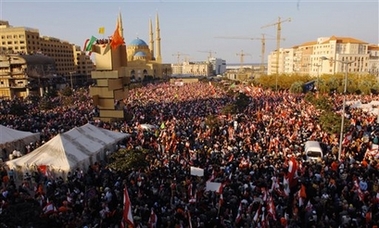
"The open sit-on called for by the Lebanese opposition continued for the second day Saturday in central Beirut, to press the unconstitutional government of the Fouad Saniora and his political bloc to quit. Thousands of people took part in the open sit-in at the Riyad El-Soloh Square, facing the Grand Serail, where Saniora and his political group are staying. The National Opposition vowed not to end the sit-in before the formation of a national unity government, a demand firmly refused by the so called majority.

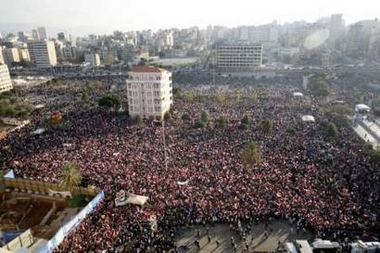
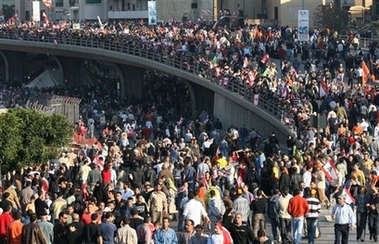
The follow-up committee of the Lebanese National Opposition said that the next couple of days would witness massive gatherings including speeches at the Riyad El-Soloh and the Martyrs Square. Hundreds of thousands of people swamped central Beirut on Friday in mass peaceful protests filling the two major squares in downtown Beirut and their peripheries. Each of two squares gathered on different occasions more than 1.5 million people, in what was later known as the March 8 and March 14 blocs.

The leader of the Parliamentary majority MP Saad Hariri vowed that "the Siniora government will not fall because of pressure from the street. However long they continue their protest, it will not fall." The determined opposition for it part vowed to stay until the government gives in, threatening to escalate their actions in the coming days. "

Saudis lead Israel peace bid


Times Online

"THE Saudi Arabian government is emerging as a key player in talks to broker a comprehensive Arab-Israeli peace agreement.
According to senior Israeli sources, Ehud Olmert, Israel’s prime minister, will soon meet high-ranking Saudi officials to explore the formation of a group of moderate Arab countries to negotiate with Tel Aviv over the future of the Middle East.

A preliminary meeting between Olmert and a leading Saudi representative took place in Amman, the Jordanian capital, at the end of September. According to Israeli sources, the Saudi was Prince Bandar bin Sultan, the former ambassador to Washington and one of the closest advisers to King Abdullah, the Saudi ruler.

Olmert is believed to be considering a Saudi initiative, endorsed by the Arab League four years ago, as the basis for a peace settlement.

This would include the establishment of an independent Palestinian state and could lead to a formal peace deal between Israel and seven Arab countries: Saudi Arabia, Bahrain, Qatar, Oman, the Emirates, Morocco and Tunisia.

Olmert promised the Palestinians their own state last week in a conciliatory speech that he was said to have written himself.

Condoleezza Rice, the American secretary of state, praised the speech and her officials welcomed it as a promising sign that “a regional peace dialogue may be resumed”.

However, an Israeli insider said: “The truth is that it was not Olmert’s own initiative but a dictate given to him last month when he met George W Bush and Condoleezza Rice in Washington.”

An Arab source said: “The Saudis wanted to see Olmert commit publicly to what he promised Prince Bandar at the secret meeting in Amman.”

According to Israeli officials, Saudi Arabia is gradually taking over the role of principal peace broker previously played by Egypt.

Saudi influence is seen as invaluable, particularly as the country has funded many Arab causes. Hamas, the militant group that won Palestinian elections last January, was established with Saudi money; and the Palestinian Authority would have collapsed long ago without Saudi funding.

Olmert, his reputation damaged by this summer’s war in Lebanon, is looking for a dramatic initiative to restore his image at home."

Corporate Media Uses Fuzzy Math to Minimize Size of Lebanese Demonstrations


By Kurt Nimmo

".......Siniora and the Arab version of “free traders” are unable to protect the Lebanese people from such vicious provocations, as they are more interested in selling the country wholesale to their bankster associates.

As Sami E. Baroudi writes, the “neoliberal ideology (or orthodox neoliberalism)” has a “great hold … over the minds and actions of the Lebanese political and economic elite,” part of a growing process throughout “the Arab world” where “one sees growing evidence of the rise to dominance of neoliberalism in inter alia: the yearning for open markets … the reduction in governmental social spending and the broadening of the tax base, the welcoming of advice and intervention from the World Bank, and the breaking of old alliances between regimes and labor in favor of new alliances with local and foreign entrepreneurs.”

In essence, this is what 800,000 people encamped outside the office-turned-residence of PM Fouad Siniora is all about, not the facile nonsense pedaled in American newspapers about nefarious Syrians and Iranians pulling the strings of Hezbollah.

Siniora will not be saved by his military or commiserating “German and British foreign ministers and calls of support from a host of Arab leaders and Western officials,” as Reuters puts it. “Although the dispute is political, many Lebanese fear the situation could spark sectarian violence. Tension between Sunnis and Shi’ites is high, in addition to bad feeling between Christians who support leaders allied to the rival camps.”

Obviously, this would be a preferable situation for the Israelis and neocons, who have managed to reduce Iraq to a bloody quagmire of sectarian violence and insanity, but such is not a foregone conclusion in Lebanon.

Hopefully, the Lebanese will get rid of their neoliberal beholden government and send a message to both Israel and the United States."


America courts 'thug' to stand up to Hamas
The Telegraph


European Union foreign policy chief Javier Solana (C) and Palestinian thug and warlord Mohammed Dahlan (R). (REUTERS photo)

Maliki's Monopoly of Power


By-Passing the Elected Iraqi Government

By RAED JARRAR
(the Iraq Project Director at Global Exchange and a member of the Steering Committee of United for Peace and Justice)

CounterPunch

"Thursday, President Bush announced that the U.S. army will "be in Iraq until the job is complete, at the request of a sovereign government elected by the people." I found this statement surprising, but apparently I was not the only one. After reading the Iraqi press and contacting a number of Iraqi members of parliament representing different Sunni, Shia, and secular groups, it became clear that no one from the Iraqi parliament was informed about Mr. Al-Maliki's plans to renew the mandate of multi-national forces in Iraq.

The UN Security Council voted unanimously to extend the mandate of the occupation force in Iraq on November 28th. The Council acted in response to a request from Iraqi Prime Minister Nouri al-Maliki in a letter he sent to the UN earlier this month. The US and the UK rushed the vote through the Council far in advance of the December 31 expiration of the mandate of the so-called "Multinational Force." The vote took place just one day after consultations were held, and the matter was not inscribed in the work program of the Council for this month.

According to Parliamentarian Dr. Jabir Habib (An Iraqi Shia close to the al-Sadr group), the Iraqi Assembly was scheduled to vote on this issue next week. "We spent the last months discussing the conditions we wanted to add to the mandate, and the majority of the Parliament decided on three major conditions," said Dr. Habib. "These conditions included pulling the coalition forces out of the cities and transferring responsibility for security to the Iraqi government, giving Iraqis the right to recruit, train, equip, and command the Iraqi security forces, and requiring that the UN mandate expire and be reviewed every 6 months instead of every 12 months." None of these conditions were included in the final document the UN unanimously voted on yesterday.

Mr. Hasan al-Shammari, a Shia Parliamentarian representing the al-Fadila party, said on Tuesday, "We had a closed session two days ago, and we were supposed to vote on the mandate in 10 days. I can not believe the mandate was just approved without our knowledge or input."

Dr. Hajim al-Hassani, a secular Sunni and former speaker of the Parliament, did not even know that the mandate had been renewed. "If this is true, it is breaking the agreements we had with al-Maliki," he said. Mr. al-Hassani added "We were supposed to have a meeting with the Prime Minister and other top officials in the Parliament during the next couple of weeks to decide what to do with the mandate." Mr. Saleh al-Mutlaq, a secular Parliamentarian, was also shocked. "This is totally unexpected. It is another example of the Prime Minister dismissing the views of the parliament and monopolizing all power". Finally, Dr. Alaa Makki, a Sunni MP, requested that I send him a copy of the UN resolution and Al-Maliki's letter since he too was unaware of these unilateral and swift actions at the UN.

According to most of the parliamentarians, it is unconstitutional for the Prime Minister to ask for a renewal of the UN mandate without consulting the Iraqi Parliament. Even this Iraqi government that was elected by the Iraqi people under the occupation is being by-passed by Mr. Al-Maliki. Even this government that is usually described as a "puppet government" is not justifying the illegal presence of the occupation troops anymore. The Bush administration does not seem to have any support outside the small circle of Al-Maliki and a handful of his assistants. The demand of the majority of the Iraqi people and parliamentarians to set a timetable for ending the foreign occupation is being ignored by both Bush and Al-Maliki. The Iraqi prime minister is very clearly just another dictator who is ready to destroy his country and oppress his own people to stay in power."

COMING TO THE AID OF THEIR PUPPET


Solana: Hamas missed opportunity for forming PA unity gov't

"EU foreign policy chief Javier Solana said the collapse of unity government talks killed hopes of ending the international economic sanctions on the Palestinian government and said Hamas missed its opportunity.

"Very sadly, I have to say the chance has been lost," he told reporters after meeting with Palestinian Authority Chairman Mahmoud Abbas.

"Some conditions have to be met in order to have full cooperation with the international community and the president (Abbas) has made tremendous efforts ... It has been impossible for the moment to get these conditions accepted (by the Hamas government) and therefore the situation (sanctions) will continue, but everybody has to know who is responsible ... It is not the president," Solana said, referring to Abbas."

***

PLAIN ENGLISH TRANSLATION OF WHAT SOLANA SAID:

"The E.U. has no guts and is totally dominated by the U.S. and Israel; therefore it has accepted the Usraeli conditions which our puppet Abbas has also accepted. These conditions include the acceptance of the Palestinians of the Israeli annexation of Jerusalem and more than half of the West Bank. In addition, the Palestinian refugees have to abandon their right to return to their homes, villages and cities. This nice man, Abbas, has accepted, but the bad people of Hamas are still demanding the rights of their people."

Abu Marzouk: Lifting blockade should not mean ceding rights


"Damascus - Dr. Mousa Abu Marzouk, the deputy chairman of the Hamas political bureau, on Saturday said that Palestinians should not surrender national rights and constants in return for lifting the "oppressive" economic and political blockade imposed on them.

Abu Marzouk, speaking to the PIC, opined that the only way out of the current political crisis was to continue national dialogue away from foreign pressures.

"We should not allow foreign dictates to influence our national options, our future and our people's rights," he elaborated.

Affirming that dialogue among various parliamentary blocs and officials in the Palestinian arena should continue towards the formation of a national unity government, he said that ending such dialogue meant that each party would boycott the other, "which is a very serious situation and a regrettable outcome".

He charged that new conditions tabled by PA chief Mahmoud Abbas had impeded the progress of national dialogue, affirming that the Hamas Movement voiced positive stands during that dialogue.

Meanwhile, Hebrew media predicted that a meeting would be soon held between Abbas and Israeli premier Ehud Barak after the former declared failure of the national dialogue during a joint press conference with visiting American secretary of state Condoleezza Rice in Jericho on Thursday evening.

The Israeli press further pointed out that the EU foreign policy coordinator, Javier Solana, was seeking to prepare for such a meeting. It said that Solana already met with Abbas on Saturday and is expected to meet with Olmert on Sunday. "

CURRENT AL-JAZEERA (Arabic) ONLINE POLL


Killed by U.S. Occupation Forces In Ramadi Last Wednesday
Five Girls Ranging in Age From 6 Months to 10 Years


This poll is really interesting since it shows that in spite of American efforts to show the situation in Iraq as a sectarian "civil war," the wider Arab public does not share this view. The poll comes just a couple of days after Saudi Arabia hinted loudly that it will interfere in Iraq to "save Sunnis." Keep in mind that most Arab Muslims are Sunni (about 85 %.)

The question is:

Do you support Saudi Arabia interferring in Iraq?

With more than 2,000 responding so far, here are the results:

Yes-------42.6%

No--------57.4%

عباس يُعلن فشل الحوار الفلسطيني

عباس يُعلن فشل الحوار الفلسطيني ويستأنف المشاورات مع الصهاينة

"الناصرة - المركز الفلسطيني للإعلام

توقعت مصادر إعلامية عبرية عقد لقاء قريب بين إيهود أولمرت رئيس الوزراء الصهيوني ومحمود عباس رئيس السلطة الفلسطينية، وذلك في الوقت الذي أعلن فيه الأخير الخميس الفائت عن فشل الحوار الفلسطيني - الفلسطيني في التوصل إلى تشكيل حكومة وحدة وطنية ووقف الاتصالات مع حركة "حماس".

وذُكر أن خافيير سولانا منسق السياسة الخارجية بالاتحاد الأوروبي‏،‏ الذي يزور الأراضي الفلسطينية حالياً‏، يسعى جاهداً لعقد لقاء مشترك بين عباس وأولمرت، مستغلاً التهدئة.

ونقلت صحيفة "جيروزاليم بوست" الصهيونية الناطقة باللغة الإنجليزية، عن مصدر مقرب من سولانا قوله: "إن سولانا بدأ مباحثاته مع عباس، اليوم السبت، ثم سيلتقي أولمرت في اليوم التالي‏"، مشيراً إلى أن زيارة سولانا تهدف‏ للمساعدة في إتمام صفقة تبادل الأسرى، بالإفراج عن الجندي الصهيوني الأسير في غزة، مقابل إطلاق سراح معتقلين فلسطينيين، إلى جانب ما يسمى "بناء الثقة" بين الفلسطينيين والصهاينة‏.‏

وكان محمود عباس قد أبدى استعداده التام لعقد لقاء قمة مع إيهود أولمرت في أي وقت، بالرغم من المجازر التي ارتكبها الأخير ضد الشعب الفلسطيني خلال الشهر الماضي (تشرين ثاني/ نوفمبر)، والتي ارتقى فيها أكثر من 140 شهيداً وأوقعت مئات الجرحى في شمال قطاع غزة. "

THE LEBANESE HAVE SPOKEN; WILL THE PUPPET SINIORA LISTEN?


Mass Demonstrations against the US backed Lebanese Government


by Michel Chossudovsky
Global Research

"The Western media, which often downplays the size of public rallies and anti-war demonstrations, confirms that "hundreds of thousands" of people from all sectors of Lebanese society gathered in Beirut in anti-government demonstrations, demanding the resignation of the US-Israeli supported government of Prime Minister Fouad Siniora.

The Beirut government is taking orders directly from the US embassy. The Siniora government has allowed the deployment of NATO forces on Lebanese territory under the pretext of a UN sponsored peace-keeping operation. NATO warships under German command are stationed off the country's Eastern Mediterranean coastline. NATO has a military cooperation agreement with Israel.

The banners read "Down with Feltman's government," in reference to US ambassador Jeffrey Feltman:

"We want a national unity government,"

"We want a clean government" (quoted in The Hindu, 1 December 2006)

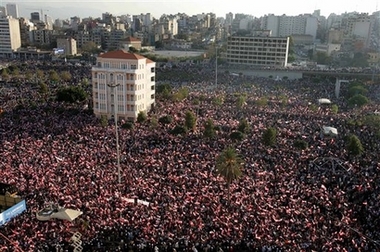
Police source estimated the crowd at 800,000 people, almost half the population of the Beirut metropolitan area. Organizers said it was much larger. (Associated Press).
The significance of the rally has been casually dismissed. According to the BBC, it was organized by Hezbollah and its so-called "pro-Syrian allies".

The rally had little to do with Syria. It demanded the resignation of an illegal government, which supports the interests of US and Israel.

Among the allegedly "pro-Syrian" protagonists of these mass demonstrations was Michel Aoun, a staunch opponent of Damascus who led the insurrection against Syrian military presence in the late 1980s and early 1990s.

All sectors of Lebanese society are demanding the resignation of the government. A majority of the Christian Maronite community is firmly behind the protest movement: "I call on the prime minister and his ministers to resign" said Michel Aoun:

"I wish that the prime minister and his ministers were among us today, not hiding behind barbed wire and army armored carriers. He who has his people behind him does not need barbed wire,"

Emile Lahoud, the country's president, has also confirmed in that the Siniora government has violated the country's constitution: "This government is no longer legal because it is not representative of all the country's religions,'' he said, following the resignation of five cabinet ministers from Hezbollah, Amal as well as one Christian loyal to President Emile Lahoud.

"Hezbollah's deputy general security, Sheik Naim Kassim, made it clear the fight is against 'American tutelage' and said the protest action will continue until the government falls. 'We will not let you sell Lebanon, we will protect the constitution and people of Lebanon,' Kassim said on television Friday, addressing Saniora." (Daily Star, 1 December 2006)

Meanwhile, President George W. Bush warned that "Iran and Syria were trying to destabilize Lebanon". US Ambassador to the United Nations John Bolton described the anti-government demonstrations as "part of the Iran-Syria inspired coup d'etat."

Christians, Shiites and Sunni have joined hands.

Washington's objective is to transform Lebanon into a US protectorate. The Lebanese people are demanding the resignation of a government which is acting on behalf of the US and the Israeli invaders of their country. They are demanding the formation of a national unity government which will defend the Lebanese homeland against US-Israeli aggression. "

The Bush Disaster Diplomacy: Middle East Meltdown

By Mike Whitney

".......In an article which appeared on Monday in the Washington Post, Saudi Arabia’s ambassador to the US, Turki al-Faisal said, “Since America came into Iraq uninvited, it should not leave uninvited’. If it does, one of the first consequences will be massive Saudi intervention to stop Iranian-backed militias from butchering Iraqi Sunnis.”

It is likely that Sunnis in the other Middle East capitals share al-Faisal’s sentiments and will be equally willing to contribute generously to their “brothers-in-arms” in Iraq.

The invasion has opened Pandora’s Box and disrupted the regional balance of power. Now there’s no telling how far the war will spread. The ferocity of the sectarian fighting suggests that a much larger conflagration is on the way. Foreign leaders are already preparing for the worst. Bush’s misguided fantasies of “Victory” in Iraq have lit a powderkeg and it's probably just a matter of time before the entire Middle East is consumed by war. "


The Banner Reads: We Will Not Withdraw From Iraq.

Friday, December 01, 2006

SECTARIANISM 101: HOW TO DIVIDE AND CONQUER BY CONDOLEEZZA RICE

West helps Lebanon build militia to fight Hezbollah

"BEIRUT -- With Western help and support from Persian Gulf states, the Lebanese government has been quietly building up a loyal force dominated by Sunni Muslims and Maronite Christians in anticipation of a possible showdown with the Shia Hezbollah militia and other pro-Syrian and pro-Iranian forces.

A senior minister in Prime Minister Fouad Siniora's cabinet told The Globe and Mail that the pro-Western government has moved about 8,000 extra soldiers into the capital in the past few days in an effort to block an expected coup attempt by Hezbollah and its allies, which are planning mass anti-government demonstrations in central Beirut today.

But the buildup began 17 months ago, soon after the pro-Western peaceful Cedar Revolution that swept Mr. Siniora into office, the minister acknowledged. The government's stability may depend on the behaviour of a separate Western-backed force of 24,000 men that was dramatically strengthened to defend the government from just such a challenge.

Syria and Iran have long poured money and weapons into Lebanese groups, primarily Hezbollah. But since Mr. Siniora and his allies took office in 2005, the United States, France and several Sunni Arab countries have set about trying to create a counterbalancing force.

Critics charge that the force is dominated by Sunnis, and that its real purpose is to defend the government of Mr. Siniora, a Sunni, against the growing power of the country's large Shia population. Most of the country's Sunnis back the pro-Western government, while most Shiites support Hezbollah. The country's Christians are split.

Since the Syrian army's departure from Lebanon in early 2005, the United States and France have been providing money and training to the Internal Security Forces, as the light-blue-uniformed police force is known. With the political situation souring further in recent weeks, the United Arab Emirates stepped in to provide the unit with an emergency "gift" of thousands of rifles and dozens of police vehicles.

The UAE and other Sunni Arab states are concerned about Iran's widening influence in the region, cabinet minister Ahmad Fatfat said in an interview, adding that the ISF has received intelligence help from Saudi Arabia, Egypt and Kuwait. Iran is Hezbollah's primary backer.

"In Lebanon, it seems we are an arena between Syria and Israel, but there's a new role for Iran. [Ayatollah Ali] Khamenei spoke of this clearly," Mr. Fatfat said, referring to recent comments in which Iran's supreme leader said Lebanon would be the battleground on which "America and the Zionists" would be defeated.

Today, the ISF will be responsible for defending the Prime Minister's office, known as the Grand Serail, from demonstrators expected to pour into the adjacent Riad al-Sohl square. The backbone will be a smaller special-forces unit of 325 crack troops known as the Panthers, identifiable by their dark blue uniforms and modern weaponry.

With the regular Lebanese army seen as unreliable in a crisis -- it fractured along sectarian lines during the civil war -- Mr. Siniora's government and its foreign backers have invested heavily in the ISF.

The United States, which sees Mr. Siniora's government as a flagship for its "new Middle East," gave $1.5-million (U.S.) in "rushed" military assistance to the ISF just before the outbreak of the summer war between Israel and Hezbollah, and the Federal Bureau of Investigation has provided training. Washington promised millions more, but it's unclear whether it was ever delivered.

The ISF has also set up a separate $30-million intelligence-gathering apparatus -- in a country that already had three other such services -- because the other forces were seen as dominated by Christians and Shiites and infiltrated by Syria. Observers say the ISF's intelligence unit is widely reviled by suspicious Christians and Shiites.

"There is no trust of the police here. The police are seen as a Sunni-dominated sectarian force," said Timur Goksel, a professor of public administration at the American University in Beirut.

According to Amin Hteit, a military analyst and retired Lebanese army general, the ISF was a secondary force of about 12,000 men, compared with 63,000 in the regular army, before the Syrian withdrawal. Reflecting the generally accepted population breakdown, a third of its members were Shiites.

The ISF has since doubled in number, with Sunnis and Christians making up most of the new troops. According to Gen. Hteit, just 1,000 of the 12,000 additions are Shiites.

Gen. Hteit, a Shiite who keeps a framed picture in his home of himself with pro-Syrian President Emile Lahoud, said the force was built up and its Shia representation lessened in order "to keep the government far from popular danger. They need a force to defend the government palace."

Meanwhile, he said, the army has shrunk to 40,000 men, 15,000 of whom are now policing the south of the country, a term of the ceasefire between Hezbollah and Israel.

The ISF is already deeply resented among those who plan to march on the centre of Beirut today. In October, riots were sparked after two children were killed and 12 people were injured when ISF members opened fire on a demonstration in a Shia neighbourhood.

Sayyidah Ali Naji, whose 11-year-old son Mohammed died after being shot twice in the head during those demonstrations, said she will be protesting today. "We expect anything from [the ISF]," she said. "But we are not afraid.""

MORE PHOTOS OF THE HISTORIC LEBANESE PROTESTS


Thanks Rabee for the Link; a lot more, high-quality photos, just by clicking Here .

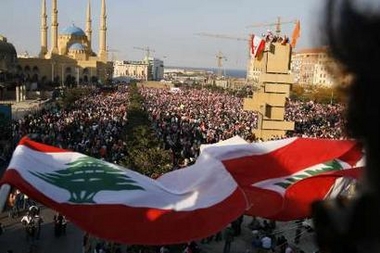
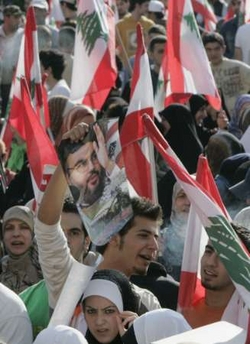
What is very noticeable is that this massive rally is not organized as a Hizbullah rally. You hardly see any Hizbullah flags; they are mostly Lebanese flags. You have to hand it to Hizbullah; they are smart, organized and hard working. Maybe one day the Palestinians will learn a little from them. Way to go!

I like the bottom photo, in particular.

THIS COUP WILL NOT BE TELEVISED

PLO Executive Committee calls on Haniyeh to resign as PM

"The Palestine Liberation Organization Executive Committee on Friday called on Palestinian Prime Minister Ismail Haniyeh of Hamas to resign due to stalled talks on the formation of a Palestinian unity government.

"The executive committee asks Haniyeh to resign to pave the way for the formation of a new government," committee member Samir Ghosheh told Reuters.

Abbas announced at a press conference with U.S. Secretary of State Condoleezza Rice on Thursday that the talks with Hamas on the establishment of a government of national unity have reached a "dead end."

Abbas told top PLO officials during a special session in Ramallah on Friday that Hamas was to blame for the talks' failure. "[Chairman] Abbas stressed that there would be no dialogue with Hamas," said Tayseer Khaled, a member of the PLO's executive committee. "He said the dialogue ended and that Hamas bears the responsibility for the failure of the talks.""

ONE OF LATUFF'S LATEST CARTOONS


(Click on cartoon to enlarge)


FACING WASHINGTON, D.C., AND PRAYING TO GEORGE W. BUSH

Beirut's unprecedented gathering; hundreds of thousands of Lebanese demand Saniora government steps down


Al-Manar

"Hundreds of thousands of Lebanese citizens flocked into central Beirut from the early hours of Friday morning to answer the call by the National Opposition to take to the streets to demand shaping up the rule in Lebanon. The Riyad el Soloh Square is full, The Martyrs' Square is also full, Beirut is literarily engulfed by protesters, and the demonstrators who are yet to come from South Lebanon, Mount Lebanon, Northern Lebanon, Baalbek, Bekaa and Western Bekaa region will eventually gather on the peripheries of the two squares. The demonstration and the open sit-in officially kicks off at 3:00 pm Beirut time (1300 GMT). Lebanese Army and police fanned out in Beirut hours before the protest. The demonstrations will be followed by a sit-in that would only end when PM Fouad Saniora's unconstitutional government steps down. Brandishing Lebanese flags the masses held white banners reading "We want a clean government" and "National unity." "Out, out Saniora" protesters shouted after catching a glimpse of the premier on the balcony. "We have had enough ordeals and tears," protesters chanted. "Saniora, out! We want a free government. We want a government that will feed our hunger." The head of the Free Patriotic Movement MP General Michel Aoun addressed the crowd saying: "Saniora has "made many mistakes" and his government has "made corruption a daily affair." He called on the people to "continue the sit-in until we reach our goals" of installing a new unity government. Bankets, food, medical supplies and electrical generators were being distributed for the sit-in, and after Aoun's speech white tents were being set up on two streets leading to Saniora's office as thousands of protesters were expected to stay. National Lebanese Opposition powers are demanding the establishment of a national unity government, a new electoral law and a fair participation in the government. But Saniora vowed his government would not fall, saying in a televised speech Thursday night that "Lebanon's independence is threatened and its democratic system is in danger." Hezbollah Deputy Secretary General Sheikh Naim Kassem said the protests would not end until Saniora's government leaves. "This government will not take Lebanon to the abyss. We have several steps to take if this government did not respond, but I tell them you will not be able to rule Lebanon with an American administration." The decision to take to the streets Friday was postponed due to last week’s assassination of Lebanon’s Industry Minister Pierre Gemayel. The opposition assured that the move will be peaceful and stressed the preservation of public and private properties is a must. Lebanese army Chief General Michel Suleiman called Wednesday on army troops to "stand ready" to maintain public order and protect freedom of expression without taking sides. The opposition has branded the government of Saniora a US puppet. The opposition accuses the majority in cabinet of monopolizing power and says protests has become their only option, after all talks and negotiations have been foiled by the ruling bloc."

اكبر من ان يحصى او تحصره الكاميرا ?!!


Siniora Is Getting Hot Under The Collar

From Al-Manar

" ومما جاء في الشعارات : "يا سنيورة طلاع برا .. بدنا حكومة حكومة حرة حرة"، "شبعنا كذب شبعنا دموع.. بدنا حكومة تسد الجوع" و"يا سنيورة اسماع قشاع ... بدنا حكومة ما بتنباع". "يا بيروت الابية .. نحن رجال الحرية" ، "الوصاية الاميركية كذبة ما بدنا هي"، "نحن شعب الانتصار.. ما منرضى بالاستعمار".

***

Some of the slogans chanted in the unprecedented mass rally in Beirut:

The slogans rhyme in Arabic.

- Siniora get out, we want a government of the free.

- We are fed up with lies AND TEARS; we want a government that ends hunger.

- Siniora get out, we want a government that is not for sale.

- Oh proud Beirut, we are the men for freedom.

- American guardianship we don't want.

- We are the victorious people; we will not accept new colonialism.


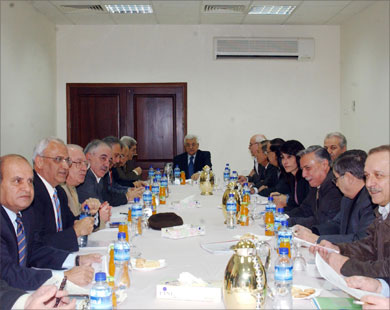
THE ONE WHO REALLY CHAIRED THE MEETING OF THE FORTY THIEVES
OF THE PLO "EXECUTIVE COMMITTEE"


ABBAS AND THE FORTY THIEVES OF THE PLO


A general view of Lebanese Hezbollah supporters waving Lebanese flags during a demonstration to force the resignation of Western-backed Prime Minister Fuad Saniora, in Beirut, Lebanon Friday, Dec. 1, 2006. Hundreds of thousands protesters from Hezbollah and its pro-Syrian allies descended on downtown Beirut on Friday in a peaceful but noisy protest to force the resignation of U.S.-backed Prime Minister Fuad Saniora, who was holed up in his office ringed by hundreds of police and combat troops.(AP Photo)


A sea of flag-waving protesters demanded on Friday the resignation of Lebanon's Western-backed government at a Hezbollah-led rally. (REUTERS)

The Bush-Maliki Summit and the New Middle East Cold War

By Juan Cole

"Al-Hayat writing in Arabic sums up the results of the Bush-Maliki Summit:

1. The US and its Arab allies rejected the notion of making any concessions to Iran in return for Tehran's help in calming the situation in Iraq.

2. The al-Maliki government would be given "another chance" to crack down on Shiite militias such as the Mahdi Army and would be given greater freedom of movement in confronting them militarily.

In other words, Bush is trying to set al-Maliki up for a confrontation with the Sadr Movement and is trying to keep the Shiite-dominated government in Baghdad from too openly embracing Iran. (That cow is already out of the barn, of course).

Al-Hayat sees the influence of Arab allies of the US on Bush's policy as decisive. It says that informed sources in Amman report that the Arab diplomats warned Bush against giving Iran nuclear privileges and against giving Syria "Lebanese" privileges, in return for their help in Iraq. These Arab countries likely include Saudi Arabia, Jordan, Kuwait and Egypt. That is, there is a new Middle Eastern Cold War between the pro-Western Arab states (Riyadh-Amman-Cairo-Kuwait City) and the Tehran-Damascus axis. The pro-Western Arabs fear the Iranian nuclear program, and they generally support Saad Hariri, Fouad Seniora, and the 14 March Movement in Lebanon against Hizbullah, which is backed by Syria and Iran.

This Middle Eastern Cold War is pushing Washington, allied with the Arab conservatives, into a contradictory stance in Iraq, having installed a Shiite, pro-Iranian government there but remaining unable to work with this new reality on a geopolitical level. The Middle Eastern Cold War pitting the Saudis and Egyptians against the Iranians and Syrians is reinforced by Washington's other major ally in the region, Israel, which also wants to contain or roll back Syria and Iran. As is often the case, despite their rhetoric of seeming enmity, the pro-Western Arab regimes and the Israelis have not so dissimilar geopolitical aims in the region, with the disposition of the Palestine Authority really the only major dispute between them. Iraq is caught in the middle of this new Cold War and seems likely to be the major victim of it.

If Bush gets his way, we could see substantial Shiite on Shiite violence in the coming months, of which it is likely the Sunni Arab guerrilla movement will take advantage.

The Sadr Movement representatives in parliament and on the Iraqi cabinet announced that the setting of a timetable for US military withdrawal from Iraq is the minimum condition for their return to al-Maliki's coalition. They also said that they would work toward the creation of a parliamentary front that would demand a US withdrawal. Over 100 out of 275 members of parliament have already voted for the US to set a timetable and leave, but rather than let the whole parliament vote a resolution, the al-Maliki government sent the issue to committee, from which it may never emerge or not for months."

Neo-conservatism at the Vatican? Kissinger to become Political Adviser to Pope Benedict XVI

Pope Benedict XVI has invited Henry Kissinger, former adviser to Richard Nixon, to be a political consultant and he accepted.

BY EDWARD PENTIN
National Catholic Register Correspondent

"VATICAN CITY — Over the course of his long and controversial career, former U.S. Secretary of State Henry Kissinger has had many titles. Now he reportedly has one more — adviser to the Pope.

According to the Italian newspaper La Stampa, Pope Benedict XVI has invited the 83-year-old former adviser to Richard Nixon to be a political consultant, and Kissinger has accepted.

Quoting an “authoritative” diplomatic source at the Holy See, the paper reported Nov. 4 that the Nobel laureate was asked at a recent private audience with the Holy Father to form part of a papal “advisory board” on foreign and political affairs.

As the Register went to press, Kissinger’s office was unable to confirm or deny the report. La Stampa stood by its story, although the Italian press is less rigorous in its authentication of stories as is the United States Press.

If true, there is speculation on which issues Kissinger would advise the Holy Father. Relations with Islam, Palestine and Israel, and Iraq — Kissinger has been critical of the conduct of the war but opposes a quick withdrawal — are likely to be high up on the agenda.

It has also been speculated that, in view of the Muslim hostility to Benedict’s recent Regensburg speech, Kissinger might provide advice on dealing with an increasingly fractious Islamic world.

Furthermore, like the Pope, Kissinger has analyzed the challenges of globalization and might provide advice in this area as well.

....Continues "

Never Heard of al-CIA-duh Group Threatens Banksters


By Kurt Nimmo

"Once again, an “al-Qaeda” affiliate nobody has ever heard of, and will never hear from again, is threatening damnation and ruin.

“The U.S. government warned American private financial services on Thursday of an al Qaeda call for a cyber attack against online stock trading and banking Web sites beginning on Friday, a source said,” Reuters reports. “The source, a person familiar with the warning, said the Islamic militant group aimed to penetrate and destroy the databases of the U.S. financial sites.”

No doubt this will be accomplished from caves with fiber optic cables or maybe from the high-tech boondocks of South Waziristan.

Of course, this is simply more propaganda designed to convince the bovine masses that the internet poses a threat, as the neocon Newt Gingrich declared the other day, and serious measures will need be taken, that is if we value our safety over our liberty. Never mind what Ben Franklin allegedly said on this subject.

.... Continues"

Iraq Mission Accomplished: They're Not Fighting Us Anymore, They're Fighting Each Other

As chaos reaches all time high coalition prepares to scale back occupation and march onwards to Syria and Iran

by Steve Watson
Global Research, December 1, 2006

"Death tolls in Iraq are hitting all time highs and the worst cases of sectarian violence of the entire war are rampant throughout the country. Amid the chaos, the government has declared that everything is going well enough in Iraq for forces to be withdrawn. This statement is accurate, the strategy has always been one of dissolution and destabilization. We are not "cutting and running" because the mission has been accomplished.

The machinations of the Machiavellian's are unfolding according to plan. Let Iraq cascade into chaos and dilute the insurgency by manipulating it to become fractious and watch in-fighting ensue. Top analysts in the CIA and State Department, as well as large numbers of Middle East experts, warned that a U.S. invasion of Iraq could result in a violent ethnic and sectarian conflict.

Stephen Zunes, professor of Politics and chair of the Peace & Justice Studies Program at the University of San Francisco, recently wrote,

"One of the long-standing goals of neoconservative intellectuals has been to see the Middle East broken up into smaller ethnic or sectarian mini-states, which would include not only large stateless nationalities like the Kurds, but Maronite Christians, Druze, Arab Shi'ites, and others. Such a policy comes not out of respect for the right of self-determination – indeed, the neocons have been steadfast opponents of the Palestinians' desire for statehood, even alongside a secure Israel – but out of an imperial quest for divide-and-rule. The division of the Middle East has long been seen as a means of countering the threat of pan-Arab nationalism and, more recently, pan-Islamist movements."

Of course it is, because the Zionist agenda has always been to divide and conquer the middle East. After many previous attempts, it's mission accomplished in Iraq now thanks to the neocons, that is why we have already seen a shift towards fomenting trouble in Syria with the decimation of Lebanon.

Israeli policy documents have always stated that it would be beneficial to the overall strategy to engender strife in the middle east. In 1982, Oded Yinon, an official from the Israeli Foreign Affairs office, wrote: "To dissolve Iraq is even more important for us than dissolving Syria. In the short term, it's Iraqi power that constitutes the greatest threat to Israel. The Iran-Iraq war tore Iraq apart and provoked its downfall. All manner of inter-Arab conflict help us and accelerate our goal of breaking up Iraq into small, diverse pieces."

That agenda was again underscored recently when Daniel Pipes, a highly influential Straussian Neo-Con media darling, told the New York Sun that a civil war would aid the US and Israel because it would entangle Iran and Syria and enable those countries to be picked off by the new world empire without the need to sell a direct invasion to the public.

A host of analysts and political experts agree that 2007 will see the bombing of nuclear facilities in Iran, with or without the approval of the US Congress. This is not surprising given that we have recently seen a spate of neoconservative and Israeli calls for the bombing to begin......"

Deep inside the 'kingdom of heaven'


By Syed Saleem Shahzad
Asia Times

Editor's note: Syed Saleem Shahzad returned to Karachi on Wednesday after being held for six days in the captivity of the Taliban in Afghanistan. Along with fellow journalist Qamar Yousufzai, Shahzad was detained on November 21 after entering the Baghran district of the southern province of Helmand. They were accused of being spies and of not having the Taliban's permission to be in the area.

"KARACHI - When the Taliban came to power in 1996 they promised to establish a kingdom of heaven, with its center based in the rugged southwest of Afghanistan. The people were promised showers of blessings from the skies, and the earth would give up unlimited treasures.

The Taliban were welcomed, but in the five years until their ouster by US-led forces in 2001, the land remained barren and the heavens silent. The Taliban did, however, deliver peace - probably the most precious gift of all.

Then came the Americans, and they pledged a paradise on Earth. The dirt-poor tribespeople of the southwest voted unanimously to give this a chance, and they handed the defeated Taliban an ultimatum: "Be good sons of the soil and surrender your guns, or go to the mountains." The Taliban headed for the hills, and their insurgency was born.

Now, once again after a five-year cycle, the wheel has turned and the Taliban have been asked to come down from the mountains and re-establish themselves among the people of the southwest.

This has been a pivotal development, as it gives the Taliban a friendly environment from which to launch the first phase in their ultimate goal of retaking first Kandahar, and then the capital Kabul.
.........continues "

Like Hitler and Brezhnev, Bush is in denial

By Robert Fisk
The Independent


"More than half a million deaths, an army trapped in the largest military debacle since Vietnam, a Middle East policy already buried in the sands of Mesopotamia - and still George W Bush is in denial. How does he do it? How does he persuade himself - as he apparently did in Amman yesterday - that the United States will stay in Iraq "until the job is complete"? The "job" - Washington's project to reshape the Middle East in its own and Israel's image - is long dead, its very neoconservative originators disavowing their hopeless political aims and blaming Bush, along with the Iraqis of course, for their disaster.

History's "deniers" are many - and all subject to the same folly: faced with overwhelming evidence of catastrophe, they take refuge in fantasy, dismissing evidence of collapse as a symptom of some short-term setback, clinging to the idea that as long as their generals promise victory - or because they have themselves so often promised victory - that fate will be kind. George W Bush - or Lord Blair of Kut al-Amara for that matter - need not feel alone. The Middle East has produced these fantasists by the bucketful over past decades.......

....Iraqi Prime Minister Nouri al-Maliki, almost as loyal a retainer to Bush as Sahaf was to Saddam, receives the same false praise from the American president that Nasser and Brezhnev once lavished upon their generals. "I appreciate the courage you show during these difficult times as you lead your country," Bush tells Maliki. "He's the right guy for Iraq," he tells us. And the Iraqi Prime Minister who hides in the US-fortified "Green Zone" - was ever a crusader fortress so aptly named? - announces that "there is no problem". Power must be more quickly transferred to Maliki, we were informed yesterday. Why? Because that will save Iraq? Or because this will allow America to claim, as it did when it decided to allow the South Vietnamese army to fight on its own against Hanoi, that Washington is not to blame for the debacle that follows? "One of his frustrations with me is that he believes that we've been slow about giving him the tools necessary to protect the Iraqi people." Or so Bush says. "He doesn't have the capacity to respond. So we want to accelerate that capacity." But how can Maliki have any "capacity" at all when he rules only a few square miles of central Baghdad and a clutch of rotting ex-Baathist palaces?

There can be no graceful exit from Iraq, only a terrifying, bloody collapse of military power. The withdrawal of Shia ministers from Maliki's cabinet mirror the withdrawal of Shia ministers from another American-supported administration in Beirut - where the Lebanese fear an equally appalling conflict over which Washington has, in reality, no military or political control.....

...No, Bush is not Hitler. Like Blair, he once thought he was Winston Churchill, a man who never - ever - lied to his people about Britain's defeats in war. But fantasy knows no bounds."

Thursday, November 30, 2006


BIRZEIT STUDENTS AND LECTURERS CALL FOR ACADEMIC BOYCOTT

Over one thousand Birzeit University students and over 110 of its faculty members signed an open letter in support of the international boycott of Israeli academic institutions. The signatures were collected by the Right to Education Student Committee in the shape of a letter [full text below] thanking the 61 Irish academics who called for a moratorium on EU aid to Israeli universities until Israel abides by international humanitarian and human rights laws. The Committee calls on student groups all over Palestine to take similar action and for students abroad to support Palestinian students by doing the same.

Israeli academia has failed to denounce the illegal occupation, racist policies and war crimes committed in their name by the Israeli state, despite their position of influence and moral obligation to do so.

Moreover, the Israeli occupation stifles the development of Palestinian education through arbitrary checkpoints, arrests, detentions and deportations. Palestinians face ongoing Israeli attacks on their educational institutions and there is a growing clampdown in the occupied West Bank and Gaza Strip. This includes the arbitrary detention of students, the prohibition of Gazans from studying in the West Bank, the harassment of foreign students entering Gaza and the West Bank and the increasing difficulties facing ordinary academic exchange between Palestinians and the outside world.

While the world remains silent in the face of the massacres in Gaza and the colonisation and segregation of the West Bank, the academic boycott is an effective way for the international community to oppose Israeli policy both from the outside and within, by pressuring Israeli academia to take action against their state’s policies of apartheid and unconditional violence against the Palestinian population.

******************************************************

Open letter in support of Irish academics,

We, the undersigned, members of the Birzeit University’s community of students, teachers, faculty staff and employees, congratulate and thank the group of Irish academics who called for a moratorium on the European Union’s financing of Israeli academic institutions until Israel withdraws from the occupied Palestinian territories and abides by international humanitarian and human rights laws, including the right of return.

The recent attacks and re-invasion of Gaza and Lebanon expose the contempt with which Israel treats the UN, its resolution and its own bilateral agreements. We strongly condemn the death, chaos and destruction inflicted upon Gazans and Lebanese, and call upon the students, academics and staff of universities worldwide to collectively condemn these acts and take action to support us in our struggle to end Israeli military aggression and occupation.

The objective of such military force is to control and subjugate Palestinian society in order to sustain Israel's Jewish demographic supremacy and enforce its unilaterally declared boundaries. As a result, Israel has built an apartheid system of controlling the Palestinian population both inside Israel and under the occupied territories. Economically, the occupied territories served as cheap-labour reserves until the building of the Wall, now it serves to make daily life unbearable so that Palestinians decide to leave, continuing the ‘silent transfer’ of the indigenous population. The Israeli civil and military bureaucracy also obstructs the development of an independent Palestinian economy through its control of borders, immigration, collection of taxes and restriction on movement inside the territories. Racially, Palestinians in Israel are consistently denied equal access to social services, housing and education, and since 2005, denied equal rights to family. In Jerusalem and the occupied territories, Palestinians are segregated by different permits based on their residency at the time of issue, and each ‘category’ is granted different freedoms of movement – at the bottom of this structure are Gaza permit-holders, who cannot move from Gaza to the West Bank, nor inside the West Bank itself. This system of control is parallel to the racial hierarchy and control during Apartheid South Africa.

Israeli academic institutions have close links with the state, and the vast majority of Israeli intellectuals and academics either contribute directly to the Israeli occupation through research that justifies or improves the mechanisms of Israeli apartheid, or are complicit through their silence about it. As Shahid Alam, Professor of Economics at North-eastern University in Boston, has pointed out, "through their links with the military, the political parties, the media, and the economy, they (Israel's universities) have helped to construct, sustain, and justify the Apartheid (policies of the occupation).”

We therefore urge international civil society and the academic community to join our call to comprehensively boycott Israeli academics who contribute or refuse to stand up against the occupation, until: Israel withdraws its military from the occupied territories, including East Jerusalem; removes all its colonies in those lands and agrees to United Nations resolutions relevant to the restitution of Palestinian refugees rights.

Yours faithfully,

1,015 students of Birzeit University, and:

1. Zeyad Munawer, Accounting
2. Dr Abdul Karim Abu-Khashan, Arabic
3. Ahmad Daoud, Arabic
4. Dr. Ibrahim Musa, Arabic
5. Khitam Salman, Arabic
6. Dr Ghadir Kharoubi, Arabic
7. Dr Mahmoud Alatchan, Arabic
8. Salahaldin Alshakhshir, Architectural Engineering
9. Dr Salem Thawaba, Architectural Engineering
10. Dr Ademar Ezzughayar, Biology
11. Jamil Abu Sada, Biology
12. Dr Munir Qazzaz, Biology
13. Dr. Tamer Essawi, Biology
14. Dr. Ahed Abdul Khaliq, Biology and Biochemistry
15. Omar Yaseen, Business Administration
16. Dr. Grace Khoury, Business Administration
17. Rania Jaber, Business Administration
18. Prof. Abdul Hamid Laila, Chemistry
19. Dr. Jack F Mustaklem, Chemistry
20. Dr. Sami Asayrafi, Chemistry
21. Dr Yacoub Ziadeh, Chemistry
22. Dr. Zaki Hassan, Chemistry
23. Belal Ameens, Centre for Environmental and Occupational Health Sciences
24. Dr Jamal Zalatimo, Civil Engineering
25. Suheym Murchad, Civil Engineering
26. Mahmoud Srour, Clinical Laboratory Science
27. Dr Hanna Bullata, Computer Science
28. Dr. Iyad Jaber, Computer Science
29. Muna Khayyat, Computer Science
30. Dr. Wasel Ghanem, Computer Science
31. Dr. Yousef Hassouneh, Computer Science
32. Dr. Abdelrahman Abdelghani, Cultural Studies and Philosophy
33. Dr. Abdul-Rahim Al-Shaikh, Cultural Studies and Philosophy
34. Dr. Islah Jadd, Cultural Studies and Philosophy
35. Dr. George Giacaman, Cultural Studies and Philosophy
36. Lubna Abdul Hadi, Cultural Studies and Philosophy
37. Dr. Mudar Kassis, Cultural Studies and Philosophy
38. Dr Adel Zagha, Economics
39. Dr. Nidal Sabri, Economics
40. Dr Mohamed Nasr, Economics
41. Yasser Abu Hejleh, Economics
42. Adballah Bsharat, Education
43. Ahmad Aljanazrah, Education
44. Dr. Ibrahim Makkawi, Education
45. Haifa Sabassi, Education and Psychology
46. Maurice Bakleh, Education and Psychology
47. Refa’ Al Ramahi, Education and Psyhcology
48. Wafa Aramahi, Education and Psychology
49. Dr. Yusef Abu Samrah, Education and Psychology
50. Dr. Wasfi Kafri, Electrical Engineering
51. Wael Abdin, English
52. Dr. Fahmi Al-Aboudi, English
53. Muna Giacaman, English
54. Murad Hanasheh, Finance
55. Sari Ghanam, Finance
56. Abdul Khalim A. Tomazi, Geography
57. Ahmad Hammad, Geography
58. Dr Kamal Abdulfattah, Geography
59. Musa S. Jamhour, Geography
60. Dr. Othman Sharkas, Geography
61. Dr. Abed Aziz Ayad, History
62. Dr Muhsin Yusuf, History
63. Dr Awad Mataria, Institute of Community and Public Health
64. Prof. Rita Giacaman, Institute of Community and Public Health
65. Dr. Samia Halileh, Institute of Community and Public Health
66. Dr. Asem Khalil, Institute of Law
67. Dr. Firas Melhem, Institute of Law
68. Liana Amin, Institute of Law
69. Reem Al-Botmeh, Institute of Law
70. Dr. Samer Fares, Institute of Law
71. Chivvis Moore, Institute of Women’s Studies
72. Eileen Kuttab, Institute of Women’s Studies
73. Basma Al Omari, Languages and Translation
74. Mahmoud Abed Al-Fateh, Languages and Translation
75. Majdi Abu Zahra, Languages and Translation
76. Muhammad Abuzeid, Languages and Translation
77. Munira Zoroub, Languages and Translation
78. Rabah Ali Ahmed, Languages and Translation
79. Samir Ramaal, Languages and Translation
80. Moussa Abou Ramadan, Law
81. Yusef Shandi, Law
82. Ahlam Awajneh, Mathematics
83. Dr Khaled Tukhman, Mathematics
84. Dr Marwan Aloqeili, Mathematics
85. Prof. Mohammad Saleh, Mathematics
86. Rasem Kabi, Mathematics
87. Allan Tubaileh, Mechanical Engineering
88. Ibrahim Hamad, Mechanical Engineering
89. Dr. Simon Alaraj, Mechanical Engineering
90. In’am El-Obeidi, Media
91. Dr. Nashat A. Aqtash, Media
92. Dr Subhi Hamdan, Media
93. Dr. Wedad Al-Barghouthi, Media
94. Dr Walid Shurefa, Media
95. Rula Halawani, Photography Department
96. Sami Said, Photography Department
97. Kamal Shamshom, Physical Education
98. Sana’ Liftawi, Physical Education
99. Dr Ghassan Andoni, Physics
100.Dr Jamal Suleiman, Physics
101.Tayseer Arouri, Physics
102.Emad Ghayathah, Political Science
103.Dr. Samer Awad, Political Science
104.Dr. Othman Abu Libdeh, Quality Assurance
105.Mayada Albadawi, Public Administration
106. Prof. Simon Kuttab, Dean, Faculty of Science
107. Hasan Ladaduah, Sociology and Anthropology
108. Dr. Ismael Nashef, Sociology and Anthropology
109. Dr. Lisa Taraki, Sociology and Anthropology
110. Mohammad Abu-Hilal, Sociology and Anthropology
111. Dr. Suha Hindiyeh, Sociology and Anthropology
112. Dr. Zuhair Sabbagh, Sociology and Anthropology
113. Vera Tamari, Virtual Gallery Arts Programme

Meanwhile in Palestine

Bulldozing the rule of law: In the first years of the occupation, Israel regularly "requisitioned'' land, ostensibly to meet provisional military needs. Palestinian residents retained ownership, but not control, of their real estate. On some of that land, the government established settlements. Facing court challenges in the 1970s, the state argued that the new communities served Israel's security and were not permanent.
Report: Yaalon escapes arrest in New Zealand: Former IDF Chief of Staff Moshe Yaalon escaped an arrest during a visit to New Zealand. The warrant, which was filed by a New Zealand citizen against Yaalon for alleged war crimes, was cancelled at the last minute after the local Justice Ministry interfered, the Palestinian Center for Human Rights reported Thursday.

Army levels several houses south of Bethlehem: The Israeli army leveled two Palestinian houses located in the Iskarba area, south of the West Bank city of Bethlehem on Thursday. The houses are located on lands belonging to Mohamed Odah and Taysser Odah nearby the illegal Israeli settlement block of Kfar Atzion.

Army levels a number of shops in Salfit: The Israeli army leveled to the ground three Palestinian owned shops in the West Bank city of Salfit. The shops are located just on the outskirts of the city near the entrance of the illegal Israeli settlement of Ari'al.

In pre dawn invasions to several West Bank areas the army takes prisoner 21 residents:
Israeli army sources said that the arrest campaign troops conducted in the West Bank on Thursday at dawn targeted what the army calls "Wanted Palestinians." None of these families were told why their relatives were taken, nor were they told where they were taken to.

AIC Member Ahmad Abu Hannya Placed in Administrative Detention for an Additional Six Months: Ahmad, coordinator of the AIC youth group in Bethlehem, was detained at a checkpoint on his way to work on 18 May 2005 and placed in administrative detention, which is imprisonment without trial or charges. As with all of the approximately 600 Palestinian administrative detainees currently being held by Israel, Ahmad and his attorney are not even permitted to know the evidence against him.

Human Rights Watch Must Retract Its Shameful Press Release - By Norman Finkelstein: After Palestinians spontaneously responded to that "unknown voice on a cell phone" by putting their own bare bodies in harm's way, HRW rushed to issue a press release warning that Palestinians might be committing a "war crime" and might be guilty of "human shielding." ("Civilians Must Not Be Used to Shield Homes Against Military Attacks"). In what must surely be the most shocking statement ever issued by a human rights organization, HRW indicted Palestinian leaders for supporting this nonviolent civil disobedience.

UN report: “Israel violated all articles of Crossings agreement”:
Number of roadblocks increased by 44%, and movement between the West Bank and the Gaza Strip is totally blocked, the report added, the West Bank is currently divided in 10 isolated sections. The agricultural sector suffered a 30 Million US Dollar loss this year, the shelling and bulldozing of agricultural hothouses and barracks caused additional 6 Million US Dollar losses, and 4200 employee in the agricultural sector are jobless.

EU diplomat: Olmert refused European force to oversee ceasefire:
According to a senior European diplomat, Prime Minister Ehud Olmert said that Israel was not interested in a European force to uphold the ceasefire with Palestinians at a meeting Tuesday with European Union ambassadors in Herzliya.

Haneya: talks on unity gov't face differences: "Unity is the national interest of the Palestinians," said Haneya, adding that Palestinian factions have agreed to set up a unity government based on a prisoners' document. The document, which calls for a two-state solution, also guarantees Hamas to participate in the government.

Al Aqsa brigades says it will not abide to the truce since it excludes the West Bank:
The Al Aqsa brigades, the armed wing of Fateh movement, issued a statement on Thursday declaring its position that it will not abide to the truce since its excludes halting the Israeli attacks, and invasions in the occupied West Bank.

Sources: Rice will ask Olmert to lift roadblocks in West Bank:
Rice's visit to Jerusalem is meant to show American support for the new negotiating process, official sources say. That began with the cease-fire, and should presumably lead to setting up a Palestinian national unity government. In the next stage, the U.S. is expected to help jump-start the political negotiations between Israel and the PA.

Mideast prisoner exchange on table: In a separate development, Palestinian officials quoted in London-based Arabic daily Al-Hayat that the fractious Palestinian militant factions are united in their demand that high-profile prisoner Marwan Barghouthi be included in a prisoner exchange that would see the release of Israeli soldier Gilad Shalit.

Hundreds of Arab Bedouin are without Water, Because of Political Considerations: In a well-governed country which provides for the welfare of its citizens, the state supplies water to citizens as a basic necessity. However, in Israel in 2006, this commodity is supplied according to political considerations. Hundreds of Arab Bedouin families are living in the Naqab (Negev) in terrible conditions without infrastructure, and even without the supply of drinking water. According to a study commissioned by the Ministry of Health, this fact exposes most of these families to serious illnesses, including cholera, dysentery and typhus.

Palestinian FM: We need unity government that doesn't comply with US demands:
Meanwhile, Zahar said his government does not rely on the visit of U.S. Secretary of State Condoleezza Rice. "This endless series of meetings has achieved nothing for our people; instead, these visits come to justify more aggressions on the people."

IRCICA to Restore Ottoman Buildings and Monuments in Jerusalem:
Having realized a project entitled “Mostar 2004” preserving the cultural heritage of Bosnia and Herzegovina, the Research Center for Islamic History, Art and Culture (IRCICA) is now taking action in Jerusalem. A sacred city according to all three celestial religions, Jerusalem’s historical buildings from the Ottoman period will be restored one by one.

Gaza and Darfur:
As a zone of ongoing, large-scale bloodletting Darfur, in western Sudan, has big appeal for US news editors. Americans are not doing the killing, or paying for others to do it. So there's no need to minimize the slaughter with the usual drizzle of "allegations." There's no political risk here in sounding off about genocide in Darfur. The crisis in Darfur is also very photogenic.

Will US position change?
President Bush's expected trip to Amman, just like the meeting between Vice President Cheney and Saudi King Abdullah, has the potential to affect Israel's diplomatic situation in the near future. These visits show that the American Administration is considering not only steps that would extract it from the Iraq mess, but even wider Middle-Eastern moves.

Security group: Start Saudi Plan talks: The Saudi plan, adopted at the Arab Summit in Beirut in March 2002, called on Arab states to "normalize relations" with Israel in return for the establishment of a Palestinian state following an Israeli withdrawal to the Green Line and a just solution to the issue of Palestinian refugees in accordance with UN Resolution 194. This resolution called on Israel to allow the return of Palestinian refugees.

It seems to be serious this time: The process began with a Palestinian initiative. The Israeli prime minister did not have much choice nor did he have the option of refusing the proposal. After all, we have just emerged from one difficult war - can Israel continue to fight? And if it can, is it wise to do so when the president of the United States is in the region?

Palestine: Peace, not Apartheid: It's the title of a new book authored by former President Jimmy Carter, and according to this statesman who oversaw the first Middle East peace agreement between Egypt and Israel, the title was meant to provoke a much-needed discussion which rarely ever transpires in US politics and media.

Ramle Mayor apologizes for offensive comments about Arab residents:
"If they don't like it they should go live in Jaljuliya, that's an Arab name," Lavi was quoted as saying. "What happened, what? Because some Mohammed wants to change the name? He should change his Allah."

Arabic teachers: Security situation is damaging the subject's image:
Carmit Bar-On, an Arabic teacher in Rosh Ha'ayin's Begin high school, is frustrated. The Internet site she set up for Arabic studies won a prize from the European Union, after competing with 800 educational sites from some 30 countries, but has received no recognition from the Education Ministry.

Palestinian killed, two wounded by Israeli Occupation Forces near Nablus.

Hamas Sets New Terms For Soldier's Release: The London newspaper quoted Hamas politburo chief Khaled Mashaal as saying a new condition was Israel's release of Marwan Barghouti, a militant leader of the Tanzim Palestinian movement.

UN: Israel breaks border agreement:
A UN report has accused Israel of breaking all provisions in a year-old US-brokered agreement on Gaza's border crossings, as Condoleezza Rice visits the region.

Gideon Levy: Twilight Zone / Shock corridor: With all the focus on the bloodshed in Gaza, daily life in the West Bank has been forgotten. At the offices of the Medical Relief organization in Nablus, the medical director, Dr. Ghassan Hamdan, says that his city is on the brink of a humanitarian disaster.

Apartheid: Israelis adopt what South Africa dropped: As a South African and former anti-apartheid advocate who visits the Palestinian territories regularly to assess the human rights situation for the U.N. Human Rights Council, the comparison to South African apartheid is of special interest to me.

Meanwhile in Iraq

Iraq Panel to Recommend Pullback of Combat Troops: The bipartisan Iraq Study Group reached a consensus on Wednesday on a final report that will call for a gradual pullback of the 15 American combat brigades now in Iraq but stop short of setting a firm timetable for their withdrawal, according to people familiar with the panel’s deliberations.

Text of U.S. Security Adviser’s Iraq Memo:
Following is the text of a Nov. 8 memorandum prepared for cabinet-level officials by Stephen J. Hadley, the national security adviser, and his aides on the National Security Council. The five-page document, classified secret, was read and transcribed by The New York Times.

Iraq: At least 99 killed in another day of horror and bloodshed in Iraq: A total of 52 bodies, with gunshot wounds and bearing signs of torture, were found in different districts of Baghdad on Wednesday, an Interior Ministry source said.

Five young girls killed in US attack on Iraqi insurgents: Five young girls were among six Iraqis killed by US forces yesterday after troops used tanks and machine guns to attack what they said was a house occupied by insurgents

Iraqis could assume security by June 2007:
Iraqi Prime Minister Nuri al-Maliki said on Thursday that his country's forces would be able to assume security command by June 2007 -- which could allow the United States to start withdrawing its troops.

Sadr seeks anti-USoccupation bloc in Iraqi parliament:
Cleric Moqtada al-Sadr is building an anti-US occupation parliamentary alliance to demand the withdrawal of American troops from Iraq, some of his party's lawmakers have told AFP.

Bush vows to keep troops in Iraq until asked to leave:
"We're going to stay in Iraq to get the job done so long as the government wants us there."

Defense Eyeing More Deployments to Iraq: The Pentagon is developing plans to send four more battalions to Iraq early next year, partly to boost security in Baghdad, defense officials said Wednesday.

Why the U.S. study group won't solve anything: The forthcoming report by James Baker's Iraq Study Group has enjoyed the biggest public buildup since the Segway. And it is likely to be just as big of a bust.

Daily Show: US in Iraq until 2045


Democracy Now! Interviews 2 of the 6 imams removed from a US Airways flight last week

Six Muslim Leaders Removed in Handcuffs From US Airways Plane After Praying in Airport:

After their release, US Airways denied them passage on any of its other flights and refused to help them obtain tickets through another airline. Two of the imams join us in our firehouse studio.

Listen Here: Broadcast - 11/29/06 - Democracy Now!


The "Independent" Palestinian "State" Envisioned By Olmert And Rice
(Baha Boukhari, Al-Ayyam, 11/29/06).


Jordanians protesting the Bush visit to Amman (Al-Safir, 11/30/06).


Oh No, He Is Getting Ready To Cry Again!

Ethnic Cleansing and Israel’s Racist Discourse


The unfortunate reality is that Israel’s campaign of ethnic cleansing has never stopped and is now more active than it has been for decades

A Good Comment
By Ramzy Baroud

".....Any act of collective punishment — whether ethnic cleansing or genocide or any other — is often preceded and or adjoined by a racist discourse that dehumanizes the victim and justifies the crime on baseless grounds, a concoction of lies and fibs that may appeal to national or religious psyches, but fails the test of law, morality or basic human norms and expectations.

Without such discourse, which depicted the original inhabitants of Palestine as cancerous, subhuman and a nuisance in the face of civilization and progress — as defined by the founders of the Zionist movement — it would not have been possible to carry out a systematic campaign of murder and ethnic cleansing in 1947-48, which saw the killing of an estimated 13,000 Palestinians, the forcible eviction of 850,000 and the depopulation and subsequent destruction of nearly 500 villages and localities. Without such a racist discourse it would have been difficult, to say the least, to carry out scores of preempted massacres, including Deir Yassin, Tantoura, Abbasiyya, Beit Daras, Bir Al-Saba’, Haifa and so forth.

Were it not for a decided campaign of institutionalized racism that occurred on such a large scale and which is maintained until today, it would have been impossible and implausible to gun down scores of innocent people after lining them up against the crumbling wall of the old Tantura mosque in May of 1948, or to bulldoze the home of a crippled man in Jenin in April 2002 without giving his mother the chance to evacuate him. Or to describe as a “great success” the killing of 14 civilians, including children when a one-ton Israeli bomb slammed into their apartment building in the Zeitun neighborhood in Gaza in July 2002. Or the wanton murder of 19 people, most of them women and children of the same extended family in Beit Hanoun earlier this November. But according to Israeli officials, every other method has been tried, and failed. “With murderous, bloodthirsty terrorism that wants to wipe you off the map, you have to respond accordingly: Wipe it out,” as Ben Caspit commented following the brutal massacre of Beit Hanoun.

Ethnic cleansing is indeed back on the Israeli political agenda, as Avigdor Lieberman, an Israeli politician who has for long advocated the ethnic cleansing of the Arab inhabitants of Palestine, was recently appointed as Israel’s new deputy prime minister. One of his early ideas since the new post, aside from sending Palestinians packing, was the killing of the entire leadership of the elected Palestinian government. “They...have to disappear, to go to paradise, all of them, and there can’t be any compromise,” he told Israeli radio last week.

The unfortunate reality is that Israel’s campaign of ethnic cleansing, though it might have changed tactics and pace throughout the years, has never stopped and is now more active than it has been for decades. It’s also clear that the adjacent racist discourse that made such a policy sustainable for six decades is also at work, making advocates of war crimes heroes in the eyes of most Israelis.

Moreover, amid unabashed American backing of such policies and almost total silence or helplessness of the international community, Israel knows that the success of its colonial project in the West Bank is dependent on the element of time.

What’s even more disheartening is the fact that Palestinian infighting is distracting and wasting energies that should be put to work to provoke and sustain an international campaign against Israeli atrocities. Infighting over governments that have no sovereignty, the lacking of any national cohesion or consensus or a clear political program that unifies Palestinians at home and in diaspora around one political and national agenda, will certainly ensure the success of the Israeli program and further contribute to the racist discourse that sees Palestinians as incapable of taking on the task of leadership and self-determination. "

Ya'alon leaves New Zealand in wake of arrest warrant for war crimes


HAARETZ

"Former Israel Defense Forces chief of staff Lieutenant General (res.) Moshe Ya'alon left New Zealand this week, after a warrant was issued for his arrest for suspected war crimes.

The New Zealand Justice Ministry issued the warrant on Tuesday, several days after a request by a New Zealand resident that was co-signed by various local and international human rights organizations.

The warrant names Ya'alon for ordering an Israel Air Force attack on the home of senior Hamas official Salah Shehada in the Gaza Strip in 2002. Shahada, the founder of Hamas' military wing, and one of his aides were killed in the attack along with 13 civilians.

Transportation Minister Shaul Mofaz and Major General (res.) Doron Almog have evaded similar charges in Britain over the past two years.

Diplomatic ties between Israel and New Zealand have been rocky in recent years. In 2004, two members of Israel's Mossad espionage agency were imprisoned in the country for illegally trying to obtain New Zealand passports.

Wellington suspended ties with Israel in the wake of the affair, but restored relations after Jerusalem offered a formal apology."

CURRENT AL-JAZEERA ONLINE POLL (ARABIC)


The question is:

Do you expect that the mass protests planned by the Lebanese opposition will cause the fall of the Siniora government?

With over 3,600 people responding so far, here are the results:

Yes---------70.6%
No----------29.4%

Sayyed Nasrallah calls for peaceful gathering and open sit-in Friday in central Beirut


Al-Manar

"Hezbollah Secretary General Sayyed Hassan Nasrallah addressed the Lebanese in a televised speech on Al-Manar channel calling them to start their peaceful protest Friday afternoon at 3 p.m. (Beirut time) in downtown Beirut to demand the formation of a national unity government.

Prime Minister Fouad Saniora's government "has proven it is incompetent and has failed to fulfill its promises and achieve anything significant," Sayyed Nasrallah said

Sayyed Nasrallah said that if we want to build a united Lebanon, we must establish a unity government adding that the decision to go out to the streets was made after the opposition was left with no other legal choice.

He also accused the government of wanting to lead a monopoly and said that it had failed in managing the country’s business.

"The government's failure is the result of its being a one camp's government. In Lebanon, in its ethnic and multicolored composition, one camp cannot rule. This government has proved that it is unable to meet its obligations and it has failed, and therefore we call for a unity government," Sayyed Nasrallah said.

Sayyed Nasrallah said that the Lebanese opposition wants all political powers in Lebanon to be represented in a unity government which will be based on solidarity and understanding.

"Our aspiration if to establish a unity government which will be based on solidarity and understanding, and not on imposing once party's positions on the other," he said.

He added that the protest will begin in Beirut and will spread to all parts of the country saying that the next stage would be to escalate the demonstrations and demand early elections. Sayyed Nasrallah called on his supporters to ensure that the protests are peaceful and civilized and called on them to carry the Lebanese flag only and avoid party banners and posters.

"On Friday, we gather in Beirut, we meet in Beirut, the Arab capital of Lebanon, the capital of the resistance and the capital of national unity, to push our country into this national, logical and intact choice, into these squares, into that position, into that noble and national target. We have been called to meet there and come from across Lebanon, for the sake of this country, its dignity, unity and future," Sayyed Nasrallah said."

More Troops Into a Lost War?

Sooner or Later, Someone in Washington Will Have to Admit the US Has Been Defeated

By William S. Lind
CounterPunch


"The latest serpent at which a drowning Washington Establishment is grasping is the idea of sending more American troops to Iraq. Would more troops turn the war there in our favor? No.

Why not? First, because nothing can. The war in Iraq is irredeemably lost. Neither we nor, at present, anyone else can create a new Iraqi state to replace the one our invasion destroyed. Maybe that will happen after the Iraqi civil was is resolved, maybe not. It is in any case out of our hands.

Nor could more American troops control the forces driving Iraq's intensifying civil war. The passions of ethnic and religious hatred unleashed by the disintegration of the Iraqi state will not cool because a few more American patrols pass through the streets. Iraqis are quite capable of fighting us and each other at the same time.

A second reason more troops would make no difference is that the troops we have there now don't know what to do, or at least their leaders don't know what they should do. For the most part, American troops in Iraq sit on their Forward Operating Bases; in effect, we are besieging ourselves. Troops under siege are seldom effective at controlling the surrounding countryside, regardless of their number.

When American troops do leave their FOBs, it is almost always to run convoys, which is to say to provide targets; to engage in meaningless patrols, again providing targets; or to do raids, which are downright counterproductive, because they turn the people even more strongly against us, where that is possible. Doing more of any of these things would help us not at all.

More troops might make a difference if they were sent as part of a change in strategy, away from raids and "killing bad guys" and toward something like the Vietnam war's CAP program, where American troops defended villages instead of attacking them. But there is no sign of any such change of strategy on the horizon, so there would be nothing useful for more troops to do.

Even a CAP program would be likely to fail at this stage of the Iraq war, which points to the third reason more troops would not help us: more troops cannot turn back the clock. For the CAP or "ink blot" strategy to work, there has to be some level of acceptance of the foreign troops by the local people. When we first invaded Iraq, that was present in much of the country.

But we squandered that good will with blunder upon blunder. How many troops would it take to undo all those errors? The answer is either zero or an infinite number, because no quantity of troops can erase history. The argument that more troops in the beginning, combined with an ink blot strategy, might have made the Iraq venture a success does not mean that more troops could do the same thing now.

The clinching argument against more troops also relates to time: sending more troops would mean nothing to our opponents on the ground, because those opponents know we could not sustain a significantly larger occupation force for any length of time. So what if a few tens of thousands more Americans come for a few months? The U.S. military is strained to the breaking point to sustain the force there now. Where is the rotation base for a much larger deployment to come from?

The fact that Washington is seriously considering sending more American troops to Iraq illustrates a common phenomenon in war. As the certainty of defeat looms ever more clearly, the scrabbling about for a miracle cure, a deus ex machina, becomes ever more desperate - and more silly. Cavalry charges, Zeppelins, V-2 missiles, kamikazes, the list is endless. In the end, someone finally has to face facts and admit defeat. The sooner someone in Washington is willing to do that, the sooner the troops we already have in Iraq will come home--alive."

THE KNIVES AND RAZORBLADES ARE BEING SHARPENED BY ABBAS; THESE ARE RICE'S ORDERS


Abbas aide: PA Chair rules out more unity gov't talks with Hamas


Never lose faith in "Brother Abu Mazen," Mr. Haniyyah. Keep clowning around the two of you.

"Palestinian Authority Chairman Mahmoud Abbas will no longer pursue unity talks with the ruling Hamas movement and instead will convene a supreme committee of the Palestine Liberation Organization to decide how to proceed [trying to give the coming coup a cover], a top Abbas aide said Thursday.

Saeb Erekat made the comment shortly after Abbas told a press conference in the West Bank town of Jericho [where he received his instructions from Rice] that such unity talks had reached a "dead end."

Hamas and Fatah had been negotiating a unity government in the expectation that it would bring about an end to international sanctions on the Hamas government imposed over the group's refusal to recognize Israel, renounce violence or abide by previous peace agreements.

"Unfortunately we are at a dead end," Abbas said. "For eight or nine months, the Palestinian people have gone without salaries, but unfortunately we have not reached an agreement." "In my opinion if the president [Abbas] says this it means he personally will not pursue this any longer" Erekat said. "He will summon the PLO Executive Committee, or leadership, and study the options, anything short of a civil war [yeah sure, that is why the boy king of Jordan is predicting a civil war among Palestinians]."

But Palestinian Prime Minister Ismail Haniyeh of Hamas said Thursday that the talks would not run into a dead end. "The atmosphere has been somewhat tense but I am confident that the door must not be closed and we will not reach a dead end," Haniyeh told a news conference in Cairo."

Palestinians are being denied the right to non-violent resistance


Human Rights Watch has lost its moral bearings

An Excellent Piece
By Jonathan Cook

".....Yet Western observers, and the organisations that should represent the very best of their Enlightenment values, seem incapable of understanding what might drive a grandmother to become a suicide bomber. Their empathy fails them, and so does their humanity.

Just at the moment Fatma was choosing death and resistance over powerlessness and victimhood -- and at a time when Gaza is struggling through one of the most oppressive and ugly periods of Israeli occupation in nearly four decades -- Human Rights Watch published its lastest statement on the conflict. It is document that shames the organisation, complacent Western societies and Fatma’s memory.

In its press release “Civilians Must Not Be Used to Shield Homes Against Military Attacks”, which was widely reported by the international media, HRW lambasts armed Palestinian groups for calling on civilians to surround homes that have been targeted for air strikes by the Israeli military.

Noting almost as an afterthought that more than 1,500 Palestinians have been made homeless from house demolitions in the past few months, and that 105 houses have been destroyed from the air, the press release denounces Palestinian attempts at non-violent and collective action to halt the Israel attacks. HRW refers in particular to three incidents.

In language that would have made George Orwell shudder, one of the world’s leading organisations for the protection of human rights ignored the continuing violation of the Palestinians’ right to security and a roof over their heads and argued instead: “There is no excuse for calling [Palestinian] civilians to the scene of a planned [Israeli] attack. Whether or not the home is a legitimate military target, knowingly asking civilians to stand in harm’s way is unlawful.”

There is good reason to believe that this reading of international law is wrong, if not Kafkaesque. Popular and peaceful resistance to the oppressive policies of occupying powers and autocratic rulers, in India and South Africa for example, has always been, by its very nature, a risky venture in which civilians are liable to be killed or injured. Responsibility for those deaths must fall on those doing the oppressing, not those resisting, particularly when they are employing non-violent means. On HRW’s interpretation, Mahatma Gandhi and Nelson Mandela would be war criminals.

HRW also applies a series of terrible double standards in this press release.

It refuses Palestinians the right to protect homes from attack, labelling these civilians “human shields”, even while admitting that most of the homes are not legitimate military targets, and yet it has not said a word about the common practice in Israel of building weapons factories and army bases inside or next to communities, thereby forcing Israeli civilians to become human shields for the army.

And HRW prefers to highlight a supposed violation of international law by the Palestinians -- their choice to act as “human shields” -- and to demand that the practice end immediately, while ignoring the very real and continuing violation of international law committed by Israel in undertaking punitive house demolitions against Palestinian families.

Israel, unlike the Palestinians, benefits in both these respects. After four decades of reporting on Israel’s occupation of the Palestinians, HRW has covered all of Israel’s many human rights-abusing practices at least once before. The result is that after a while most violations get ignored. Why issue another report on house demolitions or “targeted assassinations”, even though they are occurring all the time? And, how to record the individual violations of tens of thousands of Palestinians’ rights every day at checkpoints? One report on the checkpoints once every few years has to suffice instead.

So HRW chooses instead to equivocate. It ignores most Israeli violations and highlights every Palestinian infraction, however minor. This way it makes a pact with the devil: it achieves the balance that protects it from criticism but only by sacrificing the principles of equity and justice.

Women vounteering to surround a mosque become the equivalent of the notorious incident in January 2003 when 21-year-old Samer Sharif was handcuffed to the hood of an army Jeep and driven towards stone-throwing youngsters in Nablus as Israeli soldiers fired their guns from behind his head. According to HRW’s approach to international law, the two incidents are comparable.

Context: The actions of Palestinians occur in a context in which all of their rights are already under the control of their occupier, Israel, and can be violated at its whim. This means that it is problematic, from a human rights perspective, to place the weight of culpability on the Palestinians without laying far greater weight at the same time on the situation to which the Palestinians are reacting.

The press release denouncing the Palestinians for choosing collectively and peacefully to resist house demolitions, while not concentrating on the violations committed by Israel in destroying the houses and using military forms of intimidation and punishment against civilians, is a travesty for this very same reason.

Common sense: And finally human rights organisations must never abandon common sense, the connecting thread of our humanity, when making judgments about where their priorities lie.

This shameful imbalance, both in the number of reports being issued against each party and in terms of the failure to hold accountable the side committing the far greater abuses of human rights, has become the HRW’s standard procedure in Israel-Palestine.

But in its latest release, on human shields, HRW plumbs new depths, stripping Palestinians of the right to organise non-violent forms of resistance and seek new ways of showing solidarity in the face of illegal occupation. In short, HRW treats the people of Gaza as mere rats in a laboratory -- the Israeli army’s view of them -- to be experimented on at will.

HRW’s priorities in Israel-Palestine prove it has lost its moral bearings."


(Click on cartoon to enlarge)
By Dwayne Powell

Bush holds his course

By Jim Lobe
Asia Times

"WASHINGTON - Despite a growing and virtually universal consensus both in the US and abroad that the United States must engage Syria and Iran if it hopes to stabilize Iraq, US President George W Bush appears determined to ignore Baghdad's two key neighbors as long as possible.

But recent statements by Bush and other senior administration officials, as well as the departure of a key "realist" adviser to Secretary of State Condoleezza Rice, have fueled growing speculation that Bush and Vice President Dick Cheney hope they can still prevail in Iraq without having to sit down with the two "evil-doers".

Indeed, that appeared to be the message Bush wished to convey on Tuesday at a North Atlantic Treaty Organization summit in Riga where he recommitted the US to support for Iraq's "young democracy" and vowed not to withdraw US troops "until the mission is complete". "He has no intention to change his policy in Iraq," Pat Lang, a former top Middle East analyst at the Pentagon's Defense Intelligence Agency, concluded after reviewing Bush's remarks.........

While Gates, an ISG member until his nomination to replace Rumsfeld, and Rice are believed to support both ideas, they are strongly opposed by both Cheney and the senior Middle East director on the National Security Council, Elliot Abrams. With Rumsfeld's departure, their offices remain the last strongholds of neo-conservative influence in the administration.Their pro-Likud supporters in think-tanks and the media, notably the Weekly Standard and the editorial pages of the Wall Street Journal, have carried out an increasingly intense public campaign against the ISG since Baker announced in mid-September that the group would meet with senior officials of both Iran and Syria.

But they may yet be hitting home with Bush, who apparently is not yet ready to accept the increasingly widely held view that Washington's position in Iraq and the region as a whole has become so weak that without some help from Damascus and Tehran, it will be unable to stop a full-blown civil war that could well spread beyond Iraq's borders.

That may in fact have been the conclusion of State Department counselor Philip Zelikow, a longtime Rice collaborator and influential "realist" strategist who, like Baker, has advocated greater flexibility in Washington's diplomatic stance on a range of issues, particularly in the Middle East and Northeast Asia. To virtually everyone's surprise, Zelikow announced this week that he would return to his teaching post at the University of Virginia on January 1."

Titans square up for clash in Iraq

By Kaveh L Afrasiabi
Asia Times

"The United States and Iran have reached a critical crossroads at which the path of potential conciliation rooted in their shared "common concerns", to paraphrase President Mahmud Ahmadinejad's latest letter to Americans, intersects with the path of even greater hostility, which could turn Iraq and the rest of the Middle Eastern landscape into a theater of their power rivalry.

Unfortunately, the latter alternative appears to be gaining, and unless remedial action is taken by both sides, in Tehran and Washington, to arrest the growing momentum toward the "clash of titans", it may not be long before we observe a new realignment of forces in Iraq and beyond, with both sides jockeying for influence and support among the Sunni insurgents in Iraq and beyond.

Within Iraq, the government's tailspin toward a complete collapse has been accentuated by Muqtada al-Sadr's group's withdrawal of support of the government in response to Prime Minister Nuri al-Maliki's decision to meet with US President George W Bush in Amman, thus casting a heavy cloud of uncertainty over Maliki's administration. This is illustrated by a leaked memo by US National Security Adviser Stephen Hadley, questioning Maliki's "capability". As a result, the chances are that the Amman summit - postponed from Wednesday to Thursday - may be the last for the embattled premier who cannot appease either his domestic or American critics.

Concerning the latter, until now, with a couple of exceptions going back to the summer of 2004, when US forces and Muqtada's Mehdi Army traded blows in Najaf and Karbala, the majority Shi'ites in Iraq have not posed much of an insurgency problem. This much has been confirmed by, among others, the head of Central Command (Centcom), General John Abizaid, in his recent interview with the Columbia Broadcasting System's 60 Minutes.
........
As for the Iraqi Shi'ites and their present quandary, signs of a more assertive anti-occupation stance on their part point to a growing realization that the best way to avert a costly civil war might, indeed, be none other than to form common cause with the Sunni insurgents against the occupation forces. Switching allegiance from government backers to outright opponents is a distinct possibility that may save the beleaguered Shi'ites from the Sunnis' wrath, yet expose them to the lethal power of the United States.

Who could blame the Shi'ites if they shed their collaborationist behavior and put their military prowess at the disposal of a great nationalist crusade to liberate Iraq? For more than three years, the Shi'ites have vested their hopes on the state-building process, elections and non-violence with regard to the occupation armies. With those hopes increasingly dashed at a time of their growing military strength, the Shi'ites now seem poised to challenge the United States' power directly, with direct assistance from Iran, should the US refuse to set a timetable for withdrawing its forces.
.......continues"

***

This last scenario (the Shiites joining forces with the "Sunni insurgency" to fight the occupation) is the best scenario possible for Iraq. It will materialize only when Iran finally realizes that it will not be able to cut a deal with the Great Satan at the expense of Iraq.

I really hope that this will happen because it will channel all Iraqi forces towards fighting the occupation, not each other.


This Is How The End Will Look Like
The Last U.S. Helicopter To Leave The Green Zone
Maliki: Make Sure You Have An Assigned Seat On That Helicopter


A Puppet And His Master

Wednesday, November 29, 2006

بوادر حرب اقليمية طائفية

A Great Analysis (Arabic)
عبد الباري عطوان

"تقف المنطقة العربية حاليا علي اعتاب حرب اقليمية طائفية جديدة، ليس بين العرب والاسرائيليين مثلما يتبادر الي الاذهان، وانما بين الشيعة والسنة العرب للأسف الشديد.
السنة العرب بقيادة مصر والمملكة العربية السعودية والاردن، والشيعة بزعامة ايران ومن يتحالف معها من العرب سنة وشيعة، وخاصة سورية وحركتي حماس في فلسطين و حزب الله في لبنان.
فالادارة الامريكية تريد تعميم الحرب الأهلية الطائفية التي تسببت فيها، ولكن علي مستوي الانظمة اي جرها اليها. ووقفت خلفها في العراق، علي مختلف ارجاء المنطقة لتغطية فشل مشروعها في العراق اولا، وتوفير الغطاء العربي السني لحربها القادمة المتوقعة ضد ايران لتحييد، او بالأحري تدمير، برنامجها النووي الذي قد يشكل خطرا علي طموحاتها في الهيمنة علي منابع النفط واحتياطاته في الخليج.
هناك عدة مؤشرات اساسية تؤكد علي هذا الاستنتاج:
اولا: فتح القاهرة ابوابها علي مصراعيها امام الاحزاب والجماعات السنية العراقية، وسماحها بعد طول انتظار للشيخ حارث الضاري رئيس هيئة علماء المسلمين في العراق، بعقد مؤتمر صحافي في نقابة الصحافيين المصريين، اتهم فيه علنا الحكومة العراقية الحالية بالطائفية والتواطؤ مع الميليشيات التي تستهدف قتل ابناء الطائفة السنية. فالحكومة المصرية كانت دائما الي جانب المشروع الامريكي في العراق، ومن ابرز المتحمسين للحكومة الحالية التي انبثقت عنه.
ثانيا: الانقلاب الكبير في الموقف السعودي، الذي عبر عنه امس السيد نواف عبيد المستشار الامني للحكومة السعودية في مقال نشرته صحيفة واشنطن بوست المقربة من المؤسسة الامريكية الحاكمة، وقال فيه ان بلاده ستتدخل في العراق باستخدام الاموال والأسلحة وسلاح النفط للحيلولة دون قيام الميليشيات الشيعية المدعومة من ايران بقتل المسلمين السنة في العراق .
وذهب السيد عبيد وهو لا ينطق عن هوي الي ما هو ابعد من ذلك عندما قال ان غض الطرف عن قتل السنة العراقيين سيكون نبذا للمباديء التي قامت عليها المملكة، وسيقوض مصداقية السعودية في العالم السني واعترف ان التدخل السعودي في العراق ينطوي علي مخاطر كبيرة من بينها اثارة حرب اقليمية ، وقال وليكن كذلك فعواقب عدم التدخل اسوأ بكثير .
ثالثا: تأكيد مستشار الأمن القومي الامريكي ستيفن هادلي بان حكومة المالكي لم تعد قادرة علي السيطرة علي الاوضاع في العراق، واطلاق هذه التصريحات قبيل القمة الحاسمة بين الرئيس جورج بوش والسيد نوري المالكي رئيس وزراء العراق.
رابعا: تزايد التسريبات حول قلق القيادات العربية في المثلث المصري ـ السعودي ـ الاردني من عمليات التشييع المتسارعة لأهل السنة في اكثر من مكان في الوطن العربي وخاصة في سورية ولبنان ودول المغرب العربي، وقد نقلت وكالة رويترز يوم امس عن احد كبار المسؤولين العرب في الاردن دون ان تسميه، وجود قلق بالغ في هذا الصدد.
خامسا: الغاء اللقاء الثلاثي بين العاهل الاردني والرئيس الامريكي جورج بوش ورئيس الوزراء العراقي نوري المالكي في عمان، واقتصاره علي الجانبين الاردني والامريكي، وعدم توجيه الدعوة للسيد المالكي لحضور العشاء الرسمي الذي يقيمه العاهل الاردني لضيفه الامريكي.
السؤال الذي يطرح نفسه حاليا هو حول الدوافع وراء هذا التحول المفاجيء في مواقف دول المحور السني الاردني ـ السعودي ـ المصري، من حيث التراجع عن دعم الحكومة العراقية المنتخبة، والمنبثقة عن مشروع الاحتلال الامريكي الذي حظي بمساندتها، ودعم الجماعات السنية بهذا الوضوح!
هناك تفسيران لا ثالث لهما، الاول ان تكون الولايات المتحدة تدعم هذا التوجه الجديد وتحرض عليه وهو الأرجح، والثاني ان تكون هذه الدول قد افاقت من سباتها العميق، وقررت التمرد علي السياسة الامريكية في المنطقة انقاذا لنفسها قبل انقاذ العراق، وهو احتمال ضعيف.
فاللافت ان هذا التحول في الموقف السعودي علي وجه التحديد جاء بعد الزيارة المفاجئة التي قام بها ديك تشيني نائب الرئيس الامريكي الي الرياض في الاسبوع الماضي، وهي الزيارة التي يعتقد الكثير من المراقبين انها وضعت اسس التحرك المقبل في المنطقة علي صعيد الملفين العراقي والايراني.
فعندما يتحدث السيد نواف عبيد المستشار الأمني للعاهل السعودي عن ثلاثة خيارات تأخذها الحكومة السعودية في عين الاعتبار، من بينها دعم زعماء السنة، وبالتحديد البعثيون السابقون عماد المقاومة العراقية من أفراد القوات العراقية السابقة بالمساعدات نفسها التي يتلقاها الشيعة من ايران، اي الأموال والأسلحة وتشكيل كتائب سنية جديدة لقتال الميليشيا المدعومة من ايران، واستعداد المملكة لاغراق الاسواق بكميات اضافية من النفط لتخفيض اسعاره، وبما يؤدي الي تضييق الخناق علي ايران وتصعيب تمويلها للميليشيات الشيعية العراقية بالاموال، نقول عندما يتحدث السيد عبيد بهذه اللغة التهديدية الواضحة فإننا امام مواقف انقلابية سعودية غير مسبوقة.
دول المحور السني الجديد هي التي تتحمل مسؤولية كل ما حدث في العراق، لانها تواطأت مع مشروع الغزو الامريكي، وكان القادة العراقيون زعماء الميليشيات الشيعية من امثال السيد محمد باقر الحكيم، وشقيقه الذي حمل الراية بعد اغتياله عبد العزيز الحكيم، والسيد مقتدي الصدر، وابراهيم الجعفري، وغيرهم من الزوار الدائمين للعاصمة السعودية الرياض. ومن المفارقة ان السيد حارث الضاري زعيم هيئة علماء المسلمين لم يزرها الا من النافذة، وتحت غطاء اداء العمرة، اي انه لم يتلق دعوة رسمية كقيادة عراقية مثل الآخرين.
من الواضح ان هناك مخططا ما لتوريط العرب مجددا في الحرب الاهلية العراقية، كمقدمة لتوريطهم في اي حرب قادمة ضد ايران. اي انه مطلوب من العرب، مثلما جرت العادة، ان يصلحوا الخراب الذي احدثته المغامرات الامريكية الفاشلة في هذا البلد المنكوب.
نصرة العراق، وانقاذه كانا مطلبنا، ومطلب كل عربي حر شريف، بل اننا عارضنا الغزو الامريكي لتغيير النظام ليس لاننا نؤيد الديكتاتورية بل لاننا نعلم جيدا ما يمكن ان يحدث من خلل اقليمي استراتيجي من جراء هذا الغزو، علاوة علي خلق دولة فاشلة في العراق علي غرار ما حدث في افغانستان، وايجاد حالة من الفوضي وعدم الاستقرار تودي بحياة مئات الآلاف من العراقيين. وقلنا وفي هذا المكان، قبل اربع سنوات، ان الحرب الحقيقية ستبدأ بعد احتلال العراق.
ليس هناك اي ضرر من ان يخوض العرب الحرب من اجل مصالحهم، ومواجهة الاخطار التي تهددهم، ولكن ما نراه ان العرب، والانظمة الرسمية لا يخوضون الا حروب امريكا، ومن اجل الحفاظ علي مصالحها التي هي في النهاية مصالح اسرائيل. والا لماذا لا يدعمون المقاومة في فلسطين بالمال والسلاح ايضا؟
المقاومة العراقية هي التي قلبت كل المعادلات الامريكية في المنطقة، وبدون اي مساعدة من اي دولة عربية، بل ورغم تآمر هذه الدول عليها وانخراطها في المشروع الامريكي. واكثر ما نخشاه ان يكون التحرك العربي الجديد الذي يتخفي خلف عناوين انقاذ السنة في العراق هو لذبح هذه المقاومة بعد ان اقتربت من تحقيق النصر، وانقاذ المشروع الامريكي من الانهيار المهين."

We Are All Tortures Now!--Warning very graphic

I saw this video earlier and it made me sick to my stomach. I expect that the war cheerleaders will say that it is hypocritical to post this and ignore the the fact that Saddam tortured Iraqis as well. It's apparent that nobody has a monopoly on torture. I'm outraged by all of it. But are things so terrible in this country now that we are being measured by the same stick that Saddam was measured by?

Extraordinary Rendition:
Extraordinary rendition is an American extra-judicial procedure which involves the sending of untried criminal suspects, suspected terrorists or alleged supporters of groups which the US Government considers to be terrorist organizations, to countries other than the United States for imprisonment and interrogation. Critics have accused the CIA of rendering suspects to other countries in order to avoid US laws prescribing due process and prohibiting torture, even though many of those countries have, like the US, signed or ratified the United Nations Convention Against Torture. Critics have called this practice "torture by proxy" or "torture flights".


From Information Clearing House

Warning: This video contains graphic images and audio of torture and should only be viewed by a mature audience.


Click here to watch video.

The U.S. Government has engaged in "Extraordinary Rendition", an unlawful practice in which numerous persons have been illegally detained and secretly flown to third countries, where they have suffered additional human rights abuses including torture and enforced disappearance.

These prisoners have been transported through many countries with the knowledge of their governments. By permitting the U.S.to use its territory, these countries are in effect endorsing torture of the most vile nature in what the U.S. call its "war on terror".

This video provides some evidence of the type of torture engaged in by by our allies. As citizens of the U.S. each of us is responsible for the actions of our government. We are complicit in the torture, distance from the tools used to inflict pain in no way reduces our part in these disgusting acts of barbarity.


HUGS AND KISSES
FROM ONE PUPPET TO ANOTHER

Another Good One From Abu Mahjoob


Meanwhile in Palestine

One house leveled by the army in Hebron: However, he appealed to the Israeli supreme court and he won a preventive court ruling to cease the demolition. However, regardless of the court ruling, the army unlawfully demolished the house. This is the second time that the army levels a house in Wadi Al Suman neighborhood despite a court ruling demanding a freeze of the demolition.

Army demolishes two homes in Hebron: Army claims that the house was illegal constructed. The leveled house is only a few hundred meters away from the Kharishna Israeli illegal settlement outpost. Eyewitnesses reported that soldiers forced the family out of their home, while settlers gathered there to “celebrate” the leveling of the Palestinian house.

Palestinian families separated by Israel take action:
Hundreds of foreign nationals packed into the Al-Bireh Municipality Hall to listen to legal experts explain the options available to them in light of Israel's refusal to permit foreign nationals access to the occupied Palestinian territory (oPt). The audience was full of families with children, fearful that they will be forced to separate within days.

ISRAEL-OPT: Wall creates Palestinian cultural divide:
“The Israelis are cutting the Jerusalem Palestinians off more and more from the West Bank Palestinians, physically and culturally. They want the Jerusalemites to identify more with Arab-Israelis and become quieter,” she said. “They are starting to think of each other as different. Those with Jerusalem IDs begin to think that the West Bankers don’t like them because they can get into the city. But they are the same Palestinians from the same land and culture,” she said.

Status of Palestinian villages outside fence not up for review:
The government has no plans to change the status of nine Palestinian villages located within the municipal boundaries of Jerusalem but outside of the separation fence, despite the fact that it does not provide these communities with vital services and that residents of the towns must cross through roadblocks daily.

Army takes four prisoners from two villages near Rammallah: In Dir Ghassanah, more than 14 army jeeps stormed the village, attacked residents houses and took Mamdouh Al Bargothi, a teacher at the local school, prisoner and moved him to an unknown destination. Soldiers also fired rounds of live ammunition and tear gas at the school children who were on their way to school.
Several school girls injured as army takes over one house in a village near Hebron:Later soldiers attacked the girls school in the village and fired tear gas bombs at the classrooms and the school playground causing several chocking cases as a result of gas inhalation, medical sources reported.

Two laws, one trap for family unification: The proposed new Citizenship Law and the Illegal Residents Law (Amendment No. 19 to the Entry into Israel Law) are so much alike that it begs the question of why both are being put forth. Both call for a dramatic closure of Israel's gates to non-Jews, especially residents of the Palestinian Authority. Both tread a thin line between constitutionality and non-constitutionality. The similarity between the bills is so great that one must question whether the Justice Ministry is proposing them both in order to turn up the heat and guarantee that at least one of them is passed?

The checkpoint generation: For nearly a month now, a young Palestinian has been hospitalized at Beilinson Hospital; soldiers shot him at a checkpoint in northern Nablus on Saturday, November 4. Haitem Yassin, 25, is conscious now, but he is still hooked up to a respirator. In recent days, he has been suffering from a high fever, apparently caused by an infection in his abdomen, which was wounded in the shooting. His family is still waiting for a report from the hospital about the number or type of bullets that caused the serious injury.

Nobel laureate Desmond Tutu to head UN mission to Beit Hanun: Nobel laureate Desmond Tutu has been named to head a United Nations fact-finding mission to the Gaza Strip town of Beit Hanun, where at least 18 civilians were killed earlier this month, UN officials said Wednesday.
UN rights chief warns of 'climate of impunity' in Middle East:
UN human rights chief Louise Arbour warned of a "climate of impunity" operating in the Palestinian territories and urged Israel to carry out credible and transparent probes into civilian deaths resulting from military action.

Al- Haq 's Press Release on the International Day of Solidarity with the Palestinian People: Both Israel and the international community have repeatedly failed to meet their international legal obligations with regard to the OPT. Consequently, the full realisation of the fundamental rights of Palestinians, including the right to self-determination, remains as distant as ever.

Al-Aqsa: Release Palestinian or we'll fire Qassam: The Hebron police received a report Monday afternoon from a 9-year-old Palestinian girl, who claimed that her 20-year-old sister was kidnapped by unknown assailants near the Beit Hagai settlement in Mount Hebron. According to the Palestinians and the family, the settlers kidnapped their daughter.

Raids in West Bank continue — Peretz:
Israeli Defence Minister Amir Peretz said yesterday that Israel would continue its arrest raids in the West Bank, saying the tenuous, two-day-old truce with Palestinian militant factions applied to the Gaza Strip only.

Rice will tell Abbas 'Don't miss opportunity': Rice will pledge America's aid in strengthening Abbas' position, the sources said, but will stress that the United States expects results from him in return. Israeli officials said Washington understands that further progress depends on the success of the cease-fire, which took effect on Sunday.

Olmert to meet Rice Thursday: Rice, who has come to the area to conduct talks, will be meeting with Palestinian President Mahmoud Abbas before meeting Olmert. The decision to meet PM Olmert was made Wednesday. On Tuesday Olmert's associates said, "there is no point in a meeting between Rice and Olmert at this time."

Egyptian border guards refuse entry to Haniyeh entourage: Egyptian security officials at the Rafah border crossing on Tuesday turned back several bodyguards and aides accompanying Palestinian Authority Prime Minister Ismail Haniyeh on his first visit to Egypt.

Palestinian FM enters Gaza Strip carrying case with $20M in cash:
Palestinian Foreign Minister Mahmoud al-Zahar on Tuesday entered the Gaza Strip carrying a suitcase containing $20 million in cash. Al-Zahar raised the funds, which he brought in through the border with Egypt, over the past two weeks during a series of visits to several Arab countries.

Israel to purchase anti-Kassam system: The defense establishment plans to make an official decision in the coming days to invest $300 million in an anti-Kassam and anti-Katyusha defense system under development by Rafael - Israel's Armament Development Authority, The Jerusalem Post has learned. According to the plan, a combination of a laser and an anti-Kassam missile interceptor will be operational for deployment outside the Gaza Strip within a year and a half.

The 8th London Palestine Film Festival 2007 Calls for Submissions: The London Palestine Film Festival 2007 is calling for submissions. The festival is scheduled to run for two weeks, starting Friday April 27th 2007 at the Barbican Arts Centre in London.

Racism, Resistance and all that Jazz:
Britain’s Respect party organsied Monday a ‘night of live music and spoken words’ in London, where giant Israeli-born jazz artist Gilad Atzmon and jazz author Martin Smith coordinated to perform a spectacular show entitled ‘Jazz, Racism and Resistance.’ The show was meant to symbolise the strong link between jazz music and the struggle for justice, whether present in the civil rights movement's fight against segregation or in the current fight for the rights of the Palestinian people.

No clinic? No school? We'll open one: Today, three years after the construction of the [security] wall there, the signs of neglect and disorder are clearly apparent, even at the entrance of the neighborhood, which is right after the Qalandiyah checkpoint. That checkpoint, and the wall that runs south and north of it, give the once-fashionable Palestinian suburb the look of a slum in a Third World city.

Just do it: It is good that the prime minister is promising a significant improvement in the quality of our neighbors' lives on the road to creating a two-state reality. It is good that the prime minister understands that after he failed in one war, he must try to prevent the next war through a political initiative. However, Olmert is Olmert is Olmert. As such, the life expectancy of the Sde Boker plan he announced this week is about as long as the life expectancy of the convergence plan he announced much less than a year ago.

Cease the fire in the West Bank, too: Against this backdrop, it is difficult to understand the opposition of certain Israel Defense Forces officers, and the reservations expressed yesterday by the defense minister, with regard to an expansion of the cease-fire to the West Bank as well - especially given the Palestinians' declarations that they would be interested in expanding the cease-fire.
Baker Panel Aide Expects Israel Will Be Pressed: An expert adviser to the Baker-Hamilton commission expects the 10-person panel to recommend that the Bush administration pressure Israel to make concessions in a gambit to entice Syria and Iran to a regional conference on Iraq.

Palestinian PM pushes 1967 borders proposal:
Palestinian Prime Minister Ismail Haniyeh on Wednesday set the tone for his first foreign tour since taking office by promoting a Palestinian initiative based on an independent state on land outside Israel's 1967 borders.

Bedouin citizens of Israel denied water as means of transfer: The Water Tribunal Supported the Government's Policy of Seeking to Move Arab Bedouin Citizens of Israel from their Land in the Naqab by Upholding Decisions of the Water Commissioner not to Supply them with Drinking Water.

Olmert’s theatrics

A Good Comment
By Khalid Amayreh


"Israeli Prime Minister Ehud Olmert last week spelled out several proposals for peace with the Palestinians, saying that the Zionist state was extending a hand of peace to the Palestinian people.

“I am extending my hand in peace to our Palestinian neighbors in the hope that it will not be returned empty,” said Olmert, who was speaking at the grave of David Ben Gurion, Israel ’s first prime minister, in Sde Boker in southern Israel , last week.

Olmert, who is known more for his spin theatrics and futile political maneuvering and less for his leadership and statesmanship, added that Israel would be willing to withdraw from “large amounts of territory,” release Palestinian prisoners and reduce the number of humiliation stations in the West Bank , otherwise known as checkpoints and roadblocks.

And in return for this “ great Zionist charity,” Olmert said he expected the Palestinian people to give up the paramount right of millions of Palestinian refugees to return to their homes and villages from which they were expelled at gunpoint by Jewish gangs when Israel was created nearly sixty years ago.

Moreover, Olmert called on Palestinians to abandon armed resistance to the Israeli occupation army and reject the “uncompromising extremism of your terrorist organizations.”

Indeed, while Olmert’s speech can be looked at as constituting a certain departure from his characteristically bellicose tone, it is amply clear that it contained absolutely nothing new in actual substance. In fact, the speech seems to be nothing more than a mere reproduction and reassertion of Israel’s intransigent rejection of a true and just peace with the Palestinian people and its chronic insistence on maintaining the Jewish stranglehold over the occupied Palestinian land.

For observers with even a rudimentary knowledge of Israeli phraseology, the speech should be viewed as just another theatrical act of public relations aimed at misleading the international public opinion as well as rehabilitating Israel ’s tarnished image, especially after the recent atrocities in Lebanon and Gaza .

Actually, Olmert is not even placing old wine in new bottles, as his “offers” are far more parsimonious and far less limited than the promises of the Oslo Accords.

More to the point, it is well known that all Israeli governments voiced a certain willingness to withdraw from “some” (not all) the occupied territories, provided that the Palestinians give up large portions of their homeland, including al-Quds al Sharif ( East Jerusalem.)

Even manifestly racist Israeli prime ministers such as Golda Meir, Menachem Begin, Yitzhak Shamir and Ariel Sharon had voiced such a willingness.

So, Olmert is merely reiterating the same old “willingness” which everyone knows is defined and motivated, not by a true desire for peace with the Palestinians, but rather by Israel’s gluttonous and covetous desire to arrogate as much Arab land as possible.

Indeed, a country that builds hundreds of racist colonies on occupied territory and transfers hundreds of thousands of its citizens to live on land that belongs to another people doesn’t harbor a genuine desire for peace with her neighbors.

In truth, Olmert, like all duplicitous and dishonest politicians, doesn’t say what he truly means. That is why, a more authentic version of his speech would probably sound like the following..

“Dear Palestinian neighbors: The State of Israel will never withdraw from large parts of the West Bank . And we, under all circumstances, will retain control of the large Jewish-only settlements and, of course, Jerusalem , the eternal capital of Israel .

And we will not allow you, our dear Palestinian neighbors, to have a truly viable state in the West Bank , which means that you will have to make do with a number of scattered and geographically disconnected quasi- autonomous enclaves or Bantustans or townships. That is my understanding of President Bush’s vision of two states living side by side in peace, Israel and Palestine .

“And don’t forget, We will have to remain in control of the borders and all border- crossings connecting any prospective Palestinian entity with the outside world, because unfettered access and free movement from and to your areas pose a great danger to the security of Israel.!!

“ Besides, we will not accept any peace settlement based on the anachronistic UN resolutions 242 and 338, which are no longer relevant. Yes, our dear neighbors, let the past rest in peace, so let us turn a new page in our common history so that your children and ours will live in peace and prosperity.!!!

And as to the right of return, just forget it, don’t evoke it any more, because we will never allow these hapless refugees to return home under any circumstances, because maintaining Israel as a purely Jewish state is more important than adhering to the rule of international law and according human rights to the goyem!

“Our dear neighbors, you will have to accept Israel ’s conditions and demands for peace, and if you don’t, you will have neither peace nor freedom, and we will continue to steal your land day and night before your eyes and will continue to torment and savage you and make your life an unending nightmare as we already have been doing. And I guess you understand this too well. Just remember Beit Hanun!

In brief, we in Israel are truly sincere about peace with you, our dear cousins. We long for peace with you just as much as we desire another piece of your/our ancient land. Therefore I call upon you to change your mindset and turn your swords into plowshares and spears into pruning hooks. Shalom, Salam, Peace. Thank you, thank you.”

Well, as a Palestinian, all I can say is that I hope and pray that Palestinian political leaders, especially President Mahmoud Abbas will not be duped and bamboozled by these theatrics. We have been deceived too much by Israel , and enough is enough.

Besides, we should always pay more attention to what Israel does rather than to what Israel says. After all, Israeli leaders lie as much as they breathe and they should never be trusted. "

Meanwhile in Iraq

Saudi Arabia Will Protect Sunnis if the U.S. Leaves: The economic powerhouse of the Middle East, the birthplace of Islam and the de facto leader of the world's Sunni community (which comprises 85 percent of all Muslims), Saudi Arabia has both the means and the religious responsibility to intervene. (Oh yeah, just look at what a great job they are doing of protecting Sunnis in Palestine).

At least 28 killed in another bloody day in Iraq:
Iraqi police said a U.S.-Iraqi force killed eight civilians. Police said the dead were a man and his three sons and a neighbouring couple, their son and daughter.

25 Killed as Fierce fighting shuts down Iraqi city:
By 3 p.m., 13 insurgents, six policemen, and six civilians had been killed, including two Iraqi females who were caught up in a coalition raid north of the capital, police and U.S. officials said. That raised to seven the number of Iraqi females, including an infant, who had died during American raids in Iraq in the last two days.

American military concedes daily toll of civilians likely to rise far above 100: Violence against Iraqi civilians, which is already taking between 60 and 100 lives a day, is likely to rise still further, Major General William Caldwell, the US military spokesman in Baghdad, conceded yesterday.

Witnesses detail Iraq burning deaths:
The suspected Shiite militiamen took automatic rifles and rocket-propelled grenade launchers from the vehicles. They then blasted open the front of the mosque, dragged six worshippers outside, doused them with kerosene and set them on fire.

Sadr bloc quits government in Bush protest:
The political bloc of Muqtada al-Sadr has suspended its participation in Iraq's national unity government in protest at the Iraqi prime minister Nuri al-Maliki's meeting with the US president.

Damage control on leak of Iraq memo:
Following the leak of a memorandum in which President Bush's national security adviser pointedly questioned the competence of Iraqi Prime Minister Nouri al-Maliki's young government in confronting sectarian violence within Iraq, the Bush administration insisted today it has faith in al-Maliki.

Iraqi Prime Minister canceled a presummit dinner with Bush: Prospects for the already-delayed meeting were put into further doubt when al-Maliki canceled a presummit dinner with Bush.

U.S.-Iraq Summit Put Off Until Thursday: President Bush's high-stakes summit with Iraqi Prime Minister Nouri al-Maliki was put off Wednesday after public disclosure of U.S. doubts about his capacity to control sectarian warfare. The White House said the two leaders would meet on Thursday.
Saudi will intervene in Iraq if US withdraws-aide: Using money, weapons or its oil power, Saudi Arabia will intervene to prevent Iranian-backed Shi'ite militias from massacring Iraqi Sunni Muslims once the United States begins pulling out of Iraq, a security adviser to the Saudi government said on Wednesday.

Pentagon Considers Moving Troops From al-Anbar Province to Baghdad:
There are now 30,000 U.S. troops in al-Anbar, mainly Marines, braving some of the fiercest fighting in Iraq. At least 1,055 Americans have been killed in this region, making al-Anbar the deadliest province for American troops.

Powell: Iraq Is In A Civil War And Bush Should Stop Denying It: Former Secretary of State Colin Powell said Iraq’s violence meets the standard of a civil war and thinks President Bush needs to acknowledge that.

Kurdish Officials Sanction Abductions in Kirkuk:
Police and security units, forces led by Kurdish political parties and backed by the U.S. military, have abducted hundreds of minority Arabs and Turkmens in this intensely volatile city and spirited them to prisons in Kurdish-held northern Iraq, according to U.S. and Iraqi officials, government documents and families of the victims.

Iranian president urges Americans to demand withdrawal of U.S. troops from Iraq:
Iran's president urged the American people in an open letter Wednesday to demand the withdrawal of U.S. troops from Iraq and reject the Bush administration's policies in the war on terrorism.

Iraq's oil industry in grip of despair: The present state of Iraq's collapsing oil sector, its economic lifeline, is bleak and its future looks far worse, despairing officials say.

Powell: Bush must accept Iraq in civil war:
A report filed by CNN asserts that former Secretary of State Colin Powell has said that President Bush must accept that Iraq has descended into civil war.

Israelis adopt what South Africa dropped


A Great Piece
By JOHN DUGARD
(John Dugard is a South African law professor teaching in the Netherlands. He is currently Special Rapporteur (reporter) on Palestine to the United Nations Human Rights Council.)

"Former President Jimmy Carter's new book, "Palestine: Peace Not Apartheid," is igniting controversy for its allegation that Israel practices a form of apartheid.

As a South African and former anti-apartheid advocate who visits the Palestinian territories regularly to assess the human rights situation for the U.N. Human Rights Council, the comparison to South African apartheid is of special interest to me.

institutionalized racial discrimination that the white minority in South Africa employed to maintain power over the black majority. It was characterized by the denial of political rights to blacks, the fragmentation of the country into white areas and black areas (called Bantustans) and by the imposition on blacks of restrictive measures designed to achieve white superiority, racial separation and white security.

The "pass system," which sought to prevent the free movement of blacks and to restrict their entry to the cities, was rigorously enforced. Blacks were forcibly "relocated," and they were denied access to most public amenities and to many forms of employment. The system was enforced by a brutal security apparatus in which torture played a significant role.

The Palestinian territories — East Jerusalem, the West Bank and Gaza — have been under Israeli military occupation since 1967. Although military occupation is tolerated and regulated by international law, it is considered an undesirable regime that should be ended as soon as possible. The United Nations for nearly 40 years has condemned Israel's military occupation, together with colonialism and apartheid, as contrary to the international public order.

In principle, the purpose of military occupation is different from that of apartheid. It is not designed as a long-term oppressive regime but as an interim measure that maintains law and order in a territory following an armed conflict and pending a peace settlement. But this is not the nature of the Israeli occupation of Palestine. Since 1967 Israel has imposed its control over the Palestinian territories in the manner of a colonizing power, under the guise of occupation. It has permanently seized the territories' most desirable parts — the holy sites in East Jerusalem, Hebron and Bethlehem and the fertile agricultural lands along the western border and in the Jordan Valley — and settled its own Jewish "colonists" throughout the land.

Israel's occupation of the Palestinian territories has many features of colonization. At the same time it has many of the worst characteristics of apartheid. The West Bank has been fragmented into three areas — north (Jenin and Nablus), center (Ramallah) and south (Hebron) — which increasingly resemble the Bantustans of South Africa.

Restrictions on freedom of movement imposed by a rigid permit system enforced by some 520 checkpoints and roadblocks resemble, but in severity go well beyond, apartheid's "pass system." And the security apparatus is reminiscent of that of apartheid, with more than 10,000 Palestinians in Israeli prisons and frequent allegations of torture and cruel treatment.

Many aspects of Israel's occupation surpass those of the apartheid regime. Israel's large-scale destruction of Palestinian homes, leveling of agricultural lands, military incursions and targeted assassinations of Palestinians far exceed any similar practices in apartheid South Africa. No wall was ever built to separate blacks and whites.

Following the worldwide anti-apartheid movement, one might expect a similarly concerted international effort united in opposition to Israel's abhorrent treatment of the Palestinians. Instead one finds an international community divided between the West and the rest of the world. The Security Council is prevented from taking action because of the U.S. veto and European Union abstinence. And the United States and the European Union, acting in collusion with the United Nations and the Russian Federation, have in effect imposed economic sanctions on the Palestinian people for having, by democratic means, elected a government deemed unacceptable to Israel and the West. Forgotten is the commitment to putting an end to occupation, colonization and apartheid.

In these circumstances, the United States should not be surprised if the rest of the world begins to lose faith in its commitment to human rights. Some Americans — rightly — complain that other countries are unconcerned about Sudan's violence-torn Darfur region and similar situations in the world. But while the United States itself maintains a double standard with respect to Palestine it cannot expect cooperation from others in the struggle for human rights."

THE IRAQ PUZZLE


IRAQ: Sahar Ahmed, Iraq "We need to leave this country as soon as possible"


In commemoration of the UN’s International Day of Solidarity with the Palestinian People (November 29):

“Now I ask the world. With a raped daughter, a tortured son, a killed husband and without a house and food, maybe someone will look after us and try to help, or do they still need more proof that we are suffering and need to leave this country as soon as possible?”

UN Office for The Coordination of Humanitarian Affairs (IRIN) Report

"BAGHDAD, 28 Nov 2006 (IRIN) - Of the approximately 30,000 Palestinians who were registered in Iraq in 2003 by the United Nations agency for Palestine refugees (UNRWA), an estimated 5,000 to 6,000 are left in the country, according to UNHCR and other organisations.

The rest have either been killed or have fled to neighbouring countries. With all borders now closed to them, Palestinians who are forced to stay in Iraq face an almost certain death as they are perceived by many Iraqis to have been favoured by the government of former president Saddam Hussein.

Of those who have remained behind, many have been kidnapped, tortured or killed. They are routinely threatened and their families live in fear, expecting to be the next victims of militias and armed groups.

In the run-up to the UN’s International Day of Solidarity with the Palestinian People on 29 November, IRIN spoke to Sahar Ahmed, 41, a Palestinian mother-of-four who was born in Iraq and now finds herself trapped in the country.

Her son was kidnapped and tortured after being accused of being a follower of Saddam Hussein and was given an ultimatum to leave the country within a week. With no money, the family moved to another area of the capital but even there they were not safe.

They were followed and threatened and now live with two other Palestinian families in an empty school near the Adhamyia area of Baghdad.

“We didn’t have a choice. If we had money, we would have left Iraq but because we are Palestinians no one employs us now,” Sahar said.

“Because we did not follow their orders, they [the armed group] took my 17-year-old daughter and raped her a month ago. She was also beaten all over her body and was told that that was the payment for all Palestinians who chose to stay in their country,” she added.

Sahar said that the house in which she was living was filled with bullet holes in its walls and messages were pasted on its doors warning them that staying in Iraq meant certain death.

I sought help from NGOs and even tried to cross the Syrian border but we were forced back to the capital. Our old neighbours turned their backs on us as soon as they saw that people were targeting us. Now we are alone trying to survive,” she said.

Sahar said her husband was killed by the US army in 2003 when he went through a closed road and soldiers shot him dead.

Now I ask the world. With a raped daughter, a tortured son, a killed husband and without a house and food, maybe someone will look after us and try to help, or do they still need more proof that we are suffering and need to leave this country as soon as possible?” Sahar asked."

Hizb and Mahdi: Do they or Don't they?

By Juan Cole

"The NYT was told by somebody in Washington that Hizbullah has trained between 1,000 and 2,000 Mahdi Army militiamen. I don't know if I believe it, and I am not sure it is significant if true. There are thousands of Mahdi Army militiamen, and some have much more direct war experience, fighting the Marines in 2004, than does Hizbullah. Their popularity has anyway more to do with their charitable work, as WaPo pointed out Monday, than with their military prowess, such as it is.

The logistics are suspicious here. To get from southern Iraq to Lebanon you have to go through Iraqi Sunni Arab territory, which would get most Shiites killed. And, why take the militiamen for training all the way to Lebanon when Iran is right next door and easy to get to via Kermanshah or Basra?

Nor can the effect of the training be seen on the ground. Hizbullah's signature tactic is setting shaped charges, which is rare for the Mahdi Army but is often engaged in by the Sunni Arab guerrillas, who are not to say the least being helped by Iran or Hizbullah. And, it is being alleged that Mahdi Army is being trained to kidnap and torture. That needs training?

There is a real possibility that this report is disinformation "leaked" by the Cheney/Wurmser axis in order to forestall a move to negotiation with Iran and Syria over Iraq, which the Baker-Hamilton Commission will likely recommend."

The "Gaza-Solution" and the Ongoing War on Islam

A Very Good Article
By Mike Whitney

"“People do not forget. They do not forget the death of their fellows, they do not forget torture and mutilation, they do not forget injustice, they do not forget oppression, they do not forget the terrorism of mighty powers. They not only don’t forget; they also strike back.” Harold Pinter, Nobel Laureate

The central tenet of American foreign policy hasn’t changed since the early 1980s when Secretary of State Henry Kissinger summarized our involvement in the Iraq-Iran War saying, “I hope they kill each other.” Kissinger’s dictum reveals the basic racial and religious odium which animates the current policy and has become the organizing principle for maintaining the global empire.

Now that the Muslim world has been systematically ravaged from the southern-most part Gaza to the northern tip of Afghanistan, we can see that the application of the Kissinger Doctrine is an effective method for decimating societies where coveted resources are located.

By all accounts, it’s been a huge success.

The policy seems to be working best in Iraq, where provocative counterinsurgency operations have incited a massive sectarian war. The conflict produces an ever-increasing number of civilian casualties many of whom have been killed by other Iraqis. No doubt Kissinger is gratified that his theory is working out so splendidly.

.....

We know Bush’s plan for Muslims, because it is identical to that of his ideological-twin, Olmert. They both believe that the final solution to the “Muslim problem” lies in the Gaza Model.

The Gaza Strip is the world’s largest prison camp containing 1.5 million Palestinians. They are limited in their movements and have no reliable access to food, medical aid, clean water, electricity or employment. They do not control their borders, air space, roads or coastline. And, even though their elected officials have none of the powers that are normally associated with national sovereignty, they have been under constant siege by Israeli forces that aggressively destroy any nationalist movement which operates beyond Tel Aviv’s control.

Israel claims the absolute right to kill, detain, abduct or torture anyone it sees fit without providing any means for a legal defense. They show the same disdain for Palestinian human rights as they do for the 60 separate resolutions passed by the United Nations. Israel does as it pleases.

Nothing about the Gaza “open-air” detention facility is accidental. It’s a model that has been meticulously developed over 39 years to create a permanent state of imprisonment for the “undesirables” who have legal title to the land. If we look across the Middle East into Central Asia, we can see that the same fundamental principles for subjugation are being applied to Muslims throughout the region.

The Gaza Model is the logical corollary of Bush’s war on terror. It provides a means for dealing with the people in resource-rich lands who stand in the way of America’s corporate-political expansion. At its core, it is a strategy for “pacification” through segregation, containment and brutality. These are the grim requirements for America’s continued dominance into the next century.

The war on terror is fueled by belligerence, deception and unrelenting aggression against innocent people in their own countries. It is terrorism pure and simple.

Bush will deny this, but it is true just the same. "


The New Middle East

Let our people move


Daoud Kuttab, The Electronic Intifada, 28 November 2006

"A little over a year ago, US Secretary of State Condoleezza Rice, Quartet envoy James Wolfensohn, Israeli defense minister Shaul Mofaz, the PA's Muhammad Dahlan and the EU reached an agreement to allow Palestinians free movement in and out of the Gaza Strip.

The Agreement on Movement and Access (AMA) signed on November 15, 2005 promised Palestinians freedom of movement of people and goods. A detailed fact sheet published by the Palestinian Monitoring Group shows that since last year, none of the agreement's provisions have been fully implemented by Israel.

The AMA sought to facilitate the movement of Palestinian people and goods between Gaza and Israel (through crossing points between the two areas); between Gaza and the West Bank (through bus and truck convoys running between the two parts of the occupied Palestinian territory); within Palestinian communities in the West Bank, including east Jerusalem (by working to dismantle the internal closure regime, which consists of hundreds of checkpoints and fixed obstacles to movement between Palestinian communities in the West Bank); between Gaza and the West Bank; and to third countries (by opening the Rafah crossing point between Gaza and Egypt, allowing Palestinians to build a seaport in Gaza, and allowing Gaza's airport to reopen).

According to the United Nations Office for the Coordination of Humanitarian Affairs, the Rafah crossing point has been open, since June 28, 2006, on only 13% of the days it was scheduled to be open. The UN office has also stated that since June 25, Israel has frequently prevented EU monitors from reaching the site, thereby forcing Rafah's closure.

.... continues."

Two States or One? Rashid Khalidi and Ali Abunimah on DN!


Two leading Palestinian-American intellectuals discuss their new books: Rashid Khalidi's "The Iron Cage: The Story of the Palestinian Struggle for Statehood" and Ali Abunimah's "One Country: A Bold Proposal to End the Israeli-Palestinian Impasse."

We turn now to the latest from Israel and the Occupied Territories. But first, an unusual moment last night on American television. Appearing on CNN's Larry King Live, former President Jimmy Carter fiercely critical of Israel's occupation of the West Bank and Gaza Strip. He was talking about his new book, "Palestine: Peace Not Apartheid" which is generating heavy controversy here in the United States.
PRESIDENT JIMMY CARTER: And the oppression of the Palestinians by Israeli forces in the Occupied Territories is horrendous. And it's not something that has been acknowledged or even discussed in this country. The basic problem--

LARRY KING: Why not?

JIMMY CARTER: I don't know why not. You never hear anything about what is happening to the Palestinians by the Israelis. As a matter of fact it's one of the worst cases of oppression that I know of now in the world. The Palestinian's land has been taken away from them. They now have a encapsulating or an imprisonment wall being built around what's left of the little tiny part of the holy land that is in the West Bank. In Gaza, from which Israel is now withdrawing. Gaza is surrounded by a high wall, there's only two openings in it, one into Israel, which is mostly closed, the other into Egypt, the people there are encapsulated. And the deprivation of basic human rights among the Palestinians is really horrendous. And this is a fact, it's known throughout the world. It is debated heavily, constantly in Israel. Every time I am there the debate is going on. It is not debated at all in this country.

Carter's comments come as Israeli Prime Minister Ehud Olmert gave a major speech Monday in which he said he was prepared to offer Palestinians concessions to make peace. Olmert said Israel would return parts of the West Bank towards the creation of the Palestinian state. He called on Palestinians to renounce violence, give up the right of the return, and accept a prisoner exchange for the captured Israeli soldier Gilad Shalit. Olmert's comments marked the first time he has endorsed the idea of a prisoner exchange since Israel launched its attack on Gaza in June.

Olmert did not give new ideas on some of the most contentious issues, including Israeli settlements and the status of Jerusalem. But he said peace would be based on the Bush administration's position that any new agreement would reflect the reality of Israel's annexation of large parts of the West Bank for its settlements.

Olmert's speech comes one day after Israel pulled out of the Gaza Strip as part of a new ceasefire. Israel's five-month offensive in Gaza has killed more than 400 Palestinians including at least 74 Palestinians under the age of 18. Fighting continues in the West Bank where Israeli forces arrested thirteen Palestinians overnight.

Well today, we spend the rest of the hour with two leading Palestinian-American voices.

Rashid Khalidi, Edward Said Professor of Arab Studies and the Director of the Middle East Institute at Columbia University. His new book is called "The Iron Cage: The Story of the Palestinian Struggle for Statehood."

Ali Abunimah, creator and editor of The Electronic Intifada and more recently of Electronic Iraq. His new book is "One Country: A Bold Proposal to End the Israeli-Palestinian Impasse."

AMY GOODMAN:Today, we'll spend the rest of the program with two leading Palestinian-American voices. Both have new books on the Israel Palestine conflict. Joining me here in our firehouse studio, is Rashid Khalidi, He is the Edward Said Professor of Arab Studies and director of Middle East Studies Institute at the Columbia University. His new book is called The Iron Cage: the Story of the Palestinian Struggle for Statehood. We welcome you to Democracy Now!.

RASHID KHALIDI:Thanks for having me, Amy.

AMY GOODMAN:It's good to have you with us. First your response to this former U.S. President Jimmy Carter and his book.

RASHID KHALIDI:I certainly couldn't agree more with what he said on CNN last night. There's no question that there's been a blanket of silent for 39 and a half years and running in most of the mainstream media about what is happening daily in the Occupied Territories. The very fact that they are occupied territories, and that it's been 39 and a half years, is never, never mentioned in most news reports.

AMY GOODMAN: The fact that he's an American President talking about this, is this unusual?

RASHID KHALIDI:Well, that's why he got on Larry King. It's very, very hard to get those kinds of words across something like CNN. It is important. I mean this is a man whose gone around the world and I think very ably represented this country in terms of, standing at elections, watching them, supervising them. And, I think he's a man who has enormous credibility, though it's amazing how the Democratic Party is twisting and turning on the issue of his book.

AMY GOODMAN: Why do you think that is, the Democratic Party?

RASHID KHALIDI:Well, the politicians who have disassociated themselves from President Carter, are all Democrats, interesting enough.

AMY GOODMAN: Who?

RASHID KHALIDI:I can't remember each specific Senator or Congressman, but there was a lemming-like rush way from the President on the part of a number of them. I think because anything that is said against Israel arouses enormous ferocious emotional response among some people, and politicians are afraid of that. The media are afraid of that. And so I don't think that we get anything like a balanced discussion of the issues. In fact, a discussion of the issues is what many people would like to avoid. I think that, that's what the President himself said. We don't have these things discussed in this country. They certainly are in Israel, as he said. They are discussed everywhere else, they're just not discussed here.

AMY GOODMAN: Why did you call your book The Iron Cage?

RASHID KHALIDI:I call it The Iron Cage cause that was the metaphor that occurred to me in trying to explain the kind of constraints the Palestinians operated under during the mandate period. And then I realized that's still true today, in a sense. They are within, bounded within, both physical and constitutional and legal constraints that make it, very, very hard for them to operate. The focus of the book is not on that. However, it's on what they have done or not done within those constraints.

AMY GOODMAN: Talk about Ehud Olmert's speech, and what he is offering, in the context of, and I think as you say, without this discussion, people don't even understand the history.

RASHID KHALIDI:Right.

AMY GOODMAN:And the context of history as you talk about the story of the Palestinian struggle for statehood.

RASHID KHALIDI:Well, there's deep history and there is current history. The current history is 39 and a half years of occupation. The deeper history, which I try and go into in this book, has to do with what happened before 1948, in 1948 and since. The problem doesn't just go back to 1967. So, what Olmert is--is talking about, is a rearrangement of the current status of the Occupied Territories, with Israel, as you said, keeping much of what it occupied in 1967. What President Bush in April, 2004 basically granted Israel, the so called settlement blocks, which are undefined areas which cut the West Bank into at least three pieces. But, which could expand--continue to expand as they have been over many, many years. So there's nothing new in the proposal as far as I can tell. And it essentially involves a rearrangement of the status quo, before 2000.

AMY GOODMAN: Well, go back. Go back in time, we have time for this. Talk about the deep history.

RASHID KHALIDI:Well, the deep history has to do with a country that had a majority that was Arab, in which the British helped the Zionist movement to establish, what was called in the Balfour Declaration, a National Home for the Jewish People. That was understood by the British and by the Zionists to mean a Jewish state in all of Palestine. And that was--that was the objective I think from the beginning.

What nobody really took very seriously into account was that Arab majority, the fact that it had a national consciousness, that it saw itself as having rights. And that, even by the documents that the British themselves had helped to produce, the Covenant of the League of Nations, that population did have rights, a right of national self-determination.

What I talk about in the book is how that right was never granted. How, the Palestinians were never able to achieve it, how obstacles were thrown in their path. And then 1948, involves the expulsion of a majority of the Palestinians from their homes. It involves the establishment obviously of Israel, but the non-establishment of an Arab state, which the United Nations had called for. And, I go into why that happened as well.

AMY GOODMAN: The difference between the British rule and Israeli rule?

RASHID KHALIDI:Well, there are some similarities, the emergency regulations that the British passed in 1945, are still applied, for things like administrative detention. An innovation which are law now, includes in the form of the Military Commission's Act, where you can just be just put in jail on the say so of some government official. So, there are obviously other differences. The British pretended that they were trying to fairly judge between the two sides, in fact they had a very deep commitment to Zionism. It was only tempered in 1939, when they came to realize how impossible it was to ram the Zionist project down the throats of the Palestinians and the rest of the Arab world.

AMY GOODMAN:How did the Israelis expel the Palestinians?

RASHID KHALIDI:By force. By--by fear. In many cases people fled without actually having been attacked, out of terror, after hearing of massacres, or reports of massacres else where. It was absolutely necessary that 55% of a country that had a 65 % Arab majority, which was to become a Jewish state under the Partition Plan of 1947, that 55% had almost parody between Arabs and Jews. You wouldn't have had a Jewish state in that 55%, unless that population or large part of it had been expelled. So, more over, most of the property in that--in that 55% was Arab owned. So, it was almost a necessary and inevitable prerequisite for the establishment of a Jewish state, in a country that had 65% Arab majority.

AMY GOODMAN:What about your family's own story?

RASHID KHALIDI:Well, I mean my family comes from Jerusalem, my father's family. Some of the members of my family were involved, deeply involved in politics. One of them was, I--I mentioned him and other in various of my writings, played a pretty important role in the '30's and '40's. I'm critical of that whole generation of leadership in the book, because I think they really failed to meet the challenge that they faced. But I, I--

AMY GOODMAN:What do you think they should have done?

RASHID KHALIDI:Well, there are many things that they should've done. One thing they should not have done, is to react the way they did to the British. The British came there and put into place a series of constraints that they should not, under any circumstances, have accepted. Many of them, not just the Mufti, not just my uncle, not just a number of other people accepted positions in a British mandatory administration, which was predicated on the denial of their national existence. That was a mistake obviously. They made many other mistakes. I mean, there was only a moment in which a compromise might have been possible, when the Zionist movement, when it was weak, late '20's early/ '30's. They didn't take that chance. There was only a moment when real resistance to the British might have changed things, as it did in Iraq, in Egypt, in Syria in the '20's. The Palestinians didn't revolt until the end of the '30's and it was a popular revolt--

AMY GOODMAN:Why?

RASHID KHALIDI:That's a hard question to answer. I mean I actually don't answer it in the book, because I'm not sure why. Everywhere else you had major armed national revolts against colonial imperial rule, not in Palestine until the very end of the '30's.

AMY GOODMAN:We're talking to Professor Rashid Khalidi, he's the Edward Said Professor of Arab studies at Columbia University. Author of a number of books, his latest is called The Iron Cage: The Story of the Palestinian Struggle for Statehood. Joining us in studio in Chicago, is Ali Abunimah. He is the creator and editor of the Electronic Intafada, and more recently of Electronic Iraq, his new book is called One Country: A Bold Proposal to End the Israeli-Palestinian Impasse. Ali Abunimah, thank you for joining us, layout that proposal, please.

ALI ABUNIMAH: Thank you, Amy. What I layout in the book is really an old idea, which I think needs to be revived and discussed most vigorously. And really it's the proposition in the title One Country, recognition that what we have in Palestine-Israel is one country. It is an Israeli ruled country in which half the population, 5 million Israeli Jews, has a monopoly on political, economic and military power. And the other half, Palestinians, are disenfranchised either partially or totally.

And what I'm arguing is that--that really the conventional wisdom, that partition is the solution is completely wrong. And in fact, partition is the problem. I think Rashid's book which is really an important and a major new light on some of this history, helps illuminate that partition has always been associated with ethnic cleansing, with the dispossession of the Palestinians really from when it was first suggested in 1937, when the British suggested the partition of Palestine. They said that you would have to forcibly transfer hundreds of thousands at that time, nearly the majority of the Palestinian population, in order to create a Jewish State. And as Rashid said, Israeli could only come out of the continued dispossession of the Palestinians.

What I'm saying is that we need to do the work of imagining a different kind of future. One in which, Israelis and Palestinians can start to see themselves together. That's very, very hard work in the current context. But, I think looking at other examples around the world, like South Africa, like Northern Ireland, even like Canada where they are still struggling with these issues as we see today. There is a different path that we have to see other than the Apartheid reality Israel is creating with the world's complicity.

AMY GOODMAN:Ali Abunimah, on the issue of a one-state solution, I wanted to go back for a moment to former President Jimmy Carter. During his appearance on CNN last night he was asked about this one state idea.
JIMMY CARTER: To incorporate the Occupied Territories into Israel and have just one state, I don't think that would work, and I'll tell you why. First of all, the Palestinians, if they were given a right to vote on an equal basis with all Israelis, they would play a major role in making decisions about the whole country. And with the rapid population growth of the Palestinians, which in Gaza is 4.7% a year, one of the highest of the world, and in the foreseeable future the Palestinians would actually have a majority in that nation. So I think the only real practical solution is to have two states, side by side, in their own territories living in harmony and peace. That's I think the best and most likely approach.

AMY GOODMAN:That was former President Jimmy Carter on CNN Larry King Live. But I also wanted to ask you about the charge that advocating a one-state solution, in fact helps the strongest opponents of Palestinian rights. The argument has been made by people like, well, MIT Professor Noam Chompsky, who says he favors the two-state solution, not because it's the most just, but because it's the most realistic. He writes, "in my opinion, it's improper to dangle hopes that will not be realized before the eyes of people suffering in misery and oppression. Rather constructive efforts should be pursued to mitigate their suffering and deal with their problems in the real world." Your response.

ALI ABUNIMAH: Well, I think those views are both reflections of a flawed conventional wisdom and I take that on directly in the book. Consider this reality, Amy. There is a multibillion dollar peace process industry that has been out there for decades saying the only solution is the two-state solution. And as we see there is no Palestinian state. It was promised, President Bush promised a Palestinian State in 2005, we're close to 2007.

It is the hope of a Palestinian state that has been dangled cynically in front of the Palestinians for decades. And what President Carter is saying, and I applaud, I am thrilled by his interventions, by his book, and by his interview on Larry King Live. But, I think on this particular issue he's reflecting a flawed conventional wisdom. Because what's he saying? He's saying that the reason to oppose a one-state solution is because it would be democracy. That Palestinians would have an equal rights, one person, one vote, and an equal share in deciding the future of the country.

What I argue in the book, of course this isn't about destroying Israel. It isn't about turning things over from one day to the next. Palestine-Israel is not the only country that faces this sort of power struggle along ethnic, religious, and other lines. We have to look for structures, and I talk about this in some detail in the book. How they did it in South Africa, where by the way, the same sorts of arguments were made against ending Apartheid and against one person, one vote. We have to look at countries like Belgium, we have to look at Northern Ireland.

There are many models out there for dealing with those sort of things. So that you have one person, one vote, full democracy, full equality, while at same time, ethnic communities, the Israeli-Jewish community, the Palestinian community, will have mechanisms for expressing their national identity, for decision making over issues that concern them. We have to stop thinking this very simplistic, binary way. And this is where I'm trying to take the discussion with this book.

AMY GOODMAN:Let me ask Professor Rashid Khalidi, your response. Which do you feel is the most viable solution today?

RASHID KHALIDI:Well, I would say two things, the first is that anybody who wants to talk about a two-state solution has to talk about how you would reverse the trends that have been ongoing for at least four decades. The annexation of Palestinian land, the usurpation of Palestinian property in order to create the settlements, the chopping up of the West Bank into cantons, the erection of a matrix of control, where by every important decision the Palestinians take is ultimately passed through an Israeli screen, and there are Israeli arbiters, Ministry of Interior, security services, military, control everything. I'm talking birth/death, entry/exit, export/import, everything, of importants.

You would have to reverse that whole process, before you could even talk about the 23% of Palestine, which is the West Bank and the Gaza Strip becoming a Palestinian State. And I see those processes as having been given enormous additional impetus by President Bush's saying that the settlement blocks are realities that have to be taken into account in any settlement. So, reverse US policy first. Reverse everything Israeli has done for almost 40 years in the Occupied Territories and then come and talk about a Palestinian state.

The second thing that has to be taken into consideration in my view is that both Palestinians and Israelis are very attached to the idea of having their own state. Now, these are not just ethnic communities, these are peoples that have developed powerful senses of national identities, in part in conflict with one another. And to talk about how you move them towards a future of peace, in which you have one state and are operating within a single political system, involves not just a whole process of education and structures, which Ali does talk about in his book, but overcoming what seems to be very strong majority views in both peoples about how they want to organize their national life.

There are people in Israeli and more in Palestine, but minorities in both cases, who want some kind of one state solution. They don't all want the same one by the way, but they are distinct minorities. So, I think you have to address both of those things, irrespective of which solution you want.

AMY GOODMAN:Ali Abunimah?

ALI ABUNIMAH: Well, I think Rashid is pointing out the key obstacles. People who say the two-state solution is realistic are ignoring the reality on the ground. That there is one state already, it is basically a greater Israel in which Palestinians are disenfranchised. These people are inseparable. And I think that for many people, the idea of two states acts as a sort of a placebo. It gets us off the hook from looking at the reality that these people are deeply intertwined. They are as inseparable as blacks and whites in South Africa, as inseparable as Nationalists and Unionists, Catholics and Protestants, in Northern Ireland. And like South Africans and like people in Ireland, they have to start dealing with that reality.

On the issues of what people on both sides think it's clear that the majority of Israelis are deeply attached to their own state, a state in which they are dominant, the dominant class, as whites were in South Africa. I think with Palestinians, it's much more mixed. When you look at the opinion poles within the West Bank and Gaza, it's remarkable how high support is for a single democratic multiethnic state, not an Islamic State in which there are no Jews, but a multiethnic democratic state, is remarkably high given that there are no Palestinian leaders out there openly advocating this.

And support for a two-state solution is remarkably tepid given the fact there is this multimillion dollar industry promoting it and all the parties say that they're for it. When you look at Palestinians, the rest of the Palestinian community, the more than a million Palestinians living as Israeli citizens, second class citizens have been struggling for decades for a state of all its citizens. So, I would see them as supporting the goal of the state of equal rights and for Palestinians in the Diaspora, the issue of a two state solution has always remained contentious. Because, the way Israel conceives of it, as Ehud Olmert put it just yesterday, it means that the vast majority of Palestinians would have to give up their rights. So, in the book, and I talk about these discussions both among Palestinians and Israelis moving towards this new sort of vision.

AMY GOODMAN:We just have about a minute and a half to go and I want to tie this into what's happening today in Iraq. How you see it related? Do you see solution to the Palestinian-Israel conflict essential to peace in Iraq as well?

RASHID KHALIDI:I think what's essential is that the mind set that has dominated American policy--policy making has to change fundamentally, whether in Iraq or Palestine, or Lebanon, or elsewhere. That we won't talk to you unless you do what we want syndrome, that this administration has perfected, is bankrupt and has lead us into the abyss. Much of what we think, the conventional wisdom about places like Palestine will have to be discarded. I would, I'd love to say I see a new horizon in Iraq and Palestine because of what Olmert has done, or because the Democrats have won the election, unfortunately, I don't. There's a huge body of conventional wisdom which is entirely wrong, and which has led us where we are. And more of it than we realize is marked bipartisan on the Middle East. All of that has to change unfortunately.

AMY GOODMAN:Ali Abunimah, solution right now, on Iraq?

ALI ABUNIMAH: Well, I agree absolutely with what Rashid has said. I think the most important thing we can do what Jimmy Carter said on Larry King, we have to start talking about this. Shattering the conventional wisdom, shattering the silence that has made free discussion of Palestine-Israel such a taboo in this country for so long.

AMY GOODMAN:Ali Abunimah and Professor Rashid Khalidi, I want to thank you both for being with us. Ali Abunimah's book is called One Country: A Bold Proposal to End the Israel Palestinian Impasse, and Professor's Khalidi's book, The Iron Cage: The Story of the Palestinian Struggle for Statehood.


UN appoints Tutu to head Beit Hanoun inquiry


Nobel Laureate Desmond Tutu named to head a United Nations fact-finding mission to Gaza town 'to recommend means to protect Palestinian civilians, assess situation of victims' of Israeli strike

Associated Press

"Nobel Laureate Desmond Tutu has been named to head a United Nations fact-finding mission to the Gaza Strip town of Beit Hanoun, where 19 civilians were killed by an Israeli artillery barrage earlier this month, UN officials said Wednesday.

The South African anti-apartheid campaigner and former Anglican archbishop of Cape Town will travel to Gaza to "assess the situation of victims, address the needs of survivors, and make recommendations on ways and means to protect Palestinian civilians against further Israeli assaults," according to the president of the UN Human Rights Council, Luis Alfonso De Alba.

The mission will report its findings to the Geneva-based body by mid-December, the statement said.

Tutu chaired South Africa's Truth and Reconciliation Commission after the end of white rule. "

Ledeen: Neocon Critics are Antisemites


By Kurt Nimmo

"It is said Karl Rove once told Michael Ledeen to fax his “ideas” to him and these so-called ideas often became “official policy or rhetoric,” according to the Washington Post. Back in June, 2003, a few months into the invasion and occupation of Iraq, Jim Lobe, writing for the Inter Press Service, said Rove regularly consulted with Ledeen, to the horror of foreign policy veterans. In fact, Ledeen, according to Lobe’s sources, was the “only full-time international affairs analyst” consulting with Rove, who had Bush’s ear.

As the Baker Boys attempt to reign in the neocons, or so we are told, and the American people have turned against the Iraqi occupation, Michael Ledeen is as determined as ever to subvert the republic—or the few shreds that remain of the republic—and use it as Israel’s truncheon against Arab and Muslim enemies.

However, Israel is increasingly threatened by angry Arabs, and rightfully so. Israel remains a brutal racist state. Israel believes America needs to fight its bloody and interminable wars against the Arab and Muslim hordes, routinely characterized in cartoonish fashion. Michael Ledeen and the Israel First neocons are there to make sure this war, this brutality, is opened-ended, for a generation, maybe a hundred years or more, as promised.

In other words, Bush is not doing what is expected of him, he has not attacked Iran, and he is losing Iraq and Afghanistan, presumably because he refuses to go whole hog in Nazi Blitzkrieg fashion, sort of like the German Wehrmacht in Poland and later the Soviet Union.

It should not come as a surprise Ledeen calls the opposition, the “realists,” antisemites, as this is the habitual response of Likudniks and Israel Firsters. Ledeen has attempted to remain above them, preferring the illusion of intellectual independence, more closely associated with Gabriele D’Annunzio (the subject of his doctoral dissertation), precursor of the ideals and techniques of Italian fascism.

Soon enough, if the Anti-Defamation League of the B’nai B’rith has its way, such antisemitism, that is to say disagreement with the neocons and their scorched earth policies at the behest of the racist state of Israel, will be illegal, indeed a punishable “hate crime,” or rather thought crime.

Once again, the neocons rule the day, regardless of all the blithe nonsense pushed by the corporate media, who would have us believe the adults have taken over, sent on gallant white horses by Daddy Bush to save the day.

So long as the “al-Qaeda” villain can be effectively cited—and Ledeen presumably sends his talking point faxes to Bush’s brain, Karl Rove—and that exaggerated if not entirely fictional threat can be said to soon lurk the back streets of America, the Iraq project will continue for the foreseeable future, as engineered “civil wars,” designed to render countries into ethnic and religious pieces, can go on indef, or until the damage is done.

Soon enough, it may be even smoother sailing for the neocons, that is if Congress enacts “hate,” or criticizing Israel legislation. For as Michael Ledeen tells us, his enemies, the enemies of the Israel First neocons, are antisemites. "

Human Rights Watch Must Retract Its Shameful Press Release

A GREAT COMMENT
By Norman G. Finkelstein


"11.29.2006

Even by the grim standards of Gaza, the past five months have been cruel ones.

Some four hundred Palestinians, mostly unarmed civilians, have been killed during Israeli attacks. (Four Israeli soldiers and two civilians have been killed.) Israel has sealed off Gaza from the outside world while the international community has imposed brutal sanctions, ravaging Gaza's already impoverished economy.

"Gaza is dying," Patrick Cockburn reported in The Independent, "its people are on the edge of starvation….A whole society is being destroyed….The sound that Palestinians most dread is an unknown voice on their cell phone saying they have half an hour to leave their home before it is hit by bombs or missiles. There is no appeal."

"Gaza is in its worst condition ever," Gideon Levy wrote in Haaretz. "The Israel Defense Forces has been rampaging through Gaza – there's no other word to describe it – killing and demolishing, bombing and shelling, indiscriminately....This is disgraceful and shocking collective punishment."

Predictably Gaza teetered on the precipice of civil war. "The experiment was a success: The Palestinians are killing each other," Amira Hass wryly observed in Haaretz, "They are behaving as expected at the end of the extended experiment called ‘what happens when you imprison 1.3 million human beings in an enclosed space like battery hens.'"

It is at times like this that we expect human rights organizations to speak out.

How has Human Rights Watch responded to the challenge?

It criticized Israel for destroying Gaza's only electrical plant, and also called on Israel to "investigate" why its forces were targeting Palestinian medical personnel in Gaza and to "investigate" the Beit Hanoun massacre.

On the other hand, it accused Palestinians of committing a "war crime" after they captured an Israeli soldier and offered to exchange him for Palestinian women and children held in Israeli jails. (Israel was holding 10,000 Palestinians prisoner.) It demanded that Palestinians "bring an immediate end to the lawlessness and vigilante violence" in Gaza. (Compare Amira Hass's words.) It issued a 101-page report chastising the Palestinian Authority for failing to protect women and girls. It called on the Palestinian Authority to take "immediate steps to halt" Palestinian rocket attacks on Israel.

Were this record not shameful enough, HRW crossed a new threshold at the end of November.

After Palestinians spontaneously responded to that "unknown voice on a cell phone" by putting their own bare bodies in harm's way, HRW rushed to issue a press release warning that Palestinians might be committing a "war crime" and might be guilty of "human shielding." ("Civilians Must Not Be Used to Shield Homes Against Military Attacks")

In what must surely be the most shocking statement ever issued by a human rights organization, HRW indicted Palestinian leaders for supporting this nonviolent civil disobedience:

Prime Minister Haniyeh and other Palestinian leaders should be renouncing, not embracing, the tactic of encouraging civilians to place themselves at risk
.

The international community has for decades implored Palestinian leaders to forsake armed struggle in favor of nonviolent civil disobedience. Why is a human rights organization now attacking them for adopting this tactic?

Is it a war crime to protect one's home from collective punishment?

Is it human shielding if a desperate and forsaken populace chooses to put itself at deadly risk in order to preserve the last shred of its existence?

Indeed, although Israeli soldiers have frequently used Palestinians as human shields in life-threatening situations, and although HRW has itself documented this egregious Israeli practice, HRW has never once called it a war crime.

It took weeks before HRW finally issued a report condemning Israeli war crimes in Lebanon. Although many reliable journalists were daily documenting these crimes, HRW said it first had to conduct an independent investigation of its own.

But HRW hastened to deplore the nonviolent protests in Gaza based on anonymous press reports which apparently got crucial facts wrong.

Why this headlong rush to judgment?

Was HRW seeking to appease pro-Israel critics after taking the heat for its report documenting Israeli war crimes in Lebanon?

After Martin Luther King delivered his famous speech in 1967 denouncing the war in Vietnam, mainstream Black leaders rebuked him for jeopardizing the financial support of liberal whites. "You might get yourself a foundation grant," King retorted, "but you won't get yourself into the Kingdom of Truth."

HRW now also stands poised at a crossroads: foundation grants or the Kingdom of Truth?

A first step in the right direction would be for it to issue a retraction of its press release and an apology.

HRW executive director Kenneth Roth "commended" Israel during its last invasion for warning people in south Lebanon to flee - before turning it into a moonscape, slaughtering the old, infirm and poor left behind. It would seem that Palestinian leaders and people, too, merit some recognition for embracing the tactics of Gandhi and King in a last desperate bid to save themselves from annihilation.

(Many HRW staffers have reportedly been appalled by the press release. Your letter of protest can make a difference. Email HRW Middle East director Sarah Leah Whitson: whitsos@hrw.org.) "

Dog eats dog in fractured Iraq

By Sami Moubayed
Asia Times
(Sami Moubayed is a Syrian political analyst)

".....This might explain why the Americans have explored, over the past few weeks, several options to stabilize the country. One option is to talk to Iran to control the Shi'ite insurgency. The other is to talk to Syria to control the Sunni insurgency. The third option - too difficult for the Bush administration - is to talk to both.

Talking to Iran, in any way, is too difficult for the Americans, and if they were to acknowledge the need to deal with Tehran, it would have to be through the Syrians. The US approved the sending of a senior British envoy to Damascus last month to meet with President Bashar al-Assad and demand - among other things - Syrian support for the Maliki government.

Syria responded promptly by sending Foreign Minister Walid al-Moualim to Baghdad, which agreed to re-establish diplomatic relations with Syria. This gives great credibility to Maliki's cabinet in the eyes of Iraqi Sunnis. Syria is also preparing to receive a senior Iraqi security delegation, which includes Interior Minister Boulani, to discuss bilateral relations - an act that surely is pleasing to the Americans.

But bringing the Sunnis to order in Iraq will not be easy without the support of Saudi Arabia. And Syria's relations with Riyadh are currently tense because of the situation in Lebanon and Saudi Arabia's support for Syria's opponents in Beirut, including parliamentarian Saad al-Hariri and Prime Minister Fouad al-Siniora.

As long as there is no Syrian-Saudi rapprochement, the Sunni street of Iraq will remain divided, because Saudi Arabia has control over Iraqi Sunnis, and uses it extensively to counterbalance the meddling of Iran in Iraqi affairs. And Iran's influence on the Shi'ite street is paramount. If the US wants to pacify the Shi'ite street, it must talk to Tehran. Unless this happens, the situation will remain as chaotic as it has become since February. "

The checkpoint generation

By Amira Hass

"....In tens of thousands of homes in the West Bank live others, who may have not ended up in the hospital, but who every day accumulate harsh impressions of the nature and behavior of almost the only Israelis whom they encounter - the soldiers at the checkpoints. The non-Palestinians who pass through the checkpoints can also reach a similar conclusion - that most of the soldiers stationed at them are crude, arrogant, boastful and definitely hardhearted. All too often it appears that the soldiers intentionally cause the line of cars and people to dawdle at a checkpoint for a very long time. All too often they are seen laughing and grinning at the sight of the hundreds of people jostling and crowding in the slow line behind the narrow inspection turnstile.

The Palestinians are not interested in, and do not need to be interested in, the explanations that Israel will give: It's a difficult mission; the soldiers are afraid; maybe someone will come bearing an explosive belt; they're young, still children; they're defending the homeland; if they weren't posted at checkpoints in the middle of the West Bank, suicide terrorists would be free to enter Israel.

The truth is that even the soldiers' parents should not be interested in these explanations. They should, however, be very worried about their country sending their sons and daughters on an apartheid mission: to restrict Palestinian mobility within the occupied territory, to narrow the Palestinian expanse in order to enable Jews to move freely within that same occupied territory and in order to increase their expanse within it. In order to carry out this mission in full, facing the natives, the soldiers must feel and act like "superiors." "

NATO SUMMIT


(Click on cartoon to enlarge)
By Steve Bell, The Guardian

Saudi will intervene in Iraq if US withdraws-aide


The Start Of A Regional War?

"WASHINGTON, Nov 29 (Reuters) - Using money, weapons or its oil power, Saudi Arabia will intervene to prevent Iranian-backed Shi'ite militias from massacring Iraqi Sunni Muslims once the United States begins pulling out of Iraq, a security adviser to the Saudi government said on Wednesday.

Nawaf Obaid, writing in The Washington Post, said the Saudi leadership was preparing to revise its Iraq policy to deal with the aftermath of a possible U.S. pullout, and is considering options including flooding the oil market to crash prices and thus limit Iran's ability to finance Shi'ite militias in Iraq.

"To be sure, Saudi engagement in Iraq carries great risks -- it could spark a regional war. So be it: The consequences of inaction are far worse," Obaid said.

The article said the opinions expressed were Obaid's own and not those of the Saudi government.

"To turn a blind eye to the massacre of Iraqi Sunnis would be to abandon the principles upon which the kingdom was founded. It would undermine Saudi Arabia's credibility in the Sunni world and would be a capitulation to Iran's militarist actions in the region," he said.

U.S. President George W. Bush will meet Iraqi Prime Minister Nuri al-Maliki in Jordan on Wednesday to discuss a surge in Sunni-Shi'ite violence in Iraq.

Bush has said he does not support calls for a U.S. withdrawal from Iraq, but he is expected soon to receive proposals for possible changes in U.S. policy in Iraq from a bipartisan panel.

Saudi Arabia, the world's biggest oil producer and exporter and a close U.S. ally, fears Shi'ite Iran has been gaining influence since the 2003 U.S.-led invasion of Iraq toppled Saddam Hussein's government.

U.S. Vice President Dick Cheney held talks with Saudi King Abdullah in Riyadh on Saturday. Details were not disclosed.

Obaid said Cheney's visit "underlines the pre-eminence of Saudi Arabia in the region and its importance to U.S. strategy in Iraq."

He said if the United States begins withdrawing from Iraq, "one of the first consequences will be massive Saudi intervention to stop Iranian-backed Shi'ite militias from butchering Iraqi Sunnis."

Obaid listed three options being considered by the Saudi government:

- providing "Sunni military leaders (primarily ex-Baathist members of the former Iraqi officer corps, who make up the backbone of the insurgency) with the same types of assistance", including funding and arms.

- establishing new Sunni brigades to combat the Iranian-backed militias;

- or the Saudi king "may decide to strangle Iranian funding of the militias through oil policy. If Saudi Arabia boosted production and cut the price of oil in half ... it would be devastating to Iran ... The result would be to limit Tehran's ability to continue funnelling hundreds of millions each year to Shi'ite militias in Iraq and elsewhere." "

***

This sheds some needed light on the Cheney visit. I think that these views are the views of the Saudi leadership, otherwise thay would not have been expressed.

It seems that the "Clean Break" strategy is still intact. This is definitely laying the foundation for a regional war that will include KSA, Iran, Syria, Lebanon, Jordan,... When KSA and Cheney speak, we better listen.

Tuesday, November 28, 2006

THE PUPPET GETS HIS MARCHING ORDERS FROM THE PRINCESS OF DARKNESS


Rice to tell Abbas: 'Don't miss opportunity, impose order'

"United States Secretary of State Condoleezza Rice plans to tell Palestinian Authority Chairman Mahmoud Abbas at their meeting Thursday that he must increase his efforts to impose order in the Palestinian Authority, in order not to miss the opportunity to resume negotiations offered by the Gaza cease-fire and Prime Minister Ehud Olmert's speech in Sde Boker on Monday, sources in Washington said Tuesday.

Rice will pledge America's aid in strengthening Abbas' position, the sources said, but will stress that the United States expects results from him in return."

***

The signal for the Pinochet-style coup by Generalisimo Abbas has been given. Are you paying attention, Hamas? I am sure you still have full confidence in "Brother Abu Mazen." How are those "unity" talks going? Lots of luck! Those beards of yours will become a thing of the past under the new Pinochet; I understand that Dahlan has a lot of razors ready.

Meanwhile in Palestine

Amnesty International: Human rights defenders working in the Occupied Territories are at risk of attack by Israeli settlers. Amnesty International is concerned at the latest such attack against those who seek through their presence to afford protection
to Palestinians and to bear witness to the abuses perpetrated against them by
Israeli settlers in the area.

Army uproots trees to install a Wall section near Bethlehem: Hamdi Ayish, head of Ertas village council, said that the bulldozing is in Hasanat and Abu Al Jaratheen areas that belong to the residents of the village. “Soldiers are uprooting hundreds of trees, and destroying the lands in order to construct settler roads and install the Wall”, Hasanat told the Palestine News Network, “Efrat settlement is only one kilometer away, and they want to annex more lands to expand it”.

Non-violent Bil’in activist Ayad Burnat, released on bail: Bil'in peace activist Ayad Burnat, who was arrested at a peaceful demonstration in Bil'in last Friday has been released from Ofer military prison on NIS 4,000 bail. He was detained for four days on the trumped-up charges of violating a military order, causing property damage to the apartheid wall and assaulting a military officer. The IOF has yet to issue an indictment...

First person account as a foreigner witnesses a West Bank home demolition: As we approached four Palestinian men ran forward from behind the line of soldiers and entered their house. I was deeply moved by their courage. There were about 30 soldiers and it was impossible for us to pass them. The soldiers grabbed the men out of the house, holding one in a tight neck lock, and handcuffed two of them throughout the demolition. Within an hour the future home was nothing but a pile of rubble.

Principled Dutch ASN Bank ends relations with Veolia:
Since it first announced its intentions to become involved in an Israeli project to build a light rail / tramline system, to be constructed in occupied East Jerusalem , Veolia Transport, a French multi-national corporation, faced a lot of criticism from all over the world. The tramline aims to connect the illegally-constructed settlements in East Jerusalem with towns and cities in Israel.

UN urges end to Israeli settlements:
The United Nations human rights council has called on Israel to dismantle its settlements in occupied Palestinian territories, and to confiscate the arms of Jewish settlers. The council voted 45-1 on Monday in favour of a resolution submitted by a group of Muslim countries. Canada opposed the motion, while Cameroon abstained.

Palestinians “Prohibited” by the Shabak: Many residents of the Occupied Territories – 180,000 by some counts – are defined as “security prohibited” or “Shabak prohibited” [Shabak – General Security Service or GSS]. The restrictions imposed on these residents’ movement are greater than those imposed on any others. Thus, for example, GSS prohibited Palestinians are delayed longer at internal checkpoints on the West Bank. They are not entitled to a magnetic card (tantamount to a “certificate of good character”), and generally they cannot obtain entry permits for Israel or the settlements for work, commerce or personal needs, travel permits for vehicles within the Territories or cross the Jordan bridges to go abroad.

Israel's land-rights problem: "One Third of Jewish Area Is on Private Property," read the front-page headline in The New York Times. Hundreds of thousands of Israelis live in "settlements" that are in politically disputed territory, but the Israeli government has long insisted that settlements are only created on land that has been legally purchased. But is that so?

Sides work on extending cease-fire to West Bank:
The comments came hours after Olmert, in a speech at David Ben-Gurion's grave in Sde Boker marking the 33rd anniversary of his death, defined the concessions Israel would be willing to make were the Palestinians to end terrorism, give up demands for a right of refugee return

Palestinian force 'to police truce': Israel has agreed in principle for a Jordan-based security force loyal to Mahmoud Abbas, the Palestinian president, to deploy in the Gaza Strip and help police the ceasefire, an Israeli diplomatic source has told Reuters news agency. The request to redeploy the 1,000-strong Badr Brigade came from Abbas, the source said.

International Academy of Art Palestine to Launch Next Week:
Dr. Maria Khoury, the project's director said, "The academy will offer distinctive higher education in the field of art aiming to grant a B.A. in contemporary visual arts." The academy will also work to maintain a collective Palestinian memory, history and identity by promoting real new images of Palestine and the Palestinian people to the world.

Occupied Palestinian Territories: Gaza’s teetering tower of debt Jameela Khalil’s local supermarket has already shut its books. "I sold all my jewels after 22 years of marriage so my family could live in dignity,” said the 45-year-old PNA employee. “That was bad enough. But worse, the owner of the supermarket we have always bought from has stopped giving us goods because our liability has exceeded 4,500 shekels [US$1,000].”

Report: Rice, Abbas to meet in Jericho on Thursday:
US Secretary of State Condoleezza Rice put Washington's heft behind new Mideast peace overtures on Tuesday, scheduling a last-minute meeting with Palestinian President Mahmoud Abbas in the West Bank later this week.

Haneya leaves Gaza for regional tour:
The sources at Haneya's office said that the premier would visit Egypt, Syria, Lebanon, Saudi Arabia, Qatar, Kuwait and finally Iran before he comes back to the Gaza Strip.

Syria accuses Israel of building dam: Damascus accused Israel on Monday of building a dam on the Golan Heights to steal water and deprive Syria and Jordan from badly needed resources, Syria's official news agency reported.

Immigrants: We were foolish to come here.
"My oldest son is 25 years-old, my youngest is five. They promised us that if we make aliyah, we will have a place to live, a good life. But instead they tossed us aside and no one cares… my children are mad at me and don't want to speak to me because I convinced them to immigrate to Israel, while the Satmar hassidim wanted us to stay in New York," she said.

One State or Two?: Rashid Khalidi & Ali Abunimah on the Israeli-Palestinian Conflict

Refugees Are The Key: Israel should admit its historical responsibility to the Palestinian people and recognize the rights of the refugees.

Israel: Military probe ordered in 2003 shooting of American in Nablus:
The Military Advocate General, Brigadier General Avihai Mandelblit, has instructed military police investigators to open a probe into the question of whether Israel Defense Force soldiers bear criminal responsibility in the shooting of a 24-year-old American citizen and leftist activist in the Jenin refugee camp in April 2003.

Pelosi's Price is Right for Jewish Community:
The front of the room is where the action is: Democratic lawmakers are spouting their pro-Israel credentials and their initiatives for health care reform; the Jewish donors, who came to Washington for intimate meetings just like this one, are eating it up word for word.

24 Jewish organizations biggest fundraisers in US: At the head of the Jewish organizations on the list was the United Jewish Communities (UJC) which ranked 34. The organization raised nearly USD 334 million in 2005.

Ties to Israel nothing new for Senate's next majority leader: As a young lawyer struggling to make a living in Las Vegas, Harry Reid never failed to buy Israel bonds to benefit the United Jewish Appeal.

Meanwhile in Iraq

US kills girls and baby in Iraq: Five young girls and a baby have been killed in a US raid on a house in the Iraqi city of Ramadi, the US military has told Al Jazeera English. The US military blamed the fighters for the incident.

Bush to press Iraqi leader on 'strategy': "My question to him will be, 'What do we need to succeed?''' Bush said of his meetings planned on Wednesday and Thursday in Amman, Jordan. "What do we need to do ... about sectarian violence? ... I will ask him, 'What is required, and what is your strategy to be a country that can govern itself and sustain itself?''

Damascus summit to gather Iraqi clerics:
Damascus is to host a meeting of Iraqi religious leaders including Grand Ayatollah Ali Sistani and radical cleric Moqtada al-Sadr as well as the Sunni Iraq Islamic Party, the Al-Watan daily reported Monday. "The Syrian association for inter-religious rapprochement has proposed holding a conference in Damascus bringing together all Iraqi religious authorities to sign an agreement to unify the Iraqi position," it said

There is no solution: We’ve destroyed Iraq and we’ve destroyed the region, and Americans need to know this. - There was no civil war in Iraq until we got there. And there was no civil war in Iraq, until we took certain steps to pit Sunnis against Shias. And now it is just too late. But, we need to know we are responsible for what’s happening in Iraq today. Continue This is a must watch. Video and transcript

Bury my heart in the Green Zone
: Everyone is guilty in the ongoing Iraq tragedy. The US-trained new Iraqi army is infiltrated by militias, by death squads and even by al-Qaeda in Iraq. The SCIRI, Da'wa and the Kurds are only worried about their own interests, not the interests of Iraq as a nation. And the US - always hiding under the dubious mantra of "Iraqi democracy" - totally evades its responsibility in provoking the appalling chaos in the first place. Continue

Paying The Price: Killing The Children Of Iraq: A documentary film by John Pilger:
Sanctions enforced by the UN on Iraq since the Gulf War have killed more people than the two atomic bombs dropped on Japan in 1945, including over half a million children - many of whom weren't even born when the Gulf War began. Click to view.

At least 45 killed in another bloody day in Iraq:
Two car bombs close to west Baghdad's main Yarmouk hospital killed four people and wounded 40, a source at Baghdad police headquarters said

Patrick Cockburn : Slaughter in Iraq soon seems to be part of normal life : Iraq is rending itself apart. The signs of collapse are everywhere. In Baghdad, the police often pick up more than 100 tortured and mutilated bodies in a single day. Government ministries make war on each other.

Italy completes Iraq pull-out:
Italy is to complete the pull-out of its troops from Iraq by the end of this week, Prime Minister Romano Prodi said Monday.

British troops may stay in Iraq until 2016:
Thousands of British troops could remain in Iraq for another decade, Des Browne, the Defence Secretary, said yesterday.

Nir Rosen: Anatomy of a Civil War Ripping away the veil that hides Iraq’s descent into chaos . This is a must read

Iraq parliament bars media as tension mounts:
Iraq's parliament will bar the media from future sessions and began on Monday by refusing access to reporters and then cutting off television coverage as a debate on mounting sectarian violence became heated.

Senators pledge to end war supplementals:
"We've been funding this war dishonestly," wrote Sen. Chuck Hagel, R-Neb., in a Sunday op-ed piece.

Bush says violence in Iraq not civil war: U.S. President George W. Bush said on Tuesday that the resurging violence in Iraq is not civil war, claiming that Al-Qaida is to blame for the escalating bloodshed in this war-torn country, reports reaching here said.

Iraq Lawmakers Extend State of Emergency: Parliament voted unanimously Tuesday to extend Iraq's state of emergency for 30 more days, and suspected Sunni insurgents set off bombs that killed eight people and wounded 40 across the country. Lawmakers decided to continue the state of emergency that allows for a nighttime curfew and gives the government extra powers to make arrests without warrants and launch police and military operations.

U.S.: No point for Israel to talk to a Syria that supports terror


Haaretz

"There is no point for Israel to hold negotiations with Syria as long as the latter continues to support and facilitate terrorism, United States National Security Adviser Steven Hadley said on Tuesday.

"Here is Syria, which is clearly putting pressure on the Lebanese democracy, is a supporter of terror, is both provisioning and supporting Hezbollah and facilitating Iran in its efforts to support Hezbollah, is supporting the activities of Hamas," Hadley said, in Riga alongside President George W. Bush for a North Atlantic Treaty Organization summit.

"This is not a Syria that is on an agenda to bring peace and stability to the region, and I think Prime Minister Olmert said, under those circumstances, with that kind of Syrian policy, how can you talk about negotiating on the Golan Heights? Seems to me that's a sensible position."

This was the first time an American official has come out publicly in such detail against the proposed negotiations.

Syrian President Bashar Assad has called on Israel numerous times to renew talks, but has simultaneously hinted that Syria would be willing to take military steps if talks did not succeed. Syria seeks the return of the Golan Heights, which has been occupied by Israel since 1967. But peace talks between the two countries broke down in 2000.

Olmert has rejected the Syrian president's invitations for negotiations. The official Israeli position is that Syria must cease support of Palestinian terror organizations and Hezbollah guerrillas before renewed negotiations can be considered."

Debating "War and Peace" behind Closed Doors: NATO'S Riga Security Conference


A Very Interesting Article
by Michel Chossudovsky

"On the 29th of November, heads of State and heads of government from the 26 States together with Ministers of Defense and senior military brass of the "enlarged" Atlantic Alliance (NATO) will be meeting in Riga, Latvia.

The venue is being held in a former Soviet Republic, regrouping for the first time all 26 members of the enlarged NATO, including Poland. It directly challenges Moscow's influence in Eastern and Central Asia. It signifies to Moscow that NATO enlargement is proceeding on Russia's doorstep.

Although Israel will not be represented at the Summit, NATO has developed in the last two years a close working relationship with Tel Aviv, which in practical terms provides Israel with a "de facto associate membership" within the Atlantic Alliance. The NATO Riga Summit will launch NATO's Rome based training program for its Mediterranean partner countries and members of the Istanbul Cooperation Initiative (ICI). The latter includes a number of Arab countries as well as Israel.

From a US standpoint, this meeting will be used to build a European consensus on America's "long war". The purpose of the meeting is to rally support (e.g. in European political circles and in the military-industrial complex) for the US led military adventure in the Middle East and Central Asia, which is intimately related, from a strategic standpoint, to the battle for oil and oil pipeline corridors.

The US-NATO military build-up in the Persian Gulf and the Eastern Mediterranean as well as Washington's "New Middle East" will be on the agenda.

In parallel with the Summit, a major Security Conference ("The Riga Conference") starting on November 27, will bring together politicians, top military brass, corporate CEOs, defense and foreign policy analysts, "top feeder" media pundits, policy advisers and New World Order academics. (See list of participants below). In many regards, this parallel activity organized by the George Marshall Fund's Transatlantic Center is more important from a strategic standpoint than the official Summit venue. Headed by Ronald D. Asmus, a former deputy assistant secretary of state in the Clinton administration, the Transatlantic Center's task on behalf of NATO is to foster "transatlantic dialogue" between Europe and America as well as actively seek European "cooperation in the broader Middle East and Black Sea regions".

The Conference is intent upon building a consensus within Europe, regarding America's military agenda in the broader Middle East.

The European military-industrial complex will be represented by key figures from the Franco-German aerospace conglomerate EADS, Italy's Finemecanica. Lockheed Martin's European President Scott Martin, among others will also be attending. Several members of the Council on Foreign Relations (CFR), the US Senate, will be in Riga for the conference together with representatives from major foundations including Soros, Carnegie, Konrad Adenauer and Robert Schuman.

Among the participants are several key figures, who are known to play a behind a scenes role in international affairs, including Zbigniew Brzezinski, former National Security adviser and the author of The Grand Chessboard, former Mayor of New York Rudolph Giuliani and Uzi Arad, formerly Mossad Director of Intelligence and foreign policy adviser to Prime Minister Netanyahu, Marc Grossman, now with the Cohen Group, who was Under Secretary of State in GWB's first term in office (2001-2005), Karl-Theodor zu Guttenberg of the German Bundestag's Foreign Affairs Committee, adviser to Chancellor Angela Merkel and a staunch supporter of Israel.

Among the major themes of the Riga Conference are NATO's role in the Middle East, the broader issue of "Energy Security" as well as the "enlargement" of NATO to eventually include the Ukraine and Georgia. Both of these former Soviet republics on Russia's doorstep are increasingly within the US-NATO geopolitical orbit. They are part of GUUAM, a 1999 military cooperation agreement with NATO. They play a strategic role in the structure of oil pipeline and transport corridors out of the Caspian sea basin.

Held in Latvia on Russia's immediate border, the venue is a slap in the face not only to Russia's Vladimir Putin but also to Belarus President Aleksandr Lukashenko. Key figures of the Belarus political opposition are also part of the gathering.

Participants from the NATO's Mediterranean partners in the Istanbul Cooperation Initiative (ICI) (including Morocco, Egypt, Jordan, Tunisia and Israel) are also on the list of invitees.

In addition to the formal sessions, which will be covered by the media, the Conference is to hold several behind closed doors Night Owl sessions focusing on three related strategic issues.

Night Owl Session 1:Energy Security: What Role for NATO and EU?

Night Owl Session 2: Ukraine and Georgia: Credible Candidates for NATO Membership?

Night Owl Session 3: Does NATO have a Role in the Middle East?

One would also expect that in addition to the announced behind closed doors sessions, a number of other behind the scenes meetings and consultations will be held, which have a direct bearing on the US-UK-NATO-Israel military agenda in the Middle East and Central Asia. "

COURT JESTER OF JORDAN


LOOK AT THIS COURT JESTER!
It Must Be His British Genes

Abbas commends Olmert 'peace offer'


On queue, the puppet follows the script given to him by Rice

"Mahmoud Abbas, the Palestinian president, has said that a peace initiative proposed by Ehud Olmert, the Israeli prime minister, was a "positive" step toward peacemaking.

Olmert told Palestinians that he was prepared to grant them a state, release funds and free prisoners if they choose the path of peace, on Monday."

***

Gag me with a spoon!

Iraq: Their next massacre

by BRussells Tribunal

"The Green Zone government and its militias are attacking civilians across Iraq to halt the resistance

The US and all occupying forces are legally and morally responsible for protecting all Iraqi civilians

No level of atrocity can break the geopolitical unity and sovereignty of Iraq

The human community must wake up. The sufferings of the Iraqi people are tragic and criminal. Whole cities are under siege: Fallujah, Sammara, Kirkuk, Haditha, Hit, Ramadi. Latifiyah, Tarmiyah, Baaquba, Moqdadiyah, Buhruz, Madaen, Abualkhasib, Al-Zubeir, Fahamma, Tel Afar, Husaiba …

Entire suburbs of Baghdad are attacked by the militias and police of the sectarian government: Adhamiyah, Al-Jihad, Ghazaliyah, Al-Amiriyah, Al-Huriyah, Al-Suleikh, Al-Saidiyah, Haifa Street, Al-Baladiyat, Al-Durah, Palestine Street …

The attacks aim to stop the spreading resistance to occupation. Now the resistance is everywhere: in the north, middle and the south. It encompasses all the Iraqi populations: Arabs, Shias, Sunnis, Turkomen, seculars, Kurds, Assyrians and other Christians, and Sabbits and Yaziids.

The occupation has no future in Iraq. Though defeated, the occupation refuses to accept its defeat until it has tried all. It seems the US administration thinks a civil war will save its reputation and plans.

US strategists try to forget that killing civilians is a political and moral crime and banned under international law, whoever the doer and whatever the cause. Qualifying civilian deaths as civil war does not lift the responsibility of the local, regional or international forces that are responsible before law for stopping it.

The genocidal killings, the collective punishments, and the crimes against humanity committed over recent days in Baghdad by the sectarian militias participating in the government, and with the participation of the government’s police and the complicity of the occupation, must be stopped.

The US, instead of accepting the evident reality that only the national popular resistance — armed, political and civil — has the power and the legitimacy to bring stability, democracy and peace to Iraq, is trying to escape this reality by diverting eyes from the tragic situation to its diplomatic moves with Syria and Iran.

The US cannot escape the reality of its responsibility in the destruction of Iraq as a nation and state. It is the US that tried to build, since the invasion, an artificial Iraqi state based not on citizenship — the guiding attribute of all modern states, including Iraq since 1925 — but a state based on ethnic and sectarian principles.

The US forgot that Iraq cannot be divided; that its Arabo-Muslim identity is a cultural and geopolitical reality, and that a modern state cannot be built but on the principle of citizenship free from all discrimination. Its talk of civil war is hypocritical. It does everything to ignite it.

The entire international community, and especially the neighbours of Iraq, have a moral, political and economic interest in yielding Iraq to Iraqis, in defending its unity and integrity, and helping Iraq rid itself of the occupation and realise the sovereignty of its land, resources and destiny.

Urgent action!

We call on all institutions, governmental and non-governmental, the world over to oppose the escalating terror confronting the Iraqi people.

Trade unions, educational institutions, parliaments, rights groups and ordinary people can raise their voices to stop the gathering tragedy as the occupation and its local clients wager the life of Iraqis for their political skins.

Only the end of occupation can end these atrocities. End it now!

(28 November 2006)

Abdul Ilah Albayaty (BRussells Tribunal Advisory Committee)

Hana Albayaty (BRussells Tribunal Executive Committee)

Ian Douglas (BRussells Tribunal Advisory Committee)

Dirk Adriaensens (BRussells Tribunal Executive Committee)"

Jumblatt distributes weapons in own territories; Walid Ido ready to sell blood to buy weapons to confront opposition


Can a civil war be far away?

"Al-Manar special report – Manar Sabbagh – Translated/

Well informed sources said that MP Walid Jumblatt's Progressive Socialist Party has nearly completed distributing individual arms in large areas under its influences, particularly Mount Lebanon. The sources stressed this ongoing campaign includes the distribution of individual weapons to every home, and that the receiver signs a receipt. MP Jumblatt, a key figure in the ruling bloc, brought back to memory the language of civil war saying: "Nasrallah has his own army, and he is capable of occupying the country. He can come to Mokhtara and launch his rockets and shells, so what can I do about this? Nothing." Even when Jumblatt was backing the arms of the resistance, Hezbollah's chief Sayyed Hasan Nasrallah sought on many occasions to reassure the Lebanese that the sole use of the arms of the resistance is to confront the Israeli enemy adding that these weapons will not be used internally.

But MP Jumblatt, as usual, came up with an illusion of his own and based his speech on it, for a new incitement. Despite acknowledging the function of Hezbollah's arms and the party's performance internally, Jumblatt's attempt came once again to instigate baseless obsessions. Al-Manar TV station received documented information that reversed his accusations. According to sources, Jumblatt's PSP is in the final stages of distributing arms to its members and supporters in its regions of influence, particularly in Chuweifat, Batlou-Barouk and Aley. Where did Jumblatt receive this large stock of weapons? On who's expense? And for what reason is he seeking to reform his militias?

Jumblatt's ally, MP Walid Ido of MP Saad Hariri's Future Movement told the New York Times that "if the ruling bloc found itself obliged to take to the street, it will take to the street" adding that peaceful "confrontations" will be met with peaceful confrontations and "we will sell our blood to buy weapons to confront them and we will never let them control the country." "

Israel agrees to deployment of Badr force in Gaza


PALESTINIANS TO ENSURE ISRAEL'S SECURITY

"Nazareth - Israel has informed PA chief Mahmoud Abbas of its agreement to the deployment of the Badr force, mostly Fatah Movement affiliates, in the Gaza Strip to help block the firing of Palestinian resistance missiles.

Hebrew press quoted an Israeli diplomatic source on Tuesday as saying that the Tel Aviv government had approved the transfer of this force from its current location in Jordan to Gaza to help in enforcing the recently reached ceasefire between the Palestinians and Israel.

The source said that the deployment of the Badr force, around 1,500 men, was requested by the PA presidency before the ceasefire but its deployment at present would no doubt boost the calm.

The USA had approved the use of the Badr force in Gaza or the West Bank to "consolidate the forces loyal to Abbas", Hebrew press sources said.

The Hebrew radio quoted the Palestinian ambassador in Amman last week as saying that the Badr force was finalizing arrangements for its deployment in the Strip. "

The War Crimes Case Against Rumsfeld


By MICHAEL RATNER
CounterPunch

"On November 14, the Center for Constitutional Rights (CCR), the International Federation for Human Rights, Germany's Republican Attorneys' Association, and other groups and individuals filed a formal complaint with the German Federal Prosecutor to open an investigation and, ultimately, a criminal prosecution of former Defense Secretary Donald Rumsfeld and other major U.S. officials. The complaint argues that Rumsfeld and other high-ranking civilian and military officials named as defendants in the case have committed war crimes, and in particular torture, against prisoners in Iraq, Afghanistan, and Guantánamo Bay. Following is an interview by the staff of Revolution with Michael Ratner, president of the CCR, who was among those in Germany on November 14 to file the complaint.

Question: Let's begin with the nature of this complaint and what it's designed to accomplish. Rumsfeld is a major focus, but the lawsuit seems to go well beyond him in its scope and intentions.

Michael Ratner: Well, European countries have a way of going after people in criminal cases that we're not familiar with in the U.S. They have a procedure where human rights groups and others, as well as the victims themselves, can go and ask a prosecutor to investigate someone for criminal liability. In the U.S., of course, you can knock on a prosecutor's door but then he shuts it in your face and it's all over. In Germany and other European countries, if the prosecutor shuts the door in your face you can go to court and the prosecutor must have a valid reason for not investigating. So that's a big difference. Germany also has a law, like some other European countries are beginning to have, that says certain crimes are subject to prosecution no matter where in the world they're committed, and even if there's no connection between that particular country and the alleged crime. And certain crimes are considered so serious and so heinous that every country is considered to have an interest in prosecuting them. One of those crimes involves violation of the Geneva Conventions. And these countries have universal jurisdiction, which means they can prosecute the person no matter where he or she committed the war crimes. Germany has very good law on that, and that's why we decided to go there to try to get an investigation of the key U.S. government officials who were involved in setting up and implementing what I call the torture program in the U.S. post-9/11.

Normally, you would stay in the U.S. to do that if you could, but of course there's now a complete block here. Attorney General Alberto Gonzales is on one side as the person who would have to prosecute people criminally, but he's deeply involved himself in the torture program. And on the other side there's Rumsfeld, who has resigned but is still in office at this time and is also deeply involved in the torture program. And Congress has done nothing, with neither Republicans nor Democrats issuing a complaint about this. There's also Bush, who's insisting he wants to continue to have the right to use torture. And my view, and the view of the others who have filed this complaint, is that you must have accountability on the part of those in this country who have supported torture. We still have a torture program in place and we have to do something about it.
....
.... more questions and answers"

Will Bush Rehabilitate the Baathists?

By Juan Cole

"Al-Zaman [in Arabic] is under the impression that Bush's talks with al-Maliki in Amman will aim in part at politically rehabilitating members of the Baath Party. The "Debaathification Commission" of Ahmad Chalabi (who anyway lives in London) will be abolished, it says. Discussions will be held with the neo-Baathist leadership (grouped politically as the al-`Awdah or Return Party) of the armed resistance. The resistance cells will be offered amnesty if they come in from the cold. Their enemies, the Mahdi Army and the Badr Corps, among the Shiites will be dissolved. And Sheikh Harith al-Dhari, in Amman, will be deployed to make these contacts and concessions, along with reaching out presumably to the Salafi Sunni revivalists, as well.

I am paraphasing the article even though I don't think it sounds plausible. Al-Dhari, a wanted man, is calling on the Arab League to turn against the al-Maliki government. Though Jordanian King Abdullah II is said by al-Hayat to be conducting a furious round of meetings with expatriate Iraqis in Jordan, including al-Dhari, in preparation for Bush's summit on Wednesday. [Link below in Arabic].

And Nuri al-Maliki, head of the al-Da`wa al-Islamiyah Party (Islamic Call [Shiite]) will make all those concessions to the Baathists over his own dead body. (Remember he is already being stoned when he goes to Sadr City; what do you think the Shiite masses will do to him if he kisses and makes up with the remnants of the Baath officer corps?)

On the other hand, I have long argued that the neo-Baathist and Baathist-cum-Salafi guerrilla movements are the central political actors in Sunni Iraq, and something like the process described by al-Zaman will have sooner or later to be attempted.

This political negotiation with the Sunni Arab guerrillas would be one point of involving Syria, since elements of the Syrian Baath might still have credibility with the `Awdah Party, which is reportedly strong along the Syrian border.

Likewise, President Jalal Talabani's discussions in Tehran may be aimed at convincing them to help convince the Shiite militias to lay down their arms. Since the major Shiite militia is the Sadr Movement's Mahdi Army, though, and since a lot of Sadrists don't like or trust Iran, I'm not sure that is going to work. And, Time magazine is reporting that VP Richard Bruce Cheney and NSC adviser Stephen Hadley oppose greater Iranian involvement, according to al-Hayat (I'm traveling and don't have time to look up the English.)

This process sounds so muddled because Washington is flailing around without the slightest idea of what could be done, practically speaking, in Iraq, according to Time: "Several officials who are in touch with commission members said that with violence appearing to spiral out of control in Iraq, the group has been flummoxed about finding a solution. "There's complete bewilderment as to what to do," one official said. "They're very frustrated. They can't come up with anything. For the last couple months, they've been thrashing around, calling people, trying to find ideas."

The real reason for the muddle is, as I said yesterday, that the Bush administration has not defined a realistic and achievable set of military goals in Iraq. Its original political goal of establishing a unified Iraq with a pro-US government that would let oil contracts on a favorable basis for Houston, would ally with Israel, and would form a springboard for further US pressure on Iran and Syria, is completely unrealistic. Cheney's inability to let go of those objectives is the biggest problem we have in Iraq. Move on."

ISRAEL-OPT: Ghettos form in shadow of the wall


A lorry carries another slab for Israel's separation wall in Bethlehem.


UN Office For The Coordination Of Humanitarian Affairs (IRIN) Report

"BETHLEHEM, 28 Nov 2006 (IRIN) - Israel began building an eight-metre high, 703km-long concrete barrier through the West Bank in the occupied Palestinian territories in 2002. To date, some 670km of it has been completed.

Israel says the wall is a security measure to protect Israeli citizens from terrorist attacks by Palestinian militants, but when the barrier is completed, about 10 per cent of the West Bank will be inside Israel.

In July 2004, the International Court of Justice (ICJ) in the Hague ruled that the barrier’s route, which weaves around the western border of the majority occupied territory was illegal under international humanitarian and human rights law, because it ‘gravely’ infringes on a number of rights of Palestinians living in the West Bank.

In five articles, IRIN examines the human consequences of the wall for both Israelis and Palestinians.

Palestinian tour guide Shukri Abu Allis from Bethlehem sits with a colleague in a car and knocks back a glass of vodka and Red Bull. “We have no work at all so what can we do? Business was slowly getting better after the end of the [second] intifada [Palestinian uprising against Israeli occupation] last year but now we have the wall and then came the war with Hezbollah,” said 35-year-old Abu Allis, bemoaning the lack of tourists in the once-thriving town.

Barely five kilometres separate holy sites in Jerusalem’s Old City and the Church of the Nativity in Bethlehem, where Christians believe that Jesus Christ was born. Tourists used to stream between the two cities – but the route is now blocked by the eight-metre-high concrete slabs of the wall Israel calls its ‘security fence’.

Ostensibly designed to keep terrorists from getting into Israel, the wall also stops tourists going in the other direction, turning the once prosperous town of Bethlehem into a ghetto.

“We get a few coach-loads coming through, but the wall basically puts people off. It’s a big barrier. They think it might be dangerous on the other side and they don’t want to go through the hassle of the checkpoint,” said Abu Allis.

Anyone wanting to cross the wall must go through a sprawling modern building, known as a terminal, where Israeli soldiers check passports and enter the details of Palestinian IDs on their computer databases.

On the Bethlehem side of the wall, empty restaurants and boarded-up shops show the wall’s devastating impact on the town’s economy.

Mortal blow

When you surround a town with 50km of wall and restrict access in and out of it, you deal it a mortal blow. Thousands here depend on tourism – not just hotel owners but craftsmen and taxi drivers,” Suhail Khalilieh, settlement coordinator at the Applied Research Institute Jerusalem (ARIJ), said.

“It wasn’t just foreigners coming here. We also had internal tourism from Christian Palestinian families living in Israel. That has now completely ended,” he added.

Before the beginning of the second intifada in October 2000, more than 90,000 tourists visited Bethlehem every month. By 2004, just 7,250 tourists a month were coming through, and although things picked up a little before Israel’s conflict with Hezbollah in Lebanon this summer, since then, tourism in Bethlehem seems to have dropped even more, according to Abu Allis.

The area around Rachel’s Tomb - a holy site for Jews and Muslims located just inside Bethlehem - used to be home to restaurants and shops catering to Israelis, Palestinians and foreign tourists. But the wall now completely surrounds Rachel’s Tomb and leaves only one access point, from its western side.

Since the construction of the wall began in 2002, 72 of the 80 businesses in the vicinity of Rachel’s Tomb, have either closed or moved to the centre of the city, a study by the United Nations Office for the Coordination of Humanitarian Affairs (OCHA) found.

Rather than live a life stripped of opportunity, many Bethlehem residents are simply leaving. “The rich are leaving because they want to be able to live their lives, and the poor are leaving because they want to improve their quality of life,” said Khalilieh.

The Israeli military told IRIN that it is sensitive to the humanitarian concerns of Palestinians, but that it must have the wall to prevent suicide terror attacks by Palestinians in Israel.

A pattern of ghettoisation and population flight is being repeated in other towns along the length of the barrier.

In the northern West Bank town of Qalqilya - which is enclosed to the north, west and south by the barrier and can be shut off from the east by the Israeli military - about 4,000 people have moved out, mostly back to nearby villages, leaving about 600 shops to close, Palestinian activists said.

In al-Ram, a once bustling area on the main road between Jerusalem and Ramallah, businesses have begun shutting in anticipation of the barrier’s completion. Here, the wall is built straight down the middle of the main street, cutting through a built up area, and slicing al-Ram off from the rest of Jerusalem.

“Many of my customers are living on the other side of the wall. They used to be just a few metres away but now it is so difficult to come here that they just don’t. Before the wall I used to make 1,000 shekels [US $232] a day. Now I make 100 [US $23],” said Jimmy Ismail, who runs a lingerie and perfume shop.

“Many people here are leaving their shops. They don’t make enough money to rent the building. I am going to close. I don’t have enough money to pay my employees,” he said."

Bury my heart in the Green Zone


AN IMPORTANT ANALYSIS
By Pepe Escobar
Asia Times


"..every big player seems to be laying down a desperate game to "save" Iraq. This includes the ongoing summit between Iraqi President Jalal Talabani and his Iranian counterpart Mahmud Ahmadinejad in Iran and this week's meeting between President George W Bush and Iraqi Prime Minister Nuri al-Maliki in Jordan.The Talabani-Ahmadinejad meeting was supposed to have included Syrian President Bashar al-Assad. Syria had to walk a careful diplomatic tightrope to evade Iran's invitation without alienating a close ally and at the same time send a signal to Washington it is willing to talk with no preconditions.

But they all have forgotten to consider the guerrilla point of view; as far as the Sunni Arab resistance is concerned, any summit is guilty of legitimizing the "puppet" Iraqi government.

As for the helpless Maliki, there's not much for Bush to lecture him about; his days in power may be numbered. According to various and persistent reports, including from Western and Arab networks, a coup d'etat may be in the works in Baghdad: the US in the Green Zone may have enlisted four of Saddam's Sunni Arab generals with the mission of toppling the Shi'ite-majority Maliki government to install a regime of "national salvation". It would then restructure the Shi'ite-dominated ministries of Defense and Interior and finish off Shi'ite militias such as the Badr Organization of the Supreme Council for the Islamic Revolution in Iraq (SCIRI) and the Mehdi Army of Muqtada al-Sadr.

But only a Saddam-style dictator is capable of assuring a strong, stable central government in Baghdad in charge of security for everyone, with no discrimination. That would mean alienating the Shi'ite religious parties and their paramilitary factions to the limit.

A web of myth continues to be spun by much of the world's press, according to which Iran, as an overpowering entity, uses the US occupation to crush the Sunni Arab resistance while manipulating Shi'ite militias. This is a two-pronged fallacy. The Pentagon's finest in Iraq are not crushing anything - on the contrary. Al-Qaeda in Iraq has all but installed an Islamic emirate in al-Anbar province, while the Mehdi Army reigns in Kufa, south of Baghdad, and in Sadr City in Baghdad itself.

What the Shi'ite Islamic parties in power and Tehran agree on is a crucial point: the Sunni Arab resistance must be vanquished. But Muqtada's position is more nuanced: as a true Iraqi nationalist, he does not rule out agreements with Sunni Arabs with the supreme objective of kicking the occupiers out. Meanwhile, the US military will keep being caught in a deadly trap - between the sprawling, underground Sunni Arab resistance and the Shi'ite militias' non-stop rampage.

Everyone is guilty in the ongoing Iraq tragedy. The US-trained new Iraqi army is infiltrated by militias, by death squads and even by al-Qaeda in Iraq. The SCIRI, Da'wa and the Kurds are only worried about their own interests, not the interests of Iraq as a nation. And the US - always hiding under the dubious mantra of "Iraqi democracy" - totally evades its responsibility in provoking the appalling chaos in the first place.

The ISG may recommend more summits and more covert contacts with the Sunni Arab resistance. Ahmadinejad, Talabani and Assad may even meet again. But Baghdad sources close to the resistance in the Sunni belt have told Asia Times Online of another coup in the making - and that goes way beyond the removal of the Maliki government.

Secular former Ba'athists and Saddam's fighters congregated in the Army of Mohammed - the paramilitary wing of the Awda Party - are already in control of the Syrian border (and not Salafi-jihadis of the al-Qaeda kind).

The next big step for the Sunni Arab resistance - according to sheikhs of the powerful Shammar Sunni tribe - would be to take out the Badr Organization, holed up in the Ministry of the Interior, and the two most murderous factions of the Mehdi Army. That would mean an Iraqi nationalist purge of the hated "Iranians". And that implies an all-out attack on the Green Zone.

The return of the Ba'athists and the fall of the Green Zone: now that's a prime-time double bill to knock 'em dead."


Hypocrisy And Complicity of Arab Regimes
The Sign Reads, "We Demand The End of The Financial Siege of The Palestinians."

Slaughter in Iraq soon seems to be part of normal life


A special dispatch by Patrick Cockburn on his journey through a country being torn apart by civil war
The Independent

"Iraq is rending itself apart. The signs of collapse are everywhere. In Baghdad, the police often pick up more than 100 tortured and mutilated bodies in a single day. Government ministries make war on each other.

A new and ominous stage in the disintegration of the Iraqi state came earlier this month when police commandos from the Shia-controlled Interior Ministry kidnapped 150 people from the Sunni-run Higher Education Ministry in the heart of Baghdad.

Iraq may be getting close to what Americans call "the Saigon moment", the time when it becomes evident to all that the government is expiring. "They say that the killings and kidnappings are being carried out by men in police uniforms and with police vehicles," the Iraqi Foreign Minister Hoshyar Zebari said to me with a despairing laugh this summer. "But everybody in Baghdad knows that the killers and kidnappers are real policemen."

It is getting worse. The Iraqi army and police are not loyal to the state. If the US army decides to confront the Shia militias it could well find Shia military units from the Iraqi army cutting the main American supply route between Kuwait and Baghdad. One convoy was recently stopped at a supposedly fake police checkpoint near the Kuwait border and four American security men and an Austrian taken away.

The US and British position in Iraq is far more of a house built on sand than is realised in Washington or London, despite the disasters of the past three-and-a-half years. George Bush and Tony Blair show a unique inability to learn from their mistakes, largely because they do not want to admit having committed any errors in the first place.
........"

***

How Ironic! The Syrian regime, having waited 25 years to re-establish diplomatic relations with Iraq, has just decided to recognize an expiring government! How about that statesmanship and a sense of timing?

Beyond the brink

While politicians and large sections of the media are still reluctant to admit it, Iraq appears to be in the throes of civil war already.

By Brian Whitaker
The Guardian

"Last September, James Fearon, a professor at Stamford university and one of the world's leading experts on civil wars, gave testimony to a committee on national security in the US House of Representatives. His remarks were largely ignored by the US media, though they were noted by a couple of bloggers (Abu Aardvark and Hootsbuddy).

After saying that "by any reasonable definition" Iraq is in the midst of a civil war, Prof Fearon pointed out that civil wars typically last a long time (more than a decade on average) and usually end with decisive military victories (in at least 75% of cases). "Successful power-sharing agreements to end civil wars are rare, occurring in one in six cases, at best."

He then outlined a civil war scenario that strikes me as highly plausible:

As in Lebanon, effective political authority will devolve to city, region, and often neighbourhood levels, and after a period of fighting to draw lines, an equilibrium with low-level, intermittent violence will set in, punctuated by larger campaigns financed and aided by foreign powers.

As in Lebanon, we can expect a good deal of intervention by neighbouring states, and especially Iran, but this intervention will not necessarily bring them great strategic gains. To the contrary it may bring them a great deal of grief, just as it has the US.

The Lebanese civil war required international intervention and involvement to bring to conclusion. If an Iraqi civil war post-US withdrawal does not cause the formal break-up of the country into three new states, which it could, then ending it will almost surely require considerable involvement by regional states to make whatever power-sharing arrangements they ultimately agree on credible.

If Iraq is a bleeding sore in the heart of the Middle East for years (recall that civil wars typically last a long time), then its Sunni and Shia-led neighbours may have to come to a region-wide political agreement to be able to enjoy political and economic stability again. "


THE STOOGE ABBAS IS GETTING INSTRUCTIONS FROM THE BOSS

Monday, November 27, 2006

هلال شيعي وقوس سني

An Excellent Editorial (Arabic)
عبد الباري عطوان

"فجأة، وبدون اي مقدمات، يتحول ايهود اولمرت رئيس الوزراء الاسرائيلي الي حمل وديع يبدي تعاطفا غير مسبوق مع جيرانه الفلسطينيين، ويعدهم بالانسحابات وقيام الدولة المستقلة المتواصلة جغرافيا، والافراج عن اموالهم المحتجزة لديه، واقامة مشاريع صناعية حدودية توفر لهم الوظائف، وتغنيهم عن تنظيف مراحيض المستوطنين في تل ابيب والقدس المحتلة.
تري ما الذي أحدث هذا التغيير الكبير في موقف اولمرت، وهو الذي كان حتي الامس القريب وقبل يومين فقط، يرسل طائراته ودباباته لقتل اكبر عدد منهم واطفالهم، وتدمير بيوتهم فوق رؤوسهم، ووضع الخطط لاجتياح قطاع غزة بالكامل، واعادة احتلال ممر صلاح الدين علي الحدود المصرية ـ الفلسطينية!
الاجابة تكمن في الجولة الحالية للرئيس الامريكي جورج بوش، التي ستبدأ غدا في العاصمة الاردنية عمان، والزيارة الخاطفة التي سبقتها وقام بها المستر ديك تشيني نائب الرئيس الامريكي الي المملكة العربية السعودية، والزيارة الثالثة الاخري التي سبقت الاثنتين وتمثلت في توقف السيد رجب اردوغان رئيس وزراء تركيا في العاصمة الاردنية ايضا.
جميع هذه التحركات تصب في هدف واحد، وهو تشكيل محور سني يقدم الغطاء الشرعي للضربة الامريكية، او ربما الاسرائيلية، القادمة للمفاعل النووي الايراني الذي تراه واشنطن خطرا علي هيمنتها الحالية علي منطقة الخليج العربي حيث ثلثا احتياطات النفط في العالم.
ومثلما قدم العرب والايرانيون معا، سنة وشيعة، الغطاء الشرعي لغزو العراق واحتلاله، واطاحة النظام الحاكم فيه للأسباب نفسها، تحت ذريعة اجتياح الكويت اولا (حرب الصحراء عام 1991) ومحاولة امتلاكه اسلحة دمار شامل تهدد جيرانه ثانيا (غزو عام 2003)، ها هم يستعدون لتشكيل تكتل سني محض هذه المرة، يدعم الضربة الامريكية شبه المؤكدة لايران.
فليس من قبيل الصدفة ان يذهب ديك تشيني نفسه الي العاصمة السعودية الرياض في زيارة خاطفة غير معلنة، فهو الذي هندس الحرب الاولي لاخراج القوات العراقية من الكويت، وهو الذي اقنع العاهل السعودي الملك فهد في حينه باستقبال نصف مليون جندي امريكي علي ارض بلاده، عندما كان وزيرا للدفاع في حكومة بوش الأب.
ومن المفارقة، ان الأمير عبد الله بن عبد العزيز ولي العهد في ذلك الوقت، قد عارض استقبال القوات الامريكية، وموافقة اخيه الملك المتعجلة في هذا الصدد حسبما ذكر الجنرال نورمان شوارتزكوف قائد القوات الامريكية في حينه، ولا نعرف كيف كان رد فعله، وبعد ان اصبح ملكا، علي مخططات الادارة الامريكية المستقبلية تجاه ايران، التي عرضها عليه ديك تشيني نفسه عندما التقاه في اجتماع مغلق في الرياض قبل بضعة ايام.
العاصمة الاردنية عمان اصبحت كعبة يحج اليها الاعضاء المرشحون للانضمام الي التكتل الجديد. فالسيد محمود عباس رئيس السلطة الفلسطينية يصلها اليوم الثلاثاء، وكان قد وصلها بالامس السيد حارث الضاري رئيس هيئة علماء المسلمين السنية، بينما يستعد السيد نوري المالكي رئيس وزراء العراق الجديد للهبوط في مطارها لعقد قمة ثنائية مع الرئيس الامريكي الزائر.
فالتقسيم الطائفي الذي رسخت جذوره الادارة الامريكية في العراق، واسفر عن الحرب الاهلية الحالية التي تحصد ارواح المئات يوميا، يريد الرئيس جورج بوش ومساعدوه تعميمه في منطقة الشرق الاوسط بأسرها. ولن يكون مفاجئا بالنسبة الينا اذا ما شاهدنا حربا طائفية اكثر اتساعا تستخدم فيها الطائرات الحربية والصواريخ في غضون عام او اكثر قليلا، تنخرط فيها جيوش المنطقة.
فالهلال الشيعي الذي تحدث عنه الملك عبد الله الثاني عاهل الاردن قبل عام ونصف العام، واعتقد البعض انه زلة لسان او سوء تقدير، بات حقيقة من وجهة نظر الادارة الامريكية، وبات يمتد من ايران الي شواطيء البحر المتوسط اللبنانية مرورا بالعراق وسورية. ولهذا لا بد من مواجهته بهلال سني محكم برعاية امريكية، تنضوي تحت عباءته كل من الاردن ومصر والسعودية ودول الخليج علاوة علي تركيا.
توني بلير رئيس وزراء بريطانيا كان اول من تحدث عن هذا الهلال السني، اثناء محاضرة القاها قبل ثلاثة اشهر في جولة له في ولاية كاليفورنيا، ولكنه استخدم كلمة قوس بدلا من كلمة هلال لانه لا يكن الكثير من الود للمسلمين ومصطلحاتهم.
وحتي تترسخ قاعدة الهلال او القوس الجديد، لا بد من رمي جزرة او عظمة الي الفلسطينيين لاسكاتهم، او بالاحري لالهائهم مرة اخري، تماما مثلما تم الضحك عليهم قبيل حرب العراق الاولي من قبل بوش الاب الذي وعدهم بالمؤتمر الدولي لحل قضيتهم، وبوش الابن الذي تعهد بدولة فلسطينية مستقلة في عام 2005 لتمرير حرب العراق الثانية.
في المرة الاولي، وقبل 15 عاما، انعقد المؤتمر الدولي ولم يسفر الا عن خيبة الامل، وفي المرة الثانية مر عام 2005، وكاد العام الحالي الذي يليه ان ينتهي ووعد الدولة الفلسطينية المستقلة في رحم الغيب، وكوفيء الفلسطينيون بعد انتصار بوش في العراق بالحصار والجوع ومجازر بيت حانون والشاطيء ورفح وجنين. والشيء نفسه سيتكرر مع مبادرة اولمرت الحالية، وكرمه الحاتمي غير المحدود الذي تحدث عنه بإسهاب في خطابه يوم امس الاول.
العرب مقدمون علي خديعة جديدة، ربما تكون اكثر خطورة من ثورتهم ضد الامبراطورية العثمانية، وتعاونهم مع الانكليز حيث كوفئوا بضياع فلسطين وتقسيم اراضيهم بين الاستعمارين الفرنسي والبريطاني. فاللاعبون انفسهم تقريبا، والقوي الغربية التي استغلت غباءهم هي نفسها.
نفهم ان يكون العرب، ونحن نتحدث هنا عن الحكومات، اغبياء قبل قرن، ولا يفهمون ما يحاك لهم من دسائس ومؤامرات في الغرف المغلقة، فقد كانت الأمية طاغية وتشمل الحكام والمحكومين علي حد سواء، ولكن لا نفهم ان يستمر هذا الغباء وبصورة اكبر في القرن الواحد والعشرين، حيث ثورة الاتصالات والفضائيات والجامعات والانترنت.
اطاح العرب بالنظام العراقي بأوامر امريكية فحصدوا الحرب الأهلية والتطرف وسلموا العراق لميليشيات طائفية حاقدة طمست هويته العربية ومزقت اوصاله. والآن يستعدون لحرب ضد ايران تحت علم رئيس امريكي حاقد علي العرب والمسلمين، لا يفرق بين سني وشيعي في كراهيته، فماذا ستكون النتائج غير انتقام ايراني يدمر مدنهم ويقتل مئات الآلاف من ابنائهم ويحرق آبارهم النفطية؟
ايران التي تملك ترسانة ضخمة من الصواريخ والاسلحة الحديثة لن تستطيع الانتقام من امريكا لانها بعيدة، ولكنها قطعا ستنتقم من حلفائها العرب، ومن الدولة العبرية، فهل هذا فخر للعرب ان يدمروا دولة اسلامية، ويوضعوا مع اسرائيل في كفة واحدة كهدف للانتقام الايراني، ودون ان يقبضوا اي ثمن يستحق كل هذا الخراب من الولايات المتحدة، مثلما كان عليه الحال في كل حروبهم السابقة؟"

Meanwhile in Palestine

Palestinian elderly refugee abducted, killed in Iraq: Last Wednesday, a 70-year old Palestinian refugee in Iraq was abducted by a group that carried repeated attacks against the Palestinian refugees living in Iraq. The man, Tawfiq Abdul-Khaliq, Abu Al Abed, was found dead on Monday with clear marks of torture on his body.

The Right to Entry to the Occupied Palestinian Territory Issue Statement: An undeclared Israeli policy is currently in effect. It denies entry and/or re-entry to foreign nationals, who want to visit, live, or work in the occupied Palestinian territory (oPt). Israel is arbitrarily turning away foreign nationals at Israeli ports of entry, which are the only way to reach the oPt, causing unjustified hardships: families are being separated, investors are exiting the country, educators are unable to reach their schools and universities, students' education is being disrupted, and elderly are being left without caretakers, to state but some of the ramifications.


First Bank decides to Divest! Dutch Civil Society challenges investments in the Occupation:
Solidarity activists and the Palestinian community in the Netherlands have achieved a major success for the divestment movement as the first Bank decides to divest from Veolia, a company that actively supports Israeli colonization, and “all companies that benefit from Israel's occupation of Palestinian territory”. Veolia is a major stakeholder in the tramway built in occupied Jerusalem.


ISRAEL-OPT:
Palestinian homes abandoned in flight across Israel's wall
In July 2004, the International Court of Justice (ICJ) in the Hague ruled that the barrier's route, which weaves around the western border of the occupied territory, was illegal under international humanitarian and human rights law because it "gravely" infringes on a number of rights of Palestinians living in the West Bank. "Displacement is the root cause of the conflict. It is taking land and clearing it of people. The wall is just one aspect of a pattern of making life so difficult that people will eventually want to move."


Israel's land-rights problem:
Hundreds of thousands of Israelis live in "settlements" that are in politically disputed territory, but the Israeli government has long insisted that the private property rights of individual Palestinian owners have been respected. The official line is that settlements are only created on land that has been legally purchased. But is that so?

Carter: Israeli 'domination' over Palestinians is 'atrocious' Carter said that there was "no doubt now that a minority of Israelis are perpetuating apartheid on the people in Palestine, the Palestinian people." Many Democrats are uncomfortable with Carter's use of the term "apartheid" to describe Israeli policies. Even Congressman John Conyers, the incoming House Judiciary Committee chairman known for his more liberal ideology, has criticized the term's usage.

Fighter, woman killed near Jenin: Palestinian sources in Jenin, in the northern part of the West Bank report on Monday morning that one fighter and one woman were killed in an Israeli invasion to the nearby town of Qabatia. The fighter and the woman were killed after 50 military vehicles invaded Qabatia from several directions while military sharpshooters topped several buildings.

A group of settlers attack and injure one child in Hebron: A group of illegal settlers attacked Palestinian school kids going back home to the Tell Rumeida neighborhood in the southern West Bank city of Hebron on Monday afternoon. Wourod Shabanah, 9, was admitted in the city hospital after sustaining several cuts and broses due the settler attack. Doctors described her wounds as moderate.

Palestine quits men's volleyball event at Doha Asia: The Palestine delegation just informed that there is no chance for its volleyball team to participate in the games as the border in Gaza Strip is still closed and no athletes or team officials can get out of Gaza, said Yim Hyung Bin, AVC's vice president in a press release.

Olmert demands the Palestinians to drop the Right of Return: Israeli Prime Minister, Ehud Olmert, said on Monday that Israel insists on unilaterally drawing its borders, totally rejecting the Right of Return of the Palestinian Refugees, and that Israel will implement the Road Map plan but with the implementation of “the letter of assurances” Israel received from the American president in April 14, 2004.


Haniyeh calls on Israel to halt W. Bank operations:
Palestinian Authority Chairman Mahmoud Abbas and PA Prime Minister Ismail Haniyeh met Monday afternoon and discussed, among other issues, the Palestinian violations of the recently-declared cease-fire, Israel Radio reported. "The Palestinians are one people, and a distinction can't be drawn between the West Bank and the Gaza Strip," Haniyeh said.


Erekat: Palestinians want a comprehensive ceasefire including West Bank:
However, Israeli troops killed two Palestinians in West Bank on Monday morning, which enraged militants in Gaza who observe the truce. After the incident, Israeli radio quoted army sources as saying that the ceasefire agreement reached with the Palestinians did not include the West Bank.

Israel and Palestine work to expand truce to West Bank: Saeb Erekat, a confidant of Palestinian President Mahmoud Abbas, said he hoped to have an agreement within the next three days. “What we want is a comprehensive cessation of hostilities in the Gaza Strip and the West Bank and all over,” he said. Israeli officials said they would wait to see what happens in Gaza first.

Islamic Jihad members taken prisoner near Jenin: Israeli sources reported on Monday that the army took prisoner several members of the Al Quds brigades, the armed wing of the Islamic Jihad in Qabatia town, near the West Bank city of Jenin. The offensive was carried out by under-cover units of the Israeli army, and regular military units.

Livni: Isolate "radical" Palestinians: She said the EU and the United States must lean on Palestinians to recognize Israel, foreswear violence and honor existing peace deals. The Palestinians are trying to form a national unity government that could restore direct international aid only if it meets these three conditions.

EU meets Israeli, Arab FMs, says cease-fire is opening for peace: He also said peace between Israel and the Palestinians was crucial for stability in Lebanon. "No cease-fire will hold forever unless there is also a political process" that in the long-held view of the international community must lead to a two-state solution, he added.

Haniyeh to visit Egypt, Iran, Syria as part of first foreign trip as PM: Haniyeh's three-week tour, to begin Tuesday in Egypt, will include stops in Lebanon, Kuwait, Saudi Arabia, Qatar, Syria and Iran, an official in his office said. Haniyeh has not left the Gaza Strip, where he lives, since taking office in March, when international sanctions imposed on his Hamas-led government sent the Palestinian Authority spiraling toward bankruptcy.

Meretz MK mediating between Barghouti, PM's Office: Sources in the Israeli Left, including Chaim Oron, believe that Barghouti's release from the Israeli jail will bring about a calm and will enable reaching an agreement with the Palestinians. The same sources believe that Barghouti has changed since being jailed in Israel and that he has become more moderate and is ready for a serious and significant dialogue.

Confusion in PA: Who launched Qassam? There has been general confusion in the Palestinian Authority after a Qassam rocket was fired from the Gaza Strip into the western Negev. One of the cells of the al-Aqsa Martyrs' Brigades, Fatah's military arm, has taken responsibility for the firing.

New Palestinian English daily to go on sale at Israeli news stands: "It will be the first Palestinian newspaper to be sold on Israeli news stands," Othman Haj Mohammed, the paper's editor in chief, told reporters. "We have acquired a licence ... and will begin distribution in Israel at the end of this week."

First Palestinian English language daily launched in the West Bank and Gaza: The 12-page newspaper will cover Palestinian affairs, the conflict with Israel and developments in the Arab community in Israel, said its editor-in-chief, Othman Haj Mohammed. The newspaper is not affiliated with any Palestinian parties, Mohammed said. The op-ed page of Monday's edition included articles by the spokesman from the Hamas government, the spokesman of the rival Fatah Party and an independent analyst.

Palestine's Struggle Can Teach America About the Middle East: Within extraordinary constraints there were some moments when I think the Palestinians did have some choices. In the late 1920s and early 1930s is one point where I think they could have done things differently than they did. Another is in the 1936-1939 great revolt against British rule, when the British issued a white paper in which they revoked some of their commitments to Zionism. It was very disadvantageous to the Palestinians in a variety of ways, but I think they would have been well advised to accept it.


Abbas to visit Jordan for meeting with Bush:
Abbas and Bush are likely to meet in Jordan's port city of Aqaba afte r Bush to hold joint meeting with Iraqi Prime Minister Nouri al-Maliki and Jordanian King Abdullah II, the sources told the independent news agency of Ramattan.

Meshal, en route to victory: What has been the result? Instead of the Hamas government collapsing, the movement's strongman and the head of its political bureau, Khaled Meshal, appeared at the end of the week at a news conference in Cairo and issued an ultimatum to the international community: You have six months to organize an Israeli withdrawal from the territories and to end the conflict, otherwise a third intifada will break out and the Palestinian Authority (PA) will collapse.

Talking Unity / Cease-fire lets Hamas cling to non-recognition: In recent months the Egyptian approach had been one of creating an alternative leadership in the PA, which Israel and the international community could work with, or which would at least result in an agreement to lift the economic boycott.

A cease-fire is not enough: Imposing a cease-fire, lifting the siege on the PA and releasing prisoners are welcome steps whose importance cannot be underestimated. Nonetheless, in the absence of a broader political context, they turn into moves that are a recipe for disaster. They offer the rejectionists breathing room and a time-out to broaden their hold in the territories, without forcing them to alter any fundamental principles.

Use of human shields complicates Israel's approach: On a rooftop in a crowded neighborhood here, about 30 Palestinian women sat on chairs and mattresses on a recent afternoon, serving as human shields against a possible Israeli air strike on the family home of a prominent Hamas militant. As an Israeli drone buzzed overhead, the women were defiant. "Our technology is faith in God," said Itaf al-Masri, 47.


Palestinians shot dead by Israeli Occupation forces in West Bank:
A Palestinian resistance fighter and a woman have been killed in an Israeli military operation near Jenin in the northern West Bank.


Israel launches new propaganda campaign:
Israeli PM Offers Concessions To Palestinians In Exchange For 'Real Peace' : 'You must end the violence and terrorism, and the desire to harm Israeli citizens in the south, north and centre, recognize our right to live in peace alongside you, and give up your demand for the right of refugee return', he added.

Does It Matter What You Call It?: Genocide or Erasure of Palestinians: Having at that point just completed our fifth trip to Palestine since early 2003, we should have had the courage and the insight to call what we have observed Israel doing to the Palestinians by its rightful name: genocide.

Mass protest by anti-zionist Orthodox Jews against the existence of the State of “Israel”: Over ten thousand Orthodox Jews led by dozens of prominent Rabbis gathered outside the “Israeli” Consulate in New York City on Thursday, November 9, 2006, to protest against the existence of the State of “Israel.”