Saturday, October 07, 2006
Hazardous Intent: US Brokers in Palestine

Palestinian Hamas supporters protests US Secretary of State Condoleezza Rice's visit to the region in the West Bank city of Nablus, 6 October. The sign being held by the child reads, "Rice, you are not welcome in the land of resistance ... Hamas." (Ma'anImages/Rami Swidan)
Remi Kanazi, The Electronic Intifada, 7 October 2006
"Secretary of State Condoleezza Rice is back in the Middle East and she is in a "very concerned" state. For someone who has played Israeli ambassador to the Middle East since her tenure began, her on again, off again concern for the plight of the Palestinian people has become more predictable than orange alerts during election season. In her newest stint, providing false promises and pernicious rhetoric, Rice vowed to "redouble" US efforts to "improve conditions for the Palestinian people." Rice, however, came to the table empty handed, with photographers trailing closely behind to capture images of hope, concern, and heartfelt declarations. Nevertheless, eye-catching headlines and West Bank photo ops will not put food on the table for the Palestinian people, nor will it end the economic, physical, and political blockade imposed upon the Occupied Territories by the international community.
If Rice was concerned for the well-being of the Palestinian people, she wouldn't have waited until hundreds of Palestinians had perished at the hands of Israeli forces to take interest. A humanitarian would have intervened to stop Israel's siege and immediately combated its effects: the rise in poverty and unemployment, the drop in wages, constant food shortages, and the heightening of tensions between factions in Gaza and the West Bank. At any point, Rice could have rode in on her white horse to fulfill last year's promises: the implementation of bus convoys between the West Bank and Gaza, the sustained entryway and exit through the Rafah border and a bolstering of freedom and democracy throughout the region. Furthermore, the feeding tube that had been inserted into the Palestinian economy -- made necessary by 39 years of occupation -- would not have been pulled with her expressed support."
Bleak Ramadan in Palestine

By Khalid Amayreh
"Normally, the holy month of Ramadan is a festive season of heightened spirituality and good will. It is also an occasion where family members share the usually exquisite Iftar meals immediately after sunset at the end of the day-long fast. However, for many Palestinian families, hard-hit by extremely harsh Israeli-western sanctions, this Ramadan has the smell of real penury. Abject poverty is also becoming increasingly apparent among the traditionally weak sectors of society, such as day-laborers.
“I really don’t know what to tell you. Would you believe me if I told you that last week we didn’t have bread for three days?” said Suleiman, with a clearly subdued voice. Suleiman, like the rest of the estimated 170,000 Palestinian public employees and civil servants, has not received his salary for the seventh consecutive month due to the financial blockade imposed by Israel, the US and EU on the Hamas-led government.
Palestinian families who don’t have the basic foods, such as flour and sugar, are normally helped by the local Zakat (Alms) committees. However, the assistance is getting more meager and more irregular and can hardly make up for the unpaid salaries which nobody knows when they will be paid in full.
“And the rich Arab states prefer to heed America’s demands rather than shield Palestinian children from the ghoul of starvation.” He pointed out that the US, acting on Israel’s behalf, has bullied the Gulf states , including Saudi Arabia , to prevent Muslim donors from sending their charity to the occupied territories. “Now we mostly rely on local sources which are scarce, meager and can’t really meet the huge and growing demand.”
Another Zakat official in Bethlehem , who wouldn’t give his name for security reasons, urged Muslims to bypass government control mechanisms and help the Palestinians face “this criminals and cruel siege by the enemies of Islam.” “Please, send your charity money and donations to your brothers and sisters in Palestine . Don’t wait for your governments’ approval because your governments are likely to be mere puppets of the United States and Israel ." “ We must never reach a situation where we need a permission from the Americans to practice our religions. If helping a starving child in Rafah or Nablus is terror, then let all of us be terrorists.”
This week, visiting US Secretary of State Condoleezza Rice, instead of treating the situation in Gaza in particular and the occupied territories in general as a humanitarian disaster, congratulated her Israeli counterpart Tzipi Livni on the “success” and “effectiveness” of the Israeli-American sanctions against the prisoner Palestinian population.
With this moral depravity and criminal hypocrisy, unseen since Hitler’s armies surrounded Ghetto Warsaw during the Second World War, Palestinian suffering is even likely to exacerbate. And the world is also likely to keep silent, just as did then.
This is how Ramadan looks like in Gaza in 2006."
Haniya: We will never recognize the Israeli occupation
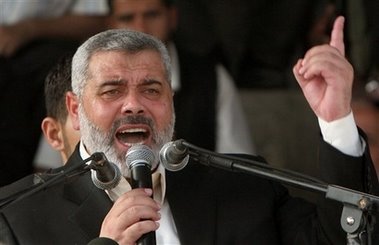
"In a landmark speech on Friday, 6 October, Palestinian Prime Minister Ismael Haniya vowed to remain steadfast in the face of combined American-Israeli pressure and blackmail, saying the Palestinian government will never ever recognize the Israeli occupation or sell out Palestinian rights.
Speaking before thousands of supporters in downtown Gaza, Haniya said Hamas was willing to accept a Palestinian state on the entirety of the 1967 occupied territories, including al-Quds al Sharif (East Jerusalem) as well as the repatriation of Palestinian refugees in return for an extended hunda or truce with Israel.
The Palestinian premier castigated “those who are coercing us to recognize Israel ,” a clear allusion to some Fatah leaders, saying that this would never happen. Haniya called for “national reconciliation” between Hamas and Fatah. Haniya said he was still committed to the National Reconciliation Document (the Prisoners’ document), stressing that the proposed national unity government ought to be based on the said document.
However, Haniya hinted that the PA leadership was coming under pressure from the Americans to effectively abandon the NRD and adopt the Quartet dictates, including unconditional recognition of Israel, putting an end to armed resistance to the Israeli occupation and accepting outstanding agreements between the PA and Israel including those Israel no longer recognizes.
Haniya also criticized Arab states saying that while Palestinians were appreciating Arab solidarity, it was sufficiently clear that these states were not doing enough to help the Palestinians who are facing a sinister siege aimed at bullying them to give up their inalienable rights in Palestine . Haniya also tacitly warned Arab states to refrain from interfering in Palestinian internal affairs.
The Palestinian Prime Minister devoted the bulk of his speech to the internal Palestinian front, lambasting those who were seeking to destabilize the government by means of vandalism and lawlessness. “We have been cursed, called traitors, vilified and called all kinds of names. We read newspapers and we listen to radio stations, and they say all kind of things and indulge in all kinds of incitement, but we never arrested a single person for expressing his views.”
Haniya said despite the suffocating economic and financial siege, the government was able to procure hundreds of million of dollars from Arab and Muslim donors. “The problem is that due to this oppressive siege, we have not been able to bring the money.
Defying those within the Fatah movement who call for the resignation of the government Haniya said the government was enjoying four kinds of legitimacy:
“There is the legitimacy of resistance, for we all came from the womb of the resistance. And then there is the legitimacy of the ballot box which gave us one of the most transparent democratic experiments in the world. Then there is the popular legitimacy in addition to the legitimacy bestowed on us by the Arab and Muslim umma.”
Haniya’s speech is viewed here as a defiant gesture to the Fatah leadership and American-Israeli efforts to isolate Hamas. Earlier this week, visiting US Secretary of State Condoleezza Rice said openly that one of the key goals of here visit to the region was to empower Abbas and weaken Hamas. Abbas, seeking to appease the Americans, said the dialogue with Hamas over the formation of a government of national unity returned to square one, blaming Hamas for reneging on earlier agreements on this regard.
Moreover, Abbas hinted that he might dismiss the government or even dissolve the legislative council in which case he would have to call for early elections in less than three months. According to opinion polls in the occupied territories, Hamas could still win if elections were to be held now."
Thanks for liberating Iraqi women, Bush...
Abduction, rape and murder are the punishments for any woman who dares to hold a professional job. A month-long investigation by The Observer reveals the terrible reality of life after Saddam
Peter Beaumont in Baghdad
Sunday October 8, 2006
The Observer
As al-Tallal, 50, walked towards her house, one of three men in the Opel stepped out and raked her with bullets.
A women's rights campaigner, Umm Salam - a nickname - knows about the three men in the Opel: they tried to kill her on 11 December last year. It was a Sunday, she recalls, and 15 bullets were fired into her own car as she drove home from teaching at an internet cafe. A man in civilian clothes got out of the car and opened fire. Three bullets hit her, one lodging close to her spinal cord. Her 20-year-old son was hit in the chest. Umm Salam saw the gun - a police-issue Glock. She is convinced her would-be assassin works for the state.
The shootings of al-Tallal and Umm Salam are not isolated incidents, even in Najaf - a city almost exclusively Shia and largely insulated from the sectarian violence of the North. Bodies of young women have appeared in its dusty lanes and avenues, places patrolled by packs of dogs where the boundaries bleed into the desert. It is a favourite place for dumping murder victims.
Iraqis do not like to talk about it much, but there is an understanding of what is going on these days. If a young woman is abducted and murdered without a ransom demand, she has been kidnapped to be raped. Even those raped and released are not necessarily safe: the response of some families to finding that a woman has been raped has been to kill her.
Iraq's women are living with a fear that is increasing in line with the numbers dying violently every month. They die for being a member of the wrong sect and for helping their fellow women. They die for doing jobs that the militants have decreed that they cannot do: for working in hospitals and ministries and universities. They are murdered, too, because they are the softest targets for Iraq's criminal gangs.
Iraq's women live in terror of speaking their opinions; of going out to work; or defying the strict new prohibitions on dress and behaviour applied across Iraq by Islamist militants, both Sunni and Shia. They live in fear of their husbands, too, as women's rights have been undermined by the country's postwar constitution that has taken power from the family courts and given it to clerics.
'Women are being targeted more and more,' said Umm Salam last week. Her husband was a university professor who was executed in 1991 under Saddam Hussein after the Shia uprising. She survived by running her family farm. When the Americans arrived she got involved in civic action, teaching illiterate women how to read and vote, independent from the influence of their husbands. She helped them fill in forms for benefits and set up a sewing workshop.
In doing so she put herself at mortal risk. And since the assassination attempt, like many women in Najaf, she has found it hard to work. Which is what the men in the white Opel wanted. To silence the women like Umm Salam, who is 42.
'It is very difficult for women here. There is a lot of pressure on our personal freedoms. None of us feels that we can have an opinion on anything any more. If she does, she risks being killed.'
It is a story familiar to women across Iraq, betrayed by the country's new constitution that guaranteed them a 25 per cent share of membership of the Council of Representatives. That guarantee has turned instead into a fig leaf hiding what women activists now call a 'human rights catastrophe for Iraqi women'.
After a month-long investigation, The Observer has established that in almost every major area of human rights, women are being seriously discriminated against, in some cases seeing their conditions return to those of females in the Middle Ages. In areas such as the Shia militia stronghold of Sadr City in east Baghdad, women have been beaten for not wearing socks. Even the headscarf and juba - the ankle-length, flared coat that buttons to the collar - are not enough for the zealots. Some women have been threatened with death unless they wear the full abbaya, the black, all-encompassing veil.
Similar reports are emerging from Mosul, where it is Sunni extremists who are laying down the law, and Kirkuk. Women from Karbala, Hilla, Basra and Nassariyah have all told The Observer similar stories. Of the insidious spread of militia and religious party control - and how members of those same groups are, paradoxically, increasingly responsible for the rape and murder of women outside their sects and communities.
'There is a member of my organisation, an activist who is a Christian,' said Yanar Mohammed, head of the Organisation for Iraqi Women's Freedom, who has had death threats for her work in protecting women threatened by domestic violence or 'honour' killings. 'She would have to walk home each day to her neighbourhood through an area controlled by one of the Islamic Shia militias, the Jaish al-Mahdi. She does not wear a veil so she gets abused by these men. About three weeks ago, one of them starts following her home saying that he wants a sexual relationship with her. He tells her what he wants to do, and if she doesn't agree he says she will be kidnapped. In the end he thinks that, because he is armed, because he threatens her existence, she will have to agree to a "pleasure marriage" [a temporary sexual union arranged by a cleric].'
Strong anecdotal evidence gathered by organisations such as that of Yanar Mohammed and by the Iraqi Women's Network, run by Hanna Edwar, suggests rape is also being used as a weapon in the sectarian war to humiliate families from rival communities. 'So far what we have been seeing is what you might call "collateral rape",' says Besmia Khatib of the Iraqi Women's Network. 'Rape is being used in the settling of scores in the sectarian war.' Yanar Mohammed describes how a Shia girl was kidnapped, raped and dumped in the Husseiniya area of Baghdad. The retaliation, she says, was the kidnapping and rape of several Sunni girls in the Rashadiya area. Tit for tat.
Similar stories are emerging across Iraq. 'Of course rape is going on,' says Aida Ussayaran, former deputy Human Rights Minister and now one of the women on the Council of Representatives. 'We blame the militias. But when we talk about the militias, many are members of the police. Any family now that has a good-looking young woman in it does not want to send her out to school or university, and does not send her out without a veil. This is the worst time ever in Iraqi women's lives. In the name of religion and sectarian conflict they are being kidnapped and killed and raped. And no one is mentioning it.'
Women activists are convinced there is substantial under-reporting of crimes against women in some areas, particularly involving 'honour killing' - there is a massive increase against a background of pervasive violence - and that families often seek death certificates that will hide the cause. In regions such as the violent Anbar province, the country's largest, which borders Jordan and Syria, there is little reporting of the causes of any death. And activists complain, in any case, that they have been blocked from examining bodies at the Medical Forensic Institute in Baghdad, or collecting their own figures to build up an accurate picture of what is happening to women.
While attacks on women have long been the dirty secret of Iraq's war, the sheer levels of the violence is now pushing it into the open. Last week in Samawah, 246 kilometres (153 miles) south of Baghdad, three women and a toddler were killed when gunmen stormed their home in an unexplained mass murder. Like Dr al-Tallal in Najaf, they were Shia Muslims in a Shia city. The three women were shot. The 18-month-old baby had her throat slit.
In the north, too, last week the killing of women became more visible, with the al-Jazeera network reporting that attacks on women in the city of Mosul had led to an unprecedented rise in the number of women's bodies being found. Among them was Zuheira, a young housewife, found shot dead in the suburb of Gogaly. Salim Zaho, a neighbour, quoted by the television station, said: 'They couldn't kill her husband, a police officer, so they came for his wife instead.'
It is one of the recurring narratives of murder told by Iraqi women. It is a violence that would not be possible without a wider, permissive brutalising of women's lives: one that permeates the 'new Iraq' in its entirety. For it is not only the religious militias that have turned women's lives into a living hell - it is, in some measure, the government itself, which has allowed ministries run by religious parties to segregate staff by gender. Some public offices, including ministries, insist on women staff wearing a headscarf at all times. A women's shelter, set up by Yanar Mohammed's group, was closed down by the government.
Most serious of all are the death threats women receive for simply working, even in government offices. Zainub - not her real name - works for a ministry in Baghdad. One morning, she said, she arrived at work to find that a letter had been sent to all the women. 'When I opened up the note it said, "You will die. You will die".'
The situation has been exacerbated by the undermining of Iraq's old Family Code, established in 1958, which guaranteed women a large measure of equality in key areas such as divorce and inheritance. The new constitution has allowed the Family Code to be superseded by the power of the clerics and new religious courts, with the result that it is largely discriminatory against women. The clerics have permitted the creeping re-emergence of men contracting multiple marriages, formerly discouraged by the old code. It is these clerics, too, who have permitted a sharp escalation in the 'pleasure marriages'. And it is the same clerics overseeing the rapid transformation of a once secular society - in which women held high office and worked as professors, doctors, engineers and economists - into one where women have been forced back under the veil and into the home. The result is mapped out every day on Iraq's streets and in its country lanes in individual acts of intimidation and physical brutality that build into an awful whole.
And so in Salman Pak, on the Tigris 15 miles south of Baghdad, The Observer is told, the Karaa Brigade of the Ministry of the Interior rounds up some Sunni men. Later some of the police return to the men's houses and promise their worried women to help find the missing men in exchange for sex.
In the Shia neighbourhood of al-Shaab in Baghdad, militiamen with the Jaish al-Mahdi put out an order banning women from wearing sandals and certain shoes, skirts and trousers. They beat up others for wearing the wrong clothes.
In Amaryah, a Sunni stronghold in Baghdad, Sunni militants shave three women's heads for wearing the wrong clothes and lash young men for wearing shorts. In Zafaraniyah, a largely Shia suburb south of Baghdad, the Jaish al-Mahdi militiamen wait outside a school and slap girls not wearing the hijab.
It is a situation bleakly recorded by the Human Rights Office of the UN Assistance Mission to Iraq. 'There are reports that, in some Baghdad neighbourhoods, women are now prevented from going to the markets alone,' Unami reported. 'In other cases, women have been warned not to drive cars, or have faced harassment if they wear trousers. Women have also reported that wearing a headscarf is becoming not a matter of religious choice but one of survival in many parts of Iraq, a fact particularly resented by non-Muslim women. Female university students are also facing constant pressure in university campuses.'
'Since the beginning of August it has just been getting worse,' says Nagham Kathim Hamoody, an activist with the Iraqi Women's Network in Najaf . 'There are more women being killed and more bodies being found in the cemetery. I don't know why they are being killed, but I know the militias are behind the killing... We went to the mortuary here in Najaf, but the authorities would not co-operate in helping to identify the murdered women. There was one doctor, though, who told us that some of the bodies showed signs that they had been beaten prior to their murder.'
And so the painful lives of Iraqi women go on.
Meanwhile in Palestine
Palestinian child deaths in conflict with Israel already nearly double that of 2005 – UN: “They are confronted with regular military operations, shelling, house demolitions, checkpoints on their way to schools,” UNICEF Child Protection Officer Anne Grandjean said. “As a result we find high prevalence of signs of stress such as anxiety, eating and sleeping disorders, and difficulties concentrating in school. “All of these signs need to be tackled as soon as possible to avoid a long-lasting impact on the child’s development,” she added.
Hebron commemorates anniversary of massacre in Ibrahimi mosque: It was 13 years ago on this, the fifteenth day of Ramadan, that Dr. Baruch Goldstein walked into Al Haram Al Ibrahimi Mosque in the southern West Bank's Hebron and opened fire. He killed 29 Palestinians in the midst of prayer. Among them were three children. The Israeli response to the massacre was to punish the victims by taking over half the mosque and turning it into a synagogue - exactly what Goldstein had been hoping for.
We Can’t Go Home Again: Now the Israeli authorities have decided that my life here has come to an end. Even after the Oslo Accords were signed and the Palestinian Authority established, Israel retained control of all borders and of the Palestinian Population Registry. Nothing or no one gets into or out of the West Bank and Gaza without Israeli permission. For a dozen years I have waited for Israel to approve my application for Palestinian residency. American Jews, indeed Jews from anywhere in the world, can come to Israel and be granted automatic citizenship.
Women activists harvest/expose the Rabin Square olive trees: `You have no permit to demonstrate here, you must disperse!` `We are not demonstrating, we are harvesting olives.` `What?` For once, the tough Tel Aviv Municipal Marshals were caught unready. Nobody had ever thought of passing a municipal ordinance or by-law forbidding the picking of olives.
Jerusalem's patriarch visits area: "I hope he's able to spread the message that (Palestinians) are not terrorists. They are people; they are Muslims, and they are Christians," said Nancy Hemminger, chairwoman of Twal's visit and coordinator of the Children's Peace Project that brought the Palestinian children in Cincinnati.
Rice offers Abbas plan to ease blockade of Gaza: Ms Rice, who left yesterday for a surprise visit to Baghdad on her way back to Washington, proposed a $25.5m (£13.5m) security centre for checking lorries on the Palestinian side of Karni. To meet Israel's concerns, it would be manned by Mr Abbas's presidential guard, supported by international monitors. The Americans are also offering $26m to expand the presidential guard from 3,500 to 6,000 men.
Haniyeh: Hamas won't be forced out, won't recognize Israel:"There are new scenarios, such as an emergency government, a technocrat government, or early elections," Haniyeh told tens of thousands of supporters. "They all aim for one thing, getting Hamas out of the government."
Abbas, Haneya likely to meet this week: Hamas spokesman: Spokesman Ghazi Hamad told reporters that Abbas was expected to arrive in Gaza before Thursday and discuss with Haneya about the forming of the proposed government of national unity.
Non-Hamas officials criticize Haneya's Friday speech: Speaking to Voice of Palestine radio, lawmaker Hannan Ahsrawi called the speech "a popular, calling up speech away from real reading of the Palestinian people' suffering," adding that the speech addressed only Hamas supporters instead of the Palestinian people."
Fatah leader urges Abbas to sack Hamas government within two weeks: The comments from Azzam al-Ahmed, head of Fatah's parliamentary bloc, underlined the increasing bitterness of the power struggle between Islamist group Hamas and Abbas, from Fatah, after their failure to agree on a coalition government.
Olmert, Abbas aides meet to plan summit: Olmert's chief of staff Yoram Turbowicz and a senior advisor met with chief Palestinian negotiator Saeb Erekat and one of Abbas's aides two weeks ago in order "to prepare the grounds for a possible meeting," the official told AFP Saturday.
P.A payment to Palestinian refugees in Lebanon stopped since March: One of the refugees, Qassem Ahmad, a member of Fateh at the Ein Al Hilwa refugee camp, said that his monthly salary from the Palestinian Liberation Organization (PLO) has stopped since March. Ahmad depends on this salary as his main source in income and livelihood since the Lebanese government does not allow the Palestinian refugees to work, obtain work permits and to own lands.
Jordan denies hosting secret Saudi-Israel talks: "These sorts of reports are put about every time there are positive signs emerging in the peace process, probably with a view to damaging it and creating a climate of suspicion around it." Israel's top-selling daily Yediot Aharonot reported Thursday that Olmert had held a secret meeting lasting several hours with Saudi officials at the palace of Jordan's King Abdullah II.
Israeli academic speaks out about Palestinian conflict: So, since '67 Israel is holding to the territories and is not willing to give them up. So if there's no, so there's one route that Israel has never tried, namely ending the occupation, signing agreement with the Palestinians and opening a new page. But if you want to stick to the territories your fate is always to use more aggression and more violence on both sides and more, more and more need to protect yourself and then to destroy others.
'You Never Know What's Next': Lubin was born into a conservative Zionist family. She had been taught that the Jews needed to establish a state of their own, so that what had happened to her relatives during World War II, when their land was occupied, and family members murdered in camps, should never happen again. For much of her life Barbara Lubin felt that the Zionist ideal was the right thing. However, in 1982 her eyes were open to a new horror: a new form of occupation, enacted by Israelis.
Despite, not because: What should be done instead of the declamatory "because?" Aid should be transferred to Gaza, the routes for agricultural exports should be opened, help must be given in restoring the electricity supply, the number of Palestinian workers in Israel ought to be increased, Palestinian prisoners should be released (in the same numbers that will in any case ultimately be released) and Gilad Shalit brought back, talks should be held with the PA chairman and prime minister, a unity government should be encouraged rather than sabotaged, there should be serious discussion of the Saudi initiative.
Film considers Palestine peace: A film, “Gaza Strip,” that shows why peace is so difficult to achieve in Palestine, will be shown at 2 p.m. Sunday in the Martha Room at First United Methodist Church, 1165 N.W. Monroe Ave. Released in 2002, “Gaza Strip” shows a population under Israeli occupation and resultant frustration of the people, especially young Gaza males.
Past comes back to haunt us in form of Kissinger
"WASHINGTON -- Say it isn't so. Hawkish Henry Kissinger is advising President Bush about Iraq war strategy? This is déjà vu all over again.
The former secretary of state -- who served in that job from 1973 to 1979 and previously from 1969 as national security affairs adviser -- inspires too many bad memories of the Vietnam War.
I remember when Kissinger came into the White House press room in 1972 just before the presidential election and announced "peace is at hand."
Three years later, we fled Saigon by our fingertips. Who can forget the pictures of refugees piling into helicopters parked on Saigon rooftops, with the North Vietnamese army at the gate.
Kissinger is back as an elder statesman doling out advice to embattled Bush and Vice President Dick Cheney that "victory over the insurgency is the only meaningful exit strategy."
Kissinger's message to the president and his top aides -- including Secretary of State Condoleezza Rice -- was they should not give an inch and to stick it out in Iraq.
He maintained that Vietnam collapsed like a house of cards because the Nixon administration did not have time, focus, energy and political support and the American people did not have the will.
White House press secretary Tony Snow said Kissinger told him "he supports the overall thrust and direction of the administration policy" in Iraq.
Kissinger also is quoted as saying that Bush needed to resist pressure to withdraw troops since that would create a momentum for an exit that is less than victory.
Woodward said on CBS-TV's "60 Minutes" on Oct. 1 that "Kissinger's fighting the Vietnam War again because, in his view, the problem in Vietnam was we lost our will." Well, Kissinger was right about that. The reason is simple: People saw no reason to lose more lives there.
His views match the administration's 35-page "National Strategy for Victory in Iraq" issued last year.
The administration would prefer not to evoke memories of the Vietnam quagmire, the 58,000-plus American war dead, and its bitter legacy, yet it all sounds too familiar when we hear officials insist we need to "stay the course" and deride dissenters as those who want to "cut and run."
They seem to forget that "those who cannot remember the past are condemned to repeat it.""
We Can’t Go Home Again
The New York Times
THIRTEEN years ago, I left a comfortable life in the United States for an uncertain future in the West Bank. Israel and the Palestinian Liberation Organization had just signed the Oslo Accords. Like many others, I saw an opportunity for Palestinians to finally build a society and economy that would lead to freedom — to a thriving Palestine alongside Israel.
As a Palestinian-American businessman, I was determined to do my part. So I moved to the West Bank city of El Bireh, where my family has lived for centuries. There I helped create a $100 million telecommunications company, which today employs more than 2,000 Palestinians. I earned an M.B.A. through Tel Aviv University. Then I developed a $10 million shopping center — the first of its kind in the Palestinian territories, employing more than 220 Palestinians. I married and had two beautiful daughters.
Now the Israeli authorities have decided that my life here has come to an end.
Even after the Oslo Accords were signed and the Palestinian Authority established, Israel retained control of all borders and of the Palestinian Population Registry. Nothing or no one gets into or out of the West Bank and Gaza without Israeli permission. For a dozen years I have waited for Israel to approve my application for Palestinian residency.
American Jews, indeed Jews from anywhere in the world, can come to Israel and be granted automatic citizenship. Thousands of American Jews freely enter and exit Israel to live in illegal Israeli settlements in the middle of the West Bank. But Palestinians whose families have lived here continually for centuries do not enjoy the same right. I need a residency card from Israel to live with my Palestinian family in my grandfather’s home in the Palestinian West Bank.
For 13 years, I’ve lived here by renewing my tourist visa every three months. Last month, an Israeli soldier stamped my American passport with a one-month visa and wrote “last permit” on it in Arabic, Hebrew and English. Now I am faced with a terrible choice. I can leave, uprooting my family and abandoning the businesses I’ve worked hard to build. I can leave alone and be separated from my wife and daughters. Or I can remain here “illegally,” risking deportation at any time.
My situation is not unique. Thousands of Palestinians are in a similar limbo. Most have less desirable options than mine. My children are American citizens. We can return to the United States. But I came here with a vision, and I remain determined to play a role in developing an economy, nonviolently ending Israel’s military occupation and building a Palestinian state.
Israeli policies effectively discourage people like me. According to the Israeli human rights group B’Tselem, it has been official Israeli policy since 1983 to “reduce, as much as possible, the approval of requests for family unification” of Palestinians. B’Tselem reports that in the last six years alone, more than 70,000 people have applied for permission to immigrate to the West Bank and Gaza to join family. Their applications have either been denied or, like mine, languish.
Each Palestinian who leaves lessens what Israelis openly call the “demographic threat” of a growing Palestinian population. But Israel needs to understand that the real threat comes not from demographics. It comes from controlling an entire population, breaking families apart and placing obstacles in the path of economic development.
Israelis and Palestinians are destined to be neighbors. One neighbor cannot ensure its security by condemning the other to hardship and despair. Many people like me — business owners, educators, artists and others — whom Israel is denying entry came to build bridges, not walls. We came to invest in a better life to follow this occupation — a bright, joint future for Palestinian and Israeli children alike.
Assad: Syrian military preparing for war with Israel

The Syrian military is preparing for war with Israel, Syria's President Bashar Assad told the Quwaiti newspaper Al-Anba on Saturday.
Assad also said he believes Israel has abandonded the peace process.
Syrian Information Minister Muhsen Bilal also said Saturday that his country is preparing for war with Israel, but added that Syria is interested in peace.
Bilal made the comments in an interview broadcast on Al-Jazeera.
"Syria is taking into account the possibility that Israel will embark on a military adventure in against Syria," said Bilal. "We are preparing for every possibility."
According to Bilal, Israel intended to "crush Hezbollah" and impose its control in Lebanon, but failed to do so.
"The crisis which Israel finds itself in today, following its failure in Lebanon, could lead it to attack Syria," said Bilal. "We always emphasized our lack of faith in Israeli governments, and this is especially true of the current government."
Bilal added that Syria is interested in peace with Israel, saying it was Israel that was responsible for the collapse of peace talks between the two nations in the year 2000.
Bilal presented the Syrian principles for peace with Israel. He said any agreement must be based on UN decisions calling for an Israeli withdrawal from the Golan Heights, southern Lebanon, the Palestinian territories and the recognition of the right of return of Palestinian refugees to Israel."
The US, Israel and Lebanon
By DAVID GREEN
CounterPunch
"The destructive and lethal forces unleashed this past summer by the United States and Israel upon Lebanon are not surprising in light of their historical roots in at least four patterns of conflict:
First, the unwillingness of Israel and its American patrons to resolve the question of the Palestinian refugees and provide for a viable Palestinian state, but rather the exploitation of this conflict to intimidate other Arab states in the region, especially Lebanon.
Second, Israel's territorial ambitions in southern Lebanon, especially regarding water, as well as the economic challenge posed to Israel by a peaceful and thriving Lebanon as a center of finance and tourism.
Third, Israel's doctrine of massive and illegal retaliation against civilian populations in response to Arab terrorism and resistance, as a means of asserting unquestioned military superiority in the region and preventing the establishment of a deterrent force that would necessitate good faith negotiation.
Fourth, Israel's military alliance with the U.S., and its willingness to serve American interests in the latter's efforts to dominate the region's energy resources, as defined more recently by both neoconservative and neoliberal doctrines that have engendered the destruction of not only Lebanon but Afghanistan, Iraq, and Gaza; and have also justified the increased concentration of wealth and economic inequality in both Israel and the U.S.
Rhetoric and Reality in the "War on Terror"
As American and Israeli efforts to control events in the Middle East become increasingly problematic, there are increased efforts to re-cast the conflict in terms of a "clash of civilizations" between "Judeo-Christians" and "Islamo-fascists." Such propaganda is obviously intended to invoke both Nazi Germany and the Cold War, reframing power-driven conflicts over land and resources as an essentialized global conflict of culture and religion.
But the ironies inherent in this propaganda may portend changes in violent historical patterns. The Bush and Olmert administrations have proved to be corrupt and deceitful; the relation between their rhetoric and reality evokes none other than fascist propagandists and Pravda. Hezbollah and Hamas have proved to be incorruptible popular movements, unrelated to al-Qaeda, that rightly stand in opposition to the Palestinian Authority, the government of Lebanon, and Israel. Meanwhile, the religious subplot in the secular Jewish State evokes Jacob Talmon's 1965 assertion (quoted by Chomsky in Middle East Illusions) that "the Rabbinate (in Israel) is rapidly developing into a firmly institutionalized church imposing an exacting discipline on its members. The State . . . has given birth to an established Church." But the religious Jew stays at home or in the illegal settlements while the secular Jew is conscripted to fight in an American/Israeli war for oil and hegemony that targets civilians and infrastructure, and now invites serious retaliation against his community. One possibility to be hoped for is that the secular Jewish-Israeli conscript and impoverished American "volunteer" will come to see no future in all of this, and realize that their respective states are also (and just as fundamentally) at war against their own citizens."
CARTOON OF THE DAY
The Emerging Russian Giant Plays its Cards Strategically
by F. William Engdahl
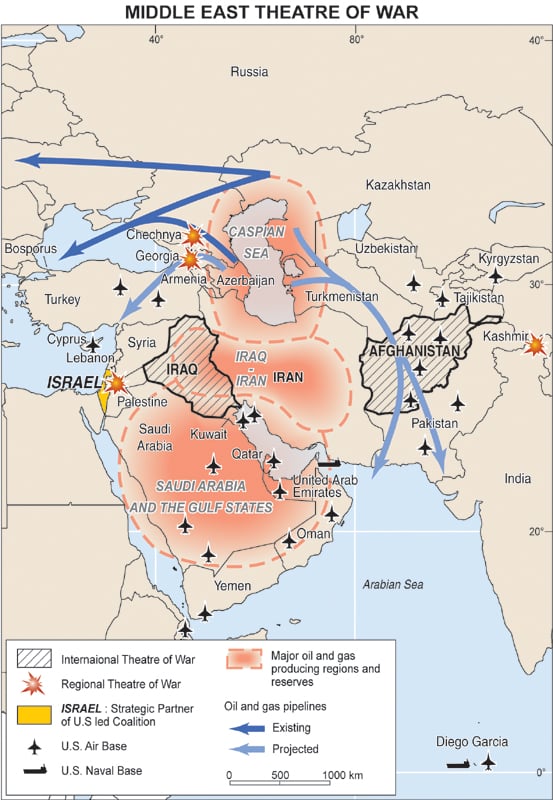
"The September 2006 summit in Paris between Russia’s Vladimir Putin, French President Jacques Chirac and German Chancellor Angela Merkel, underscored the re-emerging of Russia as a major global power. The new Russia is gaining in influence through a series of strategic moves revolving around its geopolitical assets in energy—most notably its oil and natural gas. It’s doing so by shrewdly taking advantage of the strategic follies and major political blunders of Washington. The new Russia also realizes that if it does not act decisively, it soon will be encircled and trumped by a military rival, USA, for which it has little defenses left. The battle, largely unspoken, is the highest stakes battle in world politics today. Iran and Syria are seen by Washington strategists as mere steps to this great Russian End Game.
Since the devastating setbacks two years ago from the US-sponsored ‘color revolutions’ in Georgia, and then Ukraine, Russia has begun to play its strategic energy cards extremely carefully, from nuclear reactors in Iran to military sales to Venezuela and other Latin American states, to strategic market cooperation deals in natural gas with Algeria.
The ‘Cheney Presidency,’ which is what historians will no doubt dub the George W. Bush years, has been based on a clear strategy. It has often been misunderstood by critics who had overly focussed on its most visible component, namely, Iraq, the Middle East and the strident war-hawks around the Vice President and his old crony, Defense Secretary Don Rumsfeld.
The ‘Cheney strategy’ has been a US foreign policy based on securing direct global energy control, control by the Big Four US or US-tied private oil giants-- ChevronTexaco or ExxonMobil, BP or Royal Dutch Shell. Above all, it has aimed at control of all the world’s major oil regions, along with the major natural gas fields. That control has moved in tandem with a growing bid by the United States for total military primacy over the one potential threat to its global ambitions—Russia. Cheney is perhaps the ideal person to weave the US military and energy policies together into a coherent strategy of dominance. During the early 1990’s under father Bush, Cheney was also Secretary of Defense.
The Cheney-Bush administration has been dominated by a coalition of interests between Big Oil and the top industries of the American military-industrial complex. These private corporate interests exercise their power through control of the government policy of the United States. An aggressive militaristic agenda has been essential to it. It is epitomized by Cheney’s former company, Halliburton Inc., at one and the same time the world’s largest energy and geophysical services company, and the world’s largest constructor of military bases.
Cheney’s PNAC group called on the new US President-to-be to find a suitable pretext to declare war on Iraq, in order to occupy it and take direct control over the second largest oil reserves in the Middle East. Their report stated bluntly, ‘While the unresolved conflict with Iraq provides the immediate justification (sic), the need for a substantial American force presence in the Gulf transcends the issue of the regime of Saddam Hussein ...’
Cheney signed on to a policy document in September 2000 which declared that the key issue was ‘American force presence in the Gulf,’ and regime change in Iraq, regardless whether Saddam Hussein was good, bad or ugly. It was the first step in moving the US military to ‘where the prize ultimately lies.’
In brief, NATO encirclement of Russia, Color Revolutions across Eurasia, and the war in Iraq, were all one and the same American geopolitical strategy, part of a grand strategy to ultimately de-construct Russia once and for all as a potential rival to a sole US Superpower hegemony. Russia-- not Iraq and not Iran-- was the primary target of that strategy.
By the end of 2004 it was clear in Moscow that a new Cold War, this one over strategic energy control and unilateral nuclear primacy, was fully underway. It was also clear from the unmistakeable pattern of Washington actions since the dissolution of the Soviet Union in 1991, that End Game for USA policy vis-à-vis Eurasia was not China, not Iraq, and not Iran.
The geopolitical ‘End Game’ for Washington was the complete de-construction of Russia, the one state in Eurasia capable of organizing an effective combination of alliances using its vast oil and gas resources. That, of course, could never be openly declared.
The invented term, Greater Middle East is the creation of various Washington think-tanks close to Cheney including his Project for the New American Century, to refer to the non-Arabic countries of Turkey, Iran, Israel, Pakistan, Afghanistan, Central Asian (former USSR) countries, and Azerbaijan, Georgia and Armenia. At the G-8 Summit in Summer 2004 President Bush first officially used the term to refer to the region included in Washington’s project to spread ‘democracy’ in the region.
Completion of the European missile defense system, the militarization of the entire Middle East, the encirclement of Russia and of China from a connected web of new US military bases, many put up in the name of the War on Terror, all now appear to the Kremlin as part of a deliberate US strategy of Full Spectrum Dominance."
"Cold War Shivers": War Preparations in the Middle East and Central Asia

by Michel Chossudovsky
"The overall significance of these military drills must be assessed in relation to the sequence of Russian, Chinese and Iran war exercises conducted since late August.
There is a consistent pattern. These war games are not isolated events. They are part of a carefully coordinated endeavor, in response to the US-NATO military build-up. They should also be considered as acts of deterrence, intended to display military capabilities to deter military action by US led coaltion.
The SCO and CSTO war games must also be examined in relation to the structure of military alliances. Both China and Russia are allies of Iran, involved in extensive military cooperation agreements.
China and Russia are major actors in Central Asian oil. They have significant strategic and economic interests in the Central Asian region and the Caspian sea basin. They also have economic cooperation agreements with Iran's State oil company.
The US military agenda is not limited to gaining control over Iran's oil and gas reserves, (using the "campaign against international terrorism" as a pretext). Reminiscent of the Cold war era, the objective of US military intervention also consists in weakening and ultimately displacing China and Russia from playing a significant role in Central Asia.
Directed against Iran and Syria, the US sponsored military operation, if it were to be launched, could result in a broader conflict marked by the indirect involvement of Russia and China and their central Asian allies. In fact that indirect involvement is already established through Iran's observer status to the SCO, various bilateral military cooperation agreements as well as the sale of Chinese and Russian weapons systems to Iran.
Known and documented, China is also supporting Iran in the development of its air defense system. Moreover, according to a report in the Daily Telegraph (5 October 2006), Washington has acknowledged that China has been involved in
"secretly fired powerful laser weapons designed to disable American spy satellites by "blinding" their sensitive surveillance devices, it was reported yesterday."
This article has attempted to document the various preparations for war.
The risk of an extended Middle East -Central Asian war must nonetheless be addressed. The devastation and loss of life which could result from this proposed military agenda would be incalculable, particularly if the conflict escalates to the broader Middle East- Central Asian region."
Friday, October 06, 2006
AP Learns Gitmo Guards Brag of Beatings
|
The two-page statement was sent Wednesday to the Inspector General at the Department of Defense by a high-ranking Marine Corps defense lawyer.
The lawyer sent the statement on behalf of a paralegal who said men she met on Sept. 23 at a bar on the base identified themselves to her as guards. The woman, whose name was blacked out, said she spent about an hour talking with them. No one was in uniform, she said.
A 19-year-old sailor referred to only as Bo "told the other guards and me about him beating different detainees being held in the prison," the statement said.
"One such story Bo told involved him taking a detainee by the head and hitting the detainee's head into the cell door. Bo said that his actions were known by others," the statement said. The sailor said he was never punished.
The statement was provided to the AP on Thursday night by Lt. Col. Colby Vokey. He is the Marine Corps' defense coordinator for the western United States and based at Camp Pendleton.
Calls left for representatives at Guantanamo Bay on Friday were not immediately returned. A Pentagon spokesman declined immediate comment.
Other guards "also told their own stories of abuse towards the detainees" that included hitting them, denying them water and "removing privileges for no reason."
"About 5 others in the group admitted hitting detainees" and that included "punching in the face," the affidavit said.
"From the whole conversation, I understood that striking detainees was a common practice," the sergeant wrote. "Everyone in the group laughed at the others stories of beating detainees."
Vokey called for an investigation, saying the abuse alleged in the affidavit "is offensive and violates United States and international law."
Guantanamo was internationally condemned shortly after it opened more than four years ago when pictures captured prisoners kneeling, shackled and being herded into wire cages. That was followed by reports of prisoner abuse, heavy-handed interrogations, hunger strikes and suicides.
Military investigators said in July 2005 they confirmed abusive and degrading treatment of a suspected terrorist at Guantanamo Bay that included forcing him to wear a bra, dance with another man and behave like a dog.
However, the chief investigator, Air Force Lt. Gen. Randall M. Schmidt, said "no torture occurred" during the interrogation of Mohamed al-Qahtani, a Saudi who was captured in December 2001 along the Afghanistan-Pakistan border.
Last month, U.N. human rights investigators criticized the United States for failing to take steps to close Guantanamo Bay, home to 450 detainees, including 14 terrorist suspects who had been kept in secret CIA prisons around the world.
Described as the most dangerous of America's "war on terror" prisoners, fewer than a dozen inmates have been charged with crimes. This fall, the Navy plans to open a new, $30-million maximum-security wing at its prison complex there, a concrete-and-steel structure replacing temporary camps.
Pregnant Palestinians give birth at Israeli checkpoints
Since the beginning of the second Intifada, a Palestinian uprising against Israeli military occupation, in September 2000, 68 pregnant Palestinian women gave birth at Israeli checkpoints, leading to 34 miscarriages and the deaths of four women, according to the Health Ministry's September report.
Thoraya Obaid, Executive Director of the United Nations Population Fund (UNFPA), said these figures underline the need to put an end to the agony of pregnant Palestinian women held at Israeli checkpoints.
"It is urgent to facilitate access by pregnant women to life-saving services, as stipulated by international humanitarian law," Obaid said.
Rami Abu Shaaban of the Health Ministry's Information Centre said that the amount of time Palestinians spend waiting at border crossings has increased dramatically over the past five years.
"Ten per cent of women who wished to give birth at medical centres had to spend hours on the road before reaching a hospital, while six per cent spent more than four hours. The normal time, before the Intifada, was 15-30 minutes," Abu Shaaban said.
Munna al-Astal spent 19 days stranded at the Rafah Crossing between Gaza and Egypt before giving birth nearby.
She said she was among a number of Palestinians who were being processed through the crossing when it was closed by Israeli authorities for security reasons, leaving her and the others caught inside the terminal.
According to the Palestinians, Egyptian authorities do not let them back into Egypt once their passports have been given an exit stamp; and Palestinian authorities do not let them forward into Gaza if the border has been closed.
The stranded survive on food and water they are able to buy there and from handouts from the Egyptian Red Crescent. If they need urgent medical attention, they are taken to hospital in Egypt, but once they are able, they are returned to the crossing.
"I was visiting relatives in Egypt and on my way back to Gaza the crossing was sealed off by the Israelis," al-Astal said. "I was about to give birth. I went into labour for several hours with no one to help me. Finally an ambulance came to take me to the Al-Areesh Hospital [in the Sinai] but I gave birth in the ambulance.
"I named my daughter Ma'abar [Arabic for 'crossing'] to recollect the sufferings and hardships we both had at the Rafah terminal," she added.
According to the Health Ministry's report, there are currently 117,600 pregnant women in the Palestinian territories. This includes 17,640 women who are suffering difficult pregnancies due to a lack of prenatal and postnatal care.
"Inadequate medical care during pregnancy is the third leading cause of death among Palestinian women of childbearing age," said Abu Shaaban.
UNFPA has been helping pregnant women avoid suffering at checkpoints by training health personnel and equipping them with delivery kits to provide services within their communities. It has also formed local community support teams to assist health providers and raise awareness of the availability of delivery services.
Soon after the capture of an Israeli soldier on 25 June by Palestinian militants, Israel launched a military offensive in the Gaza Strip and tightened its control of border crossings. Damage to the Gaza infrastructure, including health, communication, power and transport facilities has been extensive.
This has compounded the suffering of the 1.4 million inhabitants of the Gaza Strip, particularly women and young people, health workers say.
"We conduct such restrictions at checkpoints because we receive security warnings of planned attacks on our soldiers and civilians," said Amira Aron, director of the Arab Media Department in the Israeli Ministry of Foreign Affairs.
"Israel has horrible experience of Palestinian women being used in carrying out suicide bombings against Israeli civilian and military targets. We know that such measures increase hatred between the two peoples, but we have to defend and protect our civilians," she added.
Meanwhile in Palestine
Bil’in Defiant in Midday Sun: Not deterred by the intense midday heat and their empty stomachs, many villagers decided to continue the protest by marching down the slope along the wall and were immediately attacked by Israeli forces firing multiple rounds of tear gas. Around 20 protesters suffered from the effects of the gas and were forced to disperse into the olive groves where they watched as the IOF turned their attention to children in the olive groves on the opposite side of the road. Snipers took up positions and started firing rubber bullets at children in the groves who responded by throwing stones.
Commentary: Universal instincts - By Azmi Bishara: What are significant are the conditions. These the Palestinian Authority (PA) has to agree to in order to end the boycott, because by rejecting these conditions the elected government brought on the boycott to begin with." This is how people succumb to the logic and aims of the boycotters. It is how conditions stipulated by hostile external forces become the political agenda of a segment of internal forces. In the process, the freedom to choose and national unity are cast aside in exchange for the promise of bread for the masses. In turn, the masses become an instrument to topple the government and elect one the West approves of.
Gaza shootings kill Fatah activist: Muhamed Suleiman Atiyya was killed after evening prayers on Thursday in the southern Gaza town of Rafah. The AFP news agency reported that shortly afterwards a Hamas member of the interior ministry security force was injured when two hand grenades were thrown outside a Rafah hospital. Earlier, a Hamas member had been shot and wounded in Beit Lahiya, in the northern Gaza strip.
Palestinian PM urges Abbas to resume unity talks: Haniyeh is embroiled in an increasingly bitter power struggle with Abbas, fueled by their failure to agree a unity coalition that Palestinians hope will lift Western sanctions. "I urge the leadership of Fatah and Hamas to hold an urgent meeting, tonight, in my presence, to put an end to the internal strife. (But) we will not recognize Israel," Haniyeh said.
Israel is creating Mogadishu next to its Silicon Valley: Following the peace accords, scores of other Palestinian-Americans moved to the West Bank and Gaza. Professors came to teach at universities. Doctors came to help modernize the healthcare system and treat patients. Artists came to exhibit and perform. Other business professionals came to invest, modernize the economy and create jobs. Each, in their way, wanted to help build an independent Palestine. Each served as the real ambassadors of America, so different from the American-made Apache helicopters and F-16 fighter jets Israel uses to rain destruction on the Palestinian economy, cities and villages. But Israel has decided that we Americans are not welcome.
A time for peace?: In the summer of 2001, says Woodward, Bandar brought a blunt message to Bush, the sharpest ever delivered by him to an American president. The crown prince, Bandar told the astonished president, is planning to cut off all ties with you. We will not consider any U.S. interests and will act as we see fit. Why? Because of then prime minister Ariel Sharon and his war against the Palestinians. It is clear to us, the Saudi ambassador told the president, that the U.S. has made a "strategic decision" that means "adopting Sharon's policy." Bush protested. That's not true, he said to the ambassador. Two days later, Bush sent the crown prince a two-page letter in which he declared, for the first time, his support for the establishment of a Palestinian state.
Former U.S. President urges restoring aid to Palestinians: "The attempt to coerce Hamas leaders by starving the Palestinian people has failed, and it is time for the international community to alleviate their suffering and resort to diplomacy," Carter said in a statement. The former president added that he is doubtful that Palestinian leaders will make any progress toward reconciliation with Israel "as long as the Palestinians are subjected to this kind of debasement and personal suffering."
Israeli settlers take over Hebron mosque under armed protection of Israeli soldiers: Official Palestinian sources in the town told PNN on Thursday that the Israeli settlers carried machine guns and other weapons while overtaking the mosque for a half hour of Jewish prayer. Israeli soldiers occupying the area guarded the northern Hebron's mosque on behalf of the settlers.
Troops invade Balata refugee camp in Nablus: The Palestine News Network (PNN) reported that at least eight army vehicles and a military bulldozer, invaded the cap through Rojeeb street. The bulldozer destroyed doors and front walls of several shops in the area and fired rounds of live ammunition at street lights, especially in Al Hashasheen neighborhood.
Several residents injured while attempting to reach the Al Aqsa Mosque for Friday prayers: Palestinian sources reported on Friday that Israeli soldiers and policemen barred hundreds of Palestinians from reaching the Al Aqsa Mosque for Friday prayers, marking the second Friday of the Muslim holy month of Ramadan, several residents, including children, were injured.
Sukkot: Full closure on Gaza, West Bank: A general closure was imposed Friday on Palestinian territories and will remain in affect until the end of Sukkot; police have raised their alert level ahead of the holiday. The closure, which went into effect during the early morning hours and will be lifted in 24 hours.
Haniyeh promises right of return: Haniyeh sharply condemned the international community's economic blockade on the Palestinians. “The American regime is leading this seige to make us surrender and to politically exhaust us, but we are telling you – they won't wring us out and our fortress won't fall.
Senior Hamas official: Shalit deal to be finalized within 2 weeks: Yousef denied reports of Syrian involvement in the prisoner exchange negotiation process. "This is a matter within the Gaza Strip, and all of the sources handling the negotiations are there as well," he said.
Israeli DM promises to transfer tax revenues to Palestinians if captured soldier returns: "The key to releasing funds to the Palestinian (National) Authority is tied to the issue of returning Gilad Shalit home and to other issues that are part of our conditions, such as the halt of Qassams (rockets) and violence against communities in the Gaza area," Peretz said.
Muslim leader gets interfaith award in U.S. despite Jewish protests: Speaking at a Jerusalem Day rally, Hathout said: "We did not come here to condemn the condemned atrocities committed by the apartheid brutal state of Israel because butchers do what butchers do and because what is expected from a racist apartheid is what is happening now."
Carlos Santana coming to Israel: Guitarist Carlos Santana is scheduled to give a concert in Jerusalem in the spring of 2007 in the framework of project “Bridges of Music,” which was launched by Roy Scott in 1988 to advance peace between Jews and Muslims. The event will be sponsored by the Jerusalem Fund and the Foreign Ministry.
(Will people living behind the WALL have access to that "Peace" concert? )
Despite, not because: What can be done? The Israeli instinct has always been to spill all the old cliches over such scenes, from "there is no one to talk with" to jets of racist scorn for "the Arabs." We are having a hard time with them? They are also having a hard time with us. When at the beginning of the week, 12 Palestinians were killed in Fatah-Hamas battles, this of course made front page headlines in Israel. But the hundreds whom Israel has killed just in the darkened and hungry Gaza Strip over the past few months have already become stale non-news. The riots in the territories are a big asset for all haters of any agreement with those rioting gangs.
Siege within: While Western media reports tend to focus on the political scuffling between the Hamas government and Fatah, the once dominant party of President Mahmoud Abbas, the humanitarian crisis is duly ignored. If not for the sensitive and perceptive reporting of a few individual journalists such as Amira Hass of the Israeli daily Haaretz and Donald Macintyre of the British Independent, the untold suffering of the Palestinian people would have gone completely unnoticed.
Gaza Clashes - The Struggle for Palestine's Soul: If Peretz and others are to be believed, the gunmen could have done themselves and the 1.4 million people of Gaza a favour and simply executed Shalit weeks ago. Israel doubtless would have inflicted terrible retribution, such as the bombing of the Strip's only power station -- except, of course, it had already done that to avenge Shalit's capture. But, with the Israeli soldier dead, there would have been no obstacle to sitting down and talking.
Palestinian Affairs: Blazing battles: Mahmoud Abbas, his aides complained this week, is perhaps the only person in the Palestinian Authority who still thinks that Hamas can be transformed into a party that is willing to accept the Oslo Accords, renounce violence and implement all agreements that were signed between the PLO and Israel. "He really believes that Hamas will change, and that it will finally recognize Israel,"
كلمة الاستاذ اسماعيل هنية في مهرجان الصمود والثبات في غزة
بيان المنتدى الثقافي الاجتماعي في فلسطين
بيان من فلسطين المحتلة:
هذا بيان للناس
قبل أن تكون فتنة، ولإنقاذ الشعب من الاقتتال لصالح العدو
المنتدى الاجتماعي الثقافي في فلسطين
http://www.kanaanonline.org/articles/00956.pdf
بيان المنتدى الثقافي الاجتماعي في فلسطين
يتواصل تدهور الوضع الأمني والاجتماعي والإقتصادي والسياسي في الأراضي المحتلة باتجاه الإحتراب الداخلي الذي سيكون الضربة القاصمة للمشروع الوطني الفلسطيني. ويترافق مع هذا الإحتراب المحتمل مشروع أميركي لمزيد من الاحتراب والصراع الداخلي. ولن يكون لا الاحتراب ولا شقه الأخر المشروع الأميركي حلاً للآزمة الحالية بل تكريساً لها.
ولا يخفى على شعبنا ان الوصول إلى الوضع الحالي ما كان سوى نتيجة للإتفاقات التي بدأت من اوسلو، وهي الاتفاقات التي نقضها اساساً نفس الطرف الذي وقعها إلى جانب القيادة الفلسطينية.
أما والمؤامرة ليست حلاً، فالمطلوب هو خلق كتلة ممانعة شعبية في الأراضي الفلسطينية المحتلة يقوم موقفها على ما يلي:
حل الإشكالية القائمة ديمقراطياً، وذلك باستمرار وتواصل العملية الديمقراطية التي أوصلت الإخوة في حماس إلى السلطة، وذلك للحؤول دون الاقتتال الداخلي آنياً ولاحقاً.
التمسك بالثوابت الوطنية بعيدا عن المشروع الأميركي الصهيوني.
بلورة حكومة وطنية مستقلة من الموثوقين والمجربين على أن تكون هذه الحكومة مسؤولة أمام المجلس التشريعي وأن لا تكون مرجعيتها لا الإدارة الأميركية ولا النظام الصهيوني ولا القيادات التي أصبحت جزءاً من تفكيك المشروع الوطني. وإن يتم تصليب الموقف الشعبي، وتسيير الحياة اليومية على اسس نظيفة ووطنية واجتماعية سليمة.
هذا إلى جانب إعادة التركيز على تفعيل وتوسيع منظمة التحرير الفلسطينية ديمقراطياً وإعادة التمسك بالثوابت الوطنية إلى منظمة التحرير إلى جانب إعادة القضية إلى العمق الشعبي العربي، وسحبها من ايدي الحل العربي الرسمي الذي عليه أن يقترب من الموقف الشعبي لا ان يهمين عليه. ونحن في هذا نسترشد ونصطف إلى جانب قوى الممانعة التي ترسخت وتبلورت إثر الانتصار الأخير في لبنان بقيادة حزب الله، وهو الأمر الذي فرز الساحة العربية إلى شقين هما الممانعة والمساومة.
هذا بيان للناس
"قبل أن تكون فتنة، ولإنقاذ الشعب من الاقتتال لصالح العدو
Read the rest (Arabic)
Palestinians Refugees Targeted With Death Threats in Iraq

"Shi'a armed groups have threatened to kill Palestinian refugees living in Baghdad if they do not leave Iraq within 72 hours, Human Rights Watch said today.
Human Rights Watch urged the Iraqi government and the Multi-National Forces to investigate these threats and provide greater security to Palestinians in Iraq.
A new leaflet obtained by Human Rights Watch and bearing the name of the Al-Bayt Revenge Brigade Rapid Response Units states that "there is no place for Palestinians in the Iraq of Ali, Hassan, and Hussain." The names refer to three revered Shi'a imams; in contrast, virtually all Palestinians are Sunni Muslim. The leaflet also warns that "our swords can reach necks" and urges Palestinians to leave within 72 hours and "fight occupation in your own country," referring to Israel and the Occupied Palestinian Territories.
According to Baghdad residents, trucks with loudspeakers passed through the al-Dura neighborhood on September 25 and September 30 issuing death threats against Palestinians.
"These death threats to Palestinians underscore the constant violence against Palestinian refugees in Iraq in the aftermath of the overthrow of Saddam Hussein's government," said Sarah Leah Whitson, Middle East director at Human Rights Watch. "The Iraqi government and international forces in Iraq must take urgent steps to protect this community at risk."
Armed groups in Iraq have killed dozens of Palestinian refugees since 2003. Last month, Human Rights Watch documented killings, threats of violence and other security concerns of the estimated 34,000 Palestinian refugees in Iraq in the report, "Nowhere to Flee: The Perilous Situation of Palestinians in Iraq"."
Washington says its efforts in Palestinian territories go unrecognised

"PARIS (AFP) - US Under Secretary of State for Public Diplomacy Karen Hughes said she regretted Washington's efforts in the Palestinian territories went largely unrecognised in the media.
A close aide to President George W. Bush, Hughes was appointed to her ambassadorial post tasked with changing foreigners' perceptions of the United States, notably in the Arab and Muslim worlds.
"While I recognize that sometimes the coverage tends to portray the situation in a little different terms, I feel that the United States and President Bush don't always get much credit for the support that we provide to the Palestinian people," she told journalists during a visit to the Arab Institute in Paris.
But she said "we are working hard to work through the NGOs and others to deliver food and medical assistance and other assistance to the Palestinian people, because we are very concerned by the situation."
***
WHAT A LYING BITCH!
Coup In Iraq?
"Is the Bush administration considering a coup d’etat in Iraq before the end of the year, in a desperate effort to salvage its war? It’s not outside the realm of possibility. Like JFK in 1963, who—faced with a notoriously corrupt Saigon regime and a growing Viet Cong insurgency in Vietnam—gave the green light to topple and assassinate President Ngo Dinh Diem in Vietnam, President Bush might give a wink and a nod to the CIA, the U.S. military, and Ambassador Zalmay Khalilzad to get rid of Iraq’s current regime. The Diem coup didn’t go well. Considering how unlikely it is that Bush has even heard of Diem, I doubt he’s learned that lesson.
Question is, what are they going to replace him with—and when? According to recent reports, the United States appears to have given Maliki a deadline: two months.
Some outside experts who have recently visited the White House said Bush administration officials were beginning to plan for the possibility that Iraq's democratically elected government might not survive.
''Senior administration officials have acknowledged to me that they are considering alternatives other than democracy,'' said one military affairs expert who received an Iraq briefing at the White House last month and agreed to speak only on condition of anonymity.
Time is short? Force the issue? Get tired of this? There’s only one way to read all this, namely that the Bush administration has given Maliki 60 days to fix Iraq, or else.
So what does this mean? As I see it, there are several options that desperate Bush administration officials might seize on, if they do indeed want to replace Maliki.
Third, entirely outside the constitution, there is the possibility of a military coup d’etat. Rumors of a coup have swirled in Baghdad for at least a year. Over the weekend, when Maliki announced a sudden, and unprecedented, curfew banning vehicular and pedestrian traffic in the entire capital, there were reports that an army coup d’etat had been thwarted. One Iraq expert I talked to told me that perhaps some of the Iraqi army units being moved into Baghdad as part of the current crackdown might be candidates to seize power in the Green Zone. Of course, such an action would have to be encouraged and sponsored by the U.S. command in Iraq and the CIA, which—according to Iraqi sources—has a firm hand on Iraq’s own intelligence service.
Still, how else to read the drumbeat of you’ve-got-two-months warnings? Desperate men do desperate things. If the Bush administration is truly unwilling to consider getting out of Iraq, then what are its options? I don’t expect a coup d’etat in Baghdad this month. But after the U.S. elections—say, in two months? Anything goes."
The Struggle for Palestine's Soul
By JONATHAN COOK
Nazareth.
"The international community's economic blockade of the Strip, for example, has nothing to do with the seizing of the soldier; that was because Gazans had the temerity to cast their vote for the politicians of Hamas in March. The Palestinians' exercise of their democratic rights is also the reason why Palestinians with American and European passports are being torn from their families in the occupied territories and expelled.
And what about Israel's refusal last year to coordinate its disengagement from Gaza with the Palestinian security forces? That was because Israel had "no partner for peace", even though the supine President Mahmoud Abbas, of Fatah, was then in sole charge.
In other words, Israel has always found reasons for oppressing, destroying and killing in Gaza, whatever the circumstances. Let us not forget that Israel's occupation began four decades ago, long before anyone had heard, or dreamt, of Hamas. Israel's rampages through Gaza have continued unabated, even though Hamas' military wing refrained from retaliating to Israeli provocations and maintained a ceasefire for more than a year and a half.
Shalit is the current pretext, but there are a host of others that can be adopted should the need arise. And that is because as far as Israel and its American patron are concerned, any Palestinian resistance to the illegal occupation of Gaza and the West Bank is unacceptable. Whatever the Palestinians do -- apart from submitting willingly to occupation and permanently renouncing their right to statehood -- is justification for Israeli "retaliation".
But the immiseration of Gaza does not, of itself, explain why the clashes are taking place, or what is motivating the factions. This is not just about who will get the scraps from the master's table, or even a struggle between two parties -- Hamas and Fatah -- for control of the government. It is now no less than a battle for the very soul of Palestinian nationalism.
In returning to the occupied territories as head of the Palestinian Authority, Arafat also renounced violence against Israel. He headed the new security forces whose job was to crack down on Palestinian dissent, not respond to Israel's many military provocations or fight the occupation. And of course, Arafat and Fatah, unlike Israel, had every reason to want previous agreements honoured: they mistakenly believed that they were their best hope of winning statehood. They did not factor in Israel's bad faith, and its continuation and intensification of the settlement project.
Following the outbreak of the second intifada, a majority of ordinary Palestinians voters began to understand how terminally damaging Fatah's complicity with the ocupation had become. For example, as Palestinian, Israeli and international activists tried to demonstrate against the building of Israel's wall across the West Bank, and the subsequent annexation of large swaths of Palestinian land to Israel, the protesters found obstacles placed in their way at every turn by the ruling Fatah party. Its leaders did not want to jeopardise their cement and building contracts with Israel by ending the wall's progress. Liberation was delayed for the more immediate prize of remuneration.
The question is: will Fatah force Hamas to cave in to Israeli demands and co-opt it, or will Hamas force Fatah to abandon its collaboration and return to the original path of national liberation?
The stakes could not be higher. If Hamas wins, then the Palestinians will have the chance to re-energise the intifada, launch a proper, consensual fight to end the occupation, one that unites the secular and religious, and try to face down the bullying of the international community. As with most national liberation struggles, the price in lives and suffering is likely to be steep."
A MASSIVE RALLY SUPPORTING HAMAS IN GAZA


MASSIVE RALLY SUPPORTING HAMAS IN GAZA
***
P.S. The stadium where the rally was held is the soccer field of Al-Yarmouk Middle School in Gaza. This was my school 1956-1958. From the stands and looking east on a clear day you could easily see the mountains around Al-Khalil (Hebron) in the West Bank.
The experiment was a success: The Palestinians are killing each other
The experiment was a success: The Palestinians are killing
each other. They are behaving as expected at the end of
the extended experiment called "what happens when you
imprison 1.3 million human beings in an enclosed space
like battery hens."
These are the steps in the experiment: Imprison (since
1991); remove the prisoners' usual means of livelihood;
seal off all outlets to the outside world, nearly
hermetically; destroy existing means of livelihood by
preventing the entry of raw materials and the marketing of
goods and produce; prevent the regular entry of medicines
and hospital supplies; do not bring in fresh food for
weeks on end; prevent, for years, the entry of relatives,
professionals, friends and others, and allow thousands of
people - the sick, heads of families, professionals,
children - to be stuck for weeks at the locked gates of
the Gaza Strip's only entry/exit.
Steal hundreds of millions of dollars (customs and tax
revenues collected by Israel that belong to the
Palestinian treasury), so as to force the nonpayment of
the already low salaries of most government employees for
months; present the firing of homemade Qassam rockets as a
strategic threat that can only be stopped by harming
women, children and the old; fire on crowded residential
neighborhoods from the air and the ground; destroy
orchards, groves and fields.
Dispatch planes to frighten the population with sonic
booms; destroy the new power plant and force the residents
of the closed-off Strip to live without electricity for
most of the day for a period of four months, which will
most likely turn into a full year - in other words, a year
without refrigeration, electric fans, television, lights
to study and read by; force them to get by without a
regular supply of water, which is dependent on the
electricity supply.
It is the good old Israeli experiment called "put them
into a pressure cooker and see what happens," and this is
one of the reasons why this is not an internal Palestinian
matter.
The success of the experiment can be seen in the miasma of
desperation that hangs over the Gaza Strip, and in the
clan feuding that erupts almost daily there, even more
than in the battles between Fatah and Hamas militants. One
can only wonder that the feuding is not more frequent, and
that some bonds of internal solidarity have been
maintained, which saves people from hunger.
In contrast to the feuding between clans, Sunday's battles
in Gaza and campaigns of destruction and intimidation,
mainly in West Bank cities, were not the result of a
momentary loss of control. They are generally viewed as
battles between two militias, each of which represents one
half of the population, but they were initiated by groups
within Fatah to put a few more nails into the coffin of
the elected leadership.
The security forces of the Palestinian Authority - in
other words, of Fatah, or in still other words, the ones
that Mahmoud Abbas is in charge of - are hiding behind the
genuine distress and protests of public employees who have
not been receiving regular salaries. And they are doing so
despite the fact that everyone knows that the failure to
pay salaries is not a managerial failure, but is above all
due to Israeli policy. These forces were dispatched in
order to sow organized anarchy, as taught in the school of
Yasser Arafat.
And why is this, too, an Israeli matter? Because those who
dispatched these militants have a shared interest with
Israel in regressing to a situation in which the
Palestinian leadership collaborates with the appearance of
holding peace talks, while Israel continues its occupation
and the international community sends hush money in the
form of salaries for the Palestinian public sector.
And there is another reason why this is also an internal
Israeli issue: Whatever the outcome, the Palestinian
feuding and the risk of civil war directly affect about 20
percent of Israeli citizens, the Arabs. They affect the
Arabs, and also those segments of the Israeli public that
have not forgotten that Israel will remain the occupying
and ruling force over the Palestinians as long as the goal
of establishing a Palestinian state in all of the
territories occupied in 1967 is not realized.
PA official: Early elections amount to civil war

Deputy Palestinian Parliament Chairman tells Ynet: Abu Mazen (Palestinian President Mahmoud Abbas) doesn’t have authority to dismantle Hamas government; Hamas prepared for another round against IDF
"Still, Hamas already prepared itself for another possible round against the IDF, and was determined to stay in power without acknowledging Israel.
“Hamas wants a unified government, but if that doesn’t happen, we are prepared to stay in power according to the mandate given us by the people,” Deputy Palestinian Parliament Chairman Ahmed Bahar told Ynet.
He continued, “No one will make us disappear, we will stay, as part of a unified government or on our own. That’s what we were voted into power for, and Abu Mazen (Abbas) doesn’t have the authority to dismantle the elected institutions.”
When asked what he thought of Egyptian President Hosni Mubarak’s opinion that the current crisis would best be solved with early elections, Bahar replied that there was no need for early elections.
“Elections now would mean civil war. A unified government, based on the prisoner’s document, is what is needed,” he said.
Bahar mentioned talks by an international committee in Sharm-el-Sheikh in 1996, which he said plotted against Hamas and the resistance. “That scheme failed. All of these pressures won’t work this time either. The Palestinian people will not surrender, and we will not acknowledge Israel,” Bahar said."
Thursday, October 05, 2006
Protesting Bush in San Francisco: Rally shuts down part of Market Street


(10-05) 14:24 PDT SAN FRANCISCO -- Hundreds of people shut down westbound Market Street this afternoon in a protest against the Bush administration and the war in Iraq.
Protesters said they want President George Bush out of office and American troops out of Iraq, and many carried signs, wore T-shirts and chanted slogans such as "Impeach Bush" or "Bush get out."
The group began with a noon rally at Justin Herman Plaza and then marched up Market Street to Civic Center Plaza, where they planned to turn around and head back down to Justin Herman for another rally.
This afternoon, no arrests had been reported, and the march appeared to be peaceful.
Attendees ranged from high school students who said they had ditched class to attend the rally to bearded older men. One man carried a sign that read, "Citizens with portfolios against the war."
"We believe the Bush regime should stay out of Iraq and end the occupation. We should worry more about helping people around the world instead of fighting for oil," said Sonya Guadalupe of Berkeley, summing up the statements of many marchers. "I'm not a radical, I'm just concerned about the kind of world my daughter will live in."
The organizers, World Can't Wait -- Drive Out the Bush Regime, planned demonstrations today in 150 cities across the United States and in Canada and Switzerland. At least 70 of the demonstrations were being held in "red" cities -- those that lean conservative poltically, organizers said.
Word of the protests has largely spread through Internet -- including a social gathering spot on MySpace, as part of a push to recruit younger people. In the Bay Area, the group has distributed flyers at some high schools, telling students to "stay in school if you like Bush."
The group saw a surge of support from red states, and $100,000 in donations, after taking out ads last month in USA Today and the New York Times, national coordinator Debra Sweet said.
It's the second time the organization has staged national protests: in November 2005, there were demonstrations in 70 cities. Ten people were arrested at the San Francisco protest, which attracted about 2,000 people. One of the 10 suspects was allegedly found carrying several Molotov cocktails after such a device was thrown at The Chronicle's building.
The World Can't Wait's founders included supporters of the Revolutionary Communist Party, but in the past year the list of backers on its Web site has grown to 24,000 names. They include actors Sean Penn, Olympia Dukakis and Mark Ruffalo; writers Studs Terkel and Alice Walker; state Assemblyman Mark Leno, D-San Francisco; and Bay Area "protest mom" Cindy Sheehan, whose son was killed in Iraq in 2004.
To see more pictures click HERE.
Palestinians, No Comment
The US Occupation of Iraq: Casualties Not Counted
In all past wars the United States has been involved in, including the two World Wars, Vietnam and the first Gulf War, the military was self reliant and took care of its basic support functions like cooking, cleaning and other services.
That changed when the Cheney administration took control of the government in 2000. War has now been privatized, and the shining examples of this privatization are Afghanistan and Iraq. As you read this there are approximately 100,000-125,000 American civilian contractors working in Iraq and Afghanistan. Their jobs range from providing security to desk work to interrogating prisoners to driving convoy trucks to clearing unexploded ordnance. A year back, in November 2005, the US Department of Labor listed 428 civilian contractors dead and 3,963 wounded in Iraq - none of which are ever counted in the official casualty counts.
Continued.
Commentary: Universal instincts

A GREAT ARTICLE, AS USUAL
By Azmi Bishara
Al-Ahram Weekly
"The Palestinians have yet to win liberation and a nation state. But they have established an identity, a national movement and a will to fight for liberation. To side with a colonialist blockade is to lend oneself to jettisoning even this small accomplishment, which was achieved through such enormous sacrifices.
You can rub your eyes and open them again and still find it hard to believe. A part of the Palestinian people has decided to demonstrate against another part of the same people, telling them to either accede to the boycotters' three demands or to step aside and let others rule.
What we are seeing in progress is not just the reversion to the period before the coalescence of the liberation movement but also the retrogression to pre-modern politics. It is difficult enough to believe that in this day and age the West and the Arabs would have sunk so low as to use food as a weapon to reverse a democratic choice. It is harder to believe that some of the recipients of this tactic could bring themselves to play along with it when they could just as easily have thwarted it.
A similar process occurred in Lebanon, incidentally. There, too, the reasons for the Israeli aggression were supposed to be taken for granted and those who questioned these reasons were accused of having brought on the Israeli aggression to begin with. Moreover here, not only was the aggressor to be spared blame and the victim censored, when the victim came out ahead, his victory was denied, if only to keep things even.
Indeed, not a single democrat bothered to point out that the boycott struck long after Hamas had agreed to a truce and had halted all suicide bombing operations. Is this what Hamas was being punished for? Sometimes it looks that way. And this fact alone should give some people cause to hold their tongues and stop giving advice to Hamas.
Meanwhile, the Arab ruling elites, recently renamed "moderates," have failed in both their democracy and their patriotism exams. The former was a silly exam that they never wanted to take to begin with, but they were dragged shamefacedly to the testing hall where they proved, indeed, that they were incapable of introducing even the simplest democratic reforms that Washington was blackmailing them into making. Then, when Washington asked them to, they strengthened their ties with Israel in exchange for which Washington agreed to lay off meddling in their domestic affairs.But the boycott of the elected Palestinian government posed a tougher test, because in this case the subjects of democracy and patriotism were combined. Here the "moderate" regimes surpassed themselves for their Western masters. Their answer was that anyone who challenges the position of a colonialist or an occupation authority or others with might to throw around gets what's coming to them and that the only rational course of behaviour is to do what Israel and the US tell you.
In giving rein to such basic hunger and tribal instincts, they are catapulting the region to the predawn of modern politics, democratic or otherwise. They are turning the clock back to that era when there was no such thing as a distinct public sphere, which gave rise to such modern political concepts as the individual, the state, the nation and civil society. Thanks to democratic America and its ally Israel and their friends in the region we are reverting to the scramble over scraps, the law of the jungle and the organic bond as the only way the individual can secure his survival."
***
Azmi has outdone himself in this article; he is a great writer and thinker.
Palestinian child deaths in conflict with Israel already nearly double that of 2005 – UN
“They are confronted with regular military operations, shelling, house demolitions, checkpoints on their way to schools,” UNICEF Child Protection Officer Anne Grandjean said. “As a result we find high prevalence of signs of stress such as anxiety, eating and sleeping disorders, and difficulties concentrating in school.
“All of these signs need to be tackled as soon as possible to avoid a long-lasting impact on the child’s development,” she added.
UNICEF and the Humanitarian Aid Department of the European Commission have established teams of social workers and psychologists to respond to the children’s needs. Every month they reach some 3,000 children and their families, offering support and counselling after violent incidents.
The counselling sessions end every month with a festival and beach party organized by UNICEF and its partners, where thousands of children are given the chance to play and interact with each other away from the conflict.
“These festivals are important because they are about protecting childhood,” UNICEF Special Representative for Gaza and the West Bank Dan Rohrmann said. “It’s an opportunity for children to be children, which is rare here in Gaza, because they live in an environment of extraordinary fear and violence and insecurity.”
Meanwhile in Iraq
Iraq: At least 65 killed as U.S. occupation grinds on: A total of 30 bodies, most of them shot and tortured, were found in different districts of Baghdad during the past 24 hours, a source in the Interior Ministry said.
13 U.S. occupation troops killed in Baghdad in last 3 days : Thirteen U.S. occupation soldiers have been killed in Baghdad since Monday, the American military reported, registering the highest three-day death toll for U.S. forces in the capital since the start start of the war
U.S. Mercenary killed in Iraq: Guy Barattieri was an Army Reservist, but was working as a contractor when he was killed.
700 police relieved of duty in effort to uproot death squad connections: Iraqi authorities pulled a brigade of about 700 policemen out of service Wednesday in its biggest move ever to uproot troops linked to death squads, aiming to signal the government's seriousness in cleansing Baghdad of sectarian violence.
Marines Plead "not guilty" in murder of Iraqi Civilian: Two Marines pleaded not guilty Wednesday to murdering an Iraqi civilian in Hamdaniya and then trying to cover up the crime.
US in Iraq : Some US Generals want Donald Rumsfeld to resign : A group of Generals has called on US Defense Secretary, Donald Rumsfeld, to resign.
Iraq's universities and schools near collapse as teachers and pupils flee: "The militias from all sides are in the universities. Classes are not happening because of the chaos, and colleagues are fleeing if they can," said Professor Saad Jawad, a lecturer in political science at Baghdad University.
Iraq: The only solution left: If we want to stop the relentless slide into anarchy, the answer is to establish a UN protectorate.
Meanwhile in Palestine
Help The Ghalia Family: The incident received worldwide attention mostly due to the horrifying video footage taken minutes later of devastated Huda Ghalia (11 y.o.) next to the dead body of her father, Ali (43 y.o.)... The family has literally lost everything: most of the working men are either dead or injured, enormous amounts of money are being spent daily on the medical treatment and on the special needs for the many wounded and handicapped, and the family agricultural land is inaccessible due to repeated bombings.
A struggle among losers: In an open letter to Palestinian Authority Chairman Mahmoud Abbas, Prime Minister Ismail Haniyeh and the leadership of Hamas and Fatah, Dr. Ali Jarbawi, a lecturer at Bir Zeit University writes: "If you think that in your fighting, there will be a winning side, you are delusional. In such struggles, no one wins; everyone loses!
Save up to 50% on the New Statesman for twelve months and support the Trees for Life campaign!: By subscribing to the New Statesman magazine, not only will you receive Britain's leading current affairs weekly but you will also join the Trees for Life campaign and help to repair the enormous destruction years of war have inflicted on the olive groves of Palestine.
Settlers attack a mosque in Halhol village near Hebron: Al Nabi Mossa mosque is one of the oldest mosques in Hebron area, the settlers went inside, ransacked it then, said prayers. All of this was done under the protection of the Israeli army, which surrounded and closed the mosque area and did not allow residents to come near it, even for their morning prayers.
Closure Denies Palestinian Residents Access to their Homes: The letter was sent on behalf of Palestinian families living in the Tel Rumeida neighborhood of Hebron, whose access to their homes has been blocked and who suffer from repeated attacks by Israeli settlers. The letter represents ACRI`s final attempt to resolve this longstanding and untenable situation outside of the courts.
My Name Is Rachel Corrie Begins New York Debut Off-Broadway Oct. 5: Megan Dodds will reprise her role in the American premiere of the acclaimed — and controversial — historical solo play My Name Is Rachel Corrie, which begins preview Oct. 5 at Off-Broadway's Minetta Lane Theatre. The limited engagement will play 48 performances through Nov. 19. Opening is Oct. 15.
PA security officer dies of wounds he sustained on Monday due to infighting in Gaza: Osama Al Aeid, 23, was an officer in Hamas' newly formed Executive Force and died after suffering fatal head wounds after clashes that erupted between Fatah supporters and officers from the Executive Force late Monday night.
One resident killed by Israeli fire east of Khan Younis: The sources said that Yousef Qabalan, 18, was killed after the army stationed at a military post east of Khan Younis fired shells and rounds of live ammunition at the area.
Are security forces trigger-happy when it come to Arabs?: Eighteen Israeli Arabs have been killed since the October 2000 riots by the security forces under circumstances unrelated to national security. Eleven of these were shot to death by cops and Border Police troops. During this period there was only one comparable case in which a cop shot to death a Jew, while trying to prevent the man from stabbing his parents.
London Mayor wins High Court appeal to overturn suspension: He has also denied any bias against Jews, adding that accusations of anti-Semitism were being raised "to give weight to charges which would otherwise be too trivial to merit the gigantic fuss that has been made about this brief private exchange."
Peretz: In Israel's interests to ease conditions in PA: The two agreed that Israel would install X-ray machines at Israel-Gaza border crossings in order to ease the flow of commercial goods in and out of the Strip. Meanwhile, Rice told Foreign Minister Tzipi Livni on Thursday morning meeting that the economic boycott on the Hamas-led Palestinian government is effective and the international community will continue to maintain the boycott.
US offers millions to keep Abbas safe: The United States has proposed a USD 20 million plan to boost Palestinian President Mahmoud Abbas' personal security force and upgrade the main cargo crossing between Gaza and Israel, American officials said Thursday.
Quartet: Rafah closure puts EU observer mission at risk: American and European representatives have cautioned Israel that the continued closure of the Rafah border crossing between Gaza and Egypt puts the continued deployment of European observers there in doubt.
Paz-Palestinian petrol pact signed: Diplomatic sources suggest an awkward situation could develop in the event that Israel asks for increased pressure on Iran at the same time that an Israeli refinery is processing crude oil from Iran. According to a source in the energy industry, "a refinery doesn't distinguish between crude sourced from Iran and from anywhere else, and crude from that type of source could be marketed in Israel."
Israeli PM secretly met Saudi officials in Amman: press: The meeting, at the palace of Jordan's King Abdullah II, lasted for several hours and focused mainly on Iran's nuclear program and the spread of "Shiite terrorism" in the region, the paper said. The two sides agreed to share intelligence on the Iranian nuclear program.
Mubarak: Early elections could be way out of Palestinian crisis: Early elections might be the solution to the Palestinian stalemate, which has defied Egyptian attempts to broker a government of national unity, Egyptian President Hosni Mubarak said in remarks published Thursday..
King Mahmoud: He can dismiss the PA prime minister (the law is vague about the cabinet), but any new government has to be approved by parliament, where Hamas has 74 of the 132 seats while Fatah has 45. Mr Abbas, like the queen, is notionally head of the armed forces, but legally most of the forces answer to the Hamas-run interior ministry, and, in practice, their loyalties are divided among several chieftains.
Rice fails to win Israel pledge to ease Palestinian restrictions: US Secretary of State Condoleezza Rice failed to secure a pledge from Israel to ease restrictions on the beleaguered Palestinian territories as she ended a visit aimed at breathing life into the moribund Middle East peace process.
Palestinian killed during police round up of illegal laborers: Neighbors claim, however, that they heard police shouting "stop or I'll shoot" before shots were heard, implying that the shooting had been deliberate and not accidental, as police claim.
Abbas to request more weapons from US: Palestinian Authority President Mahmoud Abbas is planning to request a large shipment of weapons from the United States purportedly to arm his group against rival factions, a senior Palestinian official told WND today.
"79 Percent of Gazan Households are Living in Poverty": According to the World Bank, Palestinians are currently experiencing the worst economic depression in modern history.
Officer who shot Palestinian bore false witness: From investigations, it emerges that the officer cocked his weapon, unprovoked by the victim, causing a bullet to be fired accidentally. During the investigation, it was clarified that the border officer, 19, lied during his testimony that claimed that the Palestinian tried to grab his weapon. Despite this, the officer was released.
The settlers are not resting: The semiannual Peace Now report states that expansion work, including road building and preparing ground for construction, is underway in 31 outposts. It also states that permanent structures are being constructed in 12 outposts and mobile homes are being added to 13 outposts, while 10 additional outposts are the sites of infrastructure work and the construction of new roads.
Hamas member assassinated in Qalqilya: Palestinians sources told Ynet that the assassination was an operation of an elite Israel Defense Forces unit, and was carried out by Israeli soldiers disguised as Arabs. Military sources, however, said that they had no knowledge of any activity carried out in the area Wednesday morning, but added that "we are looking into the report."
Gaza's chaos offers lessons for defense establishment: But in the West Bank, where Hamas' electoral victory this past January is still not accepted, violent incidents continued, with Fatah targeting its rivals. In Gaza, Hamas Interior Minister Saeed Sayem - whose life has been threatened by Fatah's military wing - met with the Fatah-affiliated leaders of the security forces in an effort to restore calm.
Global leaders appeal for urgent action to resolve Palestine question: "There is a desperate need for fresh thinking and the injection of new political will" if the conflict, "with all its terrible consequences", is ever to be settled, they said in the statement which was organsied by the Brussels-based International Crisis Group. Shirin Ebadi, Nobel peace prize winner from Iran, former US president Jimmy Carter, ex-Soviet president Mikhail Gorbachev are among the signatories to the statement.
OPT: Refugee stories: "You have to Live in Darkness":Sixteen to eighteen hours is a long time to endure without electricity, especially when people are accustomed to life with it. Especially when there are no candles. The $150 million power plant, which was destroyed a few hours after three Israeli air strikes on Gazan bridges, provided roughly half of the Strip's electricity supply. It could take approximately one year to repair the power plant and to fully restore the Gaza Strip with electricity.
Abbas gives Hamas two weeks on Palestinian unity cabinet: Abbas told a joint news conference with visiting Bahraini Foreign Minister Khaled bin Ahmed Al Khalifa that talks on creating a government with Hamas had halted, and vowed to exercise his ”prerogatives” should the impasse persist. “At present there is no dialogue. An agreement was reached on September 11 but was broken” by the ruling Islamist movement, Abbas said.
Abbas builds up forces amid Palestinian crisis: Behind cinder-block walls on the edge of the West Bank city of Jericho, a 16-acre plot of parched earth is being transformed into new training grounds for troops loyal to Palestinian President Mahmoud Abbas. With support from the United States and its allies, Abbas's presidential guard has been expanding as a possible counterweight to the Hamas Islamists who lead the government and have been busy building up their own "Executive Force".
Rice meets Fatah officials in Jerusalem: The meeting held shortly before Rice's leaving for Ramallah for a parley with Palestinian President Mahmoud Abbas, who is also the head of Fatah movement. Rice is seeking to boost Abbas in his standoff with the Islamic Resistance Movement (Hamas), which dominates the Palestinian parliament and controls government.
Rice hopes to exploit the Arab-Iran divide: She may be appealing to the legendary Arab-Iranian rivalry to sell the US agenda of shoring up the Arab opposition to Iran's alleged aspirations to develop nuclear weapons. The United States has tried to play that card before. The newest wrinkle in this ongoing strategic power game is that Israel is reportedly also reaching out to "moderate" Arab states of the Persian Gulf region by focusing on Iran-phobia.
Rice, in Mideast, Meets Skeptics: During Rice's visit to Cairo and a stop Monday evening in Jidda, Saudi Arabia, it was clear that American allies in the region had greater ambitions for a renewed Israeli-Palestinian peace effort than the administration did. U.S. officials have said that the most they hope for now is limited progress. Bush said last week that the United States did not intend to impose a settlement on the Palestinians and Israelis.
Fatah member: Abbas recognition of Israel political: "The base of our Fatah movement keeps dreaming of Tel Aviv, Haifa, Jaffa and Akko," said Abu Ahmed, Fatah member and leader of the al-Aqsa Martyrs' Brigades in the northern Gaza Strip. "There is no change in our position. Abbas recognizes Israel because of pressure that the Zionists and the Americans are exercising on him. We understand this is part of his obligations and political calculations."
'Smugglers' get 15 minutes to go, then house is blown up: Sami Shaher,46, was rebuilding his house 50 metres from the border after it was destroyed by the Israeli army in 2002. He said he received a call at 10.30pm on Wednesday from Abu Nimr. Thirty minutes later his unfinished house was blown up, leaving a crater 20 metres wide and 10 metres deep. A 14-year-old girl was killed by flying debris. There is no visible evidence of a tunnel.
Echoes of Ireland in Palestine: "The Wind That Shakes the Barley" is no feel-good story of a heroic indigenous resistance battling against the foreign occupier. The narrative is centred on two characters, Damien (Cillian Murphy) and Teddy (Padraic Delaney), brothers who grow up to fight side by side against the British, but then find themselves on opposite sides in the brutal civil war.
When the Wall Street Journal Supports Palestine: The only thing the WSJ loves more than distrusting Arabs is the God of capitalism, the free market. Thus, a Palestinian businessman, Coca-Cola proprietor Zahi Khouri, was able to get on the pages of Journal by framing Palestinian rights in free market terms. Look, he said, Israel denies us and our goods free mobility, and thus economic development. That is the problem in Palestine.
Israeli Fuel Company Turns Off Fuel Supply Until Debt is Paid: The Israeli Transnational Corporation fuel company will not deliver fuel to West Bank cities until the Palestinian Authority pays its debt of hundreds of millions of shekels. But with the U.S.-led diplomatic and economic boycott since January, the PA has no chance of paying its debt, resulting in a two-day rush for fuel throughout the West Bank.
أولمرت يعلن عن دعم عباس للإطاحة بالحكومة الفلسطينية

الناصرة - المركز الفلسطيني للإعلام
أبدى رئيس الوزراء الصهيوني استعداده لتقديم الدعم بشتى أنواعه لرئيس السلطة الفلسطينية" محمود عباس، على أمل إضعاف الحكومة الفلسطينية المنتخبة.
وقال أولمرت إنه مستعد لمساندة محمود عباس في تطبيق الخطة المسماة "خارطة الطريق"، سعياً لاستئناف عملية التسوية، موضحاً أنه سيطرح قريباً ما سماها "أفكاراً لتقديم مساعدات للفلسطينيين"، في إطار تقوية مكانة رئيس السلطة الفلسطينية ضد الحكومة. وتحدث أولمرت عن مساعدات للفلسطينيين رغم أنّ حكومته تحتجز عائدات الضرائب المقررة للسلطة الفلسطينية والكفيلة بحل أزمة الرواتب في الضفة والقطاع، علاوة على تشديدها للحصار الاقتصادي المفروض على المواطنين الفلسطينيين.
وقد جاءت تصريحات أولمرت خلال لقاء جمعه بوزيرة الخارجية الأمريكية، غونداليزا رايس، ركز على سبل إعاقة الحكومة الفلسطينية الحالية على أمل الإطاحة بها. وتناول البحث بين الجانبين الصهيوني والأمريكي احتمال تشكيل حكومة وحدة وطنية فلسطينية؛ وجرى التأكيد على ضرورة خضوع هذه الحكومة للاشتراطات المتمثلة بالاعتراف بالكيان الصهيوني وإقرار اتفاقات التسوية السياسية المنهارة ونبذ المقاومة ضد الاحتلال.
وفي غضون ذلك؛ طالب سيلفان شالوم، وزير الخارجية الصهيوني السابق، الولايات المتحدة الأمريكية بدعم محمود عباس، بعد أن أبدى الأخير استعداداً للإطاحة بالحكومة الفلسطينية التي تقودها حركة المقاومة الإسلامية "حماس".
ونقلت وسائل إعلام عبرية عن شالوم قوله، إنّ "على الولايات المتحدة أن تتخذ إجراءات عملية ضد التطرف وعدم الاستقرار، وليس بناءً على بيانات وتصريحات"، على حد وصفه، وأضاف "إنّ على واشنطن أن تساعد عباس على استخدام سلطته ونفوذه للضغط من أجل القضاء على الحكومة برئاسة حماس"."
Despite the 'withdrawal', the siege of Gaza goes on
(John Dugard is special rapporteur to the Human Rights Council on the situation of human rights in occupied Palestinian territory)
The Independent
"In August last year Israel withdrew its settlers and armed forces from Gaza, claiming that this brought to an end 38 years of military occupation. Of course, it did nothing of the sort. Israel retained power over Gaza by controlling its air space, sea space and external borders. Sporadic shelling continued, as did the targeted assassination of militants. Despite this, there was at least an appearance of disengagement, which Israel could claim as a major step towards the peaceful resolution of the Israeli-Palestinian conflict.
In July, international attention was diverted from Gaza by Israel's attack on Hizbollah's bases in Lebanon. Sadly, despite the ending of these hostilities, Israel's war in Gaza has disappeared from the radar of international concern. Yet it is as important as the conflict in Lebanon. It highlights the intractability of the Israeli-Palestinian conflict, and reveals, yet again, the brutality of Israel's occupation.
Poverty in Gaza stands at 75 per cent. Food prices have inflated and sugar, dairy products and milk are low as commercial supplies from Israel are limited. Fish is no longer available as a result of Israel's sea blockade.
In short, the people of Gaza have been subjected to collective punishment in clear violation of article 33 of the Fourth Geneva Convention. For what? Surely not for sporadic Qassam rocket fire and the capture of Cpl Shalit? Instead, it seems the people of Gaza are being punished for having elected a Hamas government earlier this year.
Regime change, rather than security, probably explains Israel's punishment of Gaza. Whatever the reason, Gaza deserves more attention from the international community."
CARTOON OF THE DAY
Removing Hamas
AN EXCELLENT ARTICLE
By NICOLA NASSER
CounterPunch
"Within the context of a U.S.-Israeli determined campaign to remove the elected Islamic Resistance Movement from power, the best of the Palestinian mainstream anti-occupation activists of Fatah and Hamas are being polarized into a deadlocked divide that is already threatening an historic national unity with a looming civil war as a result of either risky brinkmanship tactics or what Hamas says a coup d'etat.
So far President Mahmoud Abbas could not distinctly dissociate from this minority and its risky brinkmanship tactics. However he again blurred the distinction between his agenda and theirs when he announced that "all the options are open except only the civil war," leaving a wide space of manoeuvring for the reckless minority to continue fishing in the Palestinian troubled water.
This minority represents marginal cross-faction down to earth interests that had mushroomed to the verge of corruption; it identifies with the goals of the external anti-Hamas campaign and rules out any dialogue with Hamas even if that leads to infighting until the ruling Islamic group strictly, publicly and unconditionally commit to the U.S.-adopted Israeli conditions; it postures as a self-proclaimed "peaceniks" using the slogan of peace as a per se justification for its dangerous agenda.
Those self-proclaimed "peaceniks" rule out any middle ground agreement with Hamas, but advocate consistent contacts with the occupying power even without agreement; they are big mouths in urging Hamas to commit to PLO's signed accords with Israel, but keep mum on Israel's non-commitment to the same accords.
Worse still, this minority has been recently calling publicly and irresponsibly on President Abbas to declare a state of emergency, dissolve the Hamas-led government and form an emergency cabinet; the proposal boils down to a call for an outright presidential coup d'etat.
The smell of the taboo bloodletting did not deter the provocateurs to desist from incitement against Hamas and used the let blood as a new war cry against it.
However Abbas has contributed to the crisis by not firmly distancing himself from the civil war provocateurs and by encouraging them to float their coup d'etat proposals, first by adopting their referendum idea, then by not ruling out publicly their proposed state of emergency measures. Bypassing Hamas in his international relations also sent the wrong message that he indirectly subscribed to the anti-Hamas campaign and allied himself with the provocateurs' agenda, which he has yet to confirm.
But nothing so far indicates Hamas will resort to this option and everything indicates it will honor its public pledge that it will defend the people's democratic choice which carried it to power, and this is exactly the prescription to civil war.
One could not but wonder whether the real Israeli-U.S.-backed provocateurs' aim is to bring about the downfall of both Abbas and Hamas in order to maintain and sustain a pre-Hamas comfortable status quo, where their interests and privileges are preserved and the interests of their backers are ideally served."
Palestinian Power-Struggle: Defeat from Within
"To differ is only human, indeed. But when political and ideological differences within the Palestinian leadership milieu turn into wide chasms that split further an already weakened and oppressed society in urgent need for national cohesion - amid incessant and sadly successful attempts to splinter its national identity - then one must dare question the wisdom and merit of such leadership that would allow for, in fact, instigate such a travesty.
However, it must be admitted that while the inhumanity and apathy toward the plight of the Palestinians is part-and-parcel of the West’s general attitude toward that historically ill-treated nation, thanks to internal Palestinian division and ineffectual power-struggles, Palestinians are being reduced and humiliated with the full cooperation of their own leadership.
History is rife with examples, starting with the Palestinian failure to devise a legible strategy to face the Zionist colonial project in Palestine in the early half of the last century: with a dirty power-struggle quickly surfacing between the Husseini and Nashashibi families, both claiming to be true representatives of Palestinians, the latter labelled a ‘moderate’ while the rest were designated extremists and terrorists. History has repeated itself, many times and so cruelly since then, and many segments of the Palestinian people, whether in Palestine or outside either willingly or out of desperation for a platform to resist, fell victim to factional and sub-factional divisions. Dissension, disunity and discord had indeed become Palestinians’ worse enemy. While Israel cleverly capitalized on these divisions, various Arab capitals played a similar game, buying political allegiances with hard cash.
In recent years, particularity under the Oslo dictates, the Palestinian leadership upgraded its status to that of Israel’s iron fist and most faithful prison guard, in exchange for special privileges to its members of old and emerging elites. Though this episode presumably came to an end in the legislative elections that brought a new government to power in March 2006, the Palestinian people are being pressured to repent and return to the status quo, corrupt or not, so long as Israel is satisfied with the outcome.
Mainstream Fatah is desperate to reclaim its past position, even if unity with Hamas means the sparing of the Palestinians further humiliation and misery. Hamas, wrangling with the taxing nature of politics, is sending mixed messages, injudicious ones from abroad, and more realistic, yet often indecisive ones at home. Both Fatah and Hamas are allowing their desire for self-preservation and advancement to supplant the self-preservation of the Palestinian national unity, or whatever remains of it.
Palestinians are long used to betrayal and indifference; but being let down by one’s own leadership is most painful, indeed."
US offers millions to keep Abbas safe

Associated Press
"The United States has proposed a USD 20 million plan to boost Palestinian President Mahmoud Abbas' personal security force and upgrade the main cargo crossing between Gaza and Israel, American officials said Thursday.
The plan is being worked out by Lt. Gen. Keith Dayton, the US security coordinator in the West Bank and Gaza, and was discussed during Secretary of State Condoleezza Rice's meeting with Abbas on Wednesday, the officials said.
The plan is part of a larger US effort to bolster Abbas, a political moderate who is in a power struggle with the Islamic Hamas group.
The US plan would provide funding and training to Abbas' presidential guard, which is considered the best-trained and most reliable of the security services."
***
YOU NEED TO PROTECT YOUR PUPPETS:
Why not give a contract to an American "security firm," such as Blackwater or Custer-Battle to provide private security and bodyguards to protect Abbas, in the same manner another dear US puppet, Hamid Karzai, has been protected for sometime. This way you at least recycle US taxpayers' money to an American company and spread the wealth to a private firm instead of a corrupt "Authority."
أولمرت يلتقي مسؤولين سعوديين بالقصر الملكي الأردني

Details of a secret meeting between Olmert and high-ranking Saudi officials in the Jordanian royal palace in Amman. Olmert was flown by helicopter during the night. The meeting, which lasted several hours, dealt with the potential nuclear threat from Iran and the spread of "Shi'a terror" in the region. The Saudis agreed to continue intelligence coordination with Israel regarding Iran's nuclear program.
أفادت صحيفة يديعوت أحرونوت أن رئيس الوزراء الإسرائيلي إيهود أولمرت التقى خلال الأسابيع القليلة الماضية مسؤولين سعوديين كبارا في القصر الملكي الأردني في عمان، في لقاء نظمه كل من العاهل الأردني عبد الله الثاني ورئيس جهاز الاستخبارات الإسرائيلي (الموساد) مائير داغان.
وأوضحت الصحيفة أن أولمرت نقل في مروحية إلى العاصمة الأردنية ليلا برفقة مدير مكتبه يورام توربوفتيش والملحق العسكري الجنرال غادي شامني. وقالت إن الاجتماع الذي استغرق عدة ساعات تناول الأخطار الناجمة عن محاولة إيران امتلاك سلاح نووي وانتشار "الإرهاب الشيعي" في المنطقة.
وتابعت أن أولمرت ومحادثيه السعوديين الذين لم تكشف أسماءهم اتفقوا -على ما يبدو- على مواصلة التعاون بين أجهزة الاستخبارات بشأن البرنامج النووي الإيراني.
وقالت إن أولمرت قال خلال اللقاء إنه لن يقوم بأي تحرك بشأن الملف الفلسطيني طالما أن حركة المقاومة الإسلامية (حماس) على رأس الحكومة الفلسطينية، وطالما لم يتم الإفراج عن الجندي الأسير جلعاد شاليط الذي أسرته مجموعات فلسطينية في يونيو/حزيران الماضي على حدود قطاع غزة.
وكان أولمرت ألمح في مقابلة إذاعية الخميس الماضي إلى أنه التقى مؤخرا فردا من العائلة الحاكمة السعودية. وقال إن مبادرة السلام السعودية التي تبنتها القمة العربية في بيروت عام 2002 "لا تشكل قاعدة للمفاوضات".
وتنص المبادرة السعودية على السلام مقابل الانسحاب الإسرائيلي من الأراضي العربية المحتلة حتى حدود 1967، بما يتوافق مع القرار 242 الدولي، وعلى حل "يتم الاتفاق عليه" لمشكلة اللاجئين الفلسطينيين.
وقال أولمرت "بالنسبة إلينا, مرجع المفاوضات مع الفلسطينيين هو خارطة الطريق". وتنص خارطة الطريق التي وضعتها اللجنة الرباعية الدولية للشرق الأوسط (الولايات المتحدة والاتحاد الأوروبي وروسيا والأمم المتحدة) على إقامة دولة فلسطينية مستقلة في الضفة الغربية وقطاع غزة على مراحل إلى جانب إسرائيل, غير أنها ظلت حبرا على ورق منذ إطلاقها في صيف 2003.
ونفت السعودية بشدة يوم الثلاثاء الماضي حصول أي اتصالات مع مسؤولين إسرائيليين بمن فيهم أولمرت.
Middle Eastern 'Strategic Consensus' Redux?
by Jim Lobe
"President George W. Bush and his peripatetic secretary of state, Condoleezza Rice, may believe that they have broken with 60 years of U.S. policy in order to "transform" the Middle East, but to longtime regional observers, their latest initiatives look painfully familiar.
Not only does Washington's current courtship of Sunni-led authoritarian states – most notably, Saudi Arabia, Jordan, and Egypt – raise new and very troubling questions about its self-proclaimed commitment to democratizing the region, but its new effort to forge a de facto alliance between those states and Israel against a supposedly common external threat – currently Iran – also eerily recalls the Cold-War period in general, and the first year and a half, in particular, of the administration of President Ronald Reagan a quarter century ago.
"The holy grail of U.S. policy in the region has always been to get the Arabs to forget about the Arab-Israeli conflict and to focus instead on some other threat," noted Gary Sick, an expert on Iran and the Gulf states at Columbia University. "If you don't think you can or are not prepared to deal with the Arab-Israel dispute, then trying to convince the Arabs that they should subordinate it to other strategic concerns is really a very attractive thought."
Nonetheless, that appears to be precisely the current administration's thought today, as Rice tours the capitals of "moderate" Arab states to rally support for its demands that Iran unconditionally freeze its nuclear program, which, according to Washington, poses a serious threat not only to Israel, but to the Arab states themselves."
Rice fails to win Israel pledge to ease Palestinian restrictions

Al-Manar
US Secretary of State Condoleezza Rice failed Thursday to secure a pledge from Israel to ease restrictions on the beleaguered Palestinian territories as she ended a visit to the occupied territories. Washington's top diplomat left Israel without making any public statement following meetings with her Israeli counterpart Tzipi Livni and Defense Minister Amir Peretz. She had been expected to announce "progress" on Israeli restrictions on crossings into the Gaza Strip at the tail end of her trip, aimed in part at boosting Palestinian leader Mahmud Abbas in the face of the ruling Hamas movement. Boosting Abbas against Hamas is seen by observers as a move by the US to further inflame the situation in occupied Palestine. Washington and the European Union cut aids to the Palestinian people when Hamas democratically achieved a landslide victory on the Fatah movement, in parliamentary elections last March. During her dinner with Israeli Prime Minister Ehud Olmert, Rice also failed to get Israel to agree to release customs duties collected on behalf of the Palestinian Authority that the Jewish state has been withholding since before Hamas took office. According to the World Bank, the customs duties amounted to 65 million dollars a month in 2005, or two-thirds of the Palestinian government's budget. The withholding of the revenue, along with a Western freeze on direct aid since Hamas took office, has wrought havoc on the Palestinian territories, prompting warnings from the United Nations of a humanitarian disaster. On Wednesday, Rice met with Abbas in Ramallah, where the duo presented a united front, saying any Palestinian government should respect the peace principles set out by the so-called Middle East quartet -- the European Union, Russia, the United States and the United Nations. Abbas, locked in a standoff with Hamas over a platform for a national unity government, said any future cabinet would have to abide by past peace deals -- one of the key Western demands to which Hamas refuses to accede. He reiterated that stalled talks with Hamas on forming a unity government could not go on forever and warned that "the Palestinian leadership will decide on the measures to take to get us out of this crisis." Hamas has so far refused immense pressure to soften its stance and Prime Minister Ismail Haniya accused Washington of being interested only in reshaping the region to fit its interests.
You have got to watch this.
HIIILLAAARRRIIIOOOOOOOOUUUSSS
Wednesday, October 04, 2006
Condi Rice Tries to Look Busy
By TONY KARON
Time
"Secretary of State Condoleezza Rice is in the Middle East, hoping to bolster Arab moderates — foremost among them beleaguered Palestinian Authority President Mahmoud Abbas — and revive the moribund Israeli-Palestinian peace process. The unstated objectives include helping to topple the Hamas-led government elected by the Palestinians in January, and seeking to rally moderate Arab regimes against Iran. So what are her chances of success? Let's just say it's probably easier finding weapons of mass destruction in Iraq than finding any Arabs or Israelis optimistic over Rice's prospects.
Pro-U.S. Arab leaders, including Abbas, have suffered acutely from the Bush Administration's Middle East policy, with their influence at home and abroad declining in the face of the U.S. invasion of Iraq and its backing for Israel's actions in the West Bank, Gaza and Lebanon. The simple math of Middle East politics today is that the there's an inverse proportionality between the closeness of Arab leaders to the United States and their distance from public opinion in their own countries. That much was clear when some Arab officials pointedly criticized Hizballah for initiating the summer's hostilities with Israel, but were then forced to retract as their citizenry cheered for Hizballah.
In other words, the current Israeli government has nothing to offer Arab moderates. Nor, for that matter, does Condi Rice.
The Israelis will be the first to tell Rice that, nice fellow and peacenik though he may be, President Abbas has negligible power on the Palestinian street, even over his own Fatah movement. He's never been a particularly decisive leader, and Rice's efforts to bolster him through public praise and symbolic photo opportunities may have the reverse effect — given the crisis in the Palestinian territories right now and the anti-American sentiment it has engendered, the demonstrative but empty-handed U.S. support for Abbas may be a political kiss of death."
CARTOON OF THE DAY
CURRENT ONLINE AL-JAZEERA POLL
Who do you blame for the internal Fatah-Hamas strife?
With over 22,000 responding, here are the results:
I blame Hamas-----4.5%
I blame Fatah-----77.6%
I blame Israel------17.9%
***
AN UPDATE
THE THUGGERY OF FATAH
The results shown above held fairly steady as the number of respondents reached 25,000. But by then Fatah became aware of the poll; so in a typical dictatorial Fatah fashion, it ordered it supporters to vote en masse against Hamas. So, in a very short order, the number of respondents increased rapidly, which is not the norm. At last look, with 37,000 answering, the results changed significantly:
Blame Hamas-----12.9%
Blame Fatah------68.3%
Blame Israel-------18.8%
The poll is no longer random and no longer meaningful. But the Fatah hordes will keep "voting" until the total reaches over 200,000! A typical Al-Jazeera poll usually has about 40,000-50,000 responding.
This is the thuggery of Fatah.
***
At 50,000 responding, the numbers became:
Blame Hamas-----18.2%
Blame Fatah------63.3%
Blame Israel-------18.5%
***
With 140,000 responding! (just 9 hours later), the results were completely turned around:
Blame Hamas------46%
Blame Fatah------39.2%
Blame Israel-------14.9%
***
AN UPDATE (Thursday noon, Pacific time)
I have underestimated the stupidity of Fatah. This poll must mean a lot to it. The number of those "voting" has now exceeded 320,000! The poll is supposed to run through 10/7. It must be a record for an Al-Jazeera poll.
Hezbollah's Battle with Israel a Rallying Cry in Palestinian Refugee Camp

by Hannah Allam
"AIN EL-HILWEH, Lebanon - Twenty young men from Ain el-Hilweh, Lebanon's largest Palestinian refugee camp, have died fighting U.S. forces in Iraq. Their portraits hang in honor here, plastered to filthy walls, taped to store windows and hung from the crisscrossed electrical wires that form a ceiling above narrow alleyways.
Now the image of Hezbollah leader Hassan Nasrallah has joined them, and - to the consternation of Lebanese officials - many of the camp's residents find both inspiration and shame in his face.
"I wish all the Palestinian groups were like Hezbollah," said Abu Adnan Sayegh, his voice angry and loud as he spoke from a plastic lawn chair in front of his rundown home in the camp. "Unless they do what Hezbollah did here, we'll never win. The Jews took Palestine by force and it's never going back to us except by force!"
Ever since Nasrallah declared victory over Israel after a 34-day war in which Israel fought Hezbollah to a draw, militants among the 60,000 people who live in this encampment in the port city of Sidon have grown more strident in their calls for armed action against Israel.
Nasrallah, however, seldom fails to mention Jerusalem in his speeches, portraying himself as a champion of the Palestinians at a time when peace negotiations are stagnant, other militants are focused on the war in Iraq and the Hamas-led Palestinian leadership is struggling to pay government salaries.
"Our hearts and our flags today belong to Palestine," Nasrallah told hundreds of thousands of supporters at a recent Hezbollah rally. "There's a young man dying every day in Palestine. There are homes destroyed every day. How long must we bear this shame? Let's support our people, morally, politically and financially." "
Israelis Crank Up Volume on Total War Mantra

AN EXCELLENT ARTICLE
By Kurt Nimmo
"According to the doddering ruin of a Labor (now Kadima) Zionist, Shimon Peres, speaking from Berlin, “the international community must adopt an aggressive stance against Iran,” as the neocon-infested Jerusalem Post reports. In other words, the international community, not suffering a threat by Iran, or likely to face one in the foreseeable future, must do the war crime bidding of the perfidious neocons and the Jabotinskyite Zionists in Israel.
The neocon-Zionist faction—ensconced deeply within the Pentagon, with their paws on the mechanism of mass destruction—have stepped up the shrillness and repetition of their warmaking mantra as they aggressively push for increased mass murder in the Middle East.
The neocons and their Zionists partners are engaged in “long nurtured theory” of a Hegelian “constructive chaos” in the Middle East. “According to the adepts of philosopher Leo Strauss, whose media branch is better known under the name of ‘neo-conservatives,’ real power cannot be exerted … if one remains in the status quo, but only, quite the contrary, in the act of destroying all forms of resistance. It is by plunging the masses into chaos that the elites can aspire to ensure the stability of their position.” Moreover, by engaging in such horrendous violence, the “imperial interests of the United States merge with those of the Jewish State.”
The neocon-Zionist alliance harbor a keen desire to “substitute to the States inherited by the collapse of the Ottoman empire, smaller entities of mono-ethnic character, and neutralize those mini-states by setting up them permanently against each other. In other terms, the idea is to reconsider the secret agreements concluded in 1916 by the French and British empires, the Sykes-Picot agreements and to establish rather a total domination of the Anglo-Saxons over the region. But in order to define new states, the existing ones must first be destroyed.”
As we know, these “new states” will be vassal entities, managed by installed dictators selected for the their ruthlessness and fealty to the neocon-Zionist alliance. All of this was spelled out in collaborative neocon-Zionist white and “position” papers, most notably the “A Clean Break: A New Strategy for Securing the Realm.” The Clean Break document borrows heavily from an earlier report by Oded Yinon, formerly attached to the Israeli Foreign Ministry, and published in the World Zionist Organization house organ, Kivunim."
Oranges in the Sea
Politics and Economics
Over two decades later, after peace agreements, economic protocols, road maps and disengagements, Gazans are still casting their oranges into the sea. Yet Gaza is no longer where I found it so long ago but someplace far worse and more dangerous. One year after Israel’s 2005 “disengagement” from the Strip, which was hailed by President Bush as a great opportunity for “the Palestinian people to build a modern economy that will lift millions out of poverty [and] create the institutions and habits of liberty,”i a “Dubai on the Mediterranean”ii according to Thomas Friedman, Gaza is undergoing acute and debilitating economic declines marked by unprecedented levels of poverty, unemployment, loss of trade, and social deterioration especially with regard to the delivery of health and educational services.
The optimism that surrounded the disengagement was also reflected in the Palestinian Authority’s plan for reviving Gaza’s economy known as the Gaza Strip Economic Development Strategy, published soon after the disengagement was completed.iii This document, less a development plan than an articulation of objectives, had, among its primary goals “[a]chieving stability, contiguity and control over land to support the Palestinian economy,” and “[a]dopting effective economic policies to enable the rehabilitation of the Palestinian economy to achieve comprehensive development.”iv
Needless to say the Authority has not been able to realize its objectives given the exigencies imposed. However, it is important to point out that even in the absence of many constraints, rational planning of the sort described in the Authority’s plan is simply futile in an environment that is itself so irrational, typified by increasingly acute unpredictability, vulnerability and dependency, themselves resulting from a continued and unchanged occupation. This is not a new problem but an old one that requires a new approach that argues that as long as the political environment remains unchanged (or worsened), economic development is precluded and economic planning should focus on areas less vulnerable to external pressure (e.g. labor force training, institutional development). Otherwise, planning becomes nothing more than a theoretical and increasingly abstract exercise that promises few if any meaningful results. In this context, international aid can play a critical role in helping people survive but with little if any structural impact on the economy.
The pauperization of Gaza’s economy is not accidental but deliberate, the result of continuous restrictive Israeli policies (primarily closure), particularly since the start of the current uprising six years ago, and more recently of the international aid embargo imposed on Palestinians after the election and installation of the democratically elected Hamas-led government earlier this year. However, one need only look at the economy of Gaza, for example, on the eve of the uprising to realize that the devastation is not recent. By the time the second intifada broke out, Israel's closure policy had been in force for seven years, leading to by then unprecedented levels of unemployment and poverty (which would soon be surpassed). Yet the closure policy proved so destructive only because the 30 year process of integrating Gaza's economy into Israel's had made the local economy deeply dependent. As a result, when the border was closed in 1993, self-sustainment was no longer possible—the means were simply not there. Decades of expropriation and deinstitutionalization had long ago robbed Palestine of its potential for development, ensuring that no viable economic (and hence political) structure could emerge.v
International Agencies: Realties and Forecasts
According to the World Bank, Palestinians are currently experiencing the worst economic depression in modern history. The opprobrious imposition of international sanctions has had a devastating impact on an already severely comprised economy given its extreme dependence on external sources of finance. For example, the Palestinian Authority is highly dependent on two sources of income. The first is annual aid package from Western donors of about $1 billion per year (in 2005, according to the World Bank, donors gave $1.3 billion in humanitarian and emergency [$500m/38%], developmental [$450m/35%] and budgetary [$350m/27%]) assistance, much of it now suspended. The second is a monthly transfer by Israel of $55 million in customs and tax revenues that it collects for the PA, a source of revenue that is absolutely critical to the Palestinian budget and totally suspended.vi In fact, Israel is now withholding close to half a billion dollars in Palestinian revenue that is desperately needed in Gaza.
The combined impact of restrictions, notably the almost unabated closure and the ongoing economic boycott, has resulted in unprecedented levels of unemployment that currently approach 40 percent in Gaza (compared to less than 12 percent in 1999). In fact, Palestinian workers from Gaza have not been allowed into Israel since 12 March 2006, Gaza’s primary market and all entry and exit points have been virtually sealed since June 25, 2006 when Israel’s current military campaign in Gaza began.vii In the next five years, furthermore, 135,000 new jobs will be needed just to keep unemployment at 10 percent.viii Trade levels have been similarly affected. By early May 2006, for example, the Karni crossing, through which commercial supplies enter Gaza, had been closed for 47 percent of the year with estimated daily losses of $500,000-$600,000.ix Compounding this are agricultural losses amounting to an estimated $1.2 billion for both Gaza and the West Bank over the last six years.
By April 2006 79 percent of Gazan households were living in povertyx (compared to less than 30 percent in 2000), a figure that has likely increased; many are hungry. Furthermore, in Gaza, adding one dependent member to the family increases the household's probability of being poor by 3.5 percent. The dependency burden found in Gaza is second only to that of Africa.xi Hence, the number of adults in a household who are employed is a strong factor in poverty alleviation. Not surprisingly, individuals living in the Gaza Strip are 23 percent more likely to be poor than individuals living in the West Bank.
The United Nations currently feeds approximately 830,000 of Gaza’s 1.4 million population (or 59 percent of the total population who would go hungry without UN assistance)—100,000 of whom were added since March of this year. UNRWA primarily supports 610,000 (all of whom are refugees) and the World Food Program supports 220,000 (60,000 were added in September 2006 alone) non-refugees. The latter include 136,000 “chronic poor” who previously received welfare assistance from the PA.xii
Exacerbating Gaza’s socioeconomic decline was Israel’s attack on Gaza’s only power station last June. The plant, which was destroyed, supplied 45 percent of the electricity in the Gaza Strip. The cuts in power have been extremely harmful to healthcare delivery, food and water supplies, and the treatment of sewage among other problems. Recently, the Israeli human rights group, B’tselem said the attack on the power plant constituted a war crime under international law since it targeted a civilian population.
Furthermore, since Israel’s military invasion of the Gaza Strip known as “Operation Summer Rains,” 237 Palestinians have been killed by the IDF (out of 382 since January 2006 and 2137 since September 2000, the majority civilians) and 821 wounded. The Israeli military has also fired at least 260 air-to-surface missiles and hundreds of artillery shells at mostly civilian targets including government buildings and educational institutions, dozens of private homes, six bridges and a number of roads, and hundreds of acres of agricultural land, destroying them.xiii [Note: Between 29 March and 27 June 2006, Israel launched 112 air strikes, fired 4,251 artillery shells and five naval shells killing 94 Gazans including 35 civilians.]xiv
According to the United Nations, in 2007, absent of any meaningful improvement, the Palestinian economy as a whole will be 35 percent smaller than it was in 2005, falling to its level in 1991, and over half the labor force will be unemployed.xv The UN recently published projections on the impact of reduced international aid on the Palestinian economy. Using 2005 as its basis of comparison, the projections assume a 30-50 percent reduction in aid (and with it public expenditures), a 50-100 percent increase in restrictions on trade, and a 10-20 percent increase in restrictions on labor flows to Israel. Under the worst-case scenario, which is not unlikely, the losses in GDP between 2006 and 2008 could reach $5.4 billion, which exceeds the Palestinian GDP in 2005. Eighty-four percent of total jobs available in 2005 could be lost.xvi Even under a better case scenario, writes Raja Khalidi, an economist at UNCTAD, “the Palestinian economy will implode to levels not witnessed for a generation.”xvii
The Population Factor
Gaza's problem is not only one of occupation but of population and this vital to understand. Today, there are more than 1.4 million Palestinians living in the Gaza Strip: by 2010 the figure will be close to two million. Gaza has the highest birthrate in the region – 5.5 to 6.0 children per woman – and the population grows by 3 to 5 percent annually. Eighty percent of the population is under 50 and 50 percent is 15 years old or younger. The half of the territory in which the population is concentrated has one of the highest densities in the world. In the Jabalya refugee camp alone, there are 74,000 people per square kilometer, compared with 25,000 in Manhattan.
According to the latest data produced by Harvard University’s 2010 Project, with an annual growth rate of between 3.45 and 3.5 percent, Gaza's population of 1,330,000 people will reach 1,590,000 by 2010 and 2,660,000 by 2028, doubling its current size. By 2010, furthermore, the adult population, relative to that of youth, will grow by 24 percent, placing added pressures on the job and housing markets.xviii If growing numbers of people are unable to secure work or housing, both of which are key to marriage and family structure, the resulting and widening gap between supply and demand will lead to greater violence and with it the continued militarization of society. Hence, population trends will be a major factor determining the socioeconomic wellbeing, or lack thereof, of the Gaza Strip. And even with an immediate decline in fertility, Gaza's young population will grow for at least a generation (because of the size of the upcoming cohorts).xix
The combination of a growing population and shifting age structure places enormous pressures on public services, especially education and health. In education, for example, population growth alone—without any improvement in the quality of services—will require 1,517 more teachers and 984 new classrooms over the next four years. Similarly, if Gaza's educational system is to reach current standards in the West Bank, it needs at least 7,500 additional teachers and 4,700 new classrooms. And if the Gaza Strip is to just maintain current levels of access to health services in 2010, it will need 425 more physicians, 520 additional nurses and 465 new hospital beds.xx
An Economic Forecast
The resulting damage—both present and future—cannot be undone simply by 'returning' Gaza's lands, removing 9,000 Israeli settlers, and allowing Palestinians freedom of movement and the right to build factories within an enlarged but isolated and encircled Gaza. Gaza's many problems cannot be addressed when its burgeoning population is confined within a physically constrained territory of limited resources. Density is not just a problem of people but of access to resources, especially labor markets. Without external access to jobs and the right to emigrate, something the Gaza Disengagement Plan and Olmert's realignment plan effectively deny, the Strip will remain a prison unable to engage in any form of economic development.
Indeed, in 2005, the international community (through the Ad Hoc Liason Committee) concluded that the most important factor in Palestine's economic decline is not reduced aid levels but movement and access restrictions and the suspension of revenue transfers. In fact, they concluded that in the continued absence of a political settlement (that would allow greater movement into Israel and beyond), international aid can only help Palestinians survive and nothing else.
The urgency of Gaza’s plight is considerable for as Raja Khalidi writes, “Even assuming a full return of donor support and the relaxation of mobility restrictions by 2008, GDP and employment losses would continue to accumulate. This suggests that today’s declines will have harmful, long-lasting effects on the economy that will persist even if adverse conditions are alleviated later on.”xxi
Dr. Sara Roy is a Professor at the Center for Middle Eastern Studies at Harvard University. Dr. Roy has worked in the Gaza Strip and West Bank since 1985 conducting research primarily on the economic, social, and political development of the Gaza Strip and on U.S. foreign aid to the region. Dr. Roy has written extensively on the Palestinian economy, particularly in Gaza, and has documented its development over the last three decades.
This information brief was written exclusively for The Palestine Center. The above text may be used without permission but with proper attribution to The Palestine Center. This information brief does not necessarily reflect the views of The Jerusalem Fund.
UNHCR deeply concerned by plight of Palestinian refugees in Iraq

UNHCR is deeply concerned over the well-being of Palestinian refugees inside Iraq, as well as those who fled targeted harassment and violence in Baghdad and are now stuck at the border between Iraq and Syria and in camps in Jordan and Syria.
The security situation of Palestinian refugees in Iraq has deteriorated particularly since the Samarra bombings last February � and an increasing number of them have left or are trying to leave the country. Palestinians in Iraq lack protection, have serious problems obtaining identity cards, and have been the target of continuing harassment, threats, kidnapping and killings. In late September, armed men in Baghdad hand-delivered written death threats to several Palestinians. Similar threats were issued earlier this year and created widespread panic among the Palestinians, many of whom tried to flee as a result.
International support and goodwill are needed to find a solution for Palestinians from Iraq. UNHCR has tried several possibilities to no avail, including entry to Jordan; return to the Palestinian territories, with permission of Israel; relocation to other Arab states; and resettlement outside the region. At the same time, we continue to advocate for better protection of the Palestinian community inside Iraq.
This is what "waterboarding" looks like
Rice hopes to exploit the Arab-Iran divide
Asia Times
"US Secretary of State Condoleezza Rice is in the Middle East again to shore up Arab support against Iran. If she succeeds in achieving that objective - and that is a big if - there is likely to be a major realignment of forces in that area.
She may be appealing to the legendary Arab-Iranian rivalry to sell the US agenda of shoring up the Arab opposition to Iran's alleged aspirations to develop nuclear weapons. The United States has tried to play that card before. The newest wrinkle in this ongoing strategic power game is that Israel is reportedly also reaching out to "moderate" Arab states of the Persian Gulf region by focusing on Iran-phobia.
The Bush administration finds itself in a strategic cul-de-sac from where it has to make a volte-face to avoid major erosion in its strategic interests in the Middle East. Consequently, the United States is ready to plead with the moderate Arab states - most notably Saudi Arabia and Egypt, but also with other Gulf emirates - that it was on their side all along.
The Arab perspective is that since September 11, 2001, the Bush administration has done little to dismantle the growing perception in the Arab world that the Sunni Arab states are being treated as vassals of the United States, a role that Iran is loath to play.
While Rice is making a high-profile visit to the region, Israel's diplomats are approaching the Arab sheikhdoms for a rapprochement through secret channels. No one knows for sure, but the understanding is that Israelis are enticing the Gulf sheikhs with a probable concession on the Palestinian issue."
ترتيبات انقلابية: رايس تلتقي دحلان وفارس والشيخ .. قبل عباس

الرياض/ رام الله - المركز الفلسطيني للإعلام
كشف مصدر صحفي النقاب عن أنّ غونداليزا رايس، وزيرة الخارجية الأمريكية، طلبت في الاجتماع المغلق الذي عقدته الليلة الماضية في القاهرة من نظرائها العرب من مصر والأردن ودول الخليج الستة، ممارسة ضغط أكبر على حركة المقاومة الإسلامية "حماس" لحضها على تغيير مواقفها، وهو ما يشمل الحصار المفروض على الشعب الفلسطيني وحكومته المنتخبة.
وكما أوردت صحيفة "الوطن" السعودية في عددها الصادر الأربعاء (4/10)؛ فقد طالبت رايس المسؤولين العرب بتقديم الدعم الكامل لرئيس السلطة الفلسطينية محمود عباس، على أمل الالتفاف على الحكومة الفلسطينية التي يقودها إسماعيل هنية والإطاحة بها.
- رايس تجتمع مع قيادات من "فتح"
في غضون ذلك؛ تواصل وزيرة الخارجية الأمريكية جولتها المكوكية في المنطقة، حيث تصل اليوم الأربعاء (4/10) إلى فلسطين المحتلة لتجتمع مع المسؤولين الصهاينة، كما ستجتمع مع رئيس السلطة الفلسطينية محمود عباس وبعض قادة حركة "فتح"، لا سيما التيار الانقلابي فيها، حيث ستلتقي بهم في مدينة القدس، لتنتقل بعدها للاجتماع برئيس الوزراء الصهيوني ونظيرتها تسيبي ليفني.
وذكرت مصادر فلسطينية أنّ رايس ستجتمع مع قادة فتح محمد دحلان وحسين الشيخ وقدورة فارس، وذلك قبل اجتماعها مع الرئيس الفلسطيني.
وبحسب مصدر فلسطيني مطلع؛ فإنّ الولايات المتحدة أبلغت الرئيس عباس أنّ أي حكومة لا تعترف بالكيان الصهيوني ولا توافق على الاتفاقات الدبلوماسية الموقعة بين الطرفين، لن يتم رفع الحصار عنها.
وكما ستناقش رايس الملف الفلسطيني الداخلي وأعمال الشغب التي تقوم بها جهات في حركة "فتح" لإسقاط الحكومة الفلسطينية. وورد أنّ النقاش سيتطرق لسيناريو الدعوة لانتخابات تشريعية مبكرة في حال فشلت الجهود جميعها في تشكيل حكومة تخضع للمقاييس الأمريكية.
Hamdan: Abbas fully responsible for Sunday's unfortunate incidents

"Beirut - Representative of Hamas in Lebanon Osama Hamdan has categorically blamed PA chief Mahmoud Abbas for the unfortunate bloody incidents in Gaza and the West Bank on Sunday, adding that Abbas' responsibility was based on field and political reasons.
He explained that the PA security apparatuses were practically under Abbas' command, and under the PA bylaw, elements of the security apparatuses were banned from participating in any violent acts.
"If he (Abbas) was the one who issued orders for the elements to demonstrate and riot, then that is a violation of his mandate and a breach of the law. If he wasn’t the one spurring them to do so, then it would mean that he has no power over them, and therefore, the matter must be dealt with accordingly, and perpetrators must be held accountable", Hamdan elaborated in an interview with the PIC.
The second reason, according to Hamdan, was a political reason where Abbas, under intensive American pressures, turned around the agreed-upon national harmony document that was unanimously agreed to be the basis of any future PA unity government, adding that Abbas declared the document as "invalid" for not meeting the American and European demands of recognizing the Hebrew state.
But he confirmed Hamas' willingness to form the national coalition government based on "Palestinian conditions and not "external" conditions", affirming that those putting "impossible" conditions on Hamas were indeed the ones responsible for not achieving any progress in this regard.
Reacting to threats made by Fatah leaders and militants to kill Hamas leaders and figures, Hamdan asserted "Everyone knows that Israel was the only party that targets Hamas figures and political leaders; so, are we now facing a group in Fatah which has accepted to be a tool in the hands of the Zionist enemy to achieve the mission?", he questioned.
"I believe that it is our people's right to know that the one behind those suspicious threats was a leader in Fatah in the West Bank searching for a role, and that he was the same person behind the torching of the PLC office in Ramallah few months ago in spite of being a high-ranking official in the PA", Hamdan said.
Many believed that Hamdan was alluding to Zeyyad Abu Ain, Fatah leader in the West Bank.
He added that the "one that distributed that suspicious statement was a high-ranking security official who had a known role in surrendering the Jericho prison to the IOF months ago".
He threw the ball in the court of the prudent figures in Fatah faction, saying "The suspicious statement was in hands of prudent leaders in that Palestinian faction, and therefore, the choice is theirs if they accept to surrender their organization to the hooligans, and turn Fatah, as a result, into a Movement that carries out assassinations against Palestinian leaders"."
Rice holds talks in Israel, calls from Cairo to support Abbas and Saniora
Al-Manar
US Secretary of State Condoleezza Rice arrived in Israel Wednesday on the third leg of a Middle East tour. She will hold talks with Palestinian president Mahmud Abbas in the West Bank city of Ramallah before heading to Jerusalem for a private dinner with Israeli Prime Minister Ehud Olmert. On Thursday, Rice will meet with her Israeli counterpart Tzipi Livni and Defense Minister Amir Peretz in Jerusalem. She flew in from Egypt, a key US ally in the region. Rice said after meeting with Egyptian officials and ministers from the Gulf Cooperation Council, that she discussed ways to back Palestinian President Mahmoud Abbas and Lebanese Prime Minister Fouad Saniora. In a joint press conference with her Egyptian counterpart Ahmad Abul-Ghait, the top American diplomat said discussions focused on ways to support the Lebanese government in the face of what she described as "a state within a state." Rice also urged Palestinians to help Abbas form a national unity government that will respect principles set out by the so called "Quartet" and can engage the broad consensus that a two-state solution is the answer. Rice denied that her meeting with the eight Arab foreign ministers represents an axis or some sort of alliance that has formed in the region. She said: "This is not a new coalition by any stretch of the imagination. This is a group of states that have a lot of answers to the problems of the Middle East ... that wants to promote an environment in which extremism and terrorism are fought and fought vigorously."
Meanwhile in Iraq
Violence In Occupied Iraq Leaves At Least 51 Dead: A suicide bomber unleashed a blast in a Baghdad fish market Tuesday and two Shiite families were found slain north of the capital as violence across Iraq claimed at least 51 lives.
Bloody Day of Occupation in Iraq Leaves 263 Dead : At least 16 of a total of 40 kidnap victims are still missing. Roadside bombs, mortars and simple shootings took many lives, while stray fire or mortars took the lives of several children.
11 U.S. Occupation Force Soldiers Killed In Iraq: Eleven U.S. occupation soldiers have been killed in recent fighting in Iraq. The U.S. command said the toll included nine Army soldiers and two Marines.
Beatings, abductions, shootings: on patrol with the al-Mahdi army: ABU MAHA admits freely that he kills and kidnaps Sunni “terrorists”. At checkpoints Iraqi soldiers greet him by name and let him pass.
New Militias Push Govt Back Further: Reports of the setting up of U.S.-backed Sunni militias have brought new uncertainty to deepening chaos within Iraq.
American Narcissism and Iraq: The Iraq War Isn't a Quagmire. It's Just Wrong.
Allan Weisbecker: Reading Bob Woodward to steep myself in lies: A question for Bob: What State of Denial were you living in that you could claim that a car bombing that slaughters scores and maims hundreds is rule breaking? - You want a list of laws, international and domestic – plus supreme laws of the land, this land, the U.S. of A.– that were broken in this collusion between the President and CIA Director?
Meanwhile in Palestine
Two killed in Gaza violence : Gunbattles between Fatah and Hamas fighters erupted on Monday night in the southern Gaza town of Rafah, killing two and wounding 14.
Al-Aqsa issues threat to kill Hamas chief Meshal: Fatah gunmen threatened on Tuesday to kill leaders of the governing Hamas group, escalating a power struggle marked by the worst internal Palestinian violence since the Palestinian Authority was created in 1994.
The threat of civil war in Palestine : This is the most dangerous stage in the history of the Palestinian nation’s struggle because the United States, Israel, and the European Union are making serious efforts to spark a civil war in Palestine.
Peace Now: 3,500 housing units being built in West Bank: More than 3,500 housing units are currently being built in West Bank settlements, compared to 4,144 units that were being built at the same time last year, according to Peace Now's bi-annual report. In addition, the construction of two roads - the Tekoa-Jerusalem road and the Ma'aleh Adumim-Jericho road (in the section east of Kfar Adumim) - has recently been resumed.Peace Now: Building in illegal outposts stepped-up during war: Peace Now organization reports that building in illegal outposts in the West Bank was accelerated during the war in Lebanon. 31 outposts have seen expansion and infrastructure works and 12 outposts have even seen the construction of permanent buildings, according to Peace Now's bi-annual report. Peace Now leaders now demand the Defense Minister Amir Peretz live up to his promise to evacuate illegal outposts.
Judge: Police officers lied while testifying against left-wing activists: Tel Aviv Magistrate's Court revealed Tuesday that police officers lied while testifying against 11 left-wing activists accused of violent acts during anti-fence demonstrations in the West Bank village of Bil'in. The presiding judge viewed video footage filmed by both police officers and members of the group "Anarchists Against the Wall" that did not bear evidence of violent acts.
PCHR Condemns the Violence in the Occupied Palestinian Territory: PCHR's preliminary investigation indicates that in the evening of Monday, 2 October 2006, two civilians were killed and 23 were injured. Most of the injured are civilians; and the injured include 3 critical cases and 7 children. The casualties fell during clashes between Fatah members and the Interior Ministry Executive Force in the Nejma Square in Rafah.
Palestinian in-fighting provokes despair, frustration: The bloodshed marks the worst internal fighting in more than a decade, since the Palestinian Authority was founded in 1994. For ordinary Palestinians it is not only a sour reminder of how far they have to go before there is an independent state, it also comes at a time when the vast majority are marking the Muslim holy month of Ramadan, a time of solidarity and peace.
Palestinian dies after Israeli raid on Gaza: Naji Bardawil, a 22-year-old civilian, was seriously wounded during the raid on the workshop next to his house in Khan Yunis and later died in hospital, they said. Another person in the house was also wounded in the raid.
Israel incursion in Gaza, as Rice tours ME: A Palestinian police spokesman said tank-backed Israeli troops rolled into Beit Lahya, in the north of the strip, in the early morning hours under heavy fire cover from a hovering helicopter gunship Tuesday and took up positions in the area. Similar massing of troops was reported east of Beit Hanoun, also in north Gaza, where a large number of Israeli tanks took up positions on strategic hills two days ago.
Israeli air strike wounds 2 Palestinians: witnesses: An Israeli air strike against two vehicles in Gaza on Tuesday wounded two Palestinians, Palestinian medics and witnesses said. Palestinian witnesses said the cars were set ablaze in the attack. The identities of the Palestinians wounded were unknown and it was unclear whether they were inside the vehicles at the time.
Ruling Hamas government endangers the people: Fatah official: "I think the government is no more able to keep imposing its sovereignty on the Palestinian people or serve their interests, because it moves from failure to failure and from crisis to another crisis," Ahmed Abdel Rahman told reporters. "In fact, the Hamas government is now endangering the Palestinian people,"
Rice calls for an end to fighting in PA during Middle East tour: "It looks like Mrs. Rice is adopting the old practice of divide and conquer," Haniyeh told reporters in Gaza. "She wants to weaken the states and the nations of the region." "We call on all of the Arab countries not to follow the American plans and not to adopt this policy that aimes to divide the region," Haniyeh said.
Arab League: Palestinian fighting is 'madness': "Let's leave the killing, aggression and destruction to Israel, because that's enough for the Palestinian people," said Mohamed Subaih, the Arab League's assistant secretary-general for Palestinian affairs. "This infighting is unprecedented Palestinian madness," Subaih added.
Hamas Suspends Ministries: Government spokesman Ghazi Hamad announced “The suspension of work in government institutions because of the attacks against the seat of government in the West Bank and attempts to kidnap officials.”
UNHCR deeply concerned by plight of Palestinian refugees in Iraq: Palestinians in Iraq lack protection, have serious problems obtaining identity cards, and have been the target of continuing harassment, threats, kidnapping and killings. In late September, armed men in Baghdad hand-delivered written death threats to several Palestinians. Similar threats were issued earlier this year and created widespread panic among the Palestinians, many of whom tried to flee as a result.
Poll: Fatah and Hamas would be tied if new elections are called: As one of several options, Abbas is considering calling early elections, both for president and parliament, but Tuesday's poll and other recent surveys indicate there is no guarantee voters would return Fatah to power.
Palestinian volunteer to remove unexploded Israeli Cluster bombs in Lebanon: A Lebanese TV station showed Abu Ali removing the bombs said he has successfully removed and disarmed 13,000 cluster bombs so far and is determined to remove them all. When asked about why he does not charge money for removing these bombs, Abu Ali told the TV station, “What will I do with the money if one of these bombs went off?”
The ethnic cleansing of Palestine - By Ilan Pappe: The book tries to show that in 1948, the Zionist movement waged a war against the Palestinain people in order to implement its long term plans of ethnic cleansing (whereas Israeli historians, including 'new historians', claimed that the war was waged by the Arab world against the state of Israel in order to eliminate it and it resulted in expulsions of Palestinians) . The Arab world tried to prevent this cleansing, but was too fragmented, self-centered and ineffective to stop the uprooting of half of Palestine's native population, the destruction of half of its villages and towns and the killing of thousands of its people.
The Roadmap to Nowhere: With the collapse of the political system, the army remains the body that shapes and executes Israel's policies. During the recent Israeli attack on Lebanon (not covered in the book), it became common knowledge in Israel that the military is leading the government, with Peretz, now Defense minister, often appearing on tv looking like a puppet operated by the generals surrounding him.
Rice seeks Saudi support for Abbas: She told reporters accompanying her on the flight that she plans to discuss with King Abdullah ways of assisting Palestinian Authority Chairman Mahmoud Abbas and Lebanese Prime Minister Fouad Siniora.
Not quite civil war: Abbas raised this unexpected demand apparently due to his anger at Meshal's attempts to thwart the prisoner exchange deal. The exchange of Shalit for Palestinian prisoners is part of the agreement to set up a Palestinian unity government, and Abbas is determined to sabotage any exchange deal that credits Hamas with the prisoner exchange.
Unity as a lifesaver: If no dramatic change occurs, there apparently will be no chance for a Palestinian unity government to be established. Both sides - Palestinian Authority Chairman Mahmoud Abbas (Abu Mazen) and his colleagues in the Fatah leadership; and Khaled Meshal, Ismail Haniyeh and the rest of the Hamas leaders - are sticking to their positions. The rift between them is only getting worse.
Israel asks Egypt to facilitate export of palm leaves ahead of Sukkot: During Sukkot, Jewish tradition requires believers to build palm leave-thatched huts. In order to supply the demand, hundreds of thousands of palm leaves are imported to Israel from neighboring countries every year. This year some 300,000 thousand palm leaves will be cut down in Israel alone and another 300,000 will be imported from Jordan, Gaza, Jericho and the northern Sinai.
PA deals blow to Dor Alon, ending fuel contract in 2007: The move constitutes a major blow to Dor Alon, which supplies the majority of the PA's fuel and all of its refined products and comprises some 40 percent of the company's revenue. Dor Alon has been the PA's primary supplier since 1994, which industry experts value at NIS 1.5 billion annually.
Not an internal Palestinian matter
"The experiment was a success: The Palestinians are killing each other. They are behaving as expected at the end of the extended experiment called "what happens when you imprison 1.3 million human beings in an enclosed space like battery hens."
These are the steps in the experiment: Imprison (since 1991); remove the prisoners' usual means of livelihood; seal off all outlets to the outside world, nearly hermetically; destroy existing means of livelihood by preventing the entry of raw materials and the marketing of goods and produce; prevent the regular entry of medicines and hospital supplies; do not bring in fresh food for weeks on end; prevent, for years, the entry of relatives, professionals, friends and others, and allow thousands of people - the sick, heads of families, professionals, children - to be stuck for weeks at the locked gates of the Gaza Strip's only entry/exit.
It is the good old Israeli experiment called "put them into a pressure cooker and see what happens," and this is one of the reasons why this is not an internal Palestinian matter.
The security forces of the Palestinian Authority - in other words, of Fatah, or in still other words, the ones that Mahmoud Abbas is in charge of - are hiding behind the genuine distress and protests of public employees who have not been receiving regular salaries. And they are doing so despite the fact that everyone knows that the failure to pay salaries is not a managerial failure, but is above all due to Israeli policy. These forces were dispatched in order to sow organized anarchy, as taught in the school of Yasser Arafat.
And why is this, too, an Israeli matter? Because those who dispatched these militants have a shared interest with Israel in regressing to a situation in which the Palestinian leadership collaborates with the appearance of holding peace talks, while Israel continues its occupation and the international community sends hush money in the form of salaries for the Palestinian public sector."
Tuesday, October 03, 2006
SELLING WHAT IS LEFT OF PALESTINE FOR A SALARY
The history of Palestine for the past 90 years included several players who sold or bartered a portion of Palestine to accomplish their own objectives at the expense of the Palestinians. From the British Mandate which promised the Zionists of Europe a part of Palestine to establish a “national Jewish Homeland” to king Abdullah of Trans Jordan who struck a deal with Golda Meir in exchange for annexing the West Bank to Jordan. But the price offered for the remaining 22% of Palestine has never been so low; it is basically the payment of the salaries of the PA employees and some charity from the US and the EU for the rest of the population.
To understand the turmoil and the violence among the Palestinians themselves taking place in occupied Palestine we have to realize that this did not come out of thin air nor is it a struggle for power. It represents the intended endgame of the Oslo agreements signed in 1993. The PA was created and intended to control the Palestinians, end their right to fight for their rights and stolen land, surrender the UN-sanctioned right of return, secure Israel from any attack and sign final status agreements with Israel. These agreements would formalize the surrender of most Palestinian national rights and transform the Palestinian problem from a national and political issue to a human issue of feeding and absorbing the Palestinians in the surrounding countries after expelling them from what is left of Palestine.
As much as Hamas should be faulted for putting itself in the contradictory position of opposing Oslo while participating in the legislative elections set up under these agreements, one positive result of this participation is that the Palestinian legislature, with Hamas having a majority in it, would not ratify any such agreements. This is the core issue that led Usrael to declare war, in all its forms, on Hamas. This is the reason why the Palestinians have been blockaded and starved since right after the Hamas victory.
Various approaches were attempted to break Hamas and to remove any obstacles to the puppet Abbas and the formalization of the liquidation of Palestinian rights. The first plan was that starving the population would turn the Palestinians against Hamas and topple the government. This is analogous to the recent heavy bombardment of Lebanon by Israel and the destruction of so much of the infrastructure in the vain hope of turning the Lebanese against Hizbullah.
When that did not work, establishing a government of “national unity” according to Usraeli specifications became the goal. A similar game is being pursued by the US in Lebanon now. The carrot and the stick were used to get Hamas to agree to the Usraeli conditions: end the resistance, accept Oslo, recognize Zionist and racist Israel and abandon the right of return. And what was the carrot? Hamas gets to “participate” in the government and the Palestinians get to eat again! But the rejection of these demands is precisely why Hamas won the January elections! So, why would Hamas renege on its core principles and commit political suicide? Those principles are what set Hamas apart from Fatah and Abbas.
When this second plan faltered, just at the time Abbas went to New York, the third plan was put into effect. The outlines of this third plan were put together by Israel and the US with the collaboration of a certain faction within Fatah. It is important to recognize that Fatah has been badly split for some time. That split led to its defeat in the January elections and the split deepened as a result of losing those elections. A faction consisting of those who held positions and power before, who enriched themselves and received all kinds of privileges from the US and Israel, wanted the restoration of the status quo at any cost. These are the people of the likes of Dahlan on whom Usrael depended to deliver the final status agreements.
Therefore, this third plan which was put into effect in the past few days saw a total collaboration between Abbas and this faction within Fatah, Israel, the US and the puppet Arab regimes of Egypt, Jordan and KSA to violently overthrow the Hamas government. A straightforward coup would have been attempted, except that Hamas has popular support and a certain amount of fighting power. The next best thing was to incite a campaign of sabotage, strikes, kidnappings, killings, school closures, burning of public buildings, etc in a manner reminiscent of the planned looting and destruction of Iraq. This faction within Fatah became the willing agents of Mossad and the US to destroy what Israel itself did not directly destroy. The US has used this approach many times in the past to topple a government it found undesirable. An example was the chaos and turmoil engineered and financed by the CIA in the days before toppling the government of the Iranian nationalist Mossadeq in 1953.
It is important not to get carried away with talk about a civil war among Palestinians; this is not a civil war. This is a struggle between a nationalist government (Hamas) and some collaborators with Usrael who want to topple it. As regrettable as Palestinian losses are, it is important that the Palestinians do not lose sight of the significance of the fight and what the fight is for. The Palestinians are not the first or the last people to face such a problem from within. Talk of national unity is meaningless when those you are trying to unite with are collaborating openly with the enemy.

"SHIITE CRESCENT," NOT RAMADAN CRESCENT
(The main objective of Rice's current visit is to line up puppet Arab regimes against a trumped up "Shiite Crescent" headed by Iran.)
الصهاينة يدعمون التيار الانقلابي في "فتح" للقضاء على الحكومة
I am sorry, but I could not find an English version of this important article. It describes the support Israel is providing to the Fatah faction that is attempting a coup and that is involved in the campaign of destruction and chaos which is complementing the Israeli campaign with the same goals.
الناصرة - المركز الفلسطيني للإعلام
حظي التيار الانقلابي داخل حركة "فتح" بدعم ومؤازرة كبيرين من قبل العديد من المسؤولين الصهاينة، في إطار مساعيهم للقضاء على الحكومة الفلسطينية والالتفاف على حركة المقاومة الإسلامية "حماس" التي تقودها.
وقد جاء الإطراء على هذا التيار، الذي بدأت تظهر شيئاً فشيئاً علاقات بعض رموزه مع الاستخبارات الصهيونية، من قبل الوزير بنيامين بن إليعازر، الذي شغل منصب وزير الحرب الصهيوني سابقاً، إضافة إلى رئيسه البرلمان الصهيوني.
فوزير البنى التحتية الصهيوني بن إليعازر قال للإذاعة العبرية "آمل أن تنتصر فتح"، مفسّراً تأييده لحركة فتح بقوله "أؤيد كل سبيل من شأنه أن يضعف حماس"، كما قال، في مسعى منه لتأجيج نار الفتنة.
وأعرب عضو الطاقم السياسي والأمني في الحكومة الصهيونية عن تأييده "لأن تقوم (إسرائيل) بدعم أبو مازن .. خلال سنوات اعتقدت أنّ على (إسرائيل) أن تساعد أبو مازن بشكل مباشر، لأنه من الضروري أن ندعم الأصوات المعتدلة"، حسب قوله.
- بيريز: فتح مدافعة عن السلام
من جانبه؛ لم يستطع شمعون بيريز، نائب رئيس الحكومة الصهيونية، إخفاء سروره مما يحدث على الساحة الفلسطينية، معتبراً أنّ الخبر السار في الشأن الفلسطيني أنه لم يعد هناك توحد في رفض السلام، فهناك انقسام في الفلسطينيين بين "حماس" الرافضة للسلام و"فتح" المدافعة عن السلام.
وفي كلمة له أمام المعهد الملكي للشؤون الدولية البريطاني المعروف باسم "تشاتم هاوس"، وهو أحد المؤسسات النافذة في التأثير على السياسة الخارجية البريطانية؛ فسّر بيريز هزيمة "فتح" في الانتخابات بالفساد الذي تفشى فيها، مشيراً إلى أنّ الداعمين الدوليين قدموا قرابة مليار دولار من المعونات، أُخذت بزعمه من فقراء الدول الغنية، ليحصل عليها أثرياء السلطة، في إشارة إلى السلطة الفلسطينية وقادة "فتح" الموجودين فيها.
وفي السياق ذاته؛ وصفت داليا إيتسيك، رئيسة البرلمان الصهيوني، محمود عباس رئيس السلطة الفلسطينية؛ بأنه "ضوء في نفق مظلم"، مطالبة بتعزيزه "بأي طريقة، ولو من خلال إطلاق سراح أسرى، ذلك لأننا نملك عدداً كبيراً منهم"، على حد تعبيرها.
NEW FROM CARLOS LATUFF
المصري: فئة مأجورة تهدد باغتيال الوزراء والنواب وقادة المقاومة
هاجم أمين سر كتلة "التغيير والإصلاح" بالمجلس التشريعي الفلسطيني النائب مشير المصري، الفئة التي تهدد باغتيال قادة حركة المقاومة الاسلامية "حماس" ووصفها بالفئة "المأجورة التي تدعي الوطنية، وتصطف الى جانب الاحتلال الصهيوني لتحاول تحقيق ما فشل في تحقيقه"، محذراً من أنّ ذلك "سيحرق الأخضر واليابس".
وقال المصري إنّ البيان المنسوب لكتائب الأقصى يمثل قمة السقوط السياسي والأخلاقي من قبل الفئة المأجورة التي تدعي الوطنية، ويُعتبر اصطفافاً بجانب العدو الصهيوني، ومحاولة لتحقيق ما فشل العدو الصهيوني في تحقيقه من وصول إلى رؤوس قيادة حركة "حماس".
وأضاف النائب بالمجلس التشريعي "نعتقد أنّ قادة الانقلاب الداخلي يأبون على أنفسهم إلاّ أن يثبتوا ويرسخوا شرعية الاغتيالات السياسية التي مارسوها من قبل، واليوم يعلنون على الملأ ممارستهم لاغتيالات سياسية بحق قادة المقاومة والجهاد على أرض فلسطين".
وحذّر المصري هذه الفئة من "الإقدام على مثل هذه الخطوة، التي بالتأكيد ستحرق الأخضر واليابس"، ودعا "العقلاء في حركة فتح" إلى تحمل مسؤولياتهم في "ضرورة وضع حد لقادة الانقلاب الداخلي الذين يتساوقون مع الأهداف الخارجية لإحداث الفوضى الخلاقة والوسائل المبتكرة التي دعت إليها وزيرة الخارجية الأمريكية"، وقال "لعل إدخال السلاح والتهديد باغتيال قادة حركة حماس يمثل قمة الوسائل المبتكرة التي دعت إليها وزيرة الخارجية" غونداليزا رايس.
ودعا المصري "قيادة الانقلاب للعودة إلى حكم شعبهم وإلى رشدهم، وعدم الانزلاق إلى هذا المستوى بإضفاء شرعية على الاغتيالات السياسية والتساوق مع العدو الصهيوني باتجاه القضاء على حركة حماس".
وشدّد المصري على أنّ "الشرفاء والمخلصين الوطنيين من كتائب شهداء الأقصى؛ لا يرضون لأنفسهم أن ينزلقوا إلى هذا المستوى، ولكن قادة الانقلاب الذي يتخذون من هذه الكتائب ذريعة هم الذين يمارسون هذه الفوضى الخلاقة لتحقيق أهدافهم الشخصية، القائمة على إبقاء حالة الفوضى والإرباك والشغب في الساحة الفلسطينية، وعدم الوصول إلى حالة الاستقرار، لأنّ هذا يتناقض مع مصالحهم"، وقال "نؤكد أنّ هذا يمثل الفساد وإعلان حقيقي للانقلاب".
واستطرد النائب مشير قائلاً "إنّ هذه التهديدات تؤكد أنّ التيار الانقلابي فتح كل الخيارات لكسر إرادة الشعب الفلسطيني وإسقاط حكومته، وبخاصة بعد أن رأي الشروع في محاربة الفساد والذي يتناقض مع وجوده، بالإضافة إلى أنه فشل في الوصول إلى أهدافه التدميرية بهذه المؤامرة والحصار والاختطاف والإضرابات المسيسة".
واعتبر المصري أنّ هذه التصريحات "ليست غريبةً على التيار الانقلابي الذي قام بنفس الدور الصهيوني بإحراق وتدمير مجلس الوزراء والوزارات والمقرات، وهو ما قام به العدو بقصفه بالطائرات بالإضافة لاختطافه لنواب حماس قبل شهور واختطاف بعض مسؤولي الحكومة" الفلسطينية المنتخبة.
وتابع أمين سر كتلة التغيير والإصلاح بالمجلس التشريعي قائلاً "ليس غريباً على هذا التيار الإنقلابي أن يشرعن الاغتيالات السياسية، وهو الذي مارسها من ذي قبل ولكن اليوم دون قناع"، وأضاف "لقد كشف هذا التيار الانقلابي عن وجهه، وأظهر موقفه المتصهين والمتأمرك، لكن نحن نحذِّر هذا التيار الانقلابي من مغبة الإقدام على هذه الخطوة التي يمكن أن تحرق الأخضر واليابس".
وقال أمين أسر الكتلة النيابية التي تتمتع بالأغلبية بالمجلس التشريعي "نحن نمثل حكومة شرعية منتخبة، وكتائب القسام دوماً أكدت توجيه سلاحها إلى العدو الصهيوني فقط، ولا يمكن أن تنزلق إلى هذا المستوى، وقال "نعتقد أنّ هذه الفئة المأجورة هي التي تشرع الاغتيالات السياسية، وحركة حماس تتعامل بأخلاق الإسلام وأدب الشعب الفلسطيني وتؤكد على ضرورة التوحد والتخندق ضد العدو الصهيوني" .
وأوضح المصري أنّ حالة التمرد التي أخذت "بحرق مكاتب الوزراء والنواب وتجريف الشوارع؛ لا تُفسر إلا بأنها انقلاب حقيقي على الحكومة الفلسطينية، وهو الهدف الذي سعت إليه الحكومة الأمريكية والعدو الصهيوني وفشلا في تحقيقه، والآن تسعى إلى تحقيقه بأيد فلسطينية".
وأوضح مشير المصري أنّ "صبر الحكومة الفلسطينية على الاحتجاجات على مدار شهر طويل يبين أنها تعطي للديمقراطية مساحتها الزائدة في هذا الجانب، فهناك فرق بين الاحتجاج السلمي وبين التمرد، وفرق بين التعبير عن الرأي وإطلاق الرصاص وإغلاق الطرق وتعطيل الحياة الفلسطينية"، وقال "عندما كان هناك إطلاق للرصاص وقتل للمواطنين؛ لابد للحكومة من أن تتحمل مسؤولياتها، ووزارة الداخلية تعمل بواجبها والذي استغله البعض في تشويه القوة التنفيذية"، مشيراً إلى أنّ "إحراق وتدمير مجلس الوزراء لا يفسر إلا على أنه انقلاب حقيقي على الحكومة الفلسطينية ومخطط ومفبرك لإسقاط الحكومة".
وذكر المصري أنّ هناك تيارين داخل حركة فتح، تيار انقلابي يسعى لإسقاط الحكومة الفلسطينية وتجاوز الشرعية الوطنية والشعبية، وتيار عاقل، معتبراً أنّ هذا التباين الداخلي هو الذي قد يكون السبب في ظهور بيانات وتصريحات مختلفة عن فتح، وقال "لكن نحن ندعو العقلاء في فتح إلى وضع حد لهذه الفئات المأجورة والمارقة، التي تمارس نفس سياسة الاحتلال، والتي أعطت لنفسها التهديد باغتيال قيادة سياسية فلسطينية مقاومة".
Lincoln Weeps
"If democracy can be said to have temples, the Lincoln Memorial is our most sacred. You stand there silently contemplating the words that gave voice to Lincoln's fierce determination to save the union—his resolve that "government of, by, and for the people shall not perish from the earth." On this latest visit, I was overcome by a sense of melancholy. Lincoln looks out now on a city where those words are daily mocked. This is no longer his city. And those people from all walks of life making their way up the steps to pay their respect to the martyred president—it's not their city, either. Or their government. This is an occupied city, a company town, and government is a subservient subsidiary of richly endowed patrons.
When it comes to selling influence, both parties have defined deviancy up, and Tony Soprano himself couldn't get away with some of the things that pass for business as usual in Washington. We have now learned that Jack Abramoff had almost 500 contacts with the Bush White House over the three years before his fall, and that Karl Rove and other presidential staff were treated to his favors and often intervened on his behalf. So brazen a pirate would have been forced to walk the plank long ago if Washington had not thrown its moral compass overboard.
The only way to counter the power of organized money is with organized and outraged people. Believe me, what members of Congress fear most is a grassroots movement that demands clean elections and an end to the buying and selling of influence—or else! If we leave it to the powers that be to clean up the mess that greed and chicanery have given us, we will wake up one day with a real Frankenstein of a system—a monster worse than the one created by Abramoff, DeLay and their cronies. By then it will be too late to save Lincoln's hope for "government of, by, and for the people."
This week, Bill Moyers returns to investigative journalism with MOYERS ON AMERICA, taking on crucial issues facing our nation. Previews available at www.pbs.org/moyers.
October 4, "Capitol Crimes" investigates the Abramoff lobbying scandal, revealing the web of relationships, secret deals and political manipulation and opening a disturbing window on the dark side of American politics.
October 11, "Is God Green?" looks at the implications of a debate among politically powerful conservative evangelical Christians over the handling of the environment.
October 18 "The Net at Risk" reports on how mega-media corporations could restrict the democratic possibilities of the Web's new future."
Latin America Declares Independence
"Five centuries after the European conquests, Latin America is reasserting its independence. In the southern cone especially, from Venezuela to Argentina, the region is rising to overthrow the legacy of external domination of the past centuries and the cruel and destructive social forms that they have helped to establish.
The mechanisms of imperial control - violence and economic warfare, hardly a distant memory in Latin America - are losing their effectiveness, a sign of the shift toward independence. Washington is now compelled to tolerate governments that in the past would have drawn intervention or reprisal.
These developments are in part the result of a phenomenon that has been observed for some years in Latin America: As the elected governments become more formally democratic, citizens express an increasing disillusionment with democratic institutions. They have sought to construct democratic systems based on popular participation rather than elite and foreign domination.
A persuasive explanation for this has been offered by Argentine political scientist Atilio Boron, who observed that the new wave of democratization coincided with externally mandated economic "reforms" that undermine effective democracy. In a world of nation-states, it is true by definition that decline of sovereignty entails decline of democracy, and decline in ability to conduct social and economic policy. That in turn harms development. The historical record also reveals that loss of sovereignty consistently leads to imposed liberalization, of course in the interests of those with the power to impose this social and economic regime.
Meanwhile, new socioeconomic programs under way in Latin America are reversing patterns that trace back to the Spanish conquests - with Latin American elites and economies linked to the imperial powers but not to one another.
Of course this shift is highly unwelcome in Washington, for the traditional reasons: The United States expects to rely on Latin America as a secure base for resources, markets and investment opportunities.
And as planners have long emphasized, if this hemisphere is out of control, how can the United States hope to resist defiance elsewhere?"
Rice's visit to the region; an American attempt to undermine the historic victory in Lebanon

Al-Manar special report
"The visit of US Secretary of State Condoleezza Rice to the region could have a different impact than previous visits. This visit does not carry an attempt to prepare Lebanon for one of the American - Israeli projects that have been foiled thanks to the steadfastness of the resistance and the Lebanese people. Such projects were also foiled due to the inability of some Lebanese political players to continue bargaining on foreign positions aimed at emptying the historic victory in Lebanon from its national, regional and even international meanings. After Washington failed to incite against the resistance before and during the 33-day Israeli war against Lebanon, the American administration along with some Arab regimes are working on undermining the victory, through a new project whose details still lie in Rice's visit. The American presence in Saudi Arabia, Egypt, Jordanian and the United Arab emirates, highlights the features of this new project to reshape the region. The first potentiality is to restore the political map that had prevailed in the region prior to the recent Israeli war, when Lebanon was third priority on the US Administration's agenda, after Iraq and Palestine. The second possibility is to bring about ways to undermine the aftermath of the victory, in a way that serves some Arab regimes and rulers as well as the American interests, thus sliding into a much more complex and broader "venture". Observers say that the first probability is likely to take effect simultaneously with the activation of the American role in Lebanon. The American Administration would then announce the beginning of a political process that would draw propositions such as "forming a national unity government", but according to the American agenda. Reports said that US Ambassador to Lebanon Jeffrey Feltman told the so called February 14 powers, of the necessity to change President Emile Lahoud, draw up a new electoral law, hold legislative elections and them form a national unity government. Analysts described Feltman's approach as an attempt to refresh the February 14 powers that was frustrated by Hezbollah's victory. While on her regional tour, Rice will seek to impose the American agenda in the region. This is beginning to become clearer with the rise in the American tone against the Palestinian government led by Hamas, in order to close the Palestinian issue with the formation of a national unity government that respects the so called Road Map to peace. Doing so, the Palestinian issue will put on hold, and the Americans and their so called "moderate" Arab allies will shift to bigger issues in the region and deal with what is called states of "axes"."
Palestinian citizens condemn attempts by Fatah elements to impose strikes

"Disgruntled over the merchants and stores' owners undermining of their call for a general strike, groups of armed Fatah men drove in the Palestinian streets, hysterically firing their machineguns in a bid to frighten the public and impose their factional agenda on them. In Jericho, a Palestinian storeowner was gunned down with bullets of those vandal gangs after rejecting their call to close his store.
In central Gaza city, masked armed men forced pupils out of their schools in Al-Buraij refugee camp at gunpoint, and wounded five teachers in a nearby secondary school for rejecting their calls to suspend classes. The teachers charged that PA policemen (loyal to Abbas) stationed in the area rejected their appeals for intervention to stop those gangs and arrest them.
Armed Fatah men opened their machinegun fire at house of PA deputy-premier and education minister Dr. Nasser Al-Dein Al-Shaer in Nablus city. One of Shaer's bodyguards was seriously wounded, and another one sustained a bullet in his right leg. Shaer was released last week from Israeli jails after one month of detention at the hands of the IOF troops. Tens others of PA ministers and lawmakers (all from Hamas) were also kidnapped and are still languishing in Israeli jails.
Meanwhile, the PFLP broke its silence towards what is happening in the PA-run lands, and accused certain quarters in Fatah faction of inciting against the PA elected government and Hamas Movement. Maher Al-Taher, one of the PFLP's senior political leaders abroad, blamed Israel, America, and the rest of countries involved in besieging the Palestinian people for the deteriorated security condition in the Palestinian arena, adding that in addition to the external conspiracy, groups from within the Fatah faction were also participating in strangling the PA government and instigating their followers against it."
Stay Home, Ms. Rice

By Patrick Seale
"Or is this just a public relations exercise aimed at improving America's deplorable image in the Arab and Muslim world? Has she merely come on a mission to "explore" the situation and spread around a little of her dubious charm?
These questions are legitimate because, as even the most casual observer will have noted, the Middle East has rarely been in such a dangerously volatile state.
There are persistent reports out of Washington—picked up and amplified in the American press—that the United States is preparing to attack Iran to destroy its nuclear facilities. In normal circumstances, such naked aggression would be hardly credible. It would be an act of insanity which would set the whole region on fire. But we are not living in normal times. There is such paranoia in the United States and Israel about Iran's nuclear program that anything is possible, even the unthinkable. In any event, the U.S. is being permanently blackmailed by the threat that if it does not attack Iran, Israel will do so.
Having smashed the Iraqi state, the United States does not know whether to leave or to stay, and does not seem able to do either with any degree of clarity or resolve.
Thanks to Israel's cruel repression, and also to the irreconcilable rivalry between Fatah and Hamas, the situation in the occupied Palestinian territories, and especially in Gaza, is on the very edge of a catastrophic explosion. The dreadful misery of the population—besieged, starved and murdered on a daily basis by Israeli air and artillery strikes—is a terrible stain on the conscience of the world, and particularly of the United States, Israel's chief backer.
Will she insist that Israel stop murdering innocent Palestinian civilians; stop expanding its settlements; and commit itself to the creation of an independent and viable Palestinian state? Nothing could be further from her mind.
In other words, the U.S. Secretary of State's mission is to attempt to mobilize Egypt, Jordan, Saudi Arabia and the Gulf States against Iran, Syria, Hezbollah and Hamas. This may be what Israel and its friends are demanding, but it is not what the United States should do. It will not resolve the region's old conflicts. It will only create new ones.
Perhaps Condoleezza Rice would have done better to stay at home."
'Tragic day' claims eight US soldiers in Baghdad


"BAGHDAD (AFP) - At least 17 US soldiers have been killed around Iraq since Saturday, including eight in a single day in Baghdad, the US military announced, saying the toll had brought "a tragic day".
The toll represents a dramatic spike for US casualties in Iraq which generally average no more than a couple of wounded a day, especially for the Baghdad-based forces.
"I don't have any comparative figures," said Lieutenant Colonel Barry Johnson, who declined to say whether the toll was an increase. "We have tragic days and this was a tragic day."
Monday saw four soldiers killed when their vehicle was obliterated by a roadside bomb in northwest Baghdad, as well as four soldiers killed by small arms fire in various other spots throughout the city.
Seven of the other US casualties since Saturday have been in the western Al-Anbar province, the center of a fierce anti-US insurgency that generally claims the lion's share of fatalities.
Since the summer, there has been an increase in US deaths there as well, though US military sources in the province say this is because of increased efforts to quash rebel strongholds in the towns of Ramadi, Hit and Haditha.
The number of US servicemen that have died since the March 2003 invasion is 2,723 according to an AFP count based on Pentagon figures.
Violence targeting ordinary Iraqis has been higher than usual as well, with the US military reporting that suicide bombings over the past weeks have been at an all time high."
Kissinger Still Giving Bad Advice

THE FINAL FRANTIC ESCAPE FROM THE ROOF OF THE SAIGON US EMBASSY (1975).
IS A REPEAT FROM THE GREEN ZONE IN THE CARDS?--- Tony Sayegh
By Ivan Eland
"The real surprise in Woodward's book has received less attention: The Bush administration's main adviser during the war has been Henry Kissinger.
Kissinger, according to Woodward's book, apparently has convinced the Bush White House that any troop withdrawals from Iraq will start a wave of public pressure to pull out all U.S. forces from Iraq. He is probably right in this analysis. But Kissinger missed the main lesson of Vietnam and is now missing it in Iraq. As the U.S. generals in Iraq know, killing more Sunni insurgents and Shi'ite militiamen than the United States loses of its own troops will not win a war that is fundamentally political. As Lt. Gen. William Odom (ret.), former Director of the National Security Agency and opponent of the war, has noted, the Iraq situation will continue to deteriorate and the United States will eventually be forced to withdraw from Iraq. So withdrawing sooner, rather than later, according to Odom, will save U.S. lives and money and salvage what international prestige the United States has left. If Nixon and Kissinger had followed similar advice in Vietnam, the United States, its military, and its international standing would not have been tarnished by four additional years of war. And even worse than Vietnam, continued U.S. occupation of Iraq is fueling and worsening the Islamic terrorist threat to the United States, according to an estimate from Bush's own intelligence agencies.
Even if Congress and the American people were to blame for the loss of the Vietnam War, as Kissinger contends, politicians should take into account that democracies will not allow an indefinite waste of lives and money to win a war that has little to do with national security. And the Bush administration, after the Vietnam experience, should have known that the public tires quickly of such unneeded military adventures."
Monday, October 02, 2006

LIBERATED IRAQIS
This is how they show up by the dozens daily: blindfolded, hands tied behind the back and a bullet in the head, often floating in rivers.
Thank you America; this is better than Saddam?
Meanwhile in Iraq
Iraq civilian deaths hit record in Sept - ministry: Morgue officials say they have been ordered to stop giving out data on deaths, though an official told Reuters last month that the total number of unidentified bodies, most of which are victims of violence, fell by 17 percent in August to 1,536. Morgue figures for September were not immediately available.
U.S. and U.K occupation forces among more than 114 killed in Iraq: Thirteen bodies were found with gunshot wounds in different districts of Baghdad on Monday, a source in the Interior Ministry said. Fifty had been found on Sunday.
Bodies line streets of Baghdad : Iraqi police have reported finding 50 bodies in the streets of Baghdad as parliament renewed the government's emergency powers.
'Record' Iraq civilian deaths : Partial statistics compiled by the health ministry and issued by the interior ministry put civilian deaths last month at 1 089, a 42% increase from 769 in August and more than the previous record in this series of data - 1 065 in July.
Iraqi parliament renews state of emergency: Gunmen stage mass abduction in capital; U.S. announces deaths of 3 troops
Baghdad curfew was in response to 'coup attempt' - MP : A blanket 36-hour curfew imposed on the Iraqi capital Baghdad from Friday evening was in response to an information leak concerning a possible coup attempt, according to an Iraqi Shiite parliamentary deputy.
Rupert Cornwell: Iraq: the week the truth was told: The invasion of a sovereign country in March 2003 not only was founded on false pretences. It also created more problems than it has solved.
Meanwhile in Palestine
Nof Zion vs. Jabal Mukaber: Manipulations to Erase Reality: Nof Zion is only an example of the operative code of the settlement movement as a whole with regard to the Arab presence in the West Bank and particularly in East Jerusalem. We have a modern version here of the classic Zionist statement, “A land without a people for a people without a land.” However, if, in the nineteenth century, this was said out of ignorance, today it is said out of wickedness. This is an effort to erase the Arab presence, to take over the space, together with the land, the view, to “judaize” East Jerusalem by a combination of Jewish building projects and the erasure of the Arab presence.
OPT: Freshwater shortage leads to health problems in Gaza Strip: This means severe water shortages for at least 70 percent of Gazans. In addition, Hallak says Gaza's water is low quality, containing sodium, nitrates and chlorides that exceed percentages recommended as safe for human consumption by the WHO. This is a health risk, he says, contributing to kidney problems, blood poisoning and conditions affecting pregnant women. He added that nitrate concentrations in water cause methemoglobinemia or 'blue baby' syndrome, which arises when large amounts of nitrates are ingested. Symptoms include headache, weakness, dizziness, and can progress to seizures, coma and death. High nitrate concentrations also cause gastric cancer and reduce vitamin C intake among infants.
Olive harvest season closures in northern West Bank: This year thousands of Palestinians who relive on olives for their livelihoods cannot reach their fields. Israeli soldiers have imposed a blockade on villages and towns near the site of the Wall in the West Bank. Farmers planted on their lands and are now unable to reach them for harvest.
Eight Palestinians die as Fatah and Hamas fight on streets of Gaza City: Eight Palestinians were killed and dozens injured yesterday in an increasingly violent struggle for power between rival factions in the Gaza Strip. Hours after the clashes, gunmen loyal to the Fatah movement set fire to rooms in the Palestinian cabinet building in the West Bank town of Ramallah. It was the most serious outbreak of fighting in the Palestinian territories for some months, and a sign of rising tensions between the Hamas-led government and the more secular Fatah, which lost power in elections at the start of the year.
Hamas, Fatah exchange fire in Nablus, Jericho and Gaza: In the northern West Bank town of Nablus on Monday, Palestinian Authority Chairman Mahmoud Abbas' Fatah party supporters shot at Palestinian Deputy Prime Minister Nasser Shaer's bodyguards as they rode in a government car, injuring two of them, said Shaer, who was not present during the attack. Hospital officials said a Fatah militant was also injured in the fighting.
Hamas shuts down gov't offices to protest clashes: In the West Bank city of Ramallah, Palestinian Authority Chairman Mahmoud Abbas' Fatah Party enforced a general strike, closing shops and private schools in a show of force against Hamas. For its part, the Hamas-led government ordered all ministries closed to protest Fatah attacks on government buildings.
PNI Calls for Immediate End to Internal Bloodshed: The Palestinian National Initiative (PNI) today called for an immediate end to in-fighting between Fatah and Hamas ‘security' forces, which saw 9 killed, including a 15-year-old boy, and at least 70 wounded in the Gaza Strip yesterday, and in which the Council of Ministers building in Ramallah was set ablaze by armed supporters of the Fatah movement.
Habib: “Gaza internal clashes, free gift for the occupation”: Khader Habib, a leader of the Islamic Jihad Movement, said on Monday that the internal clashes in the Gaza Strip are considered a “free gift' for the Israeli occupation in achieving its goals to divide the Palestinian people and engaging them civil war.
Palestinian fisherman killed near central Gaza coast: Israeli naval forces shot dead a Palestinian fisherman near the central Gaza Strip coast on Monday, witnesses and medical sources in the town of Deir el-Ballah said. The witnesses said an Israeli gunboat opened intensive fire at Palestinian fishing boats in the sea in central Gaza Strip town of Dier al-Balah, killing a fisherman. People transported his body to the local hospital.
Just another day at Huwarra—Journalist beaten, ten men detained: Hundreds of women and men were forced into a large holding pen, with small children being crushed against the turnstiles separating the soldiers from the Palestinians waiting in line. Young and old suffered from the heat, perspiring and holding onto one another as not to faint or fall. Young infants and fragile groceries were carried on shoulders and heads so as to escape injury as the soldiers shouted and waved their weapons in the faces of people at the back of the line to make them step forward.
Palestinians: IDF tanks, troops move into northern Gaza: The IDF said the troops entered Gaza in a routine operation to prevent militants from firing homemade rockets into southern Israel. IDF Chief of Staff Dan Halutz said earlier Sunday that Israel is weighing the possibility of stepped up military action in the Gaza Strip to halt rocket fire.
West Bank Israeli Settlers Vandalize Palestinian Villages: In a separate incident, two Palestinians were lightly wounded late Monday evening when settlers threw stones at them near the Eli settlement located east of Ariel in the West Bank. Palestinians in Fendaqumiyah, located adjacent to Homesh, said armed settlers rode through the village before dawn Sunday on all-terrain vehicles, firing their weapons in the air. Sources said settlers also entered the villages of Kuchin and Madmah, located south of Nablus. Settlers in those villages threw stones and bottles at house windows and at cars.
Gaza militants: Israel can't free solider by force: Palestinian militants who seized an Israeli soldier in June warned Israel on Monday that launching a stepped-up offensive in the Gaza Strip could lead to a breakdown in efforts to secure his release.
Israel to Divide Jerusalem?: Israel's new government is drawing up a blueprint for dividing the holy city of Jerusalem - a once inconceivable notion - giving the Palestinians nearly all the Arab neighborhoods while holding onto Jewish areas and disputed holy shrines.
Mubarak and Abdullah meet, call for end to Palestinian infighting: "How could we call on [our foreign counterparts] to help push for peace, and risk being faced with their questions regarding what is currently happening in the Palestinian arena?" Mubarak asked and added, "Do these events pave the way for the reinstatement of the peace process?"
Congress okays joint project funding: The US Congress approved an increase of $460 million in funding for joint Israeli-American defense programs over the weekend, including $20 million for the development of a short-range ballistic missile defense system which will provide protection from Katyusha rockets.
Debating the Lobby in Manhattan: What became known as the "Mearsheimer-Walt thesis" is, to paraphrase bluntly the authors' careful formulations, that the Israel lobby has been successful in "distorting" American foreign policy in Israel's interest. In particular, Mearsheimer and Walt argue, we would not have had an Iraq war without the Lobby's contribution. These are, to say the least, fighting words. Indyk and Ross showed up in fighting trim, and Slaughter threw them a slow soft one in her first question: Was the Mearsheimer-Walt paper anti-Semitic? Well, more or less, yes, was the predictable answer from Israel's defense bench.
Starting with the individual: The refusal of the Israeli court to address our legitimate claim, symbolically compensate us for our loss, recognize that loss occurred to us or even make an attempt to hold the Israeli army responsible for the wrong it did will not register with many. Much more damage has been done to many more people. But the lofty ideals of peace and justice often come down to a simple personal case.
Is Israel a partner?: There is no way of knowing whether Israel's willingness to withdraw from the West Bank and the Golan Heights would result in reliable, long-term peace agreements, but it can be confirmed that Israel is largely responsible for the fact that such moves have not been seriously considered or formulated. Israeli governments since 1967 have preferred domestic tranquility over the possibility of unrest on the foreign fronts. Defining the Palestinian and Syrian enemies as non-partners is a direct consequence of that order of priorities.
Paralysis of the Palestinian 'Authority': What's to be done?
"The paralysis of the present Palestinian Authority has simply highlighted to the world and to the Palestinians themselves, who are persistently in denial about this, the real Wizard-of-Oz nature of their Authority and public institutions.
For over a decade now, since the Oslo Agreement signed by the Palestinian Liberation Organization in 1993, the Palestinians, along with much of the world, have been laboring under a couple of misapprehensions. One is that, with Oslo, Israel had at long last recognized their aspirations, even if only partially. The other is that their leaders, as embodied by the presidency and the government that arose, had the wherewithal to move them towards a full-fledged Palestinian state on the 1967 borders in the face of Israel's grand plans and intentions in the region. It's the classic syndrome of desperate people believing what they want to believe.
The powers of the Wizard of Oz, in the well-known American novel by that name, are revealed at the end to be special effects. In spite of the Wizard's connection with the Good Witch of the North, he turns out to be a wizened old man with neither the power nor skill to provide anyone with brains, courage or heart - let alone a munchkin state."
INCIPIENT COUP


Fatah Thugs Spreading Chaos to Justify a Coup
By Tony Sayegh
All indications point to the strong probability of an Abbas-engineered coup within a day or two. Many observations lead to this conclusion:
1) Intense consultations between Jordan and the puppet Abbas, who is in Jordan, and between Egypt and Jordan.
2) The role that Egypt played in meetings in Gaza. Egypt demanded that Hamas withdraw its force that was trying to impose order, but at the same time Abbas' forces have remained deployed throughout Gaza. Hamas (stupidly) agreed. I am afraid that Hamas is being snookered, in the name of "national unity" and working with "brother Abu Mazen."
3) Aides to Abbas have announced that he will make a decision by tomorrow, when he returns from Jordan. The possibilities mentioned: Dissolve the government and declare a state of emergency, have a government of technocrats and call for early elections. All of these steps amount to spinning a coup, while pretending that it is not a coup.
4) Rice will be in Ramallah on Wednesday or Thursday, and she wants that her orders to have been carried out by then.
5) After a short period of quiet in Gaza, clashes resumed with two more people killed. In the WB, Fatah's supporters have continued their attacks on Hamas' offices, ministers, buildings and have forced a general strike. Matters continue to escalate.
This is a crucial test for Hamas and how it handles the situation. Is it going to cave in, in the name of "national unity" or is it willing to stand up to its principles? We will not have to wait too long to find out.
SEPTEMBER US DEATH TOTAL IN IRAQ SECOND HIGHEST OF THE YEAR
Since the beginning of the invasion the totals, which do not include "civilian contractors," are:
Total US Troops Killed------------2,720
Total "Coalition" Troops Killed--2,956
Total US Troops Injured---------20,468
CARTOON OF THE DAY
Rice seeks Saudi help to stabilize Iraq

By Arshad Mohammed
Reuters
"U.S. Secretary of State Condoleezza Rice said on Monday she plans to ask Saudi Arabia to do more to help stabilize Iraq, encouraging it to influence Iraqi Sunnis to become more involved in the political process.
Speaking as she flew to the Middle East, Rice said she planned during her trip to talk to U.S. allies in the region about how they can assist the Iraqi and Lebanese governments as well as Palestinian President Mahmoud Abbas.
Rice's trip to Saudi Arabia, Egypt, Israel and the Palestinian territories is her first journey to the region since a July visit at height of the war between Israel and Hizbollah militants in Lebanon.
"The countries that we are meeting ... is a group that you would expect to support the emerging moderate forces in Lebanon, in Iraq, and in the Palestinian territories," she added.
"I want the Saudis' involvement in the stabilization of Iraq. I want the Saudis' involvement in the stabilization of Lebanon through resources and political support," she said.
"Saudi Arabia has a lot of standing with a number of the forces in Iraq and they have actually been very helpful in trying to get Sunnis involved in the election," Rice said.
"So I think it would be very helpful if they were supportive of, and working toward, helping Prime Minister (Nuri) al-Maliki's national reconciliation plan," she added.
"They can rally people around the national reconciliation government. They have a lot of contacts among the tribes."
"They have already been helpful. I'd like them to continue to be helpful," she added."
***
NOTICE THE IMPERIAL LANGUAGE SHE USES: "I want the Saudis' involvement..."
She is in the region as the commander-in-chief of the entire kennel of her puppets.
Israel Continues to Steal Water And Soil From Lebanon

By Kurt Nimmo
"Of course, all of this is nonsense. Israel will stay in Lebanon forever, or until they are forced to leave.
As usual, the corporate media is only telling part of the story. For a more accurate version of events, one must look to the Arab press.
“Israeli occupation forces have completed the separation of the once-Syrian town of al-Ghajar on Saturday from the rest of the Lebanese occupied territory of Sheba’a Farms, changing the town into a military station, surrounded with barbed wires, trenches and piles of soil,” reports al-Jazeera. “The objective seems to place the town under absolute Israeli control. This was undertaken with the monitoring of the Indian UN peacekeeping brigade personnel, who limited themselves to just observing and recording the event.” It makes perfect sense for the Indian UN detachment to simply watch from afar, lest they find themselves on the receiving end of a laser-guided bomb or two, as their colleagues did on July 25.
“According to witnesses in the South, Israel also continues to steal Lebanon’s water, and is altering the Blue Line and shoveling earth to transport to the Israeli side of the border,” the Daily Star reported on September 25. In addition, Israel is adjusting the Blue Line in its favor. “Lebanon has filed a complaint with the UN and UNIFIL about Israeli alterations of the Blue Line in which hundreds of square meters of Lebanese territory were ‘added’ to the Israeli side. UNIFIL ‘is looking into the matter,’ a Lebanese Army source said.”
Indeed, UNIFIL is “looking into the matter” from 500 meters away, through field glasses, and likely nervous about in-coming.
Woodward's 60 Minutes Bloodbath

Court Stenographer Finally Comes Clean
By Mike Whitney
"Woodward speaks for establishment elites who have stood on the sidelines cheering on the war-effort regardless of the rivers of blood coursing down the streets of Baghdad. He doesn't care that people are blown apart in their homes as long as it serves the overall interests of a small cadre of white plutocrats. What affects Woodward's delicate sensibilities is the inefficiency of the slaughter which has yet to produce the desired results. That's why the gloves have come off. That's why he's been employed to mug the muggers and kill the killers.
Woodward's appearance on 60 Minutes was the moral equivalent of a Mafia Hit-man performing the one task for which he is singularly well-suited; snuffing out a rival with a quick jab to the rib-cage.
Woodward is on a mission to dethrone the Bushies and send them packing. The solidarity among American powerbrokers has dissolved into a bitter dispute over incompetence. Disenchanted elites want a place at the policy-table again and Woodward is leading the charge. His appearance is just the first of many salvos which will be aimed in the direction of 1600 Pennsylvania Ave.
If Bush gets his come-uppence, then that's great, but let's not forget that the Washington Post has supported the war from the get-go. Woodward and his ilk (Tom Friedman and William Crystal) do not object to the war, just the CONDUCT of the war. If the "right" people die, then "no problem", the American overlords can get on with the critical task of extracting valuable resources without interruption.
This is the real "State of Denial"; the belief that it's okay to slaughter people and destroy their civilization to enhance the wealth and power of a handful of western elites. It's a crime for which Woodward is just as guilty as Bush."
An Interview with Tanya Reinhart
By ERIC HAZAN
CounterPunch
(Tanya Reinhart is a Professor of Linguistics at Tel Aviv University and the author of Israel/Palestine: How to End the War of 1948 and The Roadmap to Nowhere)
"Your new book, Roadmap to Nowhere, covers the history of the Israeli occupation of Palestine in the last three years, a period dominated by Ariel Sharon's leadership. You argue that during this period it became evident that in Israel, decisions are taken by the military, rather than the political echelons. Can you elaborate?
Sharon is widely viewed in Israeli and Western discourse as a leader who has undergone a transformation from a philosophy of eternal war to moderation and concession. This is not quite the picture that emerges from your book.
Did the Road Map plan of 2003, with which your book opens, offer any real prospect for peace?
There is no doubt that fulfillment of this demand would contribute greatly to establishing some calm, and creating, at least, conditions for negotiations. But, as I mentioned, Israel refused to accept even that much, and stalled the road map in the same way that it had stalled the Tenet plan before.
A central event that you cover in the book is the Gaza pullout and the evacuation of the Gaza settlements. But your analysis of what went on behind the scenes of the pullout is quite different than the way it was perceived even in critical circles.
But currently there is no sign of any U.S. pressure on Israel?
What has been the role of the Pro-Israel lobby in shaping U.S. policies?
Despite the grim events described in the book, the overall feeling that comes through is that of hope. Why?
You note that since 2003, a new form of struggle has been formed along the route of the West Bank wall?"
Read this long and informative interview for answers to these questions.
تيار داخل فتح يقود انقلاباً ضد الحكومة

قيادي في "الديمقراطية": تيار داخل فتح يقود انقلاباً ضد الحكومة
اتهم قيادي بارز في الجبهة الديمقراطية لتحرير فلسطين، تياراً داخل حركة "فتح" بتدبير انقلاب سياسي شامل ضد الحكومة الفلسطينية برئاسة إسماعيل هنية.
وقال القيادي، الذي يقيم في دمشق، وطلب عدم ذكر اسمه، في تصريحات خاصة أدلى بها لوكالة "قدس برس" وبثتها الاثنين (2/10)، "إنّ هذا الانقلاب بدأ قبل شهر من الآن ويقوده تيار "متأمرك" يضم جبريل الرجوب ومحمد دحلان وياسر عبد ربه وآخرين، وهو تيار ضد أي مشاركة مع حماس" في حكومة وحدة وطنية.
وأوضح المتحدث الفلسطيني أنّ هذا التيار "الذي يحتل فيه محمد دحلان موقعاً بارزاً ونافذاً؛ مارس تضليلاً وخداعاً على الشارع الفلسطيني والعربي على حد سواء، بتحميله مسؤولية فشل تشكيل حكومة الوحدة الوطنية لحركة حماس".
وذكر القيادي في "الديمقراطية" أنّ الاتفاق على تشكيل حكومة الوحدة الوطنية كان قد وصل إلى نهايته وفقاً لوثيقة الوفاق الوطني؛ "لكنّ سيطرة هذا التيار على مقاليد الأمور في "فتح"، بالإضافة إلى الدعم الأمريكي و(الإسرائيلي) والمصري له جعله الأكثر تأثيرا في توجيه قرارات حركة فتح".
وكشف المصدر الذي حضر مباحثات أحمد قريع، رئيس الوزراء الفلسطيني السابق مع الفصائل الفلسطينية في دمشق؛ أنّ "داخل حركة "فتح" تيار معتدل وواقعي لا يرى ضيراً في تشكيل حكومة وحدة وطنية تكون حماس شريكة رئيسة فيها"، وقال "إنّ من بين رموز هذا التيار فاروق القدومي وهاني الحسن وصخر حبش وآخرين" من أعضاء اللجنة المركزية للحركة.
The Palestinian people are not cheap

By Khalid Amayreh
"For over seven months now, the Palestinian people have been subjected to intensive pressure from the United States, Europe, Israel and some perfidious Arab regimes for the purpose of brining us to our knees and forcing us give up our rights to freedom and independence.
Similarly, Europe , which had created Israel at the Palestinian people’s expense, froze all sorts of assistance to the Palestinians to force their government to recognize Israel and accept its Nazi-like occupation.
Interestingly, some Arab regimes that are at Israel’s and America’s beck and call have also chosen to join the anti-Palestinian chorus by barring Palestinian officials from visiting their capitals where the Mossad enjoys a virtual carte blanch to implant spies, recruit informers and closely monitor all free voices in these countries.
Fortunately, and despite the induced starvation and the daily killings in Gaza and the West Bank , the Palestinian people haven’t committed national apostasy as the enemies have hoped all along.
The massive rally in Jabalya refugee camp on 29 September, which attracted tens of thousands of people, is another testimony to the faithfulness, dignity and enduring vigor of our people.
Our people are not naïve or stupid or cheap. They know certainly that the chalice offered by America and Israel and the perfidious Arab regimes in return for recognizing Israel is a poisoned drink, they know that if they allowed themselves to be bullied into recognizing Israel, they would be forced to give up al-Quds al Sharif and al Masjidul Aqsa and the paramount right of return for Palestinian refugees. They know that America is a liar, a big liar, that should never be trusted or believed. They know that should we give up now, we will get neither freedom nor statehood, in addition to losing our national dignity.
The huge rally in Jabalya is not an isolated event. According to an opinion poll conducted by Dr. Khalil Sheqaki recently, Hamas has more or less maintained its popularity among Palestinians despite the draconian sanctions. In fact, there are genuine indications that Hamas would win once again if elections were to be held now.
Finally, a word to those Palestinians who are coordinating and conniving with the enemies and conspiring to bring the government down. What you are doing is a grand treachery because working with the enemies against your own people is an unforgivable act of treason. Besides, you know for sure that America is the tormentor of our people and nothing good can really come from it."
Bush and Barney's path to Waterloo

By Ehsan Ahrari
Asia Times
"The Vietnam War became the late president Lyndon Johnson's war - his malignant obsession that could only be ended by removing him from power. Johnson's decision not to run for re-election in 1968 turned out to be a major step toward the undoing of that obsession.
The Iraq war has become a malignant obsession of George W Bush. Unfortunately for the American people, however, he will stay in office until 2008. He has already mentioned to his close associates that he will not withdraw from Iraq even if only his wife Laura and his dog Barney remain on his side.
He is reportedly advising Bush not to give up. He is quoted as telling Bush that the US cannot afford to lose in Iraq and that "victory over the insurgency" is the only meaningful way out. In other words, Kissinger is still fighting the Vietnam War.
Bush was already attacking the Democrats as "the party of cut and run". The desperation to win the November election has made things even worse. The government seems to be in a state of siege. There are increasing calls for Rumsfeld's resignation. But Bush will hear none of it. The Department of Defense is reportedly divided from within and suffering from shaky morale.
Most of the top defense officials have a clear memory of how Vietnam was "lost" when the support for that war disappeared from the US domestic arena. A number of those officials are reading the evolution of similar trends inside the US today regarding Iraq. Even by assigning the best possible intention to the decision of George W Bush to invade Iraq, the fact of the matter is that Iraq will become his Waterloo.
If the United States does not find an honorable way out, it seems that it is steadily edging toward another humiliating exit, a la Vietnam, notwithstanding the Bush administration's endless denial that Iraq is not Vietnam."
Sunday, October 01, 2006

FATAH THUGS WHO GO INTO HIDING WHEN ISRAEL INVADES
A Fatah-linked militant shooting at the office of local Hamas lawmakers in Hebron on Sunday. (AP)