Iraqi volunteers fighting with Iraqi forces carry their weapons and chant slogans in Karbala city [EPA]
Iraq must remain a unified cosmopolitan country, as must all its neighbours.
The three cities of my childhood in Iran - Ahvaz, Abadan and Khorramshahr - were under the shadow of Basra, a magnificent cosmopolitan city in southern Iraq from which I remember we received the very first television pictures of the legendary Egyptian singer Abd al-Halim Hafez (1929-1977). Hafez would sing his "Ahwak" (I Love You) as young Iraqi girls took turns to go on stage and ever so bashfully kiss him on his cheeks and giggling came down from the other side of the stage. I must have been a wide-eyed teenager when I saw this on television in Ahvaz with my young cousins.
An enduring picture of my late father is when after a long day's work, he would sit by our Grundig radio, enjoy his Russian vodka and listen to Baghdad Radio broadcast of Umm Kalthum.
I was recently sharing these and many other reminiscences with a number of Iraqi colleagues - among them my old friend Haifa Zangana. Zangana and I grew up on two sides of Shatt al-Arab, one in Iraq and the other in Iran, under two hostile dictatorships led first by Hasan al-Bakr and then Saddam Hussein on her side, and by Mohammad Reza Shah Pahlavi on my side.
We were sharing these memories when we were hit by the news of the Islamic State of Iraq and the Levant or ISIL's intrusion into Iraq triggering what appeared to be a disintegration of Iraq into three segments - a worrisome prospect instigated much earlier by the invasion and occupation of Iraq under the joint conspiracy of then-US President George Bush and former UK Prime Minister Tony Blair - for which these two corrupt leaders have yet to be tried for war crimes and crimes against humanity.
Nasiri and countless other artists, poets, novelists, musicians, scholars that the entire Arab world knows, loves and admires were not the product of a sectarian society. Learned Iraqis have already started writing about their homeland and how it is blessed by many religions and cultures.
As the incompetent rule of Iraqi Prime Minister Nouri al-Maliki is collapsing under a widespread insurrection by Sunni Iraqis, Shia Muslims are reaching out to their Iranian benefactors, as the Kurds in the north are grabbing more land, triggering the anger of other communities, such as the Turkmen and Assyrians.
Iraq's cosmopolitan culture
A particularly precious gift that Zangana gave me when we met last was a book about Rafa Nasiri (1940-2013), a magnificent Iraqi artist who passed away last year.
Nasiri was born in Tikrit, educated at the Institute of Fine Arts in Baghdad in the late 1950s, and early in 1960s went to China where he continued his education at the Central Academy of Fine Arts in Beijing, from which he travelled to Lisbon to receive his diploma in printmaking.
I have spent many hours looking at Nasiri's exquisite work, haunted as I am by the fear of the disintegration of Iraq, and wondering about the life and career of this singularly important Iraqi artist, the product of a thriving cosmopolitan culture, now all but forgotten under the thick smoke screen of a violent and vicious sectarianism.
Nasiri and countless other artists, poets, novelists, musicians, scholars that the entire Arab world knows, loves and admires, were not the product of a sectarian society. Learned Iraqis have already started writing about their homeland and how it is blessed by many religions and cultures.
In an article for The Guardian, the Iraqi scholar Sami Ramadani has argued that "those who claim it could only have peace if it is divided into three states do not appreciate the makeup of Iraqi society - the three regions would quickly fall under the rule of violent sectarians and chauvinists. Given how ethnically and religiously mixed Iraq's regions are, particularly in Baghdad and central Iraq, a three-way national breakup would be a recipe for permanent wars in which only the oil companies, the arms suppliers and the warlords will be the winners".
People talk about the artificial frontiers of post-colonial nation-states like Iraq. Of course, all the current borders around the world, including in this ghastly colonial concoction they have called their "Middle East", are the results of rising and falling empires. Iraq, like all its neighbours, emerged in the aftermath of the collapse of the Ottoman Empire upon which various European colonial powers drew the map of their Middle East along their strategic lines and interests.
But 200 years and more into the aftermath of the post-colonial history, countries like Iraq are blessed - yes blessed not cursed - by multifaceted cultures that include their various constituents but are not reducible to them. From the Code of Hammurabi, the Babylonian law code of ancient Mesopotamia, to the artwork of Rafa Nasiri, Iraqis are - all of them Sunni, Shia, Kurds, etc. - the proud inheritors of the very cradle of world civilisation, the very alphabet of our history. That dictators such as former Iraqi leader Saddam Hussein abused that heritage for an empty and vacuous pomposity, or that the imperial buffooneries of Bush and Blair had not an iota of respect for them, does not discredit that heritage as the bedrock of a proud and confident Iraq. That pride of place and political dignity cannot go in the direction of any separatist movement from Iraq or any other country. Iraqi borders may have been decided by colonial design but Iraqi people are not a colonial product. They are the proud descendants of a magnificent civilisation that belongs to all of them. If they are Sunni, Shia or Kurd, this is a source of inspiration, diversity and pluralism for their future.
A model of democratic pluralism
Iraqi and Lebanese Shia are blessed because they must determine their political future in conversation with other religious and ethnic groupings. They can and they will provide a model of democratic pluralism for the entire region, including, and in particular for Iran, where the seemingly unified 95 percent plus majority-Shia hides a deeply divided and multifaceted society. Iran should not export its pathological "Islamic Republic" to Iraq or Lebanon or Syria. Iraqis, Lebanese and Syrians must offer their future democratic pluralism to Iranians. The Islamic Republic has spent more than 30 years suffocating a similar cosmopolitan culture and turning the country into a fanatical Shia Muslim theocracy, killing the dreams and aspirations of its own people for civil liberties. The Islamic Republic is not a model for any of its neighbours, and Iraqis - Shia or otherwise - should avoid an "Islamic Republic of Iraq" like the plague. Fragmentation of Iraq would be catastrophic - and not just for Iraq. Fragmentation of Iraq means the immediate and further fragmentation of Syria and Lebanon. It means the vindication of the murderous Syrian President Bashar al-Assad. It means the exacerbation of the repressiveness of the Islamic Republic's Shia Muslim theocracy. It means the spontaneous over-militarisation of Turkey. It means the consolidation of the Egyptian military coup. It means the events in Libya will camouflage the hopeful signs coming out of Tunisia. It means a triumph of tribal patrimony in some Gulf states. It means 200 years of colonial memory will go down the drain. And it means the downward spiral of all the beautiful nation-states into states subject to the murderous whims of international mercenaries. The Iraqi uprising can now go in two opposite directions: It can either plunge into a frightful disintegration triggered by a vicious band of mercenaries, or become the newest and most glorious phase of the Arab revolutions in the Arab Spring. Unification of Iraq also means the defeat of those who would wish to divert attention from Arab revolutions under the smoke screen of sectarian violence. That failure in turn will rekindle the original momentum of the Arab revolutions, as the Syrians resume their historic march to democracy and peacefully dismantle the Assad regime and its Russian-Iranian backing, and thus the military coup in Egypt will be exposed even more for what it is - an impediment to democracy. Iraqis may have joined the Arab Spring late, but like all late bloomers they will have the more deserving spot in this never-ending spring. We are a people, we are Iranians, Arabs, Muslims, Kurds, Turks, and we deserve a far better future than to degenerate into a self-degenerative denominator of hatred and fear. Iraq is a country and Iraq must remain a unified cosmopolitan country, as must all its neighbours. Zangana and I are the living testimonies to the promise that we were, of the promise that we are, on two sides of any colonial divide, of any post-colonial promise. To this day I have no idea if Zangana is a Sunni, a Shia, a Kurd, or a beautiful combination of all of the above. She is an Iraqi. She is Iraq.
President Obama said it is a fantasy to have believed that the Syrian rebels could ever have hoped to defeat Assad's army. He's right. There's never been a revolution in history that started with a hope in hell of succeeding. Not one. Have a look in the history books. They all started from an impulse of utter desperation and misery. Revolutions erupt because of a failure in government. When businesses fail they go bankrupt, but when governments fail they are either replaced democratically or, as in the case of despotisms, removed by force. People don't go out and willingly face the weapons of a deranged army because they feel like it. They do it because they are desperate and have nothing left to lose. And when members of the army start to defect and fight against their former commanders and governments, you know that you have the nucleus of a serious rebellion.
Nobody asked for America's permission before they started the protests against Assad. They went out on the streets because it was the right thing to do, and because they rightfully expected that you cannot run a modern country with an educated population like a medieval fiefdom anymore. The only person who didn't realise that is Assad. He thinks he's clever because he's held on to power this long whilst reducing the country to a cinder, he's not. And neither is Obama when he says something as ridiculous as that the Free Syrian rebels never had a chance of succeeding. The real miracle is that they have survived so long in spite of everybody in the world hoping they would just curl up and die quietly.To think the Syrian people are going to do that is the real fantasy.
عادت محافظة الأنبار إلى واجهة الأحداث بعد أن سيطر المسلحون أمس السبت على أربع مدن رئيسية غرب المحافظة، لتضاف إلى مساحات واسعة من العراق أصبحت خارج سيطرة الدولة، فضلا عن مساحات أخرى في وسط البلاد تشهد مواجهات مسلحة عنيفة.
وتدور المواجهات في العراق بين المسلحين من أبناء العشائر ومعهم عناصر من تنظيم الدولة الإسلامية في العراق والشام من جهة، وبين القوات الحكومية المدعومة من مليشيات ومتطوعين من جهة أخرى.
ووفق الواقع الجديد للسيطرة العسكرية على مناطق العراق الوسطى والشمالية منذ سيطرة المسلحين على مدينة الموصل في شمال العراق في العاشر من يونيو/حزيران الحالي، تكون خريطة القوة في العراق كما يأتي:
نينوىتقع
محافظة نينوى (شمالي العراق) بكاملها تقريبا تحت سيطرة المسلحين باستثناء
مناطق محدودة من بينها مطار مدينة تلعفر الذي ما زال يتحصن فيه عدد من
أفراد القوات الحكومية، من غير أن يتضح بدقة مصيره بعد أن أعلنت مصادر
للمسلحين سيطرتها على أجزاء منه.
ورغم أن القوات الحكومية انسحبت من جميع المناطق الأخرى
للمحافظة، فإن قوات البشمركة الكردية سارعت للسيطرة على مناطق محدودة في
المحافظة كانت تعتبرها "متنازعا عليها" وتطالب بضمها للإقليم ومن أبرزها
مدينة سنجار التي تسكنها غالبية من اليزيديين، إضافة إلى سكان أكراد وعرب.
وفضلا عن سنجار، سيطرت قوات البشمركة على معبر الربيعة الحدودي مع سوريا.
صلاح الدينسيطر المسلحون منذ الأيام الأولى بعد بدء الأحداث على عدة مدن رئيسية في محافظة صلاح الدين (شمال بغداد) من أبرزها مدينة تكريت مركز المحافظة، فضلا عن مدينتي بيجي والدور وسواهما.
ويؤكد المسلحون أنهم يحاصرون مدينة سامراء، التي ما زالت
القوات الحكومية تتحصن فيها وترسل الحكومة لها مزيدا من القوات والمتطوعين،
كما تسيطر هذه القوات على مدينة بلد جنوب المحافظة، لكنْ ليس واضحا مدى
سيطرة أي من الطرفين على البلدات والقرى المحيطة بمدينة بلد أو سامراء.
ديالىتمكن
المسلحون مبكرا من السيطرة على مدينة خانقين الحدودية مع إيران التي تضم
حقولا للنفط، لكن قوات البشمركة الكردية سرعان ما سيطرت على المدينة من غير
أن يبدي المسلحون رغبة في البقاء فيها.
وإلى الغرب من خانقين سيطر المسلحون على مدينة جلولاء التي
دخلها الأكراد أيضا لكنهم لم يسيطروا عليها بالكامل إذ ينازعهم المسلحون
عليها حتى اللحظة، ودارت فيها بعض الاشتباكات بين الطرفين، لكنها
ظلت محدودة.
الجدير بالذكر أن إقليم كردستان العراق يعتبر مدينتي خانقين وجلولاء من المناطق المتنازع عليها، ويطالب بضمهما إلى حدوده الإدارية.
وقريبا من جلولاء يسيطر المسلحون بالكامل على مدينة السعدية،
كما أنهم سيطروا على العديد من القرى حول مدينة المقدادية، لكن المدينة
ذاتها ما زالت تحت سيطرة القوات الحكومية المدعومة من المليشيات، والأمر
ذاته يتكرر في بعقوبة مركز المحافظة (60 كيلومترا شمال شرق بغداد) حيث تدور مواجهات عنيفة، والسيطرة في مناطقها المختلفة غير محسومة رغم أن القوات الحكومية تسيطر على مركز المدينة.
المسلحون في العراق يوسعون مناطق نفوذهم(الجزيرة)
الأنباركانت
آخر الإنجازات التي حققها المسلحون السيطرة على أربع مدن رئيسية في غرب
محافظة الأنبار: القائم والرطبة وعانه وراوه، وصدرت اليوم الأحد تأكيدات
رسمية لهذا التطور، ليكون المسلحون قد سيطروا على أكثر من نصف محافظة
الأنبار التي تشكل نحو ثلث مساحة العراق.
ويسيطر المسلحون بالفعل على مدينة الفلوجة (50 كيلومترا غرب
بغداد) وعدد من بلداتها القريبة، لكنهم لا يسيطرون إلا جزئيا على مدينة
الرمادي مركز المحافظة، حيث ما زالوا يخوضون معارك توصف بالعنيفة للسيطرة
على مقر اللواء الثامن الذي يمثل العصب الرئيسي للقوات الحكومية هناك.
وتدور مواجهات أيضا على مشارف مدينة حديثة غرب الرمادي التي
تضم سدا ضخما على نهر الفرات، ويهدد المسلحون بالسيطرة على السد الذي سيكون
عنصرا إستراتيجيا للسيطرة والقوة، وقد أشارت مصادر رسمية إلى إرسال قوات
حكومية كبيرة لحماية السد.
وسيكون على المسلحين أن يواجهوا أيضا -بعد مدينة حديثة
مباشرة- قاعدة عين الأسد الجوية التي تعتبر الأكبر من نوعها في غرب العراق،
وقد تكون السيطرة عليها أكثر تعقيدا بكثير من السيطرة السريعة على المدن
الأخرى غرب المحافظة.
كركوكهي
مركز محافظة التأميم الغنية بالنفط، وقد انسحبت القوات الحكومية منها
وأخلت مواقعها وتركت أسلحتها من دون قتال بعد سيطرة المسلحين على الموصل،
لكن إقليم كردستان الذي طالما نادى بضم المدينة إليه سارع لإرسال قواته
للسيطرة على المدينة واغتنام الأسلحة التي تركتها القوات الحكومية هناك.
وما زالت قوات البشمركة الكردية تسيطر على مدينة كركوك
ومنشآتها النفطية، لكن المسلحين يسيطرون على بعض البلدات ذات الغالبية
العربية في المحافظة وأبرزها مدينة الحويجة.
بغدادلا
تدور معارك في مركز مدينة بغداد، وتسيطر القوات الحكومية والمليشيات على
العاصمة، لكن هناك مواجهات تدور فعليا في الضواحي الشمالية والغربية
والجنوبية للمدينة، ومن أبز هذه المناطق: الرضوانية في الشمال، وأبو غريب
في الغرب، واللطيفية والمحمودية في الجنوب.
ولم تحقق هذه المواجهات نتائج حاسمة لصالح الطرفين لا سيما مع
وجود معسكرات كبيرة للجيش في مناطق بغداد الشمالية هو معسكر التاجي،
وتمركز قوات ضخمة في الضواحي الغربية والجنوبية للعاصمة.
"Hundreds of Iraqi troopsbattling for control of the vital Baiji oil refinery are outnumbered, surrounded and remain trapped inside the facility, a U.S. official told ABC News.
The battle for the refinery was in its fifth day today, although fighters for the radical Islamic militia ISIS have apparently taken control of much of the facility and are willing to keep the government forces isolated until they run out of food and ammunition, sources said.
"There is very little the Iraqi government can do to save or liberate those guys," a U.S. official told ABC News......"
(Beirut) – An Egyptian court in Minya on June 21, 2014, confirmed 183 of the 683 provisional death sentences imposed after a lightning trial that severely violated the defendants’ due process rights. The authorities should ensure that all the defendants have a prompt retrial in accordance with international fair trial standards.
Judge Said Youssef confirmed the 183 death sentences, including for Muslim Brotherhood supreme guide, Mohamed al-Badie, in connection with a mid-August 2013 attack on the Adwa police station in the central Egyptian governorate of Minya that left two policemen dead. On April 28, 2014, Judge Youssef had recommended the death penalty for 683 defendants. These provisional sentences were reviewed by Egypt’s Mufti, the country’s preeminent interpreter of Islamic law, whose advice to judges is nonbinding and confidential The court commuted four of the other provisional death sentences to lengthy prison terms, including two women and one man given life sentences and one man sentenced to 15 years in prison in addition to receiving a death sentence, and acquitted 496 others, a human rights activist who attended the June 21 session told Human Rights Watch.
“Condemning 183 rather than 683 people to die after a cursory and one-sided trial is still a travesty of justice,” said Joe Stork, deputy Middle East and North Africa director. “The punishments are deadly serious, but the trials weren’t.”
Only 74 defendants were present for the Adwa trial’s single hearing on March 25. None were present for the sentencing on April 28 and June 21. The charges included murder, the attempted murder of five people, including a local Christian man, threatening public order, and burning the Adwa police station.
Defense lawyers had boycotted the trial after the same judge condemned 529 people to death for an August 2013 attack on the Matay police station, also in Minya, following a similarly brief trial on nearly identical charges. On April 28, Judge Youssef confirmed 37 of those 529 death sentences and sentenced the other defendants to life in prison.
Attacks on the two police stations in Minya took place in August 2013 amid riots following security forces’ lethal dispersal of two large Cairo sit-ins.
Under Egyptian judicial procedure, the country's general prosecutor automatically appeals death sentences to the Court of Cassation, which can order a retrial. Defendants may also appeal to the court for a retrial. If the retrial results in a similar verdict, the defense may again ask the Court of Cassation to grant a retrial.
The original trial was in clear violation of Egyptian and international law, Human Rights Watch said. Article 96 of Egypt’s constitution holds that all those accused of a crime are “presumed innocent until proven guilty in a fair legal trial in which the right to defend oneself is guaranteed.”
The International Covenant on Civil and Political Rights (ICCPR), to which Egypt is a state party, limits the circumstances in which a state can impose the death sentence. The United Nations Human Rights Committee, the international expert body that interprets the ICCPR, has said that “in cases of trials leading to the imposition of the death penalty, scrupulous respect of the guarantees of fair trial is particularly important.”
The Minya verdicts followed a spate of death-penalty rulings for fatal violence sparked by security forces’ use of lethal force in August 2013 to disperse the Cairo sit-ins. On June 19, a Giza criminal court headed by Judge Mohamed Nagi Shahata recommended the death penalty for 14 senior Islamist politicians, including al-Badie, the Muslim Brotherhood supreme guide, on charges including inciting murder in connection with fatal violence outside Giza's Al-Istiqama Mosque.
The previous day, a Giza criminal court headed by Judge Moataz Khafagi recommended the death penalty for 12 men convicted of ambushing and killing police Gen. Nabil Farrag in the Giza village of Kirdasa, also in the wake of the lethal dispersal of the Cairo sit-ins. Those 12 men and 11 others also faced charges of, among other things, attacking soldiers, police, Christians, places of worship, and public facilities. Egypt's Mufti will review the provisional sentences in both cases.
Human Rights Watch opposes the death penalty in all circumstances as an inherently cruel and inhumane punishment.
“By confirming death sentences after blatantly unfair trials, the Minya court is undermining the basic rights that Egypt's new constitution seeks to protect,” Stork said. “The right to a fair trial is absolute, regardless of the circumstances, and is all the more vital where lives are at stake.”
You spend a week with displaced Syrian children and it gives you an insight into the Syrian crisis that is a million times better than anything Assad's enthusiasts in the West can come up with. Child after child says the same thing, airplanes bombing their villages. Mothers, fathers, uncles and cousins killed by Assad's snipers. Hunger, cold, fatigue. Fear and uncertainty as they cross fields and mountains to get to the relative safety of Turkey, and then a quick dash past the Turkish gendarmes and their patrol cars as they crawl down and then up the three metre ditches that have been dug along the border to prevent diesel smuggling from Syria, where it's cheaper.
This was the second time I had been invited by the Zeitouna program for displaced Syrian refugee kids to run my workshop. Unlike last December, the children in this camp were mostly special cases and they were doing an intensive summer school program. A lot of these children hadn't been in a proper school for over a year. I noticed that a higher number of the school children didn't want me to read their diary entries than in December. When they did the stories were heart-wrenching. Their memories were about death, destruction and loss. They were nothing you'd want a ten year old boy or girl to ever have to know. But that is the reality that they and millions of other Syrians have had to face. Beneath the smiling cheerful facade and the noise of the playground everybody in the Salam school carries a terrible burden. That includes the teachers, who have the double burden of trying to help the children live a normal life whilst also carrying their own problems. One teacher told me of how he was held by the security services for over a month with regular beatings and interrogation. He had to hang from the ceiling by his wrists, with his toes barely touching the floor. He was kept like this for three days with no food or water or toilet breaks, and he was beaten by a thick cable. When he'd faint they would chuck a bucket of water on him and he would lick his lips to try and quench his thirst. When they took him down he couldn't feel his hands for hours and thought he had lost their use forever.
After that they made him hold his hands out so that they can hit him with the cables. He was told he would be hit forty times, and that each time he flinched and tried to pull his arms back they would add another five. The final count was ninety and his hands were hit so hard that his finger nails came off. When they finally released him he had lost forty kilograms out of ninety. The judge he was presented to ordered him to tell people that he had been on vacation all this time. He escaped to Turkey as soon as he had the chance.
There is something perverse in hearing about the obscene celebrations in Assad's areas that have been going non-stop since his sham elections, and the suffering these children told me about. I ask the girls in one class to write about the happiest day in their lives, and most of them don't want to do that. They want to write about the saddest day in their lives. At first I'm adamant that they not do that, but then I give in. I tell them they can write about the saddest day in their lives if that's what they want. They say they do. Then they volunteer to read to the class. They were so hungry to tell somebody - anybody - about what happened to them, and the realisation dawned on me that this was how they wanted to unburden themselves of this big weight on their chests. Far from bringing up painful memories, I felt as if we were giving each other the chance to release pent up hurt and anguish. One of the girls started reading her journal entry, and she started talking about how her cousin was killed fighting for the Free Syrian Army, and then how, a few days later, her uncle was also shot by a sniper. I was looking at the other students in the room and was also tired so I then stared out of the window. Then I realised she had stopped talking. I looked at her and she was quietly sobbing. The other students looked down, nobody said a word. Then one girl said, "May he rest in peace", and I repeated that too. She sobbed, and then carried on reading, sharing her heartache with us in the room. It was a moment of commiseration for us all where we acknowledged our common humanity. We were grieving together. And when I think about it now maybe that is what the girls of that 12th grade really needed, somebody to grieve with and listen to how much they had been hurt.
I asked another girl in the 9th grade to write about her last day in Syria and what she saw. She didn't talk about planes bombing them, or about losing loved ones. She was a bubbly cheerful girl with a pink hejab and I liked her. She was one of my favourite students in the class. Then she started reading to us how she and her family were crossing cornfields and ditches to get to the safety of Turkey. I thought she was fine and she was smiling. Halfway through she started to sob and I choked up. She would give that beautiful smile and then start sobbing in between, as if the memory of her displacement was too much to bear and she was doing everything possible to keep up the facade of a happy girl in her early teens. I almost cried in front of everybody but I kept a straight face. My eyes burned.
The stories came non-stop and it's only now, a few days after I have come back, that I can write a little about this past week. It was beautiful, human and warm to be with the children and the teachers, and we all said tearful goodbyes on the final day. One boy came back to hug me three times, and I could feel his chest heave as he cried. I patted him on the back and whispered to him to stay strong and be patient. Inside I was dying. Last week, just briefly, we all shared something wonderful. Maybe in times of war that can make all the difference.
Hundreds of “disappeared” Egyptians are being tortured and held outside of judicial oversight in a secret military prison, according to Guardian interviews with former inmates, lawyers, rights activists and families of missing persons.
Since at least the end of July 2013, detainees have been taken there blindfolded and forcibly disappeared. Up to 400 are still being tortured and held outside of judicial oversight in the clearest example of a wide-scale crackdown that Amnesty and Human Rights Watch have jointly called “repression on a scale unprecedented in Egypt’s modern history”.
Prisoners at Azouli are routinely electrocuted, beaten and hanged naked by their tied wrists for hours until they either give up specific information, memorise confessions or until – in the case of a small group of released former inmates – are deemed of no further use to their interrogators.
They are among at least 16,000 political prisoners arrested since last summer’s regime change. But what sets Azouli’s prisoners apart is the way they are held outside of Egypt’s legal system, in circumstances that allow their jailers to act without fear of even hypothetical consequences.
“Officially, you aren’t there,” said Ayman, a middle-aged man who was brought to Azouli towards the end of 2013, and one of only a few to later be released.
“It isn’t like normal prisons. There is no documentation that says you are there. If you die at Azouli, no one would know.”
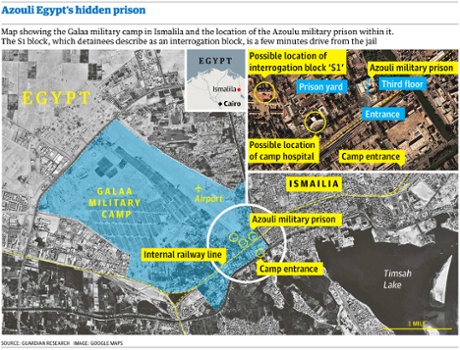
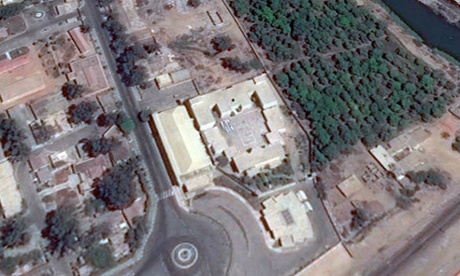
Azouli prison cannot be seen by civilians. It lies inside a vast military camp – the sprawling headquarters of Egypt’s second field army at Ismailia, a city 62 miles north-east of Cairo – but hundreds are nevertheless all too aware of its third and highest floor, where the detainees are held in cramped cells.
Azouli jail in the military base in Egypt.
According to three former inmates, each interviewed separately, the majority of Azouli detainees are Salafis – ultraconservative Muslims – suspected of involvement or knowledge of a wave of militant attacks that began after the violent dispersal of a pro-Mohamed Morsi protest camp in August 2013. Many are from the northern Sinai peninsular, the centre of a jihadist insurgency, but there are prisoners from all over Egypt.
A few are suspected members of the banned Muslim Brotherhood, others were involved in student protests and a significant minority are people with no connection to religious movements who interviewees felt had been arrested at random. All three said at least one prisoner was a child and two said another was a journalist.
The interviewees characterised their detentions as metaphorical fishing expeditions in which they were arrested on little evidence and then tortured to force them to give up any information that would justify their incarceration.
“The issue is that many of those at Azouli are arrested randomly or with very little evidence, and then the intelligence services use torture to find out whether they are actually involved in violence,” said Mohamed Elmessiry, Egypt researcher for Amnesty International, who has led an extensive investigation into Azouli.
For Khaled, a young activist, the torture began before he arrived. Arrested as he went about his daily business several months ago, he alleges that he was beaten and electrocuted by soldiers and military policemen in an enclosed outdoor space for several hours before being driven to Azouli.
“They used up two electric-shock machines,” said Khaled. “They brought a towel and put water on it and put it on my face to stop me breathing. The military policemen kept beating me.
“After four hours my clothes were ripped apart. My face was swollen. My eyes were closed. I got a wound in my jaw deep enough for a soldier to put his finger inside it.”
In the military vehicle on the way to Azouli, Khaled says he was trapped underneath a car seat with his arms locked behind him – a position of prolonged and excruciating pain he says was worse than any he would experience in the coming months.
At Azouli, he says he was immediately placed in a cell on the third floor, where the vast majority of the disappeared prisoners are held.
Two other survivors said they were beaten on arrival by a “welcoming committee” of soldiers, an experience that prisoners in civilian prisons also frequently report.
“When we arrived at the prison, they covered our eyes,” said Ayman, the middle-aged former prisoner. “They took everyone’s valuables and their belts and anything that resembled a rope. Medicines, too. And after that they started the beating. They lined us up against the wall and hit us with sticks, water pipes and fists. This lasted for 10 minutes.
“Then they lined us up and as we walked to the third floor, they beat us as we walked. In the corridor on the third floor, they uncovered our eyes again and started beating us. The warden on the third floor – he was called Gad – kept threatening us: ‘If anyone looks out of the window, if anyone makes any noise, we will beat you.’ And then they beat us for a while, with their fists to our faces. After the beating, they put us in the cell.”
The bottom two floors of the prison have long been used to detain soldiers subject to courts martial. But since July 2013, political detainees have been kept on the third floor, the majority of them in about a dozen cells that each contain between 23 and 28 prisoners.
At any one time, the third floor can hold well above 300 prisoners, with the total number of inmates likely to be higher, since some detainees have left and others have taken their places.
Amnesty believes that up to 20 have been released from any kind of custody. Lawyers also say that a number of others have “reappeared” in civilian jails, accused of terrorism charges based on confessions extracted after torture and interrogation.
The interrogation and systematic torture of Azouli’s prisoners takes place in a separate building – known as S-1 – a few minutes’ drive from the prison. About 10 prisoners are taken there at the middle of each day. Once their names are called, they are let out of their cells to blindfold themselves and form a line. Each survivor said that at this point they would be beaten then led downstairs to a minibus, where they would be beaten again. Prisoners are then driven the short journey to S-1, where they are usually led up a set of wooden stairs to a first-floor office. There the detainees wait – still blindfolded – until they are called one by one to a next-door room.
When Khaled was first called, on his first full day at Azouli, he remembers the unnerving sound of an officer silently flicking his lighter on and off for several minutes before asking a series of questions about the organisation of protests.
“And then the torture started,” Khaled recalled. “It started with electric shocks in every place in my body. [The officer] called the military policemen and told them: ‘Take off his clothes.’ They took me out of the room. I took everything off apart from my boxers. They said: ‘Make yourself totally naked.’ I said no. The officer said: ‘Bring him in.’
“I started to give him some names. He felt I had lied, so he ordered the soldiers to make me totally naked. The electric shocks were in every place in my body, especially the most sensitive areas – my lips, the places with nerves. Behind the ear and lips. Under the shoulders.”
After the electrocutions, Khaled’s hands were tied behind him. He then claims he was hanged naked by the ensuing knot from a window frame – a torture technique known as the Balango method, which left his shoulders and wrists in excruciating pain. Two-and-a-half hours later he was taken down and returned to the cells.
Two other former inmates report similar experiences, though one says he was tied in a different position, and the other – Salah, a man in his 20s – said he was allowed to keep wearing his clothes while being electrocuted.
“The officer asked me if I knew certain people from a list,” said Salah. “If I said no, he would electrocute me … My answers were, of course, no: I don’t stay very much in [my hometown]. So he would electrocute me.
“The electrocution was over my clothes, but on the testicles. I was sitting on the floor, handcuffed. He was sitting on the small table, and would stretch his hands to electrocute me in my testicles.”
The victims cannot know for certain who tortured them. But all three believe that the interrogations were led by officers from military intelligence – the army wing headed until 2012 by Abdel Fatah al-Sisi, Egypt’s new president – with involvement from the secret police, known informally in Egypt as amn ad-dawla, or state security.
One interviewee said he had been brought to Azouli by state security, who handed him over to the army.
According to Ahmed Helmy, a lawyer who represents former Azouli prisoners, many detainees are tortured by military intelligence until they memorise specific confessions to acts of terrorism. Then they are transferred to state security offices where they are asked to repeat these confessions to a police prosecutor. Other detainees from civilian jails confirm meeting Azouli prisoners at this stage in their incarceration.
If they repeat their memorised confessions correctly, Azouli prisoners are then “reappeared” in a civilian jail, where torture is less systematic, and where they are allowed visits from lawyers and relatives. But, says Helmy: “If they don’t confess exactly how the security services want, they’re sent back to Azouli for more torture.”
Helmy represents some of the detainees who he says have been transferred from Azouli to civilian jails. He says some of them may have committed parts of the crimes to which they have confessed, but because of the way their confessions were extracted it was impossible to be sure.
“You can’t know if these people have committed these crimes or not,” Helmy said. “Under the pressure of torture you can admit to anything. It’s clear that some people are admitting to things because of the torture.”
The mother of one former Azouli detainee – now transferred to a civilian jail – said it had taken her son Omar four days of torture and three trips to a civil prosecutor before he would agree to recite his forced confession. Omar’s mother said she feared he had died because during his time at Azouli no state institution would reveal his whereabouts.
She only found Omar again when he re-emerged at an official jail weeks later. “The skin on his nose was raw to the bone,” she remembered of their reunion at a family visit inside the second prison.
“There was a cut with the depth of a fingertip on his neck, which came from being beaten with a metal stick. There were two big wounds on his wrists from the hanging.
“They electrocuted him on his testicles. He said he was threatened with rape and that they used to hang them naked. He said he was prevented from going to the bathroom for six days and they kept him blindfolded for ten days.
“He asked me if we had had any visits, because they threatened that they would arrest his [female relatives], rape them, film it, and then show them the videos.”
The three former prisoners interviewed directly by the Guardian said that they were not tortured at S-1 as many times as detainees such as Omar. Over time, officials appeared to lose interest in them, which may partly explain their eventual release.
Summarising the difference between Azouli and notorious civilian jails such as Cairo’s Scorpion prison, Helmy said: “Scorpion is an official prison under the supervision of the prosecution and it’s visible. But Azouli is in a military area. It’s forbidden for any civilians to go inside.
“When we ask the civil prosecution to investigate people inside Azouli, they say they don’t have any jurisdiction to go there. So it’s a place where military intelligence can take their time and torture people without any oversight.”
At Azouli, prisoners subjected to systematic torture lack even a hypothetical legal redress.
“It gives you an idea of how confident the security forces are today,” said Amnesty’s Mohamed Elmessiry.
“They don’t care about the rule of law. They are holding people for over 90 days and subjecting them to ongoing torture without any judicial oversight. These practices are a devastating blow to detainees’ rights, as enshrined under both Egyptian and international law.”
As Khaled, one of the three survivors, summarised: “Your whole life there is a living tomb. No one knows anything about where you are.”
A senior military officer acknowledged the existence of Azouli prison, but did not respond within a fortnight to specific written allegations, and turned down a request to visit the jail.
ABBAS'S QUISLING FORCES ARE SHOOTING AT PROTESTING PALESTINIANS IN RAMALLAH. THE PROTESTS ARE AGAINST THE STRONG AND CONTINUING COLLABORATION WITH IOF FORCES BURSTING INTO HOMES AND KIDNAPPING HUNDREDS OF PALESTINIANS. WHEN THE IOF CAME INTO RAMALLAH, ABBAS'S FORCES WERE ORDERED TO STAY INSIDE THEIR BUILDING. INSTEAD OF SHOOTING AT THE IOF, THEY SHOT AT PALESTINIAN YOUTH!
مواجهات عنيفة اندلعت فجر اليوم الأحد بين قوات الاحتلال الإسرائيلي والأمن الفلسطيني وبين متظاهرين فلسطينيين عند دوار المنارة وسط مدينة رام الله. الشبان الفلسطينيون صبوا جام غضبهم على الأمن الفلسطيني والشرطة احتجاجا على التنسيق الأمني مع جيش الاحتلال، في مشهد نادر لم تشهده رام الله من قبل.
"At least one [Palestinian] person was killed in clashes between Israeli forces and Palestinians in Ramallah on Sunday as troops continued a crackdown on Islamist group Hamas. Israel blames Hamas for the abduction of three teenagers who have been missing for over a week. Palestinians celebrated as the forces drove away after the raid."
رام الله: مواجهات بين متظاهرين وبين قوات الاحتلال والشرطة الفلسطينية
تاريخ النشر: 22/06/2014 - آخر تحديث: 11:34
ذكرت تقارير إعلامية فلسطينية أن مواجهات عنيفة اندلعت فجر اليوم الأحد بين قوات الاحتلال الإسرائيلي والأمن الفلسطيني وبين متظاهرين فلسطينيين عند دوار المنارة وسط مدينة رام الله.
وقال شهود عيان إن المواجهات بدأت بين قوات الاحتلال وعشرات الشبان في محيط مركز شرطة رام الله الرئيسي، حيث ألقى الشبان الحجارة على الدوريات والجنود التي ردت بإطلاق الرصاص الحي والمطاطي.
وذكر الشهود أن المتظاهرين بدأوا بالهتاف ضد التنسيق الأمني عند اقترابهم من المقر، مستنكرين عدم مقدرة الشرطة الفلسطينية الدفاع عنهم، ثم ألقوا الحجارة على المقر الشرطة وهاجموا مركباتهم، فرد أفراد الشرطة بإطلاق النار في الهواء وعلى المتظاهرين بصورة مباشرة، مما أدى لإصابة شاب في المكان.
وخلال المواجهات مع الاحتلال والشرطة الفلسطينية أقدم الشبان على خلع بوابة مقر الشرطة، وعلى إثر ذلك دارت مواجهات بعد تدخل الشرطة الخاصة أدت لإصابة شابين جرى نقلهما لمستشفى رام الله.
وفي ساعات الصباح، انتشر المئات من أفراد الأجهزة الأمنية الفلسطينية في جميع شوارع مدينة رام الله، وتحديدا عند دوار المنارة.
وكثفت العناصر الأمنية من تواجدها بالزي الرسمي والزي المدني في الشوارع، فيما دفعت بتعزيزات أمام المقر الرئيس للشرطة وسط المدينة، خشية حدوث مواجهات، عقب قيام مجموعات من الشبان بإجبار أصحاب المحال التجارية على الإغلاق والتجمع على دوار المنارة.
وسقط شهيدان فلسطينيان في مدينتي نابلس ورام الله بنيران قوات الاحتلال فجر اليوم
يشار إلى أن الأجهزة الأمنية الفلسطينية دأبت على الانسحاب من شوارع مدن الضفة الغربية قبيل اقتحامها من قبل قوات الاحتلال، فيما أكد الرئيس محمود عباس في مناسبات عدة أن التنسيق الأمني مع الاحتلال مستمر على أرقى المستويات، في سبيل العثور على المستوطنين الثلاثة المختطفين منذ عشرة أيام.
وتطالب الفصائل الفلسطينية على اختلافها بوقف التنسيق الأمني مع الاحتلال، في الوقت الذي تقوم به الأجهزة الأمنية بملاحقة واستدعاء عشرات المواطنين يومياً بسبب الانتماء السياسي.
ونسبت صحيفة "هآرتس" اليوم لعباس قوله في مقابلة أجرتها معه قوله إن أجهزة الأمن الفلسطينية تعمل بالتنسيق مع قوات الاحتلال الإسرائيلي، وأن هذا التنسيق تواصل في الأيام الأخيرة، التي تنفذ فيها قوات الاحتلال عملياتها الواسعة في الضفة الغربية.
وقال عباس إن أجهزة الأمن التابعة للسلطة الفلسطينية أحبطت منذ بداية العام 2013 الماضي ما لا يقل عن 43 محاولة خطف واستهداف إسرائيليين، وأن قوات الأمن هذه تنقذ إسرائيليين يدخلون إلى المدن الفلسطينية وتعيدهم سالمين إلى إسرائيل.