Tuesday, October 18, 2016

Israel to assist Egypt's fragile economy

After years of political turmoil, economic frustration is putting pressure on the al-Sisi administration to remedy its multi-faceted shortcomings; Israeli and American officials see assisting Egypt as a vital security interest.

Ynet

Link

Israel is preparing for a series of large-scale projects with Egypt after many years of separation in economic cooperation between the two countries.


The joint discussions on the projects reflect not only a rapprochement between the two countries, but also an urgent need for improved infrastructure in Egypt given the severe economic crisis that threatens the political stability of the country.

After the signing of the 1979 peace agreement, economic cooperation between the two countries saw a significant boost, which was gradually reduced after Egypt expressed little interest in its renewal.

The Nile River (Photo: shutterstock) (Photo: shutterstock)
The Nile River (Photo: shutterstock)

More recently however, Egypt has raised interest in several projects with Israel—among them, desalinization of sea water to address concerns over water levels in the Nile River, which could lead to a dramatic shortage of water available for drinking and irrigation.

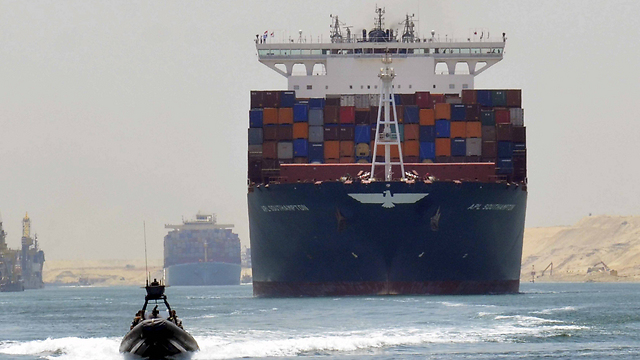
Israel is also preparing to provide cooperation and assistance to Egypt in the fields of solar energy, electricity production, agriculture, irrigation and gas. Additionally, Egypt is also examining the possibility of extending its cooperation to the tourism sector, as the billions invested in an expansion program in the Suez Canal have yet to yield the expected revenue.

Suez Canal (Photo: Reuters) (Photo: Reuters)
Suez Canal (Photo: Reuters)

One of the major factors providing the impetus to the new cooperative efforts stems from political factors which intimately affect Israel’s security.

Indeed, in talks recently held between senior Israeli and American officials, concerns were raised over the stability of the Egyptian regime, with the two allies agreeing that in the absence of any fundamental improvement in the Egyptian economy, social unrest could precipitate the pouring of Muslim Brotherhood forces into the streets to undermine the rule of General al-Sisi.

Similarly, heads of government in Egypt view the economic crisis as a major strategic threat to their country and, as such, they are placing emphasis in Egypt and abroad on efforts to increase revenue and expand infrastructure.

Egypt's economic crisis has been greatly exacerbated by the ongoing fighting raging in Sinai and Libya as well as its support to Saudi Arabia in Yemen. In addition, only a portion of the financial commitments from Saudi Arabia, the UAE and Kuwait have been received. Furthermore, the request to the IMF for $12 billion was granted on a series of conditions regarding a reduction of bureaucracy, increasing taxes and reducing subsidies—measures which, in the short term, could incite the Egyptian public.

Emad Hajjaj's Cartoon: القدس ومعارك التحرير

القدس ومعارك التحرير

مخاوف إسرائيلية من انهيار نظام السيسي

مخاوف إسرائيلية من انهيار نظام السيسي

Link

كشف المحلل العسكري في صحيفة "يديعوت أحرونوت"، أليكس فيشمان، أنّه من المرتقب أن تقوم إسرائيل بتنفيذ عدة مشاريع استثمارية في مصر، لا سيما في مجال بناء وتحسين البنى التحتية، مع عودة التعاون بين الطرفين، في ظل مخاوف إسرائيلية "جدية" من انهيار نظام الانقلاب الذي يقوده عبد الفتاح السيسي، بفعل فشل سياساته الاقتصادية، وتراجع الأوضاع المعيشية للمصريينتحت حكمه.


وأشار في تقريره اليوم الثلاثاء، إلى أنّ
مصر قدّمت لإسرائيل قائمة تطلب فيها التعاون لإنجاز مشاريع إنماء وتطوير للبنى التحتية، وذلك بعد سنوات من غياب التعاون الملموس في هذا القطاع، مشيراً إلى أنّ وزارة الأمن الإسرائيلية تدرس المشاريع.

ومن المشاريع التي تطلب فيها مصر مساعدة إسرائيلية، مشروع لتحلية مياه البحر، وذلك بفعل انخفاض منسوب المياه في نهر النيل إلى درجة تهدد قدرتها بعد عقد من الزمن، على توفير مياه الشرب ومياه الري للزراعة، في ظل الكثافة السكانية.

كما تدرس إسرائيل تقديم مساعدات لمصر في مجال الغاز والزراعة وتطوير الطاقة الشمسية، وإنتاج الكهرباء، وكذلك تشجيع حركة السياحة العالمية إلى مصر، وليس فقط السياحة من إسرائيل، وذلك بعد فشل مشروع القناة الفرعية في قناة السويس، بتحريك عجلة الاقتصاد المصري، على الرغم من الاستثمارات الهائلة والمليارات التي تم تخصيصها للمشروع.

وفقاً للتقرير، فقد جرت ولا تزال تجري اتصالات سياسية رفيعة المستوى، بين النظام المصري وبين إسرائيل وجهات أميركية، بعد أن تبين وجود مخاوف جدية على مصير نظام الانقلاب وقدرته على البقاء والصمود لسنة أخرى.

وبحسب هذه التقديرات، فإنّه في حال لم يطرأ أي تغيير حقيقي وملموس على الأوضاع الاقتصادية في مصر خلال العام 2017، فمن شأن حالة الغليان الاجتماعية أن تعيد إلى السلطة "جماعة الإخوان المسلمين"، وأن تهزّ حكم السيسي.

وأكد التقرير أنّ قادة النظام في مصر يعتبرون ويقرّون بأنّ الأزمة الاقتصادية التي تعصف بالبلاد، تشكّل خطراً استراتيجياً أساسياً، لذلك يسعون إلى بذل جهود في مصر وخارجها، سعياً لزيادة الدخل العام، وتسريع إنجاز البنى التحتية.

وأشار التقرير إلى أنّ توجه مصر للحصول على قرض من صندوق النقد الدولي بقيمة 12 مليار دولار، قوبل بسلسلة شروط أهمها فرض ضرائب، وتقليص الجهاز البيروقراطي، مما من شأنه أن يزيد من حالة الغليان العامة.

ووفقاً للتقديرات، بحسب التقرير، فإنّ العام 2017 سيكون مصيرياً لبقاء النظام الحالي في مصر، إذ تقوم إسرائيل حالياً ببذل جهود مضاعفة، واستغلال علاقاتها مع الأميركيين ودول أخرى من أجل دعم الاقتصاد المصري.

Monday, October 17, 2016

ما وراء الخبر-ما الذي تحمله زيارة علي مملوك للقاهرة؟

بدايات نظام يتهاوى في مصر

A GOOD PIECE

خليل العناني
بدايات نظام يتهاوى في مصر
Link

استنفد نظام الجنرال عبد الفتاح السيسي فرص بقائه في السلطة، وبات على شفا جرفٍ سوف ينهار به في أي لحظة. هذا ليس تمنيّاً أو تفكيراً رغبوياً، وإنما قراءة في حالة التداعي التي يبدو عليها هذا النظام الذي فشل في جميع المهام التي قيل إنه جاء لأجلها. وهو فشلٌ لن تنفع معه حالة الاستنفار الإعلامي الكاذبة التي تحاول الآلة الإعلامية للسيسي وحلفائه شحنها، من أجل لفت الأنظار عن الكارثة التي تنتظر البلاد، وهي كارثةٌ بدأت أصواتٌ محسوبةٌ على السيسي في التحذير منها علانية.
ليس سقوط نظام السيسي سوى مسألة وقت، وقد بدأت مؤشراته بالفعل. وهو سقوطٌ بدأ بذوبان الفكرة الأصلية التي استند عليها، وهي أنه "جاء كي يستبدل النظام الفاشل لجماعة الإخوان المسلمين"، وذلك علي نحو ما يكرّر السيسي دائماً في خطبه، فقد ثبت بالدليل والبرهان أن فشل السيسي تجاوز، بعشرات المرات، فشل الرئيس المعزول محمد مرسي الذي كان يملك ولا يحكم. مع الفارق الكبير أن السيسي كان، ولا يزال، معه كل المؤسسات الرسمية وغير الرسمية في الدولة، بدءاً من المؤسسة العسكرية، مروراً بالداخلية والقضاء، وانتهاء بالإعلام ودعم قوى المعارضة اليمينية واليسارية، على مختلف جماعاتها وأحزابها. والأكثر من ذلك أنه نظامٌ حظي، ولا يزال، بدعم إقليمي ودولي لم يتوفر لمن سبقوه، بمن فيهم حسني مبارك، وانهمرت عليه الأموال من الشرق والغرب، وعلى الرغم من ذلك، فشل فشلاً ذريعاً في توفير حياةٍ كريمةٍ لملايين المصريين. فرأينا شاباً يحرق نفسه، بعد أن ضاقت به الدنيا. وبدأنا نسمع، بشكل يومي ومتكرّر، شكاوى المواطنين من صعوبة الظروف الاقتصادية والاجتماعية. وبدأت الأصوات تعلو بالنقد للسيسي، خصوصاً في الدوائر الشعبية التي صفقت ورقصت لها قبل عامين، وهي الأصوات التي يحاول الجهاز القمعي للسيسي إسكاتها والتعمية عليها. 

ما فعله السيسي، سياسة واقتصاداً واجتماعاً، يتجاوز بمراحل كل ما فعله الرؤساء الذين حكموا مصر، منذ نهاية العهد الملكي أوائل الخمسينيات. ولا يمكن وضعه، على نحو ما يحاول ناصريون حالمون، في مرتبة جمال عبد الناصر الذي، على الرغم من سلطوية الأخير وقمعه، فقد كان يمتلك مشروعاً قومياً للتنمية والتحديث، استطاع من خلالها تغيير أسس النظام الاقتصادي والاجتماعي وبنيته لصالح ملايين المصريين، على عكس السيسي الذي لا يفوّت فرصةً لكي يطالب المصريين بأن يدفعوا من جيبوهم، كي يظل هو في السلطة، ووصل به الأمر، أخيراً، لكي يطالبهم بألا يأكلوا وألا يناموا، لو تطلب الأمر ذلك.
وعلى الرغم من الصورة التي يحاول نظام السيسي رسمها لنفسه، باعتباره نظاماً قوياً ومسيطراً، إلا أن الحقيقة تشي بعكس ذلك، فعندما يهتز نظام لمجرد توجيه سائق "توك توك" انتقاداتٍ لاذعةً له ولسياساته، فهو نظام فاشل. وعندما لا يتحمل نظامٌ سخرية مجموعة من الشباب، كما الحال مع فرقة "أطفال شوارع" التي اعتقلها قبل فترة، بسبب نشر فيديوهات سخرية علي الإنترنت، فاعلم أنه نظام واهٍ. وعندما لا يستطيع نظامٌ، على الرغم من سلاحه وعتاده الذي يفاخر به دوماً، حماية جنوده من رصاص مجموعات إرهابية شاردة، فاعلم أنه ضعيفٌ، ينخر السوس في عظمه. وعندما ينزعج جنرالٌ، يدّعي دوماً امتلاك المعرفة والحكمة والفلسفة، من مقالاتٍ نقدية عارضةٍ، تتحدث على استحياء، فاعلم أنه تافه.
وعلى عكس ما قد يعتقد بعضهم أن نظام السيسي يمثل "ضرورةً إقليمية ودولية"، بسبب الأوضاع التي تمر بها المنطقة الآن، فإن دوائر غربية تعبر، بشكل متواصل، عن قلقها من أن يؤدي استمرار السيسي في السلطة إلى انهيارٍ كامل للمنطقة، ولأكبر دولها. وقد خرجت تقارير غربية، أخيراً، تحذّر من وقوع انتفاضة فوضوية في مصر، إذا ما ظلت الأوضاع السياسية والاقتصادية والاجتماعية على ما هي عليه. وقد راهن الغرب، خطأً، على قدرة السيسي على جلب الاستقرار إلى مصر، فتم دعمه دبلوماسياً وسياسياً، وتم الاعتراف بشرعيته تحت ضغوط الأمر الواقع. ولكن، بدأت عواصم غربية، أخيراً، في مراجعة استراتيجيتها تجاه مصر، وإنْ بشكل غير معلن. وحسب دوائر غربية، فإن ثمّة انتقاداتٍ لاذعةً يتم توجيهها إلى المسؤولين المصريين، في لقاءاتهم بنظرائهم الغربيين، وثمّة مطالباتٌ بأن يقوم السيسي بتغيير الاتجاه الحالي، "وإلا فإن الوقت لن يكون في صالحه". وتتحدّث دوائر إقليمية عن ضرورة بدء التفكير في بدائل للسيسي، قبل أن يطيح مصالحها. ولعل ما يجعل الأطراف الدولية والإقليمية متردّدة في رفع الغطاء والدعم عن السيسي، هو غياب البديل المدني الجاهز الذي يمكنه أن يحلّ محل السيسي. وهو ما يُلقي بالمسؤولية على قوى التغيير التي ترفض، حتى الآن، الاتفاق علي برنامج سياسي موحد، يمكنه الخروج من البلاد من مأزقها الحالي. ولا تزال عاجزة عن التواصل مع الشارع، والاستفادة من حالة الغضب المتزايدة على وقع الفشل المتزايد للسيسي.
سقط نظام السيسي، فكرةً ومشروعاً، في عيون كثيرين وأذهانهم، خصوصاً من مؤيديه، ولم يعد سوى أن تُرفع عنه أجهزة الإنعاش الإقليمية والدولية، والتي لن تتحمل مزيداً من الإخفاق الذي قد يودي بها وبمصالحها، وهو أمر يبدو الآن أقرب من أي وقت مضى.

DNA - 17/10/2016 الإعلامي شبشار الأسد

Sunday, October 16, 2016

A Shia act of piety or forbidden trend? The debate on self-inflicted wounds on Ashoura

Not all Shia are on the same page when it comes to the practice of making self-inflicted wounds - tatbir - on the last day of Ashoura

Abbas, 19, says the bloodletting ritual is among the most important parts of the religious festival of Ashoura (MEE/Lizzie Porter)
Link

NABATIEH, Lebanon - Abbass pulls a cut-throat razor from his pocket, and shows me the blade, glistening under the roaring sun.
“I am waiting for my friends, and then we will go to cut ourselves,” the 19-year-old says. He mimics the series of sharp blows he will make to the crown of his head. “I will maybe cut more than last year. I have been doing this since I was two years old.”
The business management student also has a two-foot long blunt sword in his hand – "$10, bought from just round the corner,” he says.
This conjuncture would be slightly unusual – were it not the tenth day of Ashoura, a period of mourning, for Imam Hussein ibn Ali, the Prophet Mohammed’s grandson. Killed in 680 AD by Caliph Yezid I’s forces during the Battle of Karbala, in modern-day Iraq, Hussein is revered as the third imam by Shia.
It would even be more unusual were we not in the southern Lebanese town of Nabatieh.
An hour from Beirut, this Shia majority town is one of a few places in the world where the last day of Ashoura sees mass practice of tatbir. Men, boys and a few women make incisions on their foreheads, before repeatedly hitting the wound with the flat of a sword to keep the blood flowing.
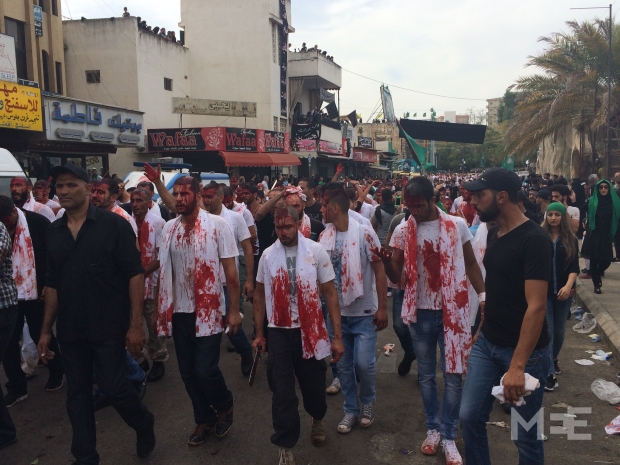
Young men covered in their own blood march through the streets of Nabatieh, chanting slogans commemorating Imam Hussein (MEE/Lizzie Porter)
50,000 people gather in Nabatieh for the commemoration, among them women representing members of Hussein’s family, cloaked in black and holding plastic dolls wrapped in green swaddling. “Dead,” one says, making a cut-throat gesture. Stalls selling sweetcorn and water line the streets, and a veritable paparazzi of onlookers snap away on smart phones.
But, among tight security, the attention focuses on the groups of increasingly bloody men and boys, who cut their foreheads in mourning for Imam Hussein. They parade in their thousands through Nabatieh’s streets, chanting, “Haidar, haidar!” - meaning lion, an alternative name for Imam Ali, Hussein’s father.
For some Shia Muslims, with no tatbir, there is no Ashoura.
“The tatbir is the best thing I can do for Ashoura,” continues Abbass, who asks that MEE publish only his first name. “Here I am with people I love. It is the best day and the saddest day at the same time.”
Parades begin from the town's Husseiniya building, where men gather to partake in the blood-letting ritual (MEE/Lizzie Porter)

Divisive practice

But in a region where politics and religion are seldom separate entities, the practice is undeniably divisive. Sunni Muslims, along with many other Shia, consider it haramor forbidden in Islam because it constitutes a form of self-harm.
In Iran, Ayatollah Khamenei has issued a fatwa against it.
During this year’s Ashoura, a spokesperson for the Iranian Grand Ayatollah Sayyid Ali al-Sistaniissued a statement that avoided clarifying his position on the practice. He said that the leader would not get involved in “such a fruitless debate,” blameable on “those who ignite it every year with the purpose of defeating the opposing party”.
In Lebanon, imams in Nabatieh close to the political party the Amal Movement have condonedtatbir, saying bloodletting on one day of the year in memory of Hussein is acceptable.
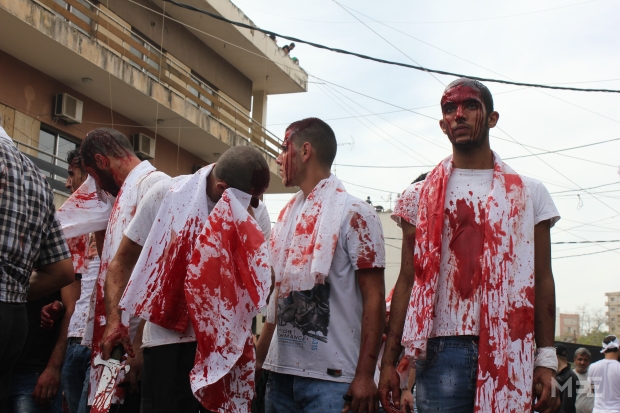
The bloodshed is practised by a relatively small number of Shi'a Muslims (MEE/Lizzie Porter)
Many of Nabatieh’s residents are Amal supporters, and – today at least – posters of its founder Moussa al-Sadr far outweigh those of Ayatollah Khamenei or Hezbollah’s Party Secretary Hassan Nasrallah. Bands of youth in T-shirts bearing the party’s logo are prominent among the blood-letters, although Abbass insists that groups form based on friendship and villages, not political affiliations.  
One man, who stumbles off to follow a group of mourners before he can give his name, claims it is “politics” that bans tatbir.“ It is a necessary part of our worship,” he bellows.
Hezbollah, (also refered to as the Party of God), Amal’s fellow Shia political party, distinctly disapproves of the practice. Nasrallah has advised followers to donate blood instead of cutting themselves.
On the tenth day of Ashoura, participants in Nabatieh are required to pass a checkpoint manned by guards in Hezbollah jackets, but once inside the procession space, only a small number of guards are visible. A spokesperson for the Party of God said that, as was tradition, they would hold their own separate, blood-less celebration in the town on the thirteenth day of Ashoura.
One Hezbollah supporter in Nabatieh sits well out from the tatbir and wrinkles his face in disgust when blood sprays from participants onto his hands.
“I am Shia but I really do not like this cutting,” he tells Middle East Eye, speaking on condition of anonymity. “I give blood instead,” he adds, making an injection gesture on his arm.
But he explains another reason for the large numbers gathering in Nabatieh and al-Dahiye, Hezbollah’s stronghold in the southern suburbs of Beirut.
“Sons, brothers and fathers are dying fighting in Syria every day. I have lost so many friends, so many friends. That’s why people are coming here in such large numbers.”
Tradition and the desire to gather among other fellow believers are behind the wild popularity of Ashoura, and tatbir in particular, in Nabatieh.
The practice of cutting open one's forehead is known as "tatbir", and is part of mourning Imam Hussein, who was killed by Ummayyad armies (MEE/Lizzie Porter)

Solidarity against perceived threats

Professor Andrew Newman, an expert on Shiism at the University of Edinburgh, explained that one reason for increasing participation in Ashoura rituals could be a statement of solidarity against perceived threats, whether against Bahrain’s monarchy, Sunni extremists in Iraq, or the Taliban in Afghanistan.
Days previously, a Saudi-led coalition air strike on a funeral in Yemen killed 140 people, and many of the Shia in Nabatieh cite their participation as solidarity with the victims.
Zeina, who gave only her first name, from the town of Bint Jbeil, listened quietly to a sermon in the Hussainiya, the religious building from which the Nabatieh’s Ashoura processions begin.
“This is the first time I have been here in 20 years,” she said. “Look what happened in Yemen. There is fear and violence and problems in the world and here we Shia come together. We want peace for others and we wish that they want peace for us too.”
The student, Abbas, who soon disappears to begin his tatbir, adds:
“It [the bloodshed] makes us feel the pain of our people, people who are killed. Why do people kill other people? The same people who killed Imam Hussein are still killing us up until now. All people hate us [Shia] and I feel sorry and sad for that.”
Thousands of green and black clad spectators gathered to watch a reenactment of the Battle of Karbala, at which Hussein was killed (MEE/Lizzie Porter)
Around midday, a grand ta’ziyeh – re-enactment of the Battle of Karbala – takes place, with actors mounted on horses and camels playing out the slaying of Hussein by Yezid I’s armies, in front of whom Hussein is believed to have stood alone. It is a professional piece of theatre, watched by thousands of spectators clad in green and black, some people hanging off nearby rooftops, cardboard juice boxes used as make-shift fans against the heat.
Women do not traditionally take part in tatbir, but today a few join in, citing their reason as the “love of Hussein”. Mona, 29, from Nabatieh, says “we do this to be like Hussein,” before moving away as part of a large crowd, chanting and beating their foreheads, making blood spray from them. “I do not feel anything, I do not feel pain,” she says.
A small number of young girls are also cut, their heads now wrapped in bandages.
“The belief is passed from father to son, and we want to do this to make sure our children learn the love of Hussein,” says the father of one girl, who does not wish to give her name.
17-year-old Reem, however, is not shedding blood. She and three female friends, clad in elegant emerald green headscarves, interpret their faith differently.
“God says we should live in peace and not hurt ourselves,” she says eloquently.
“We want to show people in Yemen and Bahrain that they are not alone.”
She adds that the cutting is “a bit of a trend” among some people. "One person does it and then the others follow. Some girls do it, if for example they want more chance for an exam or something, (through an increase in blessings) but that is not the tradition. It depends on the person.” 

The need to see blood

Indeed, the occasion is not without its victims.
Ali al-Nasreddine, post manager for the Islamic Risala Scout Association first aid workers said last year his team treated 1,200 people for blood loss and fainting. “Some people faint at the sight of blood, others at the heat. We treat wounds and do everything we can here – only in extreme cases do we take people to hospital.”
They expected similar numbers this year. “And the other first aid posts, like the Lebanese Red Cross, will maybe also see 1,000 each too.”
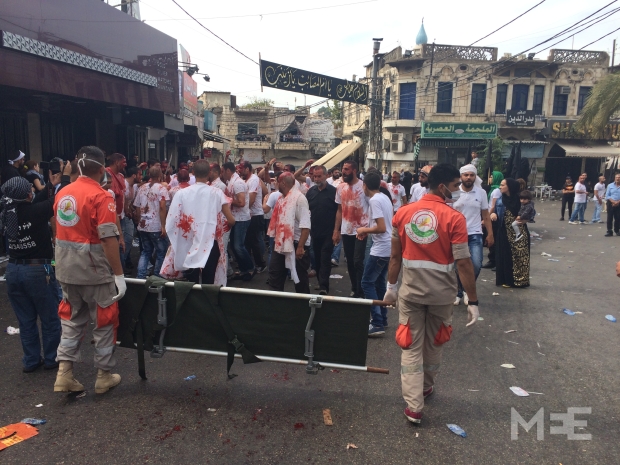
Aid workers carrying stretchers accompanied mourners, and tended to scores of people suffering from the effects of blood loss (MEE/Lizzie Porter)
At the station, spray bottles of liquid Savlon are placed next to bowls full of white bandages. Later, they are wrapped around the heads of people who have been patched up after participating in the tatbir ritual.
Authorities did not respond to MEE’s request for comment on how many hospitalisations took place on the day. But one man soaked in blood was seen suffering fits during the processions, and aid workers carrying stretchers accompanied every group of blood-stained mourners. 
As midday comes and goes, the crowds thin in the streets. Rubbish and white calico over-shirts, blossoming with red stains, litter the streets, which city municipality workers sweep clean of blood.
As Nabatieh empties, the half-joking words of one security guard ring clear, although are not, perhaps, an entirely logical argument in favour of tatbir.
“It’s important you know the facts behind this tradition,” he says. “These people live in the Middle East, they need to see blood – since they will see a lot of it in their lives”.
The debate continues. 

Yemen's Houthi rebels 'receiving Egyptian military hardware'

Yemen's Houthi rebels 'receiving Egyptian military hardware'

Link

Houthi rebels in Yemen have received a dozen advanced military boats and other supplies from Egypt over the past few months, a senior Yemeni official has told The New Arab.
Houthi rebels have received a dozen advanced military boats and other supplies from Egypt, a senior Yemeni official has told The New Arab.
The official who works directly with the Houthis and their allies on Yemen's western coast alleges that the Egyptian navy delivered the hardware to the rebels in the past two months.
The anonymous official said that the boats were supplied by the Egyptian navy and to the commander of a military base in westernHodeida province through an associate of former president Ali Abdullah Saleh.
The transaction took place on an island off the coast of al-Luhayyah, in northern Hodeida province, the official told The New Arab.

The official claims that despite Egypt's government having close ties with Saudi Arabia, Cairo also established good relations with the Yemeni rebels after the start of the Saudi-led military intervention in the country.
Egypt is officially part of the Saudi-led coalition fighting Houthi rebels in Yemen, but has been severely criticised by its Gulf Arab allies for failing to commit ground troops to the operation.
More recently, Egypt broke ranks with its Gulf allies when it voted in favour of a Russian-drafted UN Security Council resolution on Syria strongly opposed by Riyadh.
Two days later, Cairo announced that Saudi oil giant Aramco halted petroleum shipments for October, which were part of a deal signed in April for Aramco to deliver 700,000 tonnes of products monthly to Egypt.
Egyptian President Abdel Fattah al-Sisi last week defended his country Security Council vote saying "We are very, very careful about our historical relations with our brothers in the Gulf…but in the context where we respect our sovereignty, together."
"If you want real sovereignty in decision-making, nations that are sovereign in their decisions suffer, suffer a lot," Sisi added.
"Those who want to have a free will must endure," he said.

Syria talks: The urgent question

As US falters Russia becomes both judge and executioner in Syria.


By Marwan Bishara


As any student of international affairs would tell you, diplomacy is a reflection of the balance of power, not the balance of rhetoric. And in Syria, power has tilted in favour of Bashar al-Assad and his Russian patrons after the Kremlin decided to intervene militarily in Syria in September last year.
Nonetheless, the White House, which preferred to keep a distance from the Syrian war, saw an opportunity in the new Russian challenge to US hegemony in the Middle East. Vladimir Putin might have been emboldened by the intervention, but he also gained more leverage over the Assad regime and succeeded in sidelining Iran.
Analysis: Significance of Turkish-backed Syrian rebels taking Dabiq from ISIL
The Obama administration reckoned that working things out with Russia would be tidier and more productive than having to deal with Assad or his backers in Tehran.And it would pave the way towards cooperation by Russia in the war against ISIL and al-Qaeda.
US Secretary of State John Kerry has been trying ever since to no avail. Not only has he failed to bring the Russians to agree to a minimalist diplomatic settlement, but his latest failure to bring about at least a ceasefire in Aleppo makes it clear that Russia, while capable, is unwilling to use its leverage to bring about a diplomatic solution.
None of this should come as a surprise. The writing has been on the wall for some time.

Obama's reluctance, Putin's belligerence

The United States and Russia might have co-sponsored various attempts in Geneva and Vienna to bring about a political solution to the Syrian war, but ever since the Syrian issue became entangled in global power politics, it ceased to be about the Syrian future. Syrians went on to suffer and die as the whole country is sacrificed on the altar of superpower cynicism.
US-Russian confliction over Libya and Ukraine took its toll on Syria. Instead of settling the conflict, Washington and Moscow began settling scores with Russia taking the lead.
Russian President Vladimir Putin [Reuters]
Obama's reluctance to adequately support the opposition or make Assad pay for trampling over his red lines by using chemical weapons against his peoples provided Putin with an opportunity to up the ante. He increased arms shipments to Assad and eventually intervened directly on his side.
Putin's gamble worked: He changed the balance of power in Assad's favour and had little or no incentive to get rid of him. Not even in favour of a transitional ruling coalition of regime and opposition forces that leaves the state structures intact.
For the Syrian opposition, the pressures multiplied. They had to fend for themselves on two fronts: from the Russian-supported Assad regime and from ISIL.
And not only have they miraculously withstood the unrelenting bombardments, they even made progress against ISIL, latest this week, by recapturing the northern town of Dabiq from ISIL - long considered important to fulfil the group's apocalyptic prophesy.
Curiously, this same American administration that slapped Russia with tough sanctions because of its intervention in Ukraine, has rewarded it for its intervention in Syria.

A flawed process

Curiously, this same American administration that slapped Russia with tough sanctions because of its intervention in Ukraine has rewarded it for its intervention in Syria.
You might expect that the US would at least rethink its calculus and change its expectations following Russia's military. It didn't. The Obama administration has instead widened its deliberations with Russia as the lesser of two evils - war being the other evil.
But war continued unabated.
Worse, the US designated Russia as the go-to power to talk about Syria, with US officials nudging their Arab counterparts and Syrian opposition figures to go to Moscow to vent their frustrations and share their ideas. Suddenly, more diplomats were flocking to Moscow than Washington in pursuit of a Syrian solution.
But Russia became at once the judge and executioner; a co-sponsor of the Syrian talks and the co-bomber of opposition strongholds.
It protected the Assad regime in the international forums and helped Assad forces regain control of areas "liberated" from his army and militias.
Russia went on to translate its military superiority into tactical and diplomatic gains with Kerry happy to oblige in the hope of keeping the process alive.
The US accepted Russia's diktats in separating the opposition into "terrorists" and "moderates" to pursue militarily, and "moderates" before agreeing to a political settlement (Assad insisted they were all terrorists or treacherous). 
But it failed to convince or coerce the Russians to make the same distinction on their side, including Assad and Iran supported forces and militias, which are responsible for most of the civilian deaths in the country.
But then, at least the US is trying to make diplomacy work. Right?

A for effort?

Kerry has been given immense credit for his unrelenting efforts to pursue a diplomatic solution to the Syrian crisis. Just when you'd think "Mr Diplomacy" is done trying, he comes back with a new framework. And just when you think he's snapped and there's no turning back, he creeps back as if nothing had happened.
US Secretary of State John Kerry [Reuters]
But then he's at the service of a president who's so indifferent; he won't consider any alternative to cheap-talk, knowing all too well that Putin is playing a cynical game.
After four years of diplomacy, the United States may still be the one calling for the talks, but it's Russia calling the shots both on the ground and in the negotiations.
And Russia made it clear it won't give up in the negotiations what it won on the ground.
All of which brings me to the most important question of the day: When does diplomacy stop being a way to resolve the conflict and starts becoming a way to cover up for war and war crimes? Or, in other words, has diplomacy become the continuation of Russia's war by other means in Syria?
Marwan Bishara is the senior political analyst at Al Jazeera. Follow him on Facebook.

Al-Jazeera Cartoon: Partners in Crime

كاريكاتير: الشعب السوري