
Thursday, February 27, 2014


‘Trigger-happy’ Israeli army and police use reckless force in the West Bank
Amnesty International

Bilal Tamimi being attacked by an Israeli soldier at a protest in Nabi Saleh in May 2013.
© Tamimi Press
At a Glance
- Amnesty International documented the killing of 22 Palestinian civilians in the West Bank in 2013. At least four were children.
- According to the UN, more West Bank Palestinians were killed by Israeli forces in 2013 than in 2011 and 2012 combined.
- In the last three years at least 261 Palestinians, including 67 children, have been seriously injured by live ammunition fired by Israeli forces in the West Bank.
- More than 8,000 Palestinians in the West Bank, including 1,500 children, have been wounded with rubber-coated metal bullets and the reckless use of tear gas since January 2011.
"Israeli forces have displayed a callous disregard for human life by killing dozens of Palestinian civilians, including children, in the occupied West Bank over the past three years with near total impunity, said Amnesty International in a report published today.
The report, Trigger-happy: Israel’s use of excessive force in the West Bank, describes mounting bloodshed and human rights abuses in the Occupied Palestinian Territories (OPT) as a result of the Israeli forces’ use of unnecessary, arbitrary and brutal force against Palestinians since January 2011.
In all cases examined by Amnesty International, Palestinians killed by Israeli soldiers did not appear to be posing a direct and immediate threat to life. In some, there is evidence that they were victims of wilful killings, which would amount to war crimes.
“The report presents a body of evidence that shows a harrowing pattern of unlawful killings and unwarranted injuries of Palestinian civilians by Israeli forces in the West Bank,” said Philip Luther, Middle East and North Africa Director at Amnesty International.
“The frequency and persistence of arbitrary and abusive force against peaceful protesters in the West Bank by Israeli soldiers and police officers – and the impunity enjoyed by perpetrators – suggests that it is carried out as a matter of policy.”
Deaths and injuries
Amnesty International has documented the killings of 22 Palestinian civilians in the West Bank last year, at least 14 of which were in the context of protests. Most were young adults under the age of 25. At least four were children.
According to UN figures, more West Bank Palestinians were killed by Israeli forces in 2013 than the total number killed in 2011 and 2012 combined. Forty-five were killed in the past three years.
Peaceful protesters, civilian bystanders, human rights activists and journalists are among those who have been killed or injured.
In the last three years at least 261 Palestinians, including 67 children, have been seriously injured by live ammunition fired by Israeli forces in the West Bank.
An astonishing number of Palestinians in the West Bank - more than 8,000, including 1,500 children – have been wounded by other means, including rubber-coated metal bullets and the reckless use of tear gas, since January 2011. In some cases documented, victims have also died as a result of their use.
“The staggering numbers of wounded provide a sobering reminder of the relentless daily danger faced by Palestinians living in the occupied West Bank,” said Philip Luther.
Several victims were shot in the back suggesting that they were targeted as they tried to flee and posed no genuine threat to the lives of members of Israeli forces or others. In several cases, well-armoured Israeli forces have resorted to lethal means to crack down on stone-throwing protestors causing needless loss of life.
Investigations
More than a year later, the findings of investigations by the Israeli authorities into a number of suspected unlawful killings have yet to be revealed.
“The current Israeli system has proved woefully inadequate. It is neither independent nor impartial and completely lacks transparency. The authorities must conduct prompt, thorough and independent investigations into all suspected instances of arbitrary and abusive use of force, especially when resulting in loss of life or serious injury,” said Philip Luther.
“A strong message must be sent to Israeli soldiers and police officers that abuses will not go unpunished. Unless those who commit violations are held to account unlawful killings and injuries are bound to continue.”
Protests
In recent years, the West Bank has seen continuing protests against the prolonged Israeli occupation and a litany of related repressive policies and practices. These include the ever-expanding unlawful Israeli settlements, the 800km-long fence/wall, forcible house demolitions, forced evictions, Israeli military checkpoints, roads reserved for use by Israeli settlers from which Palestinians are excluded and other restrictions on the movement of Palestinians in the OPT.
Protests are also held against the detention of thousands of Palestinians and in response to Israeli military strikes in Gaza and the killing or injury of Palestinians in protests or during arrest raids.
Arms transfers
Amnesty International is calling on the Israeli authorities to instruct their forces to refrain from lethal force, including the use of live fire and rubber-coated bullets, except when strictly necessary to protect lives. They must also respect the right of Palestinians to peaceful assembly.
It urges the USA, the European Union and the rest of the international community to suspend all transfers of munitions, weapons and other equipment to Israel.
“Without pressure from the international community the situation is unlikely to change any time soon,” said Philip Luther.
“Too much civilian blood has been spilled. This long-standing pattern of abuse must be broken. If the Israeli authorities wish to prove to the world they are committed to democratic principles and international human rights standards, unlawful killings and unnecessary use of force must stop now.”
Case study: A child killed for protesting
In the West Bank, the tragic consequences of Israel’s policy of supressing Palestinian protest have become a familiar story.
Samir Awad, a 16-year-old boy from Bodrus, near Ramallah, was shot dead near his school in January 2013 while attempting to stage a protest with friends against Israel’s 800km-long fence/wall, which cuts through their village. Three bullets struck him in the back of the head, the leg, and shoulder as he fled Israeli soldiers who ambushed his group. Witnesses said the boy was directly targeted as he ran away.
Malik Murar, 16, Samir’s friend who witnessed his killing, told Amnesty International:“They shot him first in the leg, yet he managed to run away… how far can an injured child run? They could have easily arrested him… instead they shot him in the back with live ammunition.”
Amnesty International believes Samir’s killing may amount to extrajudicial execution or a wilful killing, which is considered a war crime under international law.
“It’s hard to believe that an unarmed child could be perceived as posing imminent danger to a well-equipped soldier. Israeli forces appear in this and other cases to have recklessly fired bullets at the slightest appearance of a threat,” said Philip Luther.
Under international law, the police and soldiers enforcing the law must always exercise restraint and never use arbitrary force. Security forces may only resort to the use of lethal force if there is an imminent risk to their lives or the lives of others. Israel has repeatedly refused to make public the rules and regulations governing the use of force by army and police in the OPT.
Israeli soldiers have a long history of using excessive force against Palestinian demonstrators in the West Bank extending back to at least the first Intifada in 1987.
Wednesday, February 26, 2014
Current Al-Jazeera (Arabic) Online Poll

Do you believe Iraq's denial of an arms deal with Iran?
So far, 92% have voted no.
Egypt: End military trial of journalists

"Egypt’s armed forces must end the military trial of two journalists, release them immediately and unconditionally, and drop all charges against them, Amnesty International said as it named both men prisoners of conscience.
Amr Al Qazaz and Islam Farahat are to appear before the North Cairo Misdemeanour Military Court on 26 February 2014, on charges of illegally obtaining and publishing classified military documents and videos – including interviews with Egypt’s Defence Minister Abdel Fattah Al Sisi. If convicted, both men could face up to three years in prison.
“The two journalists are prisoners of conscience detained solely for peacefully exercising their right to freedom of expression by performing their jobs,” said Philip Luther, Middle East and North Africa Programme Director at Amnesty International.
“The Egyptian authorities must release them immediately and unconditionally, and drop all charges against them. Journalism is not a crime, and civilians, including journalists, should never face trial in military courts.”
The Egyptian military authorities maintain that the videos and documents – which the journalists allegedly published on the internet – could destabilize the security situation in the country.
According to Egyptian human rights lawyer Ahmed Helmy, the journalists’ case file alleges that the classified military information they published includes videos of the Defence Minister being interviewed by the Egyptian daily Al-Masry Al-Youm as well as of a meeting he held with other senior military officials under his command.
The journalists are also accused of publishing 21 documents which include details of the government’s planned response to the banned Muslim Brotherhood’s attempt to defend its legitimacy and the legitimate rule of ousted President Mohamed Morsi.
Amr Al Qazaz’s family has told Amnesty International that plain-clothes armed security officers arrested him at his home on 12 November 2013. They searched his flat and confiscated his laptop, phones, camera, papers and books. Six days later, Military Intelligence officers reportedly arrested Islam Farahat on a Cairo street and took him away in a car with civilian licence plates.
The two men were taken to the Military Intelligence Unit in the Hadayek El Kubba area of Cairo, where they were held for at least 10 days while the military prosecutor carried out investigations. According to their families, they were blindfolded and handcuffed throughout their interrogation in the Military Intelligence office.
The imprisonment of Amr Al Qazaz and Islam Farahat is a violation of international and Egyptian law. The newly adopted Egyptian Constitution in its article 71 prohibits imprisonment in cases involving “crimes” related to publishing.
Both families told Amnesty International that they could not visit the two men until they were transferred from the Military Intelligence office to Al Mahkoum prison in Tora, reportedly on 25 November. At Al Mahkoum, Amr Al Qazaz was reportedly beaten, confined to a small cell with 11 other detainees, and had his blankets confiscated.
Lawyers representing Amr Al Qazaz and Islam Farahat did not receive a full copy of their case file until after the first trial hearing on 24 February, undermining their ability to prepare an adequate defence.
“Pending their release, the Egyptian government must allow Amr Al Qazaz and Islam Farahat access to their lawyers and families,” said Philip Luther.
Background
Amr Al Qazaz and Islam Farahat were arrested in November 2013 on charges of revealing military secrets in case no. 3558/2013. The military prosecutor referred the case to the North Cairo Misdemeanour Military Court on 22 February 2013 and the trial was set to begin on 24 February 2013. On 24 February, the court postponed the trial to 26 February.
The current Egyptian Constitution adopted in January 2014 allows for the trial of civilians by military courts. It grants military courts jurisdiction over attacks on military personnel and military installations, camps, zones and borders. It also leaves the door open for the “law” to determine other possible crimes falling under the jurisdiction of military courts.
Under the Egyptian armed forces’ 17-month rule from February 2011 to June 2012, more than 12,000 civilians, including a number of journalists, were tried by military courts.
Such military trials continued during and after the rule of ousted President Mohamed Morsi. Since 2013, at least two journalists have faced military trials: Al-Masry Al-Youm correspondent Ahmed Abu Deraa and freelance journalist and blogger Mohamed Sabry were detained for respectively a month and a few days before both receiving six-month suspended prison sentences.
Amnesty International opposes the trial of civilians by military courts, which are fundamentally unfair and breach a number of fair trial safeguards, including the right to a fair and public hearing before a competent, independent and impartial tribunal established by law; the right to have adequate time to prepare a defence; the right to be defended by a lawyer of one’s choosing; and the right to appeal against conviction and sentence to a higher tribunal."
Scale of suffering at Syrian refugee camp is revealed by photo of huge queue for food


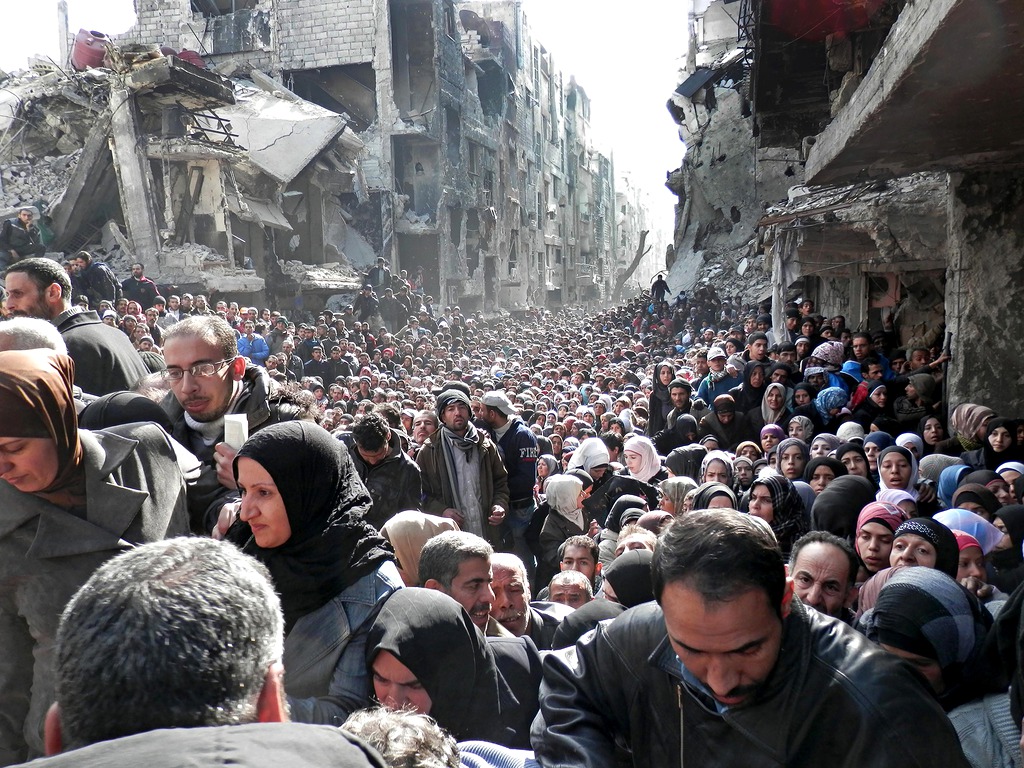
Aid is distributed at the Yarmouk camp in Damascus, where the UN says people have been reduced to eating animal feed. Since the photograph was taken, aid has ceased to be delivered because of security concerns
It is a scene of unimaginable desolation – a crowd of men, women and children stretching as far as the eye can see into the war-devastated landscape of Yarmouk refugee camp in Syria. This was the queue for aid at a UNRWA distribution point in the capital, Damascus, on 31 January. The UN relief agency has distributed more than 7,000 food parcels in the Palestinian camp, home to about 160,000 people, since 18 January. The UN has reported infant malnutrition in the community, which has been reduced to eating animal feed. As of this week, all aid distributions have been suspended because of security concerns. Chris Gunness, a spokesperson, said UNRWA had received assurances that a deal allowing humanitarian access to Yarmouk would be implemented as soon as possible. He said: “They have suffered enough.”
Photographer: UNRWA/AP
 Death of Abu Khalid al-Suri in Aleppo will fuel infighting between rival Islamist fighters

-
Millions Of Refugees Need Help. Please Donate To The UNHCR Today.
-
Made with Google. For $279. Everything you need in one laptop.
-
Compare Local Painting Quotes. Get Up to 4 Quotes in 10 Seconds!
حزب الله بعد صمت 36 ساعة يعترف بالغارة الاسرائيلية ويحتفظ بحق الرد ومواقع الكترونية تسخر وتصفه بـ”رامبو” الممانعة
حزب الله بعد صمت 36 ساعة يعترف بالغارة الاسرائيلية ويحتفظ بحق الرد ومواقع الكترونية تسخر وتصفه بـ”رامبو” الممانعة

After First Denying An Attack Took Place: Hezbollah says will respond to Israeli air strike
(Reuters) - Hezbollah will respond to an Israeli air strike that hit one of its bases on the border with Syria on Monday night, the Lebanese militant group said on Wednesday.
"The new aggression is a blatant assault on Lebanon and its sovereignty and its territory... The Resistance (Hezbollah) will choose the time and place and the proper way to respond to it [This is the Same Language Used by the Criminal Syrian Regime Which Has NEVER Responded to Israeli Attacks on Syria !]," Hezbollah said in a statement.
The strike, which Israel has not confirmed, hit the Lebanese-Syrian border near the Bekaa Valley village of Janta, Hezbollah said. It denied reports that the strike targeted artillery or rocket bases and said there were no casualties.
Lebanese security sources have said they believed that any attack took place on Syrian soil, but Hezbollah's reference to Lebanese sovereignty suggested it took place on the Lebanese side of the ill-defined frontier.
Israeli planes have struck areas on the Syrian side of the border several times in the last two years but, if confirmed, an air strike on Lebanese soil would be the first since the Syrian revolt began in 2011.
The eastern Lebanon-Syrian border area is frequently used by smugglers and Lebanese security sources say the target of Israeli strikes in Syria may have been trucks of weapons destined for Hezbollah.
Israel has voiced alarm that amid the chaos of Syria's civil war, weapons could be transferred to Hezbollah, which is supporting Syrian President Bashar al-Assad fight an insurgency but has traditionally fought Israel.
Israel's military chief Lieutenant-General Benny Gantz reiterated those fears on Sunday, a day before the strike, when he accused Iran, Assad's ally and Hezbollah's patron, of moving weapons to the militant group.
"There is no theatre in which Iran is not involved - giving out, if you like, torches to pyromaniacs - whether this is munitions or missiles or intervention in the fighting," he said.
"We are tracking the processes of arms transfers in all of the operational theatres. This is something that is very, very negative. This is something that is very, very sensitive. And from time to time, when the need arises, things can happen."
Israel's Channel 10 television on Tuesday broadcast what it said were satellite images of the locations struck, which appeared to show missile silos being readied for weapons.
The Lebanese army reported that four Israeli planes had flown across north Lebanon on Monday night towards the Bekaa Valley before heading southwest towards the Mediterranean near Lebanon's southern border with Israel. Israeli jets regularly fly through Lebanese airspace without permission.
Prime Minister Benjamin Netanyahu did not claim or deny the strike but said on Tuesday Israel would "do everything required to safeguard the security of the citizens of Israel."
Tuesday, February 25, 2014
Syrians set to replace Afghans as largest refugee population: U.N.
Residents wait to receive food aid distributed by U.N. Relief and Works Agency (UNRWA) at the besieged al-Yarmouk camp, south of Damascus February 24,2014, in this handout released by Syria's national news agency SANA.
CREDIT: REUTERS/SANA/HANDOUT VIA REUTERS
(Reuters) - Syrians are about to replace Afghans as the world's largest refugee population, fleeing a conflict where barrel bombs leave bodies in pieces and a generation of children are physically and emotionally scarred, top U.N. officials said on Tuesday.
U.N. Secretary-General Ban Ki-moon told the U.N. General Assembly that the world body would do everything to implement a U.N. Security Council resolution - adopted on Saturday to boost humanitarian aid access - and get help to millions in need.
"Supplies are ready to go into areas that have been hard to reach, and into the towns and cities that have been under siege," Ban said. "What we need is guaranteed safe passage for humanitarian supplies along key routes."
"It is incumbent on the Syrian government and all parties to the conflict to reach these agreements," he said.
Some 9.3 million Syrians - almost half the population - need help, the United Nations said. Some 2.4 million of those people have fled the country during the three-year civil war.
"Five years ago Syria was the world's second-largest refugee hosting country. Syrians are now about to replace Afghans as the present biggest refugee population worldwide," U.N. High Commissioner for Refugees Antonio Guterres said.
"It breaks my heart to see this nation that for decades welcomed refugees from other countries, ripped apart and forced into exile itself," Guterres told the 193-member U.N. assembly.
The unanimously adopted Security Council resolution demands cross-border aid access inSyria, an end to the use of weapons such as barrel bombs in cities and towns and threatens "further steps" in cases of non-compliance.
U.N. diplomats say Syria's ally Russia is unlikely to agree to any action if the Damascus government was found to be in non-compliance. But Western envoys expressed a strong intent to push for Security Council action if the resolution is ignored.
U.N. human rights chief Navi Pillay told the General Assembly that imprecise weapons, notably barrel bombs, had reportedly killed hundreds of people in February alone.
She added between December 15-28, 2013: "Barrel bombs landed on more than 12 districts, exploding on residential buildings, marketplaces, a bus station, a school and in close proximity to hospitals. This resulted in inhumane loss of life."
"As described ... by one witness after an attack on a bus station, I quote, 'bodies arrived in pieces, there were parts of bodies and parts of vehicles hanging on the power cable,'" Pillay said.
'NOTHING NEW'
Pillay said tens of thousands of people were reportedly held in official and unofficial government detention centers. She also called on foreign powers to curb supplies of arms and the inflow of foreign fighters into Syria.
"The ... influx of arms and fighters from abroad diminishes the chance of reaching a political solution," Pillay said.
A second round of peace talks in Geneva broke up on February 15 with international mediator Lakhdar Brahimi lamenting a failure to advance much beyond agreement on an agenda for a third round at a later date.
Aid workers on Tuesday doubted that the U.N. Security Council resolution on aid access in Syria had enough punch to push the Damascus government to allow more humanitarian convoys carrying vital supplies into the country.
Deputy U.N. aid chief Kyung-Wha Kang told the General Assembly that some 4.3 million children in Syria are affected by the conflict, while another 1.2 million are refugees.
"Children have been killed, arrested, abducted, tortured, mutilated, sexually abused, and recruited by armed groups. They have been used as human shields. They are malnourished," she said. "Syria is in danger of losing a generation of children."
"We are in a race against time. More people are slipping out of our reach as the conflict intensifies and armed groups fragment and more battle lines are drawn," Kang said.
She said humanitarian groups needed to bring in more aid workers and expertise to deliver more help to more people.
Ban called on the Syrian government to authorize more aid workers to enter the country. "It is not credible to cite bureaucratic procedures as reasons for delay when it is the government itself that controls those procedures," he said.
Syrian U.N. Ambassador Bashar Ja'afari accused the governments of some states of not being interested in providing humanitarian assistance to Syria. He blamed Saudi Arabia, Qatar and Turkey for pouring "oil on the fire of the Syrian crisis."
"Some states have agreed to lay out large sums of money in order to support arms deals to terrorists to let them get through the Syrian borders instead of spending this money on humanitarian assistance to those who need it," he said.
He was dismissive of the General Assembly briefing on Tuesday.
"These briefings, in spite of their great significance, didn't really offer anything new. They were confined to repeating what we have heard in similar meetings at the U.N.," he said. "Humanitarian questions, on which we have been briefed today, are the heart of concerns of the government of Syria."

Hezbollah silence on Israeli raids conveys burden at home, in Syria
February 26, 2014 12:29 AM
| The Daily Star |
BEIRUT: The pressure Hezbollah is experiencing given its military intervention in Syria and the wave of suicide bomb attacks targeting Shiite areas of Lebanon was illustrated Tuesday in the lack of response to an unusual Israeli airstrike against an area under its control on the Lebanon- Syria border.
While it remains unclear which side of the border was struck by Israeli jets in the late Monday night air raid, the fact that it occurred in the vicinity of Janta likely makes it an assault against a Hezbollah target rather than, for example, a Syrian military position.
Before the monthlong war in 2006, Hezbollah’s retaliation to an attack on its facilities would have been swift across the U.N.-delineated Blue Line in the south. But the silence from Hezbollah officials in the aftermath of the airstrike and the muted reports from Al-Manar TV channel, which said there was “no raid on Lebanese territory,” suggest that the party is not inclined to risk opening a third front with Israel on top of battling rebels in Syria and Al-Qaeda-linked suicide bombers in Lebanon. That forbearance is aided by the fact that no one can determine for sure if the Israeli airstrike hit Lebanese or Syrian territory because the area south and east of Janta is a Hezbollah military zone with no public access, granting the party some wiggle room in avoiding having to respond militarily at an inopportune time.
Determining the precise location of the airstrikes – four missiles in two sorties, according to reports – would help in identifying the target. Hezbollah operates a string of military training camps in the hills between Janta and Brital, constructed in the aftermath of the 2006 war. The camps, which consist of firing ranges, accommodation and support facilities and at least two identical small urban warfare training sites, are clearly visible from the air. However, they are relatively low-value targets and under current circumstances probably offer little attraction to the Israeli military. The fact that Hezbollah has broken with convention since 2006 by constructing training camps in the open in the Bekaa Valley, rather than covertly, points not only to an increased requirement for training facilities given the enormous recruitment surge in recent years but also to a confidence that Israel would not risk an escalation for the sake of destroying a relatively worthless facility.
The Britain-based Syrian Observatory for Human Rights said the target was a Hezbollah “missile base” that was taking part in the military operations in the Qalamoun area north of Damascus. However, if Israel chose to take the bold step of attacking a Hezbollah military facility on Lebanese territory, it would do so because it was perceived as a threat to the Jewish state, not as a favor to beleaguered Syrian rebels fighting Syrian troops in Qalamoun. Furthermore, it is unlikely that Hezbollah would employ its own arsenal of advanced missiles against Syrian rebels in Qalamoun because of the possibility that their exposure would lead to a pre-emptive Israeli airstrike.
Israel has struck Syrian weapons depots on five occasions since January 2013, reportedly destroying consignments of SA-17 anti-aircraft missiles and Iranian-made Fateh-110 guided missiles which were allegedly destined for Hezbollah. Israeli officials repeatedly state they will not allow “game-changing” weapons to reach Hezbollah. Despite some threats, the regime of Syrian President Bashar Assad has chosen to ignore the airstrikes. But Monday night’s attack is the first against targets so close to the Lebanese border, if not actually just inside Lebanon itself, and in an area where there are no significant Syrian military bases that could serve as weapons depots, thus potentially warranting attack. That suggests the target could have been a Hezbollah arms convoy en route from Syria into Lebanon via the Janta area. A dirt track that winds through rugged mountains from the Zabadani area across the border to Janta has been in use since the early 1980s to ferry arms and ammunition to Hezbollah’s weapons depots.
Since 2006, the track has been hardened and in some places asphalted, presumably to facilitate larger vehicles. Hezbollah usually dispatches its arms convoys across the border in bad weather to hinder aerial and satellite reconnaissance and has been known to switch off the local electricity supply and jam communications as an additional security measure. The weather Monday night was poor, which adds to the possibility that an arms convoy was the target.
If the assumption is correct that an arms convoy was hit in the airstrike, Hezbollah’s silence stands in contrast to the deterrence strategy it adopted against Israel in the 2000-2006 period. During those six years, Hezbollah crafted a finely tuned tit-for-tat strategy using the Blue Line as a locus of retaliation for Israeli attacks or breaches of Lebanese sovereignty. In response to Israel’s daily overflights in Lebanese airspace, Hezbollah fired anti-aircraft rounds above Israeli border settlements and then taunted the Israeli military by dispatching its own pilotless drones into Israeli skies. Hezbollah responded to assassinations of its cadres and close allies by “deniable” operations along the Blue Line such as a roadside bomb ambush against an Israeli jeep or employing a sniper to shoot dead a soldier.
The 2006 war and the subsequent mutual desire to avoid an even greater conflagration between Hezbollah and Israel led to a change in the “rules of the game” that prevailed before. Hezbollah is considerably stronger militarily than in 2006 in terms of another war with Israel, it’s commitment to the Syria conflict notwithstanding. But it has honored an unofficial and de facto cease-fire along the Blue Line over the past seven years. Instead, it is Israel that is setting the new “rules of the game,” apparently determined to take advantage of Hezbollah’s preoccupation with Syria and domestic security to try and thwart the transfer of advanced weapons to the party, an action it never risked taking before because of the potential for retaliation and unwanted escalation.
While it appears evident that Hezbollah is not seeking another showdown with Israel for now, Israel’s new sense of assertiveness against its Lebanese enemy raises once more the risk of miscalculation and overreaching, especially given the current turmoil and unpredictability in the region.
Subscribe to:
Posts (Atom)