Citizen-run health clinics, food centres, kitchens and legal aid hubs have sprung up to fill the gaps left by austerity – and now look set to play a bigger role under a Syriza government
“A long time ago, when I was a student,” said Olga Kesidou, sunk low in the single, somewhat clapped-out sofa of the waiting room at the Peristeri Solidarity Clinic, “I’d see myself volunteering. You know, in Africa somewhere, treating sick people in a poor developing country. I never once imagined I’d be doing it in a suburb of Athens.”
Few in Greece, even five years ago, would have imagined their recession- and austerity-ravaged country as it is now: 1.3 million people – 26% of the workforce – without a job (and most of them without benefits); wages down by 38% on 2009, pensions by 45%, GDP by a quarter; 18% of the country’s population unable to meet their food needs; 32% below the poverty line.
And just under 3.1 million people, 33% of the population, without national health insurance.
So, along with a dozen other medics including a GP, a brace of pharmacists, a paediatrician, a psychologist, an orthopaedic surgeon, a gynaecologist, a cardiologist and a dentist or two, Kesidou, an ear, nose and throat specialist, spends a day a week at this busy but cheerful clinic half an hour’s drive from central Athens, treating patients who otherwise would not get to see a doctor. Others in the group accept uninsured patients in their private surgeries.
Greek elections: young, broke and voting for change
“We couldn’t just stand by and watch so many people, whole families, being excluded from public healthcare,” Kesidou said. “In Greece now, if you’re out of work for a year you lose your social security. That’s an awful lot of people without access to what should be a basic right. If we didn’t react we couldn’t look at ourselves in the mirror. It’s solidarity.”
Advertisement
The Peristeri health centre is one of 40 that have sprung up around Greece since the end of mass anti-austerity protests in 2011. Using donated drugs – state medicine reimbursements have been slashed by half, so even patients with insurance are now paying 70% more for their drugs – and medical equipment (Peristeri’s ultrasound scanner came from a German aid group, its children’s vaccines from France), the 16 clinics in the Greater Athens area alone treat more than 30,000 patients a month.
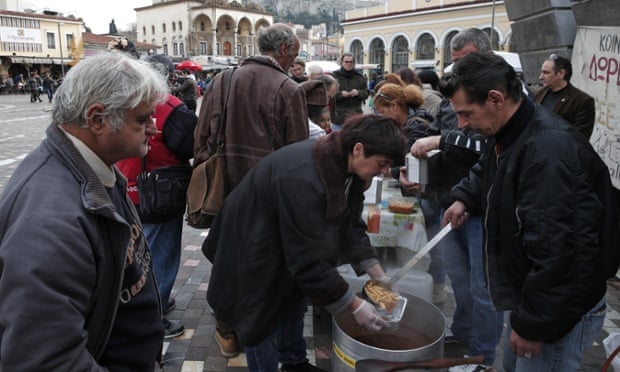
The clinics in turn are part of a far larger and avowedly political movement of well over 400 citizen-run groups – food solidarity centres, social kitchens, cooperatives, “without middlemen” distribution networks for fresh produce, legal aid hubs, education classes – that has emerged in response to the near-collapse of Greece’s welfare state, and has more than doubled in size in the past three years.
“Because in the end, you know,” said Christos Giovanopoulos in the scruffy, poster-strewn seventh-floor central Athens offices of Solidarity for All, which provides logistical and administrative support to the movement, “politics comes down to individual people’s stories. Does this family have enough to eat? Has this child got the right book he needs for school? Are this couple about to be evicted?”
As well as helping people in difficulty, Giovanopoulos said, Greece’s solidarity movement was fostering “almost a different sense of what politics should be – a politics from the bottom up, that starts with real people’s needs. It’s a practical critique of the empty, top-down, representational politics our traditional parties practise. It’s kind of a whole new model, actually. And it’s working.”
It also looks set to play a more formalised role in Greece’s future under what polls predict will be a Syriza-led government from next week. When they were first elected in 2012 the radical left party’s 72 MPs voted to give 20% of their monthly salary to a solidarity fund that would help finance Solidarity for All. (Many help further; several have transferred their entitlement to free telephone calls to a local project.) The party says the movement can serve as an example and a platform for the social change it wants to bring about.
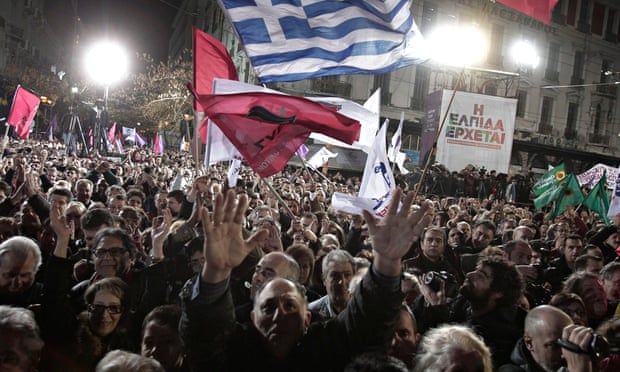
Syriza supporters at a pre-election rally in central Athens.Photograph: Yannis Kolesidis/EPA
In the sleek open plan, blonde-wood office she used when she was a successful architect, Theano Fotiou, a member of Syriza’s central committee, was packing leaflets for the last day of campaigning, with the help of a dozen or so exceedingly enthusiastic young volunteers. She is seeking re-election in the capital’s second electoral district. “The only real way out of this crisis is people doing it for themselves,” she said. “If people don’t participate, we will be lost as a country. This is practice, not theory, a new social ideology, a new paradigm – the opposite of the old passive, dependent, consumerist, individualist model. And the solidarity projects we have now are its incubators.”
Fotiou said a large part of the first stage of a Syriza’s government’s programme – ensuring no family is without water or electricity (in nine months of 2013, 240,000 households had their power cut because of unpaid bills); that no one can be made homeless; that the very lowest pensions are raised and that urgent steps are taken to relieve child poverty, now standing at 40% in Greece – was largely inspired by what the party had learned from its involvement in the solidarity movement.
“We’ve gained so much from people’s innovation,” she said. “We’ve acquired a knowhow of poverty, actually. We know more about people’s real needs, about the distribution of affordable food, about how not to waste things like medicines. We’ve gained a huge amount of information about how to work in a country in a state of humanitarian crisis and economic collapse. Greece is poor; this is vital knowhow.”
If the first instinct of many involved in the movement was simply to help, most also believe it has done much to politicise Greece’s crisis. In Egalio, west of Athens, Flora Toutountzi, a housekeeper, Antonis Mavronikolas, a packager, and Theofilos Moustakas, a primary school teacher, are part of a group that collects food donations from shoppers outside supermarkets and delivers basic survival packages – rice, sugar, long-life milk, dried beans – to 50 local families twice a month.
“One family, there are six people surviving on the grandmother’s pension of €400 a month,” said Mavronikolas. “Another, they’ve lived without running water for two months. We help them, yes, but now they are also involved in our campaign, helping others. People have become activated in this crisis. They are less isolated.”
In the central Athens district of Exarchia, Tonia Katerina, another now largely unemployed architect (“There’s not a lot of work for architects right now,” she said), is one of 15 people running a cooperative social grocery that opened a year ago and now sells 300 products, from flour to oranges, olive oil to bread, pasta to dried herbs. The business has grown rapidly and the collective’s members can now pay themselves an hourly wage of €3
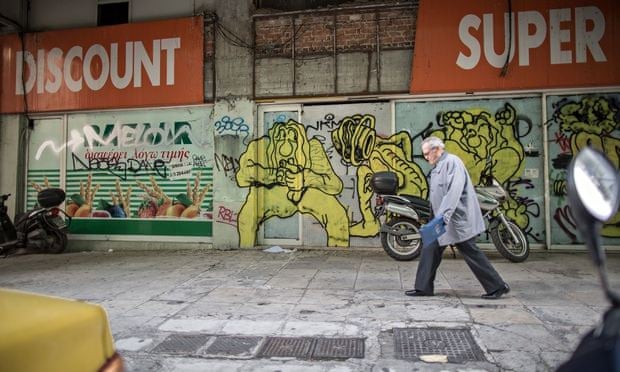
A man walks past a closed supermarket in Athens.Photograph: Michael Kappeler/dpa/Corbis
The local “without middlemen” market, one of 30-odd to have sprouted in Athens and several hundred around Greece, where farmers sell their produce for 25% more than they would get from the supermarkets and consumers pay 25% less, takes place only once a month, and the group wanted to set up a small neighbourhood grocery offering similarly good value, high quality foodstuffs directly from small producers.
Ninety per cent of the products the store sold were “without middlemen”, Katerini said, and about 60% were significantly cheaper than in the supermarket. Several come from other solidarity projects – the store’s soap, for example, is made by a collective of 10 unemployed people in Galatsi.
“All these projects, it’s very important to me, are not just helping people who need it, but they represent almost the start of a new kind of society,” Katerini said. “They are run as direct democracies, with no hierarchy. They are about people taking responsibility for their lives, putting their skills to use, becoming productive again.”
Katerina Knitou has devoted the past few years to preventing people from losing their homes. Part of a group of lawyers formed to fight a much hated “emergency house tax”, her focus has switched to the one in three Greek households fearing repossession or eviction – either because they are among the 320,000 families behind on mortgage or other debt repayments to their bank, or one of the 2.45 million Greeks who have been unable to pay a recent tax bill.
Knitou, a Syriza member like almost all those involved in the movement, gives free legal advice on how to avoid foreclosure and eviction. In the first half of last year 700 homes were either repossessed by the banks or foreclosed on by the Greek state over unpaid tax or social security bills. (With colleagues, Knitou also occasionally takes more direct action, disrupting – and preventing – planned auctions of repossessed and foreclosed homes.)
“This whole thing,” she said, “has made a lot of people very aware, not just of what they face, but also of what they can – and must – do. Expectations are going to be high after Sunday, but there are of course limits to what even a Syriza government will be able to do. It’s up to us, all of us, to change things. And honestly? This feels like a good start.”
Joining together ahead of Greek elections, leaders of Syriza and Podemos signal their unified fight against austerity will extend beyond national borders Link
Greek opposition leader and head of radical leftist Syriza party, Alexis Tsipras (L) and Spanish Podemos party Secretary General Pablo Iglesias wave to supporters following a campaign rally in central Athens January 22, 2015. Greek leftist leader Tsipras told thousands of people gathered in Athens that an end to "national humiliation" was near after opinion polls on Thursday showed his Syriza party pulling ahead three days before an election. (Photo: Reuters/Yannis Behrakis)
"History is knocking at our door," declared Alexis Tsipras, the leader of the leftwing coalition party of Syriza in Greece, during a speech addressed to thousands of supporters in Athens on Thursday night as he stood next to his foreign compatriot Pablo Iglesias of the Spanish Podemos Party.
"The wind of democratic change is blowing in Europe." —Pablo Iglesias, PodemosSyriza and Podemos have become the mouthpiece of the anti-austerity movement in southern Europe while Tsipras and Iglesias have emerged as key political leaders who emerged from the grassroots, street-level protest movements which rose in opposition to the severe economic policies imposed by elite forces following the financial crisis that began in 2008. In relatively short time, both Syriza and Podemos went from being non-existent political entities to standing on the doorstep of taking power.
With national elections in Greece just days away, and Syriza's polling numbers only improving, Alexis Tsipras announced that his party is prepared to "overthrow" the status quo and vowed to implement swift changes to undo the austerity policies—imposed at the behest of foreign creditors and attached to a bailout package offered by the European Central Bank and the IMF—that have left the Greek economy in tatters. Standing before the large crowd, Tsipras announced that by Monday, "[Greece's] national humiliation will be over. We will finish with orders from abroad."
Syriza's answer to austerity, he continued, would be this: "The bailout is over. Blackmail is over. Subservience is over."
According to reporting by the Irish Times, Tsipras "received one of his biggest cheers of the night when he said that he will press for the repayment of a forced war loan from Greece toGermany during the second World War.
Taking the podium to address the thousands gathered, Iglesias indicated the fate of the Greek and Spanish people—both crushed by unemployment and the gutting of the public sector—were intimately tied. But, Iglesias declared, "The wind of democratic change is blowing in Europe." Less than one year since its inception, Podemos is now polling ahead of Spain's ruling party. Though national elections in Spain could happen later this year, they have not yet been scheduled.
A sampling of voices taken from the crowd in Athens reveal that those supporting what Podemos and Syriza represent are ecstatic for the hope the parties are now offering.
"I am voting for Tsipras because even my parents, after 40 years of work, don't have money to pay for heating," Maria Labridou, a 55-year-old teacher at the rally, toldReuters. "He is our only hope, the only way out."
Speaking with the Irish Times, a retiree named Babis, said, "We want change not only in Greece, but across Europe. The change will start from here, and then go through Spain,Portugal and Ireland. There has to be social justice."
A continental view was not absent among the politicians on the stage either as Leonard Cohen's famous protest song, 'First We Take Manhattan,' played from the loudspeakers and Iglesias at one point declared, "Then we take Berlin!"
Ahead of the Greek election on Sunday, the latest polling in the country shows Syriza has built on its previous lead over the ruling New Democracy party, now led by Prime Minister Antonis Samaras.
As Helena Smith reports for the Guardian on Friday:
Barely four weeks after the failure of parliament to elect a president, triggering the ballot, Greece’s fate now lies in the hands of 9.8 million voters. All the polls show, with growing conviction, that victory will go to Syriza. A poll released by GPO for Mega TV late on Thursday gave the far leftists a six-percentage-point lead over Samaras’s center-right New Democracy, the dominant force in a coalition government that has held power since June 2012. A week earlier, GPO had the lead at four percentage points. [...]
Analysts maintain that Syriza’s ability to attain an outright majority will be difficult. With pressure mounting from the EU and IMF to “respect” the commitments made as the price of aid, speculation has been rife that the party might prefer to enter a coalition government that would enable it to forge ahead with the structural reforms and budget cuts demanded in exchange for the biggest financial assistance program in global history.
But Tsipras put paid to that. The leftists, who have never held office in the near 200 years of the Modern Greek state – and who, after a bloody civil war, were hounded and imprisoned for decades – wanted to win an absolute majority that would allow them to govern unimpeded, he insisted.
“We are asking for a clear mandate, crystal clear, undiluted, indisputable,” he told the crowd. “The time of the left has come.”
Dr Eleni Panagiotarea, a research fellow at Greece’s leading thinktank Eliamep, said Syriza was on a roll.
“It’s now all about making a clean break with the past. The party has picked up on the fatigue that people feel with the country. It has become a voice for the disgruntled middle class, unemployed, socially vulnerable, all those who want change.”
Though Prime Minister Samaras has tried to counter the rise of Syriza by telling Greek voters that its leftwing policies will lead the nation to ruin, experts and economists argue that it has been the austerity policies imposed across Europe, though most severely imposed in nations like Greece and Spain, that have been the clearest culprits of economic ruin.
As Mark Weisbrot, co-director of the Center for Economic and Policy research, wrote earlier this week:
Greece continues to face a dismal future under the current European program, with more than 18 percent unemployment even in 2017. This is according to IMF projections, which have been consistently over-optimistic in the past. Mass unemployment will also be the norm for the eurozone, with more than 10 percent unemployment in 2017, even if it the eurozone authorities’ program is “successful.” Not to mention all the other sacrifices in living standards, including cuts in health care spending, public pensions, minimum wages and government services.
This prolonged punishment and regressive social engineering from the European authorities is only possible because the electorate has had little or no influence over the most important economic policy-making. The Greeks are trying to win some of that back; hence the intimidation from on high.
And Nobel Prize-winning economist Joseph Stiglitz, in a recent column, called the commitment to austerity by European elites—namely the IMF, the ECB, the European Commission, and the powerful German government—a very cruel form of "economic madness" that betrays sound reasoning.
Stiglitz wrote, "If Europe does not change its ways – if it does not reform the Eurozone and repeal austerity – a popular backlash will become inevitable." Whatever happens in the Greek elections, he concluded, "this economic madness cannot continue forever. Democracy will not permit it. But how much more pain will Europe have to endure before reason is restored?"
"Yemen is suffering from a counter-revolution and a coup led by ousted President Ali Abdullah Saleh and carried out by the Shia Houthi armed militias with full Iranian support," Yemeni activist and Nobel Peace Prize winner Tawakkol Karman said.
She stressing that "the Yemeni people refuse Iranian and Houthi dictates."
During an exclusive interview with the Anadolu Agency, Karman said: "This coup d'etat aims to stall Yemenis' dreams and sabotage the 2011 revolution," adding that "the Yemeni people and powers refuse Abdul-Malik [Al-Houthi's] control of Yemen."
She announced her full support for Yemeni President Abd Rabbuh Mansour Hadi although he made mistakes in the transition period, including being slow to suppress the armed uprising and tackling corruption, yet, she said that a new constitution should be prepared and fresh elections should be held under Hadi's watch.
Karman added that President Hadi is a prisoner of tribalism and sectarianism from which Yemen has suffered from a long time.
King Abdullah's writ lasted all of 12 hours . Within that period the Sudairis, a rich and politically powerful clan within the House of Saud, which had been weakened by the late king, burst back into prominence. They produced a palace coup in all but name.
Salman moved swiftly to undo the work of his half-brother. He decided not to change his crown prince Megren,who was picked by King Abdullah for him, but he may chose to deal with him later .However he swiftly appointed another leading figure from the Sudairi clan. Mohammed Bin Nayef, the interior minister is to be his deputy crown prince. It is no secret that Abdullah wanted his son Meteb for that position, but now he is out,
More significantly, Salman, himself a Sudairi, attempted to secure the second generation by giving his 35- year old son Mohammed the powerful fiefdom of the defence ministry . The second post Mohammed got was arguably more important. He is now general secretary of the Royal Court. All these changes were announced before Abdullah was even buried.
The general secretaryship was the position held by the Cardinal Richelieu of Abdullah's royal court, Khalid al-Tuwaijri. It was a lucrative business handed down from father to son and started by Abdul Aziz al Tuwaijri. The Tuwaijris became the king's gatekeepers and no royal audience could be held without their permission, involvement, or knowledge. Tuwaijri was the key player in foreign intrigues --to subvert the Egyptian revolution, to send in the troops to crush the uprising in Bahrain, to finance ISIL in Syria in the early stages of the civil war along his previous ally Prince Bandar bin Sultan.
The link between Tuwaijri and the Gulf region's fellow neo-con Mohammed bin Zayed, the crown prince of Abu Dhabi, was close. Tuwaijri is now out, and his long list of foreign clients , starting with the Egyptian President Abdel Fattah el-Sisi may well feel a cooler wind blowing from Riyadh. Sisi failed to attend the funeral on Friday. Just a question of bad weather?
Salman's state of health is cause for concern, which is why the power he has given his son is more significant than other appointments announced. Aged 79, Salman is known to have Alzheimers, but the exact state of his dementia is a source of speculation. He is known to have held cogent conversations as recently as last October. But he can also forget what he said minutes ago, or faces he has known all his life, according to other witnesses. This is typical of the disease. I understand the number of hospital visits in the last few months has increased, and that he did not walk around, as he did before.
So his ability to steer the ship of state, in a centralised country where no institutions, political parties or even national politics exist, is open to question. But one indication of a change of direction may lie in two attempts recently to establish links with Egyptian opposition figures.
I am told that senior advisers to Salman approached an Egyptian liberal opposition politician and had a separate meeting with a lawyer. Neither of them are members of the Muslim Brotherhood but have working contacts with it. Talks were held in Saudi Arabia in the last two months about how reconciliation could be managed. No initiative was agreed, but the talks themselves were an indication of a more pragmatic, or less belligerent, approach by Salman and his advisers. It was understood that these meetings were preparatory to a possible initiative Salman may announce once he was in power.
The policy of the late King was to declare the Brotherhood terrorist organisation on a par with the Islamic State and al Qaeda.
Even before the Sudairis made their move, a power struggle within the House of Saud was apparent. Early on Thursday evening, rumours on twitter that the king was dead flooded the internet, which is the primary source of political information in the kingdom. There were official denials, when a Saudi journalist on al Watan newspaper tweeted the information.
The palace's hand was forced when two emirs tweeted that the king was dead. MBC TV network cut broadcasting and put the Koran on screen ,a sign of mourning, while national television kept on with normal programming. This was a sign that one clan in the royal family wanted the news out quickly and the other clan was stalling for more negotiations.
The need for a change of course is all too apparent. On the very night in which the royal drama was taking place, a political earthquake was taking place in Saudi Arabia's backyard, Yemen. President Abd Rabu Monsour Hadi, his prime minister and government resigned after days of virtual house arrest by Houthi militia. Hadi's resignation leaves two forces in control of the country both of them armed to the teeth : an Iranian backed militia which gets its training from Hezbollah, and al Qaeda, posing as the defender of Sunni muslims.
It is a disaster for Saudi Arabia and what is left of the ability of the Gulf Cooperation Council to make any deal stick. Their foreign ministers met only the day before. Yemen's former strongman Ali Abdullah Saleh, who was levered out of power three years ago and who according to leaked telephone calls, advised the Houthis on how to grab power, is now calling for fresh elections, and there were already calls on Thursday night for the south to split away from the North. Yemen,in other words, has officially become the Middle East's fourth failed state.
The meteoric rise of the Houthis in Yemen was not the result of spontaneous combustion. It was planned and plotted months ago by Saleh and the United Arab Emirates. Saleh's son, the Yemeni ambassador to the UAE, was a key figure in this foreign intrigue, and as I reported before, he met an Iranian delegation in Rome. This was picked by US intelligence and communicated to Hadi. The year before, the then Saudi intelligence chief Prince Bandar flew a leading member of the Houthi delegation via London for a meeting. Incredible as it seemed, the Saudis were re-opening contact with an Iranian backed Zaydi or Shia sect with whom they had once fought bitter wars.
The Saudi/Emirati plan was to use the Houthis to engage and destroy their real target which was Islah, the Islamist party and chief representative of the Sunni tribes in Yemen. As elsewhere in the Arab world, the entire focus of Abdullah foreign policy after 2011 , was to stop the Arab spring in its tracks in Tunisia and Egypt and crush all forces capable of mounting an effective opposition in the Gulf States. Everything else, including the rise of Saudi's foremost regional rival Iran, became subservient to that paramount aim to crush democratic political Islam.
The Yemen plan backfired when Islah refused to take up arms to resist the Houthi advance. As a result, the Houthis took more control than they were expected to , and the result is that Yemen stands on the brink of civil war. Al Qaeda's claim to be the only fighters prepared to defend Sunni tribesmen, has just been given a major boost.
It is too early to tell whether King Salman is capable of , or even is aware of the need for changing course. All one can say with any confidence is that some of the key figures who stagemanaged the Kingdom's disastrous foreign intrigues are now out. Meteb's influence is limited, while Tuwaijiri is out.
It is in no-one's interests for chaos to spread into the Kingdom itself. Maybe it is just co-incidence that Abdullah died almost on the eve of the anniversary of the January 25 revolution in Egypt. But the timing of his death is a symbol.The royal family should learn that the mood of change, that started on January 25 is unstoppable. The best defence against revolution is to lead genuine tangible political reform within the Kingdom. Allow it to modernise, to build national politics, political parties, real competitive elections, to let Saudis take a greater share of power, to free political prisoners.
There are two theories about the slow train crash which the Middle East has become. One is that dictatorship, autocracy, and occupation are the bulwarks against the swirling chaos of civil war and population displacement. The other is that dictators are the cause of instability and extremism.
Abdullah was evidence in chief for the second theory. His reign left Saudi Arabia weaker internally and surrounded by enemies as never before. Can Salman make a difference ? Its a big task, but there may be people around him who see the need for a fundamental change in course. It will be the only way a Saudi King will get the backing of his people. He may in the process turn himself into a figurehead, a constitutional monarch, but he will generate stability in the kingdom and the region.
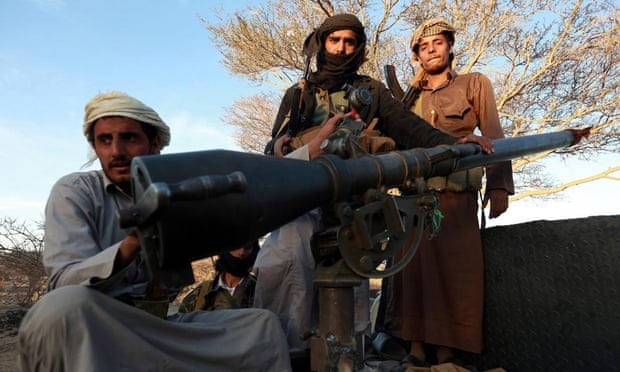
Tribal gunmen prepare to protect their province from possible attacks by Shia Houthi militias in the oil-rich province of Marib, Yemen. Photograph: Ali Mohammed/EPA
The rise of Shia Houthi rebels and the fall of the Hadi government have shaken country whose ‘deep state’ has long been a bedrock of US fight against terror
For almost 15 years, the US’s relationship with Yemen has been defined by an intelligence relationship that eclipsed all other nation-building measures and anchored America’s global counter-terrorism strategy.
Now, though, with two Washington-backed presidents having fallen in less than four years and the established military jeopardised by chaos, policymakers are bereft of solutions.
Shia Houthi rebels seized decisive control of the country’s north this week, following months of civil war and years of lawlessness and corruption.
On Tuesday, the rebels routed government forces and overran the presidential palace in the capital, Sana’a. Weakened by poverty and the waning support of neighboring Saudi Arabia, government institutions fell in a matter of days and Sunni extremists rallied in the southern provinces. The besieged president, Abdu Rabbu Mansour Hadi, finally acceded to the demands of the Houthis on Thursday.
Hadi’s resignation and the collapse of the government has left Yemen-US relations at a more unstable juncture than at any point since the bombing of the USS Cole in 2000, a seminal event in the two countries’ fraught history. Ever since, al-Qaida in the Arabian Peninsula (Aqap) has slowly evolved into a potent threat on a regional stage – with a demonstrated will to make its presence felt elsewhere.
“When you have this laser-like focus on a limited [counter-terrorism] mission that sort of distorts your perspective,” said Micah Zenko, a national security scholar at the Council of Foreign Relations.
During Hadi’s presidency and, before that, during Ali Abdullah Saleh’s, the US has launched 107 drone strikes in south Yemen, where Aqap has rallied and planned attacks
The north had been left largely to a frail political class, which proved susceptible to the rise of the Houthis. “Under US policy guidance the leader of Yemen means nothing as to whether the US can conduct military strikes in the south,” said Zenko, adding that the main effect of the Houthi rebellion on US policy will likely take place at intelligence levels that are opaque to outside observers.
Advertisement
Zenko noted that the US has not carried out a drone strike in Yemen since November, probably as “human intelligence diminished because the Yemeni security forces became preoccupied with other missions”. He said that American missions against Aqap will depend “on the degree to which US intelligence is in normal, day-to-day working contact” with Yemeni security forces.
With all strategic military bases in Sana’a now at least partially controlled by the Houthis, the implications for military operations remain unclear. Asked what the collapse of the Yemeni government would mean for US policy toward the country, a State Department spokesperson said the Houthis and the US had a common enemy in Aqap but added that developments were still being analysed.
On Friday, the US sharply scaled back its presence in Sana’a, pulling more staff out of its embassy.
Policymakers in the US and Britain fear the creation of a vacuum in Yemen similar to those in which jihadists have thrived in Syria and Iraq.
“Aqap were on the back foot and facing existential dilemmas, but the rise of the Houthis has handed them a golden opportunity,” said a western official in the region. “They have been presenting themselves as the only ones who can stop the ‘Shia’ Houthis. They are seeking to make a struggle that is essentially about power, money and territory a sectarian struggle.”
“Aqap are up there on the list of worries that keep people in our capitals up at night. They invented the non-metallic IED and, through Inspire magazine, Aqap is the powerhouse of the relatively lone gunman.”
Both the White House and the State Department said cooperation on counter-terrorism continues despite Yemen’s present disarray. Obama administrationspokesman Josh Earnest said the US had made “investments” in Yemen’s government. “We continue a strong counter-terrorism partnership with the national security infrastructure of Yemen,” he said, “and we continue to be very vigilant to counter Aqap.”
State Department spokesperson Jen Psaki said the US was in contact with “a range of officials” and still considers Hadi the nation’s current president. But she articulated a policy of wait-and-see with regard to Yemen’s future, calling the Houthis “a legitimate political constituency” and saying “it’s up to the Yemeni people to determine what their future is.”
“We’re not naive,” Psaki said, but she stressed that the US’s current emphasis was that Yemen’s politics play out in peaceful transition. She said the US would watch whether the Houthis abide by recent assurances that they do not pose a threat to American interests.
Experts say the relationship that matters most to the US is with Yemen’s “deep state” – the security and intelligence forces that wield outsize power and influence in many repressive countries. The US budgeted $45m in non-military aid to Yemen in 2014 but has separately supported the country’s security forces for years. Whether those forces continue to cooperate, are subsumed by Houthi rebels, or are pulled too deeply into the civil war will determine much of whether the US can maintain a presence in Yemen.
A parliamentary session on Friday did nothing to restore any semblance of stability after the government collapsed on Thursday night. One day earlier, state media reported Hadi had agreed to power-sharing demands made by the Houthis after they shelled his palace and house, kidnapped his chief aide and overran essential state institutions.
The apparent concession was redundant within hours though, when Hadi, the prime minister and his cabinet resigned en masse, blindsiding the Houthis, who thought they had secured political control.
Sana’a was eerily quiet on Friday, locals reported, with tension palpable in all public places and in cafes that would normally be bustling on the first day of the weekend.
Political and military leaders were refusing to take calls, and all embassies remained closed.
The US relationship with Yemen’s presidents has been so critical that it has been handled personally by President Barack Obama’s chief counter-terrorism aides: the White House’s Lisa Monaco and her predecessor, John Brennan, now the CIA director.
Much of the US-Yemeni military relationship, which the Obama administration has prioritised in order to fight Aqap, runs between the two countries’ special-operations forces.US commandos have nurtured their Yemeni counterparts, who have received many millions’ worth of helicopters, night-vision goggles, transport aircraft and surveillance equipment.