Thursday, August 18, 2016

Harrowing accounts of torture, inhuman conditions and mass deaths in Syria's prisons


Link

The horrifying experiences of detainees subjected to rampant torture and other ill-treatment in Syrian prisons are laid bare in a damning new report published by Amnesty International today which estimates that 17,723 people have died in custody in Syria since the crisis began in March 2011 – an average rate of more than 300 deaths each month.
‘It breaks the human’: Torture, disease and death in Syria’s prisons  documents crimes against humanity committed by government forces. It retraces the experiences of thousands of detainees through the cases of 65 torture survivors who described appalling abuse and inhuman conditions in security branches operated by Syrian intelligence agencies and in Saydnaya Military Prison, on the outskirts of Damascus. Most said they had witnessed prisoners dying in custody and some described being held in cells alongside dead bodies.
“The catalogue of horror stories featured in this report depicts in gruesome detail the dreadful abuse detainees routinely suffer from the moment of their arrest, through their interrogation and detention behind the closed doors of Syria’s notorious intelligence facilities. This journey is often lethal, with detainees being at risk of death in custody at every stage,” said Philip Luther, Director of Amnesty International’s Middle East and North Africa Programme.
“For decades, Syrian government forces have used torture as a means to crush their opponents. Today, it is being carried out as part of a systematic and widespread attack directed against anyone suspected of opposing the government in the civilian population and amounts to crimes against humanity. Those responsible for these heinous crimes must be brought to justice.

The catalogue of horror stories featured in this report depicts in gruesome detail the dreadful abuse detainees routinely suffer from the moment of their arrest


Philip Luther, Director of the Middle East and North Africa Programme at Amnesty International

“The international community, in particular Russia and the USA, which are co-chairing peace talks on Syria, must bring these abuses to the top of the agenda in their discussions with both the authorities and armed groups and press them to end the use of torture and other ill-treatment.”
Amnesty International is also calling for all prisoners of conscience to be freed, and all others to be released or promptly tried in line with international fair trial standards, and for independent monitors to be allowed immediate and unfettered access to all places of detention
The report highlights new statistics from the Human Rights Data Analysis Group (HRDAG), an organization that uses scientific approaches to analyse human rights violations, which indicate that 17,723 people died in custody across Syria between March 2011 when the crisis began and December 2015. This is equivalent to an average of more than 300 deaths each month. In the decade leading up to 2011, Amnesty International recorded an average of around 45 deaths in custody in Syria each year – equivalent to between three to four people a month.
However, the figure is a conservative estimate and both HRDAG and Amnesty International believe that, with tens of thousands of people forcibly disappeared in detention facilities across Syria, the real figure is likely to be even higher.
For the launch of this report Amnesty International has also partnered with a team of specialists atForensic Architecture, University of Goldsmiths to create a virtual 3D reconstruction of Saydnaya, one of Syria’s most notorious prisons. Using architectural and acoustic modelling and descriptions from former detainees, the model aims to bring to life the daily terror they experienced and their appalling detention conditions.

Using 3D modelling techniques and the memories of those who survived horrendous abuse there, for the first time we are able to get a true glimpse inside one of Syria’s most notorious torture prisons


Philip Luther, Director of the Middle East and North Africa Programme at Amnesty International

“Using 3D modelling techniques and the memories of those who survived horrendous abuse there, for the first time we are able to get a true glimpse inside one of Syria’s most notorious torture prisons,” said Philip Luther.
Abused at every stage
The majority of survivors told Amnesty International that the abuse would begin instantly upon their arrest and during transfers, even before they set foot in a detention centre.
Upon arrival at a detention facility detainees described a “welcome party” ritual involving severe beatings, often using silicone or metal bars or electric cables.
“They treated us like animals. They wanted people to be as inhuman as possible… I saw the blood, it was like a river… I never imagined humanity would reach such a low level… they would have had no problem killing us right there and then,” said Samer, a lawyer arrested near Hama.


Illustration showing "welcome party" beatings ©Amnesty International / Mohamad Hamdoun

Such “welcome parties” were often described as being followed by “security checks”, during which women in particular reported being subjected to rape and sexual assault by male guards.
At the intelligence branches detainees endured relentless torture and other ill-treatment during interrogation, generally in order to extract “confessions” or other information or as a punishment. Common methods included dulab (forcibly contorting the victim’s body into a rubber tyre) andfalaqa (flogging on the soles of the feet). Detainees also faced electric shocks, or rape and sexual violence, had their fingernails or toenails pulled out, were scalded with hot water or burned with cigarettes.
Ali, a detainee at the Military Intelligence branch in Homs, described how he was held in theshabeh stress position, suspended by his wrists for several hours and beaten repeatedly.


Illustration of shabeh torture position © Amnesty International / Mohamad Hamdoun

The combination of poor conditions in the intelligence branches, including overcrowding, lack of food and medical care, and inadequate sanitation amount to cruel, inhuman and degrading treatment and are prohibited by international law.
Survivors described being held in cells so overcrowded they had to take turns to sleep, or sleep while squatting.
“It was like being in a room of dead people. They were trying to finish us there,” said Jalal, a former detainee.
They treated us like animals. They wanted people to be as inhuman as possible… I saw the blood, it was like a river… I never imagined humanity would reach such a low level


Samer, a lawyer from Hama
Another detainee, “Ziad” (whose name has been changed to protect his identity), said ventilation in Military Intelligence Branch 235 in Damascus stopped working one day and seven people died of suffocation:
“They began to kick us to see who was alive and who wasn’t. They told me and the other survivor to stand up… that is when I realized that… seven people had died, that I had slept next to seven bodies… [then] I saw the rest of the bodies in the corridor, around 25 other bodies.”
Detainees also reported that access to food, water and sanitation facilities was often very restricted. Most said that they were prevented from washing properly. In such environments, infestations of scabies and lice, and diseases thrived. As most detainees were denied access to proper medical care, in many cases detainees were forced to treat each other with only the most rudimentary supplies, further contributing to the dramatic increase in deaths in custody since 2011.
Detainees generally have neither access to their doctors, nor their families or lawyers while in these branches, and as such this treatment in many cases amounts to enforced disappearance.
Saydnaya Military Prison
Detainees often spend months or even years in the branches of the various intelligence agencies. Some eventually face outrageously unfair trials before military courts – often lasting no more than a matter of minutes – before being transferred to Saydnaya Military Prison where conditions are particularly dire.
“In [the intelligence branch] the torture and beating were to make us ‘confess’. In Saydnaya it felt like the purpose was death, some form of natural selection, to get rid of the weak as soon as they arrive,” said Omar S.
The "welcome party". © Amnesty International / Mohamad HamdounIn Saydnaya it felt like the purpose was death, some form of natural selection, to get rid of the weak as soon as they arrive


Omar S, a former detainee at Saydnaya Military Prison
The torture and other ill-treatment in Saydnaya appears to be part of a relentless effort to degrade, punish and humiliate prisoners. Survivors said prisoners there are routinely beaten to death.
Salam, a lawyer from Aleppo who spent more than two years in Saydnaya, said: “When they took me inside the prison, I could smell the torture. It’s a particular smell of humidity, blood and sweat; it’s the torture smell.”
He described one incident when guards beat to death an imprisoned Kung Fu trainer after they found out he had been training others in his cell: “They beat the trainer and five others to death straight away, and then continued on the other 14. They all died within a week. We saw the blood coming out of the cell.”
They beat the trainer and five others to death straight away, and then continued on the other 14... We saw the blood coming out of the cell


Salam, a lawyer from Aleppo
Detainees at Saydnaya are initially held for weeks at a time in underground cells which are freezing cold in the winter months, without access to blankets. Later they are transferred to cells above ground where their suffering continues.
Deprived of food some detainees said they ate orange rinds and olive pits to avoid starving to death. They are forbidden from speaking or looking at the guards, who regularly humiliate and taunt detainees apparently just for the sake of it.
Omar S described how on one occasion a guard forced two men to strip naked and ordered one to rape the other, threatening that if he did not do it he would die.
“The deliberate and systematic nature of the torture and other ill-treatment at Saydnaya prison represents the basest form of cruelty and a callous lack of humanity,” said Philip Luther.
“The international community must make it a priority to end this kind of appalling and entrenched abuse. For years Russia has used its UN Security Council veto to shield its ally, the Syrian government, and to prevent individual perpetrators within the government and military from facing justice for war crimes and crimes against humanity at the International Criminal Court. This shameful betrayal of humanity in the face of mass suffering must stop now.”
The deliberate and systematic nature of the torture and other ill-treatment at Saydnaya prison represents the basest form of cruelty and a callous lack of humanity


Philip Luther
Most survivors of torture and other ill-treatment have been left physically and psychologically scarred by their ordeals. The majority have fled after their release and are among the more than 11 million Syrians displaced from their homes.
Amnesty International is calling on the international community to ensure that torture survivors receive the medical and psychological treatment, as well as social support, necessary for their rehabilitation.


Emad Hajjaj's Cartoon

في تطبيع غير الطبيعي (2-3)

THE SHORTEST WAY TO GAIN AMERICAN FAVOR......

IS TO GAIN ISRAEL'S FAVOR!

Wednesday, August 17, 2016

'The worst place on earth': inside Assad's brutal Saydnaya prison

Syria’s most notorious jail has been a journalistic blank spot. Now ex-detainees and architects have built an accurate model, using ‘ear-witness’ testimony, of the president’s hellish torture house

The Guardian
A ‘satellite’ image of Saydnaya prison, based on an Amnesty reconstruction.

 ‘An architectural instrument of torture’ … a ‘satellite’ image of Saydnaya prison, based on an Amnesty reconstruction. Photograph: DigitalGlobe - Copyright 2016

Link

Samer al-Ahmed remembers the size of the small hatch near the bottom of his cell door because he was regularly forced to squeeze his head through it. The prison guards would then straighten it out, so his throat was pressed against the edge of the hatch, and jump on his head with all their weight, until blood started flowing across the floor.
It is one of the many methods of torture used in Saydnaya military prison, Syria’s most notorious jail, a hidden complex now brought to life in a harrowing interactive digital model as part of Amnesty International’s work to raise awareness of the darkest untold stories of President Assad’s brutal regime.
A black spot on the human rights map, the high-security prison has been off limits to journalists and monitoring groups in recent years. It stands 25km north of Damascus, near the ancient Saydnaya monastery where Christians and Muslims have prayed together for centuries. A mute concrete trefoil is discernible from Google Earth, standing in the centre of a 100-hectare desert compound. Nothing has been known about what goes on inside until now.
Amnesty’s reconstruction of Assad's Saydnaya prison in Syria.
Pinterest
 Amnesty’s reconstruction of Saydnaya prison. Photograph: Amnesty International/Forensic Architecture.
To coincide with the launch of a damning new report, which estimates that 17,723 people have died in custody in Syria since the crisis began in March 2011, Amnesty has collaborated with the Forensic Architecture agency at Goldsmiths, University of London, to reconstruct the site.
“As we pieced together the model, we realised the building isn’t only a space where incarceration, surveillance and torture take place,” says Eyal Weizman, director of Forensic Architecture, “but that the building is, itself, an architectural instrument of torture.”
Weizman’s provocative work – tagged “the architecture of public truth” – has tackled everything from the spatial strategies of the Israeli Defence Force in Palestine to mapping drone strikes in Afghanistan and the topography of genocide in the Guatemalan jungle. His team is practically unique in the field of “architectural forensics”, using the designer’s spatial toolkit to build damning bodies of evidence used in both UN investigations and trials in the international criminal court.
For Amnesty, the team began an intensive process of interviewing former detainees of Saydnaya prison who escaped across the border to Turkey, to build up a detailed picture of the facility.
“Architecture is a conduit to memory,” says Weizman, describing how an Arabic-speaking architect built a digital model on screen as detainees described specific memories and events. “As they experienced the virtual environment of their cells at eye level, the witnesses had some flashes of recollection of events otherwise obscured by violence and trauma.”
Inmates were constantly blindfolded or forced to kneel and cover their eyes when guards entered their cells, so sound became the key sense by which they navigated and measured their environment – and therefore one of the chief tools with which the Forensic team could reconstruct the prison layout. Using a technique of “echo profiling”, sound artist Lawrence Abu Hamdan was able to determine the size of cells, stairwells and corridors by playing different reverberations and asking witnesses to match them with sounds they remembered hearing in the prison.
Samer and Jamal’s group cell – part of the Amnesty reconstruction of Assad’s prison at Saydnaya in Syria
Pinterest
 Samer and Jamal’s group cell – part of the Amnesty reconstruction. Photograph: Amnesty International/Forensic Architecture.
“Like a form of sonar, the sounds of the beatings illuminated the spaces around them,” says Abu Hamdan. “The prison is really an echo chamber: one person being tortured is like everyone being tortured, because the sound circulates throughout the space, through air vents and water pipes. You cannot escape it.”
“Ear-witness” testimonies have become a crucial form of evidence, he says, citing the recent examples of the shootings of Trayvon Martin and Michael Brown, as well as the Oscar Pistorius case, where sound played a crucial role in unpicking what happened. “Unlike vision, sound leaks into other people’s spaces,” he adds. “People might not be facing an incident, but they can still have an acoustic experience of it.”
Deprived of their visual sense for months and years on end, the Saydnaya detainees developed an acute aural sensitivity, able to identify the different sounds of belts, electrical cables or broomsticks on flesh, and the difference between bodies being punched, kicked or beaten against the wall.
Amnesty reconstruction of Assad’s prison at Saydnaya in Syria
Pinterest
 Salam blindfold – the digital modelling team. Photograph: Amnesty International/Forensic Architecture.
“You try to build an image based on the sounds you hear,” says Salam Othman, a former Saydnaya detainee, in a video interview. “You know the person by the sound of his footsteps. You can tell the food times by the sound of the bowl. If you hear screaming, you know newcomers have arrived. When there is no screaming, we know they are accustomed to Saydnaya.” During punishments, inmates were forbidden from making a sound. Any squealing only prolonged the torture.
Another detainee recounts details of the “welcome party” – the terrifying initiation ceremony that awaited new arrivals, fresh off one of the “meat fridge” trucks used to transport prisoners, clueless to their whereabouts until the doors clanged open. Beatings with metal bars and cables were followed by so-called “security checks”, during which women in particular were subjected to rape and sexual assault by male guards. “As we waited for our turn, we heard the sounds of beating, of people falling out of the truck, we heard people scream,” says Jamal Abdou. “Everyone was screaming – the guards and the prisoners.”
Abdou and Ahmed spent the first five months of their incarceration underground in a freezing-cold solitary confinement cell, a space just 2.35m by 1.65m, designed for one person but used to hold up to 15 people at a time, forced to take turns sitting down in the cramped room. They recall days at a time when the water was cut off, forcing them to drink from the toilet gutter, inducing hallucinations and waves of hysteria when the sound of water dripping through the pipes returned. “When I closed my eyes, I started seeing waterfalls,” says Ahmed.
The point of recreating this gruesome torture centre in such vivid detail, says Weizman, is twofold. It is not only a tool to induce further testimony, but serves as a powerful form of advocacy: “The aim is to get this place shut down and ensure that Assad is no part of any future peace deal.” Links on the Amnesty site direct readers to send a message to “tell Russia and the US to use their global influence to ensure that independent monitors are allowed in to investigate conditions in Syria’s torture prisons”.
“For years Russia has used its UN security council veto to shield its ally, the Syrian government,” says Amnesty’s Philip Luther, “and to prevent individual perpetrators within the government and military from facing justice for war crimes and crimes against humanity at the international criminal court. This shameful betrayal of humanity in the face of mass suffering must stop now.”
For Diab Serriya, who was imprisoned in Saydnaya from 2006 to 2011, the reconstruction serves as a lasting reminder.
“I lost five years of my life there, I nearly died there,” he says. “I just want it to remain so that other generations will see this horrible place, where we were tortured. The world should know it’s the worst place on earth.”

واشنطن تتراجع بسوريا وتدعو المعارضة للتفاهم مع موسكو والأكراد

نديم قطيش: المخلوع صالح.. القات إن حكى

Ten Times Worse Than Hell: A Syrian Doctor on the Humanitarian Catastrophe in Aleppo

Democracy Now!

Link

"In the latest escalation of the war in Syria, Russia has begun launching airstrikes from an Iranian air base. The New York Times reports this marks the first time since World War II that a foreign military has operated from a base on Iranian soil. The move comes as fighting has intensified around Aleppo, Syria’s largest city. Earlier this month, rebels fighting the Syrian government began a new offensive to break an ongoing government-backed siege of the city. The rebels have been led in part by an offshoot of the Nusra Front, which up until last month had been aligned with al-Qaeda. The International Committee of the Red Cross has described the fight for Aleppo as "beyond doubt one of the most devastating urban conflicts in modern times." The United Nations is warning of a dire humanitarian crisis as millions are left without water or electricity. For more on the humanitarian and medical crisis in Syria, we speak with Dr. Zaher Sahloul, founder of the American Relief Coalition for Syria and senior adviser and former president of the Syrian American Medical Society. He has visited Aleppo five times since the war began....."

Doping Champion

Aleppo, by Emad Hajjaj

حلب

Tuesday, August 16, 2016

IT LOOKS LIKE TURKEY IS SELLING THE SYRIAN OPPOSITION DOWN THE RIVER

A SHORT COMMENT

By Tony Sayegh

السياسة التصالحية التركية

Why is is it that I am not surprised by the latest moves by Turkey. Realizing that Turkey itself is vulnerable to Kurdish ambitions and feeling the pressure from all sides, especially from the US, Turkey is turning inward.

All of the empty talk about "strategic alliance" with Qatar and Saudi Arabia has evaporated. All of the "tough" conditions towards Israel have evaporated too. 

Turkey reconciled with Israel claiming that would relieve the siege on Gaza. Actually the reverse has happened, and all now agree that the siege is tighter than ever. Even humanitarian organizations operating in Gaza are now targeted and some of their executives arrested on false charges. The cargo of the one Turkish ship that unloaded its aid for Gaza, in an Israeli port, was not delivered. Israel claimed that "terror" supporting groups were behind the mission.

Soon after reconciling with Russia and Iran, we now see the result: Russian strategic bombers are using Iranian bases and flying over Iraq to bomb Syria. As if the Russian bases in Syria were not enough!

The Turkish PM has been saying for a few days to expect "good news" concerning Syria. The "good news" is apparently Turkish capitulation to Russian and Iranian conditions.

The US has told the Syrian opposition to deal directly with Russia, since "it has the solution." Russia has been talking to those Syrians that Russia finds acceptable.

And today the Turkish PM has spelled out his two "conditions" for an acceptable Syrian solution. First is the territorial integrity of Syria. The second is that Syria is not to be governed by a sectarian regime.

Guess what? Those two conditions are the same as those of the Assad regime.

Voila! Assad can stay and that is the "good news" from Turkey!

KISS THE SYRIAN REVOLUTION GOODBYE, BECAUSE IT HAS SUCH A LOUSY LEADERSHIP!

الاتجاه المعاكس- هل تستحق الشعوب العربية طغاتها؟


A GOOD PROGRAM

Russia uses Iranian airbase for first time in Syria campaign

Airstrikes carried out against Islamic State from base near Hamadan is a major step in collaboration between the two Assad allies

The Guardian
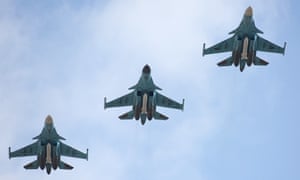
Russian Su-34 bombers returning to a base in Voronezh after a mission in March. Su-34 bombers have flown over Syria from a base in Iran for the first time.

 Russian Su-34 bombers return to a base in March. The warplanes have flown over Syria from a base in Iran for the first time. Photograph: TASS/Barcroft Media
Link

Russian jets have carried out airstrikes against Islamic State in Syria from an airbase in Iran for the first time – a major development in the collaboration between the two crucial allies of Bashar al-Assad’s regime. 
Russian state media cited the country’s defence ministry on Tuesday as saying that an unspecified number of long-range bombers, including Su-34 and Tu-22M3 warplanes, have taken off from near Hamadan, a city in the west of Iran, to target Isis near Aleppo. At least 19 civilians have been killed, according to an exiled activist group. 
Hosting Russian jets on Iranian territory is a departure for Tehran from its hitherto history of covert operations in regional conflicts. It is believed to be the first time Russian warplanes have been deployed in Iran in at least half a century. 
Al-Masdar, a news website which covers the conflicts in the Arab world, published a string of photos of Russian warplanes in the Hamadan airbase, saying it would shorten the flight time to Syrian targets by 60%. 
“The distance of these flights [from the Russian airbase] equal roughly 2,150km (1,340 miles) to reach a target near Palmyra. In comparison, the Hamadan airbase in Iran is roughly 900km from Palmyra,” al-Masdar said. It added that the Khmeimim airbase in Latakia, Syria, was not suitable for the deployment of large bombers such as the TU-22M3.
The chief of Iran’s supreme national security council, Ali Shamkhani, confirmed the Russian reports. “Tehran and Moscow have strategic cooperation in the fight against terrorism in Syria and we have the capacity and the capabilities for this collaboration,” he said on Tuesday, according to the state-run Irna news agency. 
 The location of three airbases used by Russian jets in the campaign against Isis in Syria.
Shamkhani condemned Saudi Arabia’s involvement in Syria and also in Yemen, where the Saudi-led coalition is countering the advances of the Houthi rebels. “It is not acceptable for the Muslim world to see Saudi Arabia investing towards the empowerment of terrorist and Takfiri groups [Iranian terminology for extremist jihadis sympathetic to Isis] instead of fighting the occupation by the Zionist regime [Israel].”
Iran has invested heavily in protecting Assad, dispatching some of its most experienced Revolutionary Guards commanders to Syria to plan and oversee operations and recruiting Afghan refugees to fight against Syrian rebel forces. A rising number of funerals held in Iran for those killed in Syria, often referred to as “defenders of holy sites”, is testament to that.
The state-run Russia Today said: “The long-range bombers with full bomb payload took off from Hamadan airfield to attack Islamic State and al-Nusra Front facilities in Aleppo, Deir ez-Zor and Idlib provinces,” it said. 
At least 19 civilians, including three children, were killed in an aerial bombardment on Tuesday in al-Sakhour and al-Bab areas of Aleppo, according to the UK-based Syrian Observatory for Human Rights. It said fighting between rebel forces and Isis sympathisers continued in al-Rai, in northern Syria close to the border with Turkey.
Although Iran has been involved in some of the Middle East’s most bruising conflicts in recent years, it has refrained from overt collaborations to avoid being openly accused of militarily interfering in the region. Tehran has previously allowed foreign jets to use its airspace, but never before in recent decades its airbases. 
Shashank Joshi, a senior research fellow at Royal United Services Institute in London, said Tuesday’s news was unprecedented because it was the first time in 70 years that there had been overt Russian military presence in Iran. The Iran-Azerbaijan crisis in 1946 was the last time Russian troops would have been present on Iranian soil.
“The willingness to host foreign forces on your oil soil is a big diplomatic and political step,” he told the Guardian. “Just like other countries including India, Iranians have always had a historical aversion to any foreign deployment on their soil.”
Joshi said the move revealed more about Iran than Russia: “Russia has no problem deploying forces outside its borders, but for Iran it’s a bit different. It cuts against the traditional way that Iran has thought about hosting military forces and forming alliances.”
Rebel successes in Aleppo in the past two weeks may have changed Iranian calculation and prompted Tehran and Moscow to escalate military operations to signal their commitment to Assad, he said. 
In Iraq, Iran and the west appear to be fighting a common enemy – Isis – with the US secretary of state, John Kerry, having described the Iranian role there as “helpful”; but the two are in opposing fronts in Syria.
Iran also says it is fighting Isis to prevent its advance towards its borders. On Tuesday, Iran’s semi-official Tasnim news said three “Takfiri terrorists” had been killed in Iran’s western province of Kermanshah. “After clashing with the three Takfiri terrorists, the security forces managed to kill all of them,” Tasnim reported.
Morad Veisi, an expert on Iran’s armed forces, said the Russian deployment indicated that Iranian leaders were pursuing a new approach, prompted by Saudi Arabia, Tehran’s regional rival, taking an overt and active role, particularly in Yemen. “It’s Iran’s reaction to Saudi Arabia, and saying that it will stand by Assad in spite of Saudi threats,” Veisi said. Tehran and Riyadh are particularly at odds in Yemen. 
The Mohammad Nojeh airbase in Hamedan was best located for military operations in Syria because of its closeness to Syria, he said. 
Veisi said a group of people in Iran, among them supporters and critics of the state, backed the Iranian intervention because they believe it had contributed to maintaining the security inside Iran. However, he also said it was difficult for those who were opposed to voice their view because many feared reprisal. 
Iran has maintained that its involvement in Syria and Iraq is based on an invitation from their central governments and is aimed at fighting Isis. However, critics say Syria is important to Iran because it gives Tehran physical access to Lebanon and Hezbollah, which is strategically valuable to Iranian leaders because of the group’s geographical position in respect to Israel.
Lina Khatib, the head of the Middle East and North Africa programme at the thinktank Chatham House, said the use of Iranian base by Russia was a tactical move meant to increase efficiency of Russia’s air operations in Syria.
“This comes hot on the heels of the rebels’ breaking of the siege in Aleppo, which has been embarrassing for Russia and Iran and the Syrian regime,” she said. “Both are also using the Syrian conflict as a way to increase their international influence, so their partnership remains a partnership of convenience rather than a strong political alliance.”

سورية: 2011 ليست امتداداً لأحداث 1980

سلامة كيلة

Link

منذ بدء الثورة السورية، عمد النظام بوعي إلى ربطها بأحداث سنوات 1979/ 1982، حيث خاضت جماعة الإخوان المسلمين وتنظيم الطليعة المقاتلة حرباً مسلحة ضد النظام، ردّ عليها بعنف، وانتهت بتدمير أحياء عديدة في مدينة حماة. وكانت الأحداث قد بدأت بقتل إبراهيم اليوسف جنوداً في مدرسة المدفعية في مدينة حلب.
وكان هدف الربط هو تخويف السوريين العلويين من الثورة عبر ربطها بأحداث سابقة، ظهرت وكأنها صراع طائفي، قام النظام خلاله بتصفية جماعة الإخوان المسلمين بوحشية، من أجل القول إن الجماعة تقوم عبر ما يجري بالانتقام من العلويين الذين يُحمّلون وزر المجازر التي قام بها النظام نفسه، من خلال المماهاة بين النظام والعلويين. وذلك كله من أجل إخافة العلويين من الثورة، ودفعهم إلى الالتصاق به، كونه يستخدم فئات منهم في "بنيته الصلبة" التي سيواجه الثورة بها.
اعتبرت جماعة الإخوان كذلك أن ما حدث، منذ 15 مارس، آذار امتداداً لأحداث تلك السنوات. وظلت تشير إلى أسبقيتها في مواجهة النظام، وتقديمها "آلاف الشهداء". وكان هدفها هو القول إنها القوة التي يجب أن تقود الثورة، وأن تصبح هي السلطة الجديدة. وقد كرَّر قادتها هذا الربط مراتٍ كثيرة، وعملوا على تكريسه بإحكام. ولا شك في أن إطلاق إسم ابراهيم اليوسف الآن على معركة حلب هو من باب هذا التكريس، بعد أن تراجع دورها الفعلي، وتهمّش دورها السياسي، حيث يبدو أنها تعود الآن من بوابة جبهة النصرة (سابقاً) وجبهة فتح الشام راهناً.
نلمس هنا التطابق في استخدام الرمز بين الجماعة والنظام. وعلى الرغم من أن النظام استنفذ أغراضه من ذلك، تعود الجماعة إلى تأكيده. خصوصاً بعد أن نجح النظام في الوصول إلى ما أراد منه، حيث كان هذا الربط عنصراً مهماً من جملة عناصر، جرى استخدامها لتخويف العلويين (بينها طبعاً عدنان العرعور). ليبدو أنها تصرّ على أن ما جرى سنة 2011 من ثورة شعب هو امتداد لما قامت به هي نهاية سبعينات القرن العشرين، وسنوات 1980/1982، ولتؤكد أنها تريد الانتقام، بالضبط كما صور النظام الأمر.
بين سنوات 1980/1982 وسنة 2011 تحولات واختلافات كبيرة، أولها أن طبيعة الصراع مختلفة، وأن الأهداف مختلفة كذلك، وهي مختلفة جذرياً، إلا إذا اعتبرنا أن هدف الثورة هو إسقاط النظام "الأقلوي"، لكي تحكم "الأغلبية السنية"، وهذا ما يتناقض مع جوهرها وشعاراتها ومطالب الشعب الذي قام بها. 


في نهاية السبعينات، كانت الأصولية "الإسلامية" تنتشر بدعم سعودي مباشر، بهدف "تصفية الحساب" مع حركات التحرّر، وكل الأفكار القومية والاشتراكية والتحررية. وقد خاضت تلك الأصولية الصراع على هذه الأرضية، وليس لأن النظام السوري استبدادي، أو يستغلّ الشعب. وانطلقت من منظور طائفي ينطلق من صراع "السنة" ضد "العلويين"، وليس ضد النظام السياسي المتحكّم بالسلطة. لهذا، مارست القتل على الهوية (كما فعل إبراهيم اليوسف، وفعلت الجماعة ضد شخصيات "علوية"). بالتالي، كانت معركة الطليعة المقاتلة والجماعة هي تصفية الحساب مع مرحلةٍ كانت تشهد ميلاً إلى النهوض، وتحقيق مطالب الشعب، لمصلحةٍ وهابية معمّمة، وحربٍ طائفية تفكيكية.
وقد ظهر واضحاً حينها أن هذه الحركة هي تعبير عن فئات "محافظة"، تطرح ما هو معاكس لمسار الواقع، وهو ما جعلها معزولةً عن الشعب، ومثّلت مجموعاتٍ قامت بعمل إرهابي، ليس ضد أفراد النظام فقط بل ضد المؤسسات الاستهلاكية والحافلات العامة والسينمات (كما مارست في حلب)، ورفعت شعارات ضد اليسار كذلك. فكان واضحاً أنها تفرض "أصوليةً" على المجتمع، وحرباً طائفية ضد النظام الذي كانت توصمه بأنه علوي، على الرغم من أنه كان يستند الى تجار دمشق الذين تدخلوا معه لمواجهة الجماعة. وفشلت في تحقيق ما تريد نتيجة رفض الأغلبية الشعبية لها، وبالتالي، قدرة النظام على حصارها في بعض المدن، والقيام بمجزرة حماة سنة 1982 لـ "تأديب" الشعب السوري كله، حيث قام بعملية اعتقالات واسعة ضد كل أحزاب المعارضة اليسارية.
سهّل صراع الجماعة مع النظام عليه سحق كل المعارضة، وتشديد الطابع الاستبدادي، والاعتماد أكثر على "علويين" في المواقع الحساسة في الدولة، لكنه عزَّز كذلك علاقة النظام بتجار دمشق وحلب، وسمح لهم بتعزيز نشاطهم الاقتصادي.
بلا شك، الوضع مختلف عما حدث منذ 15 مارس/ آذار سنة 2011، حيث لم يكن لأي قوة سياسية دور، بل جاء ما حدث حراكاً شعبياً توسع ثورةً من أجل إسقاط النظام. هنا، كانت الأغلبية الشعبية هي التي تندفع إلى إسقاط النظام، بينما عملت المعارضة على ركوب الحالة، وعملت جماعة الإخوان المسلمين على تصوير الحراك "إسلامياً"، واشتغلت على أن تصبح "الممثل" له، من خلال دعم دول خارجية، وليس نتيجة وجود شعبي. وما هدفت إليه الثورة هو الحرية والديمقراطية وتحقيق مطالب الشعب التي هي، في جوهرها، "اقتصادية"، تتعلق بالقدرة على العيش، بعد انهيار الوضع المعيشي لنسبة كبيرة من الشعب. وبالتالي، هي تطرح ما يناقض كل منظور الجماعة، وكل المجموعات الأصولية، وما يعبّر ليس عن ميل فئةٍ أصوليةٍ، تريد فرض نظام قروسطي يميّز بين المواطنين على أساس الدين والطائفة، ويفرض قوانين مغرقةً في الرجعية، ونظاماً استبدادياً أكثر شمولية من النظام القائم.
ما قامت به الجماعة منذ بدء الثورة، وما يقوم به كل الأصوليين، هو ركوب الثورة لفرض منظور معادٍ لها، وجاءت استعادة اسم إبراهيم اليوسف لتأكيد ذلك، حيث أنه يستعيد "كابوس" سنوات 1980/1982، ويخيف ليس الأقليات فقط، بل أغلبية الشعب الذي لم يكن مع صراع الجماعة في تلك السنوات. إبراهيم اليوسف هو رمز لصراع طائفي، ولا شك في أن أبو فرات هو رمز الثورة، رمز "البطل الشعبي" الذي يريد إسقاط النظام من أجل سورية. هذه القطيعة بين سنة 1980/1982 وسنة 2011 يجب أن تحدث، بالضبط لكي تنتصر الثورة. 


Emad Hajjaj's Cartoon: On Internal Arab Fights

الحوار والدمار !