

Thursday, September 15, 2016


Wednesday, September 14, 2016
Syrian regime is blocking aid from entering eastern Aleppo, claims UN
Twenty trucks are not being allowed to enter the beseiged city in spite of ceasefire agreement, says United Nations envoy
The Guardian
Even though eastern Aleppo is desperately short of food and fuel, the UN supply convoy has not been allowed to move. Photograph: Uncredited/AP Link
The Guardian
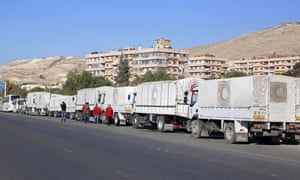
The first serious hurdle since a ceasefire in Syria came into effect on Monday has emerged after the UN said the regime was not giving permission to allow 20 UN aid trucks into eastern Aleppo.
UN special envoy Staffan de Mistura said the ceasefire agreement signed last week clearly stated that the government should simply be notified of aid entering the city.
As many as 20 trucks are ready to move and the agreed procedure is that the government is given details of the content of the trucks. Syrian government permission or inspections by its officials should not be required.
De Mistura said “the trucks are not moving” and implied the Syrian government was in breach of the agreement by refusing to allow unhindered access. “We need to do more homework,” said de Mistura.
He urged the eastern Aleppo council to drop any preconditions for the delivery of the aid. Nevertheless, he claimed the first 24 hours of the ceasefire had seen a significant drop in violence. “Calm has prevailed,” he said.
His remarks will be taken as a coded warning to the Russians to use their influence with the Syrian government to allow the aid trucks into eastern Aleppo on the terms agreed last week after marathon talks between Russia and the US in Geneva.
De Mistura insisted the process for eastern Aleppo was different from the rest of Syria where formal letters of authorisation are required before aid can be delivered. For months, the UN has faced a daily battle to wrest such permissions from the government in a bid to lift the sieges of Syrian towns.
In a statement, the Syrian government warned it would not allow Turkish humanitarian aid into the besieged city of Aleppo without its permission.
At the same time, opposition groups objected to the Russian presence along the Castello Road, the main supply route into the divided city, where 250,000 people are desperate for food and fuel. Under the agreement, the Russians are supposed to take over some of the checkpoints on the Castello Road.
De Mistura said the council should drop its preconditions for aid delivery.
A senior US official said neither Syrian government nor Kurdish opposition forces had pulled back from the Castello Road route into eastern Aleppo and that Washington was doing all it could to ensure the UN convoy safe access.
“We have spent much of today pressing the Russians and, through the Russians, pressing the regime. The UN wanted to make sure the trucks go through unhindered by the regime and unthreatened by the opposition. And we hope to get that done today,” he said.
“If an opposition group decides it doesn’t want to part of the cessation and wants to carry out attacks on the regime, then they take themselves out of the cessation of hostilities.”
Earlier, Russia claimed it was abiding by the ceasefire along with the Syrian government, but said the US government was not acting to rein in its client groups, citing 23 different violations of the terms of the ceasefire.
“Syrian government troops have completely stopped firing, with the exception of areas where Islamic State and Al-Nusra fighters are active,” said senior Russian military officer Viktor Poznikhir in a televised briefing.
“Unfortunately, the same cannot be said for armed units of the moderate opposition controlled by the US. After the start of the cessation of hostilities by this morning, 23 instances of firing on residential areas and government positions were registered.”
The ceasefire agreement for Syria, hammered out between Moscow and Washington, came into force on Monday evening. If it holds for seven days, it is designed to lead to unprecedented joint operations by Russia and the US against the twin targets of Islamic State and the Jabhat Fateh al-Sham terrorist group, formerly known as al-Nusra Front. The Syrian government air force would be grounded and debarred from attacking Al-Nusra, the US government insists.
Seeking to address confusion over the role of the Syrian air force under the US-Russian deal, another senior US official said: “For the time being, until we get seven continuous days of reduced violence, the only legitimate targets for anyone– Syrian, Russia or the US – are Nusra and Isil [Islamic State]. After that seven days, when the joint implementation centre [JIC] has been established, the regime air force will no longer be able to hit Nusra Front or opposition areas.”
But he noted that the regime had previously conducted airstrikes against other opposition groups or civilians under the pretext of targeting the Nusra Front. “We do need seven days of reduced violence. If that happens again during this period, we will not get to the JIC.”
As many as 20 opposition groups have said they will not accept the ceasefire, claiming there is no clear mechanism for punishing breaches. Some are wary of breaking with the former al-Nusra group.
But Anas al-Abdah, the president of the Syrian National Coalition, speaking in London, said he believed the ceasefire would be accepted by most rebel groups.
He said: “I think all our troops will go away from Nusra especially in seven days’ time because then Russia and the US [will be] co-operating and Nusra becomes a target like Isis. So our advice to all the troops on the ground is that they make sure they stay away from Nusra as soon as possible.”
In televised briefings from various locations around war-torn Syria, Russian military observers said that rebel violations had taken place in the provinces around Aleppo, Latakia, Damascus, Hama, Idlib and Daraa.
A Russian military officer said that “new violations” had also occurred around the ravaged city of Aleppo during the day.
As the televised briefing cut to a military monitor by the key Castello Road into Aleppo, which has been under Syria regime control, gunfire broke out and the Russian officer dived for cover.
Lebanon and the land of Karagoz
Like the Ottoman puppet show, Lebanon's politicians are seen meeting and greeting each other while nothing gets done.
![Local leaders are manipulated by taut golden strings stretching from Tehran and Riyadh to Beirut, writes Bell [Getty]](http://www.aljazeera.com/mritems/imagecache/mbdxxlarge/mritems/Images/2016/9/12/6df0582f842b481d8a3b5ddcb0a920ae_18.jpg)
by
John Bell
There was once a Turkish tradition of shadow puppets that children and adults would watch throughout the Ottoman Empire. The characters were called Karagoz and Hacivat, the former meaning "Black Eye" in Turkish after the character's dark and haunting look. Over time, in Lebanon and elsewhere, the term went on to mean a clown or joker, or Karagoz.
Today, politics in Lebanon reflect both meanings of that term: the clown and the puppet show. Every evening, Lebanese are entertained on the TV news by the splendiferous view of their politicians meeting and greeting each other.
Nothing much gets done - there is no president and only a transitional government. But, there they are, the well known cast trading deals and whispers that, like the unrequited love of Victorian novels, never transpire. It may be harsh to call them clowns, but the charade, the endless soap opera, does go on and on.
 |
Meanwhile, some also argue that the reality of Lebanon also reflects the original idea of Karagoz, the shadow puppets. The local leaders are the willing servants of regional agendas, manipulated by taut golden strings stretching from Tehran and Riyadh to Beirut.
Last piece of the puzzle
The primary theory, probably right, is that there is no president in Lebanon because Iran is holding out on that until there is further news about the future of Syria. Once this shows the light of day, and Bashar al-Assad's fate is more secure, the time will come to elect a suitable president in Lebanon.
Until then, Hezbollah is clinging to Michel Aoun while the opposite side demonstrates an equivalent antipathy to his election. There are many possible compromise candidates; the clinging to Aoun is a convenient filibuster, an excuse not to agree on a deal.
Lebanon will be the last piece of the puzzle to be put into place in any future Middle East arrangement. This was once to preserve Hezbollah's profile as the ultimate resistance to Israel during any effort to resolve the Arab-Israeli conflict.
Lebanon will be the last piece of the puzzle to be put into place in any future Middle East arrangement.
|
Today, Lebanon is the last card because it matters least. It can be conveniently ignored while larger matters - Syria, Iraq - are sorted out. All this is a testament of the endless dependency on greater regional powers - and the puppetry of Karagoz.
Why such a dependency? Lebanon was often a small part of larger empires, or a haven for minorites hiding in valleys and mountains, praying that marauding armies would blithely pass them by. That is fertile soil for the development of dependency, a world where one is not in control of one's fate.
It is also worthwhile to remember that the Lebanese genius lies in trade. The great mercantile spirit that lifted Phoenician sails to the Atlantic and beyond was fuelled by a healthy greed.
This was once married to invention and creativity - alphabets and amphorae full of wine or garum - but today it is a more basic and raw desire for gain, uncomplicated by such cultural claptrap. Many Lebanese, especially leaders, can be bought.
This sense of powerlessness alongside a keen greed leads to a reflex for short-term advantage: take whatever one can, whenever one can, for who knows what will happen tomorrow?
 |
| Adonis Valley in Lebanon [Al Jazeera] |
Israel's short-termism
Ironically, the hated enemy to the south, Israel, has its own version of such short-termism. Israelis built a state and continue on with the settlement enterprise by grabbing when and where possible. It has survived and thrived by dealing with today's reality, and abiding by Keynes's advice that, in the long term, we're all dead.
The Lebanese sense of the immediate can be salutary and their resilience is considerable. Shattered windows were rapidly repaired during the civil war, and people got on with life despite the calamities.
But, in such a world, no one has trust in the shape of the future - because today is all that matters. Business deals are unsure, there is no national planning, and all, including the mad and impulsive driving, reflects the uncertainty of rapidly shifting tides.
 |
In theory, if Lebanese leaders were to attend to their citizens' needs instead of lining their pockets or pursuing regional schemes, then matters could improve.
Citizens could also wrench a result from their recalcitrant leaders by caring more for the whole than for sectarian fragments. However, the energy and attention necessary for such efforts is unavailable because all are consumed by the toils of the day.
Meanwhile, the allure of Karagoz remains. The powers pulling the strings don't care much about Lebanon's welfare, and the cheque they provide may abet disaster. While political talks are repeated, Lebanon falls apart, rubbish fills the air, not just the streets, and illness is on the rise.
The Lebanese suffer from regional agendas in which they are little but pawns while their leaders enjoy the fruits of a dying region, and yet many remain beholden to this state of affairs. Karagoz, the shadow of a shadow of a reality, continues to thrive while real life just keeps piling up until a sure and sad breaking point.
John Bell is director of the Middle East programme at the Toledo International Centre for Peace in Madrid. He is a former UN and Canadian diplomat, and served as political adviser to the personal representative of the UN secretary-general for southern Lebanon and adviser to the Canadian government.
Tuesday, September 13, 2016
الاتفاق الجديد حول سوريا و«استراتيجية الخروج» الأمريكية
جلبير الأشقر

Link
يدرك الجميع، ولو فطرياً، أن ما تسميه دراسات التواصل «لغة الجسد» غالباً ما يكون أهم من الكلام في التعبير عن حقيقة المواقف. وينطبق الأمر نفسه بلا شك على تفاعل لغات الجسد في المسرحيات المتعاقبة التي تتألف منها الحياة اليومية. ولا تشذّ المناسبات السياسية عن تلك القاعدة، بل تبلغ فيها «لغة الجسد» ذروة أهميتها.
ومن هذا الباب، فإن تاريخ منطقتنا حافل بالمسرحيات التي تزيد فيها تلك اللغة عن الكلام بلاغةً، على غرار حفل توقيع «اتفاقية أوسلو» في واشنطن قبل 23 سنة، في 13 أيلول/سبتمبر 1993. يومذاك كانت «لغة الجسد» التي عبّر بها كل من ياسر عرفات وإسحاق رابين عن موقفيهما إزاء الحدث (افتخار الأول وازدراء الثاني) دليلاً ساطعاً على أن تلك الاتفاقية لن تشكّل سوى محطة جديدة في إحكام الطوق الصهيوني على الشعب الفلسطيني. وها نحن أمام اتفاق جديد في سلسلة اتفاقات «السلام» التي توفّر لتاريخنا المعاصر إيقاعاً مألوفاً، وهو اتفاق الهدنة المجدّد في سوريا الذي أعلنه وزيرا الخارجية الأمريكي والروسي في نيويورك بعد منتصف الليل، بحيث توجّب عليهما انتظار تغيير لوحة تأريخ الحدث من التاسع إلى العاشر من أيلول/سبتمبر.
ومن هذا الباب، فإن تاريخ منطقتنا حافل بالمسرحيات التي تزيد فيها تلك اللغة عن الكلام بلاغةً، على غرار حفل توقيع «اتفاقية أوسلو» في واشنطن قبل 23 سنة، في 13 أيلول/سبتمبر 1993. يومذاك كانت «لغة الجسد» التي عبّر بها كل من ياسر عرفات وإسحاق رابين عن موقفيهما إزاء الحدث (افتخار الأول وازدراء الثاني) دليلاً ساطعاً على أن تلك الاتفاقية لن تشكّل سوى محطة جديدة في إحكام الطوق الصهيوني على الشعب الفلسطيني. وها نحن أمام اتفاق جديد في سلسلة اتفاقات «السلام» التي توفّر لتاريخنا المعاصر إيقاعاً مألوفاً، وهو اتفاق الهدنة المجدّد في سوريا الذي أعلنه وزيرا الخارجية الأمريكي والروسي في نيويورك بعد منتصف الليل، بحيث توجّب عليهما انتظار تغيير لوحة تأريخ الحدث من التاسع إلى العاشر من أيلول/سبتمبر.
فبين ارتياح الوزير الروسي سيرغي لافروف وابتسامه وتكرّمه بإهداء الفودكا للصحافيين تعويضاً لهم عن طول الانتظار (مفترضاً أنهم جميعاً من هواة الخمر) وبين الريبة والحذر اللذين بديا في موقف الوزير الأمريكي جون كيري، بل حتى في كلامه، كان معنى الاتفاق جلياً. وقد أكّده ما جاء من ترحيب بالاتفاق من طرف طهران وتوابعها، بما فيها النظام السوري، مقابل الخيبة والتحفظات التي عبّرت عنها أوساط المعارضة السورية. ولم يناقض الأمر ترحيب الحكومة التركية بالاتفاق، إذ أتى بعد أن انحنى رجب طيب اردوغان أمام نظيره الروسي فلاديمير بوتين وكافأه هذا الأخير بمنحه الضوء الأخضر لإدخال الجيش التركي إلى الأراضي السورية تصدّياً لتقدّم القوات الكردية، وهو همّ أنقرة الأكبر في الساحة السورية.
وحقيقة الأمر أن الاتفاق الجديد محكوم عليه بالفشل كسابقه، حيث لا يرتبط بأي خطوات ملموسة تتعلّق بحلّ المشكلة الأساسية (مثلما خلت اتفاقية أوسلو عن البت في الأمور الأساسية بما حكم عليها بالفشل). ويقتصر الأمر في الواقع على موافقة واشنطن على مشاركة طيرانها للطيران الروسي بقصف «جبهة فتح الشام» (النصرة سابقاً)، وتوفيرها للـ «حليف» الروسي لتلك الغاية معلومات عن مواقع الجبهة المذكورة، مقابل امتناع طيران النظام السوري عن المساهمة في القصف المشترك. والكل يعلم أن المعارضة السورية لا تنظر إلى «جبهة فتح الشام-النصرة» كعدوّ رئيسي إذ أن قتال الجبهة الأساسي موجّه ضد النظام السوري، ناهيكم عن أنها لم تنفّذ عمليات إرهابية في الخارج، خلافاً لتنظيم داعش الذي وجّه قتاله الرئيسي في سوريا ضد المعارضة السورية بعربها وكردها ودبّر أعمال قتل همجية في شتى البلدان.
وكما ظهر للعيان، فالتدخل العسكري الروسي المباشر الذي بدأ قبل عام، والذي رحّبت به واشنطن «ما دام موجّهاً ضد داعش»، إنما تجلّى بسرعة وبلا مفاجأة تدخّلاً لتدعيم النظام السوري عقب سلسلة الهزائم التي مُني بها حتى ذلك الحين. وقد تمّ الأمر بتركيز القصف الروسي على المعارضة السورية بحجة قصف «القاعدة-النصرة»، علماً أن مواقع النصرة متداخلة مع مواقع بعض قوات المعارضة السورية بحكم قتالهما ضد قوات النظام السوري، عدّوهما الرئيسي المشترك.
هذا وقد كشفت الصحافة الأمريكية أن سبب تأخير كيري لإعلان الاتفاق إلى ساعة متقدمة من الليل يعود إلى تحفظات قيادة القوات المسلحة الأمريكية، ولا سيّما عدم ثقتها بـ «التحالف» مع موسكو وامتعاضها من فكرة تسليمها أي معلومات. والحال أن باراك أوباما قد فرض مشيئته في الملف السوري على خلاف مستمر مع قسم هام من إدارته والبنتاغون، وذلك منذ سنة 2012. أما فحوى الخلاف فكان في الأمس كما اليوم أن معارضي أوباما في الملف السوري يرون أن لا سبيل إلى تسوية سياسية في سوريا ما لم يتم تدعيم المعارضة بما يخلق ميزان قوى على الأرض يجبر النظام ومن يرعاه على إبرام مساومة حقيقية.
أما في غياب ذلك، فلن تعدو الاتفاقات كافة عن كونها هدنات قصيرة في أحسن الأحوال. وقد يعتقد كيري أن العجائب في متناوله وهو الذي يؤمن بأن كافة المشاكل يمكن حلّها بمجرّد جمع فرقائها في غرفة واحدة، كما كتب عنه متهكّماً أحد كتّاب صحيفة «فايننشال تايمز».
غير أن ذكاء باراك أوباما لا يترك مجالاً للشك في أنه يدرك حقيقة الأمر. وقد قال عنه خبير الشؤون العسكرية الأمريكي أنطوني كوردسمان بحق أن همّه في سوريا بات إيجاد «استرايجية خروج» (exit strategy)، لكن ليس للخروج من الأزمة السورية التي كان له دور حاسم في مفاقمتها، بل للخروج من منصب الرئاسة!
وكما ظهر للعيان، فالتدخل العسكري الروسي المباشر الذي بدأ قبل عام، والذي رحّبت به واشنطن «ما دام موجّهاً ضد داعش»، إنما تجلّى بسرعة وبلا مفاجأة تدخّلاً لتدعيم النظام السوري عقب سلسلة الهزائم التي مُني بها حتى ذلك الحين. وقد تمّ الأمر بتركيز القصف الروسي على المعارضة السورية بحجة قصف «القاعدة-النصرة»، علماً أن مواقع النصرة متداخلة مع مواقع بعض قوات المعارضة السورية بحكم قتالهما ضد قوات النظام السوري، عدّوهما الرئيسي المشترك.
هذا وقد كشفت الصحافة الأمريكية أن سبب تأخير كيري لإعلان الاتفاق إلى ساعة متقدمة من الليل يعود إلى تحفظات قيادة القوات المسلحة الأمريكية، ولا سيّما عدم ثقتها بـ «التحالف» مع موسكو وامتعاضها من فكرة تسليمها أي معلومات. والحال أن باراك أوباما قد فرض مشيئته في الملف السوري على خلاف مستمر مع قسم هام من إدارته والبنتاغون، وذلك منذ سنة 2012. أما فحوى الخلاف فكان في الأمس كما اليوم أن معارضي أوباما في الملف السوري يرون أن لا سبيل إلى تسوية سياسية في سوريا ما لم يتم تدعيم المعارضة بما يخلق ميزان قوى على الأرض يجبر النظام ومن يرعاه على إبرام مساومة حقيقية.
أما في غياب ذلك، فلن تعدو الاتفاقات كافة عن كونها هدنات قصيرة في أحسن الأحوال. وقد يعتقد كيري أن العجائب في متناوله وهو الذي يؤمن بأن كافة المشاكل يمكن حلّها بمجرّد جمع فرقائها في غرفة واحدة، كما كتب عنه متهكّماً أحد كتّاب صحيفة «فايننشال تايمز».
غير أن ذكاء باراك أوباما لا يترك مجالاً للشك في أنه يدرك حقيقة الأمر. وقد قال عنه خبير الشؤون العسكرية الأمريكي أنطوني كوردسمان بحق أن همّه في سوريا بات إيجاد «استرايجية خروج» (exit strategy)، لكن ليس للخروج من الأزمة السورية التي كان له دور حاسم في مفاقمتها، بل للخروج من منصب الرئاسة!
٭ كاتب وأكاديمي لبناني
الفرق بين الجنرال حفتر وتنظيم «الدولة»
رأي القدس
A GOOD EDITORIAL

في معركة سمتها وكالة أنباء «وال» الليبية «البرق الخاطف» قامت الطائرات والقوّات البرّية المحسوبة على الجنرال خليفة حفتر بالاستيلاء على ثلاثة موانئ نفطية رئيسية في ليبيا هي السردة وراس لانوف والزويتينة أو ما يسمى بـ»الهلال النفطي» متغلّبة على قوّات حرس الموانئ التابعة لحكومة الوفاق الوطني الليبية.
تأتي هذه النقلة العسكرية الاستراتيجية بعد خطوة سياسية سبقتها وسمح فيها الجنرال الطموح لبرلمان طبرق بالاجتماع بعد ستة أشهر من منعه أعضائه من اللقاء للتصديق على الحكومة في طرابلس، وذلك في جلسة تشبه بدورها عملية «البرق الخاطف» المذكورة قام فيها البرلمان المغلوب على أمره بحجب الثقة عن حكومة الوفاق.
جاءت الخطوتان الخطيرتان، سياسياً وعسكرياً، في الوقت الذي تنهمك فيه قوات حكومة الوفاق الوطني بتطهير الأجزاء الأخيرة من مدينة سرت من تنظيم «الدولة الإسلامية» وهو ما كلف قوّاتها مئات القتلى والجرحى، كما جاء في الوقت الذي تعاني فيه هذه الحكومة من ضيق ماليّ يجعلها غير قادرة على تمويل عمل وزاراتها ومهامها التنفيذية، وكان التمويل ينتظر تأمين تصدير شحنات النفط الليبي من الموانئ التي قام الجنرال بالاستيلاء عليها، وبذلك حرم الحكومة، نظريّاً، من شرعيتها النيابية، وعمليّاً، من مواردها المالية، وذلك تحت أبصار ما يسمى المجتمع الدولي والدول الغربيّة التي ورّطت حكومة الوفاق بنزاع مرير مع «الدولة الإسلامية» ولكنّها تركت الباب مشرعاً لحفتر لكسر شرعية هذه الحكومة نفسها وللاستيلاء على الثروة الريعية الأساسية التي تقوم عليها الدولة الليبية: النفط.
الواقع الليبي يقول إن حفتر ما كان ليحرّك قوّاته ويشن «برقه الخاطف» لولا قرار إقليمي يغطّيه سياسياً ويؤمن الإمدادات اللوجستية والعسكرية لقوّاته، كما أن رد الفعل الباهت من المبعوث الأممي كوبلر، ومن الدول الغربية التي ترعى العملية العسكرية لحكومة الوفاق ضد تنظيم «الدولة»، يقول إن ما فعلته قوّات حفتر، من انتزاع لموارد الدولة الليبية، وإضعاف سياسي وعسكري لحكومة طرابلس، لا يعنيان المجتمع الدولي والدول الغربية طالما أن الحملة الدموية على «داعش» مستمرة.
تأتي هذه النقلة العسكرية الاستراتيجية بعد خطوة سياسية سبقتها وسمح فيها الجنرال الطموح لبرلمان طبرق بالاجتماع بعد ستة أشهر من منعه أعضائه من اللقاء للتصديق على الحكومة في طرابلس، وذلك في جلسة تشبه بدورها عملية «البرق الخاطف» المذكورة قام فيها البرلمان المغلوب على أمره بحجب الثقة عن حكومة الوفاق.
جاءت الخطوتان الخطيرتان، سياسياً وعسكرياً، في الوقت الذي تنهمك فيه قوات حكومة الوفاق الوطني بتطهير الأجزاء الأخيرة من مدينة سرت من تنظيم «الدولة الإسلامية» وهو ما كلف قوّاتها مئات القتلى والجرحى، كما جاء في الوقت الذي تعاني فيه هذه الحكومة من ضيق ماليّ يجعلها غير قادرة على تمويل عمل وزاراتها ومهامها التنفيذية، وكان التمويل ينتظر تأمين تصدير شحنات النفط الليبي من الموانئ التي قام الجنرال بالاستيلاء عليها، وبذلك حرم الحكومة، نظريّاً، من شرعيتها النيابية، وعمليّاً، من مواردها المالية، وذلك تحت أبصار ما يسمى المجتمع الدولي والدول الغربيّة التي ورّطت حكومة الوفاق بنزاع مرير مع «الدولة الإسلامية» ولكنّها تركت الباب مشرعاً لحفتر لكسر شرعية هذه الحكومة نفسها وللاستيلاء على الثروة الريعية الأساسية التي تقوم عليها الدولة الليبية: النفط.
الواقع الليبي يقول إن حفتر ما كان ليحرّك قوّاته ويشن «برقه الخاطف» لولا قرار إقليمي يغطّيه سياسياً ويؤمن الإمدادات اللوجستية والعسكرية لقوّاته، كما أن رد الفعل الباهت من المبعوث الأممي كوبلر، ومن الدول الغربية التي ترعى العملية العسكرية لحكومة الوفاق ضد تنظيم «الدولة»، يقول إن ما فعلته قوّات حفتر، من انتزاع لموارد الدولة الليبية، وإضعاف سياسي وعسكري لحكومة طرابلس، لا يعنيان المجتمع الدولي والدول الغربية طالما أن الحملة الدموية على «داعش» مستمرة.
المعنى الآخر الكامن من وراء التواطؤ الإقليمي مع حفتر والسكوت العالمي على أفعاله هو أن تحرير حكومة الوفاق الوطني لسرت كان مهمة تم إنجازها وبالتالي لم يعد هناك دور آخر ضروري لمنفذها، وليس بعيداً أن تعتبر حكومة طرابلس ما جرى كله خديعة كبرى لاستنزافها عسكريا ثم التخلص منها سياسيا بعد استيفائها المطلوب منها.
ما صدر عن الولايات المتحدة الأمريكية حتى الآن هو أن ضرباتها الجوية لتنظيم «الدولة» في سرت بلغت 143 وأنها مستمرة، بينما قالت الحكومة الإيطالية إنها بصدد إرسال 300 عسكري آخر إلى سرت، من دون ربط أيّ كان بين معركة الحكومة الشرعية الليبية مع تنظيم «الدولة الإسلامية» ومعركتها لإقرار شرعيتها السياسية والدفاع عن موانئها النفطية.
المكافأة التي قدمتها الدول الغربية إذن لحكومة الوفاق على تضحياتها الجسيمة للتغلّب على خطر «الدولة»، هي ترك الحبل على غاربه للجنرال حفتر وراعيه الإقليميين، كما أنّها، عمليّاً فتحت مجال المواجهة المسلحة بين قوات الوفاق وقوات الجنرال المسكون بهاجس الرئاسة الليبية وإعادة عقارب البلاد إلى الوراء.
الجنرال الذي حمل لواء مكافحة «الإرهابيين» استغلّ كفاح الحكومة الشرعية للإرهابيين وانقضّ على موارد المال والسلطة، ووضع نفسه في مواجهة صريحة مع الحكومة وليس مع الإرهابيين الذين قضت عليهم.
وإذا رفعنا الملابس العسكرية والميداليات جانباً فإننا لن نجد فرقاً حقيقياً بين الإرهابيين الذين كانوا في سرت وبين الجنرال الذي يدعي مكافحتهم، باستثناء أن عمل حفتر الدائب لتدمير الدولة والعمل على بناء حكم عسكري استئصالي يقابل بتفهم الغرب وتواطئه.
ما صدر عن الولايات المتحدة الأمريكية حتى الآن هو أن ضرباتها الجوية لتنظيم «الدولة» في سرت بلغت 143 وأنها مستمرة، بينما قالت الحكومة الإيطالية إنها بصدد إرسال 300 عسكري آخر إلى سرت، من دون ربط أيّ كان بين معركة الحكومة الشرعية الليبية مع تنظيم «الدولة الإسلامية» ومعركتها لإقرار شرعيتها السياسية والدفاع عن موانئها النفطية.
المكافأة التي قدمتها الدول الغربية إذن لحكومة الوفاق على تضحياتها الجسيمة للتغلّب على خطر «الدولة»، هي ترك الحبل على غاربه للجنرال حفتر وراعيه الإقليميين، كما أنّها، عمليّاً فتحت مجال المواجهة المسلحة بين قوات الوفاق وقوات الجنرال المسكون بهاجس الرئاسة الليبية وإعادة عقارب البلاد إلى الوراء.
الجنرال الذي حمل لواء مكافحة «الإرهابيين» استغلّ كفاح الحكومة الشرعية للإرهابيين وانقضّ على موارد المال والسلطة، ووضع نفسه في مواجهة صريحة مع الحكومة وليس مع الإرهابيين الذين قضت عليهم.
وإذا رفعنا الملابس العسكرية والميداليات جانباً فإننا لن نجد فرقاً حقيقياً بين الإرهابيين الذين كانوا في سرت وبين الجنرال الذي يدعي مكافحتهم، باستثناء أن عمل حفتر الدائب لتدمير الدولة والعمل على بناء حكم عسكري استئصالي يقابل بتفهم الغرب وتواطئه.
فرص نجاح هدنة سورية
مروان قبلان
Link
للمرة الثانية خلال ستة أشهر، يتوصل الطرفان، الروسي والأميركي، إلى اتفاق "لوقف العمليات القتالية" في سورية، يستثني جبهة النصرة التي غدا اسمها جبهة فتح الشام، وتنظيم الدولة الإسلامية. وعلى الرغم من أن واشنطن وموسكو حاولتا، هذه المرة، معالجة الأسباب التي أدت إلى انهيار الهدنة السابقة، بدليل المفاوضات الماراثونية المستمرة منذ أشهر، سواء على المستوى السياسي (كيري - لافروف) أو على المستوى الفني (اجتماعات روبرت مالي- ألكسندر لافرنتيف في جنيف)، والاعتناء بأدق تفاصيل تنفيذ الاتفاق، إلا أن حظوظ الهدنة التي أعلنها الجانبان يوم الجمعة الماضي لا تبدو مع ذلك أفضل من سابقتها.
ومع أن تفاصيل كثيرة في الاتفاق غير معلنة، وبعضها قد لا يتم الإعلان عنه أبداً، إلا أنه يمكن، مع ذلك، تلمس بعض السمات العامة التي قد تتحول، بمرور الوقت، إلى ألغام تفجر الاتفاق من الداخل. يلاحظ أولاً أن المسألة السورية يتم التعامل معها على نحو متزايدٍ باعتبارها شأناً ثنائياً روسياً - أميركياً خالصاً، بعد أن استبعد كل طرف حلفاءه من المفاوضات الفعلية عندما حان وقتها، مع ترك حق التقاط صور لهم على هامش اجتماعاتٍ يزداد طابعها البروتوكولي كل مرة. وإذا كان مفهوماً أن هدف أي اتفاق هو خدمة مصالح أطرافه، فالمفهوم أيضاً أن المتضرّرين والمستبعدين سوف يسعون إلى إفشاله. ثاني ملامح الضعف في الاتفاق أنه يتعامل مع قضايا ميدانيةٍ بحتةٍ بمعزل عن أي إطار سياسي للحل، فهو يتعامل مع موضوع وقف العمليات القتالية، ومراقبة تنفيذ وقف إطلاق النار، إدخال المساعدات الإنسانية إلى المناطق المحاصرة، والتنسيق الأمني والعسكري لاستهداف جبهة فتح الشام وتنظيم الدولة، ما يعني فعلياً أن غرض الاتفاق تجميد الوضع الميداني بين النظام والمعارضة، وتأجيل البحث في الحل السياسي إلى ما بعد وصول إدارة أميركية جديدة. لكن الحكمة التقليدية تقول: اتفاق ميداني ناقصٌ إطاراً سياسياً يساوي الفشل.
ثالثاً، صمم الاتفاق، حصراً، للتعامل مع الهواجس الأميركية والروسية، مغفلاً بذلك كل سياقات الصراع المحلية والإقليمية، فالرئيس بوتين كان يسعى وراء هدفين رئيسين، يوشك أن يحققهما له الاتفاق: الأول، والأكثر أهمية، انتزاع موافقة إدارة الرئيس أوباما على التنسيق أمنياً وعسكرياً بين قيادة العمليات الروسية في سورية وقيادة قوات التحالف الذي تقوده واشنطن (ما يعني اعترافاً أميركياً سياسياً وعسكرياً بروسيا دولةً ندّاً)، وثانياً، انتزاع موافقة واشنطن "لفرط" القدرات العسكرية للمعارضة السورية، من خلال استهداف جبهة فتح الشام، ومن ثم تفكيك جيش الفتح الذي يمثل التحدّي العسكري الأكبر لقوات النظام وحلفائه في شمال غرب البلاد. أما إدارة أوباما فقد حصلت، في المقابل، على مبتغاها في موافقة روسيا على وقف استهداف النظام المدنيين في مناطق المعارضة، لأن ذلك يخفف الضغوط عليها في عز موسم الانتخابات، بسبب عدم اكتراثها بمقتل العشرات منهم يومياً، فضلاً عن قذف آلاف اللاجئين باتجاه أوروبا. وثانياً، انتزاع موافقة روسية على تركيز الجهد الحربي على تنظيم الدولة وجبهة النصرة، بدلاً من استهداف "المعارضة المعتدلة". لكن هذا الأمر تحديداً هو ما يمثل العقدة الأكبر في الاتفاق، ففي حين تسعى المعارضة إلى تجنب الدخول في مواجهةٍ مع الروس والأميركيين، إذا هي رفضت الاتفاق، إلا أنها، من جهة أخرى، لن تستطيع الوقوف موقف المتفرّج على استهداف "النصرة" التي تعد جزءاً أصيلاً من جيش الفتح الذي يخوض معارك طاحنة ضد قوات النظام وحلفائه في جنوب غرب حلب وشمال حماة، وهذا ما أدى، فعلياً، إلى سقوط الهدنة السابقة التي كبلت حركة فصائل المعارضة، فيما استمر استهداف الروس والنظام الفصائل الإسلامية المكونة جيش الفتح، بحجة أنها "نصرة" أو تتعاون مع "النصرة".
هناك تفاصيل كثيرة تضمنها الاتفاق، وأخرى سكت عنها، مثل وضع المليشيات المدعومة إيرانيا، ووضع وحدات حماية الشعب الكردية، ونطاق حركة طيران النظام، وكل واحدة من هذه القضايا كفيلةٌ بتفجير الاتفاق من الداخل، لكن العنوان الرئيس يبقى أن هذا اتفاق أمني بامتياز، لا يوصل إلى حل في سورية، لا بل يمثل، بشكله الحالي، وصفة لاستمرار الصراع بعد حرفه عن مساره الأصلي.
More than a million people still under siege in Syria, says report
Transfer of formerly besieged civilians into areas which are also cut-off means little overall drop in number of war's trapped non-combatants

Civilians in the Damascus suburb of Daraya prepare for an evacuation in a process criticised by some opposition groups as 'demographic engineering' (Reuters)
Link
 Syrian army soldiers rest in a street in the government-controlled part of the besieged town of Daraya (AFP)
Civilians in the Damascus suburb of Daraya prepare for an evacuation in a process criticised by some opposition groups as 'demographic engineering' (Reuters)
Link
More than a million Syrians remain under siege even as the current US-Russia brokered ceasefire came into force, according to a damning report released by monitoring group Siege Watch on Tuesday.
The organisation, a joint project of the PAX peace organisation and the Syria Institute, said that more than a million people remain trapped in at least 40 besieged communities across the country as of July.
While Siege Watch acknowledged that thousands of people have since been brought out of the besieged Damascus district of Daraya, the report stressed that prior to this many civilians from rebel-held areas were often just transferred to other areas under siege, greatly limiting the overall drop in the number of Syrians trapped by fighting.
The group said that a further 1.4 million Syrians were on its watchlist as being under the threat of siege and Siege Watch urgently called on the international community to act.
"These mass evacuations contribute to what has become a clear policy of demographic engineering by the government of Syria."
"The situation for besieged Syrians appears grim. Six Siege Watch besieged communities were captured by force during the reporting period, displacing tens of thousands of people. Not a single siege was lifted through diplomatic means."
The evacuation of Daraya in August, following the surrender of rebels, was branded as "ethnic cleansing" by some opposition sources, pointing out the suburb is now virtually empty after the Syria government ended its siege. Syrian President Bashar al-Assad was shown by Syrian state TV defiantly praying in the city on Monday to mark the beginning of the Muslim festival of Eid al-Adha.
"The forcible evacuations raise a number of issues beyond the fact that people are often moved to other besieged areas: these mass evacuations contribute to what has become a clear policy of demographic engineering by the government of Syria," Valerie Szybala, the executive director of the Syria Institute, told Middle East Eye.
"Syria is already overwhelmed with a massive IDP [internally displaced person] crisis, and people displaced in this manner are very vulnerable to human rights violations such as enforced disappearances or military conscription."
The al-Waer district of Homs was singled out in the report as needing the most urgent attention from world powers with a community of almost 100,000 people on the verge of "complete collapse". It said: "The medical sector has been severely impacted by the intensified siege of al-Waer, with a lack of fuel and medical supplies hampering effective treatment for all conditions."
The report also warned that civilian deaths are mounting "due to lack of care for conditions like kidney disease", adding that the government of President Bashar al-Assad rarely allowed medical evacuations of the area.
Syrian army soldiers rest in a street in the government-controlled part of the besieged town of Daraya (AFP)
The report went on to call on the UN and the International Syria Support Group (ISSG), a group of world powers working to find a solution to the crisis, to focus on ensuring free movement of civilians into and out of besieged areas, rather than concentrating on one-off aid convoys.
It also called on the bodies to "follow through on monitoring the implementation of any local ceasefire agreements that it helps to initiate".
Tense ceasefire
As part of the Russia-US brokered ceasefire, which began on Monday evening, aid convoys are set to roll into some of the worst hit areas. However, uncertainty over the stability of the truce has so far kept aid groups on the Turkey border, although agencies insist they are ready to deploy into Syria quickly.
Monday's ceasefire was greeted with wariness from the Syrian opposition, but its main umbrella group the Higher Negotiations Committee (HNC) appears to have accepted the ceasefire provided that certain "guarantees" about which groups would not be included were observed.
Russia said on Monday it would continue to target "terrorist" groups during a ceasefire in Syria, which includes the Fatah al-Sham formerly the al-Qaeda linked Nusra Front, as well as the Islamic State (IS) group.
The deal will be backed by "the largest groups", including Ahrar al-Sham, despite the latter voicing concerns over the viability of the deal and initially appearing to reject it.

As of Tuesday, the truce appeared to be holding, but analysts have warned that the ceasefire is likely to remain shaky while the international community is unable to punish violations.
"I believe [US] Secretary [of State John] Kerry noted at Friday's press conference that the deal requires 'unimpeded and sustained humanitarian access to all of the besieged and the hard-to-reach areas'. Priority for the besieged areas should be to focus on making this statement a reality," said Szybala.
"The most effective pressure that could be applied is for the terms of the agreement to actually be enforced, with consequences for violators. The lack of enforcement has been a fatal flaw in previous agreements as warring parties - particularly the Syrian government and its allies - have learned that they can commit violations with impunity."
EXCLUSIVE: UAE pilots flying sorties for Haftar in skies over Libya
New batch of leaked air traffic recordings confirm Emirati military involvement in international air strikes in support of renegade general
Link
 A Libyan man holds a picture depicting a portrait of Haftar in a demonstration marking the fifth anniversary of the Libyan revolution in Benghazi, 17 February, 2016 (AFP)
 Libyans wave their national flag and burn portraits of Egyptian Sisi and Dubai Shiekh Mohamed Bin Rashid al-Maktoum during an anti-Haftar protest in Tripoli on 5 August, 2016 (AFP)
 A Libyan protestor waves his national flag during a pro-Haftar demonstration in Benghazi on 5 August, 2016 (AFP)
Link
Emirati fighter pilots are taking part in an international operation also involving British, French and US forces in support of renegade Libyan General Khalifa Haftar against rival militia groups in eastern Libya, leaked air traffic control recordings obtained by Middle East Eye reveal.
MEE has previously reported on the presence of UAE personnel in an international operations room at the Benina air base in Haftar-controlled Benghazi but the new tapes offer the first confirmation of the presence of the Gulf state’s pilots in the skies over Libya as well.
In one audio file an Emirati pilot is heard relaying coordinates to a Libyan officer in the operations room. He is then told to “check for movement” because they "don't want to waste any bombs”.
The exclusive comes as Haftar’s forces were reported on Monday to have seized a third oil terminal in the east of the country on behalf of the Tobruk-based House of Representatives (HoR), a rival administration to the UN-backed Government of National Accord (GNA) in Tripoli.
The advance by Haftar’s forces was condemned by the US, France, the UK, Germany, Italy and Spain in a statement calling for an immediate ceasefire.
Yet pilots and air traffic controllers speaking in Arabic and American-, British-, French- and Italian-accented English can be heard in the latest batch of tapes, confirming the international nature of the air operation in support of Haftar’s campaign to gain control of eastern Libya from groups he has declared to be “extremists”.
In July, MEE revealed the involvement of US and British pilots in the operation but the latest batch of recordings shed more light on the UAE’s involvement, with Emirati pilots using the call signs Hassan, Shihab 11, and Shihab, 12.
A Libyan man holds a picture depicting a portrait of Haftar in a demonstration marking the fifth anniversary of the Libyan revolution in Benghazi, 17 February, 2016 (AFP)
In one audio file an Emirati pilot is guided to a “target.”
“Your entry is going to be at the front which is going to be just as you go right again, go right… ok… stay on that target, stand by for update,” he is told by the operations room.
The Emirati pilot is then heard relaying coordinates to a Libyan officer in the operations room, before being told: “Stay on the target and let’s just check it out because we don’t want to waste any bombs for any movement on that target… check for any movement, if there’s no movement then we’re not going.”
Another conversation then takes place between the two men in which the pilot relays fresh coordinates.
In another audio file an Emirati pilot is heard asking for permission to land at Benina, which is considered to be Haftar's most important military facility.
Many of these files sound like routine air traffic control room communications – numbers, call signs, complaints about malfunctioning radios and back-and-forth confirmations.
But by piecing together certain details, such as the temperature measurements read aloud in the leaks, MEE believes the flights took place between March and early May this year between 2200 and 0500 hours.
Frequent trips are also made to and from LGSA – a NATO airbase on the island of Chania, Greece, north of Libya.
In July, MEE revealed how air strikes in support of Haftar had targeted a fish market in Benghazi and a group called the Shura Council of Benghazi Revolutionaries (SCBR), an amalgamation of several Islamist and militant organisations.
But the group is not aligned with the Islamic State (IS) group and the air campaign being run out of Benina appears to be primarily directed at Haftar’s rivals, rather than at IS which holds territory in central Libya.
The UAE has long been suspected of carrying out military operations in Libya as part of its increasingly interventionist foreign policy in the wider Middle East.
No surprise
“It comes as no surprise to me because the UAE has already conducted ai rstrikes in Libya in Tripoli in 2014,” said Libya specialist Mattia Toaldo, a senior policy fellow at the European Council on Foreign Relations. “There were several rumours about the air strikes carried out in Ganfouda in Benghazi recently.”
In August 2014, the UAE was accused of bombing Tripoli and killing at least 18 militants battling for control of the capital’s airport. The UAE feigned surprise, but it is believed the attack was launched from an Egyptian military base in Siwa, a desert oasis close to the Egyptian border with Libya.
“Emirati involvement has always been high, both in warfare and in providing weapons,” Toaldo said.
The UAE have been busy arming themselves in recent years. Between 2006 and 2010, the UAE imported 3.9 per cent of the world’s arms – a figure that increased to 4.6 per cent between 2011 and 2015. Last year, the UAE made up 8 per cent of total US arms exports.
Last April, the UAE donated a number of armoured personnel carriers to the Tobruk-based HOR government and its military wing, the Libyan National Army that Haftar leads.
Haftar was a key military figure in Gaddafi's army, but was exiled to the US and returned during the 2011 revolution to try to oust the long-time leader. He has been accused of having links to the CIA, of having presidential ambitions and, according to the Economist, is "often considered a spoiler of efforts to unify the country".
“He’s a figure that’s extremely divisive and unlikely to be palatable to any groups around the negotiating table for a unified Libya,” Christopher Davidson, author of After the Sheikhs: The Coming Collapse of the Gulf Monarchies and reader in Middle East politics at Durham University, said of Haftar. “As far as the United Arab Emirates is concerned that therefore is the ideal kind of figure to be backing.”
Libyans wave their national flag and burn portraits of Egyptian Sisi and Dubai Shiekh Mohamed Bin Rashid al-Maktoum during an anti-Haftar protest in Tripoli on 5 August, 2016 (AFP)
The repeated audio leaks are especially damaging for the international parties involved because of Haftar’s refusal to support the UN-backed unity government in Tripoli and because he has been fighting groups that are not IS, nor even IS-aligned.
Just as IS has exploited the chaotic situation to bolster its presence inside Libya – turning Gaddafi’s home city Sirte into a training camp for its militants - Haftar appears to have exploited concerns about IS to secure foreign backing.
Two years ago, Haftar launched Operation Dignity, centred primarily around Benghazi. He subsequently allied with the HOR government, but despite his claims to have "liberated" Benghazi earlier in 2016, violence has continued to rage.
Since Operation Dignity was launched, there have been numerous reports that he receives support from foreign powers, notably Egypt and the UAE, which are thought to be responsible for night-time air strikes on sites controlled by Islamist-aligned forces.
Spoiler role
Davidson told MEE: “We have to careful not to fall into the trap of assuming states like the United Arab Emirates, and Qatar for that matter, are pursuing independent foreign policies of their own… these are key US allies in the region.”
He claimed that a unified national Libyan government wouldn’t necessarily be in US interests, saying a strong central government “may for example not open up its economy and its oil in a way the United States wants it to.”
“Much better if a pro-Western government can’t form in Tripoli is perhaps a more fragmented state, and that’s perhaps why we’re seeing on the ground partners like Haftar, with his ground forces, and in the air partners like the United Arab Emirates, essentially carving out a sort of ultimately pro-US enclave in eastern Libya,” Davidson said.
Toaldo disagreed completely, saying that “especially for the US and some European countries their credibility is on the line and if the UN-backed government fails, it is also a failure for their policy.”
Davidson downplayed the inter-Gulf rivalry in Libya between UAE and Qatar, saying “far too much is made of this in terms of these are independent states and they have been backing different sides.”
A Libyan protestor waves his national flag during a pro-Haftar demonstration in Benghazi on 5 August, 2016 (AFP)
“We’ve got two reactionary, counter-revolutionary camps in the region,” he said. “In Libya’s case of course we’ve got a very living, breathing example of this where we’ve got two of the US-backed allies serving as regional proxies on different sides of the same conflict. But both of course ultimately undermining a proper cohesive Libyan state that could represent all peoples in the country.”
The other US-backed ally Davidson was referring to was Qatar, but Toaldo thinks there is a clear asymmetry in Qatar and the UAE’s involvement in Libya.
“Qatar has been delivering some weapons to the other side, but its role cannot be compared to the Emirati or Egyptian role on Haftar’s side. One usually draws the symmetry that one side is supported by Egypt and the UAE, and the other side by Turkey and Qatar.
“But there is no such symmetry, we haven’t seen shiploads full of weapons for Qatar’s allies in Libya while we have seen shiploads full of weapons for Haftar coming from the UAE and Egypt,” Toaldo said. “There is no parallel with Qatar or with Turkey.”
As an example of the UAE’s deep involvement in Libya, both experts pointed to the scandal involving the UN’s envoy to Libya, Bernardino Leon. Last year, the envoy had corresponded in secret with Abu Dhabi while attempting to negotiate an end Libya’s civil war, with the leaked emails showing he was taking the Emirati position despite his role demanding neutrality.
The Guardian also reported that Leon was also due to begin a new $46,000 per month job directing the Emirates Diplomatic Academy at around the same time.
“They’re very much playing a spoiler role in the formation of a Libyan state, as far as I can see,” Davidson said of the UAE’s involvement in Libya.
Subscribe to:
Comments (Atom)