Tuesday, May 2, 2017

ANALYSIS: Hamas's drive for legitimacy hits brick wall of Palestinian opinion

New policy document criticised by many outside Gaza, amid claims Hamas has dropped decades of struggle to gain recognition

FOLLOWING THE FOOTSTEPS OF FATAH BEFORE......

PITY THE PALESTINIAN PEOPLE!

Link


Palestinian analysts have rounded on Hamas after it published a policy document promising a new direction, with some saying it had dispensed with decades of struggle in an attempt to gain international legitimacy.
Hamas on Monday released its 42-article declaration that accepted the 1967 borders as the basis for a Palestinian state, reneged on the call for Israel's destruction, and recognised the Palestine Liberation Organisation as the "national framework" of the Palestinian people.
However, many Palestinians outside of Hamas-controlled Gaza voiced their disappointment. An Arabic hashtag, "without substance" was used widely on social media, while many commentators and activists called the movement "opportunistic".
Read more ► 
Several social media users were troubled by article 20, which stated that Hamas now aims to establish a Palestinian state along the 1967 borders as a formula for national consensus.
This move was a clear departure from Hamas' previous stance in calling for a complete retrieval of Palestinian lands along the 1948 borders.
"The second part of article 20 is a new conspiracy among a series of conspiracies led political parties," wrote Palestinian activist Fahd Abed on Facebook. "It is a clear and unjustifiable negligence of our people's suffering, sacrifice and blood."
"Our people are not a laboratory for experimentation nor our lands to be gambled with by political parties," he said, adding that the rift between the Palestinian people and political parties would only increase from here on.
Activist and journalist Fadi Arouri, from Ramallah, mocked the declaration on Facebook: "So now, after all these years, they [Hamas] tell me that they agree to a Palestinian state along the 1967 borders," he said.
"Why didn't they just declare that long ago instead of putting us through decades of infighting with Fatah and other political parties?"
Critics said Hamas had betrayed decades of struggle (Reuters)

International recognition 

Some analysts see the move as an attempt by Hamas to ease tension with regional allies and assuage hostilities with global powers.
Speculation has also mounted over who will succeed 82-year-old Abbas, whose Fatah movement is based in the occupied West Bank, as Palestinian president.
Palestinian journalist and analyst Rami Mehdawi told MEE that after Israel had "weakened Fatah as a representative of the Palestinian people" this move by Hamas to appear "moderate" is in preparation for the movement to launch unconditional negotiations with Israel."
"It is an attempt to gain recognition and acknowledgement from the international community," added Mehdawi.
Also reflecting on the ongoing conflict between Fatah and Hamas, Palestinian activist Ahmed Harthi wrote in a Facebook post: "It is interesting that political parties are ready to become flexible and moderate in order to gain international recognition, while this flexibility disappears when we need to form a unity government."
"In an attempt to maintain power, we have seen both sides of the division [Fatah and Hamas] appear to be more flexible. But everything has a price and I fear that more seats in power will be at the price of achieving our political objectives."  

'Too early to judge'

Some analysts said while the announcement was potentially positive, they would need more time to be convinced that the party has not given up on its principles.
"It is too early to judge whether this document is a political development and manoeuvre to gain international, Arab and Western recognition, or if it is the beginning of Hamas' downfall," Palestinian journalist Ahmed Jarrar told MEE.
"The coming days, or even years, will tell whether Hamas has established a new model for resisting Israeli occupation or not."
Not all reaction was criticism, however. Others social media users regarded the move as a necessary and balanced political manoeuvre.
 خلاصة وعي ناضج وقيادة حكيمة وثبات على المواقف واصرار على نيل  الحقوق وتحرير الأرض.
Translation: The Hamas document a product of maturity, awareness, wise leadership and continuity in the path towards taking our rights and bringing us freedom.
نجحت  أن تكون أمل الأمّة،التحدي الأكبرألاّ تخذل أمّتها قبل  أم بعدها  والحفاظ على صوابية السلوك السياسي ورقيّ القيم الداخلية!
Translation: Hamas has become the beacon of hope of this ‘ummah'. The biggest challenge now is not to let us down after this declaration.
Hamas is considered a terrorist group by Israel, the United States and the European Union, while it has strained relations with many Arab states.
It has fought three wars with Israel since 2008 which maintains a crippling blockade on Gaza.

On Tuesday, there were a number of Hamas-organised protests against the decade-long blockade, with a few thousand protesters taking to the streets in different cities. 

Syrian rebels raid Doctors Without Borders hospital amid infighting

AND THESE ARE THE THUGS WHO WANT SYRIAN "LIBERATION"!!!

MSF's decision to suspend medical activities in eastern Ghouta comes amid fierce clashes between rival rebel groups

Link


Doctors Without Borders has suspended its activities in the besieged Damascus suburbs of eastern Ghouta after militants stormed its hospital looking for wounded enemies amid intense clashes between rival Syrian rebel groups.
According to reports from MSF-supported doctors in the area, about 30 masked and armed men stormed the Hazzeh Hospital in the eastern Ghouta region on 29 April, looking for specific wounded patients. They also stole the hospital’s ambulance.
MSF condemns in the strongest terms the armed incursion, the intimidation of health workers, and the seizing of an ambulance
- Brice de le Vingne, MSF director of operations
Only a few kilometers south of Hazzeh Hospital, the Aftares medical point was struck by bullets, said the report. As fighting surrounded the medical point for two days, medics were trapped and unable to collect the wounded, even those lying within sight of the hospital.
The attacks constitute grave violations of the protected status of hospitals and medical workers in war zones, said MSF.
The raid also comes amid intense fighting between opposition armed groups that have killed at least 95 people. Reports on Monday suggested rebels had fired on protesters calling for a ceasefire.
More than 320,000 people have been killed since the government opened fire on demonstrators in 2011.
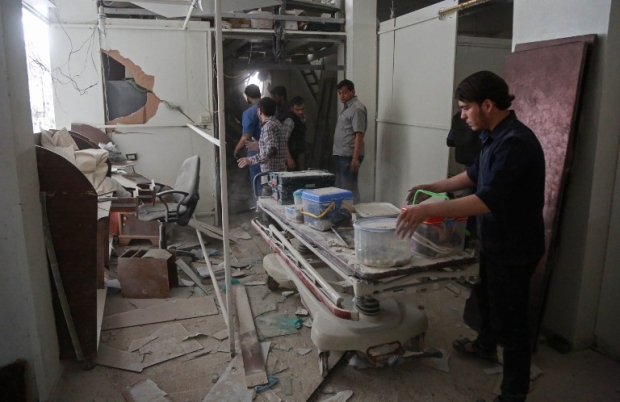
Syrians salvage medical items from a hospital following an air strike over rebel-controlled town in eastern Ghouta on 1 May (AFP)
"On behalf of the doctors we support, MSF condemns in the strongest terms the armed incursion into a health facility by masked individuals, the intimidation of health workers, and the seizing of an ambulance," said Brice de le Vingne, MSF director of operations. 
"Also of grave concern is the sustained heavy shooting by two armed groups at and around a functional hospital," said Vingne in the press release.
"Speaking over the deafening sound of gunfire, the nurses running the small Aftares medical point told us that their facility had been hit by bullets and that they managed to treat a few wounded people, but that they could only perform minor surgery and dressings."
According to Vingne, medical staff at Aftes medical point "were unable to negotiate an evacuation of their patients to better-equipped facilities".
The suspension of activities is a decision made under extreme circumstances to underscore that such attacks on health care facilities and workers will not be tolerated by MSF or the medical staff it supports, MSF said.
Medical support to the eastern Ghouta region will remain suspended until there are clear signs that fighting parties will respect the provision of health care.
"Medical spaces are protected under international law and must remain a place of humanity in war, in which everyone - civilian or not - is treated only on the basis of medical need," said de la Vingne.
"We will speak out to defend the protected nature of medical spaces and to underscore the need to prioritise the protection of patients and medical staff."
In its press release, MSF called on all armed groups in Syria to respect the protected nature of medical spaces and the protection of patients while under treatment.
The eastern Ghouta zone near Damascus has been besieged by Syrian government forces since early 2013. 

A GREAT CARTOON BY EMAD HAJJAJ: ALGERIAN "ELECTIONS"

انتخابات الجزائر

Monday, May 1, 2017

ما وراء الخبر-المبادرة الروسية لإقامة مناطق آمنة بسوريا

DNA - 01/05/2017 تصدير الديمقراطية الإيرانية

Syrian rebels 'fire on protesters' calling for end to infighting

Video images show Jaish al-Islam rebels firing on crowds calling for end to five days of clashes between rebel groups in Damascus suburb

Link

At least 95 people have been killed in five days of fighting between rival rebel groups in the Damascus suburb of Eastern Ghouta, amid reports rebels had fired on protesters calling for the clashes to stop.
Fighters from the powerful Jaish al-Islam rebel group fought against Faylaq al-Rahman after the latter rallied to the defence of Hayat Tahrir al-Sham (HTS), a coalition dominated by the former al-Qaeda affiliate Jabhat Fateh al-Sham (JFS).
More than 95 people are thought to have been killed since Jaish al-Islam launched their campaign to drive out HTS last week, fearing the coalition's encroachment on an area which as been firmly controlled by Jaish al-Isalm since 2013.
According to the Syrian Observatory for Human Rights, clashes took place late on Sunday close to Zamalka city, another suburb of Damascus which is a stronghold of Faylaq al-Rahman, a group backed by Turkey and Qatar.
A journalist from Eastern Ghouta told Al Jazeera the fighting had intensified on Monday.
"One of the main reasons behind these deadly clashes is the differences these rebel groups have," he said, on condition of anonymity.
"They have different beliefs and goals. But the infighting is affecting us because we already live under a siege. We have the government air strikes from above, a siege and fighting on the ground."
Intra-rebel fighting has flared up repeatedly in Ghouta - in May 2016, a round of violence between opposition groups in the suburb led to more than 300 deaths.
A video released on Sunday by the opposition Step News Agency purported to show Jaish al-Islam opening fire on protesters: 
In the video, demonstrators can be heard to shout "shabiha" - a derogatory term originally referring to militias hired by the Syrian president, Bashar al-Assad, to suppress dissent.
The Ghouta Media Centre told Al Jazeera that the protest took place in Arbeen, with demonstrators calling for an end to the in-fighting.
The clashes have enabled forces loyal to Assad to make advances in Damascus, the majority of which is under government control.
Eastern Ghouta has an estimated population of 400,000 people and has been under partial siege since 2013.
"The Syrian government is abusing this distraction and continues to target us with air strikes. Just a while ago a child was killed in a government air strike in Hamouriya [eastern Ghouta]," said the journalist from Eastern Ghouta.
"Residents are scared another Aleppo scenario will happen to Ghouta. We are scared of being forced to leave our homes."
During the fighting, Syrian government and allied forces attacked the rebel-held district of Qaboun northwest of East Ghouta by land and air.
The Syrian government, which is backed by Russian air power and Iranian-backed militias, launched an offensive against Qaboun and neighbouring Barza, which are believed to contain supply tunnels for the besieged enclave, in February.
Government forces advanced slightly in Qaboun on Friday, the SOHR said.
"In the end, Faylaq al-Rahman and Hayat Tahrir al-Sham brought this on themselves by trying to opportunistically diminish Jaysh al-Islam’s influence in East Ghouta and now the latter might diminish their influence in Ghouta for good," wrote Josko Baric on the Syria War Daily blog.
"If Jaysh al-Islam manages to overcome Faylaq al-Rahman and Hayaat Tahrir al-Sham it will be one step closer to a dream shared by all East Ghouta based groups, complete control over East Ghouta."
More than 320,000 people have been killed since the government opened fire on demonstrators in 2011.

Al-Jazeera Cartoon

كاريكاتير: إضراب الأسرى

Friday, April 28, 2017

DNA - 28/04/2017 هكذا ردَّت دمشق على إسرائيل

فوق السلطة - مارين الإسكندرانية.. لفرنسا دون عرب

سوريا والرئيس الكيميائي الضاحك!

رأي القدس


رغم مرور أكثر من ست سنوات على بدء الثورة السورية تحوّلت خلالها أخبار القتل الجماعي 
وقصف المشافي والأسواق والمساجد والآثار ومآسي النزوح إلى أمور لا تثير غير أحاسيس فظيعة بالعجز واليأس والقهر فإن رئيس تلك البلاد المنكوبة، بشار الأسد، يبدو الشخص الوحيد في العالم الذي يستطيع، في ظل هذه التراجيديا الهائلة التي قام بصنعها، أن يظهر على شاشات التلفزة ووسائل الإعلام سعيداً متضاحكاً ومبتهجاً متسائلاً إن كان الأطفال الذين قتلهم بغاز السارين قد قُتلوا حقّا!
لتحليل هذه الشخصية فلنتوقف عند أخبار الأمس فحسب، والتي شهدت قصف روسيا، التي قام الأسد نفسه بشكرها مرّات عديدة على حفاظها على نظامه، لمستشفيات وحواضن أطفال في إدلب، ولكنّ هذه الدولة الراعية والحامية لعرش الرئيس لم تمنع الطائرات المقاتلة لإسرائيل من قصف مستودع أسلحة لإيران، الدولة الراعية الثانية للنظام، وأين؟ في مطار دمشق نفسه ليس بعيداً عن قصر الرئيس السعيد بـ«سيادته» على البلد وبوثوقه من «الانتصار»!
في أخبار أمس أيضاً أن وزير الخارجية البريطاني بوريس جونسون، الذي كان يحيّي الأسد عندما كان خارج السلطة، يصرّح بأن بريطانيا ستشارك في أي قصف جديد على النظام السوري إذا طلبت منها حليفتها الولايات المتحدة الأمريكية ذلك.
الأسد، هو «رئيس» بلد تتحكم فيه قواعد روسيّة وتخزن إيران أسلحتها في مطاراته وثكناته وتنشر حرسها الثوري وميليشياتها الأفغانية والباكستانية والعراقية في ربوعه فيما تستبيح أجواءه وأراضيه طائرات أمريكا وفرنسا وبريطانيا وتتوسع فيه دويلات كرديّة وسلفيّة سنّية تنوس بين تنظيم «الدولة» وحلفاء «القاعدة»، وتسيطر تركيا على شريطه الحدودي الشمالي، والأردن على شريطه الجنوبي، ويندفع جهاديو «حزب الله» اللبناني إلى حلب ودير الزور ودرعا وادلب (لإنقاذ «السيدة زينب» التي رعى السوريون ضريحها لأكثر من ألف وثلاثمئة عام قبل ظهور «حزب الله») وقتل من يقف من المعارضين السوريين في طريقهم، وفوق كل ذلك تختار إسرائيل أي وقت تريد وتقصف ما تراه مناسباً، فيتجاهل الأسد كل ما يحصل ويصبّ جام غضبه على مواطنيه فحسب ثم يخرج على الشاشات ليتضاحك على فكرة أن الأطفال الذين ماتوا خنقا ربما لم يموتوا وأن الغارات السامّة «مفبركة مئة بالمئة».
في أحد الايميلات المسرّبة لزوجته أسماء الأخرس يرسل الأسد مقطعا مفضّلاً لديه من برنامج «أمريكا غوت تالانت» لشخص متعطش للدماء يقوم بقطع مساعده إلى نصفين، وهو أمر تعلّق عليه صحيفة «دايلي ميل» البريطانية بأن هذا يدلّ على شخصية إجرامية مريضة تتلذّذ بآلام الآخرين، ولكن المشكلة هنا أن الموضوعين، فعلاً، على خشبة التعذيب، هم أطفال ونساء ورجال سوريا الذين قوبلت أحلامهم البسيطة ببلد مدنيّ ديمقراطي بإصرار رئيس ساديّ على قمع تلك الأحلام بوحشية مريعة ما أدّى، في النهاية، إلى صيرورته أداة صغيرة بأيدي الدول التي اندفعت لحماية نظامه، وإلى تفسّخ البلد سياسيا وعسكريا واجتماعيا وتحوّله إلى فيضان من الآلام الجماعية التي انداحت على العالم وأسقطت ورقة التين الهشّة عن المجتمع الدولي.

Wednesday, April 26, 2017

ما وراء الخبر- الأسد والمجزرة الكيميائية.. تداعيات الأدلة الفرنسية

DNA - 26/04/2017 إعتصام مُكَسِّري لبنان

DNA - 25/04/2017 حزب الله - أمل..والمتاجرة بالمسيحيين

French intelligence blames Syrian regime for deadly chemical attack

French intelligence blames Syrian regime for deadly chemical attack

Link

A report by French intelligence services blames Syrian President Bashar al-Assad's regime for the chemical attack in rebel-held Syria that killed 87 people, Foreign Minister Jean-Marc Ayrault said on Wednesday.
Chemical analysis of samples taken from a deadly sarin gas attack in Syria earlier this month "bears the signature" of President Bashar Assad's government and shows it was responsible for the deadly assault, France's foreign minister said on Wednesday.
According to Foreign Minister Jean-Marc Ayrault, France came to this conclusion after comparing samples from a sarin attack in Syria from 2013 that matched. The findings came in a report published on Wednesday.
The Kremlin promptly denounced the French report, saying the samples and the fact the nerve agent was used are not enough to prove who was behind it.
France knows "from sure sources" that "the manufacturing process of the sarin that was sampled is typical of the method developed in Syrian laboratories," Ayrault added.

"This method bears the signature of the regime and that is what allows us to establish its responsibility in this attack."
Read also: Assad attempts to lie about children dying
France's Foreign Ministry said that blood samples were taken from a victim in Syria on the day of the attack in the opposition-held town of Khan Sheikhun on April 4 in which more than 80 people were killed.
Environmental samples, the French ministry said, show the weapons were made "according to the same production process than the one used in the sarin attack perpetrated by the Syrian regime in Sarabeq."
France's presidency said the country's intelligence services presented evidence which "demonstrate that the (Syrian) regime still holds chemical warfare agents, in violation of the commitments to eliminate them that it took in 2013." It says the information will be made public.
It's thought that Assad's government still has a stockpile hundreds of ton of chemical weapons despite saying it had handed over all of them.
Speaking to reporters in Moscow, Kremlin spokesman Dmitry Peskov said Russia's position on the attack is "unchanged" and that "that the only way to establish the truth about what happened near Idlib is an impartial international investigation."
Russia has previously urged for an international probe, and Peskov expressed regret that the Organization for the Prohibition of Chemical Weapons has turned down the Syrian government's offers to visit the site of the attack and investigate.
Read also: The organisation ridding the world of chemical weapons
The United States has also blame Assad's government for the attack. The Trump administration fired cruise missiles at a Syrian airbase in retaliation for the attack and issued sanctions on 271 people linked to the Syrian agency said to be responsible for producing non-conventional weapons. Syria has strongly denied the accusations.

The end of the Arab nation state

Khalil-Al-Anani

Link

We cannot begin to understand the disintegration and fragmentation plaguing the Arab region without looking at the failures of the nation states that were established on the ruins of the Ottoman Empire following its destruction a hundred years or so ago. Furthermore, we cannot begin to analyse the emergence of extremist phenomena, such as Daesh, in the Arab world without contextualising it within the history of the faults of the state and many other reasons that cannot be discussed here.
Over the course of a century, the modern Arab elite have supposed that the mere establishment of a nation state would allow for the achievement of two main goals: independence from colonialism and escape from Western-imperial control, and a route to modernity by breaking free from the impediments imposed by the Ottomans over the preceding two centuries.
Now, with the modern nation states duly established and post-independence, we can see that there has been a total failure in achieving either goal. The Arab elite has not recognised the inherent contradiction when it comes to the structure of these two objectives. For instance, how can true national liberation be achieved, in both the political and the modern sense, when colonialism itself was seen as the driver for modernity? In other words, it is difficult to combine national and civil independence by imitating another, Western, model which requires the import of another culture and its vocabulary for independence. The problem lies in imitating the very structure from which the Arab nation sought to separate and liberate itself. The Western version remains the ultimate model for Arab modernity, and therein lies the problem.
It is possible to speak with confidence and say that the modern Arab state has actually yet to be established, and that all that has taken place throughout the past century has been nothing more than a series of attempts to build this state, all of which have failed. A brief recap of the history of these attempts proves this.
The first came with the independence and subsequent states established in the Arab “Mashreq”, with Iraq, Syria and Lebanon, then on to Egypt and Sudan, the Arab Maghreb from Libya to Morocco, to Tunisia and Algeria, and finally the Gulf countries. As noted earlier, the failed attempts to achieve true independence are the result of the inability of these countries to rid themselves of political colonialism and its modernist cultural model.
The second attempt to build the Arab nation state came in efforts with Arab unity as the goal, and the centralisation of the liberation of the Palestinians as its main measure of success. It is no surprise that the Arab states failed miserably in both; they haven’t achieved Arab unity and Palestine is still under occupation. The setback of the Arab defeat of 1967 has been mourned every year on the 5th June ever since. Consequently, the question of national unity now focuses on how the current states can be saved in light of their imminent collapse and the divisions that they are facing.
The third attempt came with the establishment of what Nazih Ayoubi calls “the big state”, which succeeded in establishing a large and powerful state apparatus that is designed to provide everything from healthcare to education and all other social services. From the 1960s to the 1980s the state (especially in Egypt) became nothing more than a huge burden on itself. Only the security apparatus grew, albeit serving the needs of the regime instead of the people.
The fourth stage was the attempt to re-fashion the state in Islamic garb with a religious and political awakening in the Arab world. The Islamic movement in Sudan succeeded in its famous 1989 alliance with the military. At the time, the Sudanese state claimed that it was attempting to build a state upon sharia law, with the hopes of achieving Islamic justice for all of its citizens. In the end, the Sudanese establishment of an authoritarian state with a misleading religious cover did no favours to anyone; justice was not achieved.
Finally, the Arab state known as the “failed state” arrived. Such a country was no longer able to survive and lost any sense of legitimacy. Some of the Arab nation states in this situation have no sovereignty over their territories; think Iraq, Somalia, Libya, Syria and Yemen. They are no longer viable, not only in the eyes of their people but also in terms of territory, power and the international community.
What is surprising, is that despite all of the failed attempts to build a real Arab nation state, the regimes within each country continue to impose their will on the people from the top down. Civil society and the citizens have no say in their future, despite the continuing failure of the states and the model upon which they have been built
Translated from Al-Araby Al-Jadeed, 24 April 201